

Farm software · Buyer guide
Precision Agriculture Apps: 9 Compared by Job and Owner
The right precision agriculture app depends on the job: field data, records, scouting, weather or accounts. Here are nine, with ownership changes where they matter, USDA use figures and a break-even calculator.
Key takeaways
- Choose the job first: field data, records, scouting, weather or accounts. Then compare products in that group.
- 82% of US farms had a smart phone in 2025, but 22% used precision agriculture practices (USDA NASS, August 2025).
- Older lists go out of date: Granular was split up, farmathand.com now opens Decisive Farming, and FarmQA bought Farm Dog.
- USDA ERS summarises small positive net returns on US corn farms: 1.8% for mapping, 1.5% for guidance, 1.1% for variable rate (2010 data).
- Before you load records, check that you can export them, and read the data terms.
In this article
- Precision agriculture apps compared
- How we chose and checked these apps
- Nine precision agriculture apps and what each does
- Which type of precision agriculture app do you need?
- How many farms use precision agriculture apps and tools?
- Do precision agriculture apps pay for themselves?
- Who owns your farm data?
- Common problems when a farm team adopts an app
- Try one precision agriculture app before you commit
- FAQ
The best precision agriculture apps depend on the job: field maps and yield analysis, crop plans and records, scouting, weather, or farm accounts. This guide compares nine by what each one does and who owns it now, as shown on each company’s site on 5 November 2026. USDA’s Technology Use report (August 2025) found 82% of US farms had a smart phone in 2025, but 22% used precision agriculture practices.
That gap is the reason to choose with care. A phone is easy to own. A tool that changes a field decision takes setup, clean data and a season of use. Below you will find the nine apps, a guide to picking the right type, the evidence on returns, a break-even calculator and the contract questions to ask before you hand over your records.
Precision agriculture apps compared
Start with the job you need done. The table groups the apps by main use. Plans and prices change, so confirm them with the seller. The order follows the table and is not a ranking.
| App | Main job | Best for | Owner or status |
|---|---|---|---|
| Climate FieldView | Field data, yield analysis | Row-crop growers with connected machinery | Climate FieldView brand |
| Farmonaut | Satellite crop monitoring | Checking fields with no on-farm hardware | US-based company |
| Agworld | Crop plans, records | Growers working with an agronomist | Part of Semios Group |
| Decisive Farming | Whole-farm management | Farms wanting agronomy and marketing support | TELUS Agriculture; farmathand.com now opens this site |
| Bushel Farm | Records, grain, finances | Grain farms tracking contracts | Bushel; formerly FarmLogs |
| Traction Ag | Farm accounting | Farms that want books by crop year | Bought Granular Business |
| AgSquared | Labor, payroll, food safety | Crews on tree, vegetable and indoor crops | AgSquared |
| FarmQA | Agronomy and scouting | Agronomists and agribusinesses | Bought Farm Dog in November 2024 |
| Meteobot | Weather and soil stations | Timing irrigation and field work | Meteobot |
How we chose and checked these apps
We began with the seven apps in the earlier version of this page, then opened each company’s current website. Three entries need explaining. The Farm At Hand address now opens Decisive Farming by TELUS Agriculture. Granular has been split up. Farm Dog has a new owner. We kept those stories because some older lists still recommend the old names.
We dropped one earlier entry that sits outside our readers’ markets, and added FieldView, Agworld, Bushel Farm and Traction Ag, because each one clearly covers a job that row-crop and specialty growers in North America ask about. We did not test yield results or run a paid trial of each product. The feature notes below come from each seller’s own site, so treat them as claims to confirm in a demo. One entry is our own product, and we say so where it appears.
Nine precision agriculture apps and what each does
Climate FieldView
Best for: row-crop growers who want machine data, yield analysis and prescriptions in one place.
FieldView’s plan and pricing page lists a Basic plan starting at US$0.00 a year (list price, checked 5 November 2026), with paid plans adding more features. Plan features named on the page include yield analysis, field region reports, field health imagery, seed scripts and manual scripting. Ask what data your planter, sprayer and combine can send, and which hardware you must buy.
Farmonaut
Best for: growers and consultants who want field-level satellite views with no hardware on the farm. This is our own product.
It uses satellite imagery and AI to show crop vigour maps such as NDVI, by web, Android, iOS or API. A map shows where a crop differs from the rest of the field. It does not name the cause, so someone still has to walk the weak zone. Imagery also depends on clear skies and on how often a satellite passes, which we cover below.
Agworld
Best for: growers who plan crops together with an agronomist or adviser.
Agworld describes itself as collaborative farm management software, with all records in one central place to keep a farm ready for audit. Its page shows field budgets split into seed, fertilizer, pesticide and operations, and it lets you compare input plans. It is part of the Semios Group. Its strength is planning and shared records, so check what mapping or imagery you would still need from elsewhere.
Decisive Farming (formerly listed as Farm At Hand)
Best for: farms that want software plus agronomy and crop marketing support.
Anyone looking for the farm at hand app should note that farmathand.com now opens Decisive Farming by TELUS Agriculture (checked 5 November 2026). The site offers farm management, precision agronomy and crop marketing, with a focus on soil, financial and operational health. If you hold old records in Farm At Hand, ask the company how to reach and export them.
Bushel Farm
Best for: grain farms that want field records, grain contracts and money in one place.
Bushel’s farm management software was formerly FarmLogs. It covers field activity, income and expenses, and grain contracts, and says you can import contracts from more than 3,500 grain and ag retail facilities on its network. That link is useful if your elevator is on the network, so check yours before you buy. It leans toward records and marketing more than agronomic mapping.
Traction Ag (and what happened to Granular)
Best for: farms that need accounting built around the crop year.
Granular was once a farm finance platform, and some older lists still recommend it. Corteva closed Granular Agronomy on 31 August 2022, and Traction Ag bought Granular Business. Traction Ag now sells farm accounting that tracks profit by acre, field or bushel, with Schedule F and 1099 reports for US farms. Traction Ag is a bookkeeping tool first. Pair it with a separate field app if you want maps or imagery.
AgSquared
Best for: operations with crews, such as tree crops, vegetables and hydroponics.
Older lists describe AgSquared as a small-farm planner. Its current site now leads with labor tracking, payroll links, food safety and financial tools, and names crops from tomatoes to almonds to hydroponic lettuce. That is a real change in focus. If your main pain is time sheets and compliance records, it may fit. If you want crop vigour maps, look elsewhere on this list.
FarmQA (now owns Farm Dog)
Best for: agronomists and agribusinesses that scout on behalf of many growers.
Farm Dog was a scouting and field data platform owned by Deveron. FarmQA announced it had bought Farm Dog on 14 November 2024. FarmQA’s site says it builds tools for agronomists, agribusinesses and farmers, and its main platform is now named QA Advisor. Ask existing Farm Dog users what has moved over before you commit.
Meteobot
Best for: growers who want measured weather and soil readings from their own fields.
Meteobot sells weather stations with a phone app. Stations can carry rain, wind, air temperature, soil temperature and soil moisture sensors, and the app adds past data and a local weather forecast. Unlike the software-only entries here, it means buying and looking after hardware. Prices on its site are in euros and vary by sensor set, so ask for a quote for your country.
Which type of precision agriculture app do you need?
Pick the group first, then compare products inside it. Buying two tools from the same group rarely helps. A common setup is one tool for records and one for field data.
▶ Six plain steps to start precision agriculture without buying a robot. · 4:18
- Satellite and remote-sensing apps show crop vigour for each field with no hardware on the farm. They suit growers who want to spot weak zones and send scouts to the right place.
- Record-keeping and farm management apps log inputs, field operations, labor and costs. They matter for audits, certification and year-on-year planning.
- Scouting apps let agronomists pin notes, photos and pest counts to a map and share them with the grower.
- Weather and sensor apps read on-farm stations or soil probes, and help time irrigation and spraying.
- Accounting tools turn field records into cost per acre, tax reports and cash flow.
Precision agriculture software and farm management software overlap, but they answer different questions. Precision tools ask what is different across this field. Farm management tools ask what we did, what it cost and what we must prove. If you are unsure, begin with the records your lender, buyer or certifier already asks for.
How often satellite apps can see your field
Satellite apps do not all use the same images, so ask which satellites they rely on. As one reference point, the Copernicus Sentinel-2 documentation says each Sentinel-2 satellite revisits a location every 10 days, and the two-satellite setup brings that to five days over regular areas. Cloud can block an optical image on any pass. For a short-season crop or a fast pest problem, a five-day cycle with cloud gaps can miss the moment. For spotting patterns across a season, it often gives enough views to direct scouting.
Questions to ask in a demo
- Does it cover my crops and my country, including units and language?
- Can I export my data in standard formats such as shapefile, CSV or ISOXML?
- Does it connect to my machinery display and my accounting tool?
- Does it work in a field with weak signal, and does it sync later?
- Who owns my data under the terms of service, and can I get it back if I leave?
- Who owns the company, and what happens to my records if the product is sold?
The last question matters. Three of the seven apps on the earlier version of this list have been sold, split up or moved to a new brand. You may keep records for many years, so plan for a change of owner.
How many farms use precision agriculture apps and tools?
USDA measures farms using precision practices in general, not apps in particular, so read these figures as the wider picture. In the 2025 report, 22% of US farms used precision agriculture practices to manage crops or livestock, down from 27% in 2023. The figure in the 2021 report was 25%. Smart phones rose from 77% of farms in 2021 to 82% in 2023, and stayed at 82% in 2025. Online purchases of farm inputs reached 50% of farms in 2025, up from 32% in 2023.
Chart
US farm technology use
Percent of US farms, survey years
US farms outside Alaska and Hawaii are counted here, including a large number of small ones, so farm counts run below acreage measures. Use by planted area tells a different story. USDA’s Economic Research Service report on precision agriculture (EIB-248) found auto-steer and guidance on 5.3% of planted corn acres in 2001 and 58% in 2016. Yield maps reached 43.7% of corn acres in 2016 and 43.8% of soybean acres in 2018. The same report found that at least half of relatively large row-crop farms relied on yield maps, soil maps, variable rate technology or guidance, while use was far lower on smaller farms, with cotton the exception.
State figures vary widely. In 2025, the share was 42% in Iowa and Illinois, and 14% in Texas. Crop mix explains part of that: guidance and mapping are widely used on large corn and soybean fields. Year-to-year swings in a survey like this may partly reflect sampling, so look at the broad level, not one small change.
Chart
Farms using precision practices, selected states
Percent of farms using precision agriculture to manage crops or livestock
Do precision agriculture apps pay for themselves?
Expect small, field-specific gains, not a large jump. The ERS report summarises work on US corn farms using 2010 survey data: net returns were 1.8% higher with soil and yield mapping, 1.5% with guidance and 1.1% with variable rate technology. The report calls such effects small but positive. Those figures describe the technologies on corn farms some years ago, not any app on this page. Test any one app with your own numbers below.
Chart
Net return effects on US corn farms
Percent higher net returns, 2010 survey data
Benefits fall into a few plain groups:
- Time: fewer repeat trips, when maps send scouts straight to a weak area, and less paperwork at audit time.
- Inputs: a chance to trim fertilizer, seed or water where a zone will not respond. Follow the product label, local rules and your adviser’s advice on any rate change.
- Records: cleaner evidence for insurers, lenders, buyers and certifiers.
- Decisions: a few years of records let you compare hybrids, field practices and costs on your own ground.
There are costs beyond the subscription too. Staff need training, data needs cleaning and hardware needs service. A University of Illinois graduate student writing in farmdoc daily (January 2026) makes the point that precision agriculture changes labor demand and does not just remove it, shifting work from manual tasks toward technical and analytical ones. Count those hours when you judge a tool.
Who owns your farm data?
Read the contract before you load years of records. US farm groups and tech firms wrote the Privacy and Security Principles for Farm Data in 2014, and members of Ag Data Transparent updated these Core Principles in 2024. They cover ownership, portability and limits on sharing. On portability, the principles say farmers should be able to retrieve their data for their own use or for other platforms, apart from data that has been made anonymous or aggregated.
Only companies that apply for the seal are checked against them. Ag Data Transparent is a non-profit that audits companies’ data contracts and awards a seal, so look for that seal or ask for the same terms in writing. Also ask about these points:
- Is your data shared with input sellers, grain buyers or lenders, and can you say no?
- What happens to your data when the company is sold or closes?
- Is there a clear breach notice policy?
- Can you delete your account and your records, not just stop paying?
For legal terms that matter to your business, get advice from a lawyer in your own country. Rules differ between the US, Canada, the UK, the EU, Australia and New Zealand.
▶ How NDVI maps from satellites show crop stress, explained with humor. · 4:09
Common problems when a farm team adopts an app
Trouble after sign-up often has a simple cause. Plan for these points, each with a practical fix.
- No one owns the data. Name one person to set up fields, crops and users, and to check entries weekly in season.
- Field boundaries are wrong. Draw or import them with care at the start. Bad boundaries spoil every map and per-acre figure after that.
- Too many features at once. Start with one job, such as logging spray records, and add more after a season.
- Weak signal in the field. Test offline entry on your worst field before you pay for a year.
- Machines do not connect. Mixed-brand fleets can need adapters or manual uploads. Ask for proof with your own display model.
- Maps with no follow-up. A map only pays if someone checks the zone and acts. Decide who scouts, and how soon.
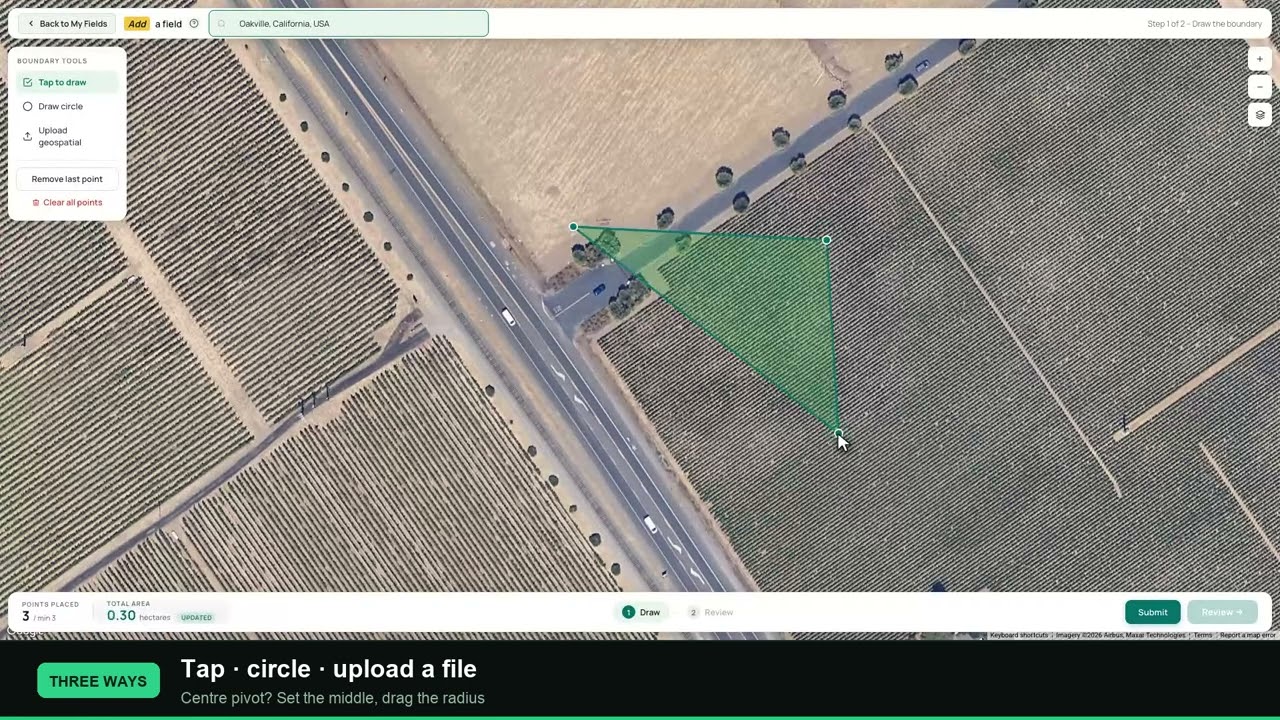
▶ How to draw or upload a field boundary in a farm mapping app. · 2:21
Try one precision agriculture app before you commit
A short, cheap trial tells you more than any list. Choose two or three fields that you know well, including one with a known problem. Run the app for part of a season and write down what it told you that you did not already know. Then compare the time spent against the calculator below, using your own costs.
- Write down the single decision you want the app to improve.
- Pick the app type that fits that decision, using the groups above.
- Export a sample of data on day one to prove you can get it out.
- Record the hours used, and any changes in inputs or trips.
- Decide at the end of the trial whether to keep, switch or stop.
Try the numbers for your own farm below.
Calculator
Would an app pay for itself on your farm?
Enter your own acres, costs and expected savings.
- Input savings: $500
- Value of time saved: $500
- App cost per acre: 2.00 US$/acre
- Input saving needed to break even: 1.00 %
Example values only, not a benchmark or a forecast. The example is set to land near break-even. Every number is your input and no savings rate is assumed by us. Use today’s price for the app and include setup and hardware.
FAQ
What is farm management software?
It is software that records and plans farm work: fields, crops, inputs, labor, costs and compliance documents. Many products add maps, weather or financial reports. It differs from a satellite or sensor tool, which measures what is happening in the field.
What is the best app for crop monitoring?
There is no single best one. For views with no hardware, use a satellite app. For measured weather and soil moisture, use a station-based app such as Meteobot. For machine-based yield data, look at a tool that links to your combine. Check that it covers your crops and region.
Are there no-cost farm management apps?
Some sellers list a no-charge entry plan: FieldView’s Basic plan was listed at US$0.00 a year on 5 November 2026. Entry plans limit features, so read the plan table. Also check whether you can export your records if you stop using the plan.
Can a satellite app replace scouting?
No. Satellite maps show where crop vigour differs. They do not tell you whether the cause is a pest, a nutrient gap, water or soil. A person still needs to check the area and decide what to do. Follow the label and local rules for any treatment.
What happened to Granular, Farm At Hand and Farm Dog?
Corteva closed Granular Agronomy in August 2022, and Traction Ag bought Granular Business. The Farm At Hand web address now opens Decisive Farming by TELUS Agriculture. FarmQA announced it had bought Farm Dog in November 2024.
How much do precision agriculture apps cost?
Prices vary by acres, features and hardware, and some sellers ask you to book a demo or contact them. Ask for the full yearly price, including setup, hardware and support, then put it into the calculator on this page.
Related pages on our site: farm apps for Australian growers; agriculture management system software; analytics in agriculture; agriculture data collection tools; farm tools and their uses; product traceability; carbon footprinting; fleet management; crop loan and insurance; large-scale farm administration; satellite data API; API developer documents; app download page.
Farmonaut crop monitoring
See your own fields from space
Check crop vigour maps for your fields on web or phone, then send a scout to the weak zones.




Keep reading
Sources
- USDA NASS, Technology Use (Farm Computer Usage and Ownership), August 2025: esmis.nal.usda.gov
- USDA NASS, Farm Computer Usage and Ownership, August 2021: esmis.nal.usda.gov
- USDA ERS, Precision Agriculture in the Digital Era, EIB-248 (2023): ers.usda.gov
- Copernicus SentiWiki, Sentinel-2 mission: sentiwiki.copernicus.eu
- farmdoc daily, University of Illinois, The People Behind the Machines (January 2026): farmdocdaily.illinois.edu
- Ag Data Transparent, Core Principles (updated 2024): agdatatransparent.com
- Ag Data Transparent, About: agdatatransparent.com
- Climate FieldView, plan pricing (checked 5 Nov 2026): climate.com
- Agworld, home page (checked 5 Nov 2026): agworld.com
- Bushel Farm, home page (checked 5 Nov 2026): bushelfarm.com
- Decisive Farming by TELUS Agriculture, farmathand.com (checked 5 Nov 2026): farmathand.com
- AgSquared, home page (checked 5 Nov 2026): agsquared.com
- FarmQA, FarmQA Acquires Farm Dog (November 2024): farmqa.com
- FarmQA, home page (checked 5 Nov 2026): farmqa.com
- Meteobot, home page (checked 5 Nov 2026): meteobot.com
- Traction Ag, home page (checked 5 Nov 2026): tractionag.com
- The Scoop, Sun Sets on Granular Agronomy (July 2022): thedailyscoop.com
- Farm Progress, Traction Ag acquires Granular Business: farmprogress.com
Discussion
Questions, corrections or field experience? Share them below. First-time comments are reviewed before they appear, and your email is never published.
No comments yet. Be the first to add a question or your experience.

 UCAL Fuel Systems
 Kubota
 FFBS
 Jontra
 Kalustyan
 Tucor
 Geno
 Hayleys Agriculture
 Linx Agritech
 Adinet
 Save Your Soils
 Grandstream Algérie
 XOS Realty
 Geospatial Lab Africa
 Agro La Gándara

 Licence holder · Niger · Gold
 Client · Tanzania · Gold
 Client · Somalia · Gold
 Client & affiliate partner · Ghana · Gold










