

Mining insurance · Guide
Expat Mining Insurance: Cover, Laws and Coal Rules
Which policies protect mine staff abroad, which countries make cover compulsory, and what US coal operators must insure or fund by law.
Key takeaways
- China requires labour firms to keep personal accident insurance for every worker sent abroad (State Council Order 620, Article 13).
- 594,000 Chinese workers were employed overseas at the end of 2024 (MOFCOM, January 2025).
- UAE private-sector workers must hold basic health insurance from 1 January 2025; the basic package costs Dh320 a year (Gulf News).
- US coal operators must insure or self-insure black lung benefits (20 CFR 726.1).
- Black lung excise tax: lower of US$1.10/ton or 4.4% (underground), US$0.55/ton or 4.4% (surface) (IRS).
In this article
- What expat mining insurance covers
- China expatriate mining insurance rules
- United States expatriate mining insurance
- UAE and Bahrain expat mining insurance
- Coal mine insurance: the main policies
- US coal mine insurance rules and costs
- Coal mine safety record and premiums
- Specialist mining risks the standard market avoids
- How to set up insurance for a foreign mine site
- Frequently asked questions
Expat mining insurance is the group of policies that protect people who work on a mine outside their home country: international health cover, medical evacuation, personal accident and life cover, employer’s liability, and in higher-risk places kidnap and ransom cover. Some of it is set by law. China requires its overseas labour firms to keep personal accident insurance for every worker they send abroad (State Council Order 620, Article 13), and the UAE has required basic health cover for private-sector workers since 1 January 2025. Coal mines carry a separate set of rules, from US black lung insurance to reclamation bonds.
This guide is written for mining consultants, contractors and project owners who staff sites abroad or run coal operations. It covers what each policy pays for, which country rules apply, the US coal rules with their dollar amounts, and a calculator for the black lung excise tax on your own coal sales.
What expat mining insurance covers
A mine worker on a foreign assignment falls outside the home country’s public health system and often outside its workers’ compensation law. A sound package fills each gap with a named policy. Most mining employers buy these as a group plan through a specialist broker, and the contract with the host-country operator or labour agency should say who pays for which part.
| Policy | What it pays for | Who usually buys it |
|---|---|---|
| International private medical insurance | Hospital, doctor and outpatient costs in the host country and often in a third country with better hospitals | Employer, as a group plan |
| Emergency medical evacuation and repatriation | Air ambulance from a remote site to a suitable hospital, and return home of the worker or remains | Employer; often bundled with medical cover |
| Personal accident and group life | Lump sums for death or permanent disability, at work or off shift | Employer or labour agency (a legal duty for Chinese labour agencies) |
| Employer’s liability or foreign voluntary workers’ compensation | Claims by injured staff whose home-country compensation law does not reach the foreign site | Employer |
| Kidnap, ransom and extortion | Crisis consultants, ransom reimbursement and related costs | Employer, for sites in high-risk areas |
| Political violence and evacuation cover | Costs of pulling staff out during unrest, strikes or war | Project owner, often alongside political risk insurance |
Two terms come up in every quote. A deductible (or excess) is the part of each claim the insured pays first. A sum insured is the most the policy will pay. For remote mine camps, the evacuation limit matters more than the hospital limit, because the flight to a capable hospital is often the largest single cost.
Expatriates, inpatriates and foreign assignments
Insurers use three words for staff who cross borders. An expatriate is sent from the home country to work abroad. An inpatriate is a foreign national brought into the company’s home country, for example a geologist from Chile posted to a US head office. A foreign assignment policy usually means short trips, such as a consultant who visits a site for two weeks to log core. Inpatriate mining benefits normally follow the host country’s rules: in the United States a foreign worker at a US mine is covered by the state workers’ compensation system like any other employee, while health cover depends on the employer’s plan.
China expatriate mining insurance rules
China is the country most searched with this topic, and the reason is scale. Chinese firms sent 409,000 workers abroad in 2024, up 17.9% on 2023, and 594,000 Chinese workers were employed overseas at the end of that year (Ministry of Commerce data reported by the State Council, January 2025). Many of them work on mines and on the roads, plants and power lines built for mines.
Chart
Chinese workers abroad, 2024
Thousand workers; full-year 2024 and January-November 2024 figures
The legal base is the 2012 Administrative Regulations on Foreign Labor Service Cooperation (State Council Order 620). Two rules matter for insurance:
- Accident insurance is compulsory. The labour cooperation firm must keep personal accident insurance for each worker during the period of work abroad, unless it agrees with the foreign employer that the employer will maintain it (Article 13).
- A reserve fund backs the firm. Each firm must deposit a risk disposal reserve fund of at least RMB 3,000,000, or a bank guarantee of the same amount, which can pay to bring workers home or settle their claims if the firm fails.
In practice a Chinese mining group working abroad builds its expatriate cover in layers: the compulsory accident policy from the labour firm or the employer, a group medical and evacuation plan bought in China or locally, and the host country’s own compulsory cover where it applies to foreign staff. Firms on large projects often add political violence and kidnap cover for sites in unstable regions.
| Who sends the worker | Workers sent, January to November 2024 | Usual insurer of the accident policy |
|---|---|---|
| Contractors on overseas projects (mines, plants, roads) | 130,000 | The contractor or its labour partner |
| Labour cooperation firms placing workers with foreign employers | 228,000 | The labour firm, unless the foreign employer agrees to insure |
Source for worker numbers: MOFCOM, Brief Statistics of China’s Overseas Labor Service Cooperation, January to November 2024. By the end of November 2024, 582,000 Chinese workers were working overseas.

▶ What foreigners need to know about small-scale mining licences in Africa. · 5:16
United States expatriate mining insurance
US mining companies and consultants that send staff to Latin America, Africa or Central Asia face one main gap: state workers’ compensation laws were written for work done in the state. Some states reach temporary work abroad, many do not, and none handle repatriation or a medical flight out of a jungle camp. That is why US employers add a foreign voluntary workers’ compensation endorsement, which pays benefits as if the home state law applied, plus employer’s liability for lawsuits.
Points a US consultant should check before a site visit:
- Whether the company’s workers’ compensation policy names the foreign country or has a foreign voluntary endorsement.
- Whether the health plan pays outside the United States, and at what level of network.
- The evacuation limit and whether it covers evacuation for security reasons, not only medical ones.
- Whether the host country requires a local policy (many mining countries require locally licensed insurers for compulsory classes).
- Who holds the kidnap and ransom policy: such policies are usually confidential, and only a few people in the company should know they exist.
UAE and Bahrain expat mining insurance
The Gulf states are home to quarry, cement and metal processing workers and to the regional offices of mining contractors. From 1 January 2025 every private-sector employee and domestic worker in the UAE must hold basic health insurance, extending the rule already in force in Abu Dhabi and Dubai to the other emirates. The employer buys the policy when it issues or renews a residence visa; the basic package costs Dh320 a year and is valid for two years (Gulf News, 1 January 2025). A mining contractor posting staff from a Gulf office to sites elsewhere still needs an international plan, because the basic UAE package does not pay for treatment abroad.
Bahrain has a smaller mining sector, centred on aluminium smelting and quarrying. Employers there should check the current health insurance rules for expatriates with the national regulator before quoting a package, since Gulf rules have changed several times in recent years.
Coal mine insurance: the main policies
Coal operations need the same property and liability cover as any mine, plus extra policies driven by coal’s specific hazards: methane and dust explosions, roof falls underground, spontaneous combustion in stockpiles, and long-tail lung disease. The workforce is shrinking. US coal mines employed 62,246 miners in 2025, down from 102,804 in 2015 (MSHA coal fatality and employment table), but each mine carries the same insurance needs. For a list of the larger producers, see our guide to top coal mining companies in the US.
Chart
US coal mine employment
Thousand miners
- Property and machinery breakdown: draglines, longwall shearers, conveyors, wash plants and haul trucks. Underground equipment is often insured only on named perils, so check whether fire and flood below ground are included.
- Business interruption: lost profit after an insured property loss, after a waiting period written into the policy.
- General and pollution liability: claims from neighbours and communities over dust, water and subsidence. Standard liability policies exclude gradual pollution, so coal operators buy a separate environmental policy.
- Workers’ compensation and black lung cover: required by law in the United States (see the next section).
- Surety bonds: reclamation and permit bonds, which are guarantees to a regulator rather than insurance for the miner.
- Auto and fleet: road haulage of coal; telematics from fleet management tools can support lower premiums by showing speed and route records.
Coal is also harder to place than other commodities. A growing number of large insurers and reinsurers have published policies that limit or end underwriting for new coal mines and coal power. Coal operators therefore tend to rely more on regional insurers, captives (insurance companies owned by the mining group) and self-insurance than gold or copper miners do.
US coal mine insurance rules and costs
Three federal rules shape what a US coal operator must insure or fund.
Chart
Black lung excise tax per ton
US$ per ton, before the 4.4% price cap
Black lung benefits insurance
Every coal mine operator must secure the payment of black lung benefits it may owe, either by qualifying as a self-insurer or by buying a commercial insurance contract, including one from a state fund (20 CFR 726.1). The Black Lung Benefits Act sets the same duty for operators in states whose compensation laws do not cover the disease (30 U.S.C. 933). Black lung, or coal workers’ pneumoconiosis, is a lung disease caused by breathing coal mine dust; it can appear decades after exposure, so this is a long-tail liability.
Black lung excise tax
Where no responsible operator pays, the Black Lung Disability Trust Fund does. It is funded by an excise tax on the first sale of US-mined coal: the lower of $1.10 per ton or 4.4% of the sale price for underground coal, and the lower of $0.55 per ton or 4.4% for surface coal (IRS). The Inflation Reduction Act of 2022 made these rates permanent after years of scheduled cuts to $0.50 and $0.25 per ton (Congressional Research Service). The 4.4% cap applies when underground coal sells below $25 a ton or surface coal below $12.50 a ton. The trust fund still owed $4.6 billion at the end of fiscal 2021, which is why the higher rate stayed.
Reclamation bonds
Surface coal mines must post a performance bond before mining starts. The regulator sets the amount at what it would cost to finish the reclamation plan if the operator defaulted, and the bond for one permit area can never be less than $10,000 (30 U.S.C. 1259). Bonds are usually bought from surety companies, and sureties price them on the operator’s balance sheet as much as on the site.
Calculator
How much black lung excise tax will your coal sales owe?
Enter your annual coal sales and an average sale price.
- Underground tax (US$): $1,100,000
- Surface tax (US$): $1,100,000
Example values only, not a benchmark. Rates from the IRS: lower of US$1.10 per ton or 4.4% of price (underground) and US$0.55 per ton or 4.4% (surface). Price is an input: example, use today’s price. Check with a tax adviser.
Coal mine safety record and premiums
Underwriters price workers’ compensation and liability on the loss record. US coal mines recorded 8 deaths in 2025 and 10 in 2024, against 12 in 2015, according to MSHA. Across all US mining, the fatal injury rate fell from 0.0119 in fiscal 2019 to 0.0101 in fiscal 2025 (MSHA At a Glance, FY1978-2025). For the controls that move these numbers, see our overview of mine safety solutions.
Chart
US coal mine fatalities by year
Deaths per calendar year, all US coal mines
What an underwriter asks a coal operator before quoting:
- Five years of loss runs (a list of past claims) for every policy line.
- MSHA citation history and any orders that closed parts of the mine.
- Ventilation, methane monitoring and dust control plans for underground mines.
- Ground control plan and roof fall history.
- Stockpile management and fire records for spontaneous combustion.
- Reclamation bond status and any outstanding notices of violation.
- Ownership, financial statements and the reclamation liability on the balance sheet.
Specialist mining risks the standard market avoids
Some mining risks are hard to place with ordinary insurers and go to specialist mining underwriters, the Lloyd’s market, captives or government agencies:
- Tailings dam failure: a single failure can cause losses far larger than the mine’s value, so capacity is limited.
- Underground property: collapse and flooding below ground are often excluded or sub-limited.
- Gradual pollution and closure costs: these are usually funded by bonds or trusts, not insurance.
- Political risk: expropriation, licence cancellation and currency controls, often covered by development finance agencies or specialist markets.
- Kidnap and ransom: written only by a small group of specialist insurers.
- Coal itself: as described above, many large insurers now limit new coal business.
Licence terms also matter. A host government can make insurance a condition of the mining concession, so check the licence text; our page on mining concessions explains how these agreements are built. Before buying into a project, a buyer should also ask how much of its risk is insured; see how to sell a mine for the due diligence side.

▶ Strip mining explained: how surface mines work and the risks they carry. · 4:37
How to set up insurance for a foreign mine site
- Map the people. List every expatriate, inpatriate, local hire and short-term visitor, with nationality and contract type.
- Check the laws on both ends. Home-country rules (such as China’s Article 13 accident insurance) and host-country compulsory cover (health, motor, workers’ compensation).
- Rate the site. Distance to a capable hospital, road and air access, security level and seasonal access.
- Set limits. Evacuation limit first, then medical, accident and liability limits that match the contract values.
- Write the contract. State who insures each person and each risk in the service and labour agency contracts.
- Review every year. Update head counts, claims and site risk before renewal.
Satellite imagery helps with step 3. A recent image of the site shows access roads, airstrips, camp layout, tailings dams and flood-prone ground, which an underwriter or risk consultant can check before visiting. Farmonaut provides satellite mapping of mining areas for this kind of desk review.
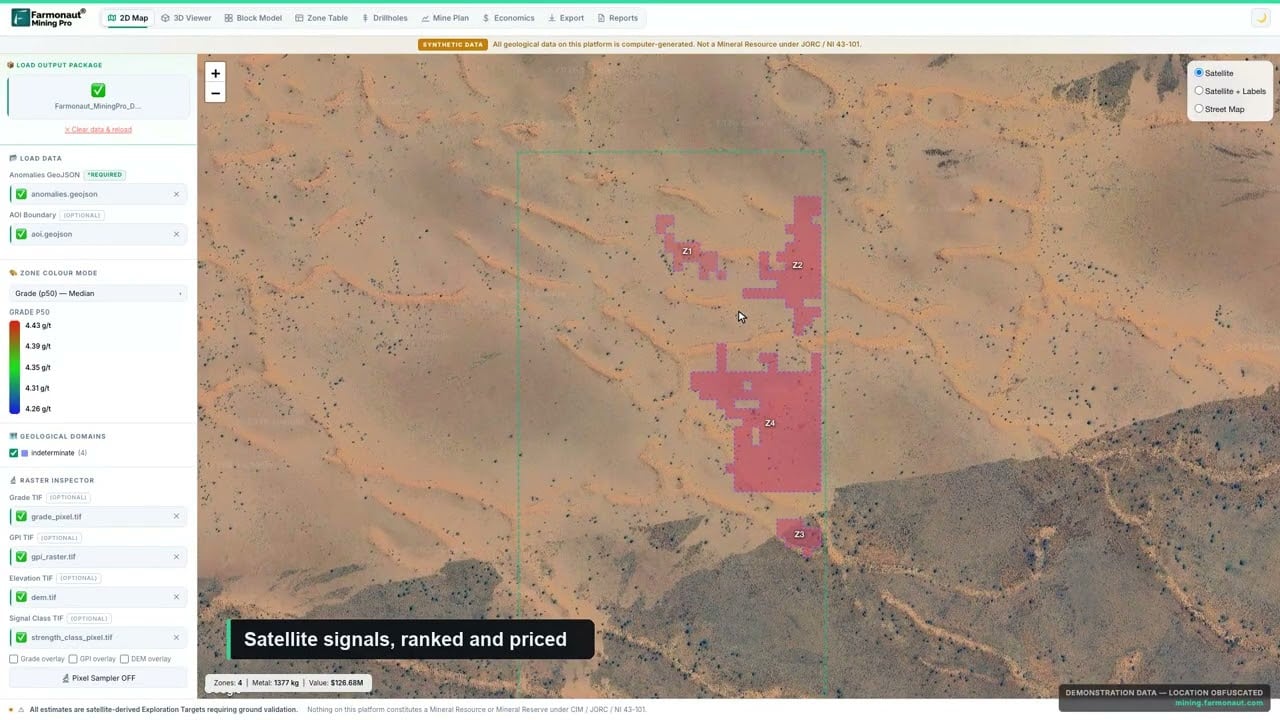
▶ A short look at Farmonaut Mining Pro, which maps a licence area from satellite data. · 4:56
Frequently asked questions
What is expat mining insurance?
It is the set of policies that protect mine staff working outside their home country: international medical cover, emergency evacuation, personal accident and life cover, employer’s liability and, where needed, kidnap and political violence cover.
Is accident insurance compulsory for Chinese workers sent to overseas mines?
Yes. Under Article 13 of State Council Order 620 (2012), the labour cooperation firm must keep personal accident insurance for each worker abroad, unless it agrees that the foreign employer will maintain it.
How many Chinese workers work abroad?
The Ministry of Commerce reported 594,000 Chinese workers employed overseas at the end of 2024, with 409,000 sent during that year.
Does US workers’ compensation cover employees at a foreign mine?
Often not fully. State laws vary on work abroad, so US employers add a foreign voluntary workers’ compensation endorsement and employer’s liability cover for staff on foreign sites.
What is inpatriate mining insurance?
It covers foreign nationals brought to work in the company’s home country. In the United States they fall under state workers’ compensation like other employees; health cover depends on the employer’s plan and visa terms.
Do UAE employers have to insure expat workers?
Yes. Since 1 January 2025 every private-sector employee and domestic worker in the UAE must have at least basic health insurance, bought by the employer when the visa is issued or renewed.
What insurance does a US coal mine need by law?
Workers’ compensation, black lung benefits cover (insured or self-insured), and a reclamation performance bond for surface mining. Lenders and contracts usually add property and liability cover.
How much is the black lung excise tax?
The lower of $1.10 per ton or 4.4% of the sale price for underground coal, and the lower of $0.55 per ton or 4.4% for surface coal, at rates made permanent in 2022.
Why is coal mine insurance hard to buy?
Many large insurers have published policies limiting cover for new coal projects, and coal carries explosion, fire and long-tail lung disease risks, so operators rely more on regional insurers, captives and self-insurance.
Which mining risks are hardest to insure in the standard market?
Tailings dam failure, underground collapse and flooding, gradual pollution, political risk, kidnap and ransom, and new coal projects. These go to specialist mining underwriters, captives or government agencies.
More from Farmonaut: carbon footprinting, crop loan and insurance, farmonaut satellite weather api developer docs, traceability, coal insurance expat mining insurance 2025 powerful trends.
This page is general information, not legal, tax or insurance advice. Policy terms vary by insurer and country; check the wording and local law with a licensed broker or lawyer.
Farmonaut mining
Map your mining site from space
Farmonaut maps roads, camps, tailings and terrain on a mine site from satellite imagery for desk risk reviews.

Mining Pro sample view, synthetic data
Keep reading
Sources
- MOFCOM (State Council), Administrative Regulations on Foreign Labor Service Cooperation, Order 620 (2012): english.mofcom.gov.cn
- State Council of China, foreign investment and cooperation in 2024 (January 2025): english.www.gov.cn
- MOFCOM, Brief Statistics of China’s Overseas Labor Service Cooperation, Jan-Nov 2024: english.mofcom.gov.cn
- Gulf News, UAE mandatory health insurance for workers begins (1 January 2025): gulfnews.com
- MSHA, Coal fatalities and employment 1900-2025: arlweb.msha.gov
- MSHA, Mine Safety and Health At a Glance FY1978-2025: msha.gov
- IRS, Change in rate for coal excise tax: irs.gov
- Congressional Research Service, The Black Lung Program, the Black Lung Disability Trust Fund and the Excise Tax on Coal (R45261): everycrsreport.com
- 20 CFR 726.1, Black lung insurance requirement (LII): law.cornell.edu
- 30 U.S.C. 933, Duties of coal mine operators (LII): law.cornell.edu
- 30 U.S.C. 1259, Performance bonds under SMCRA (LII): law.cornell.edu
Discussion
Questions, corrections or field experience? Share them below. First-time comments are reviewed before they appear, and your email is never published.
No comments yet. Be the first to add a question or your experience.

 Congo Mining Solutions
 Mining SARL
 SenGold Invest SAS
 Sania Corporation
 Sean Mining Limited
 NTS Group (Pty) Ltd
 Mine4Africa
 Lithspo Minerals Limited
 Tintina Mining Group
 Dalgety Minerals Pty Ltd
 Vortex Minerals Pty Ltd
 Faith At Work (Pty) Ltd
 Geotech Mining Solutions plc
 Vulcan International Limited
 Kidepo Associates
 GKY Mining
 Alkimy SARL
 Double A Trading
 GemSprout Metals Limited
 Qader Group
 Ileys General Trading
 SG Gold Mining LLC
 VRV Global Pte Ltd

 Client · Tanzania · Gold
 Client & affiliate partner · Ghana · Gold










