


Satellite Mineral Detection& AI Mineral Exploration
We turn a mining license area into a ranked list of promising, priced exploration targets using AI and satellite data. We combine satellite mineral detection, geological mapping, 3D modelling, drill targeting, and early mine planning — all before any drilling begins.
 Ghana
Ghana Tanzania
 Senegal
 MauritaniaBerks Gold LimitedNanita Company LimitedEnergy and Resources LtdDenkyira Nkoranza ConcessionMwerezi Minerals Company LimitedRiverside Resources LimitedRamani Investments LtdAfrican Venture Partners HoldingComfix & Engineering LimitedCritica Metals LimitedImperial Impex FZE
 Congo Mining SolutionsCIMISCO SARLViahara MiningMining SARLSenGold Invest SASSahel Shipping SA
 Sania CorporationSahara MiningEnterprise Takreem
 Sean Mining LimitedSMA Investments Ltd
 NTS Group (Pty) LtdKlusetic Mining Investments
 Mine4AfricaTimestream Mining
 Lithspo Minerals LimitedMulopwe Metals Mining LtdRains of Favour
 Tintina Mining GroupHuckleberry Garnet LLCProcess Metrology LLCWSP Investment Company
 Dalgety Minerals Pty Ltd
 Vortex Minerals Pty LtdSwati Minerals
 Faith At Work (Pty) Ltd
 Geotech Mining Solutions plc
 Vulcan International Limited
 Kidepo Associates
 GKY Mining
 Alkimy SARL
 Double A TradingTipareth MinesGeoticgy
 GemSprout Metals LimitedSouthbridge & Wess PDC Ltd
 Qader Group
 Ileys General Trading
 SG Gold Mining LLC
 VRV Global Pte Ltd
 Omsri International FZEMineral Gulf Transhipment DMCC
 G.I.T.T.
 Jaunita Erss LtdAlmosi SARLSRK ConsultingBerks Gold LimitedNanita Company LimitedEnergy and Resources LtdDenkyira Nkoranza ConcessionMwerezi Minerals Company LimitedRiverside Resources LimitedRamani Investments LtdAfrican Venture Partners HoldingComfix & Engineering LimitedCritica Metals LimitedImperial Impex FZECongo Mining SolutionsCIMISCO SARLViahara MiningMining SARLSenGold Invest SASSahel Shipping SASania CorporationSahara MiningEnterprise TakreemSean Mining LimitedSMA Investments LtdNTS Group (Pty) LtdKlusetic Mining InvestmentsMine4AfricaTimestream MiningLithspo Minerals LimitedMulopwe Metals Mining LtdRains of FavourTintina Mining GroupHuckleberry Garnet LLCProcess Metrology LLCWSP Investment CompanyDalgety Minerals Pty LtdVortex Minerals Pty LtdSwati MineralsFaith At Work (Pty) LtdGeotech Mining Solutions plcVulcan International LimitedKidepo AssociatesGKY MiningAlkimy SARLDouble A TradingTipareth MinesGeoticgyGemSprout Metals LimitedSouthbridge & Wess PDC LtdQader GroupIleys General TradingSG Gold Mining LLCVRV Global Pte LtdOmsri International FZEMineral Gulf Transhipment DMCCG.I.T.T.Jaunita Erss LtdAlmosi SARLSRK Consulting
33 countries,391,956 acres delivered
Ghana144,020Tanzania45,697Senegal38,170Mauritania34,842DR Congo20,292Mongolia17,569Zambia16,969USA10,255Singapore9,101Niger8,041Zimbabwe7,317Somalia6,919Kenya6,771Sierra Leone4,448Guyana3,907Yemen3,707Uganda3,311Nigeria1,977Mali1,347India1,310UAE1,226South Africa892 Turkey751Ethiopia741Botswana450Australia321
 Iraq272Côte d'Ivoire247
 Thailand247
 Colombia247
 Peru247Morocco222Liberia123
- Ranked Exploration Targets from fused multi-sensor data
- Prospectivity heatmap across the whole license
- Estimated location, depth and quantity per zone
- Structural and lithological geological mapping — faults, alteration zones, host rocks
- Seasonal anomaly validation for higher confidence
- Priority ranking with confidence tiers
- Commercial conclusion with indicative economics
- Georeferenced KML / GeoTIFF / GeoJSON outputs
- TargetMax™ drilling intelligence — optimal angles and depths
- Interactive 3D subsurface and vein-structure model
- Regularised economic block model with confidence codes
- Synthetic drillhole database for programme design
- Conceptual pit shell, grade–tonnage curve and LOM schedule
- Monte Carlo economics with P10 / P50 / P90
- Host-mineral distribution map for precise targeting
- Export packages for Leapfrog, Vulcan, Surpac and Datamine
- White-label reporting under your own name and address
- Report translation into the language of your jurisdiction
- GIS layer and CSV / GeoJSON data delivery
- Surpac STR / DTM and DXF-DWG geological models
- Drilling-angle and 3D modules bought on their own
- Phased delivery across a multi-license package
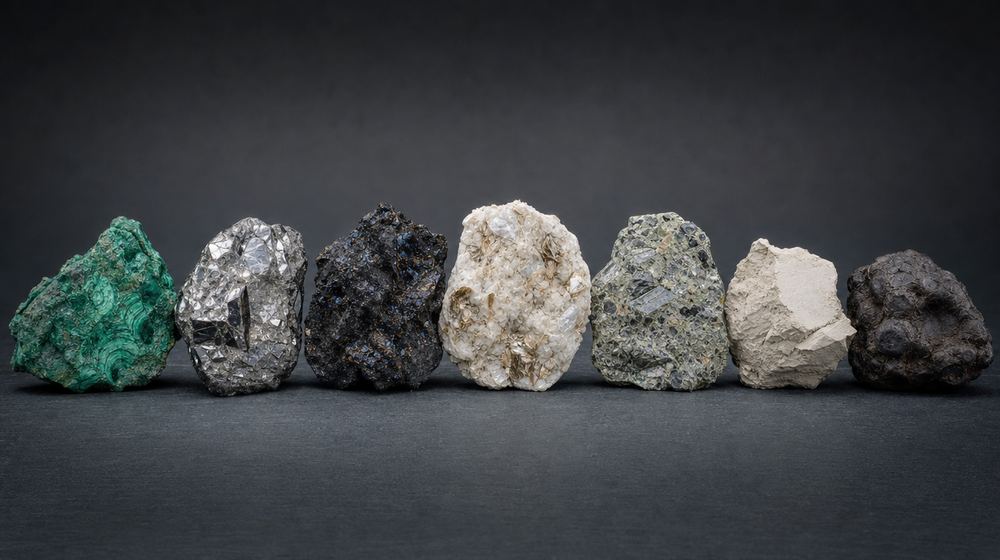
23 minerals. 4 steps.5 days.
Precious metals
3Base metals
8Battery & technology metals
8Gemstones & industrial
4The platform can analyse any mineral target with a detectable spectral or geophysical signature — including rare-earth elements, nickel sulphide, quartz, gypsum, dolomite, epidote, rhodium, palladium, and others beyond the current list.
New mineral targets require calibrating the spectral library and relevant geological, density and recovery parameters, then running the same exploration pipeline. Whatever the mineral, we can analyse it.
You send
The coordinates, a KML / KMZ / GeoJSON file, or the license or concession boundary — along with the country and target minerals.
We select the data
We pick multispectral or hyperspectral satellite data and the radar, thermal, magnetic and terrain layers your geology needs.
We analyse
Machine-learning multi-sensor fusion produces a per-pixel prospectivity index, a grade model, deposit-type classification and tonnage.
You receive
A PDF report, georeferenced maps (KML / GeoTIFF / GeoJSON) and — on Premium+ — 3D models and a conceptual mine plan.
Satellite imagery for mineral exploration:eight sensor families, matched to your mineral list
| Icon | Family | Missions | What it contributes |
|---|---|---|---|
| Optical multispectral | Sentinel-2 (10–20 m) · Landsat 8/9 (30 m) | Alteration, lithology, vegetation stress | |
| SWIR & emissivity | ASTER SWIR · ASTER GED | Clay, mica and carbonate alteration mineralogy | |
| Radar | Sentinel-1 C-band · ALOS PALSAR L-band · ALOS-2 ScanSAR | Structure, lineaments, surface roughness, canopy penetration | |
| Thermal | MODIS LST | Thermal inertia and near-surface contrast | |
| Terrain | SRTM · Copernicus GLO-30 · GEDI canopy | Structural fabric, drainage, canopy correction | |
| Magnetics | EMAG2 | Basement architecture and intrusive contacts | |
| Hydrology | MERIT Hydro | Drainage networks and placer context | |
| Land cover | Dynamic World | Screening near settlement and infrastructure |
- Cost-effective across tens of thousands of acres; dense revisit makes seasonal cross-checks practical
- Strong on iron oxides, gossans and broad alteration halos
- Gold, copper, cobalt, nickel, iron, manganese
- Separates minerals that look identical to broad bands; resolves clay, mica and carbonate species individually
- Required for rare earths and fine-grained industrial minerals
- Neodymium, cerium, scandium, yttrium, lithium, PGMs
One ranked zone, opened up end to end — which bands fired and why, how the prospectivity score was built, and what the finished report says about grade, depth and tonnage.
Mineral exploration software:9 tools, one browser tab
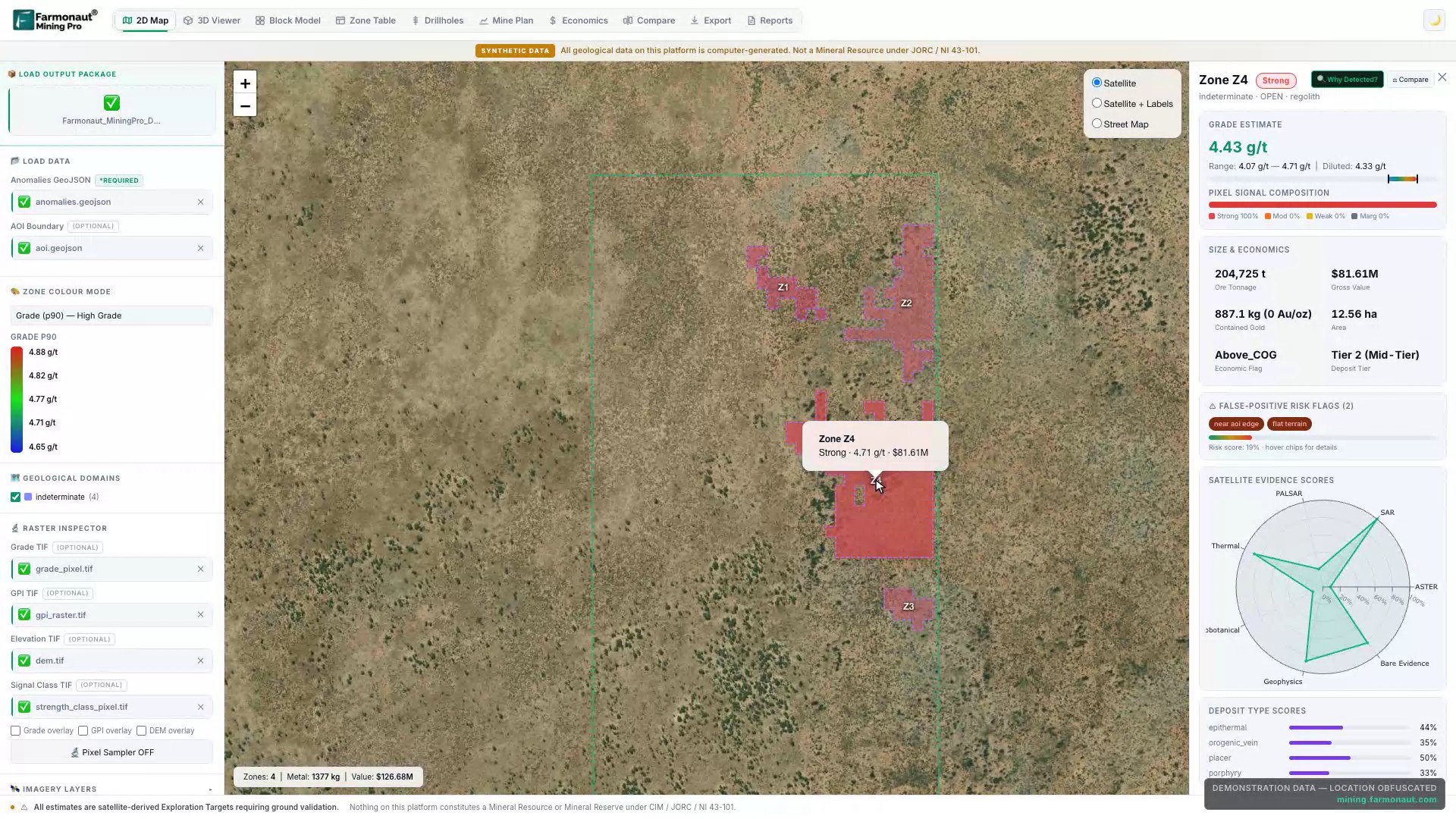
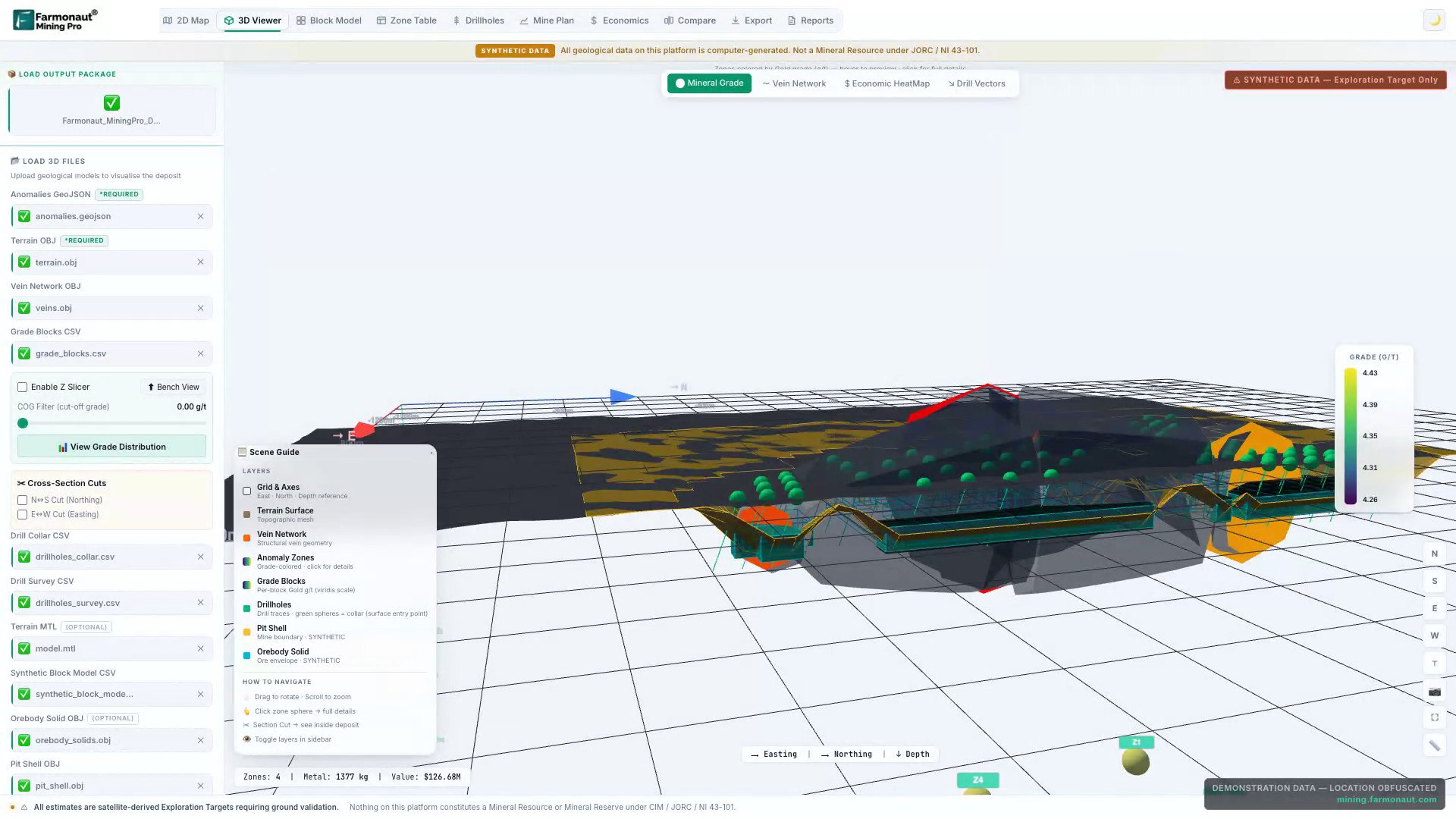

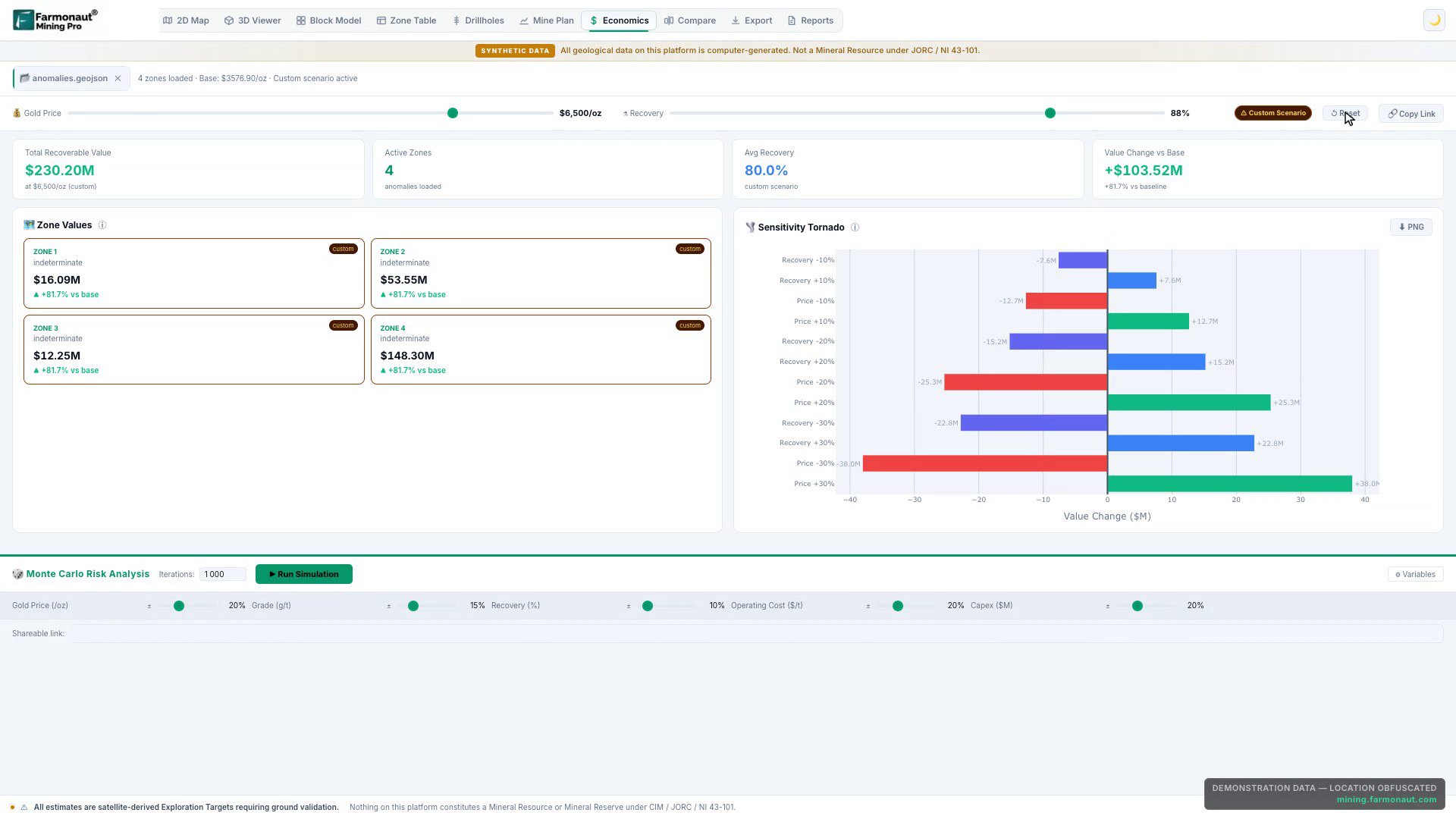
Economic block model
Regularised blocks carrying grade, density, dilution and an EXPL_TARGET A/B/C confidence code.
Synthetic drillhole set
Collar, survey, assay, lithology and de-survey tables — enough to design a first-pass programme.
Floating-cone pit shell
A conceptual pit generated on the reconciled expected-tonnage basis, not the raw envelope.
Bench & grade–tonnage
Tonnage and grade per bench, and the grade–tonnage curve behind any cut-off you choose.
LOM schedule
A conceptual life-of-mine production schedule with strip ratio by period.
Orebody solids
Wireframe solids per zone, ready to import into your own modelling package.
See the platform in action through a full 16-chapter video course, recorded live using real survey data.
The course walks through how the exploration workflow works, how satellite data is used to identify mineral targets, how targets are ranked, and how the platform moves from raw data to drill-ready insights — including the more technical parts that are difficult to explain on paper. No geology degree required.
Drilled — andthe ground agreed
68 GPS localities checked over four field days. All 14 ranked zones returned physical evidence.
Quartz · veining · gossans · old workings
Ranked targets drilled and sent to the laboratory; mineralisation confirmed by assay.
Drill core · laboratory assay
Consultancy drilled our ranked locations and found mineralisation for their client.
Drill core · visual mineralisation
Ranked targets taken to the drill on a compact license; the client confirmed mineralisation was encountered.
Drill core · client-confirmed
Targets drilled and mineralisation encountered on a small-scale license.
Drill core · visual mineralisation
18 publishedgold engagements
South AfricaNigerZimbabweZimbabweZimbabweGhanaGhanaZambiaZambiaKenyaKenyaEthiopiaPeruUSATanzaniaMauritaniaZimbabweBeyond gold —battery, base and industrial minerals
Copper – cobalt
Under 250 acres · ranked targets drilled, mineralisation found · up to 30 days saved
Cobalt
DR Congo3 zones · over 3,400 g/t cobalt indicated
Lithium + gold
Nigeria741 acres · targeting complete, drilling planned · 6+ months saved
Lithium
NigeriaPegmatite-hosted lithium spots identified by remote sensing
Diamond
Botswana450 acres of kimberlite-prospective ground mapped
Bentonite
India4 clay zones · ~102,000 t of smectite mapped
Gold + manganese
Australia1,310 acres across three projects
Gold, silver, uranium
ZimbabwePolymetallic screen under 75 acres · 6+ months saved
Nickel
Tanzania30,196 acres — the largest single non-gold license delivered
Silver
USA2,414 acres across a multi-license silver package
Feedback from the clients
NTS Group (Pty) LtdAlmosi SARLMalik
57 namedclient companies
Berks Gold LimitedNanita Company LimitedEnergy and Resources LtdDenkyira Nkoranza ConcessionMwerezi Minerals Company LimitedRiverside Resources LimitedRamani Investments LtdAfrican Venture Partners HoldingComfix & Engineering LimitedCritica Metals LimitedImperial Impex FZECongo Mining SolutionsCIMISCO SARLViahara MiningMining SARLSenGold Invest SASSahel Shipping SASania CorporationSahara MiningEnterprise TakreemSean Mining LimitedSMA Investments LtdNTS Group (Pty) LtdKlusetic Mining InvestmentsMine4AfricaTimestream MiningLithspo Minerals LimitedMulopwe Metals Mining LtdRains of FavourTintina Mining GroupHuckleberry Garnet LLCProcess Metrology LLCWSP Investment CompanyDalgety Minerals Pty LtdVortex Minerals Pty LtdSwati MineralsFaith At Work (Pty) LtdGeotech Mining Solutions plcVulcan International LimitedKidepo AssociatesGKY MiningAlkimy SARLDouble A TradingTipareth MinesGeoticgyGemSprout Metals LimitedSouthbridge & Wess PDC LtdQader GroupIleys General TradingSG Gold Mining LLCVRV Global Pte LtdOmsri International FZEMineral Gulf Transhipment DMCCG.I.T.T.Jaunita Erss LtdAlmosi SARLSRK ConsultingSend us alicense boundary
The coordinates, a KML / KMZ / GeoJSON file, or the exploration license or concession boundary — along with the country and target minerals. We’ll come back with the scope, price and expected delivery timeline — within one working day.
200 Vesey Street, 24th Floor
New York, NY 10006
Wilmington, Delaware 19709
You own the client relationship and the conversation — we do the technical work and the delivery. Free to join, commission on every successful project, no technical background needed.
Become a PartnerCase studies from real exploration projects
How licence holders and exploration teams used our satellite analysis to find and rank targets before drilling.


