

Powered by JEEVN AI
AI farm advisory for each of your fields
Farmonaut's AI farm advisory uses each new satellite image of your field to put together a plan for the week. You get irrigation amounts in millimeters, fertilizer doses in kilograms, the pest risks for your crop, and the readings behind each recommendation. Quite often the advice is to hold off on water or fertilizer, and the report says that too.
Businesses with fields on the platform
- Gator Blueberries
- Dirks Bros Farms
- JJM Farms
- Unifrutti Gulf
- Sun Palm Australia
- Elders
- BayWa
- Hayleys Agriculture
- CGIAR
- Fair Climate Fund
- Kubota
- John Deere
Inside the Personalized Farm Advisory
What the report covers for each field
You'll find the advisory in the Farmonaut web app at sat.farmonaut.com. It's generated by JEEVN AI, which takes each new satellite pass and combines it with the crop's growth stage, the soil and the local weather forecast. Each field gets its own report, so a dry block and a wet block on the same farm get different advice.
Crop health
A map with five levels, from healthy to very high stress, and the percentage of the field at each level. It shows you which part of the field to go and check.
Water for the next 7 days
How many millimeters to apply each day. The plan also lists forecast rain with its probability, the best time window to irrigate, and your irrigation method.
Soil
Acidity, salinity and organic matter, each with a short note on what the reading means for the crop you're growing.
Yield and harvest date
Expected yield per acre and for the whole field, and when the harvest window is likely to open. Both are updated through the season.
Pests, disease and weeds
Which pest, disease or weed is likely, how likely it is, and an organic and a chemical way to control it.
Fertilizer by nutrient
Five nutrients, each rated optimal, monitor or needs attention, with a dose in kilograms. If a nutrient is already in range, the dose is zero.
Pest, disease and weed warnings
Why each warning was raised
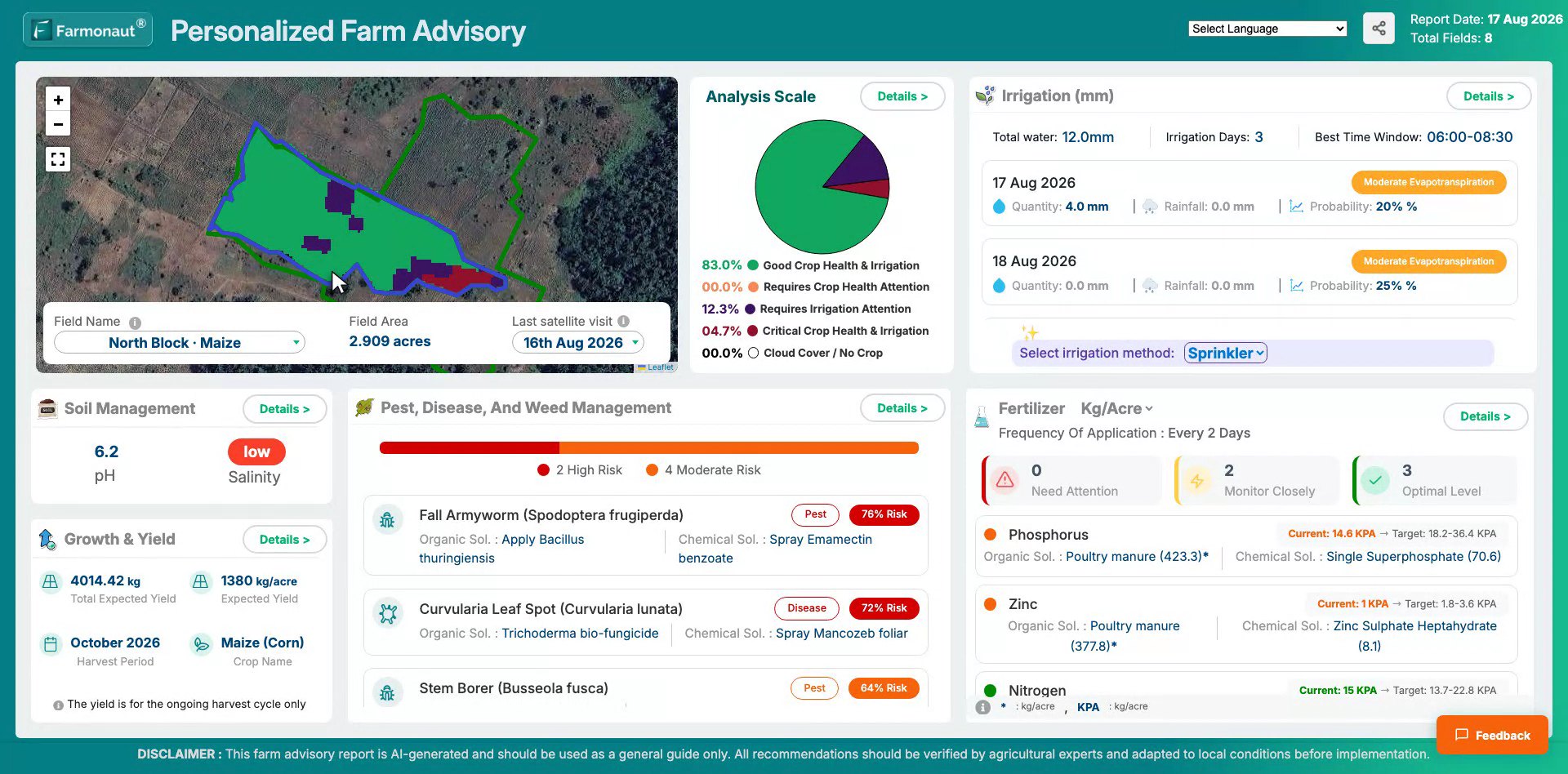
A risk percentage by itself doesn't give you much to go on. When you open a warning, the report lists the satellite readings that triggered it and the crop-protection guidelines they were checked against.
- The readings: in a cloudy week on one maize field, the report noted that cloud had blocked the optical images, that the radar vegetation index had dropped to 0.61 during grain filling, and that soil moisture was high.
- What that means: a wet canopy favors leaf-spot fungi, and at the ear stage the crop is still exposed to fall armyworm and stem borer.
- References: which satellite readings were used and which published crop-protection guidelines apply.
- Control options: for fall armyworm at 76% risk, Bacillus thuringiensis (organic) or emamectin benzoate (chemical).
Fertilizer doses worked out per nutrient
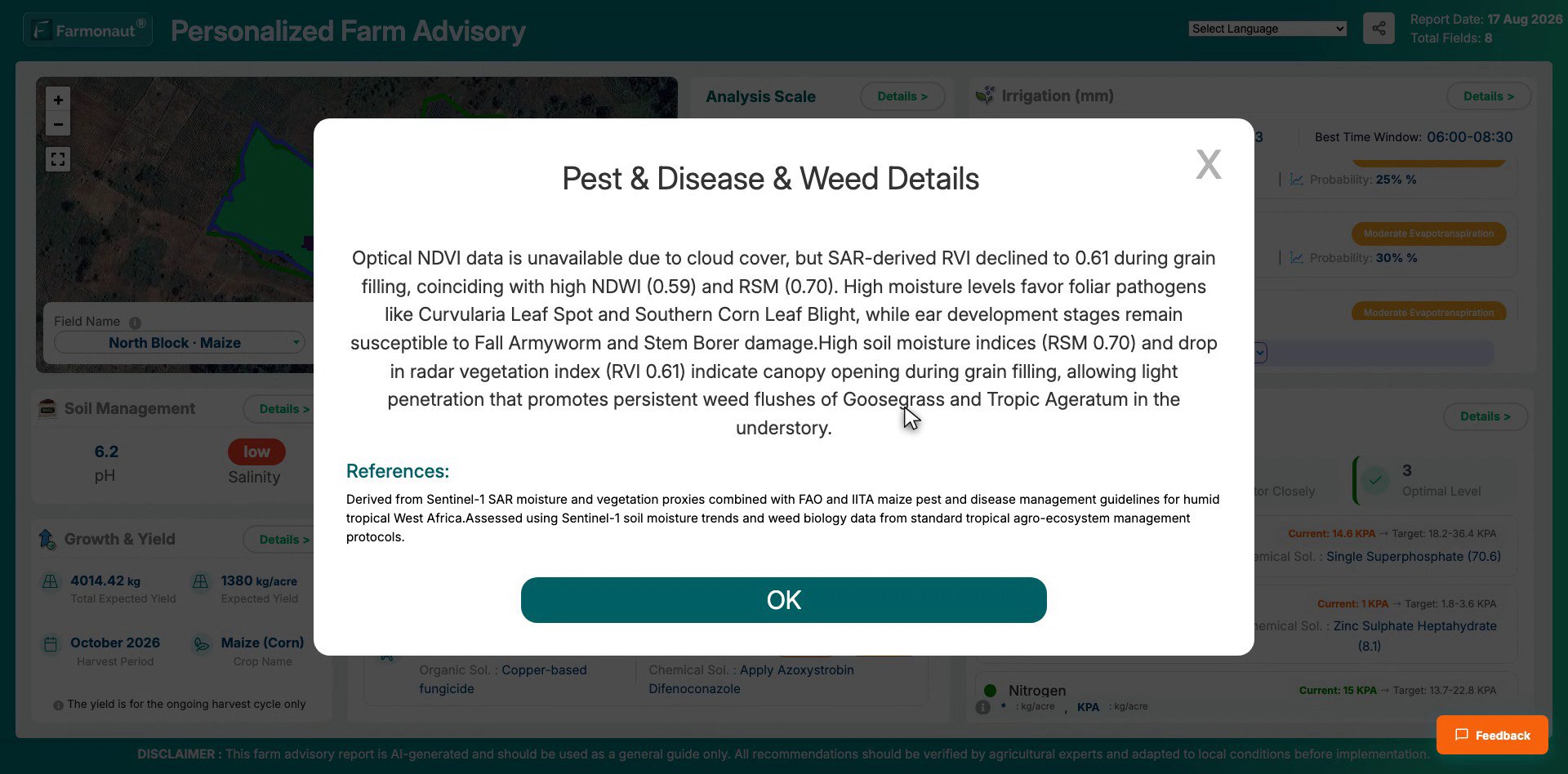
We calculate fertilizer recommendations separately for each field and each nutrient. Every line in the panel shows the current level, the target range for the crop, and an organic and a chemical product to make up the difference.

A week of irrigation scheduling on one Algerian farm
Below is the 7-day irrigation schedule a farm in El Bayadh, Algeria, got for its four center-pivot fields. The crops were at very different stages that week: the barley was still growing, the wheat was drying down, and the oats and alfalfa had both been cut. A single calendar for the whole farm would have watered all four the same way.
| Field | D1 | D2 | D3 | D4 | D5 | D6 | D7 | Week |
|---|---|---|---|---|---|---|---|---|
| Barley65 acres · stem elongation | 4.5 | 0 | 4.0 | 0 | 4.5 | 0 | 4.5 | 17.5 |
| Durum wheat65 acres · maturity | 2.5 | 0 | 2.0 | 0 | 1.5 | 0 | 0 | 6.0 |
| Oats40 acres · harvested | 0 | 0 | 0 | 0 | 0 | 0 | 0 | 0 |
| Alfalfa20 acres · regrowing after a cut | 3.5 | 0 | 3.5 | 0 | 4.0 | 0 | 4.0 | 15.0 |
| Irrigate, mm that dayDo not irrigate | ||||||||
Small farms and large estates use the same advisory
The advisory runs on our satellite crop monitoring platform, which farmers and agribusinesses use on six continents. The figures below are platform totals.
Results growers have reported
The percentages are the customers' own estimates, from the feedback form in the app. We then went back through the advisories they'd received to see where the savings came from.
 Blueberries · Florida, USA
"No water" days on a Citrus County blueberry farm
A Citrus County grower with 25 blocks on 124 acres. Out of 1,048 reports, a single week had "no water" on 78 of 175 block-days and "no fertilizer" on 8 blocks.
Read the story Wheat, barley, oats, alfalfa · Algeria
Each pivot watered for its own crop stage
190 acres under four pivots. The 40-acre oat field got no water all week, and each of the six high-risk pest warnings named a pest of that field's own crop.
Read the story 70%+Fertilizer and scab warnings across 10 crops
15 fields, 10 crops, 181 reports in 75 days. The apple field was flagged for apple scab (Venturia inaequalis) and the pear field for pear scab (Venturia pyrina).
Read the storyA crop advisory system for individual fields
Spray calendars and field-level advice side by side
Calendar-based advice
- The same irrigation days for every block
- A fertilizer program applied across the whole farm
- Pest sprays on a fixed schedule, whatever the risk
- Advice in one language, on paper or a call
Farmonaut AI farm advisory
- A separate 7-day water plan for each field
- A dose per nutrient, per field, including zero
- A named risk with a probability and the evidence
- The report in the grower's own language, as a PDF or a link
The advisory is AI-generated and meant as a guide. Confirm a pest or disease in the field before you spray, and adapt the advice to local conditions.
Growers, and the people who advise them
Growers check the advisory on their phone before they head out. It shows which fields need water today and which pest to look out for when they walk the rows. The same report is also used by the people around the grower:
Getting your first advisory
All the advisory needs is the field boundary. Once that's drawn, you open the advisory from the field map in the web app.
Add your field
Search an address, draw the boundary, or upload a KML, KMZ or shapefile.
Wait for the next pass
Satellites pass over every few days. We also use radar, which works through cloud and haze.
Open Farm Advisory
Pick a field and a language. Download the PDF or share a link.

How an AI farm advisory works out irrigation scheduling
Most irrigation advice, from extension services and from software, is built on one idea from the FAO's guide to crop evapotranspiration (Irrigation and Drainage Paper 56). Evapotranspiration is the water a field loses to evaporation from the soil and transpiration through the leaves. You start from a reference figure, ET₀, calculated from the weather: temperature, humidity, wind and sunshine. Hot, dry, windy days push it up.
Crop coefficients, simply
A crop coefficient (Kc) scales that reference to your crop at its current stage. A young maize crop with bare soil between the rows uses far less than the reference, with a Kc around 0.3. At silking, with the canopy closed, it's around 1.2. So on a day with an ET₀ of 6 mm, mature maize uses roughly 7 mm. Subtract the rain that will actually soak in, allow for what the soil is still holding, and you have the net amount to put back.
Our irrigation plan uses the crop's stage and water use, recent satellite readings of plant and soil moisture, and forecast rain with its probability. That's why the four pivots in the Algerian table above got such different numbers in the same week. The satellite part matters because it shows how the crop is actually doing, which can differ from what the calendar says it should be doing.
Where the fertilizer recommendations come from
A fertilizer recommendation is a balance: what the crop needs to reach a realistic yield, minus what the soil can already supply. The advisory reads each nutrient against a target range for that crop, then gives the shortfall as a dose in kilograms, with an organic and a chemical way to meet it. When a nutrient is already in range, the dose is zero.
Some nutrients are easier to see from orbit than others. Nitrogen shows up fairly directly in leaf chlorophyll, which red-edge indices such as NDRE pick up (our post on NDVI vs NDRE explains why). Phosphorus, potassium and micronutrients leave a much weaker signal in the imagery, so any satellite-based estimate of them is less direct. A lab soil test every season or two is still the best check on them, and it's worth comparing its results with the readings in the report.
How pest and disease risk is estimated
No satellite can see an aphid. What it can see is the crop's condition and stage, and combined with the weather that says a lot about which problems are likely. Fungal diseases need moisture on the leaf, so long humid spells and a wet canopy raise the risk of leaf spots, rusts and blights. Insects develop faster in warm weather and attack particular growth stages: fall armyworm in maize at the whorl and ear stages, for example.
The advisory puts these together into a named risk with a probability and shows the readings behind it. Treat a high-risk warning as a reason to scout that field this week. Before you spray, confirm the pest is there and check it against the action threshold your agronomist or extension service uses for that crop. That's standard integrated pest management, and the warning is meant to make the scouting trip more targeted.
How to judge an AI agronomist or crop advisory system
What to check
- Is the advice specific to the field, or does every field in the district get the same message?
- Are amounts given in units you can act on, such as millimeters and kilograms, with a date or window?
- Does it ever say "apply nothing" or "do not irrigate"? A system that always recommends something deserves a closer look.
- Can you see the readings and references behind a warning?
- Does it offer organic options, and does it reach your growers in their own language?
The fairest test is a season on one field with a strip managed your usual way next to it. Compare water used, inputs bought and yield at the end. Our article on AI crop advisory platforms and our comparison of AI farming assistants and apps go further.
What it can't know without you
An AI farm advisory sees the field from above and reads the forecast. From above it can't tell the variety you planted, when you last ran the pivot, what went on with the last spray, whether a tile drain is blocked or how much water your pump can actually deliver. It also can't know the label restrictions and pre-harvest intervals that apply to you, or what your buyer's contract allows. Keep your own records next to the report, and adjust the advice where you know something it can't.
Working with agronomists and consultants
The advisory works best as the first pass before an expert looks at the field. A typical routine for a consultant: on Monday, open each client's reports and sort the fields by risk and stress. Visit the ones that changed most, take the advisory's numbers as a starting point, and adjust them with what you know about the farm. Then send the grower the PDF, or a share link, in the language they read.
This changes where a consultant's time goes more than how much of it there is. The AGROEX consultancy in our case studies received 181 reports across 15 client fields in 75 days, a fresh report for each field about every six days. If you're curious how the role is shifting, we've written about agronomist careers and the AI agronomist. If you only need the crop health maps and indices, see satellite crop monitoring.
A season with the advisory, stage by stage
Here is how a grower would typically use the report across a maize season. The pattern is similar for most annual crops.
| Stage | What to look at | Typical decision |
|---|---|---|
| Emergence | Crop health map, gaps in the stand | Replant patches, check for waterlogging |
| Rapid growth | Fertilizer panel, NDRE, irrigation plan | Side-dress nitrogen where the dose isn't zero |
| Tasseling and silking | 7-day irrigation plan, forecast rain | Keep water up when crop water use peaks |
| Grain fill | Pest and disease warnings | Scout for armyworm and leaf disease after wet spells |
| Maturity | Yield estimate, harvest date | Taper irrigation, book harvest and storage |
Toward the end of the season the irrigation plan winds down, as it did for the durum wheat at maturity in the Algeria example, which got only small amounts on three days that week. The yield estimate and harvest date become the numbers you plan around.
Common questions about the AI farm advisory
What is an AI farm advisory?
An AI farm advisory uses data about a specific field to recommend what to do on it. Ours combines satellite readings of the field with the crop's growth stage, the soil and the weather forecast, and covers six things: crop health, a 7-day irrigation plan, soil readings, a yield estimate, pest and disease risk, and fertilizer doses.
What is JEEVN AI?
JEEVN AI is the engine behind Farmonaut's Personalized Farm Advisory. You use it inside the Farmonaut web app at sat.farmonaut.com. It's included with a Farmonaut farm plan and isn't sold as a separate product.
How does it decide how much to irrigate?
It uses the crop's stage and water use, recent satellite readings of plant and soil moisture, and the forecast rain with its probability. From those it works out millimeters per day for the next seven days and the best time window to irrigate. On days when the forecast rain is enough, or the crop no longer needs water, the recommendation is zero.
Does it recommend organic options?
Yes. Every pest, disease and weed warning comes with one organic and one chemical control option, and every fertilizer line lists an organic source and a chemical source with a dose for each.
Can I trust the pest and disease warnings?
Use them as a guide. Each warning lists the satellite readings and references behind it, which lets you judge how strong the case is. Satellites pick up the conditions and crop stress that favor a pest or disease, but confirming it on the ground is still up to you, and the report says so.
What is a crop coefficient in irrigation scheduling?
A crop coefficient (Kc) is the factor that converts reference evapotranspiration, worked out from the weather, into the water your crop actually uses at its current stage. It's low for a young crop with bare soil showing and peaks around flowering, when the canopy is full. Maize, for example, goes from about 0.3 after emergence to about 1.2 at silking.
Can an AI agronomist replace my agronomist?
No. It's best used as the first look at every field before your agronomist decides what to do. The advisory can't see your variety, your spray records or a blocked drain, and it can't confirm a pest on the ground. Agronomists use it to decide which fields to visit first.
Does the advisory work for orchards and perennial crops?
Yes. Apple, almonds, blueberries, grapes, cocoa and oil palm are among the 166 crops already monitored on the platform. One Florida blueberry grower gets a separate advisory for each of his 25 blocks.
Can a cooperative or input company use it for many farmers?
Yes. You can keep members' fields under one account and send each farmer the advisory for their own field, in their language, as a PDF or a link that opens without a login. Larger programs usually talk to our team about setup and pricing.
Which languages and formats are available?
The advisory report is available in 248 languages. You can read it in the web app, download it as a PDF, or share a link that opens without a login.
Which crops does it cover?
166 crops are already monitored on the platform, from apple, almonds and blueberries to rice, wheat, maize, cotton, sugarcane, cocoa and oil palm. If your crop is missing, tell us.
How much does the AI farm advisory cost?
The advisory comes with Farmonaut's farm plans, which are priced by the area you monitor. See the current plans on the pricing page. Cooperatives, input companies and large estates can contact us for a quote.
What would the advisory say about your field?
Draw the field boundary in the web app and choose the language you want. The advisory is ready after the next satellite pass.
More Farmonaut solutions

 MapMyCrop
 Cresol
 Atur Kuliner
 MDCV UK
 Zerella Group
 Etech Consulting Madagascar
 Vestlandsforsking
 Delicio
 WB Dev
 Sama Premium
 Tres Valles
 LACOS Geoinformation
 Magrifly
 LatConnect 60
 Blickwinkel
 Agricultural Credit Policy Council
 Marei Nursery
 eKGIS
eKGIS Mostas Tech
