

Silver mine profile · Idaho
Hecla Lucky Friday Mine: Output, Costs, 7 Key Changes
Lucky Friday is Hecla’s deep underground silver, lead and zinc mine near Mullan, Idaho. It produced a record 5.26 million oz of silver in 2025, with 5.0 to 5.2 million oz guided for 2026 (Hecla, November 2026).
Key takeaways
- Record 5,260,686 oz of silver in 2025, with 34,284 tons of lead and 14,924 tons of zinc (Hecla 10-K).
- 2026 guidance: 5.0 to 5.2 million oz, AISC of $24.50 to $25.50 per oz (Hecla, 3 November 2026).
- Reserves of 71.6 million oz in 6.38 million tons at 11.22 oz/ton (Hecla, 31 December 2025), about 15 years at the 2025 mill rate.
- Underhand Closed Bench mining supplied 88% of tons mined in 2025 (Hecla 10-K).
- The mine lists no gold output, despite the Gold Hunter name.
In this article
- Hecla Lucky Friday mine at a glance
- How much silver the mine produces
- Lucky Friday costs: cash cost and AISC
- Geology: the Lucky Friday Vein and Gold Hunter
- Lucky Friday reserves and mine life
- What is Underhand Closed Bench mining
- 7 changes that shaped the Lucky Friday mine
- History of the Lucky Friday mine
- Environment, water and closure at the site
- Jobs and the local economy in Shoshone County
- What consultants and investors should watch
- Frequently asked questions
The Lucky Friday mine is a deep underground silver, lead and zinc mine one mile east of Mullan, Idaho, wholly owned by Hecla Mining Company (NYSE: HL). It produced a record 5,260,686 ounces of silver in 2025, and Hecla now expects 5.0 to 5.2 million ounces in 2026 (Hecla, 3 November 2026).
This page sets out the numbers a mining consultant or investor usually wants first: output by year and by quarter, costs on a like-for-like basis, reserves, the mining method, and the seven engineering and site changes that explain why output has risen. A small calculator lets you test a narrow-vein operation with your own inputs.
Hecla Lucky Friday mine at a glance
| Item | Figure | Source and date |
|---|---|---|
| Owner and operator | Hecla Mining Company; operated since 1958, 100% owned since 1964 | Hecla 10-K, February 2026 |
| Location | Coeur d’Alene Mining District (the Silver Valley), Shoshone County, Idaho | Hecla, 2026 |
| Mine type | Underground, narrow vein, shaft access | Hecla, 2026 |
| Metals | Silver, lead, zinc (no gold reported) | Hecla, 2025 production |
| Silver output | 5.26 million oz in 2025; 4.89 million oz in 2024 | Hecla 10-K |
| Lead and zinc output | 34,284 tons lead and 14,924 tons zinc in 2025 | Hecla 10-K |
| Ore milled | 427,048 tons in 2025, about 1,170 tons per day | Hecla, 2025 results |
| Silver reserves | 71.6 million oz in 6.38 million tons at 11.22 oz/ton | Hecla, 31 December 2025 |
| Employees | 444, of whom 325 are union-represented hourly staff | Hecla 10-K, 31 December 2025 |
Tons here are short tons (2,000 lb), the unit Hecla reports in. One short ton is 0.907 metric tonnes, and 1 oz/ton of silver is about 34.3 grams per tonne.
Hecla’s 2025 annual report says it has owned and operated the mine since 1958 and wholly owned it since 1964. Hecla’s production tables for the site list silver, lead and zinc only; the “Gold Hunter” name refers to an old property, not to gold output.
How much silver the mine produces
Annual silver output has more than doubled since 2020, but the path has not been smooth. Two events explain the low years: a strike that ended in January 2020, with full production returning late that year, and an underground fire in August 2023 that stopped production until January 2024.
Chart
Silver output by quarter
thousand ounces
Chart
Lucky Friday silver output by year
million ounces
The Idaho Geological Survey records 2,031,874 oz in 2020 and 3,564,128 oz in 2021. Hecla’s 10-K filings give 4,412,764 oz for 2022 and 3,086,119 oz for 2023. In 2025, higher mill throughput (up 5%) and a higher milled grade (up 2%) lifted output 8% over 2024, setting annual records for both silver and throughput.
The quarterly figures show how sensitive a narrow-vein mine is to the ore being mined at the time. The record second quarter of 2026 (1,532,569 oz) came with a milled grade of 15.6 oz/ton. Hecla said at the time that the 31% higher grade was in line with plan but would not be sustained. In the third quarter, tons milled barely changed (100,545 against 101,978), yet grade returned to 13.2 oz/ton and output fell 17% to 1,272,585 oz.
Where it sits among silver mines
Lucky Friday is one of three silver mines Hecla runs. In 2025 Greens Creek in Alaska produced 8.72 million oz and Keno Hill in Yukon 3.02 million oz, so Lucky Friday supplied about 31% of those three mines’ silver. The USGS estimates total US mine output of about 1,100 metric tons of silver in 2025. Lucky Friday’s output equals about 164 metric tons, or roughly 15% of that estimate (our calculation).
Global rank depends on the measure. Hecla calls it one of the top seven primary silver mines on a silver-equivalent basis, a claim that adds other metals to silver at chosen prices. On silver ounces alone, a 2024 ranking by Mining Visuals placed it 14th at 4.9 million oz. Our list of the largest silver mines compares the wider field.
Lucky Friday costs: cash cost and AISC
Two measures matter. Cash cost per ounce is the site cost of producing silver after subtracting income from by-products, here lead and zinc. All-in sustaining cost (AISC) adds sustaining capital and reclamation, so it is closer to what it costs to keep the mine running over time. Both are non-GAAP measures, defined by Hecla in its results.
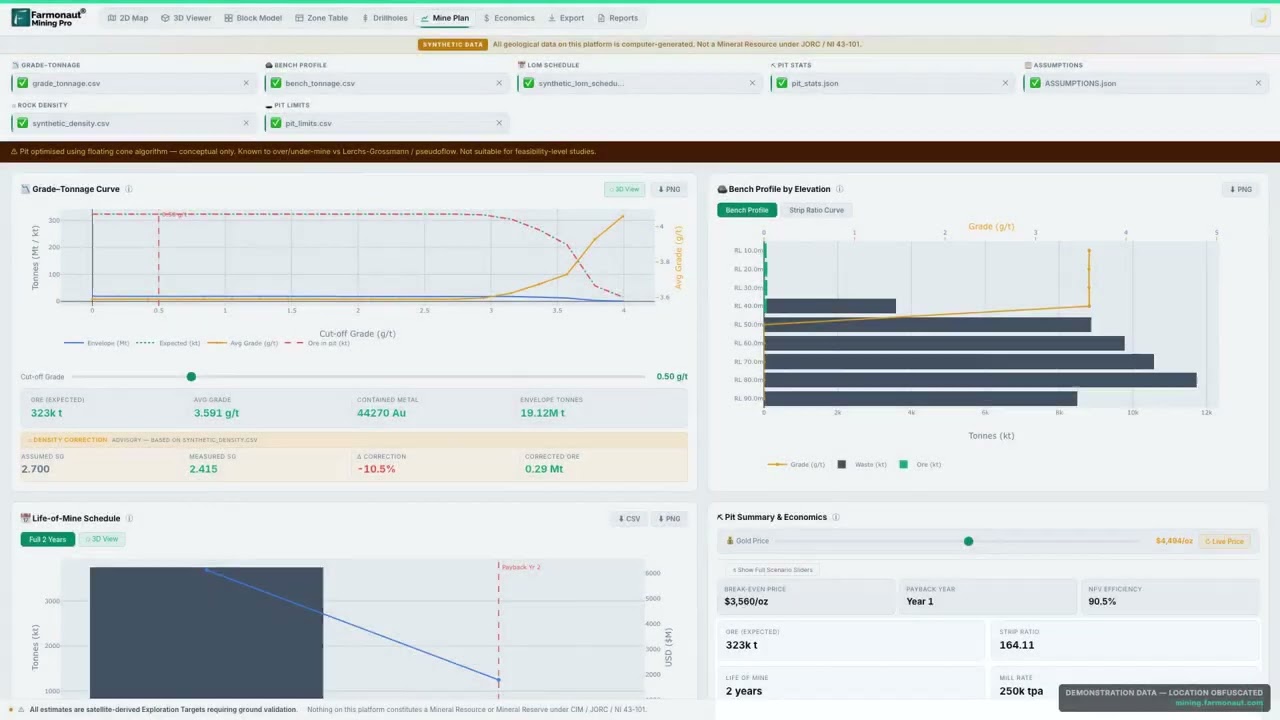
▶ How to build a cost picture on an all-in sustaining cost per ounce basis. · 14:58
Chart
Cash cost and AISC by quarter
US$ per silver ounce, after by-product credits
The gap between them is wide at this mine because deep, narrow-vein mining needs constant development spending. For the first nine months of 2026, Hecla reports a cash cost of $7.50 and AISC of $22.47 per ounce. In the third quarter the AISC rose to $27.68 from $17.08 in the second, as fewer ounces and more sustaining capital fell on the same cost base.
For the full year, Hecla’s November guidance for the mine is cash cost of $8.50 to $9.00 and AISC of $24.50 to $25.50 per ounce, with costs applicable to sales of $140 million and capital investment of $79 million to $84 million, all classed as sustaining.
For scale, the average silver price Hecla realized across its sales in the third quarter of 2026 was $63.62 per ounce, against $42.58 a year earlier. Site cash flow from operations was $88.3 million in that quarter. Adding back $2.1 million of exploration and deducting $23.7 million of capital investment leaves $66.8 million, as reported by Hecla. Costs also respond to price: the company’s January guidance attributed part of an expected rise to higher profit-sharing payments linked to the silver price.
If you compare this mine with others, check the basis. Our guide to mining profitability explains how margins are built. Keep three points in mind: by-product credits move with lead and zinc prices, AISC varies with how much capital falls in that period, and a single quarter can mislead.
Calculator
What would a narrow-vein silver mine earn at your numbers?
Enter your own mill rate, grade, recovery, price and cost.
- Silver revenue, US$ per year: $307,944,000
- Margin after AISC, US$ per year: $179,634,000
- Margin per ounce, US$: 35.00
Example values only, not a benchmark or a forecast for this mine. The silver price is an input (example, use today’s price). The margin is before tax and growth capital, and ignores smelter terms unless they are built into your AISC.
Geology: the Lucky Friday Vein and Gold Hunter
The Coeur d’Alene district is a belt of steep silver-lead-zinc veins in Precambrian sedimentary rock. Until 1997 the main ore body here was the Lucky Friday Vein, which sits in Revett Formation quartzite, strikes northeast, stands nearly vertical and averages six to seven feet wide. Its main ore minerals are galena (lead sulfide) and tetrahedrite (a copper-antimony sulfide that often carries silver), with minor sphalerite and chalcopyrite.
In 1991 Hecla found high-grade silver veins on the Gold Hunter property, about 5,000 feet northwest of the old workings. Full production from this area began in 1998. These veins run west-northwest and dip about 85 degrees south. They are hosted in a 200-foot-thick siliceous lens in the Wallace Formation, which gives way to the St Regis Formation below the 5900 level. Gold Hunter, also called the Lucky Friday Expansion Area, is where the #4 Shaft gives access to what Hecla calls the highest-grade ore in the mine’s history.
Lucky Friday reserves and mine life
Hecla’s reserve table at 31 December 2025 lists proven and probable reserves of 6.38 million tons at 11.22 oz/ton silver, 7.1% lead and 3.8% zinc, holding 71.6 million oz of silver. Those reserves assume $25 silver, $0.90 lead and $1.15 zinc per pound, with a cut-off of $280 per ton of net smelter return (the value of the ore after smelting and transport charges). Actual 2025 recoveries were 94.5% for silver, 94.3% for lead and 85.1% for zinc.
Chart
Silver in reserves and resources
million ounces, 31 December 2025
| Category | Tons (000) | Silver (oz/ton) | Lead (%) | Zinc (%) | Silver (000 oz) |
|---|---|---|---|---|---|
| Proven reserves | 4,747 | 11.82 | 7.5 | 3.8 | 56,096 |
| Probable reserves | 1,636 | 9.47 | 6.0 | 3.7 | 15,493 |
| Measured resources | 1,806 | 11.81 | 7.4 | 2.1 | 21,328 |
| Indicated resources | 1,619 | 11.87 | 6.2 | 1.5 | 19,213 |
| Inferred resources | 2,238 | 11.63 | 8.6 | 2.9 | 26,033 |
Hecla states mine life in two ways. Its November 2026 release refers to a reserve mine life of fifteen years. Its 10-K says the current plan uses reserves and resources for about 17 years of production, through 2044. The first counts reserves only; the second includes resources, which carry more uncertainty and are not yet shown to be economic. Hecla’s site page also uses an older 20 to 30 year range, tied to the #4 Shaft project.
A simple check: 6.38 million tons at the 2025 mill rate of 427,048 tons a year is about 15 years, which matches the reserve figure.
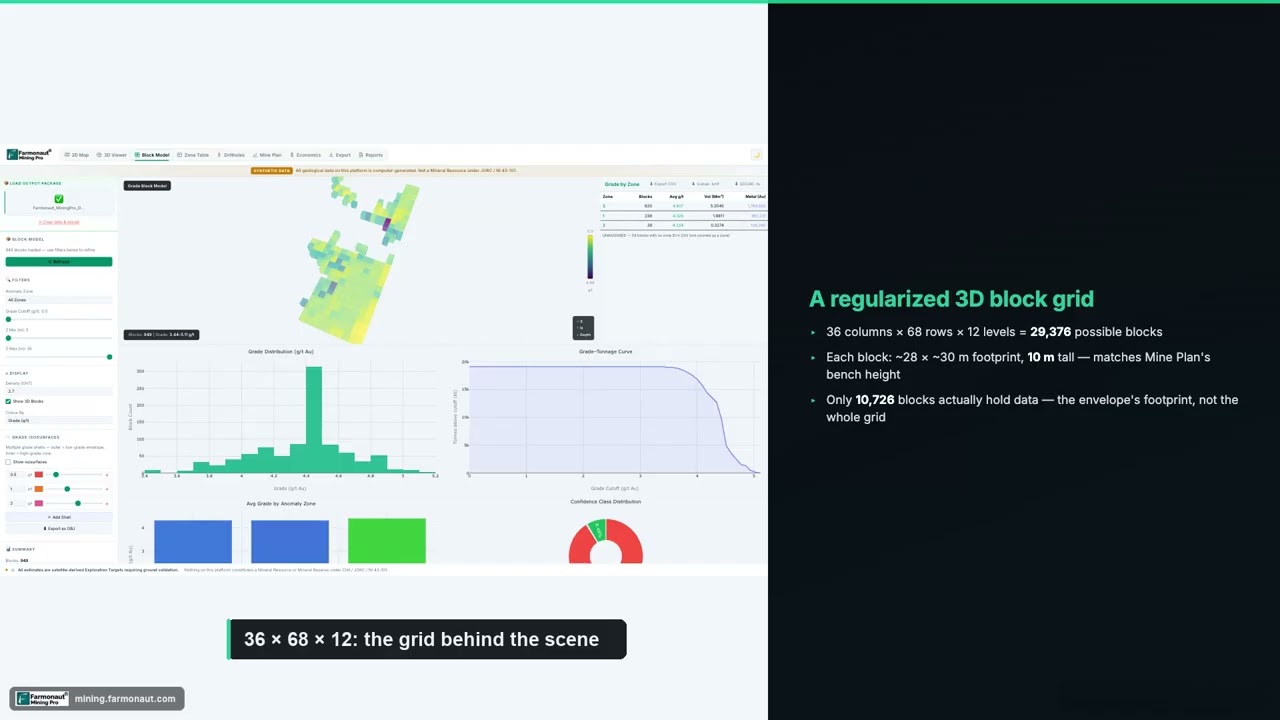
▶ A plain-English walkthrough of the block model behind a reserve estimate and mine plan. · 5:23
What is Underhand Closed Bench mining
Underhand Closed Bench (UCB) is the patented method Hecla developed at this mine to manage fault-slip seismicity, the sudden movement along faults that deep, high-stress mining can trigger. It has been tested and used here since 2020.
A top cut is driven along the vein beneath engineered backfill. Crews then fragment the vein below it with one large blast: up to 45,000 lb of pumped emulsion and programmable electronic detonators, breaking up to 500 feet of strike length to a depth of about 24 feet. The blast is meant to induce fault-slip movement at the time of the blast and shortly after, rather than during later work. The broken corridor is then mined underhand in two cuts with little or no further blasting, the walls are supported, and the cycle repeats further down under fill.
According to Hecla’s 10-K, UCB supplied 88% of tons mined in 2025, 86% in 2024 and 87% in 2023, and the method has not been used at other mines. The filing also carries a clear caution: seismicity increases as mining goes deeper, and Hecla says it cannot predict unknown hazards from the method or from deeper work. Our mining safety guide covers these hazards more widely.
7 changes that shaped the Lucky Friday mine
Earlier versions of this page listed “breakthroughs” with figures we could not trace. These seven changes are documented in Hecla filings and results, listed roughly in date order.
- #4 Shaft. This internal shaft, now complete and operational, reaches 9,600 feet below surface and gives access to the highest-grade ore in the mine’s history, in the Gold Hunter area. The main Silver Shaft, begun in 1980 at a cost of $40 million according to Idaho State University, is the access from surface.
- UCB mining. In use since 2020 and now the source of most tons, as described above.
- A new labor agreement. After the strike of March 2017 to January 2020, the union ratified a six-year agreement in January 2023 that runs to May 2029.
- A new secondary escape route. After the 2023 fire in the #2 ventilation shaft, Hecla extended a ramp by 1,600 feet and added a 290-foot manway raise and an 850-foot ventilation raise.
- Dropping the remote vein miner. Hecla tested a remote vein miner, then wrote it down by $13.9 million in 2024 because UCB’s success left no use for it. Not every technology bet pays off, and this one was closed out on the accounts.
- Surface cooling plant. Heat rises with depth. Construction of this plant has finished and it entered commissioning after the third quarter of 2026. It is designed to raise cooling capacity over the mine’s reserve life.
- New tailings facility. Work began in 2025. Tailings are the ground rock left after metals are recovered; some coarse tailings already return underground as cemented backfill.
Satellite data sits at the other end of the mining cycle from this kind of deep engineering. Farmonaut’s satellite screening is used on early-stage ground to rank exploration targets before drilling; it does not measure a deep vein system or replace a resource estimate. For wider reading on technology suppliers, see our list of digital transformation providers in mining.
History of the Lucky Friday mine
The early years were not promising. Idaho State University’s account says the Friday claim sold at a sheriff’s sale for $2,000 in 1912 and for $120 in back taxes in 1936. John Sekulic, a Mullan garage mechanic, bought it for $15,000 in 1938 and formed the Lucky Friday Mining Company. The first ore shipped in 1942, and the ore improved as the shaft went deeper.
| Year | Event |
|---|---|
| 1942 | First ore shipped |
| 1964 | Hecla and Lucky Friday merge, giving Hecla full ownership |
| 1980 | Sinking of the Silver Shaft begins |
| 1991 | High-grade Gold Hunter veins found |
| 1998 | Full production from Gold Hunter |
| 2002 | More than 125 million oz of silver produced to this date |
| 2017 | Strike begins in March |
| 2020 | Strike ends in January; UCB testing starts |
| 2023 | Fire in August suspends production for the rest of the year |
| 2024 | Production restarts in January |
| 2025 | Record 5.26 million oz of silver |
Environment, water and closure at the site
The site discharges treated water into the South Fork of the Coeur d’Alene River, and reducing that volume is its main stated water goal. Hecla reports that a new chiller installed underground in 2024 allows more water to be reused, moving the mine closer to a closed-loop system. It does not yet describe the site as closed-loop.
On energy, Hecla says the local provider uses hydropower and natural gas, with 60% of the electricity sourced being renewable. It also links UCB’s process efficiency with its work to cut diesel use.
For closure, the 10-K records a $14.9 million asset retirement obligation at 31 December 2025, the accounting provision for reclamation and closure. The filing also notes that the facilities date from the 1950s to 2025, which is worth remembering when judging sustaining capital at a mine of this age.

▶ The main environmental impacts of mining, explained in clay animation. · 2:31
Jobs and the local economy in Shoshone County
Hecla describes itself as among the largest private employers in Shoshone County. It reports a $190 million impact on neighboring communities including Mullan, Wallace and Kellogg in 2025: $68 million in wages, $120 million in vendor purchases and $1.2 million in taxes and fees. It also reports $20,000 in donations to local clubs and charitable groups that year. These are company figures, not independent estimates. An earlier version of this page stated a much larger annual community investment that we could not trace, so it has been removed.
What consultants and investors should watch
- Grade against plan. The second-quarter peak was planned and temporary, so judge a year rather than a quarter. Guidance implies fourth-quarter output of about 0.96 to 1.16 million oz (our calculation from the 4,042,442 oz produced in nine months).
- Heat and depth. Check how the cooling plant performs after commissioning, and whether seismicity stays manageable as mining goes deeper.
- Tailings capacity. Work on the new facility is a large part of capital spending.
- Labor. The current agreement expires in May 2029, and past disputes have stopped production for years.
- Exploration. Hecla also controls about 26 square miles of mineral interests next to the mine. For other names in this space, see our list of silver exploration companies.
Other Farmonaut products, outside the scope of this page, include fleet management, carbon footprinting, product traceability, a satellite and weather API and an admin app.
Frequently asked questions
Where is the Lucky Friday mine?
It is about one mile east of Mullan in Shoshone County, northern Idaho, and 55 miles east of Coeur d’Alene along Interstate 90. Hecla says the Silver Shaft head frame can be seen near exit 69.
Who owns the Lucky Friday mine?
Hecla Mining Company owns 100% of it. It has owned and operated the mine since 1958 and wholly owned it since 1964.
What metals does the Hecla Lucky Friday mine produce?
Silver, lead and zinc. In 2025 that meant 5.26 million oz of silver, 34,284 tons of lead and 14,924 tons of zinc, shipped as silver-lead and zinc concentrates.
Does Lucky Friday produce gold?
Hecla’s production tables and reserve table for the mine list no gold. The name Gold Hunter comes from an older mining property in the same area.
How deep is the Lucky Friday mine?
The #4 Shaft, an internal shaft, reaches 9,600 feet below surface, according to Hecla. Depth drives both the seismic and the heat challenges.
How much silver has Lucky Friday produced?
Idaho State University reports more than 125 million oz through 2002. Recent output adds roughly 5 million oz a year.
How long will the mine last?
Hecla cites a reserve mine life of fifteen years, and its 10-K describes a plan based on reserves and resources for about 17 years of production, through 2044.
What happened in the Lucky Friday fire?
In August 2023 a fire started during repairs to an unused station in the #2 ventilation shaft, which was also the required secondary exit. Normal ventilation was restored by early September, but a new escape route had to be built, and production restarted in January 2024.
Is the Lucky Friday mine unionized?
Yes. The United Steelworkers represents 325 hourly employees, out of 444 at the site at the end of 2025. Hecla says it is the only one of its operations where employees are under a collective agreement.
How long did the Lucky Friday strike last?
It ran from March 2017 until January 2020. Local 5114 narrowly approved a settlement that returned 164 miners to work, according to the Idaho Geological Survey.
Is Lucky Friday the largest silver mine in the US?
No. Hecla’s Greens Creek in Alaska produced more silver in 2025, at 8.72 million oz against 5.26 million oz.
More from Farmonaut: hecla lucky friday mine 7 breakthroughs for 2026.
This page is for information only. It is not investment advice. Company figures are as reported by Hecla and may change.
Farmonaut mining
Map your mining site from space
Screen a client's license or claim area with satellite data to rank exploration targets before drilling.

Mining Pro sample view, synthetic data
Keep reading

Sources
- Hecla, Third Quarter 2026 Results (3 November 2026): investingnews.com
- Hecla, Second Quarter 2026 Results: finance.yahoo.com
- Hecla, Q4 and Full Year 2025 Results: s29.q4cdn.com
- Hecla, Full Year Production and 2026 Guidance (January 2026): nasdaq.com
- Hecla, Form 10-K for 2025 (SEC): sec.gov
- Hecla, Form 10-K for 2023 (SEC): sec.gov
- Hecla, Mineral Reserves and Resources table (31 December 2025): hecla.com
- Hecla, Lucky Friday site page: hecla.com
- Idaho State University, Northern Idaho and Mining: isu.edu
- Idaho Geological Survey, Staff Report S-23-02: idahogeology.org
- USGS, Mineral Commodity Summaries 2026: Silver: pubs.usgs.gov
- Mining Visuals, Top 20 Primary Silver Mines 2024: miningvisuals.com
Discussion
Questions, corrections or field experience? Share them below. First-time comments are reviewed before they appear, and your email is never published.
No comments yet. Be the first to add a question or your experience.

 Double A Trading
 GemSprout Metals Limited
 Qader Group
 Ileys General Trading
 SG Gold Mining LLC
 VRV Global Pte Ltd
 Omsri International FZE
 G.I.T.T.
 Jaunita Erss Ltd
 Almosi SARL
 SRK Consulting
 Berks Gold Limited
 Mwerezi Minerals Company Limited
 Mining SARL
 SenGold Invest SAS
 Sean Mining Limited
 NTS Group (Pty) Ltd
 Mine4Africa

 Client · Oregon, USA · Gold










