

Mine development · Method guide
Box Cut Mining: Method, Design Steps and Volume Calculator
A box cut is the first trench that opens a mine: the initial cut of a strip mine, or the open cut where an underground decline starts. Design steps, blasting, real projects and a calculator.
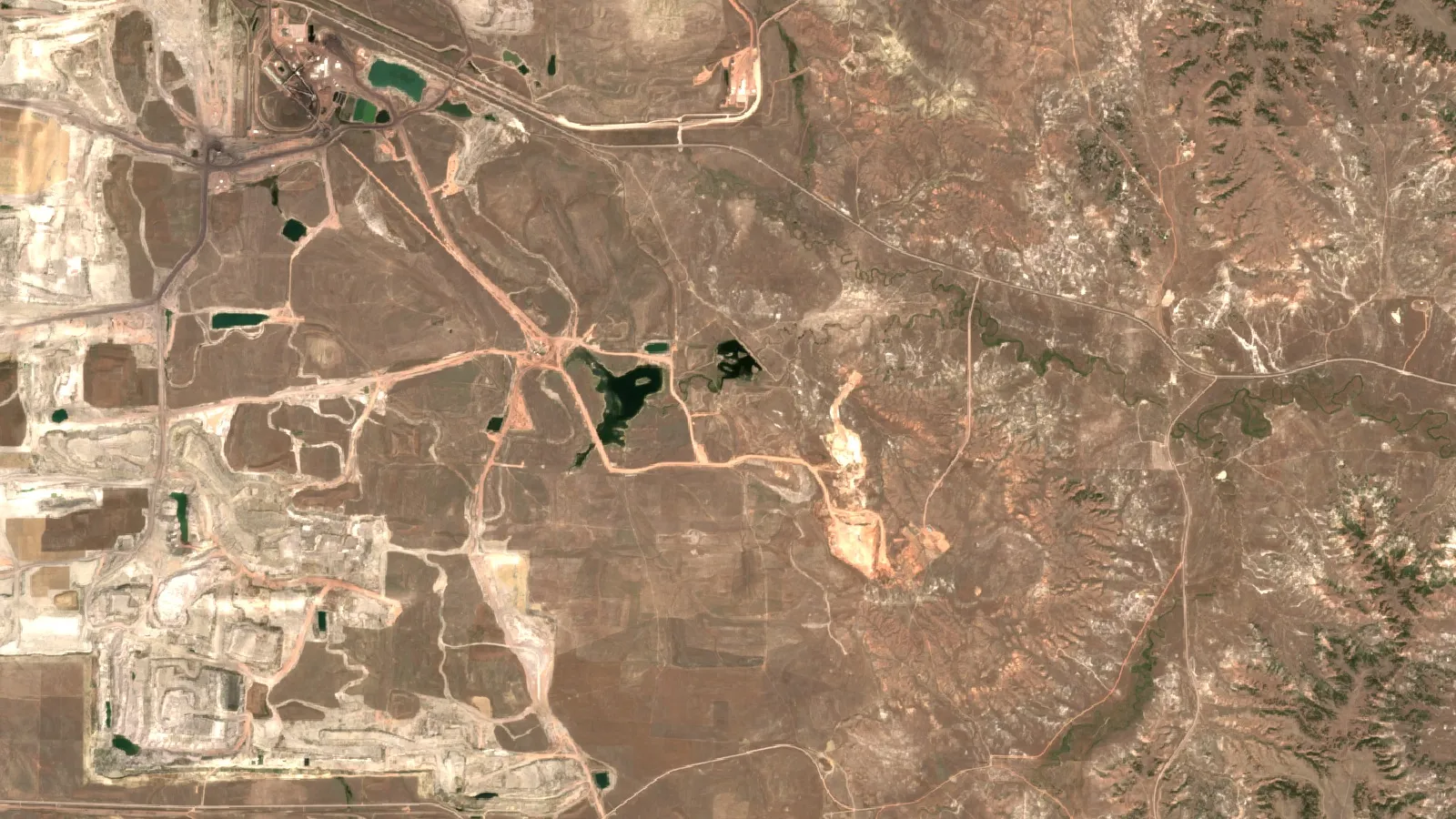
Key takeaways
- OSMRE lists box cut mining with strip, contour, area and open pit mining as a surface coal method.
- In strip mining the first cut’s spoil goes on unmined ground; later strips backfill the previous trench (IntechOpen).
- Surface mines produced about 306 of 512.5 million short tons of US coal in 2024 (EIA).
- A box-shaped blast with one open face needs more explosive than a corner cut; typical surface powder factors are 0.2-0.45 kg/m3 (US Bureau of Reclamation).
- Ivanhoe Mines completed the Kahala and Kansoko Sud box cuts at Kamoa-Kakula in Q2 2026.
In this article
- What is box cut mining?
- How the box cut mining method works in strip mining
- Box cut excavation for a decline portal, step by step
- Box cut design: depth, walls, water and ground support
- Blasting a box cut: why it needs more explosive
- Real box cut projects and what they show
- Box cut volume and cost calculator
- Safety rules and common failure points
- Environmental footprint and closure
- What to check before you approve a box cut design
- Frequently asked questions
Box cut mining is the first excavation that opens a mine: a long, steep-sided trench cut from the surface to reach a coal seam or the portal of an underground decline. In US coal regulation it is listed by the Office of Surface Mining Reclamation and Enforcement next to strip, contour, area and open pit mining as a recognised surface method. In hard-rock mines the same word names the open trench where a decline tunnel starts. This guide explains both meanings, the design steps, real projects, the blasting and slope rules that apply, and a calculator for the volume and cost of your own cut.
What is box cut mining?
A box cut is a rectangular excavation with near-vertical or battered (sloped) side walls and a ramped or flat floor. It is dug through the overburden, which is the soil and rock that sit on top of the material you want to mine. Once the cut is open, it gives a working face, a place for water to collect and be pumped out, and a safe entry for people and machines.
The term is used in two closely related ways:
- Strip mining box cut. The first cut of a strip mine. Machines strip the overburden in a long rectangle to expose the seam. Later cuts run parallel to it.
- Decline or portal box cut. A trench excavated down to solid rock so that a decline (a sloping tunnel, also called a ramp) can start from a stable face. Many underground mines, such as Khoemacau in Botswana and Havieron in Western Australia, start this way.
A third, older use comes from blasting manuals, where a “box cut” is a blast pattern with only one open face, such as the end of a trench. That use matters for cost because, as shown further down, a box-shaped blast needs more explosive than a corner blast.
How the box cut mining method works in strip mining
Strip mining suits shallow, flat-lying seams. An IntechOpen chapter on open pit mining describes the sequence: clear vegetation and topsoil, open an initial rectangular box cut, remove the overburden (often with a dragline), and then place the overburden from each new strip into the trench left by the one before. Strips can run for more than a mile.
Chart
US coal production by mining method
Million short tons
The first cut is the odd one out. Because there is no empty trench yet, its spoil has to be stored on unmined ground beside the pit. That is why the first strip usually moves the most material per tonne of coal and why planners try to keep it as short and shallow as the seam allows. After it, each later strip is backfilled with the overburden from the next, so reclamation can follow close behind the working face.
The steps of a typical strip-mine opening are:
- Strip and stockpile topsoil so it can be put back during reclamation.
- Drill and blast the overburden if it is too hard to dig directly.
- Excavate the initial cut and place the spoil on undisturbed ground outside the pit.
- Clean and mine the exposed seam.
- Open the next parallel strip and cast its overburden into the mined-out first trench.
- Grade, re-cover with topsoil and revegetate the backfilled strips.
Surface methods still produce most US coal. In 2024, surface mines produced about 306 million short tons of the 512.5 million short tons mined in the country, roughly 60%, according to the EIA Annual Coal Report. Wyoming’s 15 surface mines alone produced about 191 million short tons that year. In Australia, Whitehaven Coal reported that early mining at its Vickery Extension Project in New South Wales continued after the box cut began in its 2024 financial year (quarterly report, July 2026), and Stanmore Resources reported that about 90% of the E Ramp box cut at its South Walker Creek mine was complete, giving access to low strip-ratio coal (results for 2025).

▶ Strip mining explained in clay: how overburden is removed and the land put back. · 4:37
Box cut excavation for a decline portal, step by step
In metal mines, the box cut is where the underground mine meets the surface. Loose soil and weathered rock near the surface cannot hold a tunnel open, so the mine digs down until it reaches rock that is competent (strong enough to stand with normal ground support) and starts the decline from that face. If the cover is poor, a steel or concrete tunnel is built in the cut and buried again. Greatland reported that its main boxcut tunnel at Havieron in Western Australia was installed and backfilled in the June 2026 quarter, which it said protects the decline against rainfall events.
Infographic
Portal box cut in 5 steps
- 1InvestigateDrill and pit the weathering profile and water table.
- 2DesignSet floor level, wall slopes, ramp, sump and portal.
- 3ExcavateStrip topsoil, dig soft cover, blast rock in benches.
- 4Support and drainBolt, mesh and shotcrete walls; pump the sump.
- 5Form the portalBuild the canopy and fire the first decline rounds.
A typical sequence looks like this:
- Site investigation. Shallow drilling, test pits and mapping define the weathering profile, groundwater level and rock quality. Ivanhoe Mines, for example, used a dedicated rig to drill the stratigraphy and weathering profile of the area outlined for a potential box cut at Kakula in the DRC.
- Design. Engineers fix the floor level, wall slopes, berms (horizontal steps in the wall), the ramp for trucks, the drainage sump and the portal position.
- Clearing and topsoil removal. Topsoil is stockpiled for closure.
- Bulk excavation. Digging without blasting in soft material, drill-and-blast in rock, working down in benches.
- Ground support and water control. Shotcrete (sprayed concrete), mesh and rock bolts on the walls, a sump and pumps on the floor, bunds and diversion drains above the crest.
- Portal and first rounds. A reinforced portal is formed and the decline is advanced in short blast rounds.
Timelines vary from months to years. Mineral Resources fired the first blast for the decline box cut at its Mt Marion lithium mine in April 2024 and set a target depth of 350 m within the following 18 months, as reported by Global Mining Review. In Arizona, Ivanhoe Electric said all city, county and state permits needed to complete the box cut at its Santa Cruz copper project had been obtained, with box cut development expected to start in October 2026 and tunnel-boring-machine decline development targeted for summer 2027.
Box cut design: depth, walls, water and ground support
Good design is mostly about four things.
Depth and position
The floor must reach rock that can carry the portal. In deep, sandy cover that can mean a long, deep cut. At Khoemacau in Botswana, the operators developed several boxcuts through the Kalahari sand to establish portal faces for the Zone 5 underground mine, which is reached through three boxcuts serving twin decline systems, according to Mining Technology. The declines there are 6 m by 6 m, run at a gradient of 1 in 7 and have a minimum turning radius of 25 m.
Wall slopes and berms
Wall angles depend on the soil and rock strength, joints, groundwater and how long the cut must stay open. Soft overburden needs flatter batters and berms; fresh rock can stand much steeper. In the US, 30 CFR 56.3130 requires surface metal and non-metal mines to use methods that keep walls, banks and slopes stable where people work or travel, and to size benches to the equipment used to clean them.
Water
A box cut is a hole in the ground, so it fills with rain and groundwater unless the design stops it. Typical controls are a diversion drain around the crest, a sump at the lowest point, pumps sized for a design storm, and a raised bund at the portal. Core Lithium reported that before restarting work at its BP33 deposit in the Northern Territory it dewatered the box cut, built a temporary sump, cut back the walls and installed ground support at the portal location (June 2026 quarter).
Ground support
Common support in the cut and portal includes rock bolts, mesh, shotcrete, steel sets and a canopy over the portal entrance. Where cover is poor, a buried steel culvert or concrete tunnel carries the decline through the weak zone before the cut is backfilled.
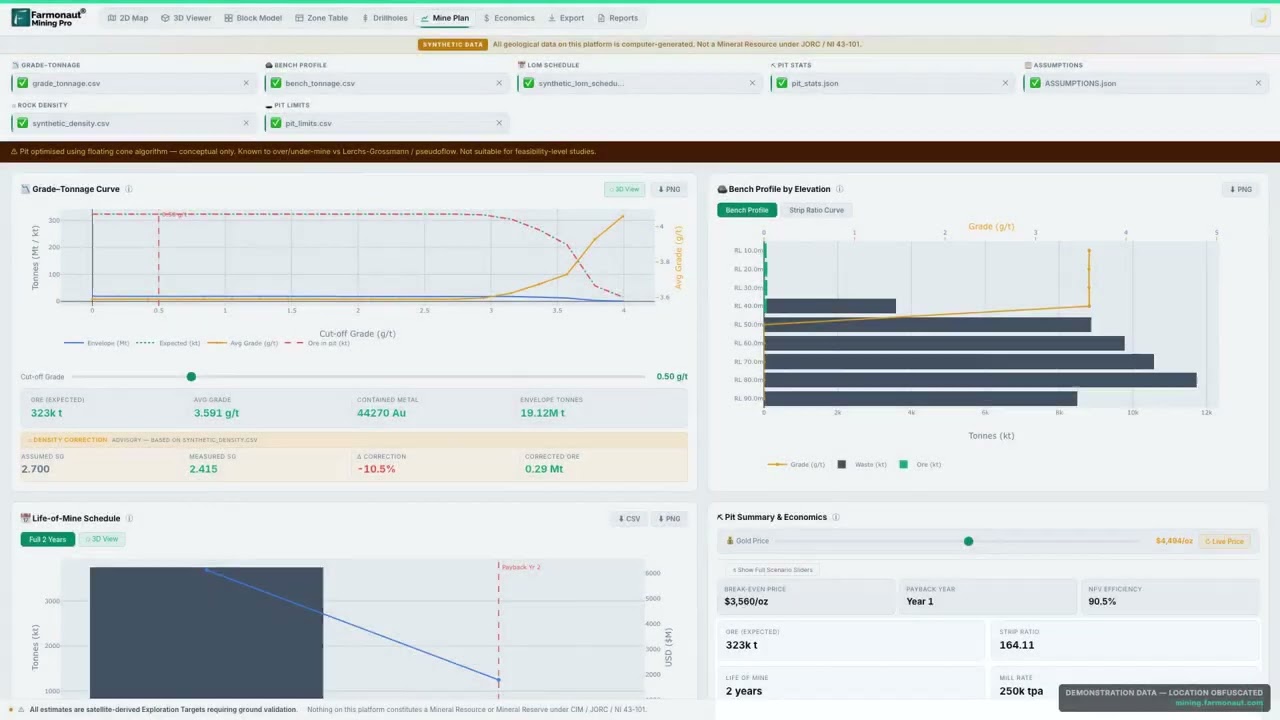
▶ Mine plan costs and pit engineering parameters such as wall angle and bench height. · 14:58
Blasting a box cut: why it needs more explosive
When the cut goes into rock, it is drilled and blasted. Powder factor is the amount of explosive used per volume of rock broken. The US Bureau of Reclamation’s Engineering Geology Field Manual explains that the more open faces a blast can break towards, the less explosive it needs: a corner cut with two vertical open faces needs less than a box cut with only one. The same manual gives typical surface powder factors from 0.1 to 1.14 kg per cubic metre (0.25 to 2.5 lb per cubic yard), depending on how hard the rock is to break, with 0.2 to 0.45 kg per cubic metre most common.
Chart
Typical surface blasting powder factors
kg of explosive per cubic metre, low and high end of each class
In practice that means the opening blasts in a box cut tend to sit at the higher end of the range for that rock. Once an open face exists, later blasts can be designed more like normal bench blasts. Vibration and flyrock limits near roads, camps and power lines should be set before blasting starts. For a deeper look at blast design tools, see our guide to controlled blasting in mining and our comparison of drill and blast software.
Real box cut projects and what they show
Company reports give a sense of scale. The table lists recent and well-documented examples, with the source date in brackets.
Chart
Decline length linked to three box cuts
Metres of decline
| Project | Country | What was reported | Source |
|---|---|---|---|
| Ranger 3 Deeps (uranium) | Australia | A$50 million contract for a boxcut near Pit 3 and a 2.2 km decline that reached 500 m depth; built May 2012 to end of 2014 | World Nuclear Association |
| Havieron (gold-copper) | Australia | Box cut and decline started February 2021; over 2,110 m of main decline by 30 June 2024; boxcut tunnel backfilled June 2026 quarter | Greatland Gold |
| Kamoa-Kakula (copper) | DRC | Kahala box cut completed Q2 2026, decline in ore since June 2026; Kansoko Sud box cut completed Q2 2026 with about 590 m of decline left to reach ore | Ivanhoe Mines (Q3 2026) |
| Khoemacau Zone 5 (copper) | Botswana | Three boxcuts through Kalahari sand feed twin declines at 1 in 7 | Mining Technology |
| Khoemacau expansion (copper) | Botswana | Boxcut development progressing in line with plan; first concentrate expected first half of 2028 | MMG (Q2 2026) |
| Mt Marion (lithium) | Australia | First box-cut blast April 2024; 350 m target depth within 18 months | Global Mining Review |
| Santa Cruz (copper) | United States | Box cut development expected from October 2026; TBM decline targeted summer 2027 | Ivanhoe Electric (2026) |
The World Nuclear Association record of Ranger 3 Deeps is a useful benchmark because it gives a cost, a length, a depth and a schedule for one boxcut-and-decline package. At Kamoa-Kakula, Ivanhoe Mines credited new box-cut access into the Kamoa 1 mine, more crews and the start of stoping (production mining) for a 30% rise in the mining rate to over 700,000 tonnes per month. New box cuts are often added to a running mine to open more faces, not only to start one.
Box cut volume and cost calculator
The size of a box cut drives its cost. A simple estimate treats the cut as a trench with a trapezoid cross-section: volume = length x depth x (floor width + depth x wall batter), where the batter is the horizontal distance per metre of depth on each wall. Add a swell factor to turn bank cubic metres (in place) into loose cubic metres for trucking, and a powder factor if the cut is blasted. Enter your own design and unit costs below. The result ignores the sloped end walls and the ramp, so treat it as a first pass.
Before you rely on the number, check the inputs against site data: test-pit logs, drill core and a geotechnical report. Our guide to rock core samples explains what core can tell you about rock quality, and the guide to exploration drilling rigs compares the rigs that collect it.
Calculator
How big is your box cut, and what will it cost?
Enter your own design dimensions and unit rates.
- Loose volume to haul (m3): 45,630
- Explosive needed (kg): 10,530
- Excavation cost (US$): $210,600
Example values only, not a benchmark. Trapezoid section; end walls and ramp ignored. Typical surface powder factors are 0.2-0.45 kg/m3 (US Bureau of Reclamation, Engineering Geology Field Manual). Unit costs are inputs: example, use today’s price from your contractor.
Safety rules and common failure points
Most box cut incidents fall into a few groups: wall or slope failure, flooding, falls from the crest, and machine-person interaction on the ramp. Practical controls include:
- Inspect walls every shift and after heavy rain or blasting; scale loose rock before people enter.
- Keep a windrow or bund along the crest and keep heavy machines back from the edge.
- Monitor wall movement with survey prisms, radar or simple crack pins on long-life cuts.
- Keep the sump and pumps working and sized for a design storm; plan for power failure.
- Separate light vehicles from haul trucks on the ramp and fix a speed limit.
- Build the portal canopy before the first decline rounds so people are protected from falling material.
For the wider set of systems that mines use to manage these hazards, see our ranking of mining safety solutions. Dust from excavation and haul ramps is covered in our guide to dust suppression systems in mines.
Environmental footprint and closure
A box cut is small next to a full open pit, but it still disturbs land, changes drainage and creates spoil. Common measures are to stockpile topsoil separately, keep clean runoff out of the cut, treat or settle dirty water before release, and reshape spoil to stable slopes. In strip mining the box-cut spoil is the one pile that is not placed straight back into a trench, so its final landform needs a plan from day one.
At closure, portal box cuts are usually backfilled and sealed. Aurelia Metals reported that earthworks to fill the mine entrance box cut at its Dargues gold mine in New South Wales will form a major part of site activity in its 2027 financial year (June 2026 quarter). Budgeting for that work early avoids a surprise at the end of mine life.

▶ The seven environmental impacts of mining, explained with satellite maps. · 2:31
What to check before you approve a box cut design
For consultants and owners reviewing a contractor’s design, these questions catch most problems:
- Does the floor sit in competent rock, and is that confirmed by drilling or test pits, not assumed?
- Are wall angles backed by a geotechnical assessment that covers wet-season conditions?
- Is the sump and pump capacity sized for a stated design storm, with a backup power plan?
- Where does the spoil go, and is that ground clear of the future pit, roads and drainage lines?
- Has the blast design been checked for vibration and flyrock against nearby structures?
- Are permits, land access and water discharge approvals in place for the full footprint?
- Is closure (backfill, sealing, revegetation) costed?
Satellite imagery helps at the screening stage: recent multispectral scenes show drainage paths, vegetation, settlements and existing disturbance around a planned cut, and repeat images show how spoil and water change over time. Farmonaut maps project areas from satellite data for licence owners and consultants; field investigation is still needed for the design itself.
Frequently asked questions
What is a box cut in mining?
It is a rectangular trench excavated from the surface to open a mine. In strip mining it is the first cut that exposes the seam; in underground mining it is the open cut where the decline portal starts.
What is the box cut mining method?
It is the strip-mining sequence that starts with one initial cut whose spoil goes on unmined ground, followed by parallel strips whose overburden is cast into the previous trench, so mining and backfilling move across the deposit together.
Why is it called a box cut?
The excavation has a flat floor and steep walls on three or four sides, so in plan and section it looks like an open box.
How deep is a box cut?
It is as deep as needed to reach the seam or competent rock for the portal. That can be a few metres in fresh rock or tens of metres in deep sand or weathered cover, as at Khoemacau in the Kalahari.
What is the difference between a box cut and an open pit?
A box cut is a single access excavation. An open pit is a full mine that is widened and deepened in benches over many years to extract ore. A box cut can also be started in the wall of an existing pit.
What is box cut excavation in blasting?
In blasting manuals a box cut is a pattern with only one open face. The US Bureau of Reclamation notes it needs more explosive per volume than a corner cut with two open faces.
How much does a box cut cost?
Cost depends on volume, rock hardness and location. One published package, the Ranger 3 Deeps boxcut and 2.2 km decline in Australia, was let as an A$50 million contract (World Nuclear Association). Use the calculator above with local unit rates for a first estimate.
What happens to a box cut when the mine closes?
Portal box cuts are normally backfilled and sealed, and the surface is reshaped and revegetated. In strip mines the first-cut spoil pile is graded into the final landform.
Which equipment digs a box cut?
Hydraulic excavators, dozers and trucks for soft material; drill rigs and explosives for rock; draglines in large strip mines. Pumps, shotcrete rigs and bolting rigs follow for water control and ground support.
Is box cut mining still used?
Yes. Recent company reports describe new box cuts at Kamoa-Kakula in the DRC, Khoemacau in Botswana, Havieron in Western Australia and Santa Cruz in Arizona.
More from Farmonaut: agro admin app, carbon footprinting, farmonaut satellite weather api developer docs, fleet management, product traceability.
This page is for information only. It is not engineering or legal advice. Confirm designs with a qualified geotechnical engineer and the rules with your mining regulator.
Farmonaut mining
Map your mining site from space
Consultants can screen drainage, vegetation and existing disturbance around a planned cut with satellite maps of the project area.

Mining Pro sample view, synthetic data
Keep reading


Sources
- OSMRE, Glossary (surface coal mining operations): osmre.gov
- IntechOpen, Open Pit Mining (chapter 71931): intechopen.com
- US EIA, Annual Coal Report 2024: eia.gov
- US EIA, Annual Coal Report 2023: eia.gov
- US EIA, Annual Coal Report 2022: eia.gov
- US EIA, Annual Coal Report 2021: eia.gov
- US EIA, Annual Coal Report 2020: eia.gov
- US EIA, Annual Coal Report 2019: eia.gov
- US Bureau of Reclamation, Engineering Geology Field Manual Vol. 2, Ch. 19 Blast Design: usbr.gov
- 30 CFR 56.3130, Wall, bank and slope stability (LII): law.cornell.edu
- Mining Technology, Khoemacau Copper Project, Botswana: mining-technology.com
- MiningDataOnline, Khoemacau (Zone 5) Mine: miningdataonline.com
- World Nuclear Association, Australia’s Uranium Mines: world-nuclear.org
- Ivanhoe Mines, Kamoa-Kakula Q3 2026 production release: ivanhoemines.com
- Ivanhoe Mines, Kamoa-Kakula Project page: ivanhoemines.com
- Greatland Gold, Havieron update RNS (2024): investegate.co.uk
- Greatland, June 2026 Quarterly Activities Report: investegate.co.uk
- Global Mining Review, MinRes starts development at Mt Marion (April 2024): globalminingreview.com
- Ivanhoe Electric, Santa Cruz pre-feasibility study (2026): ivanhoeelectric.com
- MMG, Second Quarter 2026 Production Report: mmg.com
- Core Lithium, June 2026 Quarterly Report: bulletin.webull.com
- Aurelia Metals, June 2026 Quarterly Activities Report: aureliametals.com
- Whitehaven Coal, June 2026 Quarterly Production Report: announcements.asx.com.au
- Stanmore Resources, Appendix 4E for 2025: announcements.asx.com.au
Discussion
Questions, corrections or field experience? Share them below. First-time comments are reviewed before they appear, and your email is never published.
No comments yet. Be the first to add a question or your experience.

 SMA Investments Ltd
 NTS Group (Pty) Ltd
 Mine4Africa
 Lithspo Minerals Limited
 Tintina Mining Group
 Dalgety Minerals Pty Ltd
 Vortex Minerals Pty Ltd
 Faith At Work (Pty) Ltd
 Geotech Mining Solutions plc
 Vulcan International Limited
 Kidepo Associates
 GKY Mining
 Alkimy SARL
 Double A Trading
 GemSprout Metals Limited
 Qader Group
 Ileys General Trading
 SG Gold Mining LLC
 VRV Global Pte Ltd
 Omsri International FZE
 G.I.T.T.
 Jaunita Erss Ltd
 Almosi SARL
 SRK Consulting
 Berks Gold Limited

 Client · Tanzania · Gold










