

Australia · Company comparison
Mining Technology Companies in Australia: 11 Compared
Orica, Imdex, Micromine, Maptek, Deswik, RPMGlobal, Gekko, Plotlogic, Emesent, Mining3 and Seequent compared by what they make and who owns them, plus the mining IT services behind automation.
Key takeaways
- Three of the 11 firms changed owner between 2022 and 2026: Deswik (Sandvik, April 2022), Micromine (Weir, 30 April 2025) and RPMGlobal (Caterpillar, completed after an October 2025 announcement).
- Imdex reported group revenue of A$520 million in financial year 2026, up 21% from A$431 million (Imdex annual report, August 2026).
- Komatsu commissioned its 1,000th autonomous ultra-class truck in April 2026; Rio Tinto had 300 Komatsu autonomous trucks across 10 Australian sites by August 2024.
- The METS sector earned A$114 billion in 2020, the latest national Austmine survey figure, cited by Export Finance Australia.
- OreSense is Plotlogic’s ore sensing platform, developed from University of Queensland research.
In this article
- How we chose these 11 mining technology companies
- Mining technology companies in Australia compared
- Blasting, drilling and processing: Orica, Imdex and Gekko
- Mine planning and geology software: Micromine, Maptek, Deswik, RPMGlobal and Seequent
- Sensors, AI and research: Plotlogic, Emesent and Mining3
- Who runs the driverless trucks in Australian mines
- Mining IT services: what sits behind the machines
- How big is the sector, and how are listed firms doing
- How to compare vendors before you buy
- Where satellite data fits
- Frequently asked questions
Mining technology companies in Australia fall into a few clear groups: blasting and drilling suppliers, mine planning software houses, sensor and AI makers, and the truck makers that sell autonomy. This guide compares 11 firms and research bodies by what they make, where they are based and who owns them, using company pages and filings dated up to October 2026. It also covers the IT side of mining, including networks and operations centres, because many buyers search for it alongside the equipment.
How we chose these 11 mining technology companies
We included a firm when it met three tests: it sells a technology product or research service to mining, it has an Australian base or major Australian operation, and its own site or a stock exchange filing describes what it makes. We left out miners that build in-house tools, and global equipment makers appear only in the section on driverless trucks. Entries are facts about each company, not endorsements, and the order below is by function, not by quality.
Ownership changes fast in this sector. Three of the firms below changed hands between 2022 and 2026, so check the current owner before you sign anything.
Mining technology companies in Australia compared
| Company | What it makes | Base, owner or origin |
|---|---|---|
| Orica | Commercial explosives, blasting systems, a Digital Solutions segment | East Melbourne; listed on the ASX (ORI) |
| Imdex | Drilling tools, downhole sensors, geoscience analytics | Balcatta, Western Australia; listed on the ASX (IMD) |
| Micromine | Exploration, design, planning and operations software | Owned by Weir Group since 30 April 2025 |
| Maptek | 3D modelling, mine design and blasting software (Vulcan, BlastLogic) | Adelaide; private |
| Deswik | Mine planning and scheduling software | Australian-based; owned by Sandvik since April 2022 |
| RPMGlobal | Simulation, planning and asset management software | Brisbane; owned by Caterpillar |
| Gekko Systems | Gold and mineral processing equipment | Ballarat, Victoria; builds its equipment there |
| Plotlogic | OreSense ore sensing and AI platform | Founded 2018 from University of Queensland research; commercial platform used by mining operations |
| Emesent | Hovermap lidar mapping and autonomy payload | Hovermap profiled by CSIRO |
| Mining3 | Member-funded mining research | Brisbane; formed 2016 from CRCMining and CSIRO work |
| Seequent | Leapfrog 3D geology and Oasis montaj geophysics software | New Zealand origin; owned by Bentley Systems since 2021 |
Blasting, drilling and processing: Orica, Imdex and Gekko
Orica (ASX: ORI) is headquartered in East Melbourne and is one of the world’s largest suppliers of commercial explosives and blasting systems (Wikipedia company profile). Its half-year results presentation of 7 May 2026 reports a Digital Solutions segment next to Blasting Solutions and Specialty Mining Chemicals, and names WebGen and 4D among the blasting technologies it is rolling out at customer sites (Orica half-year presentation, ASX, May 2026).
Imdex (ASX: IMD) calls itself a mining technology and earth sciences company and has its head office in Balcatta, Western Australia. Its financial year 2026 annual report, covering 1 July 2025 to 30 June 2026, shows group revenue of A$520 million, up 21% from A$431 million, and says it completed five acquisitions in the year, including Datarock, Krux Analytics and Earth Science Analytics (Imdex FY26 Annual Report, August 2026). The chart in the sector section below compares its two years.
Gekko Systems designs gold and mineral processing equipment and builds it in Ballarat, Victoria. The company says it has developed recovery technology since the mid-1990s and is making InLine Pressure Jigs at its Ballarat plant (Gekko Systems). Gravity jigs separate heavy gold-bearing particles from lighter rock by density. For the wider process, see our guide to gold ore processing methods.
Mine planning and geology software: Micromine, Maptek, Deswik, RPMGlobal and Seequent
Mine planning software turns drill data into a 3D model of the ore, then into a pit or tunnel design and a production schedule. Five firms dominate the short lists, and four of the five now sit inside larger groups.
Micromine describes its tools as covering the path from the first drillhole to final extraction, across exploration and geology, design and planning, and operations (Micromine). Weir Group completed its purchase on 30 April 2025 in an all-cash deal valued at £624 million (A$1.31 billion) in cash (MINING.COM, April 2025).
Maptek has made mining technology since 1981 (Maptek). It is a private company based in Adelaide, with offices in Brisbane, Newcastle, Perth and Sydney (Wikipedia). Its product list includes Vulcan for 3D mine modelling and BlastLogic for drill and blast design (Maptek Vulcan).
Deswik supplies mine planning and scheduling software and consulting. Sandvik completed its acquisition of the Australian-based company on 4 April 2022 (Sandvik press release, April 2022).
RPMGlobal, headquartered in Brisbane, makes simulation, planning and asset management software. Caterpillar announced the purchase in October 2025 and has since completed it; RPMGlobal says it will keep selling under its own brand (RPMGlobal customer update; Mining Technology).
Seequent grew out of University of Canterbury research in New Zealand and makes Leapfrog, a 3D implicit modelling product, and Oasis montaj for geophysics. Bentley Systems bought it in 2021 (Seequent). It is a New Zealand company, so it is not on an Australian-only list.
When you compare these tools, ask which file formats each one imports, whether the licence is per seat or per site, and whether a drilling contractor or consultant on your project already uses it. A switch late in a project is costly because block models do not always convert cleanly.
Sensors, AI and research: Plotlogic, Emesent and Mining3
Plotlogic says its OreSense platform combines sensing and AI to give real-time, quantitative ore data. The company began as University of Queensland research in 2016, built the first prototype in 2017 and was founded in 2018 (Plotlogic).
Emesent makes Hovermap, a lidar mapping and autonomy payload that works where GPS is unavailable, such as underground stopes. It can be carried by a drone, mounted on a vehicle or held by hand (Emesent; CSIRO).
Mining3 is a Brisbane-headquartered, member-based research organisation. It was formed in November 2016 when CRCMining and CSIRO’s hard-rock mining research were combined; at launch it had eight industry members and five research partners (International Mining, November 2016). That makes it the nearest thing to the “innovation centre” some older lists describe. For a longer look at which sensors and robots are in use, read our guide to automated mining and our mining technology innovations overview, or the data-led mining robots and autonomous drills guide.
▶ Explains what an AI mining app does and who makes one. · 3:52
Who runs the driverless trucks in Australian mines
Mining automation in Australia mostly means autonomous haul trucks, and the two biggest suppliers are not Australian companies. Komatsu (Japan) and Caterpillar (United States) sell the systems; Australian miners and local dealers run them. Komatsu says it commissioned its 1,000th autonomous ultra-class truck in April 2026 and that its FrontRunner customers have moved more than 11.5 billion metric tons of material. About 52% of the 1,000 trucks are 930E models, with 24% each for the 830E and 980E (International Mining, April 2026).
Chart
Komatsu autonomous trucks delivered to or running at Rio Tinto
Selected dates only; 2011 is the first five delivered, 2018 is ‘more than 80’ operating
Chart
Komatsu autonomous trucks by model
Trucks commissioned with FrontRunner, to April 2026 (1,000 in total; 930E share is 52%, others 24% each)
In the Pilbara, Rio Tinto received its 300th Komatsu autonomous truck in August 2024. The 300 trucks work across 10 Australian sites and account for around 80% of Rio’s daily production capacity, according to AlCircle (AlCircle, August 2024). In January 2018 Rio reported more than 80 autonomous trucks in operation and said they ran at 15% lower unit cost than manned trucks in 2017 (MINING.COM, January 2018). That is one operator’s reported figure from its own fleet, not a benchmark.
Fortescue took the Caterpillar route. By November 2019 its Cat MineStar Command trucks had moved 1 billion tonnes, with 137 autonomous trucks running, and Fortescue reported a 30% productivity gain at the site (MINING.COM, November 2019). Both systems need reliable networks and control rooms, which is where mining IT comes in.
Mining IT services: what sits behind the machines
Mining IT services are the networks, data platforms and remote control rooms that let software and automated machines work together. The hardware is not optional: an engineer at Barrick’s Hemlo mine in Canada told Canadian Institute of Mining (CIM) Magazine that a leaky feeder radio system supported neither the bandwidth nor the latency that automation needs, so the mine ran fibre-optic cable to its autonomous trucks (CIM Magazine). Latency, the delay in moving data, matters more than raw bandwidth for vehicle control.
Rio Tinto’s Mine of the Future programme, launched in 2008, includes an operations centre near Perth airport (MINING.COM, January 2018).
When you buy managed IT or IT support for a mining company, the main items to price are:
- Site connectivity: fibre, private radio or satellite links, and who maintains them.
- Operational systems support: fleet management, dispatch, and the planning software above.
- Data platforms: where drill, sensor and production data are stored and who can read them.
- Remote operations: staffing and uptime terms for control rooms.
Ask for response times in writing and for a clear split between corporate IT and the systems that control machines.
How big is the sector, and how are listed firms doing
Australia’s mining equipment, technology and services (METS) sector generated A$114 billion in revenue in 2020, according to the latest Austmine National Survey cited by Export Finance Australia; two-thirds of companies exported A$17 billion of goods and services, about 5% of Australian exports that year (Export Finance Australia, July 2024). It is the newest national survey figure cited by that source.
Chart
Imdex results, financial year 2025 and 2026
A$ million, years ending 30 June
For a recent company-level view, Imdex is the clearest listed example. Revenue rose 21% in financial year 2026, and normalised EBITDA (earnings before interest, tax, depreciation and amortisation, adjusted for one-off items) rose 29% to A$163 million. The company links the growth to its digital and geoscience analytics business and five acquisitions (Imdex FY26 Annual Report). This is a statement of reported results, not advice on the shares.
How to compare vendors before you buy
Use the same checklist for every supplier on your short list:
- What exactly do you sell: software, hardware, a service or all three?
- Who owns you today, and has that changed in the last three years?
- Which mines in my commodity and climate use the product, and can I speak to one?
- What data formats do you read and write, and who owns the data afterwards?
- What does support cost, and what are the response times?
The calculator below turns a vendor’s claimed saving into a payback period. Enter your own figures; the defaults are placeholders, not benchmarks.
Calculator
What payback does a vendor’s claimed saving imply?
Enter your own fleet size, cost and the saving a vendor claims.
- Annual saving at the claim (A$): $4,000,000
- Annual operating cost of the fleet (A$): $40,000,000
Example values only, not benchmarks and not any company’s results. Costs are in A$; use your own quotes.
Where satellite data fits
None of the companies above works on early exploration from orbit. Satellite imagery is a screening step before drilling: it can point to ground worth testing, ahead of any resource estimate. Farmonaut offers satellite mineral screening for licence areas, delivered as exploration targets, not as a JORC resource. Our guide to advanced mining technology explains where each tool sits in the project sequence, and the Australia mineral deposits map shows which districts these suppliers serve. For the critical-minerals side of Australian mining, see the critical minerals companies list. If you handle industrial minerals, our mica mining guide covers one example.
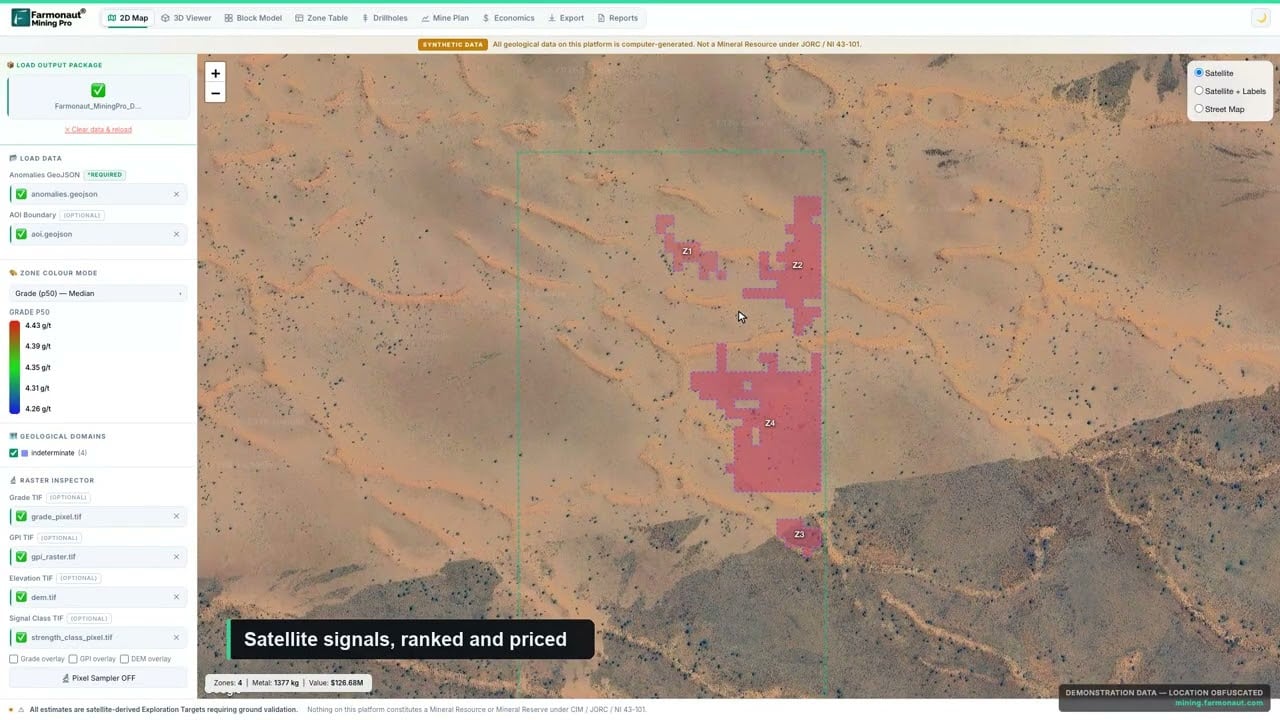
▶ A quick look at Farmonaut Mining Pro, which turns a licence boundary into an exploration-stage picture. · 4:56
Frequently asked questions
What are mining technology companies?
They are businesses that sell software, sensors, equipment or services to miners. In Australia they range from explosives and drilling suppliers such as Orica and Imdex to mine planning software firms such as Micromine, Maptek and Deswik.
Which mining tech companies are based in Australia?
Orica, Imdex, Maptek, Gekko Systems, RPMGlobal and Mining3 are headquartered in Australia, and Deswik is Australian-based. Micromine, Deswik and RPMGlobal are now owned by overseas groups (Weir, Sandvik and Caterpillar).
What are the major brands in smart mining technology?
For autonomous haulage, Komatsu (FrontRunner) and Caterpillar (MineStar Command) lead the Australian iron ore fleets named above. For software, the brands in this guide are Micromine, Maptek Vulcan, Deswik, RPMGlobal and Seequent Leapfrog.
What are mining industry solutions?
The term covers the products and services a mine buys to find ore, plan the pit or tunnel, blast, haul, process and report. Minerals and metals industry solutions usually mean software plus equipment plus support, bought from several suppliers.
What is mining automation in Australia?
It is mainly autonomous haul trucks, plus automated drills and remote operations centres. Rio Tinto reported 300 autonomous Komatsu trucks in August 2024, and Fortescue reported 137 Caterpillar autonomous trucks in 2019.
How is AI used in Australian mining?
Examples in this guide are AI-assisted ore sensing (Plotlogic OreSense), geoscience analytics (Imdex) and planning software. Always ask a vendor for results from a mine similar to yours.
What technology are scientists in Australia developing for mining?
Research bodies such as Mining3 and CSIRO work on rock sensing, blasting, automation and safety. CSIRO’s pages also describe lidar mapping for underground mines.
What are industrial mining innovations?
Recent ones include autonomous trucks, lidar mapping of underground voids, blasting systems such as Orica’s WebGen, and AI ore sensing. Each is listed above with its maker.
What do mining IT services include?
Networks, operational systems support, data platforms and remote operations. Prices vary by site, so ask suppliers to quote against a written scope.
Do these companies work on gold, lithium and other commodities?
Check each vendor’s own product pages for the commodities it supports. Gekko says its focus is gold and mineral processing.
This page is for information only. It is not investment advice, and it names companies as facts, not recommendations. Check each company’s current filings and ownership before you decide anything.
Farmonaut mining
Map your mining site from space
See how satellite data screens a licence area as an exploration target, ahead of a resource estimate.

Mining Pro sample view, synthetic data
Keep reading
Sources
- Orica half-year presentation (ASX, 7 May 2026): announcements.asx.com.au
- Imdex FY26 Annual Report (August 2026): investorpa.com
- MINING.COM, Weir completes acquisition of Micromine (30 April 2025): mining.com
- Sandvik, completes the acquisition of Deswik (4 April 2022): home.sandvik
- RPMGlobal, Caterpillar completes acquisition of RPMGlobal: rpmglobal.com
- Mining Technology, Caterpillar acquires RPMGlobal: mining-technology.com
- Seequent, About us: seequent.com
- Maptek, About: maptek.com
- Maptek, Vulcan: maptek.com
- Micromine, home page: micromine.com
- Gekko Systems, home page: gekkos.com
- Plotlogic, About: plotlogic.com
- Emesent, home page: emesent.com
- CSIRO, Emesent Hovermap: csiro.au
- International Mining, Mining3 formed (November 2016): im-mining.com
- International Mining, Komatsu 1,000th autonomous truck (April 2026): im-mining.com
- AlCircle, Rio Tinto 300th Komatsu autonomous truck (August 2024): alcircle.com
- MINING.COM, Rio Tinto autonomous trucks in the Pilbara (January 2018): mining.com
- MINING.COM, Fortescue autonomous haulage milestone (November 2019): mining.com
- CIM Magazine, The bandwidth backbone: magazine.cim.org
- Export Finance Australia, mining services (July 2024): exportfinance.gov.au
- Wikipedia, Orica: en.wikipedia.org
- Wikipedia, Maptek: en.wikipedia.org
Discussion
Questions, corrections or field experience? Share them below. First-time comments are reviewed before they appear, and your email is never published.
No comments yet. Be the first to add a question or your experience.

 Ramani Investments Ltd
 Congo Mining Solutions
 Mining SARL
 SenGold Invest SAS
 Sania Corporation
 Sean Mining Limited
 NTS Group (Pty) Ltd
 Mine4Africa
 Lithspo Minerals Limited
 Tintina Mining Group
 Dalgety Minerals Pty Ltd
 Vortex Minerals Pty Ltd
 Faith At Work (Pty) Ltd
 Geotech Mining Solutions plc
 Vulcan International Limited
 Kidepo Associates
 GKY Mining
 Alkimy SARL
 Double A Trading
 GemSprout Metals Limited

 Client · Somalia · Gold
 Client & affiliate partner · Ghana · Gold










