

Farmland · Iowa services guide
Midwest Farm Management in Iowa: Fees, Appraisal, Values
Iowa farm managers lease land, collect rent and report to owners for a fee; a 2013 extension answer put fees at 5% to 10%, averaging 8%. Federally related farm appraisals need an Iowa certified general appraiser. Land averaged $11,549 per acre in November 2025 (Iowa State) and cash rent $270 per acre in 2026 (ISU Extension).
Key takeaways
- Farm management fees are set by each firm; a 2013 extension answer reported 5% to 10%, averaging 8%, with crop share leases at the higher end; the base the percent applies to was not stated (Ask Extension, 2013).
- Iowa farmland averaged $11,549 per acre on November 1, 2025, up 0.7%, from $7,623 in South Central to $14,522 in Northwest Iowa (Iowa State University Land Value Survey).
- Iowa cash rent averaged $270 per acre of corn and soybean land in 2026, down $1 from 2025 (ISU Extension).
- Agricultural appraisals that need a federal-standard credential must be done by an Iowa certified general appraiser (or an out-of-state appraiser with an Iowa temporary practice permit): bachelor’s degree, 300 course hours and 3,000 hours of experience.
- Ask for AFM or ARA designations from ASFMRA, the fee basis in writing, where rent money is held, and how the firm handles conflicts of interest.
In this article
- Midwest farm management and appraisal at a glance
- How farm management services work in Iowa
- Farm management fees in Iowa and how they are charged
- Iowa farmland values by district
- How Iowa compares with other Midwest states
- Iowa cash rents and lease benchmarks
- How a farm appraisal works
- How to choose a farm manager or appraiser in Iowa
- When you need a farm manager, an appraiser or both
- Midwest Ag Services, Inc.: what the firm says about itself
- Buying or selling Iowa farmland: auctions and private sales
- How we checked the numbers
- Keeping an eye on a managed farm from a distance
- FAQ
Midwest farm management in Iowa means hiring a professional to lease your land, collect rent, pay taxes and report back to you, often for a fee tied to farm income. An extension expert answering an Iowa question in 2013 reported a survey in which professional farm manager fees ranged from 5% to 10%, averaging 8%; the answer did not say what the percent is taken from (Ask Extension, 2013). A farm appraisal is a separate service: a state-certified appraiser gives a written opinion of value, which matters when the average Iowa acre was worth $11,549 in November 2025 (Iowa State University Land Value Survey).
This guide explains how both services work, how fees are charged, what land values and cash rents look like by district, and which credentials to check before you sign. It also gives a fee calculator you can run with your own acres and rent. If you searched for Midwest Ag Services, Inc., the Council Bluffs firm, there is a section below that describes it from its own website. Farmonaut has no business relationship with that firm.
Midwest farm management and appraisal at a glance
Three services often sit under one roof at Iowa farm firms. They need different licences and they are priced in different ways.
| Service | What you get | Credential to ask about | How it is priced |
|---|---|---|---|
| Farm management | Tenant choice, lease, rent collection, tax and insurance payments, budgets, farm visit reports | Accredited Farm Manager (AFM) from ASFMRA; Iowa real estate licence where needed | Often a percent of gross farm income; varies with the work done |
| Farm appraisal | Written opinion of market value for a sale, loan, estate or lease | Iowa certified general real estate appraiser; Accredited Rural Appraiser (ARA) | Quoted per job; ask for the fee and due date in writing |
| Land brokerage | Listing, marketing, auction or private sale, closing | Iowa real estate broker or associate broker licence | Commission or auction fee set in the listing agreement |
The rest of the page takes each row in turn, then shows the land value and rent data that every fee and appraisal is measured against.
How farm management services work in Iowa
A farm manager stands between the owner and the tenant. Illinois Extension describes two levels of help: paid consulting that leaves decisions with the owner, or full management that also sets the cash rent and handles grain marketing contracts. Duties vary by farm size, assets and company policy.
A full-service contract in Iowa usually covers these jobs:
- Tenant selection. Finding a financially sound operator and checking their references.
- Lease negotiation and review. Cash rent, crop share or custom farming terms, reviewed each year against local rents.
- Rent collection. Collecting on time and, where used, filing a landlord’s lien to protect the owner.
- Bills and records. Paying property taxes and insurance, keeping accounts and sending a year-end statement for the owner’s tax return.
- Farm visits. Inspecting the land, meeting the tenant and sending a written report after each visit.
- Improvements. Managing tiling, terraces or building repairs that the owner approves.
- Government programs. Reviewing USDA program choices with the tenant and owner.
The lease type changes the workload. With cash rent, the manager sets the rent and collects it. With crop share or custom farming, the manager also helps plan inputs, market grain and track yields, so the job takes more time. Good stewardship also belongs in the plan; our guide to land stewardship covers the practices owners most often write into leases.
Professional managers also help set the reference numbers others use. Of the 1,450 usable responses to Iowa State’s 2026 cash rent survey, 9% came from professional farm managers and realtors, 44% from farm operators and 39% from landowners (ISU Extension, Cash Rental Rates for Iowa 2026 Survey).
Cash rent, crop share and custom farming compared
The lease you choose decides how much work the manager does, how much risk you carry and, often, how the fee is set.
| Lease type | Owner’s income | Owner’s risk | Manager’s work |
|---|---|---|---|
| Cash rent | A fixed rent per acre, paid on agreed dates | Low: tenant carries yield and price risk | Set the rent, choose the tenant, collect rent, watch the land |
| Flexible cash rent | A base rent plus a bonus tied to yield, price or revenue | Shared: rent moves with the year | All of the above, plus checking yield and price records |
| Crop share | A share of the crop and of some input costs | Shared: owner takes part of yield and price risk | Plan inputs, split bills, market the owner’s grain, track yields |
| Custom farming | All crop income, minus all costs and the custom hire bill | High: owner carries the full operating risk | Run the farm business: inputs, insurance, marketing, records |
As the owner takes on more risk, the manager takes on more work, which is why the Ask Extension answer below says crop share costs more to manage than cash rent.

▶ How the Farmonaut Agro Admin app lets one manager track crop health and tasks across many farms. · 7:27
Farm management fees in Iowa and how they are charged
There is no official fee schedule. Each firm sets its own price, and the price depends on the work. One public figure comes from a 2013 Ask Extension reply to a person managing a 160-acre farm in Monona County, Iowa, who asked what percent of gross income to charge. The expert reported a survey in which professional farm manager fees ran from 5% to 10%, averaging 8%, without saying what the percent was applied to, and noted that crop share leases cost more because they take more time (Ask Extension, 2013). That answer is now more than ten years old, so treat it as a starting point for questions, not a current price.
Fees are set in a few common ways. Ask which one a firm uses and get it in writing:
- Percent of gross income. A share of the owner’s rent, crop sales and program payments. Simple to check against your statements.
- Percent plus a per-acre base. A small fixed amount per acre plus a percent, used where income swings from year to year.
- Flat annual fee. One price per year, which suits small farms or consulting-only work.
- Separate charges. Extra fees for appraisals, sales, building projects or crop insurance work. Ask for this list before you sign.
To turn a percent into dollars, multiply it by your rent. On the 2026 Iowa average cash rent of $270 per acre (ISU Extension), an 8% fee is about $21.60 per acre, or $3,456 a year on 160 acres. Use the calculator below with your own numbers.
A manager can earn the fee back if better leases raise your rent or cut your own time on the farm. Illinois Extension notes that farm-managed leases rent higher than USDA published averages in the Illinois farm managers’ survey. That is an Illinois finding, not a promise for any one Iowa farm. This page is general information, not financial or legal advice; talk to your own advisers before you sign a management contract.
Try the numbers for your own farm below.
Calculator
Does a farm manager pay for itself on your farm?
Enter your own acres, rents, fee and time to compare hiring a manager with managing the farm yourself.
- Yearly management fee: $3,712
- Fee per acre: $23
- Managed rent needed to break even: $290 /acre
- Your net rent per acre with a manager: $267
Example values only, not a benchmark or a forecast. The $270 rent default is the 2026 Iowa statewide average cash rent (ISU Extension, File C2-10, May 2026); the 8% fee default is the average from the survey quoted by Ask Extension (2013). The managed rent, hours and hourly value are made-up examples set near break-even. The fee is applied to the managed rent only, as a percent of gross cash rent; your contract may use a different base or add other charges. Taxes and lease costs are not included.
Iowa farmland values by district
Iowa State University’s survey put the statewide average at $11,549 per acre on November 1, 2025, up 0.7% or $83 from a year earlier. After inflation, the value fell 1.8% to $8,475 per acre in 2015 dollars (ISU working paper 25-WP 674). The nominal figure is still about $286 below the 2023 peak of $11,835 (ISU news release, December 2025).
The survey is an expert opinion survey. Its 316 respondents in 2025 were licensed brokers, farm managers, appraisers, lenders, county assessors and others who follow the land market; lenders were 28% of them, and brokers and farm managers 17% each. So the figures reflect what land professionals see in their counties, not individual sale prices.
The gap between districts is wide. Northwest Iowa averaged $14,522 per acre and South Central Iowa $7,623. By county, O’Brien had the highest average at $16,269 per acre and Appanoose the lowest at $6,679. A county-wide average cannot price one farm, which is why lenders and estates pay for a full appraisal.
Who sells matters too. In the 2025 survey, estate sales made up 55% of Iowa farmland sales and retired farmers 22%, while existing farmers bought 68% of the land sold and investors 26%. Many of those estate sales need an appraisal for the estate and a manager or broker for the sale.
Chart
Iowa farmland value per acre, statewide and two districts
Nominal dollars per acre, all land qualities, as of November each year
How Iowa compares with other Midwest states
USDA’s National Agricultural Statistics Service (NASS) uses a different method: it surveys about 30,000 farm operations from April to June. In its report released July 31, 2026, Iowa cropland averaged $10,700 per acre in 2026, up 3.9% from 2025, the highest of the Corn Belt states (USDA NASS, Land Values 2026 Summary). Iowa farm real estate, which includes buildings and pasture, averaged $10,100 per acre.
The ISU and NASS numbers are not the same measure. ISU reports expert opinion for November; NASS reports operator estimates for the spring. Use one series at a time when you compare years, and say which one you used in any lease or sale talks.
Chart
Cropland value per acre in selected Midwest states
Dollars per acre, 2026, USDA survey of farm operators (April to June)
Iowa cash rents and lease benchmarks
On cash-rented farms, rent is the income that a percent-based management fee and an income-based appraisal start from. Iowa State’s 2026 survey put the statewide average at $270 per acre of corn and soybean land, down $1 from 2025 and $9 below the $279 of 2023 and 2024 (ISU Extension, 2026).
District averages in 2026 ran from $215 per acre in South Central Iowa to $292 in West Central Iowa. In Pottawattamie County, home of Council Bluffs, the 2026 average was $282 per acre, with high-quality land at $325 and low-quality land at $242. The survey lists things that can justify a higher or lower rent, such as small or odd-shaped fields, poor access, fertility levels and the length of the lease.
A manager should show you how a proposed rent compares with the county figure for your land quality. If the rent sits far from that figure, ask why. Some owners now use flexible leases that move with yields or prices; ISU Extension publishes guides for these, and our page on Midwest agriculture gives wider context on the region’s crops.
Chart
Average Iowa cash rent for corn and soybean land
Dollars per acre, statewide average of typical rents, by survey year
How a farm appraisal works
An appraisal is a written opinion of market value on a set date. Iowa requires every appraiser working under its board to follow the Uniform Standards of Professional Appraisal Practice (USPAP), and only a certified general appraiser may appraise agricultural land in work that needs a federal-standard credential (Iowa Admin. Code r. 193F-5.1, as of 2024; the rules have since been renumbered, so check the current version).
Chart
Low- vs high-quality land value by Iowa district
Dollars per acre, November 2025, 8 of Iowa’s 9 crop reporting districts
The steps for a farm appraisal follow a common pattern:
- Engagement. You agree the purpose (sale, loan, estate, gift, lease), the date of value, the fee and the delivery date in writing.
- Inspection. The appraiser walks or drives the farm and notes drainage tile, terraces, access, buildings and any timber or pasture.
- Soils. The appraiser works out the soil mix and its CSR2 (Corn Suitability Rating 2), a soil productivity index used across Iowa and built on USDA soil survey data.
- Comparable sales. Recent sales of similar farms nearby are adjusted for differences in soils, size, location and improvements.
- Income check. Where useful, the farm’s rent potential is turned into a value and compared with the sales result.
- Report. A signed report gives the value, the method and the data behind it.
Appraisal fees are not published in any statewide survey we could find, and they depend on farm size, travel and the report type. Ask for a written quote. If you are paying travel, the IRS business standard mileage rate is 72.5 cents per mile for 2026 (IRS, December 2025), a useful check on any mileage line.
How to choose a farm manager or appraiser in Iowa
Ask every firm the same questions, and keep the answers in writing.
- AFM designation. The Accredited Farm Manager title from the American Society of Farm Managers and Rural Appraisers (ASFMRA) requires a four-year degree or approved equivalent, four years of farm or ranch management experience, 82 hours of courses including ethics, and a demonstration farm management plan (ASFMRA, AFM requirements).
- ARA designation. The Accredited Rural Appraiser title requires state certification as a certified general appraiser, 118 hours of ASFMRA courses, five years of appraisal experience with at least 600 rural hours in each of three years, an exam and a graded demonstration report (ASFMRA, ARA requirements).
- Iowa appraiser certification. An Iowa certified general appraiser needs a bachelor’s degree, 300 hours of core courses, 3,000 hours of experience (at least 1,500 of them in non-residential work) over at least 18 months and the certified general exam (Iowa Admin. Code r. 193F-5.1, as of 2024; the rules have since been renumbered, so check the current version). Ask for the licence number and check it with the Iowa Real Estate Appraiser Examining Board.
- Real estate licence. Brokers who list and sell farms should hold an Iowa real estate licence; ask for the number. Leasing land and collecting rent for others can also fall under the state’s real estate rules, so ask whether the manager is licensed and check with the Iowa Real Estate Commission or your lawyer.
- Conflicts of interest. Some farm management offices are owned by banks that also lend to tenants. Illinois Extension flags this as a possible conflict. Ask how the firm keeps lending and management apart, and how it handles a managed farm it is also asked to sell.
- Client money. Ask where rent is held, whether the account earns interest and whether that interest is yours.
- Reports. Ask how often you get income and expense reports, farm visit notes and a year-end statement.
- Fee basis. Get the percent, the base it applies to (gross or net, cash rent only or all income) and every extra charge in the contract.
When you need a farm manager, an appraiser or both
Owners do not always need all three services. These are the common situations, and the service each one calls for.
- Settling an estate. Estate sales were 55% of Iowa farmland sales in the 2025 ISU survey. Heirs often need an appraisal for the date of death, then either a manager to lease the farm or a broker to sell it.
- Owning land from a distance. An heir in another state who keeps the farm may want full management: someone to choose the tenant, collect rent and send reports.
- A retiring farmer leasing out. Some retiring owners set the first lease themselves and hire a consultant only to check the rent against the county figure.
- Refinancing or a land loan. The lender will normally ask for an appraisal; where the loan needs a federal-standard credential, that means an Iowa certified general appraiser; a manager is not needed.
- Buying land as an investor. Investors bought 26% of the Iowa farmland sold in 2025 (ISU). They often hire a broker to buy, an appraiser to check the price and a manager to run the lease.
- Gifting land or splitting a farm among family. An appraisal sets the value for the gift or the split; ask a tax adviser which report type the work needs.
If one firm offers all three services, ask how it avoids a conflict, for example appraising a farm that it also hopes to list for sale. Some owners use one firm to manage and a different, independent appraiser to value the land.
Midwest Ag Services, Inc.: what the firm says about itself
Midwest Ag Services, Inc. is a farm management, appraisal and land brokerage firm at 245 West Broadway, Council Bluffs, Iowa (phone (712) 323-5353, per its company site). Its homepage cites more than 30 years of experience; its auction page says over 20 years. Everything in this section comes from that website; we have not checked the firm’s work, fees or results, and Farmonaut has no partnership with it.
On its farm management page, the firm lists custom farm plans, operator selection and lease negotiation, supervision of crop and livestock work, grain and livestock marketing, insurance review, payment of expenses and taxes, monthly or quarterly income and expense reports, farm visit reports, annual budgets and cash flow projections, and government program review. It says trust accounts earn short-term money market interest with no fees or minimum balance, and that it files landlord liens and aims to collect cash rent up front on March 1.
Its appraisal page says the firm offers state-certified appraisals for buying, selling, financing and estate planning, covering row crop farms, livestock operations, specialty crop farms and recreational land. The page does not publish fees.
The firm’s team page lists two people. Evan Summy, President, is described as an Iowa associate real estate broker and an Iowa certified general real estate appraiser who joined in 2012 after an Iowa State business degree. Kelly Summy, Vice President, is described as an Accredited Farm Manager with a 40-year farm management career and, before that, 15 years of banking experience. To contact the firm or check current listings, use its own website.
Buying or selling Iowa farmland: auctions and private sales
Farmland in Iowa changes hands at public auction, by sealed bid or by private treaty. Firms such as Midwest Ag Services list in-person and online auctions on their auction pages; in October 2026 its page showed two one-chance sealed-bid auctions of Pottawattamie County farmland with bids due in December 2026. A sealed bid gives each buyer one offer, while a live auction lets bids rise in the room or online.
Whichever route you choose, ask the broker for recent comparable sales, the commission or auction fee, who pays for the survey and title work, and how the current lease will pass to the buyer. Ask a lawyer how the current lease affects the sale before you sell a rented farm. For recent sale prices across the region, see our summary of farmland auctions; if you are buying as an investor, our guide for farm investors compares the main routes into farmland.
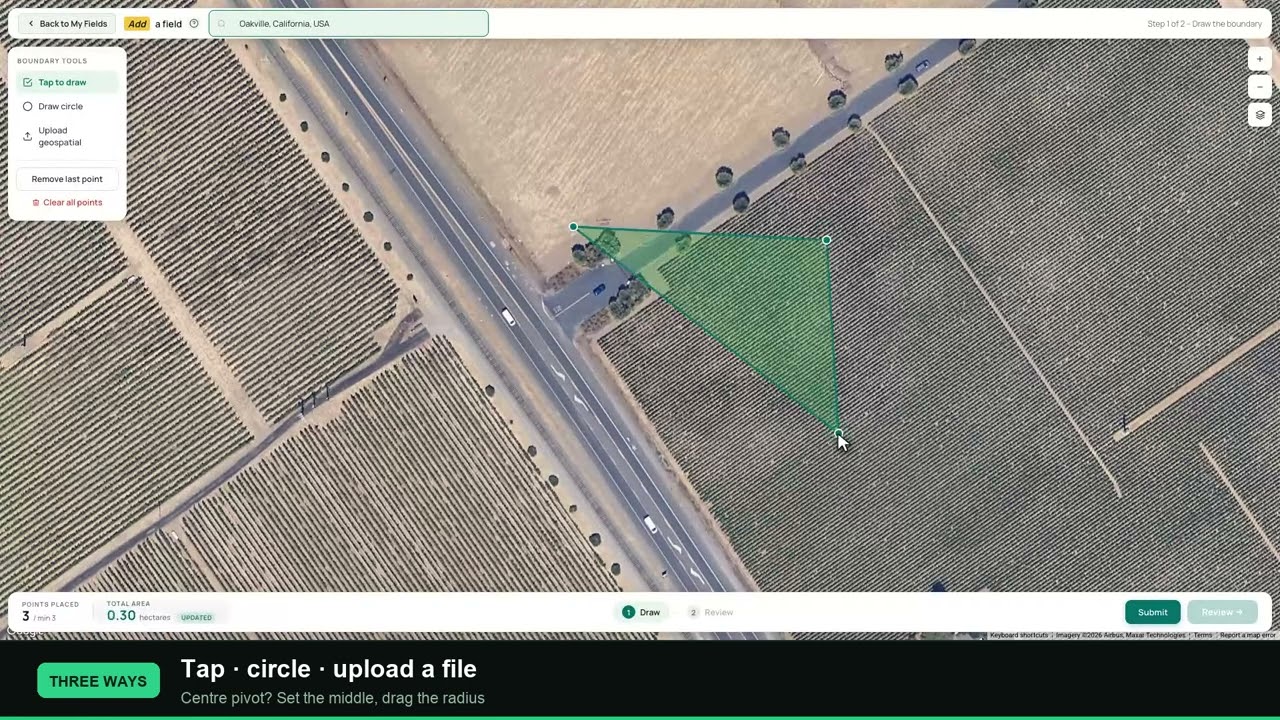
▶ Three ways to draw or upload a field boundary on a farm mapping app, useful for mapping a farm you plan to buy. · 2:21
How we checked the numbers
Every figure on this page comes from a named public source that we opened in October 2026. Land values come from the Iowa State University Land Value Survey for November 2025 and from the USDA NASS Land Values 2026 Summary. Cash rents come from ISU Extension’s 2026 cash rent survey, published in May 2026. Credential rules come from ASFMRA’s designation pages and from Iowa’s appraiser rules.
We kept the two land value series apart because they measure different things at different times of year. We show nominal dollars unless a line says the figure is adjusted for inflation. The fee range is the one dated figure on the page: it was reported in a 2013 Ask Extension answer (the survey’s own year is not given), and we found no newer public survey of Iowa farm management fees. If you know of one, the calculator still works; just enter the fee you are quoted.
The section on Midwest Ag Services uses only that firm’s own website. We did not contact the firm, and nothing here is a review or an endorsement. Firms change their services, staff and fees, so check each point with the firm before you rely on it. Both ISU surveys are updated every year, in May for rents and December for land values, so check for a newer release before using a figure in a lease or sale.
Keeping an eye on a managed farm from a distance
Many Iowa farm owners live far from their land. Farm visit reports and yield records are the main way to see how the farm is doing. Satellite images can add a check between visits: a vegetation map shows where crop growth lags the rest of the field, which you can raise with your manager or tenant. It cannot tell you the cause.
The Farmonaut Satellite + AI Farm Monitoring System shows those vegetation maps for fields you draw on a map, on web, Android or iOS. Owners and trustees with many farms can use the Farmonaut Agro Admin App for large-scale farm management to see them in one place, and developers can use the satellite and weather API documentation.
Related pages on our site: Farmonaut home, fleet and resource management, carbon footprinting, product traceability, crop loan and insurance verification, oil-and-gas and mineral asset management, farmland activity in New York and Iowa farmland values by county.
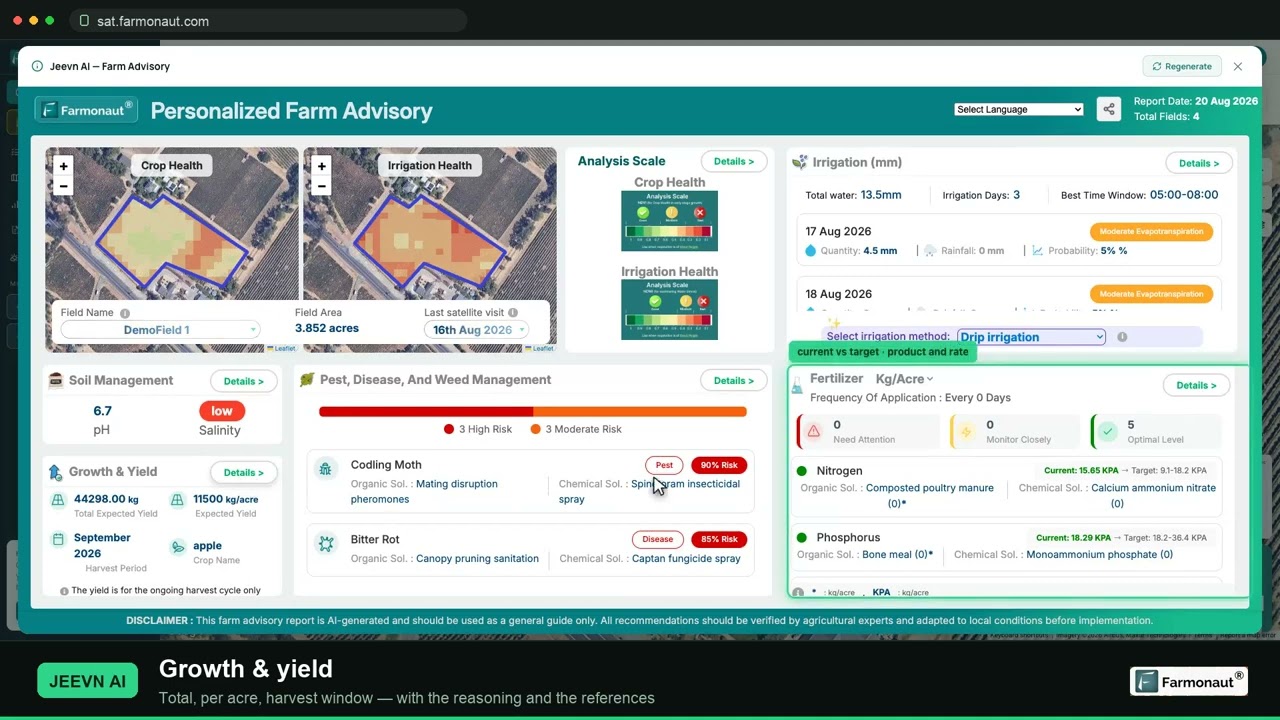
▶ A full walkthrough of satellite crop monitoring: reading NDVI maps and pulling a field report. · 19:36
FAQ
How much does a farm manager charge in Iowa?
There is no set rate. A 2013 extension answer reported a survey in which fees ran from 5% to 10%, averaging 8%, with crop share leases at the higher end; it did not say what the percent was applied to (Ask Extension, 2013). On the 2026 Iowa average rent of $270 per acre, 8% is about $21.60 per acre. Ask each firm for its fee basis and extra charges in writing.
What does a farm management company do?
It finds and screens tenants, writes and reviews leases, collects rent, pays taxes and insurance, keeps the books, visits the farm and reports to the owner. With crop share or custom farming it also helps plan crops and market grain.
Who can appraise farmland in Iowa?
For work that needs a federal-standard credential, an Iowa certified general real estate appraiser, the only Iowa credential that covers agricultural property. The ASFMRA’s Accredited Rural Appraiser (ARA) title adds rural training and experience on top of that certification.
What is Iowa farmland worth per acre?
Iowa State’s survey put the statewide average at $11,549 per acre in November 2025, ranging from $6,679 in Appanoose County to $16,269 in O’Brien County. USDA NASS put Iowa cropland at $10,700 per acre in 2026, using a different method.
What is the average cash rent in Iowa?
$270 per acre of corn and soybean land in 2026, per ISU Extension, down from $271 in 2025. District averages ranged from $215 to $292 per acre.
Is Midwest Ag Services connected to Farmonaut?
No. Midwest Ag Services, Inc. is an independent firm in Council Bluffs, Iowa. This page describes it from its own website only, as one example of an Iowa firm offering management, appraisal and brokerage.
Farmonaut crop monitoring
See your farms from space between visits
Draw your fields once and Farmonaut shows satellite vegetation maps for them through the season, on web, Android or iOS.




Keep reading
Sources
- Iowa State University CARD, 2025 Iowa State University Land Value Survey: Overview (December 2025): card.iastate.edu
- Iowa State University CARD, 2025 Land Value Survey full working paper 25-WP 674 (PDF, December 2025): card.iastate.edu
- Iowa State University, Iowa Farmland Values Inch Up in Market Readjustment, news release (December 9, 2025): farmland.card.iastate.edu
- ISU Extension, Ag Decision Maker File C2-10, Cash Rental Rates for Iowa 2026 Survey (May 2026): extension.iastate.edu
- USDA NASS, Land Values 2026 Summary (July 31, 2026): release.nass.usda.gov
- Ask Extension, Are there guidelines as to what a person can charge for farm management fees? (2013): ask.extension.org
- Illinois Extension, Hiring Farm Managers: extension.illinois.edu
- Illinois Extension, Considerations when hiring a farm manager (March 2024): extension.illinois.edu
- ASFMRA, Accredited Farm Manager designation requirements: asfmra.org
- ASFMRA, Accredited Rural Appraiser designation requirements: asfmra.org
- Iowa Admin. Code r. 193F-5.1, certified appraiser types and requirements (2024 version, via Cornell LII): law.cornell.edu
- IRS, 2026 business standard mileage rate, IR-2025-128 (December 29, 2025): irs.gov
- Midwest Ag Services, Inc., home page: midwestagservices.com
- Midwest Ag Services, Inc., Farm Management Services: midwestagservices.com
- Midwest Ag Services, Inc., Appraisal Services: midwestagservices.com
- Midwest Ag Services, Inc., Meet the Team: midwestagservices.com
- Midwest Ag Services, Inc., Auctions: midwestagservices.com
Discussion
Questions, corrections or field experience? Share them below. First-time comments are reviewed before they appear, and your email is never published.
No comments yet. Be the first to add a question or your experience.

 AgroStar
 Native Seeds
 Andex
 FCF India
 Unifrutti Gulf
 Deluxe Conseil
 TVS Electronics
 BW Pipelines
 WICO
 Gen Chayat
 Chimera Innovation
 SkyHarvest
 Polaris Digitech
 Teledarbas
 Wild Oak Farm

 Licence holder · Niger · Gold










