

Reviewed August 2026 against the USDA Farm Service Agency and USDA NASS.
Try it: Run your own numbers →
A USDA Direct Farm Ownership Loan carried a 6.00% interest rate in August 2026, with a Joint Financing variant at 4.00% and a Down Payment loan for beginning farmers at 2.00%, per the Farm Service Agency’s August 2026 lending rate announcement. The September 2026 FSA release left all three rates unchanged. Direct loans max out at $600,000; the guaranteed version, underwritten by a commercial lender and backed by USDA, goes up to $2,343,000, both repayable over as long as 40 years. This article covers who qualifies, how the loan types compare, and what farmland actually costs right now — with a calculator at the end to size your own payment.
What a USDA Farm Ownership Loan Actually Is
The USDA Farm Ownership Loan program, run by the USDA through its Farm Service Agency (FSA), finances the purchase, expansion, or improvement of farmland and ranch land for people who don’t qualify for full commercial financing on their own — or who want better terms than a bank offers. It is the program behind most of the queries this page is written for: farm ownership loans, farmland loans, USDA land loans, and USDA loans to buy land are, in FSA’s own vocabulary, largely the same product with a few structural variants.
There are three variants. The Direct loan is funded and serviced by FSA itself, capped at $600,000, at 6.00% as of August 2026. The Guaranteed loan is originated by a bank, credit union, or Farm Credit lender, with FSA guaranteeing up to 95% of the loss if the borrower defaults — this is the version that reaches the $2,343,000 ceiling, and its rate is set by the private lender rather than FSA, so it is not on the August 2026 rate sheet. The Joint Financing variant pairs an FSA direct loan with a conventional lender or state program, cutting FSA’s blended rate to 4.00%. A fourth product, the Down Payment loan, is reserved for beginning farmers and ranchers and carries the lowest rate on the sheet, 2.00%, up to 45% of the purchase price.

Current Rates and Loan Limits
FSA re-sets its direct loan rates monthly, effective on the first or third business day of the month, and posts them as a news release rather than a static rate page — that’s why the number itself will move even though this article’s structure won’t. As of the August 2026 announcement:
- Farm Ownership – Direct: 6.00% interest, up to $600,000, up to 40-year term.
- Farm Ownership – Joint Financing: 4.00% interest on the FSA portion, blended with your co-lender’s rate.
- Farm Ownership – Down Payment (beginning farmers): 2.00% interest, up to 45% of the purchase price, remainder financed by a Guaranteed or private lender.
- Farm Ownership – Guaranteed: up to $2,343,000, rate set by the originating commercial or Farm Credit lender, not FSA.
To get the rate in effect when you read this, open the FSA lending rates news release for the current month — search “USDA announces [month year] lending rates” if the URL above has rolled to a newer release, since FSA replaces rather than updates these pages each month.
USDA Land Loan Programs Compared
The table below separates the four Farm Ownership variants plus the Operating and Emergency loan categories, since “farm land loans” and “farm loans to buy land” searches conflate real-estate financing with working-capital financing that FSA treats very differently.
| Loan Program | Interest Rate (Aug 2026) | Max Loan Amount | Max Term | Who It’s For |
|---|---|---|---|---|
| Farm Ownership – Direct | 6.00% | $600,000 | 40 years | Buying, expanding, or improving farmland; FSA is the lender |
| Farm Ownership – Joint Financing | 4.00% (FSA share) | FSA covers up to 50% of the purchase cost | 40 years | Applicants pairing FSA with a bank or state ag-finance program |
| Farm Ownership – Down Payment | 2.00% | Up to 45% of purchase price | 20 years | Beginning farmers and ranchers (5% down payment required) |
| Farm Ownership – Guaranteed | Set by private/Farm Credit lender | $2,343,000 | 40 years | Larger purchases; FSA guarantees up to 95% of the loan to the lender |
| Operating Loan | 5.250% direct (Sept 2026) | Varies by direct/guaranteed cap | Up to 7 years | Seed, feed, fuel, equipment repair, and livestock purchases — not real estate |
Full current terms, including the guaranteed program’s fee schedule, are maintained by FSA at its Farm Ownership Loans page and its Guaranteed Farm Loans page. If you need working capital rather than real estate — day-to-day input costs — that’s the FSA Operating Loan, a materially different underwriting path from the ownership products above.

What Farmland Costs: NASS Values by Land Type
Loan limits only matter against actual land prices. USDA’s National Agricultural Statistics Service put the average U.S. farm real estate value at $4,500 per acre in its 2026 land value survey. Cropland averaged $6,020 per acre, up 3.3% from the prior year’s survey, while pastureland averaged $2,000 per acre, up 4.2%. That gap matters directly for the $600,000 direct-loan cap: it buys roughly 100 acres of average-priced cropland, or roughly 300 acres of pastureland — before you account for regional variation, which NASS breaks out at the state level in the same report.
For your specific state or county, use NASS’s land value report as the baseline, then check NASS QuickStats (nass.usda.gov/QuickStats) for any interim updates before the next annual survey, expected July 2027. A single national average masks enormous swings — irrigated cropland in high-demand regions routinely prices several multiples above dryland pasture in the same report, so treat the $4,500 figure as a scale reference, not a quote for your parcel.
FSA Loan Categories: Ownership, Operating, Cattle, Emergency
FSA obligated $6.74 billion through 27,792 farm loans in fiscal year 2025, up from $5.39 billion across 24,555 loans a year earlier, according to the American Farm Bureau Federation, citing FSA data. That volume spans four structurally distinct categories:
Key Categories of USDA FSA Loans
- Ownership Loans: purchasing or expanding farmland, real estate improvements, or constructing buildings — the loans this article is about.
- Operating Loans: shorter-term funding (up to 7 years) for input costs, equipment repair, and livestock purchases — day-to-day, not real estate. Covered in depth at FSA Operating Loan key requirements.
- Emergency Loans: disaster recovery financing for physical or production losses in a declared disaster area.
- Cattle and Livestock Loans: financed through either the Ownership program (barns, fencing, water systems tied to real estate) or the Operating program (the livestock itself) — detailed below.
FSA’s FY2026 program data, which will show whether that 28,000-loan pace held, is expected in FSA’s annual report cycle around October 2026 — check the same report page then rather than relying on this figure past that date.

USDA Cattle, Ranch & Livestock Loans
There is no separate “USDA cattle loan” program by that name — cattle, ranch, and livestock financing runs through the same Farm Ownership and Operating structures described above, split by what’s being financed. Buying the herd itself — breeding stock, feeder cattle, replacement animals — is an Operating Loan expense, since livestock is treated as a depreciating working-capital purchase rather than real estate. Buying ranch land, or building or upgrading the infrastructure a herd needs — fencing, barns, corrals, water systems — falls under the Farm Ownership Loan at the same rates in the table above: 6.00% direct, 4.00% Joint Financing, 2.00% Down Payment for a beginning rancher.
This split matters for how you apply: a rancher buying land and building fence in the same transaction may need to combine an Ownership loan for the real estate with an Operating loan for the cattle, rather than expecting one loan to cover both. FSA’s Farm Ownership Loans page confirms ranch land and livestock infrastructure as eligible collateral and use-of-funds categories under that program.
One gap worth naming directly: neither FSA’s public rate sheet nor its Farm Loan Programs report break out cattle- or livestock-specific loan counts or approval rates separately from the broader Ownership and Operating totals. If you need that split, ask your local FSA Service Center directly — it isn’t in FSA’s published national statistics as of this writing.
Farmonaut’s Fleet and Resource Management tools help track the equipment and logistics costs that typically accompany a ranch ownership or operating loan application, separate from the loan itself.

Land Types Financed: Farmland, Rural Parcels & Forestry
Farm Ownership loans are not restricted to row-crop acreage. Eligible land use includes cropland, pastureland and rangeland, forestry and timberland managed as part of a farm operation, and land improvements tied to conservation or water management. What it does not cover is a purely recreational purchase with no agricultural production plan attached — FSA’s underwriting requires a farm operating plan, so a parcel bought solely for hunting or as vacant recreational land generally does not qualify for the Farm Ownership program described here.
- Cropland and pastureland: the core use case, priced per the NASS figures above.
- Forestry and timberland: eligible when it’s part of a working farm’s diversified income plan, not a standalone timber investment.
- Water and soil infrastructure: irrigation systems, drainage, and erosion-control structures are financeable improvements under the same loan.
- Buildings and fencing: barns, grain storage, and livestock fencing count as real-estate improvements eligible for Ownership loan funds.
Farmonaut’s Product Traceability tools can support the documentation trail for specialty-crop or forestry operations financed this way, tracking inputs and outputs against the operating plan filed with FSA.

Can a USDA loan buy land with no farm plan?
Many people who search for a USDA land loan want to buy a bare rural lot, often to build a house later. USDA has two separate agencies here, and they lend for different things.
- Farm Service Agency (FSA) farm ownership loans can buy land, but only for a farm or ranch you will own and operate. You need an operating plan and farm experience, as set out below.
- Rural Development home loans (Section 502) finance a home in an eligible rural area. The loan can cover the site as part of buying or building the house, per USDA Rural Development, but not a lot bought on its own.
- Rural housing site loans (Sections 523 and 524) do fund land purchase and development, but only for nonprofits and public bodies that subdivide it into home sites, per USDA Rural Development.
So if you want land to farm, start with FSA. If you want land for a home, a Section 502 loan can include the lot only when the house is part of the same deal. For recreational or investment land, USDA has no program; a bank, credit union or Farm Credit lender is the usual route.
Eligibility Rules and the Application Sequence
Who Qualifies
FSA’s published eligibility rules for the Farm Ownership Loan are specific, not aspirational:
- U.S. citizenship or permanent residency, per FSA.
- Farm or ranch operating experience: at least 3 of the 10 years before applying, under 7 CFR 764.152 — this is the single most concrete eligibility figure FSA publishes, and it rules out a pure first-time buyer with zero operating history from the standard Direct program (the regulation lets farm-related education, a farm management course, military service or management experience stand in for up to 2 of the 3 years).
- A viable farm operating plan: projected income, expenses, and land use submitted with the application.
- Acceptable credit history: no outstanding federal debt delinquency; credit standards are documented as more flexible than typical commercial mortgage underwriting, though FSA does not publish a specific minimum score.
- Legal capacity to incur the debt and control of the farm or ranch being financed.
Application Steps
- Identify the right loan variant: Direct, Guaranteed, Joint Financing, or Down Payment — and separately, whether you need an Operating Loan alongside it for livestock or inputs.
- Build your farm operating plan: projected production, income, and expenses, plus the land-use and conservation details FSA will review.
- Gather documentation: proof of citizenship, tax returns, farm operating history, and financial statements.
- Meet with your local FSA Service Center: FSA staff confirm which program fits and walk through county-specific requirements.
- Submit the application through your Service Center; FSA reviews creditworthiness, repayment ability, and the operating plan together.
Farmonaut’s Crop Loan and Insurance verification service can help organize the production and compliance records FSA’s operating-plan review asks for.



Loan Payment Calculator
Enter a loan amount, rate, and term to estimate your monthly and annual payment on a USDA Farm Ownership loan — try the 6.00% direct rate, the 4.00% Joint Financing rate, or the 2.00% beginning-farmer Down Payment rate from the table above, against your own purchase price.
Run your own numbers
Assumes a standard fixed-rate fully amortizing loan with no fees, no balloon payment, and no guarantee or origination fees added to principal. It excludes property taxes, insurance, and any Guaranteed-loan servicing fees a private lender may charge — use it to compare rate and term scenarios, not as a binding payment quote.
Conservation Requirements Tied to These Loans
FSA’s operating-plan review for Farm Ownership loans routinely evaluates soil and water conservation practice as part of assessing whether the operation is viable long-term — cover cropping, reduced tillage, and irrigation efficiency show up as underwriting-relevant factors, not just goodwill add-ons, because they affect the land’s productive value over a 40-year term. Highly erodible land and wetland conservation compliance rules under the Farm Bill also apply to FSA-financed land, meaning a borrower already needs a conservation plan on file for certain acreage regardless of the specific loan variant chosen.
Farmonaut’s Carbon Footprinting tool can help document the practices FSA’s conservation compliance review looks for, and track them over the life of a long-term ownership loan.
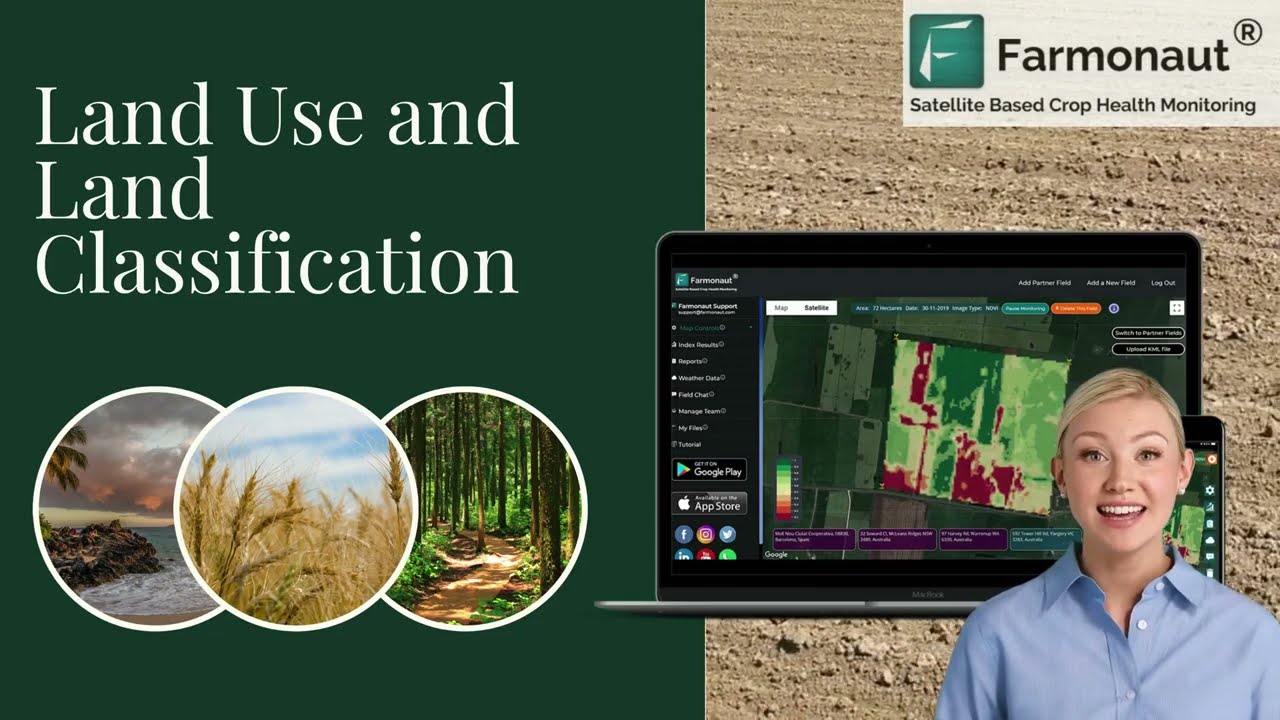
Tracking Loan Compliance With Satellite Data
Once land is financed, FSA’s conservation-compliance and operating-plan reviews continue for the life of the loan. Satellite-based monitoring gives borrowers a way to document what’s actually happening on the ground between FSA site visits.
- Satellite & AI monitoring: tracks crop health, soil moisture, and land-use change relevant to conservation compliance reviews.
- Blockchain traceability: documents input use and output records for operations that need to show a verifiable production chain.
Explore product traceability. - Fleet and resource management: tracks equipment and logistics costs relevant to an operating budget.
See fleet management solutions. - Carbon footprint monitoring: documents conservation-relevant practices over time.
Read about carbon footprint monitoring. - API integration: the Farmonaut API and its developer documentation let a lender, accountant, or farm management system pull satellite and weather data directly.
Farmonaut’s large-scale farm management platform extends this to multi-field operations tracking crop rotation, soil monitoring, and water use across an entire financed operation.
Farmonaut Subscription Plans
Subscription tiers are modular, built for operations of any size — from a single newly financed parcel to a multi-field enterprise needing year-round monitoring.
Or try the app directly.
FAQ: USDA Land and Farm Ownership Loans
What is the current USDA Farm Ownership direct loan interest rate?
6.00% as of the August 2026 FSA rate announcement. FSA resets this monthly — check the latest FSA rate release for the figure in effect now.
What is the maximum USDA farm ownership loan amount?
$600,000 for a Direct loan; $2,343,000 for a Guaranteed loan, per FSA’s Farm Ownership Loans and Guaranteed Farm Loans pages.
Is there a specific “USDA cattle loan” or “USDA ranch loan” program?
No separate program by that name. Cattle purchases run through the Operating Loan; ranch land and livestock infrastructure (fencing, barns, water systems) run through the Farm Ownership Loan at the same rates as farmland.
How much farming experience do I need to qualify?
FSA requires at least 3 of the past 10 years of farm or ranch operating experience for the standard Farm Ownership program. Agricultural education, a farm management course, an internship or military service can count for up to 2 of those 3 years, under 7 CFR 764.152.
What does farmland actually cost per acre right now?
USDA NASS put the 2026 national average at $4,500 per acre for all farm real estate, $6,020 for cropland, and $2,000 for pastureland — see the NASS land value report for state-level detail, since the national figure hides large regional swings.
How long is the repayment term on a USDA land loan?
Up to 40 years for Farm Ownership real estate loans, whether Direct, Guaranteed, or Joint Financing. The Down Payment loan for beginning farmers runs up to 20 years.
How many of these loans does USDA actually approve?
Roughly 28,000 direct and guaranteed farm loans were approved in Fiscal Year 2025, totaling about $6.7 billion, per FSA’s Farm Loan Programs report. FY2026 figures are expected around October 2026.
Do USDA farm ownership loans cover buildings, fencing, or irrigation?
Yes — barns, fencing, water systems, and irrigation infrastructure are eligible real-estate improvements under the Farm Ownership Loan.
Can I combine a USDA loan with other financing?
Yes. Joint Financing pairs an FSA direct loan with a private or state lender by design, and many producers layer insurance-backed funding on top. Farmonaut’s crop loan and insurance verification service can help organize documentation across multiple sources.





Further reading:
Where This Stands and What Changes Next
The rates in this article — 6.00% direct, 4.00% Joint Financing, 2.00% Down Payment — are the August 2026 figures, and FSA replaces them monthly, so the durable part of this article is not the number but the structure: four Farm Ownership variants distinguished by lender, rate, and down-payment size, a separate Operating Loan track for cattle and input costs, a $600,000/$2,343,000 direct/guaranteed ceiling, a 40-year maximum term, and a 3-of-10-years experience threshold for the standard program. Check those four data points — this month’s rate release, the current NASS land value report, the latest FSA program-data report, and your local Service Center’s read on your specific experience and credit profile — before treating any number here as current.
Farmonaut supports the compliance and monitoring side of that process with satellite, AI, and traceability tools built for farm operations financed this way.

 Oath Inc
 Reddane Farming
 Esri North East Africa
 Farmer Amigo
 Cresol
 Atur Kuliner
 MDCV UK
 Zerella Group
 Etech Consulting Madagascar
 Vestlandsforsking
 Agritein
 Delicio
 WB Dev
 Sama Premium
 Prochecker
 Tres Valles
 LACOS Geoinformation
 Magrifly
 LatConnect 60
 Blickwinkel
 Agricultural Credit Policy Council
