
Farm finance · Equipment loans
Tractor Loan Interest Rate: What Lenders Charge Now
US banks charged an average of 7.06% on farm machinery loans in the third quarter of 2026 (Federal Reserve survey). Here are dated rates from banks, Farm Credit and the FSA, how rates are set, and a calculator to compare a dealer low-rate deal with a cash rebate.
Key takeaways
- US commercial banks averaged 7.06% on machinery and equipment loans in Q3 2026, down 68 basis points on a year earlier but 249 points above 2020 (farmdoc daily, Federal Reserve survey).
- AgDirect’s published list rates for November 2026 ran from 7.25% to 8.75% fixed and 6.50% variable; smaller loans and longer terms cost more.
- The USDA FSA direct farm operating rate was 5.625% from 1 November 2026, for farmers who cannot get commercial credit.
- The average US bank machinery loan was about $39,300 with a 29.3-month term in Q3 2026.
- Compare the total cost of a dealer promotional rate with the cash rebate it replaces before you sign.
In this article
- Tractor loan interest rate at a glance
- How tractor loan rates are set
- What US banks charge for machinery loans
- Regional bank surveys
- Farm Credit and dealer finance programs
- USDA Farm Service Agency loans
- Buy, finance or lease
- Low dealer rate or cash rebate?
- How to get a lower rate on a tractor loan
- Paperwork lenders ask for
- Tractor loan rates in Canada, the UK and Australia
- Interest rate trends for farm equipment loans
- Your tractor loan checklist
- How we checked the numbers
US commercial banks charged an average of 7.06% on farm machinery and equipment loans in the third quarter of 2026, according to a farmdoc daily analysis of the Federal Reserve’s lending survey. That is the best national benchmark for a tractor loan interest rate today. Your own quote will depend on the lender, the size of the loan, the term, whether the rate is fixed or variable, and your credit file.
This guide explains where tractor loan rates come from, what banks, Farm Credit lenders, dealers and the US Farm Service Agency charge right now, and how to compare offers. It has dated rate tables, three charts and a calculator that checks a dealer low-rate deal against a cash rebate with bank finance. Figures are in US dollars unless stated. Canadian, UK and Australian readers will find the base rates that drive their local loans in a separate section.
Tractor loan interest rate at a glance
The table brings the main reference points together. Each comes from the source named in the right column, with the date it applies to.
| Lender type | Rate | What it is | Date and source |
|---|---|---|---|
| US commercial banks | 7.06% average | Average effective rate on new machinery and equipment loans (survey result, not a list price) | Q3 2026, Federal Reserve survey via farmdoc daily |
| Dallas Fed district banks | 7.66% fixed, 7.67% variable | Average rate reported by bankers on intermediate-term loans in Texas, northern Louisiana and southern New Mexico | Q2 2026, Dallas Fed agricultural survey |
| AgDirect | 7.25% to 8.75% fixed, 6.50% variable | Published list rates by loan size and term (a Farm Credit equipment finance program) | Rates for 1 to 30 November 2026, AgDirect |
| FSA direct farm operating loan | 5.625% | Government rate for borrowers who cannot get commercial credit | Effective 1 November 2026, USDA FSA |
| US bank prime rate | 7.00% | Base rate used to price many business loans | 4 November 2026, Federal Reserve H.15 |
These numbers are not offers. Dealer promotions, rebates and fees can make a loan with a higher headline rate cheaper overall, or the other way round. The calculator further down shows how.
How tractor loan rates are set
A lender starts from its own cost of money. In the US that moves with the Federal Reserve’s policy rate and with base rates such as prime. The Federal Reserve’s H.15 release showed the bank prime loan rate at 7.00% on 4 November 2026. The Fed notes that prime is “one of several base rates used by banks to price short-term business loans”.
On top of that base, the lender adds a margin for risk and cost. The margin is usually larger when:
- the loan is small, because the paperwork costs the same as for a big loan;
- the term is long, because the machine loses value over time and the lender carries more risk;
- the tractor is used, old or bought from a private seller rather than a dealer;
- the farm’s cash flow, debt load or credit history is weak;
- the down payment is low.
A fixed rate stays the same for the whole loan. A variable rate moves with a base rate such as prime or SOFR. Variable rates often start lower, but your payment can rise if base rates go up.
What US banks charge for machinery loans
The Federal Reserve’s National Survey of Terms of Lending to Farmers tracks new farm loans at commercial banks. In the third quarter of 2026 the average rate on machinery and equipment loans fell by 68 basis points to 7.06%, according to the farmdoc daily summary. The average for all non-real estate farm loans was 6.77%, and operating loans averaged 6.66%.
Rates are lower than a year ago but still well above 2020. In the third quarter of 2020, machinery loans averaged 4.57%. The 2026 figure is 249 basis points higher, so a farm borrowing the same amount pays much more interest than it did six years ago.
The same survey shows smaller and shorter equipment loans. The average machinery loan was about $39,300, down 9.5% from $43,400 a year earlier. The average maturity fell from 53.9 months to 29.3 months, well below the 2015 to 2025 average of 40.4 months. Shorter terms mean higher payments but less total interest.
Chart
Average bank rate on farm machinery loans
Average effective interest rate on new machinery and equipment loans at US commercial banks, third quarter of each year shown
Regional bank surveys
Federal Reserve district banks also ask rural bankers what they charge. The Dallas Fed agricultural survey for the second quarter of 2026 covers Texas, northern Louisiana and southern New Mexico. Its “intermediate term” category is the one that covers machinery and equipment. The average fixed rate was 7.66% and the average variable rate 7.67% in that quarter, down from 8.20% fixed a year earlier.
In the Midwest, a Purdue University credit outlook found that, as of the third quarter of 2025, operating loan rates in the Chicago and St. Louis Fed districts had fallen for five quarters in a row but remained at levels not seen since 2007. These district surveys help you test whether a local quote is in line with what other banks in your region charge.
Chart
Intermediate-term farm loan rates, Dallas Fed district
Average fixed rate reported by bankers in Texas, northern Louisiana and southern New Mexico, by quarter
Farm Credit and dealer finance programs
Farm Credit lenders and equipment makers’ finance arms publish rate sheets. AgDirect, an equipment finance program of the Farm Credit System, lists rates by amount financed and term. For 1 to 30 November 2026 its fixed rates ran from 7.25% for loans of $250,000 or more on a 2 to 5 year term up to 8.75% for loans of $5,000 to $24,999 over 6 to 7 years. Its variable rate was 6.50% at every size. All rates are subject to credit approval.
Chart
Fixed equipment loan rate by amount financed
AgDirect published fixed rate for a 2 to 5 year term, by loan size, November 2026 (list rates)
| Amount financed | Fixed, 2 to 5 years | Fixed, 6 to 7 years | Variable |
|---|---|---|---|
| $250,000 and above | 7.25% | 7.50% | 6.50% |
| $100,000 to $249,999 | 7.50% | 7.75% | 6.50% |
| $25,000 to $99,999 | 7.75% | 8.00% | 6.50% |
| $5,000 to $24,999 | 8.50% | 8.75% | 6.50% |
Source: AgDirect published rates, effective 1 to 30 November 2026 (list rates, before credit approval).
The table shows the size effect clearly. A $20,000 compact tractor loan carries a fixed rate 1.25 points above a $300,000 loan for a large row-crop tractor on the same term. AgDirect also sets rules by purchase type: auction and private-party purchases need a sales price of at least $25,000, and loans under $10,000 are limited to 2 to 5 year terms.
Equipment makers’ finance arms often run promotions such as a low or 0% rate for a set term on new machines, or a cash rebate if you pay cash or use outside finance. These offers change monthly and by model, so ask the dealer for the written terms and the rebate you give up by taking the low rate.
USDA Farm Service Agency loans
The USDA Farm Service Agency makes direct and guaranteed loans to family-size farmers and ranchers who cannot get commercial credit from a bank, a Farm Credit System lender or another lender. FSA operating loans can pay for equipment as well as livestock, feed and other farm costs.
According to FSA’s current loan interest rates page, the direct farm operating rate was 5.625% and the farm ownership rate 6.250%, effective 1 November 2026. Microloans carry the same 5.625% operating rate. FSA resets these rates each month.
FSA also caps what banks can charge on loans it guarantees. For rates that are variable or fixed for under five years, the cap is the prior business day’s SOFR plus 6.75%. For rates fixed for five years or more, it is the five-year Treasury yield plus 5.5%. Lenders may charge less. A guarantee can help a newer or smaller farm get a bank loan it would not get alone.
Buy, finance or lease
The interest rate is only part of the cost of a tractor. Kansas State University’s guide to evaluating tractor ownership costs groups machinery costs into interest, depreciation, repairs and maintenance, labor, fuel and lubrication, and property taxes, insurance and shelter. A cheap loan on a machine that loses value fast can still cost more than a dearer loan on one that holds its value.
A second K-State publication, Leasing vs. buying farm machinery, explains that with a loan the interest part of each payment is tax deductible and the owner takes depreciation. With a lease, the lease payments are deductible instead. It recommends comparing options by present value, because payments at different times are not worth the same. Its worked example uses a 20% down payment, a 6.9% rate and a five-year loan. Tax rules change, so check them with your tax adviser.
Leasing can suit a farm that trades machines every few years or wants lower payments. Buying with a loan usually suits a farm that keeps machines a long time and can use the tax deductions.

▶ Six plain steps to start precision farming without buying expensive machines first. · 4:18
Low dealer rate or cash rebate?
Dealers often let you choose between a low promotional rate and a cash rebate. To compare them, work out the total you pay under each one. The rebate cuts the amount you borrow from a bank at the normal rate. The promotional rate keeps the full price but charges less interest. The calculator below does this for any numbers you enter.
A shorter term usually favours the rebate, because there are fewer months for the rate gap to add up. A large rebate on a small loan also favours the rebate. A long term and a big loan tend to favour the low rate.
Try the numbers for your own farm below.
Calculator
Dealer low rate or cash rebate: which costs less?
Enter the price, the rebate and both rates from your own quotes.
- Monthly payment, rebate + bank loan: 1,785 US$
- Monthly payment, dealer rate: 1,807 US$
- Total repaid, rebate + bank loan: 107,079 US$
- Total repaid, dealer rate: 108,435 US$
Example values only, set close to break-even; they are not offers or forecasts. Rates are examples, use today’s quotes. The calculator assumes equal monthly payments, no fees and the same down payment in both cases. It ignores taxes and the value of your cash. Get professional advice before you borrow.
How to get a lower rate on a tractor loan
- Get at least three written quotes. Ask your bank, a Farm Credit lender and the dealer. Compare the annual percentage rate, fees and the total repaid, not just the headline rate.
- Put more money down. A larger down payment lowers the lender’s risk and the amount you pay interest on.
- Borrow over a shorter term. AgDirect’s sheet charges 0.25 points more for 6 to 7 years than for 2 to 5 years at each loan size.
- Bundle purchases. Rate sheets step down at higher loan amounts, so one larger loan may be cheaper than two small ones.
- Bring good records. Recent balance sheets, tax returns, yield and production records and a cash-flow plan help a lender price risk.
- Check fixed against variable. In November 2026 AgDirect’s variable rate was below its fixed rates, but a variable rate can rise.
- Ask about prepayment. Find out whether you can pay early without a penalty if your harvest is better than planned.
Loan terms and tax treatment vary by lender and by state. This guide is general information, not financial advice. Get professional advice before you sign.
Paperwork lenders ask for
Most farm equipment lenders ask for similar documents. Having them ready speeds up approval and can help your rate.
- a dealer quote or bill of sale with the make, model, year, hours and serial number;
- two or three years of tax returns, or farm financial statements;
- a current balance sheet listing assets and debts;
- proof of insurance on the machine;
- land leases or ownership records, if the lender asks for them;
- for FSA loans, a farm operating plan and proof you could not get credit elsewhere.
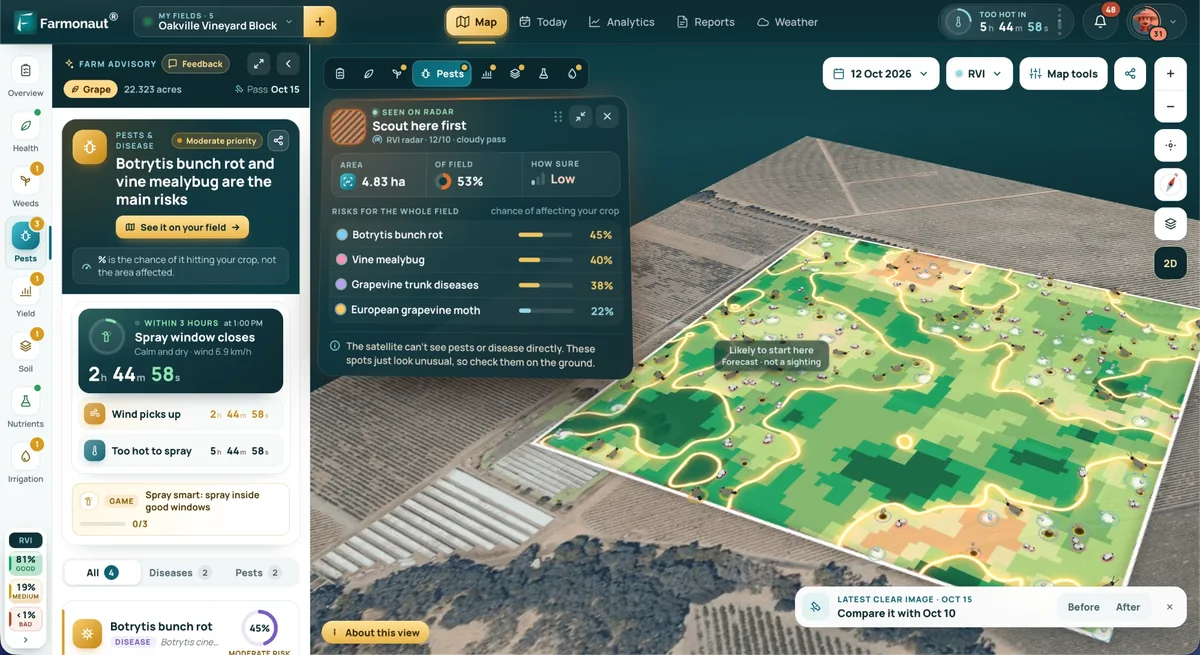
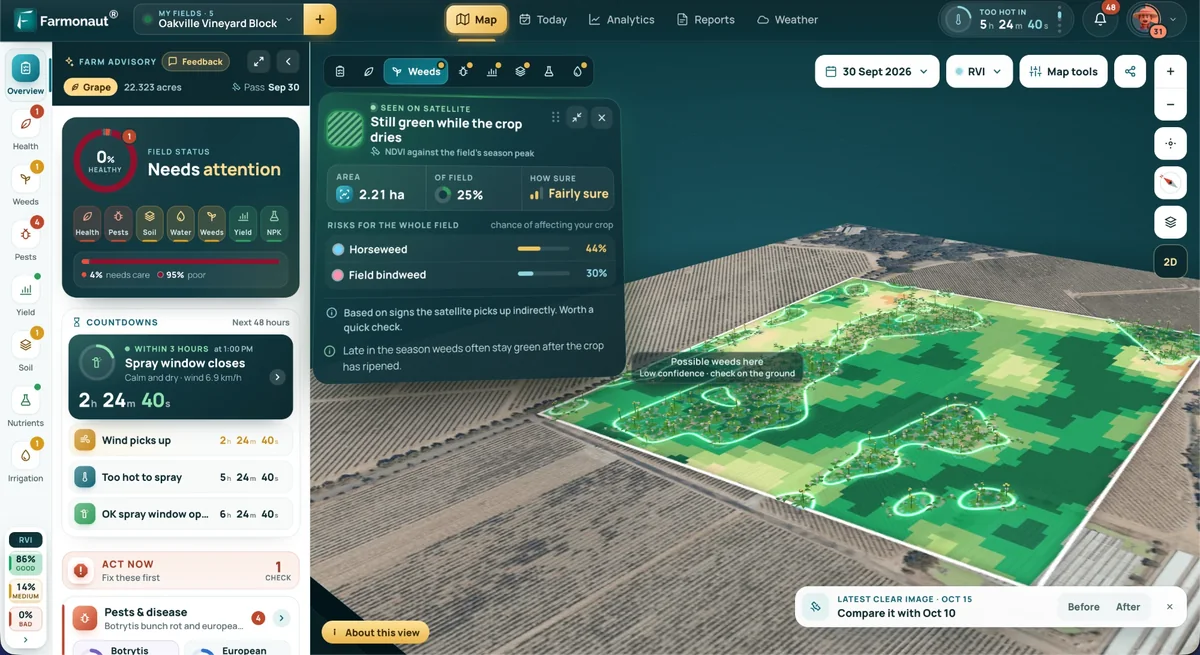
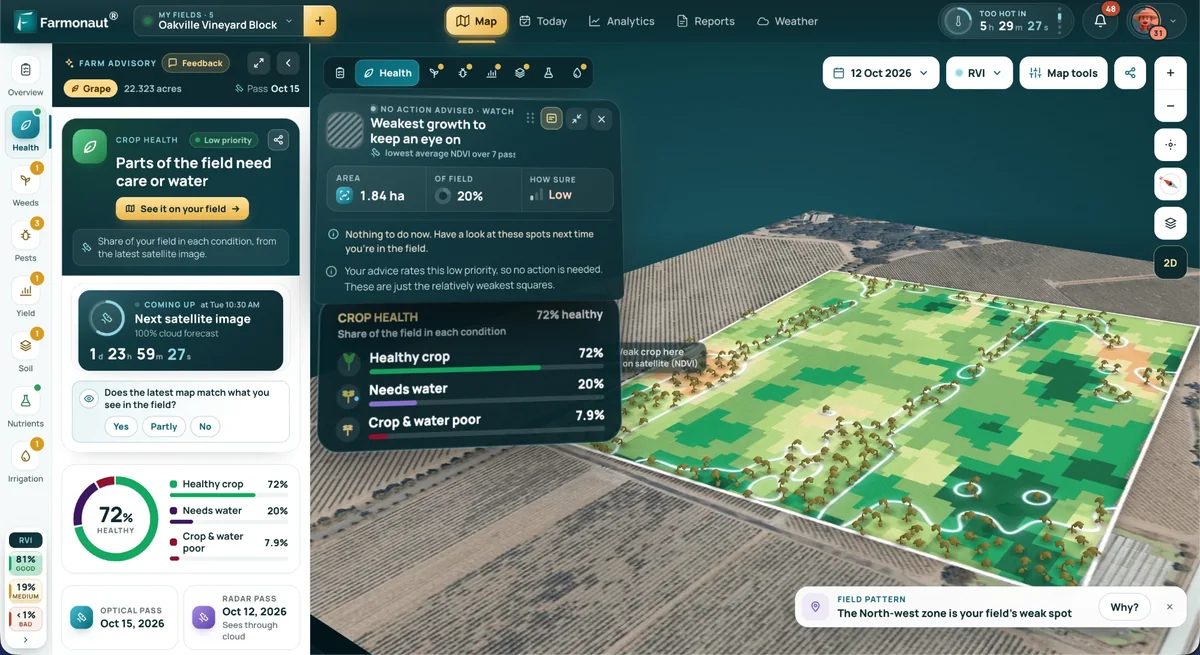
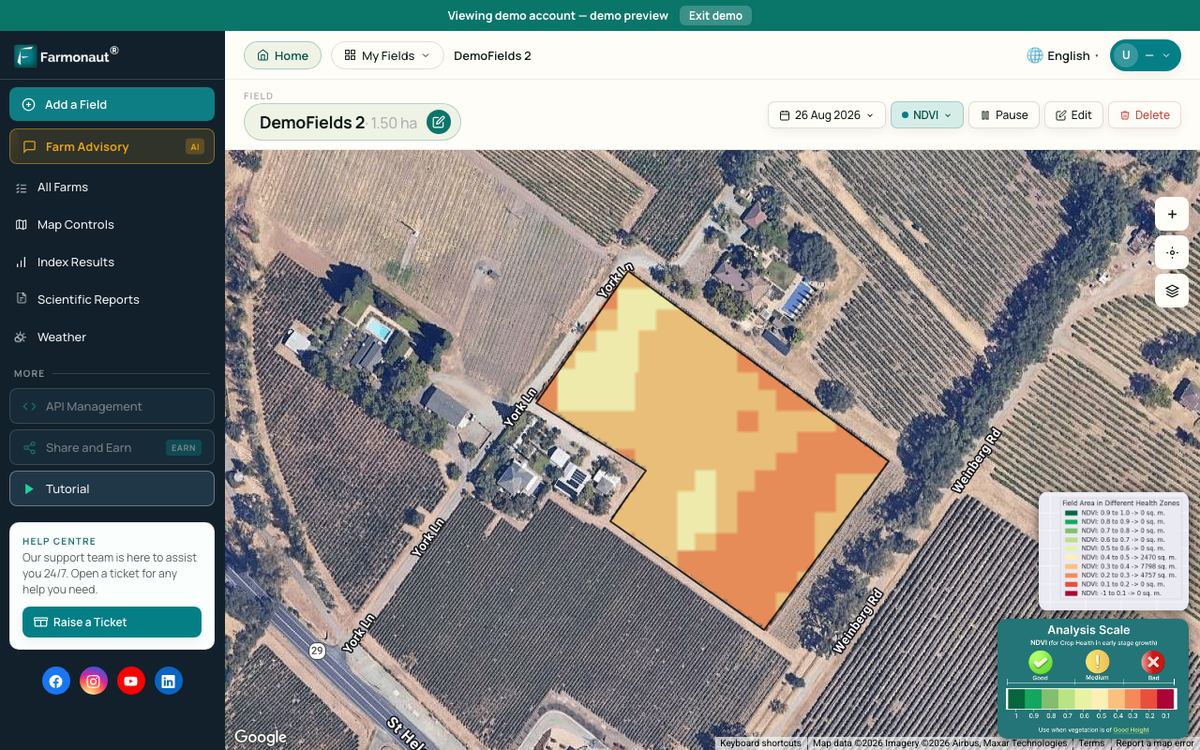
Lenders also look at how the farm is run. Clear field records, yield maps and crop health history show that the operation is managed well. Tools such as satellite crop monitoring can help you keep those records season by season.

▶ A step-by-step tutorial on monitoring crop health by satellite in the web app, useful for keeping field records. · 8:43
Tractor loan rates in Canada, the UK and Australia
Outside the US, tractor loans follow the local central bank’s rate plus a lender margin. The base rates moved in different directions in autumn 2026.
- Canada: the Bank of Canada raised its target for the overnight rate by 0.25 points to 2.50% on 28 October 2026, after holding at 2.25% since October 2025. Canadian lenders’ prime rates follow this target.
- United Kingdom: the Bank of England raised Bank Rate by 0.25 points to 4% on 5 November 2026, citing higher energy prices. Asset finance and hire purchase rates for machinery are usually quoted against Bank Rate.
- Australia and New Zealand: equipment loans and chattel mortgages are priced off each lender’s own base rate, which moves with the central bank’s cash rate. Check the current cash rate on your central bank’s website when you compare quotes.
Because base rates were rising in Canada and the UK in late 2026, a fixed rate fixes the cost at today’s level, while a variable rate could rise. Check local rules and lender terms before you choose.
Interest rate trends for farm equipment loans
Bank rates on machinery loans rose sharply from 2020 to 2025 and eased in 2026. The Dallas Fed series shows intermediate-term fixed rates falling from 8.20% in the second quarter of 2025 to 7.62% in the first quarter of 2026, then holding near 7.66% in the second quarter. In the national survey, machinery rates fell from 7.74% to 7.06% over the year to the third quarter of 2026.
Farmers also borrowed less for equipment. Machinery and equipment loan volume at banks (estimated at an annual rate) fell from $2.61 billion to $2.46 billion in the third quarter, which was 38.9% below the 2015 to 2025 third-quarter average, according to farmdoc daily. farmdoc daily links the fall mainly to smaller average loan sizes; the number of machinery loans actually rose 3.8%.
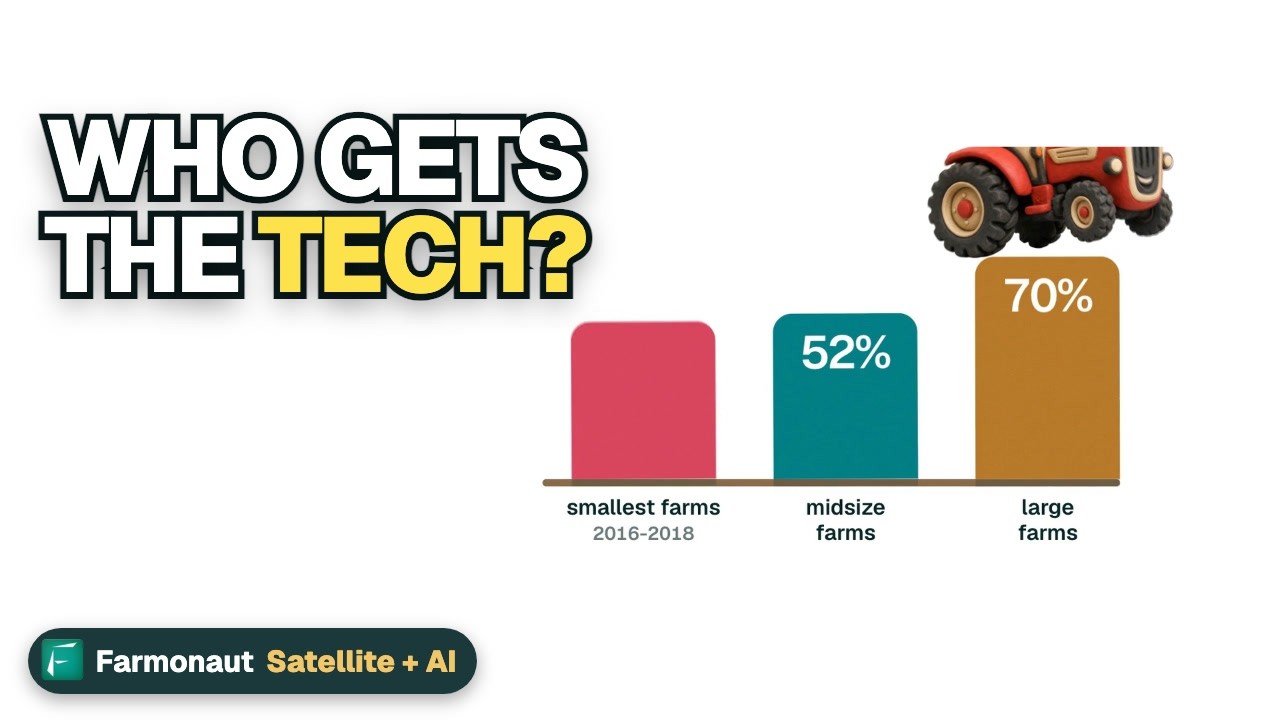
▶ What new farm technology, from self-driving tractors to satellites, means for money and jobs in rural towns. · 3:50
Your tractor loan checklist
| Question to ask | Why it matters |
|---|---|
| Is the rate fixed or variable, and tied to what base rate? | A variable rate can rise with prime, SOFR or Bank Rate |
| What is the annual percentage rate including fees? | Fees raise the true cost above the headline rate |
| What rebate do I give up for the promotional rate? | The rebate may be worth more than the rate cut |
| What down payment is needed? | More down means less interest and often a lower rate |
| Can I pay early without a penalty? | Flexibility helps after a strong harvest |
| Are payments monthly, quarterly or annual? | Annual payments can match harvest income |
| Is insurance required, and who must be named on it? | Adds to yearly cost |
How we checked the numbers
Bank rates are survey averages from the Federal Reserve’s National Survey of Terms of Lending to Farmers, as summarised by farmdoc daily, and from the Dallas Fed agricultural survey. Lender rates are AgDirect’s published list rates for November 2026 and are not offers. FSA rates come from FSA’s own rates page. Base rates come from the Federal Reserve, the Bank of Canada and the Bank of England. Each rate is shown with its date. All sources are listed at the end of the article.
Related pages on our site: modern farm equipment, types of farming, crop loan and insurance verification, farm fleet tracking, farm carbon footprint, crop traceability, large farm management, satellite data API, weather API documentation and our home page.
FAQ
What is the average tractor loan interest rate right now?
US commercial banks averaged 7.06% on machinery and equipment loans in the third quarter of 2026 (Federal Reserve survey via farmdoc daily). Published Farm Credit list rates for November 2026 ran from 6.50% variable to 8.75% fixed, depending on size and term.
Are tractor loans fixed or variable?
Both are common. Fixed rates keep your payment the same. Variable rates follow a base rate such as prime or SOFR and can go up or down during the loan.
Can I get a government loan for a tractor?
In the US, FSA operating loans can pay for equipment if you cannot get commercial credit. The direct operating rate was 5.625% from 1 November 2026. FSA can also guarantee a bank loan.
Is a 0% dealer offer always the best deal?
No. Dealers often offer a cash rebate instead. Taking the rebate and financing with a bank can cost less in total, especially on a short term. Use the calculator above to compare.
How long can a tractor loan run?
Many lenders offer two to seven years. In the third quarter of 2026 the average maturity of US bank machinery loans was 29.3 months, shorter than the 11-year average of 40.4 months.
Farmonaut crop monitoring
Keep a season-by-season record of your fields
Draw your fields once and Farmonaut shows satellite crop health maps for them through the season, on web, Android or iOS.



Sources
- farmdoc daily, Smaller Loans Drive Decline in Non-Real Estate Farm Lending at Commercial Banks in Q3 2026 (University of Illinois, 29 October 2026): farmdocdaily.illinois.edu
- Federal Reserve Bank of Dallas, Agricultural Survey, second quarter 2026: dallasfed.org
- Purdue University Center for Commercial Agriculture, 2026 Agricultural Credit Outlook: ag.purdue.edu
- AgDirect, Farm Equipment Financing rates, effective 1 to 30 November 2026: agdirect.com
- USDA Farm Service Agency, Current FSA Loan Interest Rates (effective 1 November 2026): fsa.usda.gov
- USDA Farm Service Agency, Farm Loan Programs: fsa.usda.gov
- Federal Reserve Board, H.15 Selected Interest Rates (4 November 2026): federalreserve.gov
- Bank of Canada, Policy interest rate (October 2026 decision): bankofcanada.ca
- Bank of England, Interest rates and Bank Rate (5 November 2026): bankofengland.co.uk
- Kansas State University, Evaluating Tractor Ownership Costs (AgManager.info): agmanager.info
- Kansas State University, Leasing vs. Buying Farm Machinery, MF2953 (AgManager.info): agmanager.info
Discussion
Questions, corrections or field experience? Share them below. First-time comments are reviewed before they appear, and your email is never published.
No comments yet. Be the first to add a question or your experience.

 Hiteshi Infotech
 Clubhouse OS
 Progenseed
 SkyHarvest
 Polaris Digitech
 Teledarbas
 Wild Oak Farm
 SFX
 BACF Africa
 Doodlakine
 Exurbia Geospatial
 FieldZero
 Indico Company
 Licence holder · Niger · Gold
 Client · Tanzania · Gold
 Client · Somalia · Gold
 Client & affiliate partner · Ghana · Gold