

AI in mining · Buyer guide
AI Mining App: What It Does, Who Makes One, How to Get It
An AI mining app is software that uses machine learning to rank places to explore or to run a mine. This guide separates the two jobs, shows sourced results and says how to get one.
Key takeaways
- An AI mining app does one of two jobs: it ranks places to explore, or it helps run an active mine (haul trucks, mill control, maintenance).
- Komatsu said in April 2026 that it had commissioned its 1,000th autonomous ultra-class haul truck (International Mining, 21 April 2026).
- Earth AI’s 75% discovery success rate is a company-reported figure relayed by AzoMining, not an industry average.
- Faster targeting does not shorten permitting: S&P Global Market Intelligence put the US average from discovery to first production at almost 29 years (June 2024).
- Market estimates range from about $1.7 billion for AI-powered exploration technology in 2025 (MarketIntelo) to USD 35.47 billion for all AI in mining (Precedence Research), because each defines the market differently.
In this article
- What Is an AI Mining App?
- How Big Is the AI Mining Market — and How Fast Is It Growing?
- Comparative Table: The 7 Core AI Mining Applications
- The 7 Applications, Explained
- How to Download an AI Mining App (Android, iOS, Web, API)
- Farmonaut's Satellite and AI Mining Tools
- Discovery Is Only Half the Story: US Permitting Timelines
- Calculator: Exploration Cost Savings from AI-Guided Targeting
- FAQs
- Conclusion
Try it: Run your own numbers →
An AI mining app is software that applies machine learning to geological, satellite, and sensor data to find mineral deposits, run autonomous equipment, sort ore, and flag safety risks — replacing manual map interpretation and fixed maintenance schedules with predictive models. Earth AI, an exploration company, reports a 75% success rate in discovering new reserves, against a traditional industry rate of under 1%; both numbers are company-reported (AzoMining, 2024–2025). This article covers what these apps actually do, what they cost the industry versus save it, how to download one, and what “AI in mining exploration” means in practice for a geologist deciding where to drill next.
What Is an AI Mining App?
An AI mining app combines satellite or drone imagery, geological survey data, and machine learning models into a single platform a geologist, mine planner, or fleet manager can run from a phone, browser, or API call. The category spans two distinct jobs that people search for under the same phrase: apps that help find deposits (exploration targeting, geospatial ML, hyperspectral analysis) and apps that help run an active mine (autonomous haul trucks, ore sorting, predictive maintenance, safety monitoring). Anyone searching “ai mining app download” or “ai mining apk” is usually looking for the second kind — a working tool, not a research paper.
Market sizing backs up why this category is growing fast enough to have its own search demand: MarketIntelo values the AI-powered mineral exploration technology market at about $1.7 billion in 2025 and projects $8.9 billion by 2034. A wider estimate, from Precedence Research as reported by AzoMining, puts all AI in mining at USD 35.47 billion in 2025. That growth is why an “ai miner app” or “aimining.app”-style tool is no longer a novelty pilot at a handful of major producers: Komatsu says it has commissioned its 1,000th autonomous ultra-class haul truck.
Is an AI mining app the same as crypto mining?
No. In this guide, mining means taking metals and minerals out of the ground. Apps that sell crypto “AI mining” are a different product. The US Commodity Futures Trading Commission warned in January 2024 that fraudsters use interest in AI to sell trading bots that promise unreasonably high or guaranteed returns (CFTC customer advisory). A real mining AI tool does not promise returns. It ranks places to explore or helps run equipment, and its maker should be able to show a project or study behind each claim.
Searches for AI in mining, mining artificial intelligence and mining AI all point at the same two jobs, finding deposits and running mines. The rest of this guide sorts the evidence by job.
▶ What an AI mining app does, the three jobs it can do and who builds one. · 3:52
How Big Is the AI Mining Market — and How Fast Is It Growing?
Three figures frame the scale of this shift, and each is a vendor or company figure. First, market size: MarketIntelo puts AI-powered mineral exploration technology at about $1.7 billion in 2025 and forecasts $8.9 billion by 2034, roughly a fivefold rise (vendor forecast). Second, a wider scope: Precedence Research counts all AI in mining, fleets and processing included, and gives USD 35.47 billion for 2025 and USD 828.33 billion for 2034, a 41.92% yearly growth rate (as reported by AzoMining). The gap with the first figure comes from scope, not from two views of the same market. Third, capital: KoBold Metals, which pairs AI with geologists, raised $537 million in early 2025 at a valuation near $3 billion (AzoMining).
Chart
AI-powered mineral exploration technology market
US$ billion, vendor estimate for 2025 and vendor forecast for 2034
On the cost side, published numbers come from single projects, not industry averages. A mining-news article reports that one unnamed copper porphyry operation cut resource-conversion drilling cost by 37% by placing drill holes with AI probability maps (Discovery Alert). For method rather than cost, a 2021 arXiv review of machine learning on remote sensing data (Shirmard and co-authors) concludes that the two work well together for mapping geological features, and that newer satellite data should improve prospectivity maps. It gives no single saving figure, which is a fair warning about any vendor that quotes one.
Comparative Table: The 7 Core AI Mining Applications
Every AI mining app on the market — ours included — builds on some combination of these seven applications. Here’s what each one actually improves, with a sourced example for each where one exists:
Each row shows what one named source reports. Company figures are company-reported, and rows without a figure have no sourced industry number.
| Application | Stage | What a source reports | Source |
|---|---|---|---|
| AI-powered exploration | Exploration | Earth AI reports a 75% success rate against under 1% for traditional discovery (company-reported). KoBold Metals targets about 300,000 t of copper a year at Mingomba, first output in the early 2030s. | AzoMining; KoBold Metals |
| Autonomous machinery and fleets | Haulage | Komatsu commissioned its 1,000th autonomous ultra-class truck in April 2026. Rio Tinto reported 15% lower unit costs and 700 more hours a year per autonomous truck for 2017 (reported January 2018). | International Mining; Mining.com |
| Ore sorting and grade control | Processing | No single sourced industry figure | None |
| Predictive maintenance and process control (vendor blog case) | Equipment and mill | A vendor blog reports that Freeport-McMoRan added 90,000 tons of copper a year with no new processing facilities, at about 10% lower cost (company case). | Smartdev |
| Environmental monitoring | Compliance | No single sourced industry figure | None |
| Safety and hazard management | Safety | Rio Tinto reported no injuries attributed to its autonomous haul trucks from the 2008 trial to January 2018. | Mining.com |
| Integrated decision systems | All stages | No single sourced industry figure | None |
The 7 Applications, Explained
The following sections break down each mining application in the table above, with the operational detail behind each figure.
1. AI-Powered Mineral Exploration & Deposit Discovery
This is the application most searches for “ai in mining exploration” are actually asking about. AI models analyze satellite imagery, hyperspectral scans, magnetic field data, and seismic surveys together, at a scale no human team can replicate manually. The headline figure — Earth AI’s reported 75% discovery success rate against under 1% for traditional exploration methods (AzoMining, 2024–2025) — comes from one company’s field results, not an industry-wide average, so treat it as a ceiling demonstrated in practice rather than a guaranteed outcome for every project.
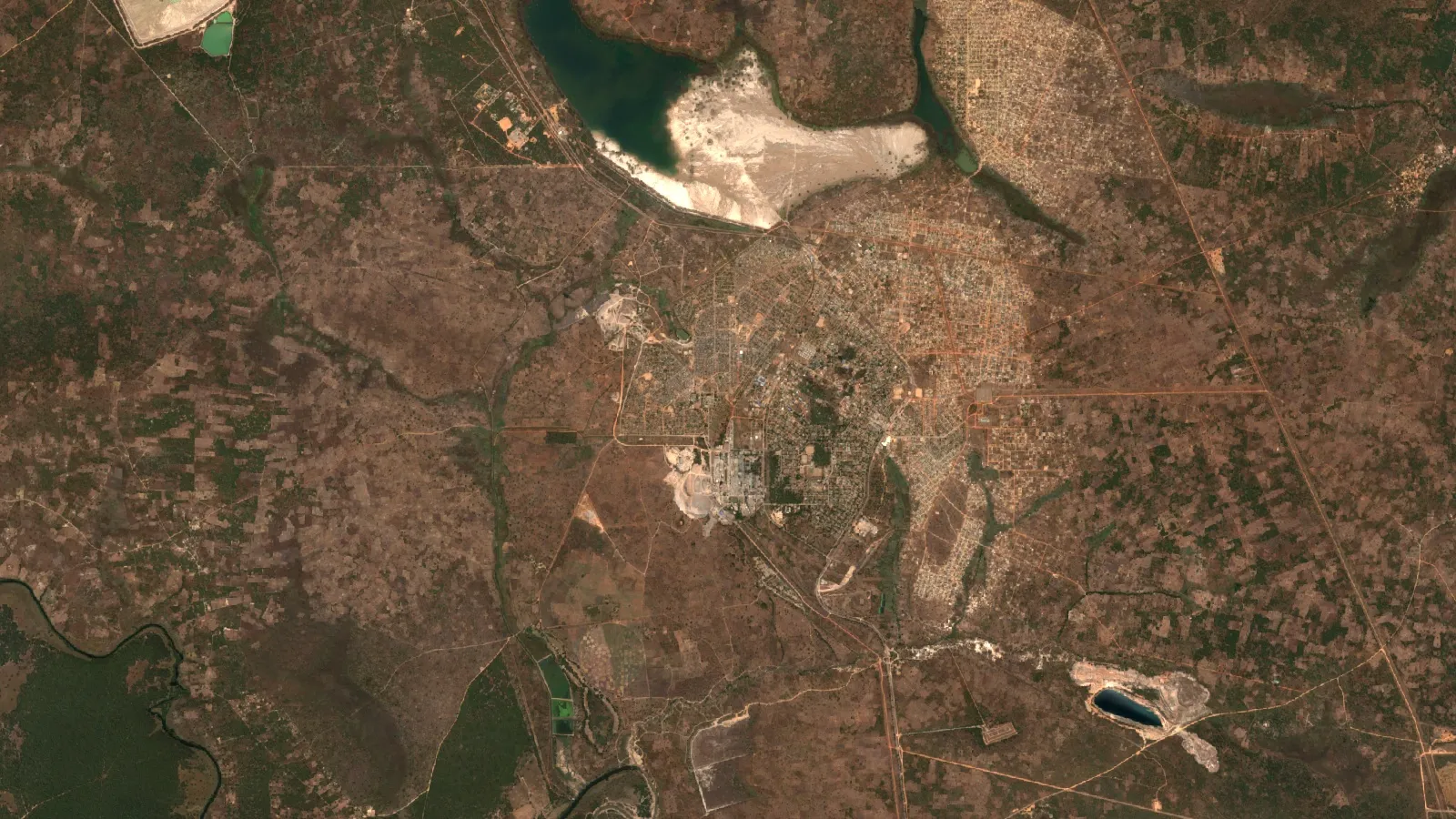
- The largest example is KoBold Metals’ Mingomba copper project in Zambia, where shaft construction began in April 2026: KoBold puts the investment above $2 billion and targets about 300,000 tonnes of copper a year, with first output in the early 2030s (KoBold Metals, May 2026). It is a company statement about a mine that is not yet producing, so it shows where AI targeting led, not what the project will return.
- The US Geological Survey says one critical-mineral assessment typically takes about two years to prepare, partly because about 90% of its map data are scanned images of paper maps (USGS, December 2022).
- DARPA’s CriticalMAAS program aims to build AI and machine learning tools that speed up that USGS assessment workflow (DARPA).
Satellite-driven analytics platforms — including Farmonaut’s — are one route into this workflow: they rank candidate exploration targets by fusing multispectral imagery with geospatial ML, without requiring a proprietary drone fleet or in-house data science team.
2. Autonomous Machinery & Intelligent Fleet Management
Autonomous haul trucks are in service at large operations on several continents. Two sourced data points show the scale. Komatsu said in April 2026 that it had commissioned its 1,000th autonomous ultra-class haul truck, and that its customers have moved over 11.5 billion tonnes with them (International Mining, 21 April 2026). Rio Tinto said in January 2018 that its autonomous trucks ran 700 hours longer in 2017 and at 15% lower unit costs than manned ones, and that no injuries had been attributed to them since the 2008 trial (Rio Tinto, via Mining.com).
- Autonomous systems remove personnel from the highest-hazard zones of a mine — the single largest safety lever in this list.
- Onboard and remote sensor data, processed through machine learning, drives failure prediction and maintenance scheduling.
- IoT connectivity ties fleet data to resource allocation, letting operators optimize fuel use and haul routes in real time.
Explore our Fleet & Resource Management tools for route optimization, equipment tracking, and compliance reporting.
3. Automated Ore Sorting & Grade Optimization
Ore sorting uses computer vision and sensor fusion — spectrometers, X-ray fluorescence detectors, LIDAR — to separate valuable ore from waste rock on the conveyor line, in real time. The clearest figure in the sources we opened is for AI process control in the mill, which sits next to sorting in a processing circuit: Freeport-McMoRan is reported to have raised annual copper output by 90,000 tons with no new processing facilities and cut costs by about 10% (Smartdev, 2025; company case).
- Rejecting waste rock before the mill means less material moved, crushed and stored, which saves energy and water as well as processing cost.
- Integration with blockchain-based traceability adds supply-chain transparency; see Farmonaut’s Traceability Tools.
- Grade optimization matters most for low-concentration, high-value ore — gold recovery economics depend on catching marginal-grade material that manual sorting would miss.
4. Predictive Maintenance & Real-Time Equipment Health Monitoring
Predictive maintenance analyzes vibration, telemetry, and sensor data from haul trucks, drills, and conveyors to flag failures before they happen. Smartdev’s mining use-case review says these models learn normal equipment behavior and flag anomalies that often come before a mechanical failure, so crews can step in before a breakdown (Smartdev, 2025). It gives no single downtime figure that applies across operations, so ask any vendor for results from a comparable fleet.
- Anomaly detection triggers maintenance alerts automatically, shifting crews from reactive repair to scheduled service.
- Reduced unplanned downtime keeps haul trucks, crushers, and conveyors running at planned capacity instead of idle during unscheduled fixes.
Modern AI mining apps push these alerts to mobile dashboards for on-site and remote engineers — see Mining & Infrastructure Management for how this looks on web and mobile.
5. AI for Resource Optimization & Environmental Monitoring
AI in mining extends past extraction economics into environmental compliance. Platforms combine satellite and ground-sensor data to track energy use, water consumption, emissions, and land condition, then apply predictive analytics to forecast risks like tailings dam instability or groundwater contamination before they become incidents.
- Post-mining land rehabilitation increasingly relies on satellite-monitored soil quality and vegetation-regrowth data to guide restoration planning.
- Carbon-footprint tracking supports both voluntary ESG reporting and mandatory regulatory filings.
Our carbon footprinting module lets mining operators measure and report these metrics directly.
6. AI-Driven Safety & Hazard Management
Edge AI cameras, wearable health monitors, and IoT ground-movement sensors give operations managers real-time visibility into hazards — air quality, rockfall risk, worker fatigue — before they become incidents. This is the application most directly tied to the autonomous-vehicle safety gains in Section 2: removing people from active haul routes and blast zones is still the single largest reduction in exposure to mining’s most dangerous conditions.
7. Integrated AI-Driven Decision-Making Ecosystems
The most advanced deployments combine machine learning, IoT, and blockchain traceability into one platform — sometimes called a digital twin of the mine — covering exploration, extraction, processing, logistics, safety, and environmental compliance in a single system. For large-scale, multi-site operations, this is the tier that replaces a patchwork of single-purpose tools with one dashboard.
See our Large-Scale Mining Operations Management suite for this integrated tier.

▶ AI in mineral exploration: what it does, where it fails and how to check a vendor’s claim. · 4:37
How to Download an AI Mining App (Android, iOS, Web, API)
If you searched “ai mining app download,” “ai mining apk,” “ai miner app,” or “aimining.app” looking for a working tool rather than a market report, here’s where to get one. Farmonaut’s mining platform is available on all four channels below — there is no separate .apk distributed outside the Google Play Store, since sideloaded APKs from third-party sites carry security risk and are not an official distribution channel for this app.
Developers can access satellite and AI mining data directly via the
Farmonaut API,
with onboarding through our
API Developer Docs.
AI mining software: three kinds you can get
The tools behind the headlines are sold or used in three different ways, so “AI mining software” can mean three things.
- Fleet and mine automation comes from equipment makers and is bought with the machines. Komatsu’s FrontRunner autonomous haulage system is one example (International Mining, April 2026).
- Exploration targeting by AI explorers: KoBold Metals and Earth AI (a self-described predictive explorer and driller) use their own software on their own projects rather than selling it as an app (KoBold Metals).
- Satellite and data screening is sold to licence owners and consultants as a report or a platform. Farmonaut’s mineral detection starts from a licence boundary in KML, KMZ or polygon form and returns ranked satellite exploration targets, usually in 5 to 20 business days.
Before you pay for any of them, ask five questions:
- Does it find deposits or run a mine? Pick the job first.
- What result can the maker show on a project like yours, and who measured it?
- What data does it need, and do you already hold it?
- Is the output a ranked target list? A target is not a resource estimate under JORC or NI 43-101, and drilling and sampling still decide.
- What is the all-in cost, per project or per seat?
For how targets get ranked, see our guides to exploration targeting and mineral prospectivity mapping.
Farmonaut’s Satellite and AI Mining Tools
Farmonaut provides satellite-driven AI solutions for mining across web, Android, iOS, and API, combining multispectral satellite imagery, AI-based advisory, blockchain traceability, and resource management.
- Satellite-Based Mining Monitoring: Track mineral sites, environmental condition, and resource utilization from orbit.
- Satellite mineral detection: ranked exploration targets for a licence boundary you supply as KML, KMZ or a polygon.
- Blockchain Traceability: Trace minerals across the supply chain — see Traceability Solutions.
- Fleet & Resource Management: Equipment and resource tracking.
- Environmental Impact Monitoring: Carbon footprint, land restoration, and emissions tracking via our Carbon Monitoring Platform.
Compare subscription packages below:
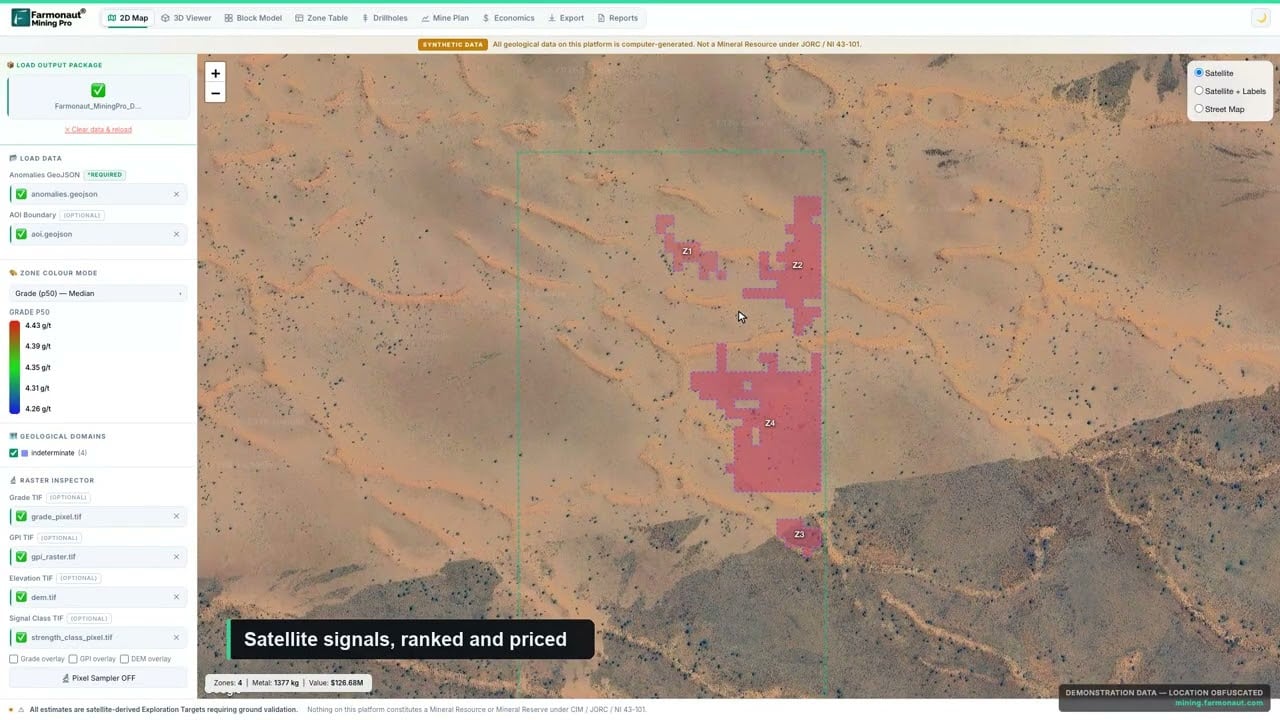
▶ A quick look at Farmonaut Mining Pro, which turns a licence boundary into a satellite geological and economic picture. · 4:56
Discovery Is Only Half the Story: US Permitting Timelines
Every figure above measures how much faster AI finds a deposit or runs a mine — not how fast that discovery becomes a producing operation. In the United States, S&P Global Market Intelligence put the average time from first discovery to first production at almost 29 years (June 2024), the second longest of the countries it compared after Zambia at 34 years. Canada averaged 27 years and Australia 20. That gap is structural — it reflects federal and state environmental review, water rights, and land-use processes that AI targeting does not shorten. Anyone evaluating an AI mining app’s ROI on a US project should model the permitting timeline separately from the exploration-cost savings; a cheaper discovery phase does not compress the queue behind it. The S&P figure assumes that US properties not yet producing start by 2030, so it measures history, not a forecast for your project.
Chart
Years from discovery to first production
Average in four selected countries, in years (US figure assumes non-producing US properties start by 2030)
The gap differs by metal. In the same S&P Global data, gold mines take the shortest time to develop at 20.8 years worldwide, against 24.2 years in the US. Copper takes 24.1 years worldwide and 31.8 years in the US (S&P Global Market Intelligence, June 2024). An AI tool that cuts months from exploration works on the first slice of that timeline.
Chart
Years from discovery to first production, by metal
World average against US average, in years
Calculator: Exploration Cost Savings from AI-Guided Targeting
Enter your planned exploration budget and drilling program to estimate potential savings from AI-guided targeting, based on your own assumption for how many holes screening lets you skip.
Assumptions: the calculator applies the share of holes you expect to skip to your drilling budget and subtracts the cost of the screening work. It does not model permitting costs, land access, commodity-specific drilling costs, or the discovery-success-rate difference (75% vs. under 1%) described above — those depend on deposit type, jurisdiction, and the specific AI platform used, and should be modeled separately with a geologist or exploration cost estimator.
Calculator
What could screening first save on a drill programme?
Enter your own drill plan and your own guess for how many holes screening lets you skip.
- Drill holes skipped: 8.0
- Drilling budget before screening: $2,400,000
- Net saving as share of budget (%): 18.8
Example values only, not a benchmark or forecast. The share of holes skipped is your own assumption; no published average is used. All money is in US$.
FAQs
-
What is an AI mining app?
Software that applies machine learning and satellite or sensor data to mining tasks — deposit discovery, autonomous equipment control, ore sorting, predictive maintenance, safety monitoring, and environmental compliance — available via web, mobile, or API. -
Where can I download an AI mining app?
Farmonaut’s mining platform is available via web, the Google Play Store for Android, and the Apple App Store for iOS. There is no separate .apk file distributed outside the official Play Store listing. -
How does AI in mining exploration actually improve discovery odds?
By fusing satellite, hyperspectral, and geophysical data through machine learning models that flag high-probability target zones. Earth AI reports a 75% discovery success rate this way, versus under 1% for traditional exploration (AzoMining); a 2021 arXiv review found that machine learning on remote sensing data works well for mapping geological features, though it gives no single saving figure. -
How are AI mining apps different from legacy mining software?
Legacy software stores and displays data. AI mining apps use live, often cloud-connected pipelines that learn from operational data to predict outcomes and, in some cases, act autonomously. -
Does finding a deposit faster mean a mine opens faster?
Not in the US. S&P Global Market Intelligence puts the US average from discovery to first production at almost 29 years (June 2024) — exploration speed and permitting speed are separate bottlenecks. -
Are AI mining apps suitable for small or medium mining companies?
Some do. A licence owner can start with a satellite screening report instead of building an in-house data system. -
Do you offer API or data integration for custom mining applications?
See our API page and API documentation. -
Where can I find more about Farmonaut’s mining solutions?
Explore via web, Android, and iOS, or contact us for a demo.
Further reading:
What is the best AI software for mining?
It depends on the job. For hauling, equipment makers such as Komatsu sell autonomous systems with their trucks. For finding deposits, KoBold Metals and Earth AI describe themselves as explorers that use their own AI on their own projects. For a licence owner who wants a first look at a boundary, a satellite screening report is the usual starting point.
Does AI in mining replace geologists?
The sources we opened describe AI as working with geologists. KoBold Metals calls its model AI-and-HI-driven, meaning artificial plus human intelligence (KoBold Metals, May 2026), and a geologist still has to check a target in the field.
Is an AI mining app the same as crypto mining?
No. AI in mining means machine learning applied to ore, equipment and imagery. Be careful with apps that promise guaranteed returns from AI, which the CFTC flagged as a common fraud pattern in January 2024.
Conclusion
AI mining apps now span two real, separate use cases: platforms that find deposits (with a company-reported 75% success rate against under 1% for conventional exploration (Earth AI, via AzoMining)) and platforms that run active mines more efficiently (Komatsu has commissioned 1,000 autonomous ultra-class trucks, and Rio Tinto reported 15% lower unit costs for autonomous hauling in 2017). Both categories are growing; one vendor sizes AI-powered exploration technology at about $1.7 billion in 2025, heading toward $8.9 billion by 2034. The durable check for any reader evaluating a specific tool: ask which of the seven applications above it actually covers, ask for the study behind its efficiency claim rather than a rounded industry average, and if you’re in the US, model the permitting and development timeline separately (S&P Global’s US average runs almost 29 years from discovery to production) from whatever exploration-cost savings the app promises.
This page is for information only. It is not investment advice. Market figures are vendor forecasts. Satellite and AI results are exploration targets, not resource estimates under JORC or NI 43-101.
Farmonaut mining
Get a quote for a satellite mineral screen
Send your licence boundary as KML, KMZ or a polygon to see which satellite signals sit inside it before you plan drilling.

Mining Pro sample view, synthetic data
Keep reading
Sources
- International Mining, Komatsu commissions 1,000 autonomous ultra-class trucks (21 April 2026): im-mining.com
- MINING.COM, Rio Tinto autonomous trucks now hauling a quarter of Pilbara material (30 January 2018): mining.com
- KoBold Metals, Breaking ground at Mingomba (21 May 2026): koboldmetals.com
- AZoMining, The Role of AI in Mineral Exploration: azomining.com
- AZoMining, AI in Mining Market: Overview, Trends and Outlook: azomining.com
- MarketIntelo, AI-Powered Mineral Exploration Technology Market: marketintelo.com
- USGS, DARPA announces winners of AI competition to aid critical minerals assessments (16 December 2022): usgs.gov
- DARPA, CriticalMAAS program: darpa.mil
- S&P Global Market Intelligence, Development times of US mines in perspective (June 2024): cdn.ihsmarkit.com
- CFTC, Customer advisory cautions the public to beware of artificial intelligence scams (25 January 2024): cftc.gov
- arXiv, A review of machine learning in processing remote sensing data for mineral exploration (2021): arxiv.org
- Smartdev, AI in mining: top use cases: smartdev.com
- Discovery Alert, AI and mineral exploration success: discoveryalert.com
- PR Newswire, Earth AI press release (20 December 2024): prnewswire.com
Discussion
Questions, corrections or field experience? Share them below. First-time comments are reviewed before they appear, and your email is never published.
No comments yet. Be the first to add a question or your experience.

 Vortex Minerals Pty Ltd
 Faith At Work (Pty) Ltd
 Geotech Mining Solutions plc
 Vulcan International Limited
 Kidepo Associates
 GKY Mining
 Alkimy SARL
 Double A Trading
 GemSprout Metals Limited
 Qader Group
 Ileys General Trading
 SG Gold Mining LLC
 VRV Global Pte Ltd
 Omsri International FZE
 G.I.T.T.
 Jaunita Erss Ltd
 Almosi SARL
 SRK Consulting
 Berks Gold Limited
 Mwerezi Minerals Company Limited
 Mining SARL
 SenGold Invest SAS

 Exploration consultancy · South Africa · Gold










