
Gold · West Africa
West Africa Gold Mining: Palm Oil Roots to Top Producers
From James Irvine’s 1880s Gold Coast concessions to Ghana’s record 2025 output: production by country, six listed miners with tickers and dated figures, mining-code changes and a consultant’s checklist. Facts only, not investment advice.
Key takeaways
- The best-documented palm-oil-to-gold case is James Irvine of Liverpool, ‘formerly of the West African Oil-rivers’, whose Gold Coast concessions Burton and Cameron toured in 1882.
- Ghana mined a record 5.94 million ounces in 2025, and small-scale miners produced about 52% of it (Ghana Chamber of Mines).
- Endeavour Mining produced 1,209,000 ounces in 2025, all from mines in Burkina Faso, Côte d’Ivoire and Senegal.
- Barrick regained Loulo-Gounkoto after a November 2025 settlement with Mali; GlobalData expects Mali’s output to rise 28% in 2026.
- Company facts come from filings; nothing here is a recommendation. Not investment advice.
In this article
- Who was the palm oil company turned gold mining in West Africa?
- From trading houses to listed gold miners
- West Africa gold production by country
- Gold mining in Ghana: small-scale output overtakes large mines
- Mali, Burkina Faso, Guinea and Côte d'Ivoire: what changed
- Gold mining companies in West Africa compared
- Royalties, mining codes and state stakes
- The West Africa gold mining chemical market
- What consultants should check before advising on a West African gold project
- Gold price and what West African ounces are worth
- Satellite monitoring for West African gold sites
- Frequently asked questions
The best-documented case of a palm oil trader turning into a West African gold miner is James Irvine of Liverpool. Richard Burton and Verney Lovett Cameron, who toured his concessions in 1882, described him as “formerly of the West African ‘Oil-rivers'” and by then “a large mine-owner in the Gulf of Guinea” (Burton and Cameron, To the Gold Coast for Gold, 1883). The Oil Rivers was the palm-oil trading coast of the Niger delta, so Irvine’s path ran from the oil trade to Gold Coast mining concessions. That path still shapes the region: Ghana, the old Gold Coast, mined a record 5.94 million ounces in 2025 (Ghana Chamber of Mines, via Graphic Online).
This page covers both halves of that story. First the history: who the trading houses were, how palm oil money met gold concessions, and which company from that era survives today. Then the modern industry: production by country, the listed companies that run the large mines, the royalty and mining-code changes of the last two years, the chemical supply side, and a checklist for consultants who advise on a West African gold project. A value calculator sits near the end.
Who was the palm oil company turned gold mining in West Africa?
In the nineteenth century the coast from Sierra Leone to Cameroon was run commercially by trading houses from Liverpool, Bristol, London, Hamburg and Marseille. After the slave trade was abolished, palm oil became their main export. Factories in Britain used it for soap, candles and machine grease, and the trade was so concentrated in the Niger delta that British traders called the creeks there the “Oil Rivers”.
James Irvine was one of those merchants. By late 1881 he held gold concessions in the Gold Coast Colony, in what is now western Ghana, and he invited Burton, the explorer and consul, to inspect them. Burton writes that Irvine “proposed to me a tour with the object of inspecting his concessions” in the autumn of 1881, and the two explorers sailed early the next year (Wikisource text, Chapter I). Their two-volume book, published in 1883, was partly travel writing and partly a prospectus for investors in London.
So when people search for a palm oil company that turned into a gold miner in West Africa, the historical record points to this group of Liverpool oil traders and their promoters, with Irvine as the named, sourced example. The pattern was simple: a merchant already had ships, agents, credit and relations with coastal chiefs; a gold concession was one more trade good to buy from local owners and sell to London shareholders.
How big was that first gold boom?
Burton’s preface gives a snapshot. The Ancobra (Ankobra) river valley, a strip of about 26 miles of coastline by 60 miles inland, “now (early 1882) contains five working companies”, and upwards of seventy concessions had been obtained from native owners (Burton and Cameron, Preface). The Ankobra valley runs through the Tarkwa area, which is still one of Ghana’s main gold districts and the site of Gold Fields’ Tarkwa mine today.
Many of those first companies were small and short-lived. The lasting company came 15 years later. The Ashanti Goldfields Corporation was founded by Joseph Ellis and Joseph Biney, both from Cape Coast, and its mine at Obuasi has produced since 1897 (Wikipedia, Ashanti Goldfields Corporation). Around 1900 it was among the most important gold companies listed in London. In 2004 it merged with AngloGold to form AngloGold Ashanti, which still runs Obuasi.
Did the big palm oil firms go into gold?
Mostly not. The largest palm oil business of the colonial era moved the other way, into plantations, shipping and retail. William Hesketh Lever, the soap maker, entered the West Africa trade to secure palm oil and bought the Royal Niger Company in February 1920, just before palm kernel oil fell from £115 a ton in February to £55 a ton in July 1920 (Wikipedia, United Africa Company). That business became the United Africa Company, a trader rather than a miner. The oil-to-gold crossover belongs to individual merchants and promoters such as Irvine, not to the large soap and trading groups.
From trading houses to listed gold miners
The structure of the industry has changed three times since Irvine’s day:
- Merchant concessions (1870s to 1890s): traders and promoters bought concessions from chiefs and floated companies in London. Capital was speculative and most companies failed or merged.
- Colonial and state mining (1900s to 1980s): railways reached Tarkwa and Obuasi, a few large companies such as Ashanti Goldfields dominated, and after independence several governments took large stakes.
- Listed miners and artisanal growth (1990s to today): new mining codes opened the region to companies listed in Toronto, New York, London and Sydney, while artisanal and small-scale mining (ASM, meaning individuals or small teams working with simple tools and little or no mechanisation) grew alongside them.
The third phase is now shifting again. Governments in Mali, Burkina Faso and Ghana have rewritten mining codes, raised state stakes or taken back mines, and Ghana has centralised the buying of artisanal gold. Those changes are covered below.
West Africa gold production by country
Ghana is the anchor. The U.S. Geological Survey estimates Ghana mined 149 tonnes of gold in 2024 and about 150 tonnes in 2025, with reserves of 1,000 tonnes (USGS Mineral Commodity Summaries 2026, Gold). That put Ghana in the world’s top ten in the USGS table, close to the United States (160 tonnes) and Mexico (140 tonnes). The national Chamber of Mines reports a higher 2025 figure because it counts formalised artisanal gold bought by the state (see the next section).
Chart
Ghana against other leading gold producers, 2025
Tonnes of gold mined, USGS estimate
USGS groups Mali, Burkina Faso, Guinea, Côte d’Ivoire and Senegal under “other countries”, so national ministries and analysts are the sources for them. GlobalData’s regional review of June 2026 gives the direction of travel for each (Mine magazine / GlobalData, July 2026):
| Country | Main large mines | What changed | GlobalData outlook for 2026 |
|---|---|---|---|
| Ghana | Ahafo, Obuasi, Tarkwa, Namdini, Edikan, Bibiani | Record 2025 output led by formalised small-scale gold; Damang returned to the state | Growth of 5.9% |
| Mali | Loulo-Gounkoto, Fekola, Syama, Sadiola | 2025 output cut sharply by the Loulo-Gounkoto dispute | Growth of 28% as Loulo-Gounkoto restarts |
| Burkina Faso | Houndé, Mana, Essakane, Kiaka | State stakes raised; several mines nearing closure | Growth of 7%, driven by Kiaka |
| Guinea | Siguiri, Lefa, Kiniero | Kiniero began production in late 2025 | Rebound expected |
| Côte d’Ivoire | Ity, Lafigué, Yaouré, Séguéla | Steady new-mine additions | Expected to pass Mali as West Africa’s third-largest producer |
| Senegal | Sabodala-Massawa, Mako | Underground expansion at Sabodala-Massawa | Supported by Makabingui and Diamba Sud |
GlobalData also expects the smaller producers (Côte d’Ivoire, Niger, Liberia, Senegal and Sierra Leone) to grow by 3.8% together in 2026. For a wider ranking, see our guide to the major gold producing countries and the map of gold mines in the world.
Gold mining in Ghana: small-scale output overtakes large mines
Ghana’s 2025 numbers are the biggest change in the region. The Chamber of Mines annual report puts national output at 5.94 million ounces, up 23.41% from 4.82 million ounces in 2024. Small-scale mining rose from 1.9 million ounces to 3.11 million ounces, about 52% of the total (Graphic Online, 2025 annual report). Earlier provisional data reported by Reuters rounded the total to 6 million ounces and put large-scale mines at 2.9 million ounces, unchanged from 2024 (Kitco / Reuters, 12 February 2026).
Chart
Ghana gold output by source, 2024 and 2025
Million ounces
Part of the jump is real new mining and part is gold that used to leave the country unrecorded. The Chamber of Mines told Reuters that Ghana’s state gold-buying programme had reduced smuggling, drawing more small-scale output into the official figures (Kitco / Reuters). For anyone working with Ghanaian statistics, that means 2025 is not directly comparable with earlier years: the 2024 to 2025 change mixes production growth with better recording.
On the large-scale side, the industry body said stable output reflected ramp-ups at Cardinal Namdini (owned by the Shandong Gold group) and Newmont’s Ahafo North, offset by declining grades at older mines including Gold Fields’ Damang (Kitco / Reuters). Grade here means the amount of gold per tonne of rock, usually written in grams per tonne (g/t); as grade falls, a mine must move more rock for the same ounces.
Ghana’s artisanal sector has a darker side as well. Unlicensed mining, known locally as galamsey, has damaged rivers and farmland, and much small-scale gold is still recovered with mercury. A 2023 review of global estimates gives a sense of scale for neighbouring countries: about 88% of Mali’s and 60% of Guinea’s artisanal gold was reported as produced with mercury (Mercury and ASGM review, PMC). Our guide to artisanal gold mining covers the sector in more depth.
Mali, Burkina Faso, Guinea and Côte d’Ivoire: what changed
Mali: the Loulo-Gounkoto dispute and restart
Loulo-Gounkoto, in western Mali, is Barrick’s main West African asset. A dispute over the 2023 mining code led the state to place the complex under provisional administration in 2025. On 24 November 2025 Barrick and the government signed an agreement to settle all disputes: charges against Barrick and its staff were to be dropped, four detained employees released, provisional administration ended and operating control returned to Barrick, which withdrew its arbitration claims (Mining Technology, November 2025). On 13 February 2026 Mali renewed the Loulo licence for 10 years; under the previous arrangement the state held 20% of Loulo and Barrick 80% (Ecofin, 16 February 2026). Barrick’s second-quarter 2026 report described the Loulo-Gounkoto ramp-up as ahead of schedule (Barrick Q2 2026 results).
Security is the other risk. GlobalData notes a January 2026 attack on the Morila gold mine as an example of the challenge of reviving production in unstable areas.
Burkina Faso: state stakes and closures
Burkina Faso has raised the state’s role in the sector, and several foreign companies have sold mines there. Endeavour Mining still runs Houndé and Mana. GlobalData expects 2026 growth of 7% from West African Resources’ Kiaka project, but a weaker long-term outlook as Essakane, Bomboré, Yaramoko and Boungou approach planned closure.
Guinea, Côte d’Ivoire and Senegal
Guinea’s rebound rests on the new Kiniero mine and better performance at AngloGold Ashanti’s Siguiri, although GlobalData flags scheduled closures at Lefa, Kiniero, Tri-K and Kouroussa after 2030. Côte d’Ivoire has added mines steadily over the last decade (Ity, Yaouré, Lafigué, Séguéla) and is expected to overtake Mali in 2026. Senegal’s growth comes from Sabodala-Massawa’s underground expansion and new projects at Makabingui and Diamba Sud.
Gold mining companies in West Africa compared
The table lists the main listed companies running large West African gold mines, with exchange, ticker, West African assets and the latest dated figure from each company’s own filing. It gives facts, not ratings; it does not say which share to buy, hold or sell.
Chart
Endeavour Mining output by mine, 2025
Thousand ounces of gold
| Company (exchange: ticker) | West African mines | Latest dated figure |
|---|---|---|
| Endeavour Mining (LSE / TSX: EDV) | Houndé, Mana (Burkina Faso); Ity, Lafigué (Côte d’Ivoire); Sabodala-Massawa (Senegal) | 1,209,000 oz in 2025; 2026 guidance 1,090,000 to 1,265,000 oz |
| Newmont (NYSE: NEM) | Ahafo South, Ahafo North (Ghana) | Ahafo South 664,000 oz and Ahafo North 70,000 oz in 2025; Akyem sold in Q2 2025 |
| AngloGold Ashanti (NYSE: AU) | Obuasi, Iduapriem (Ghana); Siguiri (Guinea) | Obuasi 266,000 oz in 2025 |
| Barrick Mining (NYSE: B; TSX: ABX) | Loulo-Gounkoto (Mali) | Ramp-up ahead of schedule in Q2 2026; Tongon (Côte d’Ivoire) sold in Q4 2025 |
| Gold Fields (NYSE: GFI) | Tarkwa (Ghana) | Tarkwa 192,000 oz in H1 2026; Damang transferred to the state in April 2026 |
| Perseus Mining (ASX: PRU) | Edikan (Ghana); Sissingué, Yaouré (Côte d’Ivoire) | Three African gold mines in operation; Nyanzaga (Tanzania) first gold targeted January 2027 |
Sources: Endeavour FY-2025 results; Newmont Q4 2025 operating statistics; AngloGold Ashanti 2025 annual report; Barrick Q2 2026 results; Gold Fields H1 2026 results; Perseus Mining operations page.
How we chose the companies
We included listed companies that operate at least one large, producing gold mine in West Africa and publish mine-by-mine production. Mine owners that are not listed on a major Western exchange or that do not report West African output separately (state companies, several Chinese and Russian groups, and private miners) are named in the country table instead. Order is by the scale of West African output in the latest company figures, with Endeavour first because all of its mines are in the region. For a global ranking, see the top 20 gold mining companies and our list of leading gold mining companies.
Endeavour Mining: the largest pure West African producer
Endeavour produced 1,209,000 ounces in 2025 at an all-in sustaining cost (AISC, the cost of producing an ounce including sustaining capital and overheads) of US$1,433 per ounce; the company said it met guidance on a royalty-adjusted basis. Ity in Côte d’Ivoire was the largest mine at 319,000 ounces, followed by Sabodala-Massawa at 274,000 ounces (Endeavour FY-2025 release). In the first half of 2026 it produced 564,000 ounces at an AISC of US$1,871 per ounce and said it remained on track for guidance (Endeavour Q2-2026 release). Its 2025 release lists higher royalty costs among the cost drivers; royalties rise with the gold price.
Royalties, mining codes and state stakes
Every West African gold mine pays a royalty, a payment to the state calculated on gross revenue rather than profit. Rates and state stakes have risen since 2023:
- Ghana: large-scale miners paid a 5% royalty on gross revenue and 35% corporate income tax, according to the Chamber of Mines, when the government said in January 2026 that it would rewrite the mining law for a bigger share of gold revenue (EWN / Reuters, 29 January 2026). GlobalData describes a sliding-scale royalty, which rises with the gold price, as part of that tightening.
- Mali: the 2023 mining code raised the state’s potential stake and royalties; settling the Barrick dispute included Barrick agreeing to sign on to it, according to people familiar with the deal cited by Reuters.
- Burkina Faso: a revised code and a national mining company have increased state participation.
- Licence renewals: Ghana did not renew Gold Fields’ Damang lease and took control of the mine; Tarkwa’s lease renewal is the next item GlobalData flags.
For a consultant, the practical point is that the fiscal terms in a five-year-old study rarely match today’s. Any valuation should be rebuilt on the current code, the current state stake and the royalty at today’s price.
The West Africa gold mining chemical market
Large West African gold mines recover gold with cyanide. Ore is crushed and ground, mixed with a weak sodium cyanide solution that dissolves the gold, and the gold is then caught on activated carbon (the carbon-in-leach or carbon-in-pulp process) before being stripped, smelted and poured as doré bars. Lime controls the acidity of the slurry, and flotation reagents are used where the gold sits inside sulphide minerals. Our guides to gold extraction methods and chemicals used in gold mining explain each step.
Chemical demand follows tonnes processed rather than ounces produced. When grades fall, as at Ahafo South and Tarkwa, a mine must treat more ore for the same gold, so reagent use per ounce rises. Higher gold prices push the same way: they make lower-grade ore economic, which adds tonnes to the mill. No public source breaks out the dollar size of the regional reagent market, so suppliers’ annual reports and national import statistics are the closest checks.
The artisanal sector is a separate chemical market: it relies on mercury. Ghana, Mali and Burkina Faso have all ratified the Minamata Convention on Mercury (Minamata Convention, list of parties), and countries with significant artisanal gold mining prepare national action plans to cut mercury use (review of national action plans, PMC).
Regulation of mining chemicals
Regulators in the region control cyanide mainly through environmental permits and licence conditions rather than a single regional standard. Common requirements are:
- a cyanide management plan as a condition of the environmental permit;
- controls on chemical storage, transport and tailings disposal, with inspection by the national environmental agency;
- engineered tailings storage facilities with monitoring of seepage into groundwater and rivers.
Problems still happen at large mines. AngloGold Ashanti’s 2025 annual report describes management’s response to a seepage event at Iduapriem and the suspension of its plant there for part of the year. Independent site evidence, such as satellite images of tailings extent and nearby water, is a useful cross-check on any operator’s compliance statement.
▶ How gold is mined and refined, step by step, from rock to bar. · 5:27
What consultants should check before advising on a West African gold project
Most of the readers who contact us about West African gold are consultants, licence holders and investors’ technical advisers. These steps are the checks that change a recommendation most often:
- Confirm the licence in the national cadastre. Each country keeps its own register (Ghana’s Minerals Commission, Mali’s mines ministry, Burkina Faso’s mines ministry). A licence valid in one country gives no standing in another, and there is no regional database.
- Rebuild the fiscal model. Apply the current mining code, royalty and state stake, not the terms in the original study.
- Check renewal dates. Damang shows that a lease can lapse to the state at renewal. Note when each licence expires and what the code says about renewal.
- Map artisanal activity on and around the licence. With small-scale mining now more than half of Ghana’s gold, overlapping pits are common. They affect community relations, environmental liability and the ore left to mine.
- Review security. In the Sahel, attacks on mines and supply routes have halted production. Use current security assessments, not historical output, to judge continuity.
- Check processing and water. Confirm the plant route, cyanide management, tailings design and water licence. Seepage events carry clean-up cost and permit risk.
- Look at the ground first. Before field visits, screen the licence on satellite imagery for access roads, existing pits, vegetation loss and alteration zones. Our gold claims guide shows the same first step for a small claim in Canada.
Supply chains add their own checks: reagent delivery times, fuel, spare parts and export logistics. Our note on supply chain challenges in gold mining covers them.

▶ Can a foreigner get a small-scale mining licence in Africa? The routes that are open. · 5:16
Gold price and what West African ounces are worth
Gold averaged US$3,442 per ounce in 2025, up from US$2,388 in 2024 (World Bank Pink Sheet annual prices, October 2026). Kitco quoted a spot bid of US$4,123.60 per ounce at 7:57 a.m. EDT on 20 October 2026 (Kitco quote via Depor). At that spot price, Ghana’s 5.94 million ounces of 2025 would be worth about US$24.5 billion gross, before costs, royalties and tax.
Chart
Gold annual average price, 2019 to 2025
US$ per troy ounce, nominal
Higher prices raise royalty payments and state interest in the sector at the same time, which is part of why mining codes have been rewritten. The calculator below turns an output figure into gross value, royalty and margin over AISC; use it for a single mine, a company or a country. Our overview of gold mining industry statistics puts the regional numbers in a global context, and seven trends in the gold mining industry covers the wider drivers.
Calculator
What is a year of West African gold output worth?
Enter ounces for a mine, a company or a country.
- Royalty to the state (US$ million): $205
- Margin after AISC and royalty (US$ million): $2,295
- Margin per ounce (US$): 2,295
Example values only. The gold price is an example, use today’s price. Royalty is applied to gross revenue; corporate tax, state dividends, hedging and capital spending are excluded.
Satellite monitoring for West African gold sites
Satellite imagery helps with three of the checks above: spotting artisanal pits and new clearings on a licence, tracking tailings and water bodies over time, and screening ground for alteration before drilling. Farmonaut provides satellite-based mineral screening and site monitoring through its mining platform; the company’s wider tools, including carbon footprinting, fleet management, product traceability, the admin app, the mobile app and the satellite and weather API (developer docs), are listed on the Farmonaut home page.
▶ Seven environmental impacts of mining, explained in clay. · 2:31
Frequently asked questions
Which palm oil company turned to gold mining in West Africa?
The best-documented example is James Irvine of Liverpool, a former palm oil trader in the Niger delta’s “Oil Rivers” who by 1881 held gold concessions on the Gold Coast. Burton and Cameron toured his concessions in 1882 and described him in their 1883 book.
What was the Oil Rivers?
It was the British traders’ name for the creeks and river mouths of the Niger delta, the centre of the nineteenth-century palm oil trade. The area later became the Oil Rivers Protectorate, part of today’s Nigeria.
Which is the oldest gold mining company in West Africa still producing?
The Obuasi mine of the former Ashanti Goldfields Corporation has produced since 1897. Ashanti merged with AngloGold in 2004, and AngloGold Ashanti still operates Obuasi, which produced 266,000 ounces in 2025.
Which country produces the most gold in West Africa?
Ghana. USGS estimates about 150 tonnes for 2025, and the Ghana Chamber of Mines reports 5.94 million ounces including formalised small-scale gold. Ghana is also Africa’s largest producer.
How much gold does Ghana produce from small-scale mining?
About 3.11 million ounces in 2025, or roughly 52% of the national total, according to the Chamber of Mines. It was the first year in over a century that small-scale miners produced more than large mines, helped by the Ghana Gold Board drawing more gold into official channels.
What are the largest gold mining companies in West Africa?
By West African output, the main listed producers are Endeavour Mining, Newmont, AngloGold Ashanti, Barrick Mining, Gold Fields and Perseus Mining. Endeavour is the only one with all its mines in the region, producing 1,209,000 ounces in 2025.
Is Barrick still mining in Mali?
Yes. Barrick and Mali settled their dispute in November 2025, control of Loulo-Gounkoto returned to Barrick, the Loulo licence was renewed for 10 years in February 2026, and Barrick reported the ramp-up as ahead of schedule in its second-quarter 2026 results.
What royalty do gold miners pay in Ghana?
Large-scale miners paid a 5% royalty on gross revenue plus 35% corporate income tax, according to the Chamber of Mines in January 2026. The government has since moved towards a sliding-scale royalty that rises with the gold price.
What chemicals are used in West African gold mining?
Large mines use sodium cyanide, activated carbon and lime, with flotation reagents for sulphide ores. Artisanal miners mostly use mercury, which national plans under the Minamata Convention aim to reduce.
Why did Mali’s gold output fall?
Mainly because Loulo-Gounkoto, the country’s largest mine, was under provisional administration for much of 2025 during the dispute over the 2023 mining code. GlobalData expects Mali’s output to rise 28% in 2026 as the mine restarts.
Can foreigners get a small-scale gold licence in West Africa?
Usually not directly. In Ghana, the Minerals and Mining Act (Act 703, section 83) reserves small-scale licences for citizens aged 18 or over (Minerals Commission), so foreign investors typically work through larger exploration or mining licences, or through service and partnership roles. Check the current law in each country before committing money.
This page is for information only. It is not investment advice. It rates no company and names no security to buy or sell. Check company filings and speak to a licensed adviser. Anyone prospecting or mining needs the landowner’s permission and a valid licence, and should never use mercury.
Farmonaut mining
Map a West African licence from space
Farmonaut maps alteration, access, artisanal pits and tailings inside a licence boundary, so consultants can rank ground and check site conditions before a field visit.
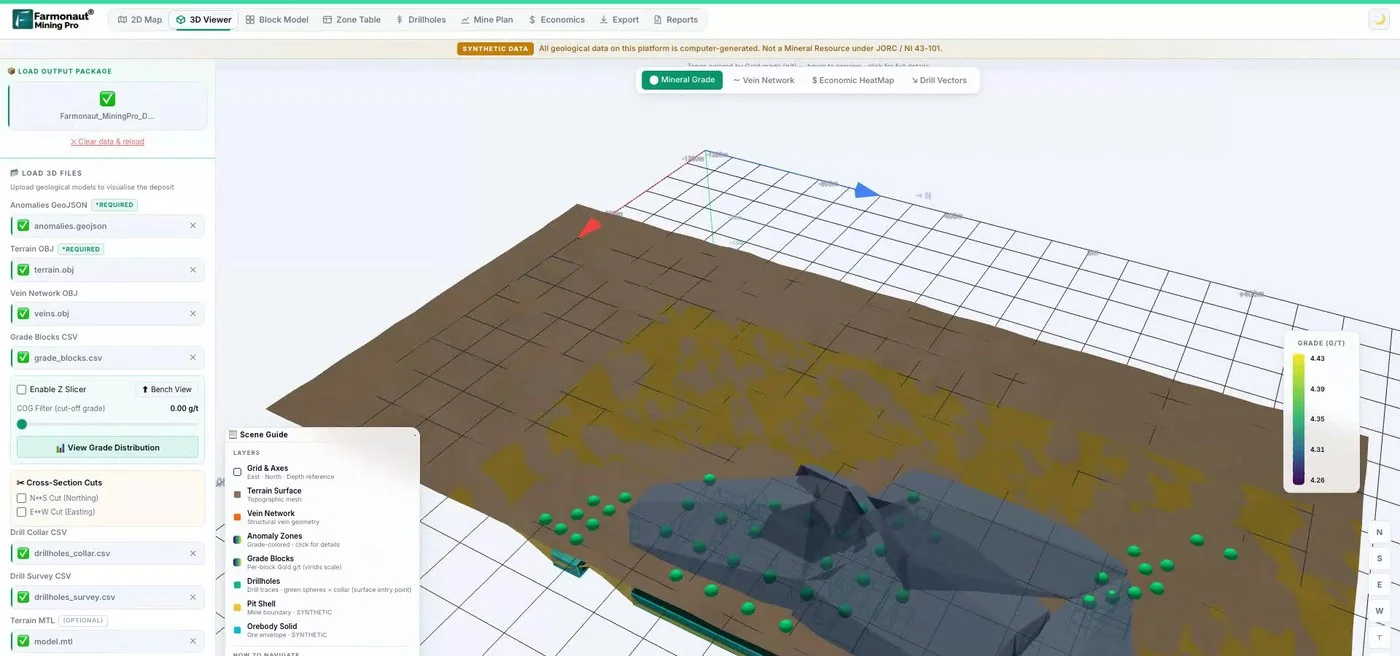
Mining Pro sample view, synthetic data
Keep reading
Sources
- Burton and Cameron, To the Gold Coast for Gold (1883), Chapter I, Wikisource: en.wikisource.org
- Burton and Cameron, To the Gold Coast for Gold (1883), Preface, Wikisource: en.wikisource.org
- Wikipedia, Ashanti Goldfields Corporation: en.wikipedia.org
- Wikipedia, United Africa Company: en.wikipedia.org
- USGS, Mineral Commodity Summaries 2026: Gold: pubs.usgs.gov
- Graphic Online, Ghana records 23.41% increase in gold production in 2025: graphic.com.gh
- Kitco / Reuters, Ghana’s gold output hits record 6 million oz in 2025 (12 February 2026): kitco.com
- Mine magazine / GlobalData, West Africa’s 2026 gold recovery (July 2026): mine.h5mag.com
- Mining Technology, Barrick and Mali strike deal (November 2025): mining-technology.com
- Ecofin, Mali renews Loulo licence for Barrick (16 February 2026): ecofinagency.com
- Barrick Mining, Second Quarter 2026 results: s25.q4cdn.com
- Endeavour Mining, Q4 and FY-2025 results release: edv-14806-s3.s3.eu-west-2.amazonaws.com
- Endeavour Mining, Q2-2026 results release: edv-14806-s3.s3.eu-west-2.amazonaws.com
- Newmont, Q4 2025 operating statistics: s24.q4cdn.com
- AngloGold Ashanti, 2025 annual report: minedocs.com
- Gold Fields, H1 2026 results booklet: goldfields.com
- Perseus Mining, Our operations: perseusmining.com
- EWN / Reuters, Ghana moves to rewrite mining laws (29 January 2026): ewn.co.za
- Mercury and artisanal and small-scale gold mining: review of global use estimates (PMC): pmc.ncbi.nlm.nih.gov
- World Bank, Commodity Markets: Pink Sheet: worldbank.org
- Kitco gold quote, 20 October 2026 (via Depor): depor.com
- Minamata Convention, list of parties: mercuryconvention.org
- Minerals Commission: mincom.gov.gh
Discussion
Questions, corrections or field experience? Share them below. First-time comments are reviewed before they appear, and your email is never published.
No comments yet. Be the first to add a question or your experience.

 SRK Consulting
 Berks Gold Limited
 Mwerezi Minerals Company Limited
 Mining SARL
 SenGold Invest SAS
 Sania Corporation
 Sean Mining Limited
 NTS Group (Pty) Ltd
 Mine4Africa
 Lithspo Minerals Limited
 Tintina Mining Group
 Dalgety Minerals Pty Ltd
 Vortex Minerals Pty Ltd
 Faith At Work (Pty) Ltd
 Geotech Mining Solutions plc
 Vulcan International Limited
 Licence holder · Nigeria · Gold + lithium
 Client · Somalia · Gold