

Agriculture Inventory Management Software: Full Guide
Reviewed August 2026 against USDA NASS Grain Stocks, USDA Economic Research Service, and IMARC Group.
Try it: Run your own numbers →
Table of Contents
- Why Farms Need Inventory Management Software
- The US Farm Software Market: Size and Adoption
- Inventory Software vs. Warehouse, Laboratory, and Asset Systems
- Key Features to Look For
- How Satellite Data Adds Precision to Inventory Planning
- Comparison Table of Leading Platforms
- Grain Storage Utilization Calculator
- How to Select the Right Platform
- Implementation Best Practices
- Frequently Asked Questions
- Conclusion
- Try it: Run your own numbers
Agriculture inventory management software is a digital system that tracks farm inputs (seed, fertilizer, chemicals, fuel, parts) and outputs (grain, livestock, produce) so operators know what they have, where it is, and when to reorder. The category includes general farm inventory software, crop-specific farm grain inventory management software, agricultural warehouse management systems for off-farm storage, and ranch inventory management tools for livestock and feed. This guide covers what each does, what it costs, and how to judge whether it is worth adopting for a US operation.
The Real Cost of Not Tracking Farm Inventory
Manual inventory tracking on spreadsheets or paper breaks down at scale for a specific reason: farm inventory has two clocks running at once — a seasonal clock (inputs bought once or twice a year, applied over weeks) and a storage clock (grain and produce that degrades, requires cycling, or occupies capacity that has a hard ceiling). Missing either clock produces the two classic failures: an unplanned trip to the supplier mid-planting, or grain sitting past its safe storage window.
The scale of US on-farm storage makes the stakes concrete. On-farm grain storage capacity stood at 13.6 billion bushels as of December 1, 2024, according to the USDA National Agricultural Statistics Service (NASS) Grain Stocks report. That sits alongside 7,922 off-farm storage facilities counted in the same report. Total US grain storage capacity across all facility types was 25 billion bushels as of the 2019 measurement, per farmdoc daily’s analysis of USDA NASS data, which also notes that national storage capacity growth has stalled — meaning existing bins and elevators need better utilization tracking, not just more concrete.
Downstream, poor inventory control compounds into waste that is measured at the national level. USDA’s Economic Research Service estimated 133 billion pounds of food went uneaten at the retail and consumer levels in 2010, valued at $162 billion at retail prices — see the USDA ERS Food Loss Data System. The same dataset put average supermarket loss across 31 fresh vegetables at 11.6% in 2016. These are supply-chain-wide figures, not a single farm’s numbers, but they show why buyers, cooperatives, and larger operations increasingly require documented inventory and loss tracking as a condition of contracts.
The US Farm Software Market: Size and Adoption
The US farm management software market — the broader category inventory tools sit inside — was valued at $691 million in 2024 and is forecast to reach $1,751 million by 2033, according to the IMARC Group US Farm Management Software Market report. That is roughly a 2.5x increase over the forecast window. Adoption is already mainstream rather than niche: 63% of US farms used some form of farm management software in 2024, per the same IMARC data reported by Scoop Market’s farm management software statistics roundup. Adoption skews toward larger operations — 68% of farms larger than 400 hectares (roughly 990 acres) had adopted software in 2024, against the 63% all-farm average.
Precision-ag hardware that inventory software increasingly has to integrate with is also widespread: 70% of large-scale crop farms and 52% of midsize farms used guidance autosteer systems in 2023, per USDA’s Agricultural Resource Management Survey data cited in the Scoop Market report. That matters for inventory buyers specifically because autosteer, yield monitors, and variable-rate applicators all generate machine data that a modern inventory platform should be able to ingest via API rather than require re-keying.
On the equipment side, the assets that inventory and asset-management software are meant to track have grown sharply more valuable. US farm equipment inventory was valued at $244 billion as of the Federal Farm Credit Administration’s 2012 analysis, and the USDA’s Farm Equipment Price Index rose 85% between 2003 and 2015 — see the FCA/NBER Update on Farm Equipment Trends report. Higher per-unit asset values raise the cost of losing track of a piece of equipment, which is the core argument for “best agriculture asset management software” search intent: as machinery gets more expensive, the penalty for an untracked idle asset or missed maintenance window grows with it.
Inventory Software vs. Warehouse, Laboratory, and Asset Systems
These search terms often get treated as synonyms, but they describe genuinely different software categories, and picking the wrong one wastes an implementation cycle:
- Farm inventory software and agriculture inventory management software (general terms): track consumable inputs and harvested outputs across one operation — seed, chemicals, fuel, feed, grain in the bin.
- Farm grain inventory management software: a narrower subset focused specifically on grain lots — bin-level quantities, moisture, test weight, and often ties into scale tickets and elevator settlement sheets. If your operation is row-crop and grain-only, this is a closer fit than a general inventory platform; if you also run livestock, chemicals, and equipment, a general platform with a grain module will cover more ground.
- Agricultural warehouse management system: manages off-farm storage and distribution — think co-op elevators, packing houses, and cold storage — where the unit of work is pallets, lots, and outbound shipments rather than field-level input tracking. Of the 7,922 off-farm grain storage facilities counted by USDA NASS as of December 2024, most run warehouse-management-style software rather than farm-level inventory tools, because their operational unit is throughput and turnover, not seasonal input planning.
- Ranch inventory management: livestock-first tools tracking herd counts, feed inventory, health records, and pasture rotation rather than crop inputs. A ranch running row crops alongside cattle typically needs a platform with both a livestock module and a crop-input module, not two separate systems.
- Agriculture laboratory management software: a distinct category for testing labs (soil, tissue, seed, water) that manages sample chain-of-custody, LIMS-style workflows, and lab equipment/reagent inventory — this is adjacent to farm inventory software but serves a different buyer (the lab, not the farm) and a different workflow (sample-in, result-out rather than input-in, crop-out).
- Farm ag inventory management software and farm inventory management software: functionally the same category as general agriculture inventory management software; treat these as synonyms when comparing vendors.
The practical rule: match the software’s core data model to your primary operational unit. If that unit is a field and a season, choose a general or grain-specific farm inventory platform. If it is a facility and a shipment, choose a warehouse management system. If it is a herd, choose a livestock/ranch platform. If it is a sample, choose laboratory management software.
Key Features to Look For
Across the general and specialized categories above, the “best” platforms converge on a common feature set. Here is what to check for and why each one matters.
1. Real-Time Stock Tracking & Automated Data Entry
- IoT Sensor Integration: Bin-level sensors and connected equipment update input/output quantities automatically as activities occur, cutting the manual re-entry that causes most inventory-record drift.
- Mobile Access: Field staff update inventory from a phone at the point of use rather than at end-of-day, which is where most recording errors are introduced.
- Automated Alerts: Low-stock alerts on critical inputs (seed, chemicals, fuel) prevent the mid-season supply run that spreadsheet tracking rarely catches in time.

2. Integrated Supply Chain and Financial Management
- Centralized Inventory Control: One system covering procurement, inventory, accounting, and sales instead of separate spreadsheets that drift out of sync.
- Supplier Management: Transaction history by supplier supports negotiation and audit requirements without digging through paper invoices.
- Purchase Order Automation: Auto-generated purchase orders below threshold levels remove the lag between noticing a shortage and ordering.
3. Crop and Grain-Specific Planning
- Historical Consumption Data: Prior-season usage by crop and field informs how much of each input to stock for the coming season.
- Storage-Capacity Awareness: With national on-farm capacity at 13.6 billion bushels and growth stalled per the farmdoc analysis cited above, software that tracks bin-by-bin fill against capacity — rather than a single farm-wide total — is what actually prevents overflow or forced early sale.
- Grain Quality Tracking: Moisture, test weight, and lot identity by bin, which is the core function separating dedicated grain inventory tools from general input trackers.
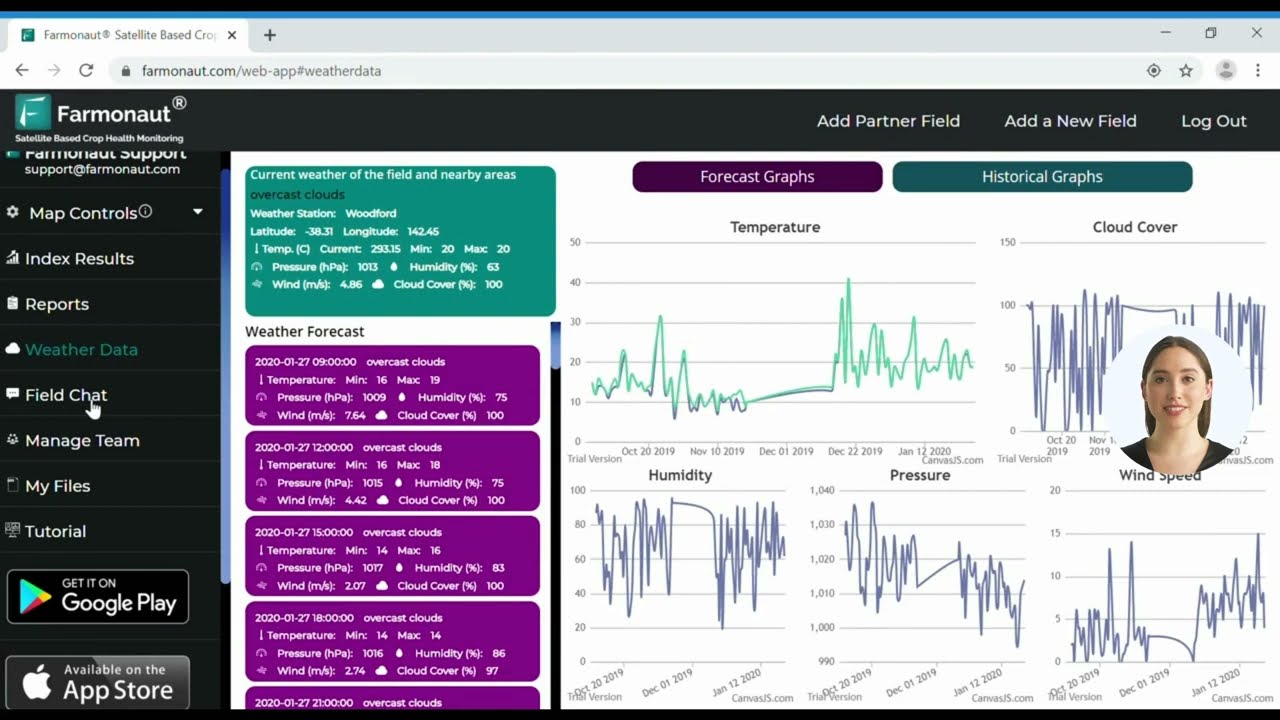
4. Compliance, Traceability, and Record-Keeping
- Regulatory Compliance Support: Application and usage logs for pesticides, fertilizers, and chemical inputs, needed for audits, certifications, and export documentation.
- Blockchain Traceability: Blockchain-powered traceability modules record the origin and movement of each lot, which increasingly matters for buyers requiring documented chain-of-custody.
- Automated Reporting: Generate compliance documentation for regulators, buyers, and certifiers without manual compilation.
Explore Farmonaut’s traceability tools: Product Traceability with Blockchain.
5. Scalability and Modular Architecture
- Modular Functionality: Add or remove modules (grain, livestock, laboratory, warehouse) as the operation’s mix of activities changes.
- Cloud-Based Storage: Multi-user access from any device, which matters most for operations spanning multiple locations or family partners in different places.
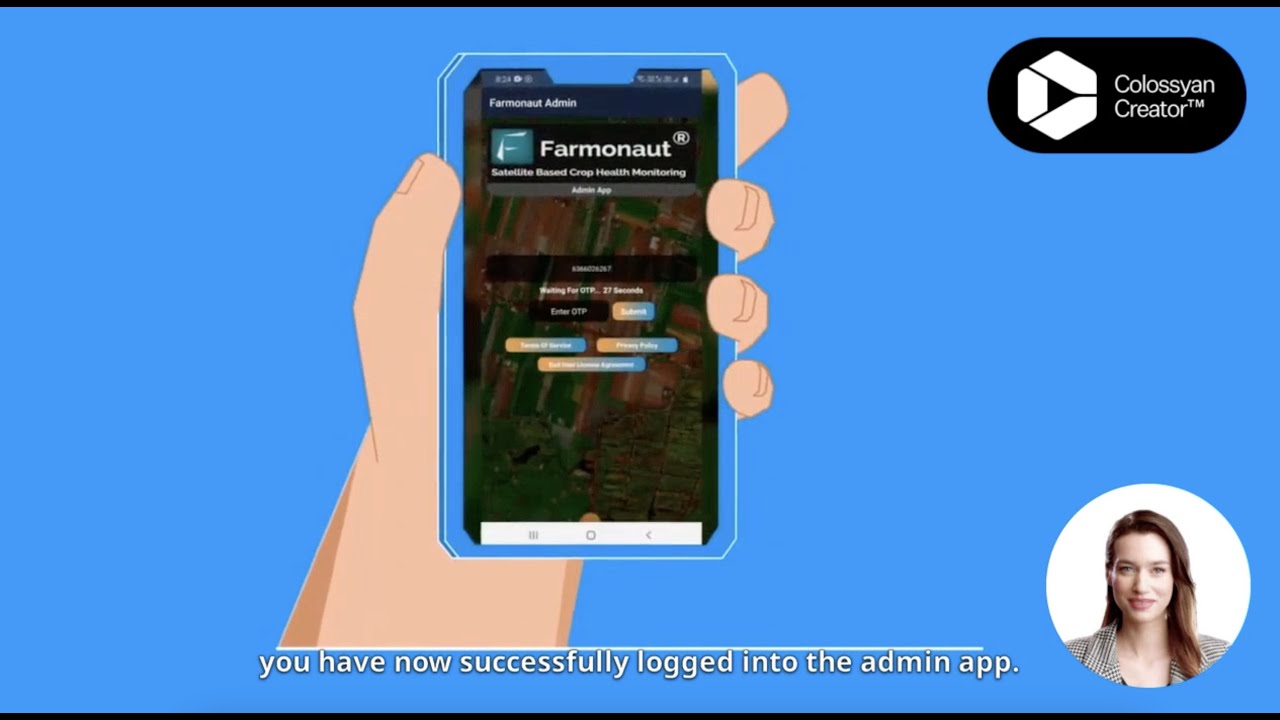
6. Integration with Other Agri-Tech Platforms
- API Access: An open API lets inventory software pull in satellite and weather data alongside existing farm management systems, rather than operating as an island.
-
Cross-Platform Mobile Support: Inventory data accessible on Android, iOS, and web.



- Developer Docs: See the API Developer Documentation for integration specifics.
How Satellite Data Adds Precision to Inventory Planning
Inventory decisions are only as good as the field data behind them. Satellite monitoring closes a specific gap: it tells you what a field’s actual condition is right now, independent of what the planting or spray log says should have happened, so input-usage forecasts and reorder timing can be corrected against reality rather than assumption.
How Farmonaut Supports Inventory Decisions:
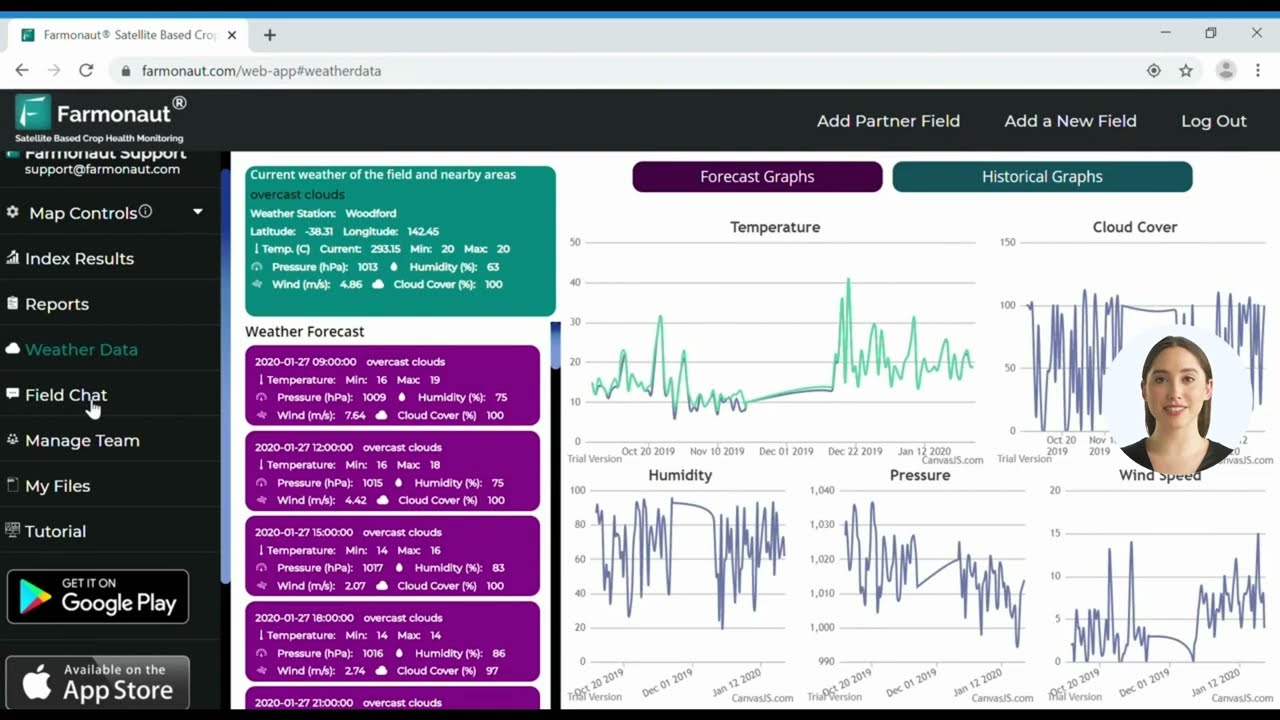
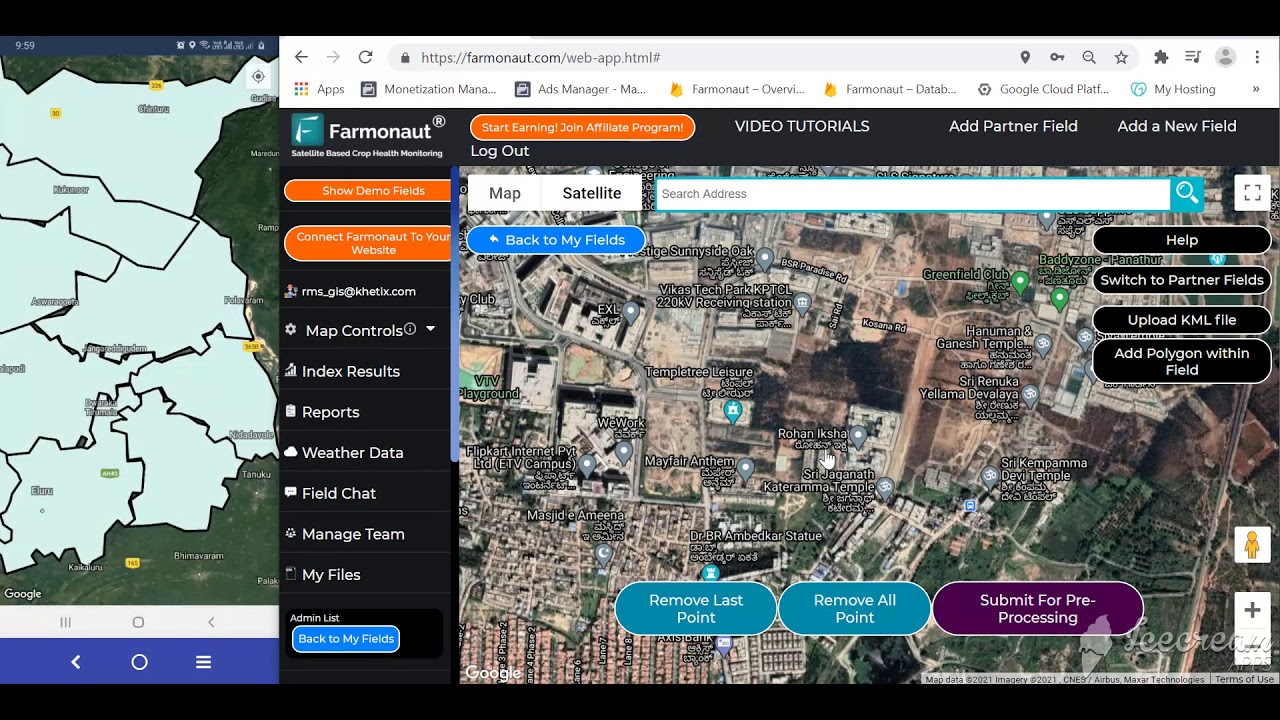
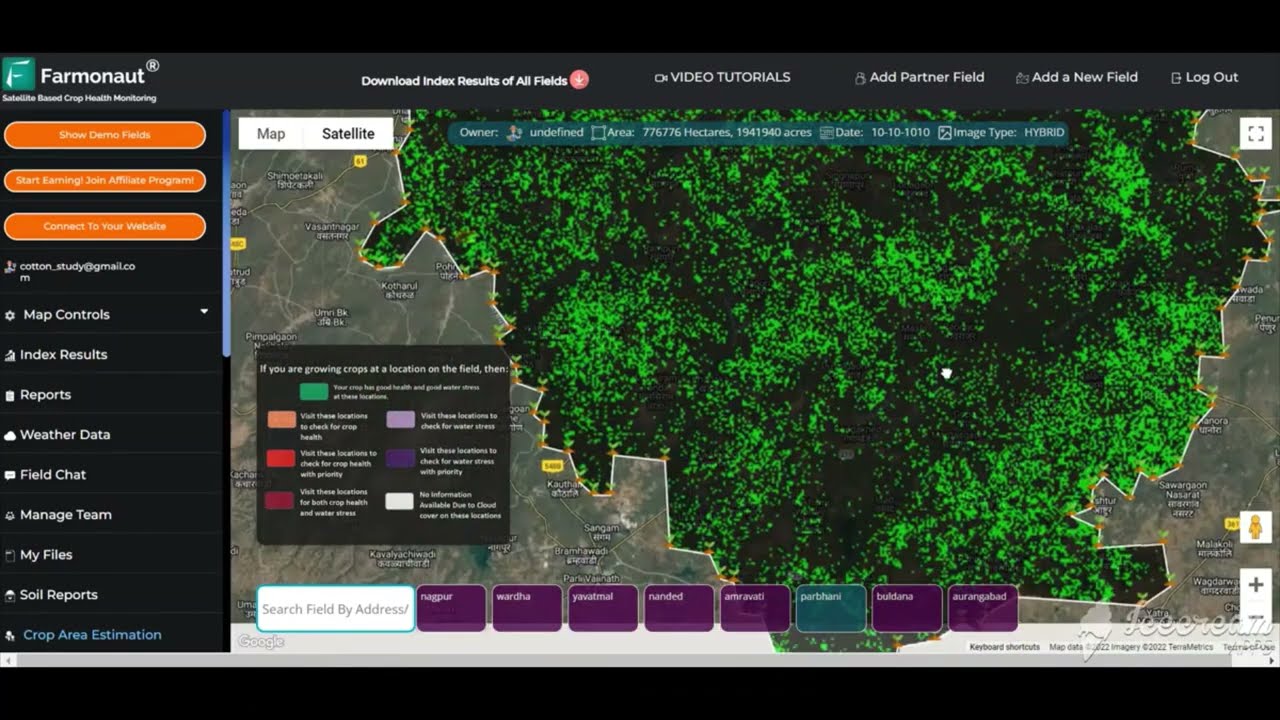
- Satellite-Based Monitoring: Up-to-date imagery tracks crop health and field boundaries, making input-usage forecasts and reorder timing more accurate than calendar-based planning alone.
- Jeevn AI Advisory: Processes satellite and agricultural data to flag when input application is likely needed, helping align purchase timing with actual field conditions instead of a fixed schedule.
-
Blockchain Traceability: Records each step of a product’s journey from input procurement to final produce.
Learn more about traceability solutions. -
Fleet and Resource Management: Tools for tracking equipment and machinery movement across large operations.
Fleet Management: optimize agricultural logistics and machinery use. - Environmental Compliance: Carbon footprinting tools support sustainability reporting requirements that increasingly accompany inventory and compliance audits.
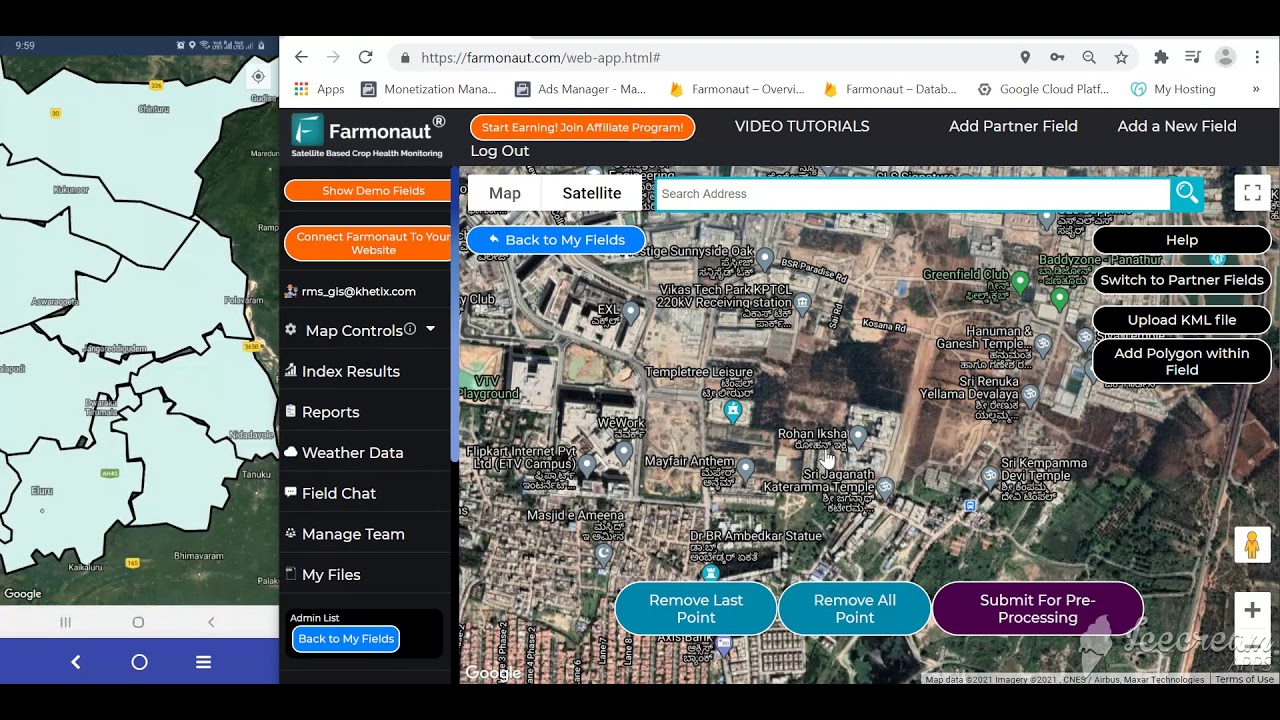
- Accessible Pricing: Satellite-driven insights via web and mobile, including the Agro Admin App for large-scale operations.
- Flexible Subscription Model: Choose only the modules needed rather than a fixed all-in-one bundle.
- Scalability: The modular platform supports both individual operators and multi-location businesses.

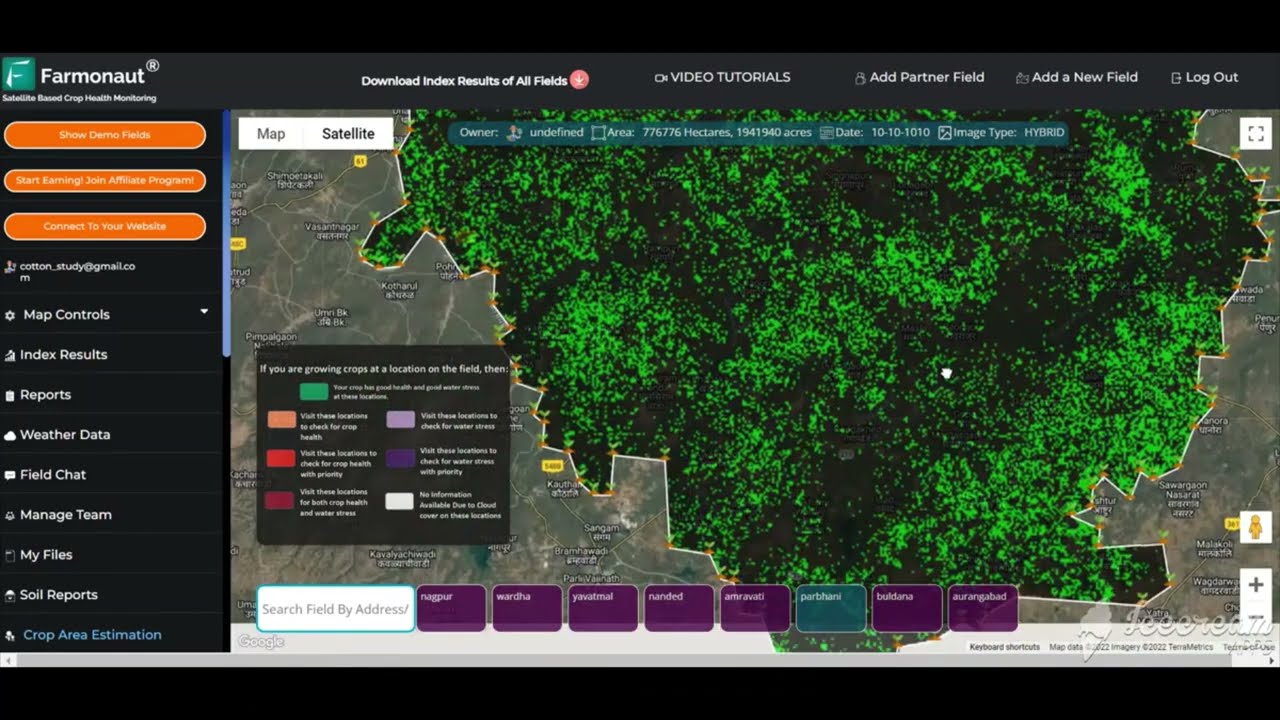
Interested in farm and inventory integration, carbon management, or crop insights? Try Farmonaut today!
Comparison Table of Leading Agriculture Inventory Management Software
| Software | Primary Category | Key Features | Starting Price (per Month) | Best Fit | Compliance Capabilities |
|---|---|---|---|---|---|
| Farmonaut | General farm inventory + satellite | Satellite monitoring, AI advisory, blockchain traceability, real-time inventory tracking, mobile/web access, fleet management, open API | $35 | Small to large row-crop and mixed operations | Full regulatory and blockchain-based traceability |
| AgriWare Pro | General farm inventory | Real-time inventory, supplier management, cloud-based, integrated accounting, multi-location support | $40 | Medium to large farms | Regional and global compliance modules |
| Trimble Ag Software | Farm management + asset tracking | Integrated farm management, precision ag, asset tracking, crop planning | $49 | Operations already on Trimble hardware | Traceability and compliance dashboards |
| AgriWebb | Ranch inventory management | Livestock and crop dual inventory, IoT sensor support, offline mode, custom templates | $35 | Ranches and mixed livestock-crop operations | Regulatory compliance, farm audit reports |
| AgriERP | Agricultural warehouse / ERP | Full agriculture ERP, multi-crop inventory, analytics, e-commerce integration | $30 | Large enterprises and elevators/co-ops | Advanced audit trail and compliance checks |
Pricing above is vendor list pricing at time of research and changes by tier and contract length; confirm current pricing directly with each vendor before budgeting.

Grain Storage Utilization Calculator
Estimate how much of your on-farm storage capacity is committed and how many days until you hit the ceiling at your current fill rate.
Run your own numbers
Assumptions: single-bin or aggregated-capacity model; shrink applies uniformly to current stored grain; excludes moisture-based dry-matter loss over time and multi-commodity mix. For facility-level benchmarks, national on-farm capacity was 13.6 billion bushels as of December 1, 2024 per USDA NASS.
How to Select the Right Agriculture Inventory Software
Key Considerations
- Farm Size and Scale: Confirm the platform handles your current volume and has headroom for growth — adoption among farms over 400 hectares already sits at 68% per IMARC Group, so scalability at that size is a solved problem for established vendors.
- Primary Operational Unit: Match the category to your unit of work — field/season (general inventory), bin/lot (grain), herd (ranch), facility/shipment (warehouse), or sample (laboratory) — as covered in the categories section above.
- Crops and Operations: Confirm support for your specific crop mix, especially for multi-crop, livestock, or diversified operations.
- Technology Infrastructure: If you already run IoT sensors, GPS, or satellite data, confirm the software integrates with those feeds rather than requiring separate systems.
- Compliance Needs: Choose platforms with built-in compliance, traceability, and reporting modules, particularly for export or organic certification.
- Usability: Platforms should be intuitive with a short onboarding curve for seasonal and full-time staff alike.
- Support & Training: Confirm the vendor provides tutorials and support to maximize adoption.
- Pricing & Scalability: Favor modular licensing so costs track actual usage as needs evolve — list pricing among the platforms compared above ranges from $30 to $49 per month at entry tier.
Integration with the Broader Agri-Tech Ecosystem
Integration with carbon footprinting tools, weather APIs, and satellite monitoring is increasingly a baseline requirement rather than a differentiator, since standalone inventory data without field-condition context leaves reorder and storage decisions less accurate.
Best Practices for Implementing Agriculture Inventory Software
- Planning & Data Migration: Start with a clean migration of existing inventory records and identify which crop-specific or grain modules you need before rollout.
- Staff Training: Invest in structured onboarding — Farmonaut’s tutorials on the large-scale admin tools are one example of vendor-provided training material.
- Mobile Enablement: Give field staff app access for real-time entry of resource usage, improving accuracy over end-of-day batch entry.
- Automate Where Possible: Use automation for purchase orders, low-stock alerts, and compliance documentation rather than manual triggers.
- Monitor and Adjust: Set a recurring review cadence (monthly or per growing-season milestone) to refine inventory plans against actual usage data.
- Benchmark Against Public Data: Use USDA NASS Grain Stocks reports, released quarterly on March 1, June 1, September 1, and December 1 reference dates, to sanity-check your own storage utilization against regional and national trends via USDA NASS Quick Stats.

Frequently Asked Questions
-
What is agriculture inventory management software?
A digital platform that helps farmers and agribusinesses monitor, plan, and control farm resources — seeds, fertilizers, pesticides, machinery, and harvested produce — in one system instead of spreadsheets. -
What’s the difference between farm inventory software and an agricultural warehouse management system?
Farm inventory software tracks inputs and outputs at the field/operation level. A warehouse management system tracks storage and distribution at the facility level — pallets, lots, and outbound shipments — which is the model used across most of the 7,922 off-farm grain storage facilities counted by USDA NASS as of December 2024. -
Is there dedicated software for grain inventory specifically?
Yes — farm grain inventory management software focuses on bin-level tracking of quantity, moisture, and test weight, often tied to scale tickets. If your operation is grain-only, this is narrower and often simpler than a general-purpose platform; mixed operations usually need the grain module bundled into a broader system. -
What is agriculture laboratory management software, and is it the same thing?
No — it manages sample chain-of-custody and testing workflows for soil, tissue, seed, or water labs, serving the lab as the buyer rather than the farm. It is a distinct category from farm inventory software, though both can share compliance-reporting concepts. -
How widely is farm management software actually adopted in the US?
63% of US farms used farm management software in 2024, rising to 68% among farms over 400 hectares, per IMARC Group’s US Farm Management Software Market report. -
How does satellite technology improve inventory accuracy?
Platforms like Farmonaut use satellite imagery to monitor crop and field status, helping align input inventory levels and reorder timing with actual field conditions rather than a fixed calendar. -
What is blockchain-based traceability, and do I need it?
It records every transaction and movement in the inventory chain in a way that is independently verifiable, which matters most for export markets and buyers requiring documented chain-of-custody. -
Can inventory software reduce farm costs?
It reduces the specific costs tied to manual error: overstocking, missed reorder windows, and undocumented compliance gaps. The scale of what’s at stake nationally — $162 billion in retail value of lost food in 2010 per USDA ERS — shows why even small percentage improvements in loss tracking matter financially. -
How do I get started with satellite-powered inventory management?
Visit the Farmonaut app or API portal to explore available tools, or request a demo.




Conclusion
Agriculture inventory management software is now mainstream infrastructure rather than an optional upgrade — 63% of US farms had adopted farm management software by 2024, and the US market is projected to grow from $691 million in 2024 to $1,751 million by 2033 per IMARC Group. The right choice depends less on brand recognition than on matching the software’s core data model to your operational unit: field and season for general farm inventory software, bin and lot for grain-specific tools, herd for ranch inventory management, facility and shipment for agricultural warehouse management systems, and sample for laboratory management software.
The durable test to reapply as vendors and features change: does the platform’s basic unit of tracking match how your operation actually organizes work, and does it integrate with the field-condition data (satellite, IoT, weather) needed to make reorder and storage decisions ahead of a problem rather than after it. Storage capacity data from USDA NASS and market data from IMARC Group referenced throughout this guide are both published on a recurring schedule — check them directly for current figures rather than relying on any single year’s snapshot.
Ready to bring satellite-informed accuracy to your farm’s inventory planning?
Start with Farmonaut’s inventory, satellite monitoring, and compliance tools.
Related resources:
- Carbon Footprinting: Monitor and reduce the environmental impact of farming operations.
- Crop Loan and Insurance Verification: Streamline financial access with satellite-based verification.
- Fleet & Resource Management: Manage farm machinery and logistics efficiently.
Discussion
Questions, corrections or field experience? Share them below. First-time comments are reviewed before they appear, and your email is never published.
No comments yet. Be the first to add a question or your experience.

 MISE Maroc
 Drift-Sense
 NWNS
NWNS Hydenmet
 Dirks Bros Farms
 Red August Group
 Farm Inc
 WeMe Global
 Agrotoken
 Blue BearX
 Insignito
 Croptimum
 DnCubed
 Field Capacity
 Indosistim Teknologi
 Liquify Digital
 CU Foods
 BeyondTech Global
 Licence holder · Niger · Gold
 Licence holder · Nigeria · Gold + lithium










