

Applied AI in Agriculture Market: Size by US, EU & Japan
Reviewed August 2026 against USDA’s Economic Research Service, the European Commission’s Farm to Fork pesticide-reduction monitoring, and market trackers from Market Research Future and Precedence Research.
Try it: Enter your numbers above to see estimated savings. →
The global applied AI in agriculture market was valued at $3,324.84 million in 2025 and is forecast to reach $43,494.66 million by 2035 — a 29.32% compound annual growth rate — according to Market Research Future’s Applied AI in Agriculture Market report. Precedence Research, using a wider definition of “AI in agriculture,” sizes the same industry at $2.57 billion in 2025 climbing to $20.12 billion by 2035 at a 22.85% CAGR. Both trackers agree on direction; they disagree on scope, and that gap is the first thing worth understanding before comparing a US, European, or Japanese figure to anything else.
This article breaks the market down by the United States, Europe, and Japan, names the tracker or government agency behind every number, lists the AI applications already running on working farms, and ends with a calculator that turns the industry’s own input-savings data into your farm’s dollars.
Contents
- Applied AI in Agriculture Market Size: The Global Numbers
- US Applied AI in Agriculture Market
- Europe Applied AI in Agriculture Market
- Japan Applied AI in Agriculture Market
- AI Applications in Agriculture: What’s Actually Deployed
- Precision Farming Tools Built on This Data
- AI in Agriculture Statistics: Quick-Reference Table
- Calculator: Your Farm’s Applied-AI Input Savings
- Supply Chain, Traceability, and Carbon Data
- Adoption Gaps — and How to Get a Fresher Number
- FAQ: Applied AI in Agriculture
- Conclusion
Applied AI in Agriculture Market Size: The Global Numbers
“Applied AI” in market-research language means AI built to do one bounded job inside a working system — steer a tractor, flag a diseased leaf, schedule an irrigation valve — rather than a general-purpose foundation model. That distinction is why the applied AI in agriculture market and the broader AI in agriculture market get sized differently by different firms, and it’s also the frame the term “applied AI market” refers to across every industry, not just farming.
Market Research Future tracked the global applied AI in agriculture market at $2,571.02 million in 2024, rising to $3,324.84 million in 2025, with a forecast of $43,494.66 million by 2035. By its regional split, North America holds close to 45% of that 2025 revenue, Europe near 30%, Asia-Pacific near 20%, and the Middle East and Africa the remaining 5%. Precedence Research’s wider-scope AI in agriculture market — which folds in more software and services categories — was $2.57 billion in 2025, reaching $20.12 billion by 2035 (22.85% CAGR), with North America holding more than 39% of 2025 revenue. Farmonaut’s own AI in agriculture market size breakdown tracks how these figures shift release over release.
The table below lines up every regional tracker used in this article so the US, European, and Japanese figures that follow can be checked against each other and against the source that published them.
| Tracker | Scope | Base Value | Forecast Value | CAGR | Region |
|---|---|---|---|---|---|
| Market Research Future | Applied AI in agriculture | $3,324.84M (2025) | $43,494.66M (2035) | 29.32% | Global |
| Precedence Research | AI in agriculture (broad) | $2.57B (2025) | $20.12B (2035) | 22.85% | Global |
| Precedence Research | AI in agriculture (broad) | $701.61M (2025) | $5,678.04M (2035) | 23.26% | United States |
| Market Research Future | Applied AI in agriculture | $664.97M (2025) | $8,698.67M (2035) | 29.32% | Europe |
| MarketsAndMarkets | AI in agriculture | — | — | 26.20% (through 2032) | Japan |
| market.us | Smart agriculture (adjacent category) | $213M (2023) | $651M (2033) | 11.8% | Japan |
Watch on YouTube: How AI Drones Are Saving Farms & Millions
US Applied AI in Agriculture Market
Precedence Research prices the US AI in agriculture market at $701.61 million in 2025, growing to $5,678.04 million by 2035 — a 23.26% CAGR. That commercial figure sits alongside a harder government number: the U.S. Government Accountability Office reported, in GAO-24-105962 (released January 31, 2024), that just 27% of US farms and ranches used precision agriculture practices to manage crops or livestock in USDA’s survey window of June 2022 through June 2023. USDA and the National Science Foundation put nearly $200 million into precision-agriculture research and development, including AI research-institute partnerships, across fiscal years 2017–2021 — federal funding is already ahead of farm-level adoption, not behind it.
Adoption isn’t new, either. USDA’s Economic Research Service, in Economic Information Bulletin 248 (February 22, 2023), found automated guidance and auto-steer systems on more than 50% of the acreage planted to corn, cotton, rice, sorghum, soybeans, and winter wheat, with corn specifically rising from 5.3% of planted acreage in 2001 to 58% by 2016. At least half of large row-crop farms rely on yield maps, soil maps, and variable-rate technology; adoption on winter wheat, cotton, sorghum, and rice acreage sits between 5% and 25% of planted area, well behind corn and soybeans.
One documented example: sensor networks and AI-driven crop monitoring deployed around West Lafayette, Indiana show how this technology moves from a market-research line item into a specific county’s fields — a level of detail no generic market-size article carries.

Watch on YouTube: Smart Farming, AI Telematics & the $2.3B Equipment Market
Europe Applied AI in Agriculture Market
Market Research Future’s Europe Applied AI in Agriculture Market report puts the region at $388 million in 2023, $514.2 million in 2024, and $664.97 million in 2025, forecast to reach $8,698.67 million by 2035 (29.32% CAGR). Within the 2024 figure, Germany accounts for $150.0 million, the UK $100.0 million, France $90.0 million, Russia $70.0 million, Italy $50.0 million, Spain $30.0 million, and the rest of Europe a combined $24.2 million.
Europe’s applied AI case is regulatory as much as commercial. The European Commission’s Farm to Fork pesticide tracker shows chemical pesticide use and risk falling 58% across the 2018–2023 period against the 2015–2017 baseline, with a further 6% year-on-year drop from 2022 to 2023 — moving toward the legally binding target of a 50% cut in pesticide use and risk, a 20% cut in fertiliser use, and 25% of EU farmland under organic management, all by 2030. Precision inputs and AI-guided spraying sit alongside integrated pest management as the tools the Commission cites for closing that gap.
A 2025 peer-reviewed review of precision-farming studies found AI-guided input management cutting water and fertilizer use by 10% to 15% on the farms studied, worth an estimated €5,000 to €10,000 in annual savings per farm — a direct link between the regulatory target above and the AI tooling built to hit it.

Watch on YouTube: AI-Powered Field Scouting for Enhanced Productivity
Japan Applied AI in Agriculture Market
MarketsAndMarkets forecasts Japan’s AI in agriculture market growing at a 26.20% CAGR through 2032, driven overwhelmingly by one demographic fact: the country’s average commercial farmer is 68.4 years old, and average farm size has risen from 1.4 to 3.3 hectares as smaller operations consolidate, per the Government of Japan’s own account of the shift. market.us sizes the adjacent Japan Smart Agriculture Market at $213 million in 2023, projected to reach $651 million by 2033 (11.8% CAGR, 2024–2033) — a smaller number than the AI-specific figure above because it excludes some AI software categories, another illustration of how much “market size” depends on what a report counts.
Japan’s applied AI push is visible in hardware, not just spending. Kubota’s autonomous “Agri Robo” tractors, rice transplanters, and combine harvesters — the first fully unmanned model shipped in 2017, followed by a 2020 AI development partnership with Nvidia — had close to 700 machines shipped and working on Japanese farms by 2024, per the same Government of Japan account. Japan’s Ministry of Agriculture, Forestry and Fisheries began its own smart-agriculture demonstration project in 2019, running technology trials across 148 regions nationwide.
Our guide to farm robots and what they cost covers both the tasks that field robots like these do on farms and their prices.

Watch on YouTube: Revolutionizing Farming with Satellite-Based Crop Health Monitoring
AI Applications in Agriculture: What’s Actually Deployed
AI in agriculture and farming covers a specific, testable set of applications, not a vague label. A 2025 peer-reviewed review published on PubMed Central compiled the performance data behind the applications most farms actually run:
- Disease and pest detection: image-recognition apps such as Plantix reached 90% to 100% accuracy identifying disease on staple crops including maize in the studies reviewed; combined traditional-and-deep-learning CNN models reached 95% accuracy on crop stress and disease identification.
- Yield prediction: a CNN-LSTM model tested on soybean data reached an R² of 0.78; a spatial-spectral-temporal neural network tested on wheat reached an R² of 0.83 with an RMSE of 0.67 — the model’s predicted yield tracked 78% to 83% of the actual variation in the test data.
- Smart irrigation: neural-network-controlled irrigation systems in the reviewed studies cut water use by 27% and energy use by 57% against uncontrolled baselines; variable-rate irrigation systems reached 85% to 87.97% water-delivery efficiency.
- Autonomous machinery: GPS- and sensor-guided tractors, harvesters, and drones handle planting, spraying, weeding, and scouting with reduced direct human input — the same category driving Japan’s robotics investment above.
Across the applications the review covered, AI adoption was tied to productivity gains ranging from 20% to 150%, a wide spread because a phone-based disease-detection app and a fully autonomous harvester solve different problems at very different capital costs.
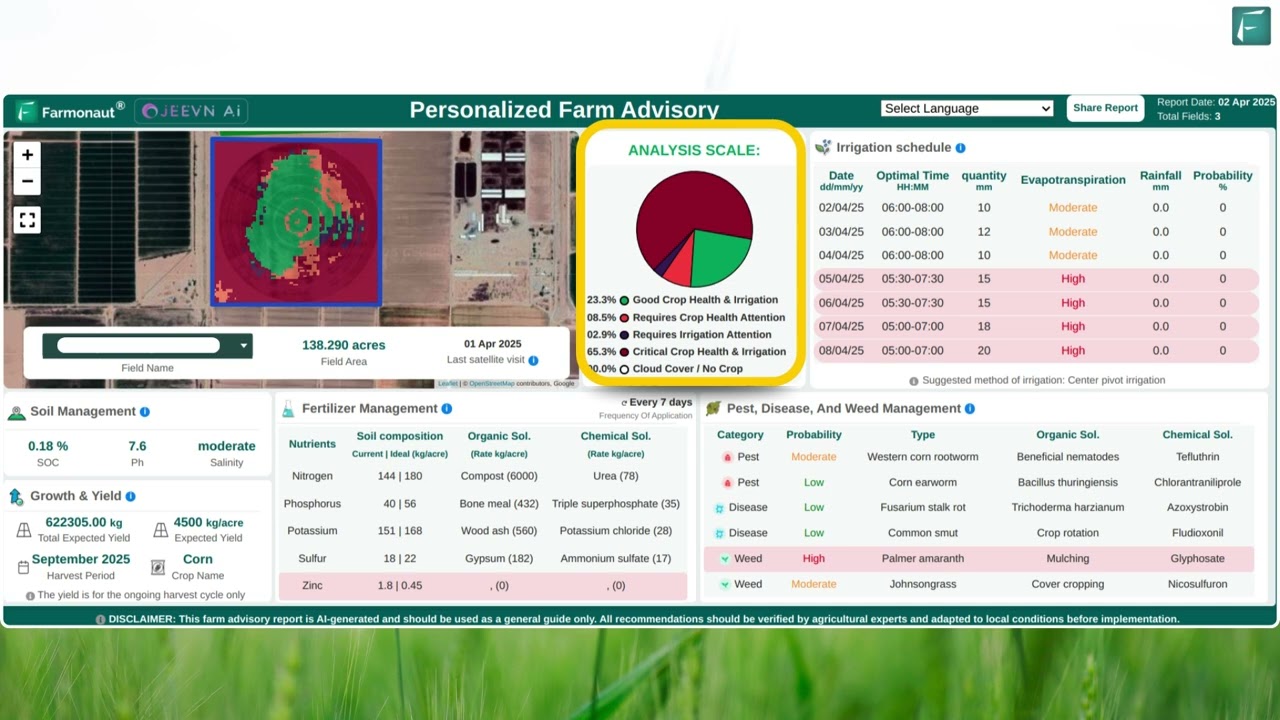
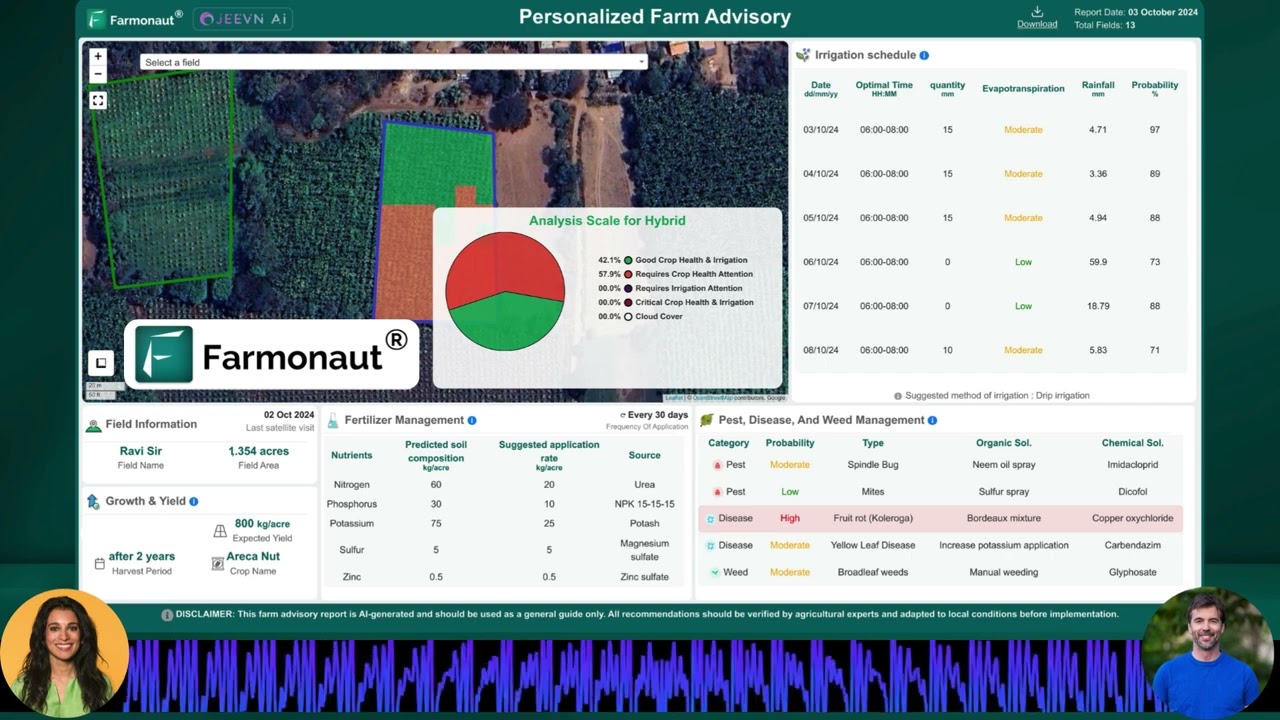
On the fleet and automation side, fleet management platforms track and schedule autonomous and semi-autonomous machinery in real time, and a large-scale farm management app gives multi-site operations one view of growth stages, resource use, and logistics. Augmented reality is a smaller, adjacent layer on top of this stack — overlaying soil and sub-surface data onto a technician’s live view during equipment maintenance or training — and the AI advisory tool below is a working example of insights delivered straight to a grower’s phone.

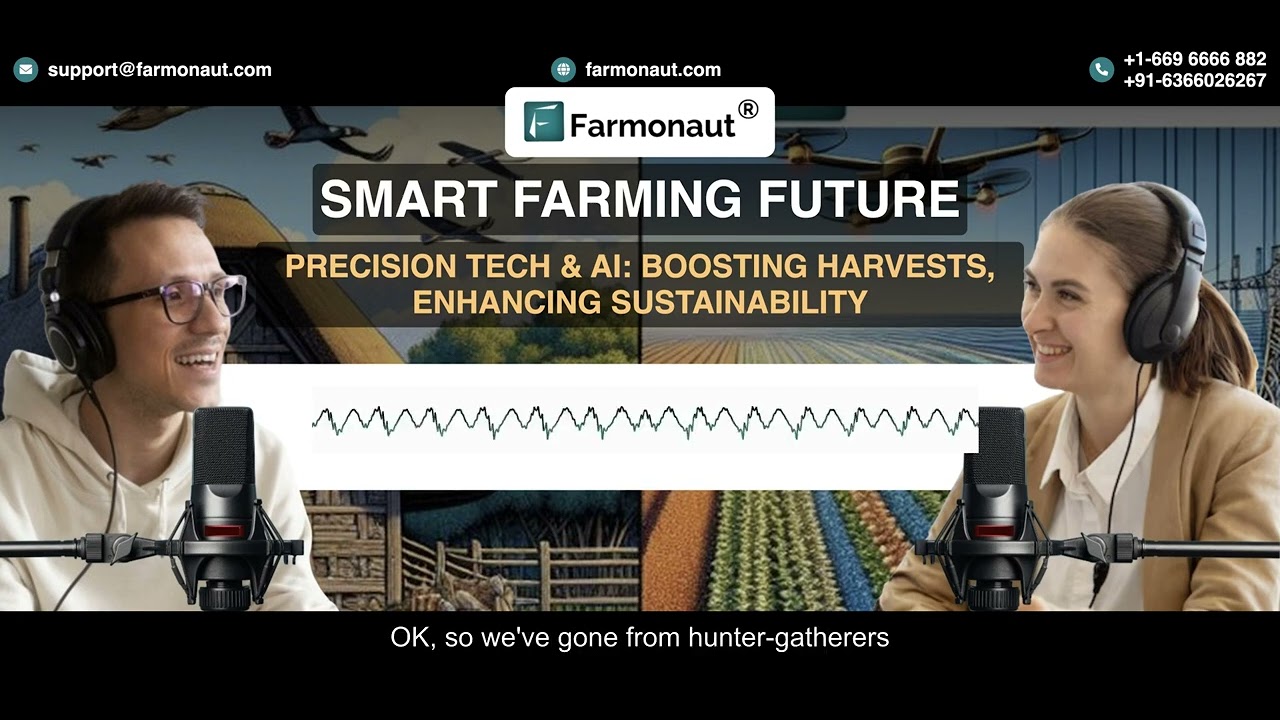
Watch on YouTube: Precision Tech & AI Boosting Harvests

Watch on YouTube: JEEVN AI Smart Farming Insights
Precision Farming Tools Built on This Data
Every application above depends on a data pipeline: satellite and drone imagery feeding computer-vision models that flag stress, disease, or moisture problems before they show up in yield. Farmonaut’s web and mobile platform runs that pipeline end to end — satellite-based NDVI monitoring, AI advisory, and fleet tracking in one account. Developers building their own tools can query the same imagery and forecast data directly through the Farmonaut API, documented in full in the API developer documentation.




Watch on YouTube: AI Drones Saving Farms in Modern Agriculture
AI in Agriculture Statistics: Quick-Reference Table
The figures above come from different reports measuring different things. Here they are in one place, each tied to its source and vintage, so you can check for a newer number before citing any of them.
| Statistic | Value | Period / Vintage | Source |
|---|---|---|---|
| Global applied AI in agriculture market | $3,324.84M → $43,494.66M | 2025 est. → 2035 forecast | Market Research Future |
| Global AI in agriculture market (broad scope) | $2.57B → $20.12B | 2025 est. → 2035 forecast | Precedence Research |
| US AI in agriculture market | $701.61M → $5,678.04M | 2025 est. → 2035 forecast | Precedence Research |
| US farms using precision agriculture | 27% | Survey window Jun 2022–Jun 2023 | U.S. GAO, GAO-24-105962 (Jan 2024) |
| US corn acreage under auto-steer | 5.3% → 58% | 2001 vs. 2016 | USDA ERS, EIB-248 (Feb 2023) |
| Europe applied AI in agriculture market | $664.97M → $8,698.67M | 2025 est. → 2035 forecast | Market Research Future |
| EU chemical pesticide use/risk change | -58% | 2018–2023 vs. 2015–2017 baseline | European Commission, Farm to Fork tracker |
| Japan AI in agriculture market growth | 26.20% CAGR | Through 2032 | MarketsAndMarkets |
| Japan smart agriculture market | $213M → $651M | 2023 → 2033 (11.8% CAGR) | market.us |
| Kubota autonomous “Agri Robo” machines shipped | ~700 | Cumulative through 2024 | Government of Japan |
| AI disease-detection accuracy, staple crops | 90%–100% | Studies reviewed as of 2025 | Peer-reviewed review, PMC |
| AI-controlled irrigation savings | 27% water / 57% energy | Studies reviewed as of 2025 | Peer-reviewed review, PMC |
Calculator: Your Farm’s Applied-AI Input Savings
The peer-reviewed review cited above found precision-farming AI cutting water and fertilizer use by 10% to 15% on the farms studied. Enter your own acreage and input costs to see what that range is worth on your operation.
Enter your numbers above to see estimated savings.
Assumes the 10%–15% input-reduction range applies to your combined fertilizer and irrigation spend. Excludes equipment, subscription, or labor costs of the AI tools themselves, and excludes any yield increase from the same technology.
Supply Chain, Traceability, and Carbon Data
Applied AI’s reach extends past the field into everything downstream of harvest. AI-driven blockchain-enabled product traceability tracks a crop from field to buyer, supporting the same food-safety and transparency goals the EU’s Farm to Fork strategy is regulating toward. Satellite-verified field data also underpins crop loan and insurance products, letting lenders confirm crop condition remotely instead of requiring an in-person inspection.
Carbon accounting is the newest layer built on the same pipeline. Farmonaut’s carbon footprinting tools let operations measure, report, and reduce emissions using the same satellite inputs already collected for crop monitoring — relevant to EU sustainability compliance and to the wider shift covered in farming and agricultural investment trends.

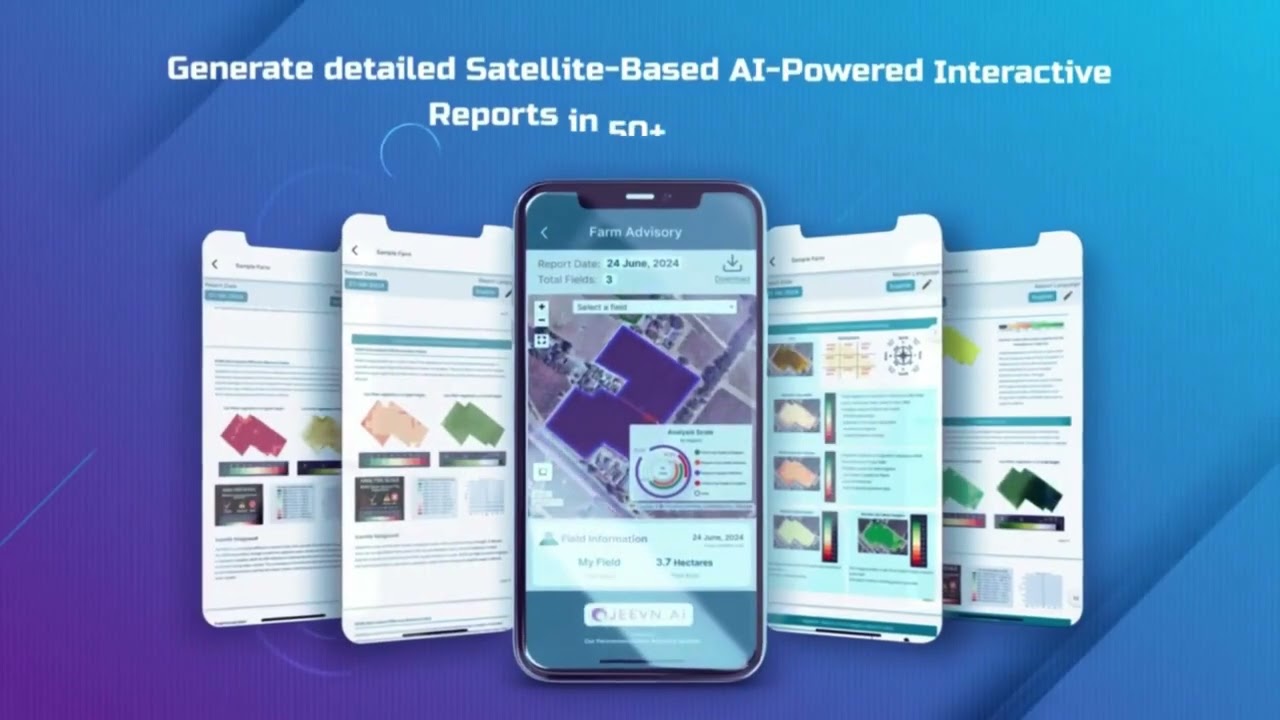
Watch on YouTube: How Personalized Reports Are Changing Agriculture
Adoption Gaps — and How to Get a Fresher Number
Every figure in this article has an expiration date. Market trackers republish on a rolling basis; government surveys run on multi-year cycles. Use this checklist instead of treating any single number as permanent:
- US adoption: USDA’s Agricultural Resource Management Survey (ARMS) is refielded periodically by USDA’s Economic Research Service — search “ARMS precision agriculture” on ers.usda.gov for the newest release.
- US and global market size: Precedence Research and Market Research Future both republish their AI-in-agriculture forecasts; check the report page directly for the version dated closest to today.
- EU pesticide and fertiliser progress: the European Commission’s Farm to Fork tracker updates annually with the newest reporting year’s reduction percentage against the 2015–2017 baseline.
- Japan: Japan’s Ministry of Agriculture, Forestry and Fisheries publishes smart-agriculture programme updates directly, and Kubota’s own product pages carry the current Agri Robo Series shipment count, which will already be higher than the ~700-machine figure cited here for 2024.
The pattern that persists across all three geographies is the same one: capital-intensive applied AI — autonomous machinery, satellite subscriptions — reaches large operations first. USDA’s own 27% overall adoption figure sits well below the 58% adoption seen on corn acreage specifically and the 70% guidance-system adoption GAO reported on large-scale crop farms, meaning farm size, not country, is the strongest predictor of who has adopted applied AI so far.
FAQ: Applied AI in Agriculture
What is the applied AI in agriculture market?
It’s the market-research category covering AI systems built to do one specific job on a farm or in an ag-supply chain — computer vision for disease detection, machine learning for yield prediction, autonomous guidance for machinery — as distinct from general-purpose AI research. Market Research Future sizes it at $3,324.84 million globally in 2025, forecast to reach $43,494.66 million by 2035.
How big is the AI in agriculture market in the US specifically?
Precedence Research values the US AI in agriculture market at $701.61 million in 2025, rising to $5,678.04 million by 2035. Separately, GAO-24-105962 shows 27% of US farms and ranches already using some precision-agriculture practice as of the June 2022–June 2023 USDA survey window.
How big is the market in Europe?
Market Research Future puts the Europe applied AI in agriculture market at $664.97 million in 2025, forecast to reach $8,698.67 million by 2035, with Germany ($150.0 million), the UK ($100.0 million), and France ($90.0 million) as the largest 2024 country markets.
How big is the market in Japan?
MarketsAndMarkets forecasts a 26.20% CAGR through 2032 for Japan’s AI in agriculture market, driven by an average farmer age of 68.4 years. market.us separately sizes Japan’s smart agriculture market at $213 million in 2023, growing to $651 million by 2033.
What are the main AI applications in agriculture today?
Disease and pest detection via computer vision (90%–100% accuracy on staple crops in reviewed studies), yield prediction via machine learning (R² of 0.78–0.83 in reviewed models), AI-controlled irrigation (27% water and 57% energy savings in reviewed systems), and autonomous or semi-autonomous machinery for planting, spraying, and harvesting.
Where can I check these numbers for a more current figure?
See the checklist in the “Adoption Gaps” section above — it lists the exact USDA, European Commission, Japanese-government, and market-tracker pages to check, since every figure here carries a publication date and a refresh cycle.
Where can I get affordable, scalable applied AI tools for my own farm?
Platforms such as Farmonaut offer subscription access to satellite-based crop monitoring, AI advisory, fleet management, carbon footprinting, and traceability — with apps, an API, and developer documentation available for custom integration.



Conclusion
The applied AI in agriculture market isn’t one number — it’s at least three, depending on whether the question is about the US ($701.61 million in 2025, per Precedence Research), Europe ($664.97 million in 2025, per Market Research Future), or Japan (26.20% CAGR through 2032, per MarketsAndMarkets), and each keeps moving every time its tracker republishes. What doesn’t move is the underlying pattern: farm size predicts adoption more than country does, disease-detection and irrigation AI already clear 90%+ accuracy and 27%+ savings in peer-reviewed studies, and the regulatory pressure building in Europe and the labor pressure building in Japan are pulling the same technology toward market from two different directions.
Explore all Farmonaut platforms and solutions to see where your own operation sits against these numbers.

 Cazlv
Cazlv HIPSAC
 ZOL Zimbabwe
 Juligerm
 AdBio
AdBio MISE Maroc
 Drift-Sense
 NWNS
NWNS Red August Group
 Farm Inc
 WeMe Global
 Agrotoken
 Blue BearX
 Insignito
 Croptimum
 DnCubed
 Field Capacity
 Indosistim Teknologi
