

Citrus · Diagnosis guide
Black Spots on Lemons: Causes, Fixes and Cost Calculator
Black spots on lemons are either sooty mold, which grows on honeydew and wipes off, or a lesion in the leaf or rind. Match the spot to its cause, then see what treatment fits.
Key takeaways
- Sooty mold grows on insect honeydew, wipes off with soap and water, and fruit under it is still edible (UC IPM).
- Lesions that do not wipe off point to Septoria, bacterial blast, melanose, greasy spot or citrus black spot; hard spot on fruit is 3 to 10 mm wide (UF/IFAS).
- Melanose needs 10 to 12 hours of leaf wetness at 75 to 80 degrees F and citrus black spot needs 24 to 48 hours (UF/IFAS).
- Citrus black spot was confined to portions of eight southwest Florida counties in September 2026 (Citrus Industry Magazine, reporting APHIS); fruit and plants in residential quarantine areas may not leave them.
- Copper sprays protect, they do not cure; follow the label and your local extension timing.
In this article
- Black spots on lemons: the quick wipe test
- Leaves or fruit: where the black spots appear
- Causes of black spots on lemon trees
- How to read the spots: size, wetness and timing
- Citrus black spot in the US: where it is regulated
- 7 treatment tips for black spots on lemons
- Is a spray programme worth it? A cost calculator
- What to do this week
- Prevention and monitoring
- FAQ
- How we checked the numbers
- Sources and where to go next
Black spots on lemons come from a handful of causes, and one wipe test separates sooty mold from a true lesion. Sooty mold is a black film that grows on insect honeydew and washes off with soap and water, according to UC IPM. Real lesions are part of the leaf or rind, so they do not wipe off. This guide shows how to tell each cause apart, what treatment fits, and a calculator to test whether a spray programme pays for your trees.
It is written for home growers, orchard managers and advisers in the US, Canada, Europe and Australia. Disease names and timings come from university extension and plant-protection sources, and every pesticide step comes with the same rule: follow the product label and your local rules.
Black spots on lemons: the quick wipe test
Start with a damp cloth and a drop of dish soap. Rub one blackened leaf or fruit for a few seconds. If the black layer comes off and the green or yellow surface is clean underneath, you have sooty mold. If the spot stays, you have a lesion, and the shape, size and position of the spot point to the cause.
| What you see | Wipes off? | Likely cause | First step |
|---|---|---|---|
| Black soot-like film, sticky leaves | Yes | Sooty mold on honeydew | Find and treat the insects |
| Tiny pits on rind, dark dots inside | No | Septoria spot | Usually cosmetic on home trees |
| Black petiole, curled leaves, dead twigs | No | Bacterial blast | Prune dead wood in spring |
| Rough, raised brown to black specks | No | Melanose | Remove dead twigs |
| Yellow patch above, dark blister below | No | Greasy spot | Rake and clear leaf litter |
| Sunken round spots, gray centre | No | Citrus black spot | Call your state agency |
Two causes can occur on the same tree. Insects feeding on a tree that is also stressed by frost or wind give sooty mold and a disease at the same time. Treat the cause that is active now, then revisit the second one.
Leaves or fruit: where the black spots appear
Where the spot sits narrows the list quickly. The table splits the causes by plant part, so you can start from what you see on your own tree.
| Plant part | Possible causes | Clue |
|---|---|---|
| Leaf surface | Sooty mold | Sticky film that wipes off |
| Leaf, with yellow halo | Septoria, melanose, black spot | Small, raised or sunken, will not wipe |
| Leaf underside | Greasy spot | Blister below, yellow mottle above |
| Leaf stalk and twig | Bacterial blast | Black stalk, curled leaf, dead twig |
| Fruit rind | Septoria, melanose, black pit | Pits, specks or dark circles |
| Fruit, sunken round | Citrus black spot | Gray centre, dark margin |
The seven causes below start with the one you can fix with soap and water.
Causes of black spots on lemon trees
1. Sooty mold on honeydew
Sooty mold is the cause behind a black film on leaves and fruit. The fungi do not infect the plant. They live on honeydew, the sweet liquid that aphids, whiteflies, mealybugs, soft scales, psyllids and leafhoppers excrete while they feed (UC IPM, Sooty Mold Pest Notes). A thick film blocks light from the leaf, which reduces photosynthesis and can stunt growth and cause early leaf drop.
Fruit covered by sooty mold is still edible. UC IPM advises washing it off with mild soap and warm water. The fix is to remove the insects, not the mold. Ants protect honeydew producers from natural enemies, so ant control matters too. For the pests themselves, read our guide to aphids and leaf diseases on lemon trees and the comparison of aphids and mealybugs.
2. Septoria spot
UC IPM says Septoria spot affects Valencia and navel oranges and only occasionally lemons and grapefruit. It marks the rind with small tan to reddish-brown pits, about 1 to 2 mm wide, with dark fruiting bodies in the pits. It appears after cool, wet weather, mainly on fruit hurt by cold. On leaves, it makes raised, blister-like black spots up to about 4 mm wide with a yellow halo, on leaves or twigs injured by frost or pests. UC IPM says no management action is generally recommended on home fruit trees because the damage is mostly cosmetic.
3. Bacterial blast and black pit
Bacterial blast is caused by Pseudomonas syringae. It starts as small black or water-soaked lesions in the leaf stalk that spread into the leaf axil. Once the stalk is girdled the leaf curls, turns brown and drops, and whole twigs can die. On fruit the same bacterium causes black pit, with numerous dark circular lesions in the rind, and lemon fruit are among the most susceptible (UC IPM, Bacterial Blast of Citrus). The bacterium enters through small wounds from insects, thorns and wind. Damage is worst on the exposed side of the tree after wet winters.
4. Melanose
Melanose is caused by the fungus Diaporthe citri. The spores form in small dead twigs, especially twigs that died in the past few months, and rain splashes them onto young leaves and fruit. On fruit, UF/IFAS describes small, raised, superficial dots and pustules from brick red to black that feel like sandpaper, often in tear-streak patterns where water ran down the rind. On young leaves it starts as minute dark depressions with yellowish margins that turn raised and rough. All citrus can be damaged. Fruit becomes resistant to infection about 12 weeks after petal fall. Dead wood from a freeze is a common source. Pruning out dead twigs removes the spore factory, and brush piles left for long periods can spread the sexual-stage spores further.
5. Greasy spot
Greasy spot is a leaf disease caused by Zasmidium citri-griseum. A swelling forms on the underside of the leaf with a yellow mottle on the upper surface. The swollen tissue then collapses and turns brown or black, and infected leaves can drop in winter and early spring (UF/IFAS, A Guide to Citrus Disease Identification). The spores form in decomposing leaf litter on the ground, and UF/IFAS lists ways to speed up litter decay under the trees as part of control (UF/IFAS).
6. Citrus black spot
This disease, caused by Phyllosticta citricarpa and shortened to CBS here, is the one the name suggests, but it is regulated, so treat it separately. UF/IFAS notes that lemons are reported to be even more susceptible than sweet oranges in other regions. The classic fruit symptom is hard spot: nearly round, sunken lesions 3 to 10 mm across with a gray centre and a brick-red to black margin, often with tiny black fruiting dots in the middle. The EPPO datasheet adds that on lemons, leaf and twig lesions are frequent, as small, round, sunken spots with a yellow halo.
The symptoms can look like those of melanose, Septoria and other problems, and EPPO says the disease is unlikely to be confirmed by looking at the fruit alone. In the US the disease is confined to part of southwest Florida and is under federal quarantine. In the EU it is listed as a quarantine pest, and EPPO expects it to affect mainly lemons and late-maturing sweet oranges and mandarins if it arrived. If you think you have it outside those areas, do not move fruit, leaves or twigs. Contact your state department of agriculture or county extension office first.
7. Pests, frost and wounds
Insects cause black spots indirectly through honeydew, and they also make the small wounds through which bacteria enter. Frost, wind and thorn punctures do the same. A tree with scattered dead twigs, black leaf stalks and recent cold weather should be checked for blast before you reach for a fungicide.

▶ A talk-through of aphids, black bugs and spots on lemon trees and how to keep an eye on foliage health. · 10:52
How to read the spots: size, wetness and timing
Size helps. Rind pits from Septoria are small, melanose and false-melanose specks are small, and CBS hard spot is the largest of the group. The chart gives the upper end of the width quoted in each source. Use a ruler or a coin for scale before you decide.
Chart
Widest spot size quoted for each black-spot type
millimetres, upper end of the size range given by each source
Weather matters as much as appearance. Fungi need leaves or fruit to stay wet for a set number of hours before they infect, so overhead irrigation and long rain spells raise the risk. The next chart shows the wet hours the extension sources give for melanose and CBS.
Chart
Hours of leaf wetness needed for infection
hours of continuous wetting; for melanose in cooler weather UF/IFAS says up to 18 to 24 hours may be needed
Citrus black spot in the US: where it is regulated
The disease was first identified in Florida in Collier and Hendry counties in 2010. In August 2022 APHIS described it as confined to portions of six counties in southwest Florida, and in September 2026 the agency said it was confined to portions of eight. That is eight counties per Citrus Industry Magazine (8 September 2026); the FDACS page lists six.
Chart
Florida counties with citrus black spot
counties where the disease was found or quarantined, three dated points
For backyard growers, the Florida Department of Agriculture and Consumer Services says citrus fruit, trees and plant material grown in or moved into a residential quarantine area may not be moved out of it, and dooryard fruit should be eaten in the neighbourhood where it grew. Outside those US quarantine areas, a black spot on a lemon is far more likely to be one of the other causes above. The disease also occurs in parts of Africa, Australia, Southeast Asia and South America (EPPO), so growers there should ask their state or national plant-protection service.
7 treatment tips for black spots on lemons
Treatment depends on the cause, so confirm it first. For any spray, follow the product label, the rate, the plant-back and the re-entry rules for your state or country. Some products can only be used by licensed applicators.
Tip 1. Confirm the cause before you spray
Use the wipe test and the size chart, then take a close-up photo and a sample to your county extension office or a plant clinic. A copper spray will not clear sooty mold, and an insecticide will not stop melanose.
Tip 2. For sooty mold, treat the insects
A strong stream of water can knock off aphids and other soft-bodied insects, and soap and water will wash the mold from leaves. UC IPM adds that fertilizing and watering in moderation avoids the soft new growth that sap-sucking insects prefer. Once honeydew production falls, the mold gradually fades. Insecticides, including soaps and oils, must be used as the label directs.
Tip 3. Keep ants off the tree
Ants feed on honeydew and guard the insects that make it. UC IPM suggests a sticky barrier compound around the trunk, trimming limbs that touch buildings or other plants, and ant baits where suitable. When ants are gone, natural enemies of scale, aphids and whiteflies can reduce the pests.
Tip 4. Prune dead wood in dry weather
Dead twigs feed melanose, and blast-killed twigs hold bacteria. UC IPM advises pruning out dead or diseased twigs in spring once the rainy season is over. Dispose of cuttings promptly. Do not leave brush piles to sit for long periods. Clean pruning tools between trees.
Tip 5. Water the soil, not the leaves
Spores are spread by splashing water, according to UC IPM on Septoria, and infection needs wet leaves or fruit. Use drip or basin irrigation and avoid sprinklers that soak the canopy.
Tip 6. Use copper only where the disease calls for it
Copper leaves a protective residue on the surface, and UF/IFAS notes that residues wear down with fruit growth and rain. It does not remove spots that have already formed. UC IPM says that where blast is common, Bordeaux mixture or another copper fungicide can be sprayed to cover the tree before the first fall rain. For melanose on fresh-market grapefruit in Florida, UF/IFAS puts the first spray in mid to late April, when fruit is 0.25 to 0.5 inch across. For CBS in Florida quarantine groves, UF/IFAS recommends monthly sprays from early May to mid-September. UF/IFAS also warns that copper applied in hot weather, above 94 degrees F, can spot the fruit. These are commercial grove programmes. Your timing will differ, so use your local extension spray guide and the label.
Tip 7. Clear leaf litter and report suspected CBS
Fallen leaf litter is the main spore source for greasy spot (UF/IFAS), and APHIS lists leaf litter as one way CBS spreads. If you suspect black spot, do not carry leaves, fruit or twigs off the property: APHIS prohibits moving citrus plant parts out of quarantine areas, so ask your state agency how to dispose of litter. If you are in a quarantine area, or the spots match hard spot, call your state agency before you move anything.

▶ The citrus black fly, the damage it causes and integrated pest management for orchards. · 10:11
Is a spray programme worth it? A cost calculator
Cosmetic spots on a home tree rarely justify a spray programme. On a block that sells fresh fruit, blemishes cut the price per box. The calculator below compares the money recovered from fewer blemished boxes with what the programme costs. The defaults are examples chosen to sit near break-even, not benchmarks, so replace them with your own prices, losses and spray costs.
Try the numbers for your own farm below.
Calculator
Does a spray programme pay for your trees?
Enter your own fruit, prices and spray costs.
- Boxes kept at fresh price: 22.5 boxes
- Value recovered: $382
- Programme cost: $400
- Break-even cut in blemished fruit: 15.7%
Example values only, not a benchmark or a forecast: every number is your input, and the prices are examples, so use today’s price for your market. Blemish shares are your own counts from a sample of fruit. The result ignores yield effects, labour time and the effect of weather. A copper or other spray must be on the product label for your crop, pest and rate.
What to do this week
If you are a home grower with one or two trees, do the wipe test, hose the tree, check the leaf undersides for insects and look for ants on the trunk. Prune out dead twigs once the wet season is over. Leave Septoria alone unless the fruit are for sale, since UC IPM calls it mostly cosmetic on home trees.
If you manage a block that sells fresh fruit, count the share of fruit with blemishes in a sample from several trees, write down which cause you found, and work out the cost of control before you plan sprays. The calculator above gives the break-even blemish reduction for your prices. An adviser or the extension service can help you set spray dates for local weather.
If you are an agronomist advising several growers, ask each grower for photos of leaf tops, leaf undersides and twigs. Many lookalikes only separate on the underside of the leaf or at the leaf stalk, so photos of fruit alone are not enough.
Prevention and monitoring
Prevention is mostly timing and hygiene. UC IPM suggests fertilizing and pruning citrus in spring or early summer instead of late in the season, because the fall flush of leaves is the most open to blast. Plant windbreaks on the exposed side where blast has been common. Keep new trees apart for a few weeks and inspect them before planting them near your others.
Walk the trees every one to two weeks in warm, wet spells and after each new flush. Look under leaves, check twigs for dead patches, and note the date, location and what you did. A simple log shows whether a spot is spreading or only a one-off. On large blocks, satellite vegetation maps such as those from Farmonaut can show which parts of an orchard are changing, so you know where to walk first. They show change in canopy vigour, not the cause of a spot, so a visit to the tree is still needed.
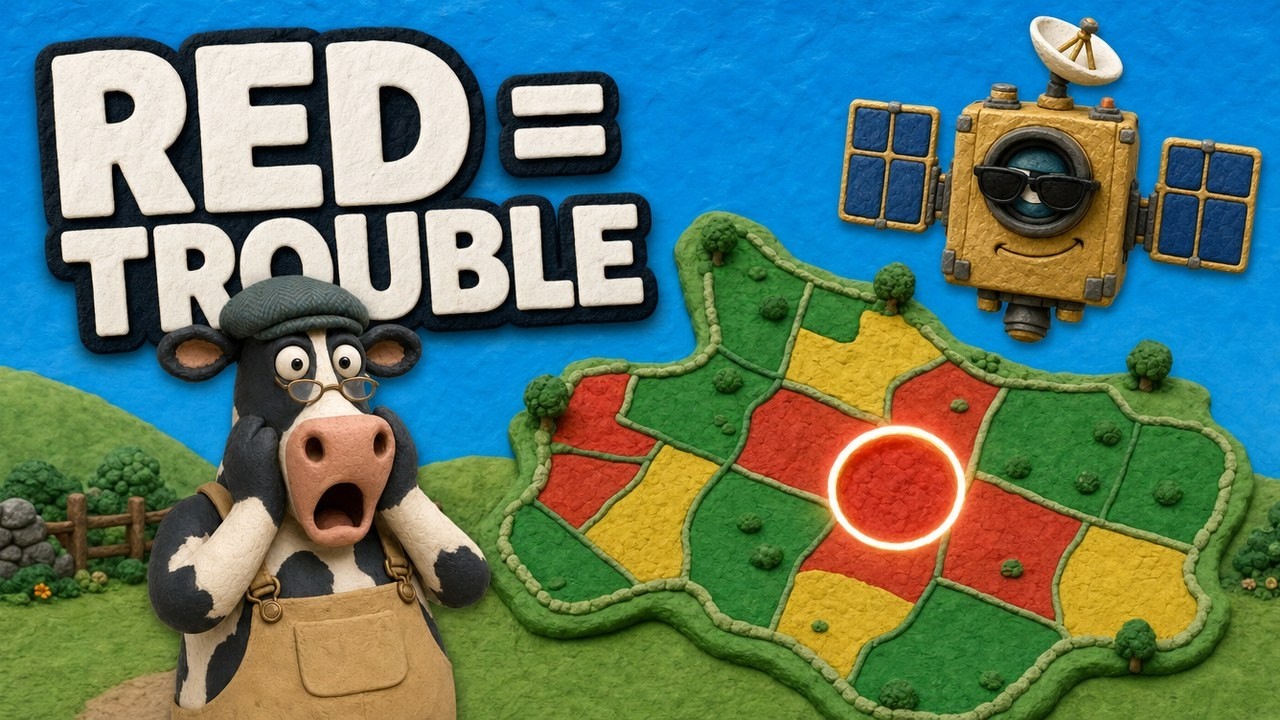
▶ How satellite NDVI maps show changes in plant cover, here used to spot crop stress across a large farm. · 4:09
FAQ
Are lemons with black spots safe to eat?
Lemons with sooty mold are still edible once washed with mild soap and warm water (UC IPM). For CBS, UF/IFAS says the lesions rarely cause internal fruit rot and ripe fruit is still suitable for processing, but regulated areas restrict moving the fruit. Do not eat fruit that is soft, moldy or rotten.
How do I tell sooty mold from the regulated black spot disease?
Sooty mold sits on top and wipes off, and the leaves are usually sticky from insects. CBS makes sunken, round lesions on the fruit that do not wipe off, with a gray centre and a dark margin, and lemon leaves may show small sunken spots with a yellow halo.
Should I use neem oil or copper on black spots on lemon leaves?
It depends on the cause. Oils and soaps are labelled against sap-sucking insects. Copper is a protective spray used against some fungal and bacterial diseases. Neither removes a lesion that has formed. Check that the product label lists citrus, the pest or disease, and the rate.
Will the spots go away once I treat the tree?
Sooty mold fades gradually after the insects are controlled, and can be washed off. Lesions on the rind and the leaf are permanent, but new growth can stay clean if the cause is dealt with.
Can I move lemons from a Florida quarantine area?
Not outside the area. FDACS says citrus fruit, trees and plant material grown in or moved into a residential citrus black spot quarantine area may not be moved out. Check the current map with FDACS or APHIS.
How often should I check my trees?
A walk-through every one to two weeks is a practical routine. Check more often in warm, wet spells, after each new flush and whenever you already have a problem.
How we checked the numbers
Lesion sizes, wetting hours and spray timings come from UF/IFAS extension publications and the EPPO datasheet. Disease descriptions for sooty mold, Septoria and bacterial blast come from University of California IPM. County counts come from a USDA APHIS notice of August 2022 and from Citrus Industry Magazine’s 8 September 2026 report of the latest APHIS notice. Movement rules come from the Florida Department of Agriculture and Consumer Services. Florida spray dates are for commercial groves and need local adjustment. California and Florida also differ in which diseases occur, so read the guidance for your own region.
Sources and where to go next
Treatment advice varies by country, state and product registration. Pesticide, dose and legal points in this guide are summaries of the sources listed. Always follow the product label and local rules, and ask a licensed adviser or your extension office before you spray.
Related pages on our site: lemon tree disease treatment, black bugs on lemon trees, farm monitoring, farm management app, satellite and weather API documentation, product traceability, carbon footprint tracking, crop loan and insurance verification.
Farmonaut crop monitoring
Watch your orchard from space
Draw your orchard once and Farmonaut shows satellite vegetation maps for it through the season, on web, Android or iOS.




Keep reading

Sources
- University of California IPM, Sooty Mold Pest Notes: ipm.ucanr.edu
- University of California IPM, Bacterial Blast of Citrus (Home and Landscape): ipm.ucanr.edu
- University of California IPM, Septoria Spot of Citrus (Home and Landscape): ipm.ucanr.edu
- UF/IFAS, HS-798 A Guide to Citrus Disease Identification: ask.ifas.ufl.edu
- UF/IFAS, 2026-2029 Florida Citrus Production Guide: Citrus Black Spot (PP279/CG088): edis.ifas.ufl.edu
- EPPO Global Database, Phyllosticta citricarpa datasheet: gd.eppo.int
- UF/IFAS, 2026-2029 Florida Citrus Production Guide: Melanose (PP-145/CG019): ask.ifas.ufl.edu
- UF/IFAS, 2026-2029 Florida Citrus Production Guide: Greasy Spot (PP-144/CG018): edis.ifas.ufl.edu
- Florida Department of Agriculture and Consumer Services, Citrus Quarantine and Disease Detection Maps: fdacs.gov
- USDA APHIS bulletin DA-2022-31, citrus black spot quarantine update (August 2022): content.govdelivery.com
- Citrus Industry Magazine, Citrus Black Spot Quarantine Expanded in Florida (8 September 2026): citrusindustry.net
Discussion
Questions, corrections or field experience? Share them below. First-time comments are reviewed before they appear, and your email is never published.
No comments yet. Be the first to add a question or your experience.

 SkyHarvest
 Sarvome
 Polaris Digitech
 Teledarbas
 Wild Oak Farm
 SFX
 BACF Africa
 Doodlakine
 Exurbia Geospatial
 FieldZero
 Indico Company
 Kubota
 FFBS
 Jontra

 Licence holder · Niger · Gold
 Client · Tanzania · Gold
 Client · Somalia · Gold
 Client · Oregon, USA · Gold
 Client & affiliate partner · Ghana · Gold










