

Reviewed September 2026 against USDA National Agricultural Statistics Service (NASS) and California Department of Food and Agriculture (CDFA) Citrus Pest and Disease Prevention Division data.
Try it: Run your own numbers →
Table of Contents
- Introduction: What’s Actually Attacking Your Lemon Tree
- White Bugs on Lemon Tree: The #1 Search, Answered
- Common Pests Affecting Lemon Trees
- Pest Identification and Management Strategies Table
- How to Get Rid of Bugs on Lemon Tree Indoors
- Schefflera and Lemon Trees: Do They Share Pests?
- Integrated Pest Management for Citrus Trees
- Top 7 Tips: How to Get Rid of Bugs on Lemon Tree
- Treatment Cost & Spray Interval Calculator
- Detailed Pest-Specific Control Strategies
- Farmonaut Tools for Pest Management
- Frequently Asked Questions
- Conclusion
- Try it: Run your own numbers
Bugs on Lemon Tree: ID Guide + What Kills Them Fast
If you found white, cottony, or waxy bugs on a lemon tree, you’re almost certainly looking at mealybugs or cottony cushion scale — not a single insect species called “lemon bugs,” but one of eight recurring citrus pests with distinct fixes. This guide identifies each one from a photo-free description, tells you which control actually works for your situation (indoors versus outdoors, potted versus in-ground), and gives you a cost-and-timing calculator so you’re not guessing at spray schedules.
Lemon tree pests are a recurring problem wherever lemons are grown commercially or in containers. In the United States, that’s overwhelmingly California and Arizona: USDA NASS put US lemon-bearing acreage at 54,500 acres for the 2013–14 season (California 46,000 acres, Arizona 8,500 acres), and by the 2023–24 season NASS recorded Arizona’s lemon-bearing acreage at 3,100 acres — a steep contraction that reflects both water costs and pest/disease pressure on Arizona groves. California alone produced 79% of total US citrus in the 2023–24 season, per NASS. None of that changes what’s crawling on your tree in a container on a windowsill in Ohio, but it explains why nearly all the pest-management research and extension guidance you’ll find is calibrated to California and Arizona growing conditions — worth knowing when you’re reading advice written for a 500-acre orchard and applying it to one potted tree.



White Bugs on Lemon Tree: The #1 Search, Answered
“White bugs on lemon tree” is the single highest-traffic question this page answers, so here’s the direct call: white, cottony masses clustered in leaf axils and along stems are mealybugs. If the white material looks more like flat, waxy plates or fluted cushions on bark and twigs rather than loose cotton, you’re looking at cottony cushion scale, a related but different pest that needs a different response because its waxy coating blocks contact sprays. A fine white dust that flies up when you brush the leaves, rather than staying put, is whiteflies — tiny winged insects, not a stationary mass.
The fix differs by which one you have. Mealybugs respond well to direct removal (a cotton swab dipped in isopropyl alcohol kills on contact) plus horticultural oil to smother eggs hidden in crevices. Cottony cushion scale’s wax layer means oil sprays need to fully coat the insect — partial coverage lets it survive — and heavy infestations often need a second application 10–14 days later to catch newly hatched crawlers before they build their own wax coating. Whiteflies are best caught with yellow sticky traps for the flying adults combined with oil sprays timed to the nymph stage on leaf undersides. Confusing these three is the most common reason a lemon-tree pest treatment fails: the spray was right for a different insect than the one actually present.
Common Pests Affecting Lemon Trees
Lemon trees, like other citrus plants, are susceptible to a diverse array of pests. Knowing how to identify these insects at an early stage can be a game-changer in maintaining a healthy, thriving tree. Below are the eight pests responsible for nearly all reported damage on citrus trees:
- Aphids: Soft-bodied pests feeding on plant sap, causing leaf distortion and potentially spreading disease. See our dedicated guide on eliminating aphids on lemon trees for species-specific detail.
- Scale Insects: Appear as small bumps on stems and leaves, leading to yellowing and stunted growth.
- Mealybugs: White, cottony masses on plants feeding on sap, thus weakening the citrus tree — the pest behind most “white bugs on lemon tree” searches.
- Spider Mites: Tiny arachnids inducing leaf stippling and drop in severe infestations.
- Citrus Leaf Miners: These moth larvae leave winding trails and cause leaf distortion and reduced photosynthesis.
- Whiteflies: Small, winged insects that excrete honeydew, thus promoting sooty mold and causing yellowing leaves.
- Thrips: Feeding on a variety of plant parts, these insects create silver streaks impacting fruit and leaf growth.
- Citrus Root Weevils: Beetle larvae feasting on roots, leading to wilting and poor growth.
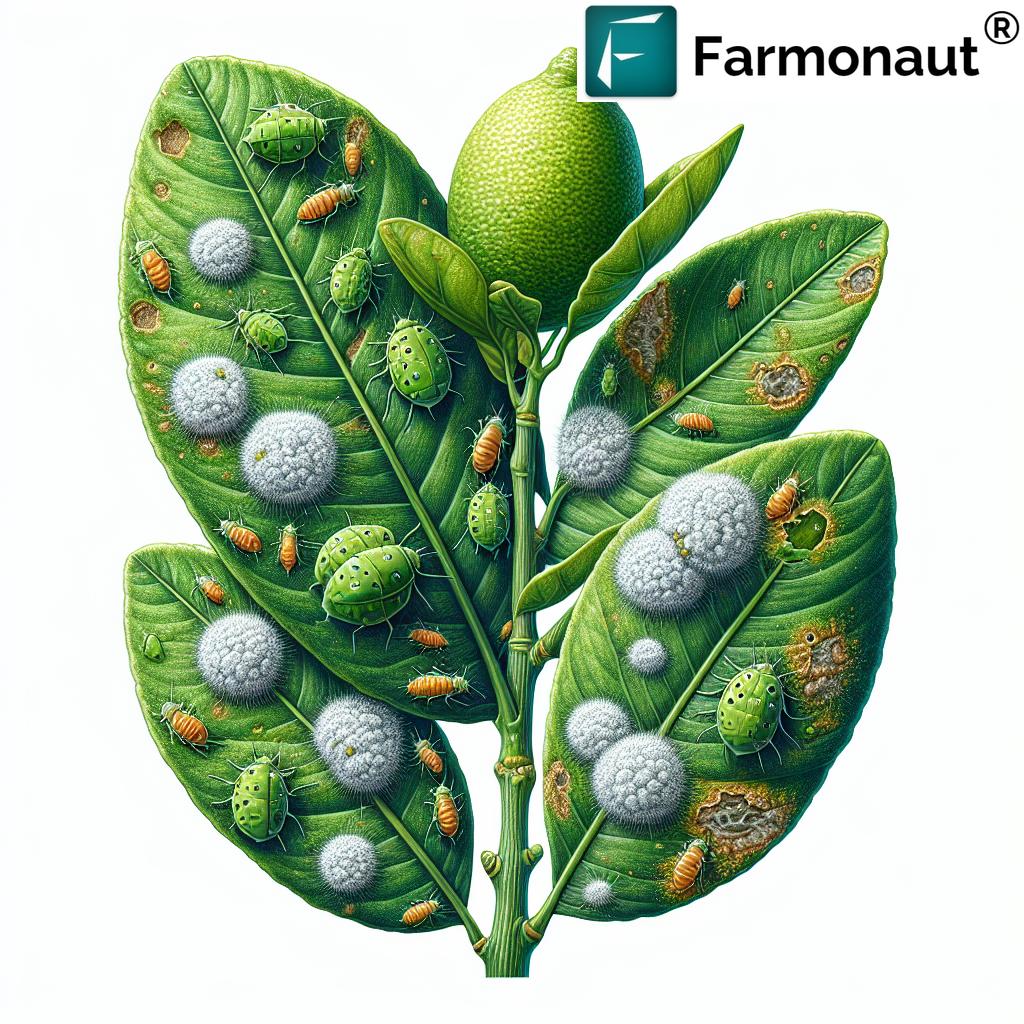
Does a lemon tree attract bugs more than other trees do? Not inherently — but citrus foliage stays evergreen year-round (unlike deciduous fruit trees that go dormant and shed pest habitat each winter), and the soft, sap-rich new growth citrus produces in flushes is exactly what aphids, mealybugs, and leaf miners target. A stressed lemon tree — underwatered, overwatered, or over-fertilized with nitrogen — pushes out more of that vulnerable soft growth and becomes a more attractive target than a well-managed one. Regular inspection catches problems while they’re still confined to one or two branches, before they spread through the canopy.
Pest Identification and Management Strategies Table
| Pest Name | Appearance | Common Symptoms | Infestation Severity | Recommended Control Methods |
|---|---|---|---|---|
| Aphids | Green, yellow, or black soft-bodied, 1–3mm | Deformed, curled leaves; sticky residue (honeydew) | High |
|
| Scale Insects | Brown/tan bumps on stems/leaves | Yellowing, stunted growth, sticky leaves | Medium |
|
| Mealybugs (white bugs) | White, cottony masses on stems/leaves | Sticky honeydew, leaf yellowing, weak growth | High |
|
| Cottony Cushion Scale | White, fluted, waxy cushions on bark/twigs | Yellowing, honeydew, dieback on heavy limbs | Medium–High |
|
| Spider Mites | Tiny red/yellow/green mites, form webs | Leaf stippling/yellowing, leaf drop | Medium |
|
| Citrus Leaf Miners | Tiny moth larvae, white trail in leaves | Winding silvery trails, leaf curling/distortion | Low–Medium |
|
| Whiteflies | Tiny white, flying insects underneath leaves | Yellowing, sticky honeydew, sooty mold | Medium |
|
| Thrips | Tiny, slender yellow-brown insects | Silver streaks on leaves, deformed fruit | Low–Medium |
|
| Citrus Root Weevils | Black/brown beetles; larvae in soil | Wilting, poor growth, roots chewed | Low–Medium |
|
How to Get Rid of Bugs on Lemon Tree Indoors
Indoor lemon trees — typically dwarf or Meyer varieties in containers — face a narrower set of pests than orchard trees, but treatment options are more restricted because you can’t spray broad-spectrum products in a living room and you can’t rely on outdoor predator insects like ladybugs or parasitic wasps to show up on their own. Three pests account for nearly all indoor citrus complaints: spider mites (favored by the dry air of heated homes in winter), mealybugs (favored by the still air and lack of rain that would otherwise wash them off), and scale.
- Isolate first. Move the affected tree away from other houseplants immediately — indoor pests spread fast in still air with no wind or rain to disrupt them.
- Raise humidity for mites. Spider mites thrive in the low humidity typical of heated indoor air in winter; misting the foliage or running a humidifier nearby reduces the conditions that let populations explode.
- Wipe, don’t just spray. For mealybugs and scale, physically wiping leaves and stems with a damp cloth or alcohol-soaked cotton swab removes far more of the population than a spray alone, because indoor plants lack the rain that normally washes dislodged insects away for good.
- Use oil sprays outdoors, then bring the tree back in. Horticultural oil and insecticidal soap work indoors, but the fumes and the risk of spraying an enclosed space make it worth carrying a potted tree outside or into a garage for the application, letting it dry for a few hours, then returning it inside.
- Quarantine new plants. Most indoor infestations arrive on a new plant brought into the house — a two-week isolation period for any new arrival prevents most future outbreaks.
None of the acreage or production figures cited earlier in this piece apply to a single potted tree — those numbers describe commercial orchard economics in California and Arizona, not container growing. For an indoor tree, the right benchmark is your own inspection log: check weekly, note what you find, and treat as soon as you see it rather than waiting for a visible infestation.
Schefflera and Lemon Trees: Do They Share Pests?
Schefflera (umbrella tree) is a common houseplant, not a citrus species, and it is not related to lemon trees botanically. That said, if you’re searching for schefflera pest advice while also dealing with a lemon tree, the overlap is real at the level of the insect, not the plant: schefflera and indoor citrus are both frequently hit by the same generalist houseplant pests — spider mites, mealybugs, and scale — because these insects aren’t picky about host plant, they’re picky about growing conditions (still air, moderate temperatures, and a lack of the rain or wind that disrupts outdoor populations).
That means the identification and early-response steps in this guide’s white-bugs and indoor sections apply directly to a schefflera showing the same cottony masses or webbing. The one meaningful difference: citrus tolerates horticultural oil and insecticidal soap sprays well, while schefflera and some other ornamental houseplants can show leaf sensitivity to oil sprays in low light or high heat — always test any spray on a single leaf first and check the product label for houseplant-specific cautions before treating a non-citrus plant with a citrus-labeled product.
Integrated Pest Management for Citrus Trees: The Smart Approach
To keep our citrus trees robust and prolific, integrated pest management (IPM) is a proven, eco-friendly strategy. IPM combines cultural, biological, physical, and, where needed, chemical control methods—all aimed at reducing pest populations with minimal risk to people and the environment.
By implementing these integrated approaches, we’re not just responding to outbreaks, but actively preventing them. Here’s IPM for lemon trees broken down step by step:
- Cultural Controls: Maintain healthy soil, remove weeds, and prune infested branches to naturally discourage pests.
- Biological Controls: Encourage or introduce natural enemies like ladybugs and beneficial nematodes.
- Physical Controls: Use barriers, traps, and direct removal techniques.
- Chemical Controls: Employ insecticidal soaps, oils, or targeted pesticides only if cultural, biological, and physical controls are insufficient.
IPM requires regular inspection and monitoring—which is where advanced tools like Farmonaut’s real-time crop health monitoring can be invaluable for orchard-scale growers. Farmonaut leverages satellite-based observations and AI-driven insights to help identify infestations early, manage resource use, and time interventions precisely. Discover Farmonaut’s Crop Plantation and Advisory solutions for pest and disease management at scale.
For advanced users and developers, Farmonaut also offers robust API access and API developer documentation for satellite-driven crop monitoring, making integration with existing farm management systems straightforward.

Top 7 Tips: How to Get Rid of Bugs on Lemon Tree
Here are the 7 most effective, integrated tips for managing and defeating lemon tree pests, indoors or out.
-
Regular Inspection and Early Identification
- Inspect trees weekly—look for curled, sticky, or yellowing leaves, and visible bugs on stems and fruits.
- Use a magnifying glass to spot tiny insects like spider mites and aphids on lemon tree leaves.
-
Healthy Soil and Watering Practices
- Use well-drained, nutrient-rich soil to support robust tree growth, making trees less susceptible to pests.
- Avoid overwatering, which invites pests and diseases to flourish around roots.
-
Pruning and Sanitation
- Prune out infested or unhealthy branches immediately to reduce lemon tree pest populations.
- Regularly remove fallen leaves, branches, and fruit to prevent pest life cycles from continuing undisturbed.
-
Weed and Companion Plant Management
- Keep weed growth in check; many weeds are a hiding spot for pests affecting citrus trees.
- Plant pest-repelling companions like basil and marigolds nearby as natural pest control for lemon trees.
-
Biological Pest Control for Lemon Trees
- Attract and protect beneficial insects (ladybugs, lacewings, predatory wasps) that feed on aphids, mealybugs, and whiteflies.
- For soil-dwelling pests, release beneficial nematodes to target larvae and root weevils.
-
Physical Pest Controls: Traps, Water, and Mulches
- Apply strong water sprays to dislodge soft-bodied pests like aphids and spider mites.
- Set up yellow sticky traps to capture and monitor adult whiteflies and some thrips.
- Use reflective mulches to deter sap-sucking insects from landing on the citrus tree foliage.
-
Chemical Controls: Last Resort, Not First Response
- Opt for insecticidal soaps and oils that target soft-bodied insects (aphids, mealybugs), minimizing harm to beneficial species.
- For severe infestations, use citrus-safe systemic insecticides or miticides, always following label directions and safety precautions.
Treatment Cost & Spray Interval Calculator
Enter your tree count and infestation severity to estimate spray sessions needed and rough material cost through a full treatment cycle.
Run your own numbers
Assumptions: figures are planning estimates only, not a substitute for label directions on your specific product. One spray bottle is assumed to treat roughly 4 medium potted trees per session, or a proportional share of one in-ground tree. Excludes cost of beneficial insects, pruning tools, or professional treatment. Indoor sessions get one extra pass to account for the lack of rain washing off dislodged pests. Always follow the product label’s own reapplication interval over this estimate.
Lemon Tree Pest Control: In-Depth Strategies for Each Pest
Here is a closer look at each pest and the stepwise management methods that follow the principles of integrated pest management for citrus trees:
Aphids on Lemon Tree Leaves
- Typically cluster on new growth and tender leaves, aphids suck sap, distorting and curling foliage, often leaving a sticky residue (honeydew).
- Natural controls: Spray with water, introduce or conserve ladybugs, keep plants weed-free to minimize insect hiding spots.
- Physical/chemical: Apply insecticidal soap or neem oil. For severe issues, use systemic insecticide—but only as a last resort.
- Tip: Honeydew attracts sooty mold, leading to further stress and yellowing.
Mealybugs on Citrus Trees (the “white bugs”)
- These pests resemble white, fluffy spots (“cottony masses”) on stems, foliage, and sometimes fruit — this is the pest behind most white-bug and lemon-bug searches.
- Control: Remove visible clusters with alcohol-soaked cotton swabs, encourage lacewings and ladybugs, apply horticultural oils.
- Ensure good air circulation and avoid excessive nitrogen fertilizer—which encourages rapid, soft growth attractive to mealybugs.
- Tip: Cleanliness and prompt action are essential to reduce mealybug populations.
Scale Insects (including Cottony Cushion Scale)
- Appear as hard or soft dome-shaped brown bumps, or as white fluted waxy cushions, attached to stems and leaves, sucking sap directly from the plant.
- Control: Prune and dispose of heavily infested parts to break the lifecycle, apply horticultural oils/soaps during the crawler stage.
- Beneficial predatory insects like parasitic wasps and, for cottony cushion scale, vedalia beetles aid in population reduction.
- Tip: Dormant oils applied while the tree is not actively flowering can help manage hidden scale eggs.
Spider Mites and Thrips
- Mites are tiny arachnids causing leaf stippling, browning tips, and sometimes webbing. Thrips create silver streaks and leaf markings.
- Physical control: Wash undersides of leaves regularly; maintain humidity to discourage mite outbreaks, especially indoors in winter.
- Biological and chemical: Introduce predatory mites; apply miticides or approved soaps/oils if necessary.
- Tip: Inspect during hot, dry weather when mite populations peak.
Citrus Leaf Miners
- These are the larvae of tiny moths that feed under the skin of leaves, causing twisting, curling, and silvery “trails” across new growth.
- Control: Remove damaged leaves, use pheromone traps for adults, avoid over-fertilization which stimulates flushes of new, susceptible growth.
- Tip: Leaf miner infestations seldom seriously harm mature trees but can weaken young transplants.
Whiteflies on Lemon Tree
- Congregate on the undersides of leaves, causing yellowing, wilting, and often leaving honeydew that leads to sooty mold.
- Control: Deploy yellow sticky traps, encourage natural predators, apply neem oil or insecticidal soaps as directed.
- Tip: Frequent inspection under warm, dry conditions will help to visually detect whiteflies early, before the fine white dust becomes a full cloud when the branch is disturbed.
Citrus Root Weevils
- Adult beetles are rarely spotted, but larvae feed on roots, causing wilting and stunted growth above ground.
- Biological control: Apply beneficial nematodes to soil as a safe and highly effective solution.
- Practice proper watering to reduce attraction and improve overall tree resilience.
Interested in sustainable growing? Learn how to minimize environmental impact with Farmonaut Carbon Footprinting solutions.
For enhanced food safety, track the origin of your citrus fruits with blockchain-based supply chain traceability from Farmonaut.
For accessing agricultural loans or crop insurance with higher transparency, rely on satellite verification with Farmonaut’s crop loan and insurance verification technology.
How Farmonaut Technology Supports Modern Pest Management Practices
For growers managing more than a handful of trees, precision technology changes how fast a pest problem gets caught. Farmonaut’s satellite-based solutions help you monitor citrus crop health, detect stress caused by pest damage, track irrigation needs, and manage interventions with more accuracy than a weekly walk-through alone. Here’s how the platform supports integrated pest management for citrus trees:
- Real-Time Crop Health Monitoring: Identify irregularities early—NDVI and other spectral indices reflect pest or disease stress before visible symptoms appear.
- AI-Based Pest & Crop Advisory: Receive custom, data-driven recommendations for pest, disease, and nutrition interventions, saving both time and input costs.
- Blockchain Traceability: Ensure transparency from orchard to table—vital for food safety and market value.
- Resource Management: Optimize irrigation and fertilizer use, creating less favorable conditions for pests while boosting efficiency and sustainability.
The economics of pest management scale differently for a commercial grower than for a home gardener. California’s citrus industry (all types combined — oranges, lemons, grapefruit, mandarins) generated $2.2 billion in gross revenue in 2017, per CDFA — and pest and disease control is a direct line item against that revenue, not an optional add-on. Lemon growers in the Central California Tristeza Eradication Agency’s program pay a $9.20-per-acre assessment to fund area-wide pest and disease eradication efforts, according to CDFA’s citrus program — a cost structure that only makes sense at orchard scale, but illustrates that professional growers treat pest monitoring as a recurring budget line rather than a reactive one-off spray.
Farmonaut is accessible via Android, iOS, Web, and API—so whether you manage a small home garden or a large-scale citrus operation, you can stay ahead of threats by regularly monitoring pest risks and receiving targeted pest control guidance.
Want affordable, real-time satellite crop monitoring for your citrus orchard?
Subscribe to Farmonaut and empower your crop pest management!
Frequently Asked Questions
What are the white bugs on my lemon tree?
Cottony, loose white masses in leaf axils and along stems are almost always mealybugs. Flat, waxy, fluted white cushions on bark and twigs are cottony cushion scale. A fine white dust that lifts off and flies when you disturb the branch, rather than staying fixed in place, is whiteflies. Each needs a different treatment — see the White Bugs section above for the full breakdown.
How do I get rid of bugs on a lemon tree indoors?
Isolate the tree from other houseplants, raise humidity to discourage spider mites, physically wipe leaves and stems for mealybugs and scale rather than relying on spray alone, and apply any oil or soap treatment outdoors or in a well-ventilated space before returning the tree inside. See the Indoor section above for the full routine.
Does a lemon tree attract more bugs than other plants?
Not inherently — but its evergreen foliage and frequent flushes of soft new growth make it a steadier food source for aphids, mealybugs, and leaf miners than deciduous trees that go dormant. A stressed tree, from over- or under-watering or excess nitrogen, produces more of that vulnerable new growth and draws more pests as a result.
Do bugs eating lemon tree leaves need a different treatment than sap-suckers?
Yes. Chewing damage (ragged holes or missing leaf tissue) usually points to caterpillars or beetle larvae rather than the sap-sucking insects covered in most of this guide (aphids, mealybugs, scale, whiteflies). If your damage is chewed holes rather than curling, yellowing, or honeydew, inspect for caterpillars and treat with a targeted product for chewing pests rather than the oils and soaps recommended here for sap-suckers.
Which lemon tree pests are most common?
Aphids and mealybugs are the most prevalent lemon tree pests, followed by scale insects, spider mites, citrus leaf miners, whiteflies, thrips, and citrus root weevils.
Are chemical controls necessary for lemon tree pest management?
Chemical controls are a last resort in integrated pest management for citrus trees. Try cultural, biological, and physical methods first; use citrus-safe insecticidal soaps or oils when populations are high, and reserve systemic insecticides or miticides for acute, unmanageable outbreaks.
How does proper watering and fertilization impact pest control?
Proper watering and balanced nutrition promote strong, resilient tree growth, making lemon trees less appealing to pests and less vulnerable to disease transmission. Overwatering and excessive nitrogen should be avoided, as both attract pests and can lead to root rot.
Can digital technology help with lemon tree pest management?
Yes, for orchard-scale growers. Platforms like Farmonaut provide satellite-driven crop health monitoring and AI-driven pest advisory, enabling precise, prompt intervention and more sustainable lemon orchard management. For a single indoor or backyard tree, a weekly visual inspection using the steps in this guide remains the most practical approach.
Conclusion: Achieve Pest-Free Lemon Trees with Smart, Sustainable Strategies
Managing lemon tree pests is an ongoing process requiring vigilance, correct identification, and the right integrated approach. Get the ID right first — white cottony masses, waxy cushions, and flying white dust are three different insects with three different fixes — then combine regular inspection, cultural practices, biological controls, and, when needed, chemical interventions to keep the tree productive.
Farmonaut’s precision agriculture solutions make crop health monitoring, pest detection, and resource management accessible for growers managing citrus at scale, while the identification steps and calculator above are built for anyone with one tree on a patio or a windowsill. Whichever end of that range you’re on, correct identification followed by the least invasive effective treatment is what actually gets rid of the bugs — and keeps them from coming back.

 WB Dev
 Sama Premium
 Mahaswami
 Prochecker
 Tres Valles
 LACOS Geoinformation
 Pulsar Supernova
 Magrifly
 LatConnect 60
 WebsEdge
 Blickwinkel
 Agricultural Credit Policy Council
 MCSOD
MCSOD Marei Nursery
 eKGIS
eKGIS Mostas Tech
 Andex
Andex FCF India
 Unifrutti Gulf
 Deluxe Conseil
