

Bismuth metal · Uses, price and supply guide
Bismuth Metal Uses: 8 Applications, Price and Supply
Bismuth metal goes mainly into medicines, cosmetics and pigments, lead-replacing brass and solder, and low-melting alloys. World output was about 16,000 tons in 2025, with China at 88% (USGS, 2026).
Key takeaways
- Main uses: chemicals for medicine and cosmetics, lead replacement in metals, and low-melting alloys (USGS, 2026).
- China made 88% of about 16,000 tons of refined bismuth in 2025 (USGS estimate).
- Nearly all bismuth is a by-product of lead, tungsten or zinc processing (USGS, 2026).
- The annual average price reached an estimated US$20 per pound in 2025, a record, after China’s export controls (USGS).
- The US relied on net imports for 92% of apparent consumption in 2025 (USGS estimate).
In this article
- What makes bismuth metal different
- What is bismuth metal used for? 8 main uses
- Is bismuth used in batteries, farming or water treatment?
- How bismuth is mined and where it comes from
- Bismuth metal price and the spike
- Who depends on imports: the US supply picture
- What a by-product of bismuth is worth to a project
- Exploring for bismuth-bearing systems
- Bismuth safety and environmental handling
- Frequently asked questions
Bismuth metal is used mainly in three ways: as bismuth chemicals for medicines, cosmetics and pigments; as an additive that replaces lead in brass, steel, aluminium and solder; and in low-melting alloys for devices such as fire sprinklers. The USGS Mineral Commodity Summaries (February 2026) lists all of these. It also puts world refinery output at about 16,000 tons in 2025, with China at 88%.
This guide goes through each use and the property behind it, then covers what matters to anyone assessing a bismuth-bearing project: where the metal comes from, why it is almost never mined alone, what happened to its price in 2025, and how to estimate the by-product value of your own ore. All tons here are metric tons, as in the USGS tables.
What makes bismuth metal different
Every important use traces back to a short list of physical traits. Bismuth is element 83, a brittle, silvery post-transition metal with a pink tint. Reference data for the element gives these values:
| Property | Value | Why it matters |
|---|---|---|
| Melting point | 271.5 °C (520.7 °F) | Forms alloys that melt at low temperatures |
| Density | about 9.8 g/cm³ (lead: 11.32) | Close enough to lead to replace it as a weight |
| Behaviour on freezing | Expands as it solidifies | Casts fill a mould sharply and can offset lead’s shrinkage |
| Thermal conductivity | 7.97 W/(m·K), among the lowest of any metal | Useful with tellurium in thermoelectric parts |
| Magnetism | Diamagnetic; no metal is verified as more strongly so | Mostly of scientific interest |
| Toxicity | Some compounds are less toxic by ingestion than lead, arsenic or antimony compounds | The main reason it replaces lead |
One point surprises many readers. Bismuth-209 is very slightly radioactive: its alpha decay was detected in 2003, with a half-life of about 2 × 10¹⁹ years, roughly a billion times the age of the universe. In practice the metal is handled as a stable material.
Those colourful stepped crystals sold as specimens are mostly lab or home grown. High-purity bismuth forms them readily from a melt, but they are virtually unseen in nature. Natural bismuth ore looks far duller; our companion guide to bismuth minerals and bismuth rods covers bismuthinite and related species.
What is bismuth metal used for? 8 main uses
How we chose: the list below includes uses named by the USGS or documented in the reference sources cited on this page. It is grouped by type and is not a ranking, because the USGS does not publish a tonnage split by use. As a rough guide, one reference summary says compounds take about half of global production.
1. Stomach medicines and other pharmaceuticals
Bismuth subsalicylate is the active ingredient in over-the-counter stomach remedies. MedlinePlus says it is used for diarrhea, heartburn and upset stomach in adults and children aged 12 and over. USGS also lists compounds for burns, intestinal disorders and stomach ulcers. Follow the label or ask a pharmacist; this page is not medical advice.
2. Cosmetics and pearlescent pigments
Bismuth oxychloride has a layered crystal that splits light, which gives the pearly shine in eye shadows, hair sprays and nail polishes. Bismuth vanadate is a high-performance yellow pigment used in paints. These compounds cannot be recycled in practice, since the metal ends up widely dispersed.
3. Brass for plumbing
This use has a clear legal driver. Under the US Safe Drinking Water Act, the limit is now a weighted average of 0.25% lead on wetted surfaces of pipes, fittings and fixtures. USGS reports that bismuth use in brass for pipe fittings, fixtures and water meters grew after the lower limit replaced the old 8% one in 2014.
4. Machining additives in steel and aluminium
Lead was long added to steel and aluminium so that chips break cleanly during machining. Bismuth does a similar job. Foundries also add it to malleable cast iron to improve metal integrity.
5. Low-lead and no-lead solders
European limits on lead in electronics widened the use of bismuth in low-melting solder as a replacement for tin-lead grades. Bismuth strengthens tin by distorting its crystal lattice. Its low toxicity also suits solder in food-processing equipment.
6. Fusible alloys and fire sprinklers
Combined with metals such as tin, lead, indium and cadmium, bismuth forms alloys that melt far below water’s boiling point. One indium-cadmium-lead-tin-bismuth alloy melts at 47 °C (117 °F). Rose’s metal is 50% bismuth, and Wood’s metal is another classic grade. USGS names four jobs for fusible alloys: holding lenses for grinding, plugging abandoned oil wells, filling tubes during bending, and triggering sprinklers.
7. Semiconductors and thermoelectric devices
Bismuth telluride is a semiconductor and a strong thermoelectric material, used in mobile refrigerators, processor coolers and infrared detectors. USGS adds that a bismuth-tellurium-oxide paste is used to make semiconductor devices. The tonnage involved is not separately reported.
8. Lead replacement in shot, sinkers and greases
Because its density is near that of lead, bismuth substitutes for it in fishing weights and hunting ammunition. USGS also lists lubricating greases among the applications where it is a nontoxic substitute for lead.
Is bismuth used in batteries, farming or water treatment?
Web articles often make broad claims here. The USGS summary of bismuth markets does not name batteries, farm chemicals or pollution clean-up, so treat such claims as research topics until a supplier or regulator documents them for your use.
How bismuth is mined and where it comes from
Almost nobody mines for bismuth alone. USGS says bismuth minerals rarely occur in sufficient quantities to be principal products. It names only two mines where bismuth has been the primary product: the Tasna Mine in Bolivia, inactive since 1996, and a mine in China. The rest arrives as a by-product, meaning a metal recovered while processing ore mined for something else.
Chart
Bismuth refinery production by country, 2025
Metric tons, USGS estimates. All countries listed by USGS.
The host metal depends on the region:
- Lead ores: the most common source worldwide, with bismuth recovered during lead processing.
- Tungsten and other ores: a by-product or co-product in China and Vietnam. See our notes on tin exploration in granites for a related geological setting.
- Zinc ores: the route in Japan and the Republic of Korea. Read more about zinc mining.
USGS also notes that reserves are generally not reported at mine or country level, so any headline figure for “world bismuth reserves” deserves suspicion. Its 2026 edition gives production but no reserve table.
Largest bismuth producing countries
China’s 14,000 tons dwarfs everyone else. The Republic of Korea is next at 1,000 tons, followed by Japan and Laos at 500 tons each. The United States has refined no primary bismuth since 1997, and its last primary lead smelter closed at the end of 2013. Lead concentrates containing bismuth are now exported for smelting.
From ore to 99.99% ingot: one planned flowsheet
Few projects publish a bismuth circuit, which makes Fortune Minerals’ NICO project (TSX: FT) in Canada’s Northwest Territories a useful public example. It is a development-stage cobalt-gold-bismuth-copper deposit, not an operating mine. Fortune describes a mine and concentrator in the territory, with a refinery planned in Alberta. There, concentrate would be reground and floated, bismuth leached with ferric chloride, cemented onto iron powder, then smelted and refined to 99.99% ingots.
The company reports mineral reserves of 33.1 million tonnes containing 102.1 million pounds of bismuth, from its 2014 feasibility technical report. That works out at roughly 0.14% bismuth (our arithmetic). Planned output is about 1,700 tonnes a year of bismuth in ingots during the first 14 years. A company update describes a newer feasibility study nearing completion, so check its latest filings for current figures. These are company statements, and the project has not been built.
Bismuth metal price and the spike
For years this was a cheap, quiet market. The USGS annual average sat between US$2.73 and US$5.40 per pound from 2019 to 2024, then jumped to an estimated US$20 in 2025, the highest annual average on record.
Chart
Bismuth annual average price
US$ per pound, 99.99% metal, in-warehouse Rotterdam. 2025 is a USGS estimate.
The trigger was policy. USGS reports that China issued export controls on bismuth in response to 10% US tariffs in February 2025. Monthly Rotterdam prices went from US$5.96 per pound in January to a peak of US$34.22 in March, then eased to US$17.50 by October. US imports from China fell an estimated 40%, from 760 tons in 2024 to 460 tons in 2025.
The USGS price is for 99.99% metal, in-warehouse Rotterdam, in lots of at least 1 ton (Fastmarkets data through October 2025). Quoted prices for small retail lots of bismuth shot or ingot usually sit on a different basis, so do not compare them directly. For a live quote, ask a metal trader or a price reporting agency; the last official figure here is the October 2025 monthly average.
Who depends on imports: the US supply picture
US net import reliance was 92% of apparent consumption in 2025 (USGS estimate). Scrap supplies about 80 tons a year, and recycled alloy scrap makes up as much as 10% of apparent consumption. The country held no government stockpile. Bismuth is on the USGS 2022 list of critical minerals.
Chart
Where US bismuth imports came from
Share of imports, 2021 to 2024, %.
From 2021 to 2024, imports came from China (56%), the Republic of Korea (22%), Germany (13%) and others (9%). Total imports of metal, alloys and scrap were about 1,500 tons in 2025, down from 1,800 tons in 2024, and estimated apparent consumption was 1,000 tons.
USGS also lists substitutes, which cap how far buyers will chase a high price. Alumina, antibiotics, calcium carbonate and magnesia can replace bismuth compounds in medicine. Titanium-dioxide-coated mica competes in pigments. Resins and glycerin-filled glass bulbs can replace fusible alloys in holding and sprinkler jobs. Cadmium, indium, lead and tin can partly replace it in low-temperature solder.
What a by-product of bismuth is worth to a project
For a licence owner or consultant, bismuth rarely decides whether a project goes ahead. It is a possible credit on top of a main metal. Three questions matter more than the price headline:
- Is it assayed? Check whether historic lab certificates include bismuth, and consider re-running retained pulps if they exist.
- Does it report to a payable stream? Do not assume a buyer pays for contained bismuth. Ask for the concentrate terms in writing.
- Who recovers it? The NICO example shows that capturing it as metal can need its own refinery circuit.
Use the calculator below for a first-pass number, then replace the assumptions with your metallurgical test results and offtake terms.
Calculator
What could bismuth add to your project?
Enter your own tonnage, grade and terms for a first-pass by-product figure.
- Contained bismuth (tonnes): 1,000
- Recovered bismuth (tonnes): 500
- Value per tonne of ore (US$): 5.51
Example values only, not a benchmark or a forecast. Price input: example, use today’s price. Grade, recovery and payable share must come from your own assays, tests and offtake terms. Fixed constant: 2,204.62 pounds per metric ton.
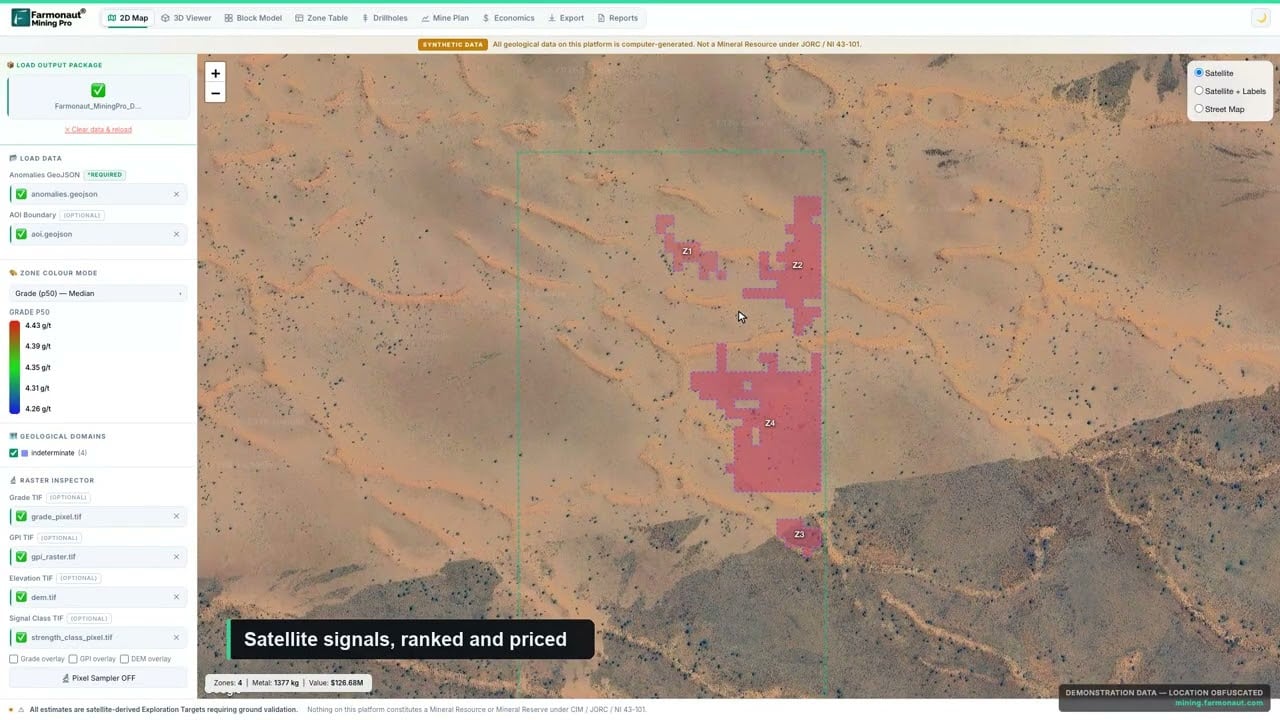
▶ A short look at what Farmonaut Mining Pro shows for a licence area · 4:56
Exploring for bismuth-bearing systems
Since bismuth follows other metals, explorers look for the host system. Target types include lead-zinc mineralisation, tungsten and tin settings, and iron-oxide copper-gold deposits such as NICO. Fortune reports bismuthinite and native bismuth among the sulphides there, within altered ironstone breccias up to 70 metres thick. Graphite, cobalt and nickel explorers working related ground can compare methods in our guide to graphite, nickel and cobalt targets.
Satellite imagery cannot see bismuth itself. It helps at the screening stage by mapping alteration and structure around host systems before anyone pays for fieldwork. Farmonaut offers this kind of satellite-based mineral detection, and its results are exploration targets that need soil sampling, assays and drilling to confirm. You can contact the team or ask for a project quote.
▶ Remote sensing for mining, explained in about two minutes · 2:01
Bismuth safety and environmental handling
Lower toxicity than lead does not mean a site can ignore it. The ore usually comes with other metals: NICO, for one, hosts cobaltian arsenopyrite, an arsenic mineral. Tailings, dust and water plans must therefore address the whole ore, with bismuth as just one part. Your local regulator’s limits apply. For consumers, a medicine dose is a medicine dose: follow the label.

▶ The main environmental impacts of mining, explained in clay · 2:31
Frequently asked questions
What is bismuth metal used for?
Mainly chemicals for medicines, cosmetics and pigments, plus additives replacing lead in brass, steel, aluminium and solder, and low-melting alloys for devices such as fire sprinklers (USGS, 2026).
Is bismuth a rare metal?
It has a small market. World refinery output was about 16,000 tons in 2025 (USGS). That is small for an industrial metal, and it depends on by-product supply.
Where does most bismuth come from?
China, with 88% of estimated world production in 2025. The Republic of Korea, Japan and Laos are the next largest producers (USGS, 2026).
Is bismuth mined on its own?
Almost never. USGS names only Tasna in Bolivia, inactive since 1996, and one mine in China as primary bismuth mines. Most comes from lead, tungsten and zinc processing.
How much is bismuth metal worth?
USGS estimated a 2025 annual average of US$20 per pound for 99.99% metal in Rotterdam, with a monthly high of US$34.22 in March and US$17.50 in October 2025. Prices move quickly, so get a current quote.
Why did the price of bismuth jump?
China imposed export controls on bismuth in response to US tariffs in February 2025, according to USGS. The annual average came to almost four times the 2024 level.
Is bismuth toxic or safe to handle?
Some bismuth compounds are less toxic by ingestion than compounds of lead, arsenic or antimony, which is why it replaces lead. That does not make every compound or dust exposure harmless, so follow safety data sheets.
Is bismuth radioactive?
Only very slightly. Bismuth-209 has a half-life of about 2 × 10¹⁹ years, so its decay has no practical effect on normal handling.
Can bismuth replace lead?
In many uses, yes: plumbing brass, solder, machining alloys, fishing weights and ammunition (USGS, 2026). It is less dense than lead and brittle.
Is bismuth a critical mineral in the US?
Yes. It appeared on the USGS 2022 critical minerals list, and the US relied on net imports for 92% of apparent consumption in 2025 (USGS estimate).
Can bismuth be recycled?
Partly. Alloy scrap supplies up to 10% of US apparent consumption (USGS). Medicines, pigments and cosmetics scatter the metal, so recovery from those uses is impractical.
More from Farmonaut: Agriculture impact on society
This page is for information only. It is not investment, legal or medical advice. Company figures are the company’s own statements; confirm them in its filings.
Farmonaut mining
Map your mining site from space
Send a licence boundary to screen alteration and structure around your host-metal system before you commit to fieldwork.

Mining Pro sample view, synthetic data
Keep reading
Sources
- USGS, Mineral Commodity Summaries 2026: Bismuth: pubs.usgs.gov
- USGS, Mineral Commodity Summaries 2025: Bismuth: pubs.usgs.gov
- USGS, Mineral Commodity Summaries 2022: Bismuth: pubs.usgs.gov
- USGS, Mineral Commodity Summaries 2021: Bismuth: pubs.usgs.gov
- USGS, 2022 list of critical minerals: usgs.gov
- US EPA, lead rule for drinking-water pipes, fittings and solder: epa.gov
- MedlinePlus (NIH), Bismuth Subsalicylate: medlineplus.gov
- Wikipedia, Bismuth (element data, alloys and compounds): en.wikipedia.org
- Fortune Minerals, NICO project page: fortuneminerals.com
- Fortune Minerals, NICO feasibility study update: fortuneminerals.com
Discussion
Questions, corrections or field experience? Share them below. First-time comments are reviewed before they appear, and your email is never published.
No comments yet. Be the first to add a question or your experience.

 Timestream Mining
 Lithspo Minerals Limited
 Tintina Mining Group
 Dalgety Minerals Pty Ltd
 Vortex Minerals Pty Ltd
 Faith At Work (Pty) Ltd
 Geotech Mining Solutions plc
 Vulcan International Limited
 Kidepo Associates
 GKY Mining
 Alkimy SARL
 Double A Trading
 GemSprout Metals Limited
 Qader Group
 Ileys General Trading
 SG Gold Mining LLC
 VRV Global Pte Ltd
 Omsri International FZE
 G.I.T.T.
 Jaunita Erss Ltd
 Almosi SARL
 SRK Consulting
 Berks Gold Limited
 Mwerezi Minerals Company Limited

 Exploration consultancy · South Africa · Gold










