

FSMA 204 and GS1 2D Barcodes: The Road to Total Product Traceability
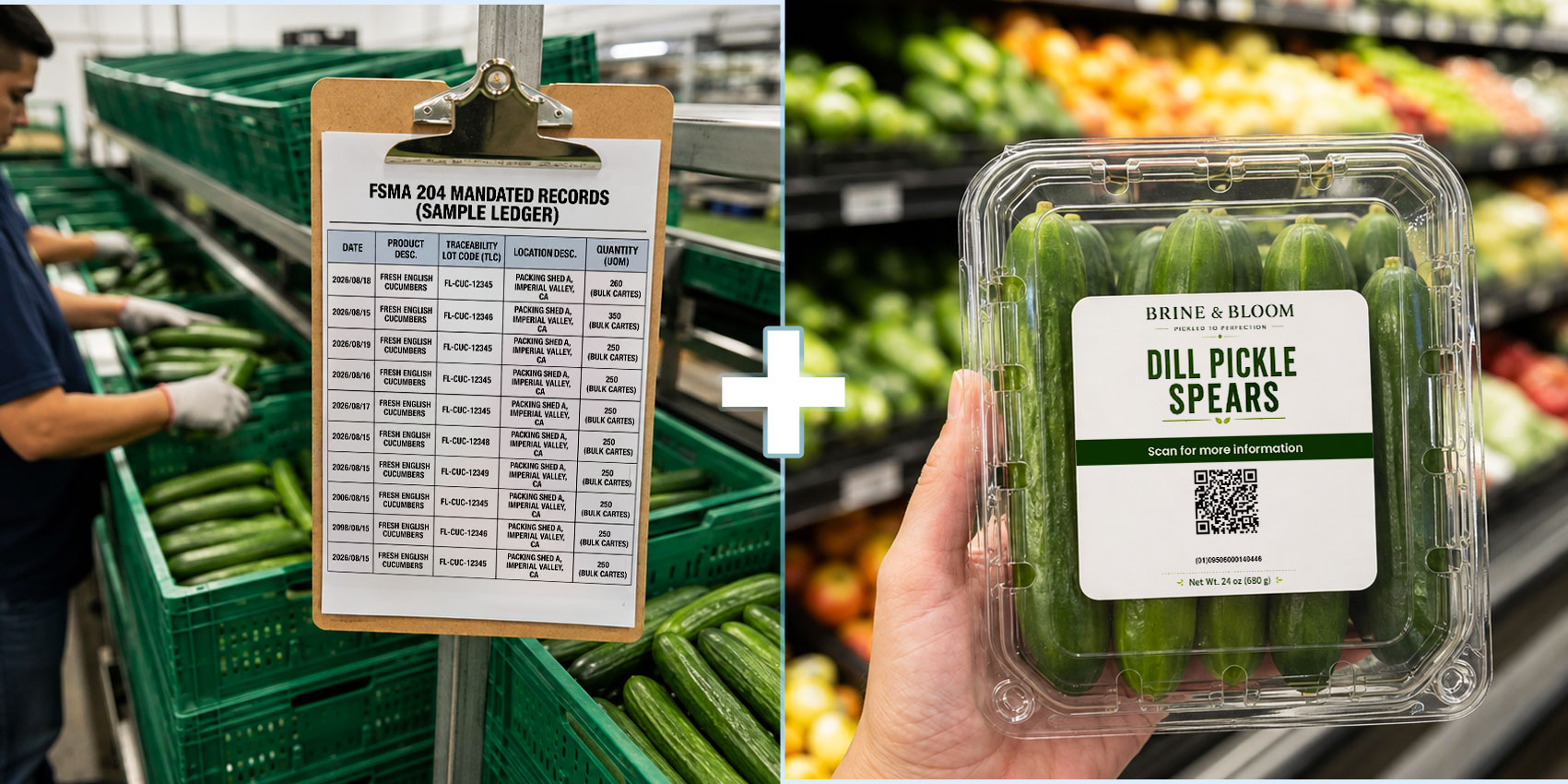
The US FDA’s Food Safety Modernization Act (FSMA 204) introduced the Food Traceability Rule to improve how certain foods are tracked through the supply chain.
The rule was created to help the FDA and the food industry quickly identify where a food came from and where it went when a food safety problem occurs, such as a contamination or outbreak.
Better records can help companies find affected products faster and make recalls more targeted.
The rule requires covered companies to keep specific records as food moves through key steps in its journey.
The rule centers on several key concepts:
- Food Traceability List (FTL): The foods covered by the Food Traceability Rule.
- Critical Tracking Events (CTEs): Key steps such as harvesting, cooling, initial packing, receiving, shipping, and transformation.
- Key Data Elements (KDEs): The information companies must record for these events.
- Traceability Lot: A group of food treated as one unit.
- Traceability Lot Code (TLC): A code used to identify a specific traceability lot and connect it to its records.
- TLC Source: The location where the TLC was assigned.
- TLC Source Reference: Information that allows the FDA to access the TLC Source.
- Traceability Plan: A written plan describing how a company maintains its required traceability records.
The basic goal is simple: if a food safety problem is discovered, the records should help identify the affected lot, trace it back to its source, and determine where other products from that lot may have gone.
However, there are practical gaps between having traceability records and keeping those records connected to the physical food item.
GS1 2D barcodes can help improve this connection by putting key product and lot information into a machine-readable format that can be scanned instead of manually entered.
To see where improvements can be made, let’s first look at how the TLC is assigned and how it changes as the food moves through the supply chain.
Assigning a TLC and tracking transformations
A TLC is assigned when an FTL food reaches the point where the rule requires a traceability lot. The TLC identifies that lot and connects it to the required traceability records.
As the food moves through the supply chain, the TLC generally stays with the lot. However, a transformation can change the traceability lot and require a new TLC.
Transformation can include activities such as processing, combining, commingling, repacking, or relabeling an FTL food. Depending on what happens to the food, there are three possible outcomes:
1. The TLC remains the same
Repacking is considered a transformation, but if a food is repacked without mixing it with another lot/batch, the original TLC can remain with that food.
The company still records the required information for the repacking event, including where and when it happened. The TLC continues to identify the same food lot.
This is important because a change in packaging does not automatically mean a new TLC is needed. The key question is whether the activity creates a new traceability lot under the rule.
2. A new TLC is required
A new TLC is required when a transformation creates a traceability lot that is still on the FTL.
For example, a food manufacturer receives cheese, leafy greens, and cucumbers and uses them to make a packaged, ready-to-eat salad for shipment to retail stores.
The new food lot receives a new TLC, which is linked to the TLCs of the ingredients used to make it. This creates a traceability link between the packaged salad and the original food lots.
The manufacturer must then maintain the required transformation records and, when the product is shipped to another business, the required shipping record
3. The transformation includes a kill step or the food leaves the FTL
A transformation step can include a “kill step,” like cooking or pasteurizing the food. If a company applies a kill step, it must keep a record showing the process was done.
Once a valid kill step has been applied, the shipping and receiving steps that come after it don’t need to follow the extra FSMA 204 tracking rules.
A transformation can also change the food enough that it’s no longer on the Food Traceability List (FTL) at all. When that happens, the resulting food falls outside the Food Traceability Rule entirely.
Either way, the extra tracking rules no longer apply to the food from that point forward.
Note: this only removes the extra FSMA 204 tracking. Companies still need to follow normal food recordkeeping rules, like knowing who they got the food from and who they sent it to. That basic recordkeeping never goes away, even when the extra FSMA rules no longer apply.
Gaps in FSMA 204 and where GS1 2D barcodes can help
FSMA 204 sets the basic requirements for food traceability. However, the rule does not cover every way a business may want to identify and track a product.
GS1 2D barcodes can help fill some of these gaps. They are optional tools and do not replace the records required.
Gap 1: The TLC does not have to be a scannable identifier
FSMA requires companies to assign and maintain a TLC and keep the required records connected to it. However, the rule does not generally require the TLC to be printed on the physical package as a machine-readable barcode.
A company can therefore have the required information in its records while workers still have to read, type, or manually match the TLC to the physical product.
This can create opportunities for errors, especially when large numbers of products and lots are handled.
What can help: A GS1 DataMatrix can carry the product’s GTIN and batch/lot number in a format that machines can scan. It can be added when a TLC is first assigned and when a transformation creates a new TLC.
The barcode can also continue to identify the product after it is no longer subject to the additional FSMA 204 traceability requirements. This allows a company to maintain its own traceability system beyond the point where the rule stops applying.
Gap 2: Traceability can stop before the product reaches the consumer
FSMA focuses on specific events and records as food moves through the supply chain. When a qualifying kill step applies, or when a transformation changes the food so that it is no longer on the FTL, the additional FSMA traceability requirements can stop applying to the food as it moves to later stages of the supply chain.
A business may still want to identify that product, connect it to its source, and provide information if a recall or other product issue occurs.
What can help: A GS1 Digital Link QR Code can be added to the finished retail product. It can contain the GTIN and batch/lot information and connect the physical product to digital information.
This allows the business to continue identifying the product. It can also provide a way to connect the product to information such as recall notices or product details.
Product end-to-end traceability
FSMA 204 provides the records needed to trace food through key points in the supply chain.
GS1 2D barcodes add a physical, scannable connection to those records. They can make it easier to identify specific products and lots without relying entirely on manual entry or paperwork.
Together, they can help make food safety responses faster, more precise, and easier to manage, from identifying specific affected product batches to tracing them back to their source.

 Godrej Agrovet
 Hayleys Agriculture
 Linx Agritech
 Adinet
 Save Your Soils
 GalaxEye Space
 Grandstream Algérie
 XOS Realty
 Geospatial Lab Africa
 Agro La Gándara
 HIPSAC
 ZOL Zimbabwe
 Juligerm
 AdBio
AdBio MISE Maroc
 NWNS
NWNS Red August Group
 Farm Inc
 WeMe Global
 Agrotoken
 Blue BearX
 Insignito
 DnCubed
 Indosistim Teknologi
 Liquify Digital
 CU Foods
 BeyondTech Global
 Rouge VC
 AgroRisk
 Oath Inc
 Esri North East Africa
 MDCV UK
 Etech Consulting Madagascar
 Vestlandsforsking
 WB Dev
 Sama Premium
 Tres Valles
 Blickwinkel
 Agricultural Credit Policy Council
 eKGIS
eKGIS Mostas Tech
 Andex
Andex Deluxe Conseil
 WICO
WICO Chimera Innovation
 SkyHarvest
 Teledarbas
 Exurbia Geospatial
 FieldZero
