

Alaska · Company guide
Alaska Mining Companies: Operators and Output by Mine
Seven lode mines produce Alaska’s metals: Teck runs Red Dog, Kinross runs Fort Knox and Manh Choh, Northern Star runs Pogo, Coeur runs Kensington and Hecla runs Greens Creek. Output by mine is below, with the explorers behind the next ones.
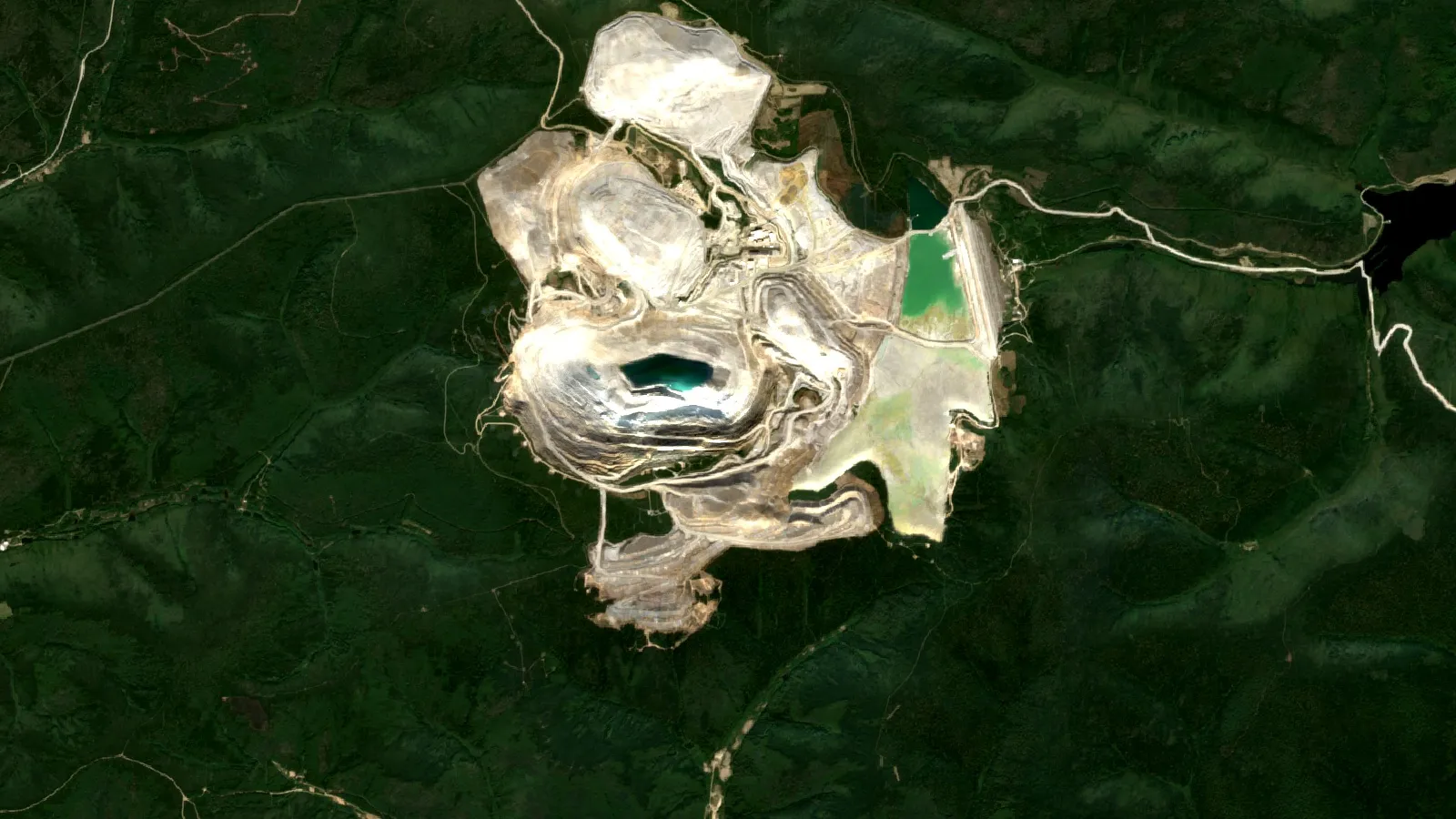
Key takeaways
- Seven lode mines and about 150 placer mines operate in Alaska; they mined metal worth about US$4 billion in 2024 (Alaska DGGS).
- Fort Knox, with Manh Choh ore, was the top gold producer: 410,822 gold-equivalent oz in 2025 (Kinross, counting all Manh Choh ore), ahead of Pogo at 273,895 oz and Kensington at 106,068 oz.
- Red Dog made 462,700 t of zinc in 2025, down from 555,600 t in 2024, and Teck guides lower output as it nears the end of current reserves.
- Greens Creek made 8.7 million oz of silver in 2025 (Hecla), the most of any US mine; USGS ranks Alaska the leading silver state.
- Donlin and Pebble are not producing: Donlin is in feasibility work, and the Pebble court case had no ruling as of August 2026.
In this article
- Alaska mining companies at a glance
- How the mines were chosen and measured
- Red Dog: Teck's zinc, lead and germanium mine
- Fort Knox and Manh Choh: Kinross and Contango
- Pogo: Northern Star's underground gold mine
- Kensington: Coeur's Southeast Alaska gold mine
- Greens Creek: Hecla's silver mine
- Dawson, placer miners and coal
- Gold output by mine compared
- Donlin and Pebble: the two giant projects
- Major explorers and developers
- Federal policy and the new mining rush
- Check a mine's margin
- Screening ground in Alaska before you stake
Alaska mining companies at a glance
Seven lode mines and about 150 placer operations produce Alaska’s metals, according to the Alaska Division of Geological & Geophysical Surveys (DGGS). Teck runs Red Dog, Kinross runs Fort Knox and Manh Choh, Northern Star runs Pogo, Coeur runs Kensington, Hecla runs Greens Creek and Sundance Mining Group runs Dawson. Together they mined metal worth about US$4 billion in 2024, roughly 12% of US metal production by value (DGGS).
The table lists each producer, the mine, the main metals and the latest full-year output from a company filing or the state survey. Ounces are troy ounces; tonnes are metric tonnes.
| Operator | Mine | Main metals | Latest full-year output | Source |
|---|---|---|---|---|
| Teck Resources | Red Dog (northwest Alaska) | Zinc, lead, silver, germanium | 462,700 t zinc in 2025 (555,600 t in 2024) | DGGS, quoting Teck |
| Kinross Gold | Fort Knox, with Manh Choh ore (Interior) | Gold | 410,822 gold-equivalent oz in 2025 (377,258 oz in 2024) | Kinross results |
| Northern Star Resources | Pogo (Interior) | Gold | 273,895 oz in 2025; 265,000 oz sold in the year to June 2026 | DGGS; Northern Star |
| Coeur Mining | Kensington (Southeast) | Gold | 106,068 oz in 2025 | Coeur results |
| Hecla Mining | Greens Creek (Southeast) | Silver, zinc, lead, gold, copper | 8.7 million oz silver and 59,349 oz gold in 2025 | Hecla results |
| Sundance Mining Group | Dawson (Southeast) | Gold | About 12,800 oz in 2024, similar in 2025 | DGGS |
| Usibelli Coal Mine | Usibelli (Interior) | Coal | About 910,000 t in 2025 | DGGS |
For the whole state, DGGS estimates 2025 output at 925,000 to 955,000 oz of gold, 13 to 15 million oz of silver, 510,000 to 522,000 t of zinc and 95,000 to 124,000 t of lead (preliminary, DGGS presentation, January 2026). The US Geological Survey adds that Alaska produced about 22% of domestic gold in 2025 and was the leading silver-producing state (USGS Mineral Commodity Summaries 2026).
How the mines were chosen and measured
The table covers every producer DGGS lists for 2025: the lode mines, with Manh Choh shown under Fort Knox because its ore is milled there, plus Usibelli coal. Each figure names its source. The headline metric fits each metal: gold in ounces for the gold mines, zinc tonnes for Red Dog, silver ounces for Greens Creek. Where a company reports more than one basis, we use the one the company labels as production, not sales or payable metal.
Two cautions on reading the numbers. First, Kinross reports Fort Knox and Manh Choh as one segment, in gold-equivalent ounces, and its production table counts 100% of Manh Choh ore. Kinross’s own attributable share, after the 30% Contango interest in Manh Choh, was lower: about 353,000 oz in 2025. Second, DGGS figures for 2025 were preliminary when published in January 2026; where a company has since filed audited full-year results, those are used instead.
Red Dog: Teck’s zinc, lead and germanium mine
Red Dog is a sediment-hosted zinc-lead-silver deposit that has operated as an open pit since 1989. It is the largest zinc mine in the United States, about 4% of world zinc output, and the only US mine producing germanium, a metal used in fibre optics and infrared lenses (DGGS). The land belongs to NANA Regional Corporation, the Alaska Native corporation for the region, and about 52% of the workforce are NANA shareholders. For context on zinc worldwide, see our guide to the biggest zinc mines and producing countries.
Output is falling by design. Zinc production was 555,600 t in 2024 and 462,700 t in 2025, with 107,000 t of lead in 2025 (109,100 t in 2024), and the mine plan calls for lower output through 2029 (DGGS, quoting Teck). Fourth-quarter 2025 zinc was 87,300 t, down 41,100 t on a year earlier because of lower ore grades and recoveries, which Teck’s fourth-quarter 2025 report says matches the mine plan. Teck expects to finish mining the higher-grade Qanaiyaq pit in 2026 and move to the lower-grade Aqqaluk pit in the fourth quarter.
Zinc and lead at Red Dog are shipped in a short summer season; in 2026 the shipping season opened on 12 July (Teck second-quarter 2026 report). Sales are therefore lumpy by quarter, so annual production is the better yardstick.
Against the US total of about 670,000 t of zinc in concentrate for 2025 (USGS), Red Dog’s 462,700 t is roughly 69%. The mine’s future rests on the Red Dog Mine Life Extension, formerly the Anarraaq and Aktigiruq program. The deposits lie 10 to 20 km from the current pits, the project is at prefeasibility stage, an all-season access road was advanced in 2025, and Teck guided 2026 growth spending of US$200 million to US$250 million. Teck says the work could extend the mine beyond 2032. The DGGS slide shows Aktigiruq and Anarraaq together at about 83 million tons (DGGS’s unit; more than half of it inferred) grading 14.5% zinc, 4.0% lead and 76 g/t silver (Teck, December 2024), at depths of 400 to 1,000 m.
Ownership news: Teck agreed in September 2025 to merge with Anglo American to form Anglo Teck. Shareholders approved it in December 2025, and Teck’s merger page and its second-quarter 2026 report describe the deal as subject to the remaining regulatory approvals. Until it closes, Teck remains the operator.
Fort Knox and Manh Choh: Kinross and Contango
Fort Knox, northeast of Fairbanks, is an intrusion-hosted open-pit gold mine owned by Kinross Gold. It poured its nine-millionth ounce in September 2023 and employs about 730 people plus 300 contractors; the Gilmore expansion extends mine life through 2029 with exploration continuing (DGGS). Kinross reported 410,822 gold-equivalent oz for the Fort Knox segment (100% of Manh Choh) in 2025 against 377,258 oz in 2024, a rise it ties to a full year of higher-grade, higher-recovery ore from Manh Choh (Kinross 2025 results). In the first half of 2026 the segment produced 206,872 oz (Kinross second-quarter 2026 release).
Manh Choh sits on Tetlin tribal land near Tok. It is a gold-silver-copper skarn mined by the Peak Gold joint venture, in which Kinross holds 70% and Contango ORE holds 30% (now trading as Contango Silver & Gold, ticker CTGO). The first gold pour came on 8 July 2024. Trucks haul ore about 225 miles to the Fort Knox mill, where it is processed alongside local ore, and the plan runs to 2028. DGGS gives the December 2024 reserve and resource at about 3.7 million tonnes grading 7.1 g/t gold. Kinross’s own tables show the grade of Manh Choh ore milled falling from 7.39 g/t in the second quarter of 2025 to 4.98 g/t in the second quarter of 2026, and first-half 2026 segment output of 206,872 oz compares with 227,118 oz in the first half of 2025.
Our guide to the largest active US gold mines places Fort Knox against the Nevada operations.
Pogo: Northern Star’s underground gold mine
Pogo is an underground mine in the Interior, working quartz veins in a shear zone, with about 650 employees. It belongs to Australia’s Northern Star Resources (ASX: NST). Pogo produced 273,895 oz in calendar 2025 and about 5.5 million oz since it opened (DGGS, quoting Northern Star). Northern Star’s 2 July 2026 update says Pogo sold 265,000 oz in the financial year to June 2026 and met its revised guidance (ASX announcement).
The reserve and resource table, as of March 2025, totals 27.1 million tonnes at 9.13 g/t gold for 8.29 million oz, of which 2.97 million oz is inferred. Expansion work includes two new portals mined in summer 2025 and the Goodpaster zone, a 1.1 million oz resource reached by development under the Goodpaster River. The company’s stated aim is an annual rate near 300,000 oz. For the mine’s history and technology, read our Pogo gold mine profile.
Kensington: Coeur’s Southeast Alaska gold mine
Kensington is an underground gold mine in a mesothermal quartz-vein system in Southeast Alaska, wholly owned by Coeur Mining (NYSE: CDE). In 2025 it milled 692,178 t at 5.2 g/t gold with 92.0% recovery and produced 106,068 oz, up 11% on 2024’s 95,671 oz and inside the 98,500 to 108,500 oz guidance. Adjusted cost applicable to sales was US$1,685 per ounce, and the mine generated US$91.7 million of cash flow after capital spending (Coeur fourth-quarter 2025 results).
For 2026 Coeur guides 98,000 to 110,000 oz at US$1,750 to US$1,950 per ounce adjusted cost, and says drilling is aimed at holding a five-year reserve-based mine life (Coeur second-quarter 2026 results). Mine life is the figure to watch: DGGS’s slide, on a December 2024 basis, shows life through 2027, and the company keeps adding to it by drilling the Kensington, Jualin, Raven and Elmira veins plus the Bunkhouse and Cookhouse targets.
Greens Creek: Hecla’s silver mine
Greens Creek is a volcanogenic massive sulfide deposit on Admiralty Island in Southeast Alaska, owned by Hecla Mining (NYSE: HL). It is the largest silver producer in the United States and also yields zinc, lead, gold and copper (DGGS). In 2025 it produced 8.7 million oz of silver and 59,349 oz of gold, up 3% and 7% on 2024, while milling 2,388 tonnes per day (Hecla 2025 production release).
Chart
Gold output rose at three mines
Thousand troy ounces, company-reported
Hecla’s 2026 guidance for the mine is 8.0 to 8.3 million oz of silver (raised from 7.5 to 8.1 million in August) and 51,000 to 55,000 oz of gold, lower than 2025 mainly on expected milled grades. In the second quarter of 2026 the mine produced nearly 2.1 million oz of silver and over 14,000 oz of gold, and set a quarterly record of US$130 million in site cash flow after capital spending (Hecla second-quarter 2026 results). Reserve-only mine life runs to 2037 and a tailings expansion lifts capacity to 2045. Hecla also reports the dry-stack tailings hold an estimated 51 million oz of silver. See also our ranking of the largest silver mines in the world.
Dawson, placer miners and coal
Dawson is a small underground gold mine run by Sundance Mining Group on a 2.4 km vein-fault system, with an announced 50-year mine life and about 12,800 oz a year (DGGS). It is the smallest of the lode producers on the state’s list.
Placer gold, which is gold washed out of gravel rather than cut from rock, comes from about 150 active mines, mostly small family and owner-operator businesses in Interior and western Alaska. Coal comes from the Usibelli mine, which has operated since 1943 and supplies Interior power plants; DGGS puts 2025 output near 910,000 t. Staking rules for individual prospectors are in our guide to getting a gold claim in Alaska.
Gold output by mine compared
Ranked by ounces, Fort Knox with its Manh Choh ore leads, Pogo is second and Kensington third. Greens Creek and Dawson are by-product or small-scale producers. The chart below shows 2025 gold only; the dumbbell chart above compares 2024 and 2025 for the three mines with matching company filings.
Chart
Gold produced by Alaska lode mines in 2025
Thousand troy ounces; Fort Knox is gold-equivalent and includes 100% of Manh Choh
Donlin and Pebble: the two giant projects
Donlin Gold in the Kuskokwim region is a large undeveloped gold project. The June 2021 estimate is 504.8 million tonnes at 2.09 g/t in proven and probable reserves, or 33.9 million oz, inside a total resource of 45.0 million oz, with a plan for about 1.1 million oz a year over 27 years (DGGS, quoting Donlin Gold). Barrick sold its 50% in 2025 for US$1 billion; NOVAGOLD now owns 60% and Paulson’s affiliates 40%. On 21 July 2026 the two signed an agreement to combine, with NOVAGOLD shareholders due to vote on 3 November 2026 (NOVAGOLD proxy statement). DGGS reports a 2026 exploration program of US$134.1 million, a bankable feasibility study, and a construction decision targeted for 2027. These are plans, not production.
Pebble is a porphyry copper-gold-molybdenum deposit near Bristol Bay with a 10.9 billion tonne resource grading 0.34% copper (August 2023), held by Northern Dynasty Minerals through the Pebble Partnership. The US Environmental Protection Agency issued a Clean Water Act Section 404(c) determination on 30 January 2023 that restricts discharges in the project area. Northern Dynasty sued in March 2024; the Alaska federal court heard summary judgment arguments on 25 June 2026, and the company’s filing of 12 August 2026 states that no decision had been announced (Northern Dynasty filing). Pebble is not a producing mine.
Major explorers and developers
DGGS tracks about 60 exploration projects. The table lists those with a published resource or federal support, using the figures on DGGS’s January 2026 slides. Resource figures are not reserves and use different cut-offs, so do not add them up.
Chart
Reported gold in selected Alaska resources
Million troy ounces; resource bases differ (AuEq, inclusive of reserves, inferred)
| Company | Project | Target | Reported figure |
|---|---|---|---|
| Freegold Ventures | Golden Summit, Fairbanks district | Intrusion-related gold | 789.6 Mt at 1.15 g/t AuEq, 29.2 Moz AuEq (July 2025) |
| US Gold Mining (NASDAQ: USGO) | Whistler | Porphyry copper-gold | Indicated 294.5 Mt, 3.93 Moz gold (September 2024) |
| Nova Minerals | Estelle | Gold and antimony | 5.2 Moz under S-K 1300; US$43.4 million Defense Production Act grant for antimony |
| Felix Gold | Treasure Creek | Gold-antimony | 25 Mt at 0.58 g/t, 467,000 oz inferred |
| Contango | Lucky Shot; Johnson Tract | High-grade gold; polymetallic VMS | Johnson Tract 4.2 Mt at 4.66 g/t gold; on the federal FAST-41 list |
| Graphite One | Graphite Creek | Graphite | 444 Mt at 5.16% graphite carbon; feasibility study April 2025 |
| Alaska Energy Metals | Nikolai | Nickel-copper-cobalt-PGE | Indicated 1.189 billion t at 0.20% nickel equivalent |
| Trilogy Metals | Ambler district | Copper-zinc | US government took a 10% stake in October 2025 |
| Grande Portage | New Amalga | Orogenic gold | 6.5 Mt, 1.95 Moz gold |
| Vizsla Copper | Palmer | VMS copper-zinc | Deal to buy from American Pacific Mining for US$21.4 million (November 2025) |
Two themes stand out. Antimony, nickel and graphite projects are drawing defence and critical-minerals money, and gold remains the largest share of drilling. DGGS reports that Alaska can potentially produce 51 of the 54 critical minerals on the USGS list.
Federal policy and the new mining rush
The shift began on 20 January 2025, when an executive order, Unleashing Alaska’s Extraordinary Resource Potential, told agencies to revise rules that limit resource development on federal and state land in Alaska and reinstated the 2020 record of decision for the Ambler Road. On the energy side it made Alaska LNG and oil and gas leasing in the Arctic National Wildlife Refuge and the National Petroleum Reserve-Alaska federal priorities.
Chart
What Alaska explorers were drilling for
Share of exploration by deposit type, 2024-2025 (%), selected types
Recent federal decisions have shifted the pace of Alaska projects. On 6 October 2025 the administration approved the appeal of the Alaska Industrial Development and Export Authority and directed agencies to issue authorizations for the Ambler Road, a proposed 211-mile industrial access road to the Ambler district; the same day the government announced a US$35.6 million investment giving it 10% of Trilogy Metals (DGGS). Donlin, Graphite Creek and Johnson Tract sit on the FAST-41 federal permitting dashboard, which sets published timelines for agency reviews, and Nikolai and the Greens Creek surface exploration program are in its transparency tier.
Not every decision helped developers. The EPA veto on Pebble stands while the court case continues. Permitting still takes years, and state and tribal consultation continue to apply.
Whether this is a rush is a matter of measurement. DGGS counts about 60 exploration projects, and the Fraser Institute’s 2024 survey (published July 2025) ranked Alaska third for investment attractiveness, though its 2025 survey (published February 2026) no longer puts Alaska in the top three. DGGS also flew about 49,000 square kilometres of airborne geophysics in 2025 with USGS Earth MRI funding. Exploration in 2024 and 2025 split by deposit type, as the chart shows, with volcanogenic massive sulfide and intrusion-related gold targets together near 68%.

▶ Farmonaut video on Alaska gold mining, from the Klondike era to satellite-led exploration. · 11:35
Check a mine’s margin
Enter your own ounces, price and cost to see what a gold mine earns before tax, interest and royalties. The default cost uses the middle of Coeur’s 2026 Kensington guidance as an example only, and the price is an example. Use today’s price and the company’s own cost definition.
Calculator
What margin does a gold mine earn per ounce?
Enter your own ounces, price and cost.
- Revenue: $400,000,000
- Total cost: $185,000,000
- Margin per ounce: $2,150
- Margin as share of revenue (%): 53.8
Example values only, not a benchmark. The cost default sits in the middle of Coeur’s 2026 Kensington adjusted-cost guidance of US$1,750-1,950 per ounce (Coeur, 2026). Gold price is an example, use today’s price. Result is before tax, interest and royalties.
Screening ground in Alaska before you stake
Alaska’s land is a patchwork of federal, state, Native corporation and private parcels, and a claim is only useful if the ground can actually be mined. Before spending on a claim or a drill program, many owners map alteration minerals, iron staining and structure from public satellite data to rank targets. Farmonaut produces satellite mineral-detection reports from a licence or claim boundary; these are exploration targets, not a resource estimate or a land-access clearance.
Check land status and claim records with the Bureau of Land Management and the Alaska Department of Natural Resources before any fieldwork, and carry permission from the landowner.
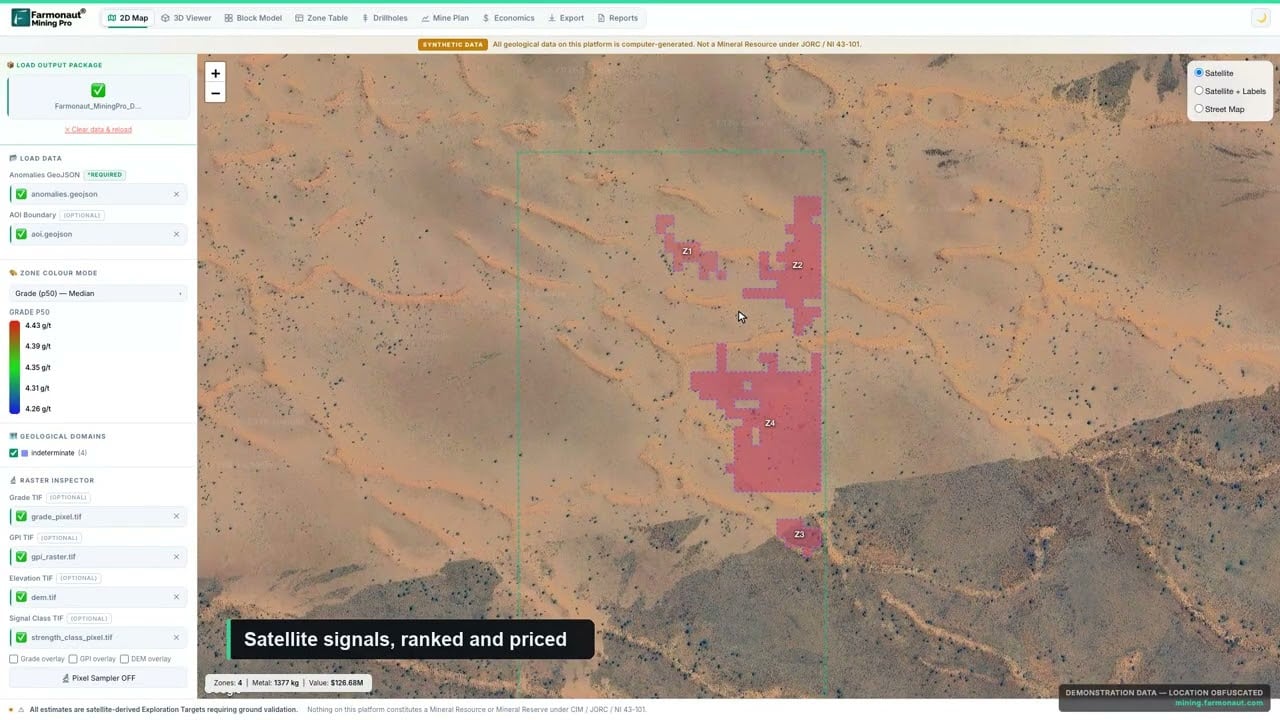
▶ What Farmonaut Mining Pro does with a licence boundary. · 4:56
Frequently asked questions
Who are the biggest mining companies in Alaska?
By output, Teck (Red Dog zinc), Kinross (Fort Knox and Manh Choh gold), Northern Star (Pogo gold), Coeur (Kensington gold) and Hecla (Greens Creek silver). Kinross reported 410,822 gold-equivalent oz from its Fort Knox segment in 2025 (100% of Manh Choh), the largest gold figure of any Alaska operator.
How many mines are operating in Alaska?
DGGS’s January 2026 presentation counts seven lode mines in 2025, about 150 placer gold mines, one coal mine and about 80 sand and gravel operations. Its web page cites six operating lode mines and about 150 placer mines.
Who owns the Red Dog mine?
Teck operates Red Dog on land owned by NANA Regional Corporation; the DGGS slide lists a US$327 million royalty payment for 2024. Teck’s pending merger with Anglo American would put the mine under Anglo Teck once the deal closes.
Which Alaska mine produces the most gold?
Fort Knox, with 410,822 gold-equivalent oz in 2025, which counts all Manh Choh ore milled there (about 353,000 oz attributable to Kinross). Pogo is next at 273,895 oz, then Kensington at 106,068 oz.
What is Alaska’s largest silver mine?
Greens Creek, owned by Hecla, produced 8.7 million oz of silver in 2025 and is the largest silver producer in the United States.
Is Pebble mine going ahead?
Not at present. The EPA’s 2023 restriction remains in force, and the Alaska federal court had not ruled as of Northern Dynasty’s August 2026 filing.
Is there a Motherlode mine in Alaska?
Not as a working mine. The best-known Mother Lode mine in Alaska is a historic copper mine at Kennecott, in Wrangell-St. Elias National Park, worked from 1911 to 1938 and now part of a National Historic Landmark managed by the National Park Service. None of the seven operating lode mines in the DGGS production summary carries that name. For a specific property, check the Alaska Department of Natural Resources mining claims records.
How have recent federal policy shifts affected mining in Alaska?
The October 2025 approval for the Ambler Road, the US government’s 10% stake in Trilogy Metals and the FAST-41 listing of Donlin, Graphite Creek and Johnson Tract speed up review steps for those projects. They do not remove state, tribal or court processes, and the Pebble veto still stands.
Which Alaska company is a producer rather than an explorer?
Teck, Kinross, Northern Star, Coeur, Hecla and Sundance run operating mines. Contango owns 30% of Manh Choh through Peak Gold and is also an explorer at Lucky Shot and Johnson Tract. The names in the explorer table have resources but no mine.
Where can I find the latest Alaska production data?
DGGS publishes its mineral industry reports and conference presentations at dggs.alaska.gov, and the listed companies file quarterly results. USGS publishes state rankings each January in its Mineral Commodity Summaries.
This page is for information only. It is not investment advice. Company figures use each company’s own reporting basis and date. Check land status and claim rules with the regulator before any fieldwork.
Farmonaut mining
Screen your Alaska claim from space
Send a claim or licence boundary and get a satellite mineral-detection report in 5 to 20 business days.

Mining Pro sample view, synthetic data
Keep reading
Sources
- Alaska DGGS, Alaska’s Mineral Industry reports page: dggs.alaska.gov
- Alaska DGGS, 2025 Alaska Mining Industry Overview (AME Roundup, Jan 2026): dggs.alaska.gov
- USGS, Mineral Commodity Summaries 2026: Gold: pubs.usgs.gov
- USGS, Mineral Commodity Summaries 2026: Zinc: pubs.usgs.gov
- USGS, Mineral Commodity Summaries 2026: Silver: pubs.usgs.gov
- Teck, fourth-quarter 2025 financial report: teck.com
- Teck, merger of Teck and Anglo American: teck.com
- Kinross, 2025 fourth-quarter and full-year results: finviz.com
- Kinross, second-quarter 2026 results: s204.q4cdn.com
- Northern Star, production update, 2 July 2026 (ASX): announcements.asx.com.au
- Coeur Mining, fourth-quarter 2025 results: s201.q4cdn.com
- Coeur Mining, second-quarter 2026 results: nasdaq.com
- Hecla, full-year 2025 production and 2026 guidance: nasdaq.com
- Hecla, second-quarter 2026 results: finance.yahoo.com
- NOVAGOLD, definitive proxy statement (Donlin Gold, July 2026): sec.gov
- Northern Dynasty Minerals, filing with MD&A (Pebble, August 2026): sec.gov
- Teck, second-quarter 2026 results: teck.com
- The White House, Unleashing Alaska’s Extraordinary Resource Potential (20 January 2025): whitehouse.gov
- Teck, second-quarter 2026 unaudited results (PDF): teck.com
Discussion
Questions, corrections or field experience? Share them below. First-time comments are reviewed before they appear, and your email is never published.
No comments yet. Be the first to add a question or your experience.

 Jaunita Erss Ltd
 Almosi SARL
 SRK Consulting
 Berks Gold Limited
 Mwerezi Minerals Company Limited
 Mining SARL
 SenGold Invest SAS
 Sean Mining Limited
 NTS Group (Pty) Ltd
 Mine4Africa
 Lithspo Minerals Limited
 Tintina Mining Group
 Dalgety Minerals Pty Ltd
 Vortex Minerals Pty Ltd
 Faith At Work (Pty) Ltd

 Licence holder · Nigeria · Gold + lithium










