

Pest guide · Castor and lychee
Achaea Janata (Castor Semilooper): ID, Life Cycle, Control
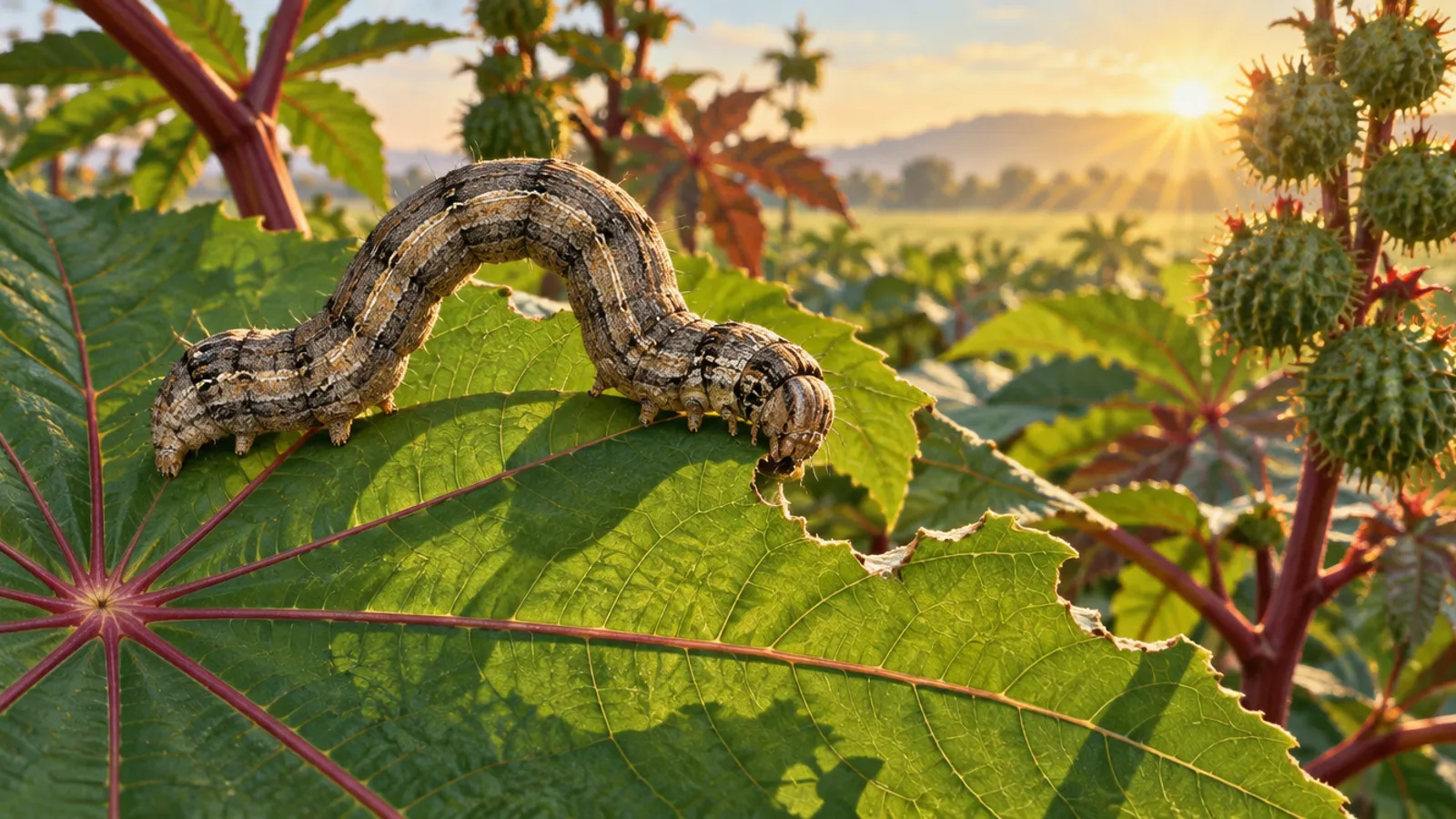
Achaea janata is the castor semilooper, an Erebidae moth whose caterpillars strip castor bean, croton, lychee and longan leaves. Egg to adult takes about 48 to 50 days (University of Hawaii); Queensland advises spraying lychee only past a set scouting threshold.
Key takeaways
- Achaea janata (Erebidae, Lepidoptera) is also called the castor oil looper or croton caterpillar.
- Egg to adult took 48 to 50 days in a Hawaii study; in a lab study, females laid an average of 1,305 eggs.
- Hosts include castor bean, croton, lychee, longan, cocoa, tamarillo and macadamia.
- Queensland: spray lychee or longan only if more than 50 of 100 flushes are infested and leaf loss tops 30%.
- Bt kurstaki works best on young larvae; follow the label and local rules for any product.
In this article
Achaea janata is a moth in the family Erebidae, order Lepidoptera, whose caterpillar is known as the castor semilooper, castor oil looper or croton caterpillar (GBIF species record). The larvae chew leaves of castor bean, croton, lychee, longan and many other plants, and outbreaks can strip trees down to the veins, according to the University of Hawaii Crop Knowledge Master.
This guide covers how to identify each life stage, how long the life cycle takes, which crops it attacks in Australia, Hawaii and the Pacific, and when control is worth it. It also has a scouting calculator built on the Queensland action level for lychee and longan.
Achaea janata at a glance
| Item | Detail |
|---|---|
| Scientific name | Achaea janata (Linnaeus, 1758) |
| Family and order | Erebidae, Lepidoptera |
| Common names | Castor semilooper, castor oil looper, croton caterpillar |
| Damage stage | Caterpillar (leaf feeding) |
| Main hosts | Castor bean, croton, lychee, longan |
| Range | Tropical and subtropical Pacific, Australia, south-east Asia |
The Atlas of Living Australia lists several old synonyms, including Ophiusa ekeikei, so older papers may use a different name for the same moth.
Where the castor semilooper is found and what it eats
The moth is spread across the tropical and subtropical Pacific and Australia. It was first collected in Hawaii in 1944 and is now on all major islands (University of Hawaii). In Australia it has been recorded in Western Australia, the Northern Territory, Queensland, New South Wales, South Australia and Lord Howe Island, and also in New Zealand (Australian Caterpillars and their Butterflies and Moths).
Castor bean and croton are the preferred hosts in Hawaii. Occasional hosts there include banana, cabbage, macadamia, rose, sugarcane, tomato and some legumes. In Queensland, Business Queensland lists lychee, longan, castor oil plant, cocoa and tamarillo. Records from Australia also include rambutan, noni, soybean, cotton and eucalyptus.
How to identify each life stage
Egg
Eggs are round, about 1 mm (1/25 inch) across, pale to dark green with deep ridges. They are laid singly or in clusters on either side of the leaf, at night (University of Hawaii).
Caterpillar
There are six larval stages. The first stage is pale yellow-brown and about 3 mm long. Older larvae range from orange-brown to grey-brown, with a broken black stripe on each side and a hump near the tail with two red-orange spots. The first pair of prolegs is reduced, so the larva moves with a looping walk; this is where the name semilooper comes from. Fully grown larvae reach 50 to 60 mm.
Pupa
Mature larvae spin a loose silk cocoon in a folded leaf or drop to the ground and pupate in leaf litter. The brown pupa is covered in a fine white powder.
Adult moth
The castor oil looper moth is about 25 mm long with a 55 mm wingspan, according to Business Queensland. The forewings are mottled brown. The dark hindwings carry a white band and three white spots along the edge.
Chart
Adult wingspan: castor oil looper vs fruit piercing moth
mm, as stated by each source
Achaea janata life cycle
A Hawaii study found the full cycle from egg to adult takes 48 to 50 days. Eggs hatch in 3 to 4 days, each larval stage lasts about 2 days and the last about 4 days. More food lengthens the larval stage and warmer weather shortens the pupal stage. Queensland notes that the life history on lychee is not well studied, but suggests about 5 days as an egg, about 4 weeks as a caterpillar and about 10 days as a pupa. Females start laying 2 to 5 days after they emerge and lay an average of 1,305 eggs each, which explains sudden outbreaks.
Chart
Stage length: Hawaii study vs Queensland guide
Days per stage; Hawaii egg uses 3.5 (3-4 days); Queensland figures are stated as probable
Chart
Caterpillar age by larval stage
Approximate days since hatching at the end of each of the six stages, Hawaii
What the castor semilooper damages
Young larvae scrape the leaf surface and older larvae eat holes and then whole leaves. In outbreaks only veins and leaf stalks remain. An FAO review of lychee production calls the castor oil looper a voracious feeder in Australia that can cause severe defoliation. Business Queensland rates loopers as sporadic minor pests that can strip trees, and notes they are most active in north Queensland after the wet season.
Fruit damage is a separate question. The adult moth feeds on fruit juice and is suspected of piercing fruit. In Queensland, though, the main fruit piercing moths are Eudocima species. Their larvae feed on native vines, and the adults pierce ripe citrus, banana, mango and lychee at night. In Pacific outbreaks, more than 70% of citrus fruit has been damaged. Bagging or netting fruit works for them, and no satisfactory chemical control is known.

▶ Six plain steps to start precision farming, from field maps to satellite monitoring. · 4:18
Natural enemies of the castor semilooper
In Hawaii, an ichneumonid wasp and two tachinid flies have been reared from larvae and pupae, and the egg parasite Trichogramma minutum is present. Other Trichogramma species have parasitised 50 to 83% of eggs in field studies. The fungus Nomuraea rileyi gave 80 to 90% mortality in one trial. Where the egg parasite Telenomus proditor has been introduced, it gave only limited control (University of Hawaii). A Queensland lychee field guide lists tachinid flies among the natural enemies of loopers.
How to manage Achaea janata
Start with scouting. For lychee and longan, Queensland advises checking 5 flushes on each of 20 trees spread through the block. Spray only if more than 50 of the 100 flushes are infested and more than 30% of the leaves are lost. Trees can lose a lot of leaf and recover, and natural enemies often hold loopers down.
- Scout new flush. Look for tattered leaves on young trees, as these lose the most growth.
- Use Bt on young larvae. Bacillus thuringiensis var. kurstaki has been effective against this caterpillar. The NPIC Bt fact sheet says young larvae are most affected and sunlight breaks down spores quickly, so spray small larvae late in the day.
- Protect natural enemies. Avoid repeated broad-spectrum sprays that kill parasitic wasps and flies.
- Use a registered product if needed. Pyrethroids have worked better than natural pyrethrins in trials, and neem seed kernel extract deters feeding on castor.
- Clean up after harvest. Shallow cultivation exposes pupae in the soil to birds and predators.
Older guides named malathion and chlorpyrifos for this pest. Registrations for both have changed in many countries, so do not rely on old spray lists. Check the APVMA PubCRIS database in Australia, or your national regulator, for products registered on your crop. Always follow the product label, withholding periods and local rules, and get advice from a local agronomist.
Try the numbers for your own farm below.
Calculator
Has your lychee block reached the looper spray threshold?
Enter what you found on your scouting walk.
- Infested share still below threshold: 2.0 points
- Leaf loss still below 30% threshold: 2.0 points
Example values only, not a benchmark. The 50% flushes infested and 30% leaf loss action levels are fixed in the formulas and come from Business Queensland’s Loopers page (lychee and longan). Spray only when both gaps are below zero, and follow the product label and local rules.
Watching for defoliation from above
A satellite cannot see a caterpillar. It can show where leaf cover drops in a block, which tells you where to walk first. That is one use of the Farmonaut Satellite + AI Farm Monitoring System, which maps plant health for each field. You can read how this works at scale in this story on 10 million farm images processed in 14 days.
Related pages on our site: agricultural science careers in Australia · key areas of agricultural cooperation
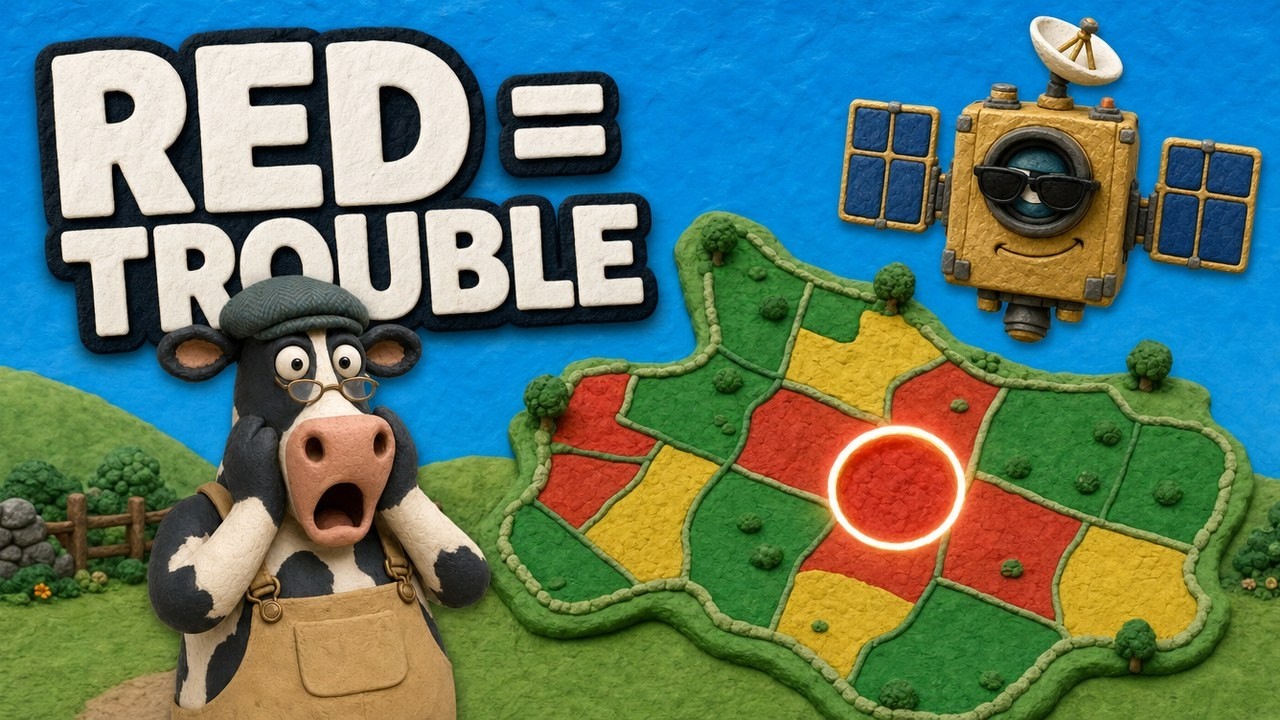
▶ How satellite NDVI maps show crop stress before you can see it from the ground. · 4:09
FAQ
What is the scientific name of the castor semilooper?
Achaea janata (Linnaeus, 1758). It belongs to the family Erebidae in the order Lepidoptera.
How long is the Achaea janata life cycle?
About 48 to 50 days from egg to adult in a Hawaii study. Heat and food supply change the length of each stage.
Why is it called a semilooper?
Its first pair of prolegs is reduced, so it arches its body as it walks, like a looper, but less fully.
Does Achaea janata pierce fruit?
The adult feeds on fruit juice and is suspected of piercing fruit. In Queensland the main fruit piercing moths are Eudocima species.
When should I spray for loopers in lychee?
Queensland advises spraying only when more than 50 of 100 sampled flushes are infested and leaf loss passes 30%. Use a product registered for your crop and follow the label.
Farmonaut crop monitoring
See your own fields from space
Draw your blocks once and Farmonaut shows satellite plant-health maps for them through the season, so you know where to scout first.




Keep reading

Sources
- University of Hawaii CTAHR, Crop Knowledge Master: Achaea janata (2007): cms.ctahr.hawaii.edu
- Business Queensland, Loopers (accessed 2026): business.qld.gov.au
- Business Queensland, Fruit piercing moth (reviewed 2025): business.qld.gov.au
- Herbison-Evans and Crossley, Australian Caterpillars: Achaea janata: lepidoptera.butterflyhouse.com.au
- FAO, Lychee production in the Asia-Pacific region, Major pests and diseases: fao.org
- Queensland DAF / Hort Innovation, Lychee pest and disease field guide: era.daf.qld.gov.au
- Pacific Pests, Pathogens, Weeds and Pesticides: Citrus fruit piercing moth (2025): apps.lucidcentral.org
- APVMA, PubCRIS registration database: portal.apvma.gov.au
- Atlas of Living Australia, Achaea janata: bie.ala.org.au
- GBIF, Achaea janata species record: api.gbif.org
- National Pesticide Information Center, Bacillus thuringiensis fact sheet: npic.orst.edu
Discussion
Questions, corrections or field experience? Share them below. First-time comments are reviewed before they appear, and your email is never published.
No comments yet. Be the first to add a question or your experience.

 Indico Company
 Byju’s
 Kubota
 FFBS
 Jontra
 Kalustyan
 Tucor
 Geno
 Hayleys Agriculture
 Linx Agritech
 Adinet
 Save Your Soils
 Grandstream Algérie
 XOS Realty

 Licence holder · Niger · Gold










