

Palm Weevil Control: Treatment Options That Actually Work
Reviewed September 2026 against USDA APHIS eradication records and the Purdue CAPS (Cooperative Agricultural Pest Survey) datasheet for Rhynchophorus ferrugineus.
Try it: Enter your values above. →
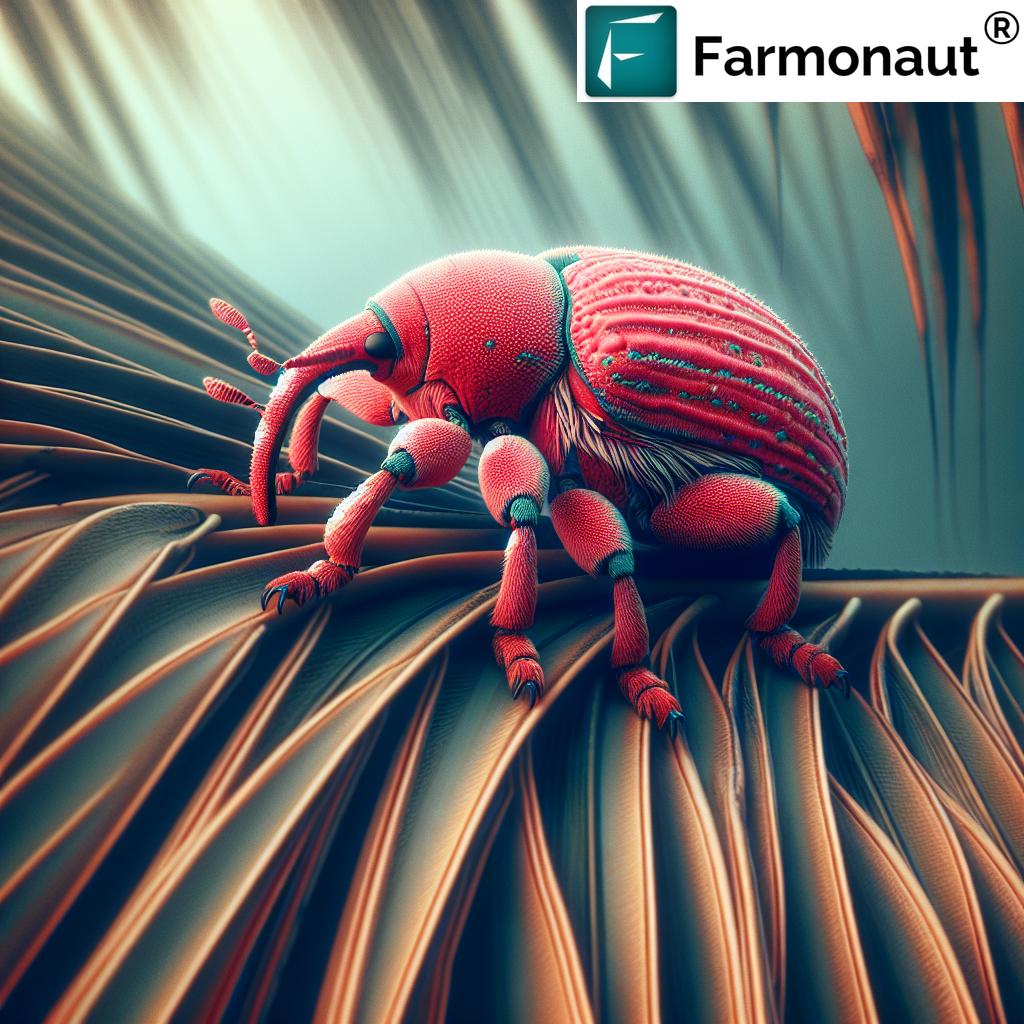
Palm weevil control works best as a three-part sequence: pheromone-baited traps for detection and mass-trapping, a systemic or contact insecticide matched to infestation severity, and sanitation that removes breeding material before eggs are laid. Chlorantraniliprole has shown the highest recovery rate among tested chemical treatments at 88.14%, trap density of 2.5 traps per hectare is the threshold used in area-wide suppression programs, and the United States has one documented, successfully eradicated population — detected in Laguna Beach, California, in September 2010 and declared eradicated on January 18, 2015. This article covers what each control method actually does, how they compare on cost and effectiveness, and where in the US the pest is a realistic risk versus a non-issue.
Table of Contents
- Weevil Biology and Why Timing Matters for Treatment
- Red Palm Weevil Status in the United States
- Detection: Monitoring Methods Compared
- Chemical Control: Insecticide Recovery Rates Compared
- Weevil Control Products: Pheromone Traps and Bait Combinations
- Vine Weevil and Tree Borers: How They Differ from Red Palm Weevil
- Building an Integrated Pest Management Program
- Economic Impact and Cost Considerations
- Regulatory Considerations in the US
- Trap Density Calculator
- How Farmonaut’s Satellite Monitoring Fits In
- Frequently Asked Questions
- Try it: Enter your values above.
Weevil Biology and Why Timing Matters for Treatment
The red palm weevil (Rhynchophorus ferrugineus) is the species behind almost every serious palm weevil control case worldwide, and its life cycle is the reason treatment timing determines whether an insecticide works at all. Adult females lay eggs in wounds, pruning cuts, or natural crevices in the crown and upper trunk. Larvae hatch within days and immediately burrow into the internal tissue, where they feed concealed for weeks — this is the stage that does the structural damage, and it’s also the stage no external spray can reach effectively once larvae are deep in the trunk. Larvae pupate inside cocoons built from fibrous palm tissue, and adults emerge to mate and disperse, restarting the cycle.
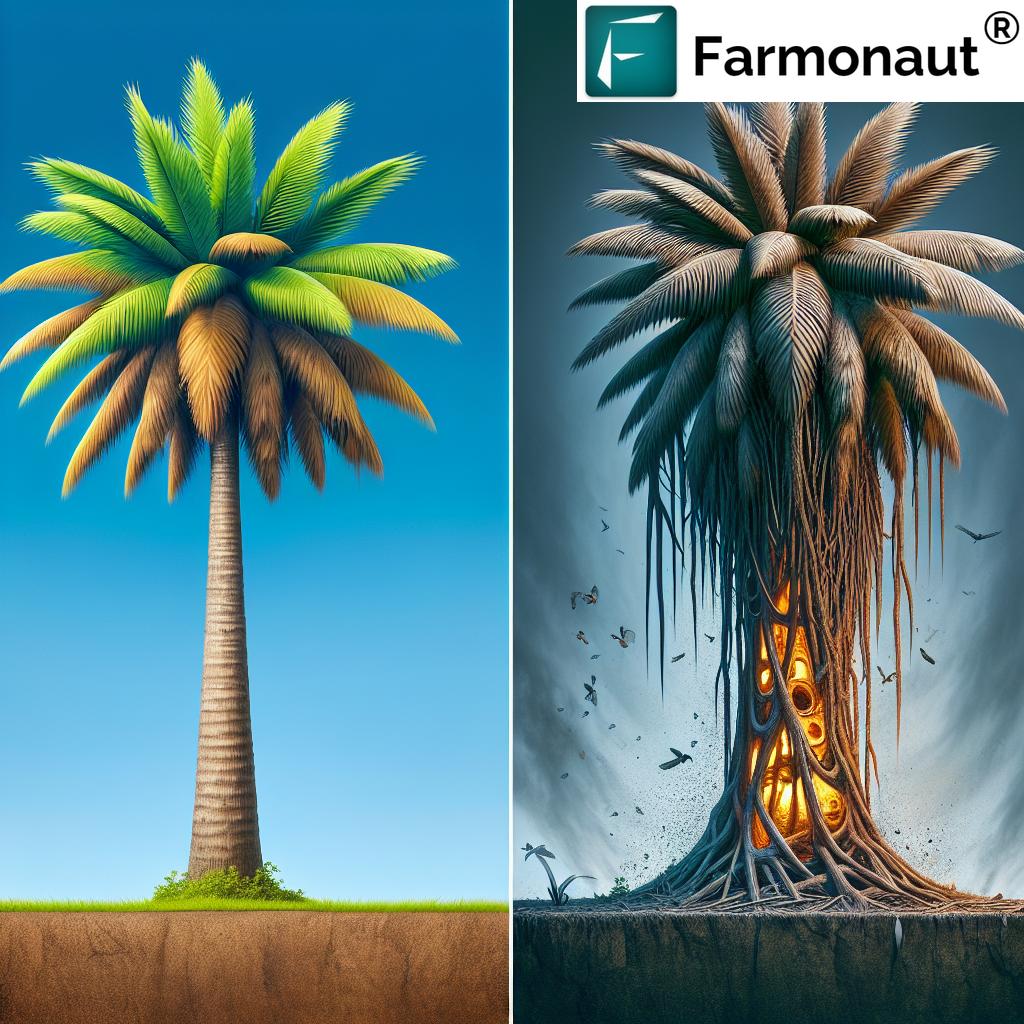
The practical consequence: once you see the classic external symptoms — oozing brown liquid, sawdust-like frass at the base of fronds, holes in the trunk, or a collapsing crown — larvae have usually already caused internal damage that is difficult to reverse. Effective treatment depends on catching the infestation at the egg or early-larval stage, before frass and structural collapse are visible, which is why trapping and remote monitoring matter as much as the chemical you eventually choose.
Recognizing Infestation Before It’s Advanced
- Yellowing or wilting of crown leaves, often asymmetric
- Holes in the trunk or at the base of fronds
- Oozing of a brown, viscous liquid from wound sites
- Sawdust-like frass accumulating around the crown or trunk base
- Stunted growth or death of offshoots in clustering palm species
- Audible feeding sounds from larvae inside the trunk in advanced infestations
Red Palm Weevil Status in the United States
This is the question most US searchers actually have, and it has a specific, verifiable answer rather than a general one. Red palm weevil was first detected in the continental United States in September 2010, in a single Canary Islands date palm (Phoenix canariensis) in Laguna Beach, Orange County, California, according to USDA APHIS. The agency’s last confirmed detection in that population was January 18, 2012. After three years without a new find, APHIS declared the Laguna Beach population officially eradicated on January 18, 2015.
That is the full, current US detection record on the public APHIS bulletin cited here. It does not mean the risk is zero going forward — USDA APHIS modeling places the pest’s potential establishment range across USDA Hardiness Zones 8–14, which covers the southern mainland US, Hawaii, and US territories, and the same modeling flags 16 specific counties in Florida as high-risk for establishment based on climate and host-palm density, per the Purdue CAPS datasheet. Growers and municipal arborists in Florida, the Gulf Coast, southern California, and Hawaii are the audience for whom active monitoring is worth budgeting, even in the absence of a current known population.
To check whether that status has changed, the authoritative source is USDA APHIS’s official bulletin, which is the agency’s system of record for detection and eradication announcements. If you manage palms in one of the 16 flagged Florida counties or another Zone 8–14 region, the durable practice — not a one-time check — is to register for APHIS pest alerts for your state and to report any suspected sighting to your state department of agriculture rather than waiting for a periodic re-read of this page.
Detection: Monitoring Methods Compared
Early detection is the single biggest lever on outcome, because treatment options narrow sharply once larvae are established deep in the trunk. The table below compares the three detection approaches growers actually use.
| Method | Early Detection | Coverage Area | Cost-Effectiveness | Accuracy |
|---|---|---|---|---|
| Visual Inspection | Limited — symptoms visible only after internal damage | Small, labor-limited | Low per-tree cost, high labor cost at scale | Moderate |
| Pheromone Traps | Moderate — confirms adult presence, not egg/larval stage | Medium, needs 2.5 traps/hectare for area-wide programs | Moderate — trap and lure replacement recurring cost | Good, especially with food-bait combination |
| Farmonaut Satellite Monitoring | Detects vegetation stress signals before visible symptoms | Large — whole-plantation coverage | High at scale, reduces blanket spraying | Very good for stress detection; cause confirmation still needs ground truth |
None of these three methods work well in isolation. Visual inspection is what most homeowners and small growers rely on by default, but by the time frass or oozing is visible, larvae have typically been feeding for weeks. Pheromone traps close that gap for adults but say nothing about eggs or larvae already inside a tree. Satellite-based stress detection extends the window further by flagging canopy or spectral changes before a human would notice them on the ground — Farmonaut’s system is built for exactly this large-scale, early-warning role, monitored through the Farmonaut app or integrated via the Farmonaut API.
Chemical Control: Insecticide Recovery Rates Compared
This is the data most palm weevil treatment searches are actually looking for, and it’s specific enough to act on. Peer-reviewed 2023 field research measured recovery rates — the share of infested palms that survived and recovered — across three commonly used chemical treatments:
| Active Ingredient | Recovery Rate | Application Method |
|---|---|---|
| Chlorantraniliprole | 88.14% | Systemic — trunk injection or soil application |
| Indoxacarb | 81.25% | Contact/systemic combination |
| Imidacloprid | 60.39% | Systemic — soil drench or trunk injection |
Imidacloprid has historically been the default systemic recommendation in many palm weevil treatment guides, but at 60.39% recovery in this trial it is the weakest of the three tested actives — worth knowing before defaulting to it out of habit. Chlorantraniliprole’s 88.14% recovery rate is the strongest figure in this dataset. As with any pesticide decision, product selection and application rates must follow the label and your state’s pesticide regulations; a licensed applicator or your state extension office can confirm which of these active ingredients is currently registered for palm use in your state, since registration status changes independently of efficacy data.
Chemical Control Methods in Practice
- Systemic insecticides: Applied as a soil drench or trunk injection, these move through the vascular system and are most effective against larvae feeding internally — this is where chlorantraniliprole, indoxacarb, and imidacloprid apply, per the recovery-rate data above.
- Contact insecticides: Sprayed directly on the tree surface and crown, these target adult weevils on contact and are typically used alongside systemic treatment rather than as a standalone.
Note: Always follow label instructions and your state’s pesticide regulations. Rotate active ingredients with different modes of action across treatment cycles to reduce the risk of resistance developing in local populations — worth flagging because no resistance cases have been documented in North American red palm weevil populations to date, largely because the one confirmed US population was eradicated before resistance had time to develop. That’s a reason to stay disciplined about rotation now, not a reason to assume it won’t become an issue.
Weevil Control Products: Pheromone Traps and Bait Combinations
For anyone searching “weevil control products,” the trap-and-lure system is the core physical product category, and the research on how to deploy it is specific. Purdue’s CAPS datasheet identifies 2.5 traps per hectare as the effective density threshold for area-wide suppression programs in North American deployment protocols — below that density, trap networks catch adults but don’t meaningfully suppress the breeding population.
Lure composition matters as much as density. Peer-reviewed research published via NCBI/PMC found that combining pheromone lures with a food bait increased capture rates by 6.95 times compared to pheromone lures used alone. That’s the single highest-leverage, lowest-cost change most growers can make to an existing trap network — the traps and pheromone dispensers are typically already in place; adding a food-bait component is what multiplies catch rate.
Mechanical and Trap-Based Control
- Pruning: Remove and properly dispose of infested material — improperly discarded fronds and trunk sections can become breeding sites for surviving larvae or pupae.
- Pheromone-and-food-bait traps: Deploy at 2.5 traps/hectare for area-wide monitoring and suppression; use food bait in combination with pheromone lures for the 6.95x capture improvement documented above.
- Trap placement: Position traps at canopy height near known host palms, and service/refresh lures on a fixed schedule since pheromone efficacy degrades with UV exposure and time — check your product label for the specific replacement interval, since this varies by formulation and is not a fixed universal number.
Vine Weevil and Tree Borers: How They Differ from Red Palm Weevil
Not every “weevil” search is about palms, and it’s worth being direct about the distinction. Vine weevil (Otiorhynchus sulcatus) is a different species entirely — it attacks the roots and foliage of ornamental shrubs, container plants, and berry crops (particularly rhododendron, yew, strawberry, and other nursery stock), not palm trunks. Adult vine weevils notch leaf edges at night, while larvae feed on roots underground, which is the more damaging stage and is often invisible until a plant wilts or fails despite adequate water. Vine weevil control leans heavily on biological control — entomopathogenic nematodes applied to soil are a standard treatment — plus systemic insecticides labeled specifically for ornamental and nursery use. If vine weevil on non-palm plants is your situation, the chlorantraniliprole/indoxacarb/imidacloprid recovery-rate data above was generated specifically for red palm weevil in palm hosts and should not be assumed to transfer directly; check your state extension service or a nursery-specific product label for vine weevil guidance.
For “best insecticide for tree borers” as a broader category: tree borers are a large group spanning bark beetles, longhorn beetles, and clearwing moths in addition to palm weevils, and the correct product depends on the target species and host tree, not a single universal answer. The recovery-rate comparison in this article is specific to red palm weevil in palm hosts. For borers in non-palm trees (oak, ash, fruit trees), your state or county extension entomologist is the right first call, since borer identification typically requires either the insect itself, its exit-hole pattern, or frass characteristics that are host- and species-specific.
Building an Integrated Pest Management Program
The most effective palm weevil control programs combine cultural, mechanical, biological, and chemical methods rather than relying on any single approach — a principle covered in more depth in Farmonaut’s sustainable pest management guide and its companion piece on IPM strategies for insect pests.
1. Cultural Control
- Sanitation: Remove dead or dying fronds promptly — decaying plant material and wound sites are the primary egg-laying targets.
- Wound management: Treat pruning cuts and other wounds promptly; fresh cuts are a preferred oviposition site.
- Quarantine: Isolate newly acquired palms before planting them near existing stock, and inspect them on a fixed schedule during isolation rather than a single check at intake.
2. Mechanical Control
Covered in detail in the trapping section above — pruning of infested material and pheromone-plus-food-bait trapping at 2.5 traps/hectare.
3. Biological Control
- Entomopathogenic nematodes: Applied to soil or directly into larval galleries, these target larvae without broad-spectrum chemical exposure.
- Entomopathogenic fungi: Certain fungal formulations infect and kill weevils at multiple life stages and are used as part of a rotation to reduce chemical load.
4. Chemical Control
Covered in detail above — chlorantraniliprole (88.14% recovery), indoxacarb (81.25%), and imidacloprid (60.39%), applied per label and rotated by mode of action.
Putting It Together: A Monitoring-to-Treatment Sequence
- Monitor continuously using pheromone-and-food-bait traps at 2.5/hectare, supplemented by visual inspection and, at plantation scale, satellite stress detection.
- Set an action threshold — a defined trap-catch rate or stress-signal level that triggers inspection, rather than treating reactively after visible symptoms appear.
- Confirm infestation on the ground before committing to chemical treatment.
- Select treatment by severity: early-stage/preventive favors systemic insecticide per the recovery-rate table; advanced infestation may require removal of severely damaged material alongside treatment of surrounding trees.
- Re-evaluate on a fixed schedule and adjust trap density, lure type, or chemical rotation based on results.
Economic Impact and Cost Considerations
USDA ARS estimates the global economic loss from red palm weevil damage and control costs at $5.18 to $25.92 million annually, a figure that spans direct crop and tree loss plus the cost of monitoring and treatment programs worldwide. That wide range reflects how much control cost depends on local infestation severity, labor costs, and how early a population is caught — which is precisely the argument for early detection over reactive treatment.
A US-market-specific breakdown of treatment cost per infested palm — covering labor, chemical, and trap costs — is not published in a form specific to US conditions; the $5.18–25.92 million figure is a global aggregate, not a per-tree or per-acre US number. If you need a cost estimate for your own operation, the practical method is to build it from three inputs you control directly: (1) your state’s typical hourly rate for a licensed pesticide applicator, (2) the per-unit cost of your chosen active ingredient from your supplier, quoted at your actual application rate, and (3) trap and lure replacement cost at the 2.5-traps/hectare density, multiplied by your acreage. That gives a figure specific to your operation rather than a global average that may not reflect US labor and product costs.
Where the Cost Curve Bends
- Reduced yields, especially in date palm production
- Tree removal and replacement costs once infestation is advanced
- Reduced property value for ornamental palm plantings
- Recurring trap, lure, and chemical costs for ongoing monitoring programs
Early detection is the lever that moves cost the most: a tree caught and treated at the early-larval stage is a fraction of the cost of removing and replacing a tree lost to advanced infestation, and it avoids the risk of the population spreading to neighboring palms.
Regulatory Considerations in the US
- Pesticide regulations: Follow federal EPA registration status and your state’s specific pesticide-use regulations; ensure applicators are licensed where required.
- Reporting: Report any suspected red palm weevil sighting to your state department of agriculture or to USDA APHIS directly — early reporting is what made the 2010–2015 California eradication possible.
- Quarantine zones: If a detection occurs in your area, be prepared to comply with movement restrictions on palm material, consistent with how the Laguna Beach population was contained.
- Worker safety: Follow OSHA and state-level requirements for PPE and training when applying systemic or contact insecticides.
Trap Density Calculator
Use the figures above — the 2.5 traps/hectare threshold and the 6.95x food-bait multiplier — to plan a trap network sized to your property.
Enter your values above.
How Farmonaut’s Satellite Monitoring Fits In
Farmonaut’s satellite monitoring system is designed to close the detection gap described in the biology section above — the weeks-long window where larvae are feeding internally but no external symptom is visible yet. The system tracks vegetation stress signals across an entire property, which matters most for plantation-scale operations where daily visual inspection of every tree isn’t practical.
- Large-scale monitoring: Covers whole plantations rather than tree-by-tree inspection, useful for flagging which blocks need ground follow-up.
- Trend tracking: Repeated imagery over time helps distinguish a developing stress pattern from a one-off signal, informing when to deploy ground inspection or traps.
- Targeted treatment: Identifying stressed areas early supports applying chemical treatment only where needed rather than blanket spraying, which is also the more resistance-conscious approach discussed in the chemical control section.
Access the platform through the Farmonaut app, available on Android and iOS, or integrate satellite data directly into an existing farm management system via the Farmonaut API. For broader context on why proactive monitoring reduces overall crop losses, see Farmonaut’s guide on the importance of crop protection in agriculture.
Frequently Asked Questions
Q: Is red palm weevil currently established anywhere in the United States?
A: The only documented US population — in Laguna Beach, California — was declared eradicated by USDA APHIS on January 18, 2015, following a last confirmed detection on January 18, 2012. Check USDA APHIS’s official bulletin directly for any update to this status, since it is the agency’s system of record.
Q: Which insecticide has the best recovery rate for red palm weevil?
A: Among the three actives tested in 2023 peer-reviewed field research, chlorantraniliprole had the highest recovery rate at 88.14%, followed by indoxacarb at 81.25% and imidacloprid at 60.39%. Confirm current registration status for your state before selecting a product.
Q: How many pheromone traps do I need per hectare?
A: Purdue’s CAPS datasheet identifies 2.5 traps per hectare as the effective density for area-wide suppression programs. Use the calculator above to size a trap network to your property and estimate setup cost.
Q: Does adding food bait to pheromone traps actually improve results?
A: Yes — peer-reviewed 2024 research found pheromone-plus-food-bait traps captured 6.95 times more weevils than pheromone lures used alone.
Q: Is vine weevil the same pest as red palm weevil?
A: No. Vine weevil (Otiorhynchus sulcatus) attacks roots and foliage of ornamental shrubs and berry crops, not palm trunks, and is controlled differently — typically with soil-applied nematodes and ornamental-labeled systemics rather than the palm-specific treatments covered in this article.
Q: Which US regions are actually at risk for red palm weevil establishment?
A: USDA APHIS modeling places potential establishment across Hardiness Zones 8–14, covering the southern mainland US, Hawaii, and US territories, with 16 specific Florida counties flagged as high-risk based on climate and host-palm density.
Q: How quickly can Farmonaut’s satellite system detect signs of weevil infestation?
A: The system is built to flag vegetation stress signals before visible external symptoms like frass or crown wilting appear, which is the window during which treatment is most effective. Detection speed depends on imagery revisit frequency for your specific plan and region — check current revisit intervals via the Farmonaut API documentation.
Q: What is the global economic cost of red palm weevil damage?
A: USDA ARS estimates $5.18 to $25.92 million annually in global losses from damage and control costs combined. A US-specific per-tree cost figure is not published; use the cost method described in the economics section to estimate your own operation’s exposure.
Subscribe to Farmonaut

 CGIAR
CGIAR Hayleys Agriculture
 Linx Agritech
 Adinet
 Save Your Soils
 GalaxEye Space
 Grandstream Algérie
 XOS Realty
 Geospatial Lab Africa
 Agro La Gándara
 HIPSAC
 ZOL Zimbabwe
 Juligerm
 AdBio
AdBio MISE Maroc
 NWNS
NWNS Red August Group
 Farm Inc
 WeMe Global
