

Satellite Irrigation Advisory: 190 Acres in Algeria

On the high steppe of El Bayadh, on the northern edge of the Saharan Atlas, every millimetre of water reaching a crop has been pumped there. Khater’s 190-acre centre-pivot farm, growing durum wheat, barley, oats and alfalfa, reported that our advisory had helped optimise its irrigation. We opened the week it was reading — and found that on three of its four fields, the instruction was to stop.
Most irrigation advice is about how much to apply. In arid agriculture the more valuable question is often when to stop, and this farm is a clean demonstration of why. It sits in the Daïra de Brezina, Wilaya d’El Bayadh — high steppe country on the northern fringe of the Sahara, where rainfall is measured in a couple of hundred millimetres a year and irrigated cereal production runs on pumped groundwater under centre pivots. Water here is not a line item. It is the constraint the whole operation is built around.
In late May 2026 the account holder completed the feedback form attached to his satellite irrigation advisory and confirmed that the report had helped him optimise his irrigation. Working from the advisory data alone, the mechanism is unusually easy to point at: across four fields and seven days, 17 of 28 field-days carried an instruction not to irrigate at all — and one entire 40-acre field was told to stay off for the whole week.
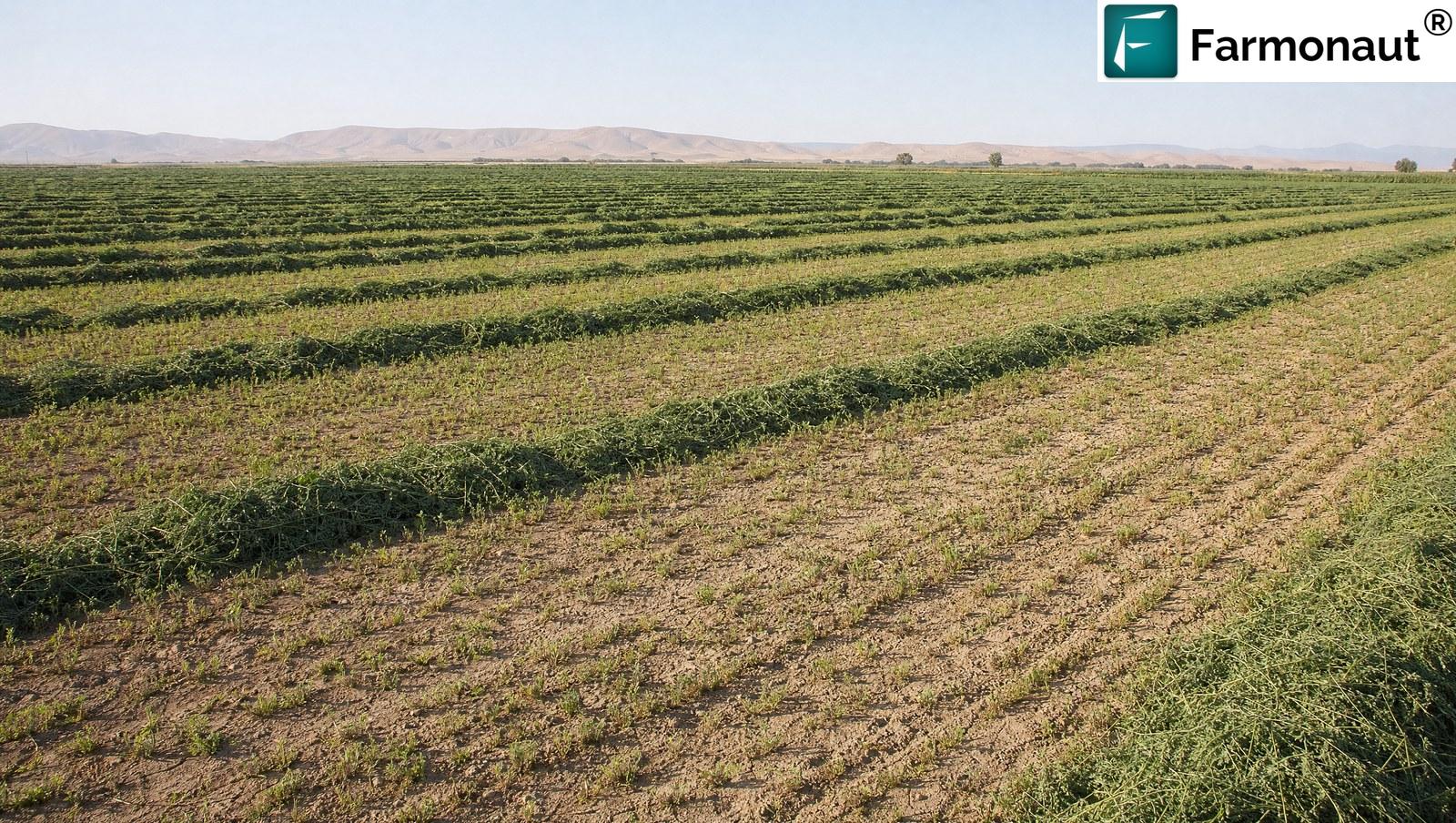
The four fields were at four different points in their season: barley still at stem elongation, durum wheat at maturity, and both the oats and the alfalfa at or past harvest. The advisory treated that as four separate problems — full water to the one crop still growing, a tapering ramp to zero on the maturing wheat, and nothing at all on the two that were finished. On a single-crop calendar, all four pivots would have kept running.
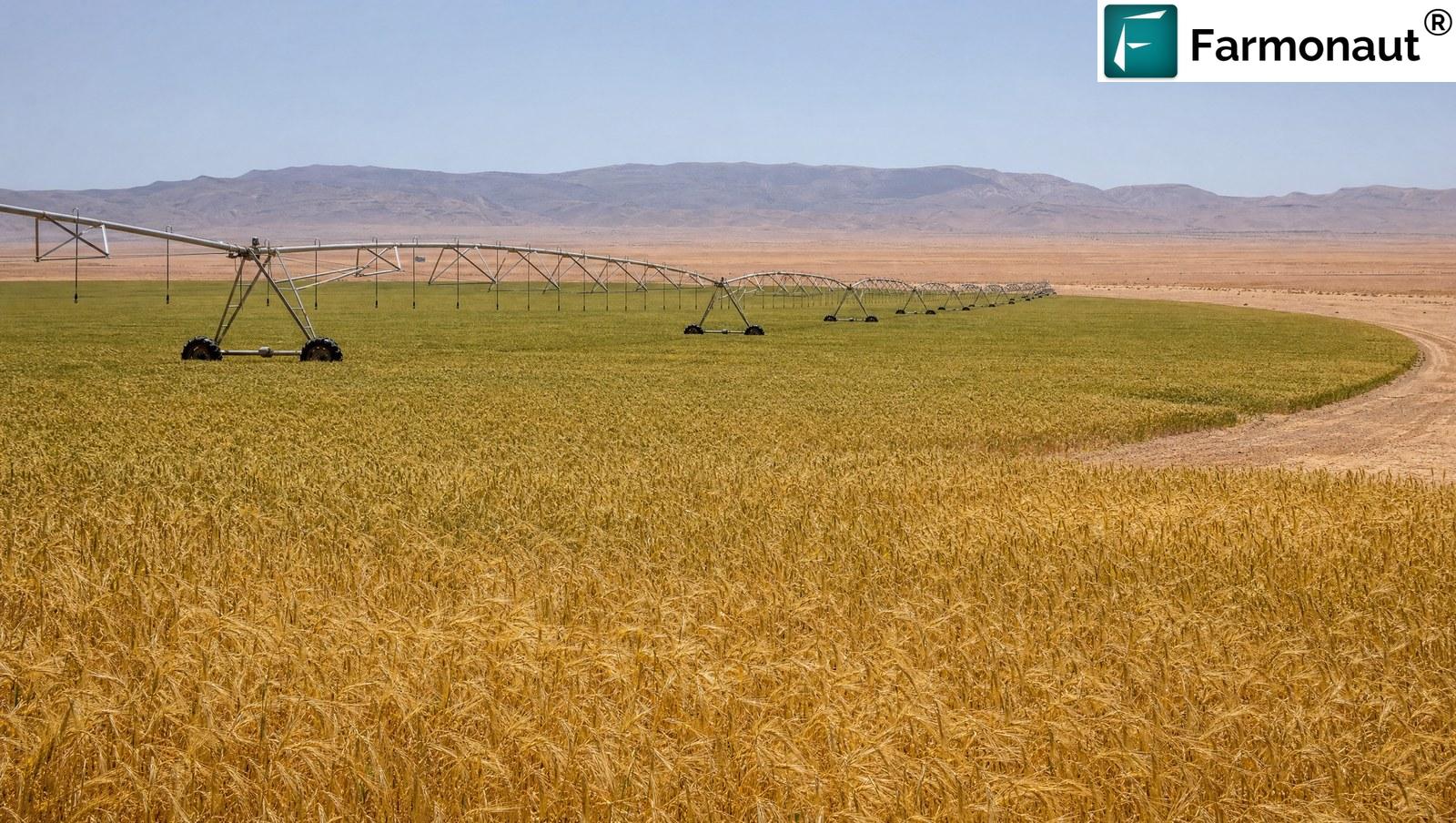

Four fields, four points in the season
The farm runs four centre-pivot circles totalling 190.6 acres (77.1 hectares), all within the same district, and it has been monitored since February 2026. By the date of the feedback the account had received 91 field advisories across 23 satellite acquisition dates, at a median revisit of five days.
| Crop | Acres | Growth stage | Irrigation days | Week’s water | Fertiliser | Top alert |
|---|---|---|---|---|---|---|
| Barley | 65.47 | Stem elongation | 4 of 7 | 17.5 mm | Full programme | Aphids (Rhopalosiphum padi) 94% |
| Durum wheat | 65.01 | Maturity / harvest | 3 of 7 | 6.0 mm | None required | Sunn Pest (Eurygaster integriceps) 95% |
| Oats | 40.22 | Harvest / post-harvest | 0 of 7 | 0.0 mm | None required | Grasshoppers 90% |
| Alfalfa | 19.93 | Harvest / post-harvest | 4 of 7 | 15.0 mm | None required | Alfalfa Weevil (Hypera postica) 88% |
| Portfolio | 190.6 | 4 stages | 11 of 28 | 60.7% zero days | 1 of 4 fields fed | 6 alerts ≥80% |
On three of four pivots that week, the most valuable thing the advisory said was nothing.

What the satellite irrigation advisory delivers per field
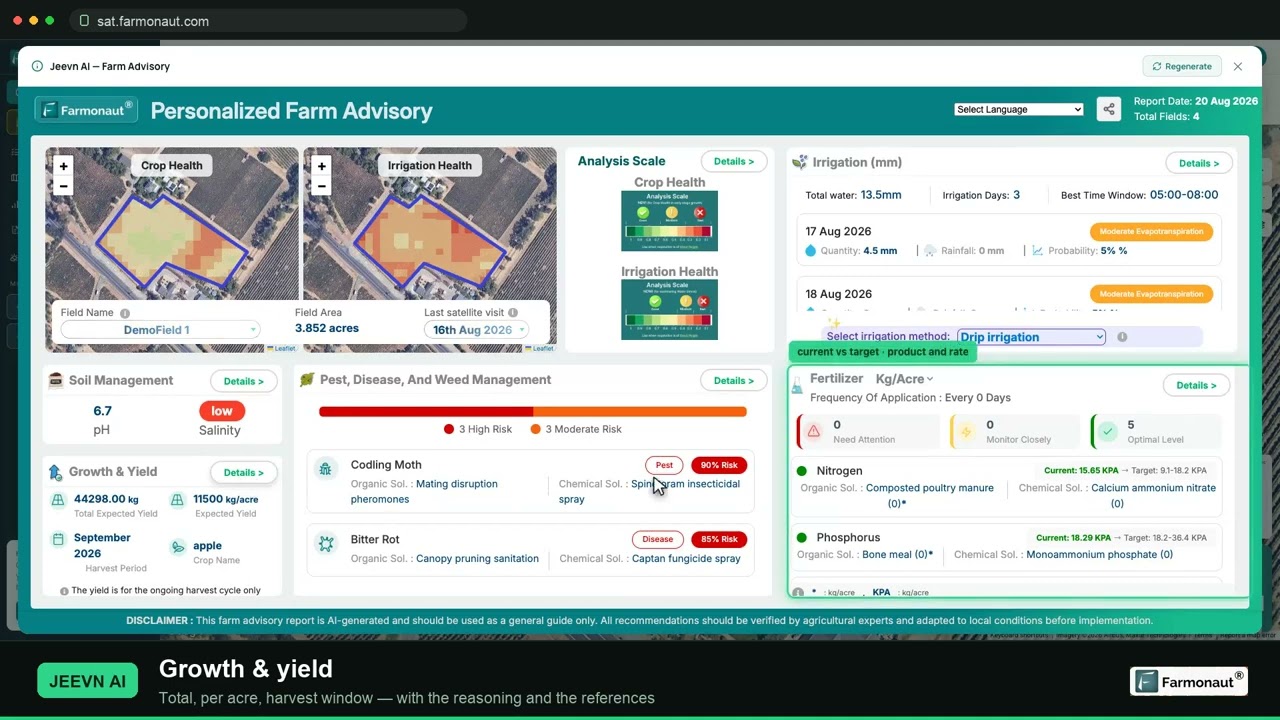
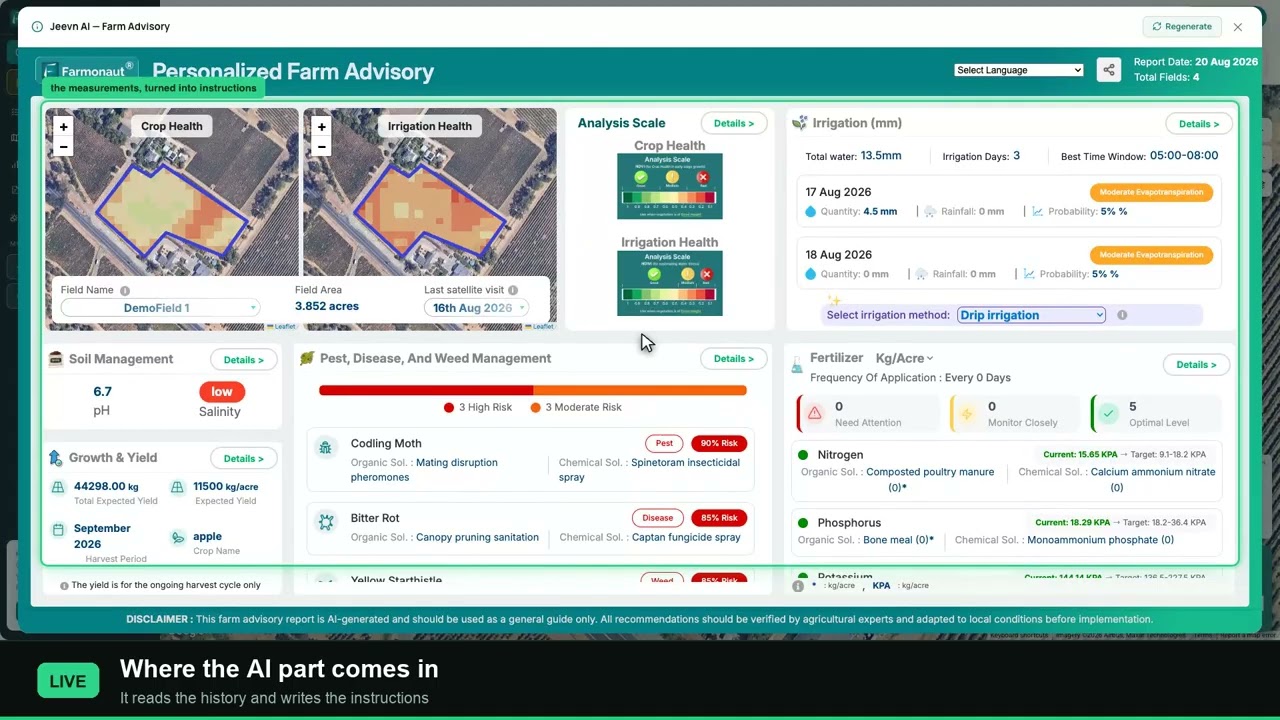
Each field receives its own report per satellite pass, carrying a day-by-day irrigation schedule with a recommended delivery method, per-nutrient fertiliser rates with organic and chemical sources, pest and disease risk, weed pressure, soil chemistry and a yield estimate. The advisory’s own references name the underlying calculation: FAO-56 Penman–Monteith reference evapotranspiration with crop coefficients, driven by Sentinel-1 radar soil-moisture and Sentinel-2 optical indices. That chain is what turns a satellite pass into a satellite irrigation advisory a pivot operator can act on the same morning.
Irrigation: the ramp down, and the full stop
The clearest thing in the data is the shape of the wheat schedule. At maturity, a durum crop should be drying down, not drinking — irrigating late delays harvest, raises lodging and disease risk, and spends water on grain that has already filled. The advisory tapered it: 2.5 mm, zero, 2.0 mm, zero, 1.5 mm, then zero and zero. A declining ramp to a full stop, across 65 acres.
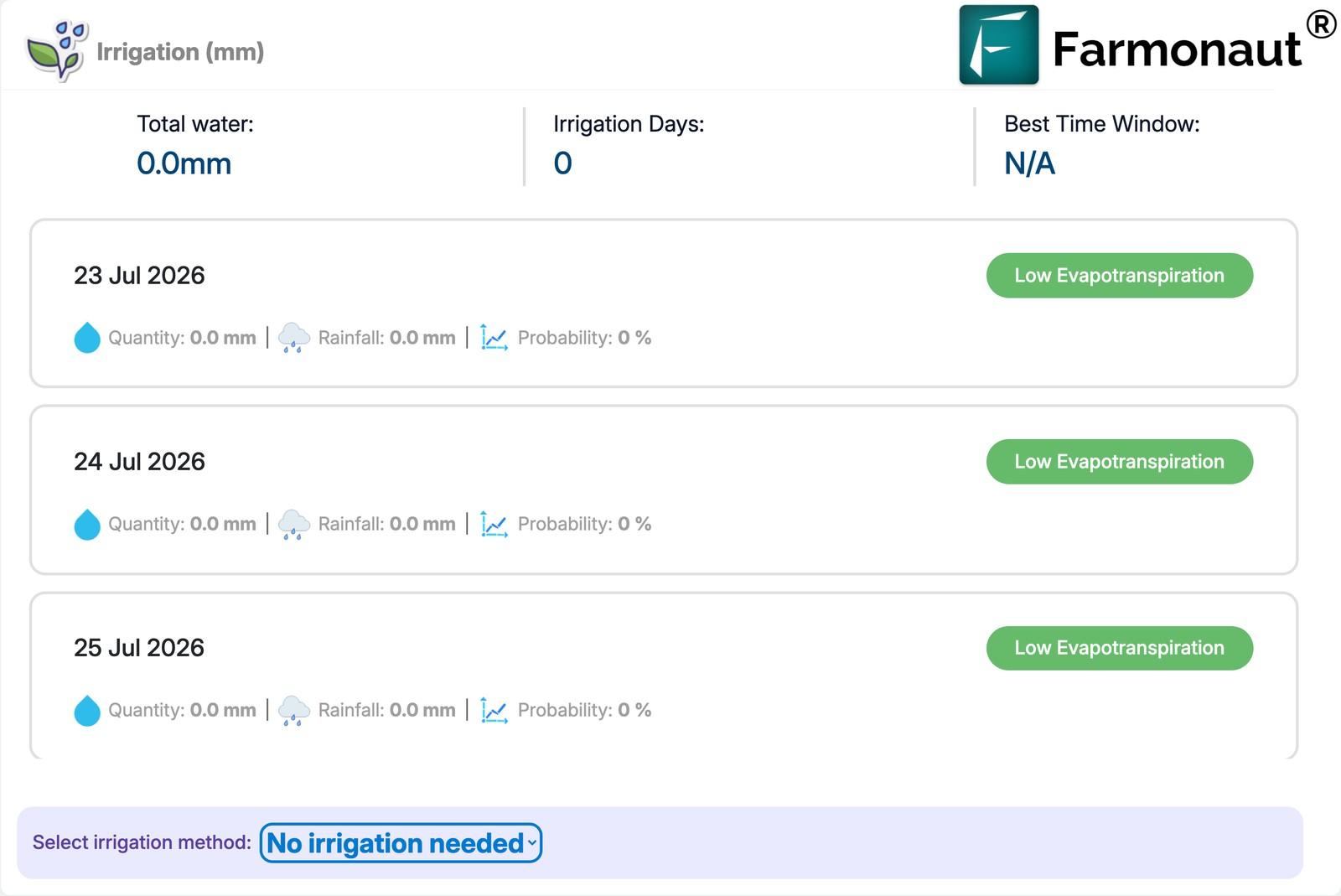
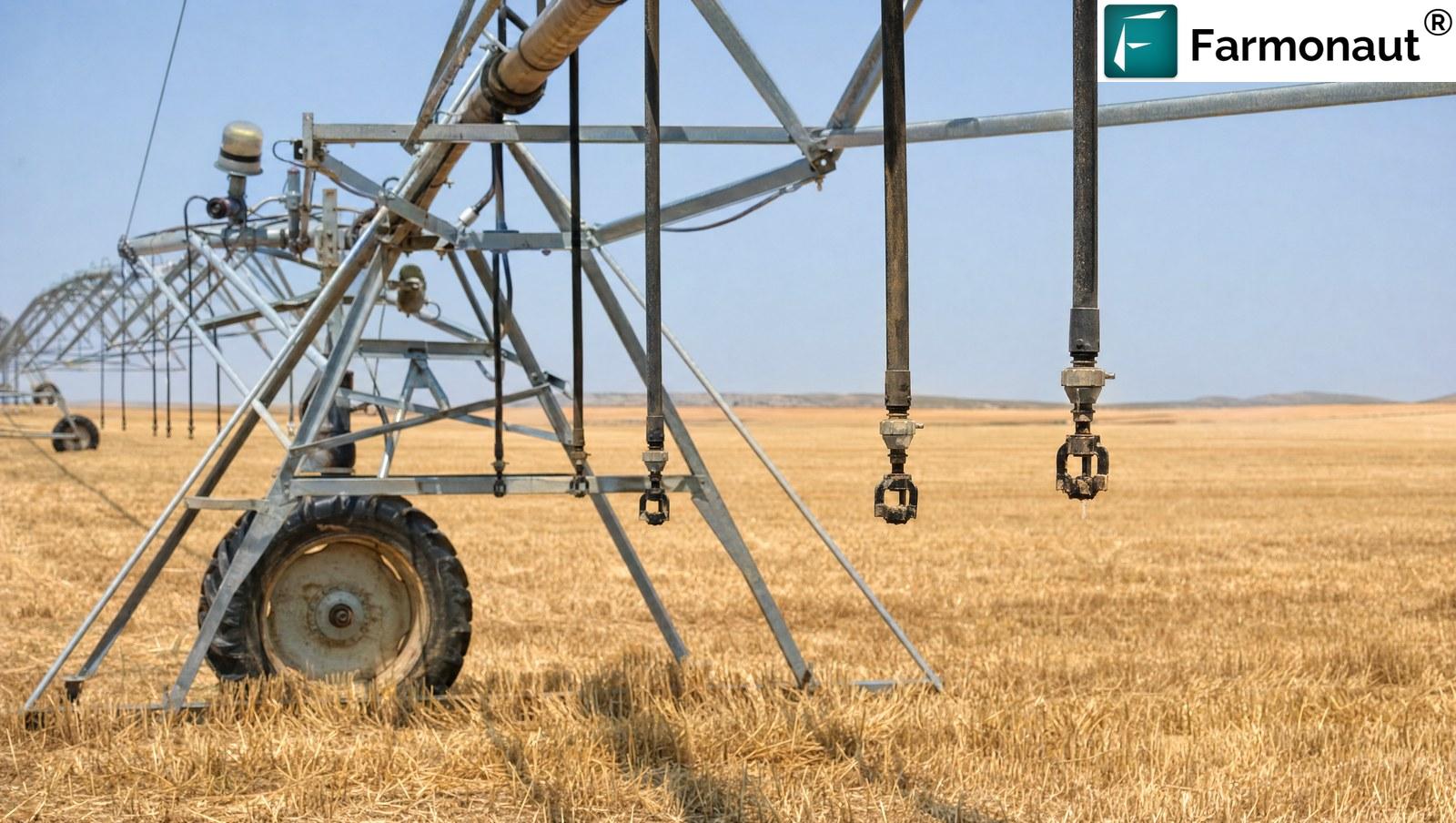
The oat field went further. Across all seven days the recommended quantity was 0.0 mm, the best time window read N/A, and the method selector resolved to “No irrigation needed”. Forty acres of pivot, switched off, in a place where the alternative is pumping.
Meanwhile the barley — the only field still at stem elongation, with active biomass accumulation still ahead of it — was scheduled 4.5 mm, 4.0 mm and 4.5 mm on alternating days, the highest allocation on the farm. The alfalfa, a perennial regrowing after a cut, held a steady 3.5–4.0 mm on alternate days. Four crops, four water regimes, one week.
On a mixed-cereal farm the number to watch is the irrigation-days count per circle, not the millimetre figure. A pivot that should be running three days a week instead of seven is the single largest controllable cost on an arid holding — and the change costs nothing to implement.
The report also quantifies the delivery method rather than assuming it. Where alternatives were listed, drip came in 14–21% below the centre-pivot figure — 3.8 mm against 4.5 mm on the barley, 2.0 mm against 2.5 mm on the wheat, 3.0 mm against 3.5 mm on the alfalfa. Centre pivot remained the recommendation, because that is the infrastructure the farm has; the drip column shows what a future conversion would be worth.
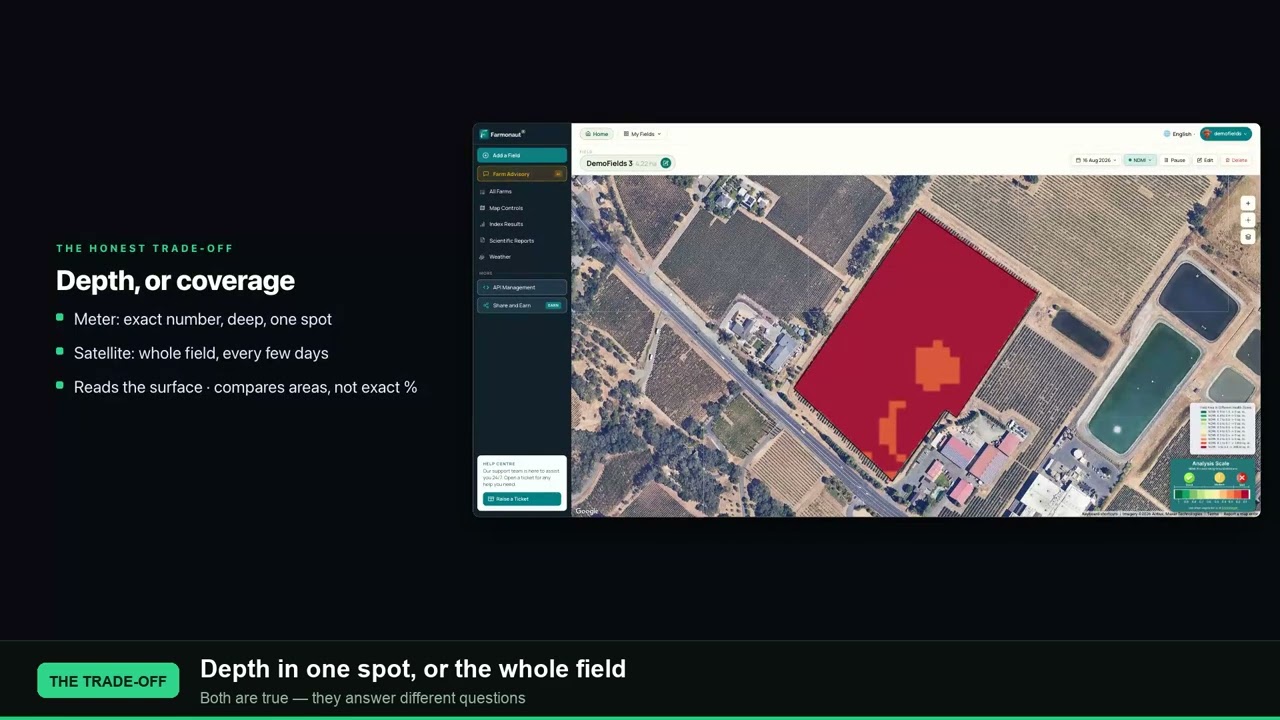
Fertiliser: one field fed, three finished
The nutrient side follows the same stage logic, and just as decisively. Of the four fields, only the barley was prescribed any fertiliser at all — nitrogen at 25.5, phosphorus at 57.4, potassium at 83.0, sulphur at 31.7 and zinc at 2.14 kg/acre. The wheat, oats and alfalfa each returned zero across all five nutrients, because a cereal at maturity and a forage just cut have no remaining uptake to support.
That is the fertiliser saving in one line. Taking the barley rates as the only programme on offer and applying them across the whole farm — a reasonable thing to do without per-field stage data — would have meant about 38,100 kg of nutrient instead of the 13,100 kg prescribed. Nearly three times as much, spread over crops that could not use it.
Pest and disease: the right rust on the right cereal
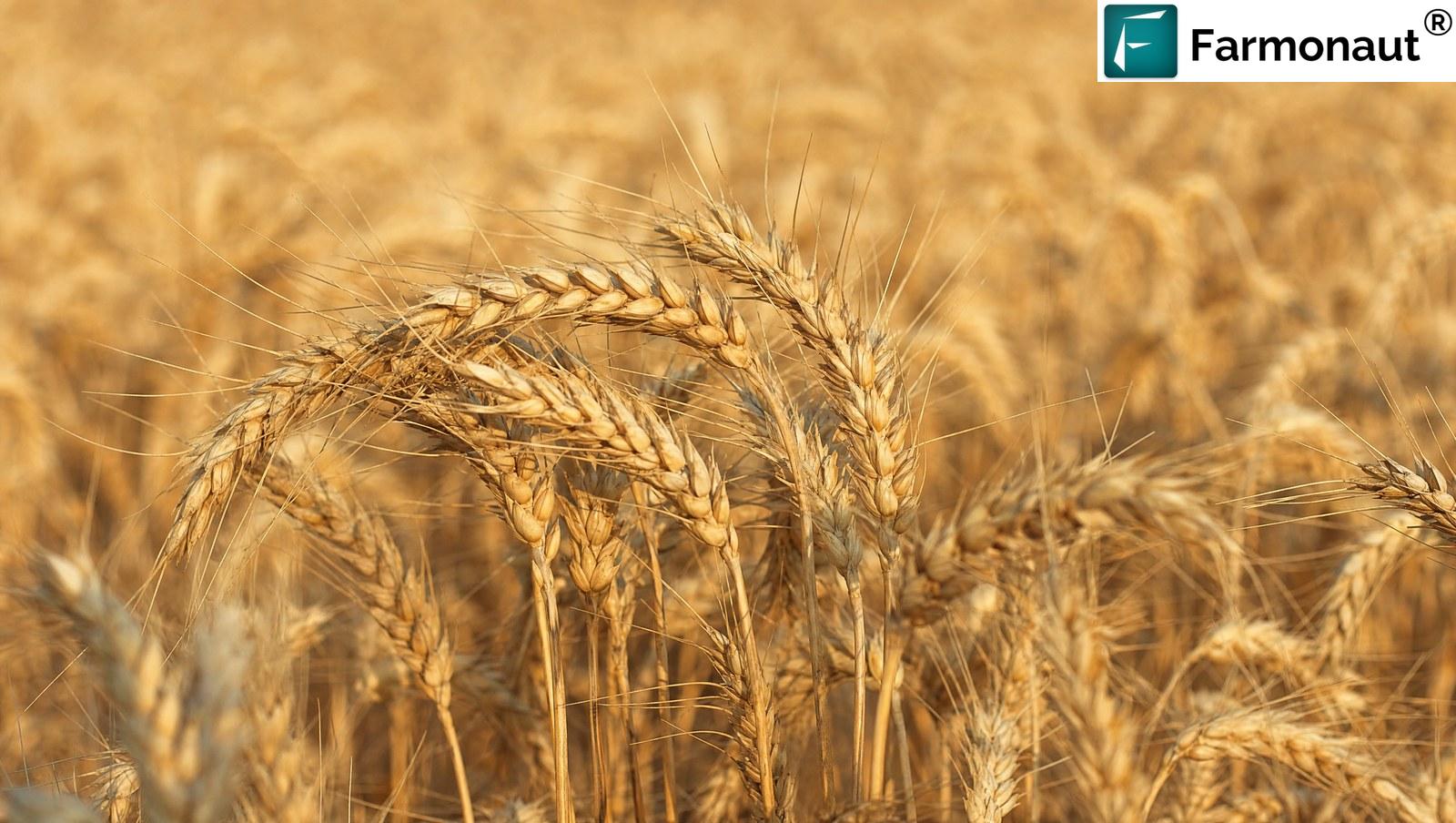
Six alerts crossed the 80% threshold that week, and each belonged to its host. The barley led with Aphids (Rhopalosiphum padi) at 94% — the bird cherry-oat aphid, the principal cereal aphid and the vector of barley yellow dwarf virus — alongside Barley Leaf Rust (Puccinia hordei) at 89% and net blotch (Pyrenophora teres), both barley-specific.
The durum wheat, in the same district, led with Sunn Pest (Eurygaster integriceps) at 95% — the defining wheat pest of North Africa and West Asia, and the one that ruins milling quality rather than yield — plus common bunt (Tilletia caries) at 80%. Where rust appeared on the wheat it was named Puccinia triticina, the wheat leaf rust, not the P. hordei flagged on the barley next door. Same genus, correct species per host.
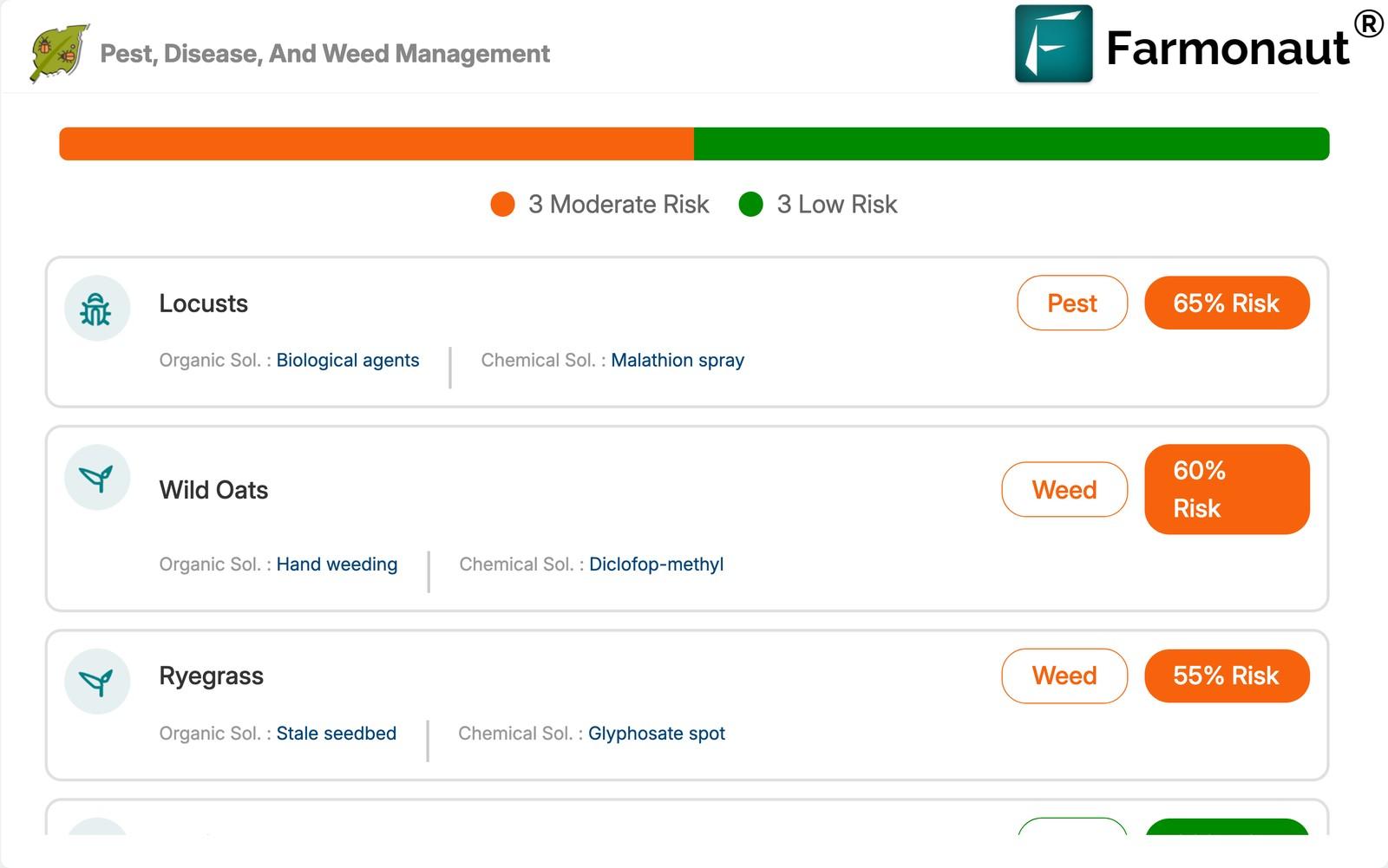
Weed pressure was equally regional: Wild Oats (Avena fatua) at 90% on the barley and 85% on the wheat, with ryegrass (Lolium spp.) behind it. Those two are the defining grass weeds of the North African cereal belt, and both are hard to control selectively in a cereal — which is exactly why an early probability flag has value.
It is worth converting that percentage into something a farm manager can price. Across the four circles the advisory’s schedule totals roughly 7,400 cubic metres of water for the week. Running all four pivots every day at each field’s own peak rate would have drawn about 15,200 cubic metres. The difference is close to 7,800 cubic metres — some 7.8 million litres — in a single week, on 190 acres, in a district where all of it arrives by pump. Whatever the diesel or electricity tariff, that is the number the schedule is actually moving.
Seven point eight million litres, in one week, on 190 acres — simply by not watering crops that had finished.
What the numbers add up to
Every figure below is computed from the advisory itself.
| Mechanism in the advisory | What it delivers on this farm |
|---|---|
| Stage-aware scheduling: full water to barley, a tapering ramp on maturing wheat, nothing on the two harvested fields | 51.2% less water than running all four pivots daily at their own peak rate |
| One 40-acre oat circle resolved to “No irrigation needed” for seven consecutive days | An entire pivot’s pumping cost removed for the week |
| Nutrient prescribed only to the one field still in active growth | ~13,100 kg instead of ~38,100 kg — roughly a third of a uniform programme |
| Six alerts at ≥80%, each correct to species for its host cereal or forage | Scouting directed to a named field and a named organism |
| Drip quantified 14–21% below centre pivot where alternatives exist | A costed upgrade path, disclosed rather than assumed |
On an arid holding the two savings compound. Water not pumped is diesel or electricity not burned, and nutrient not applied to a finished crop is fertiliser not bought at import prices. Both come from the same input — knowing what stage each field is actually at — and neither requires new equipment in the ground.

Grower-reported outcome, as submitted
The cards below reproduce Khater’s answer to our in-app feedback questionnaire for the advisory dated 29 May 2026, exactly as recorded, alongside the account facts as held on the platform.
Running a whole farm on one crop calendar. It is the default when four circles are managed by one operator from one schedule, and on this farm it would have kept the oat pivot turning for a week after the crop had finished, and fed three fields that had no uptake left. The stage of each individual field is the variable that decides everything else — water, nutrient and which pest is even relevant.
The account has been running a satellite irrigation advisory on all four circles since February 2026, and the cadence matters as much as any single week: 91 field advisories over 23 acquisition dates, refreshed roughly every five days. A stage-aware schedule is only useful if it keeps pace with the crop, and on a cereal moving from stem elongation through maturity to harvest inside a couple of months, a five-day revisit is what lets the water come down in steps rather than all at once at the end.
No percentage was given on the form, so there is no grower-stated figure to quote here. What the advisory data does show is the size of the decision it put in front of him that week: three of four pivots recommended off or tapering, and a single field carrying the entire nutrient programme.
Building soil under a pivot
Two readings run across all four circles and shape the whole nutrient approach. Soil organic carbon sits between 0.13% and 0.16% — characteristic of arid calcareous steppe soils, and the reason organic matter is worth building rather than only replacing nutrients. Soil pH reads 7.2 to 7.8, mildly to distinctly alkaline, which is where phosphorus and zinc availability becomes the thing to manage rather than the total applied — and is visible in the barley prescription, where phosphorus at 57.4 kg/acre runs well above nitrogen.
Salinity reads moderate on three of the four fields, which is the expected signature of long-irrigated land in an arid basin, where evaporation concentrates salts faster than irrigation leaches them. The advisory tracks it per circle on every pass, so the grower knows which pivots to watch rather than working from a farm-wide assumption.
In a pumped-groundwater system, cutting applied water and managing salinity are the same task. Every millimetre not applied is a millimetre not drawn from the aquifer and not passed through a saline profile. The 51.2% reduction here is an aquifer outcome as much as a cost outcome — and on this farm it came from switching pivots off at the right time, not from under-watering a growing crop.

Why per-field beats per-farm in arid cereal
The yield estimates show why a single farm-level figure would be no use here. Alfalfa is cut several times a season and projects 5,150 kg/acre; the durum wheat, harvested once, projects 1,700; the oats 1,050 and the barley 1,020.
Underneath all of it sits a per-pixel read of each circle from orbit, resolved through crop coefficients and regional pest models into instructions for that specific field at that specific stage. On a farm where the four pivots are at four different points in the season, that resolution is the entire product.
Running this on your own farm
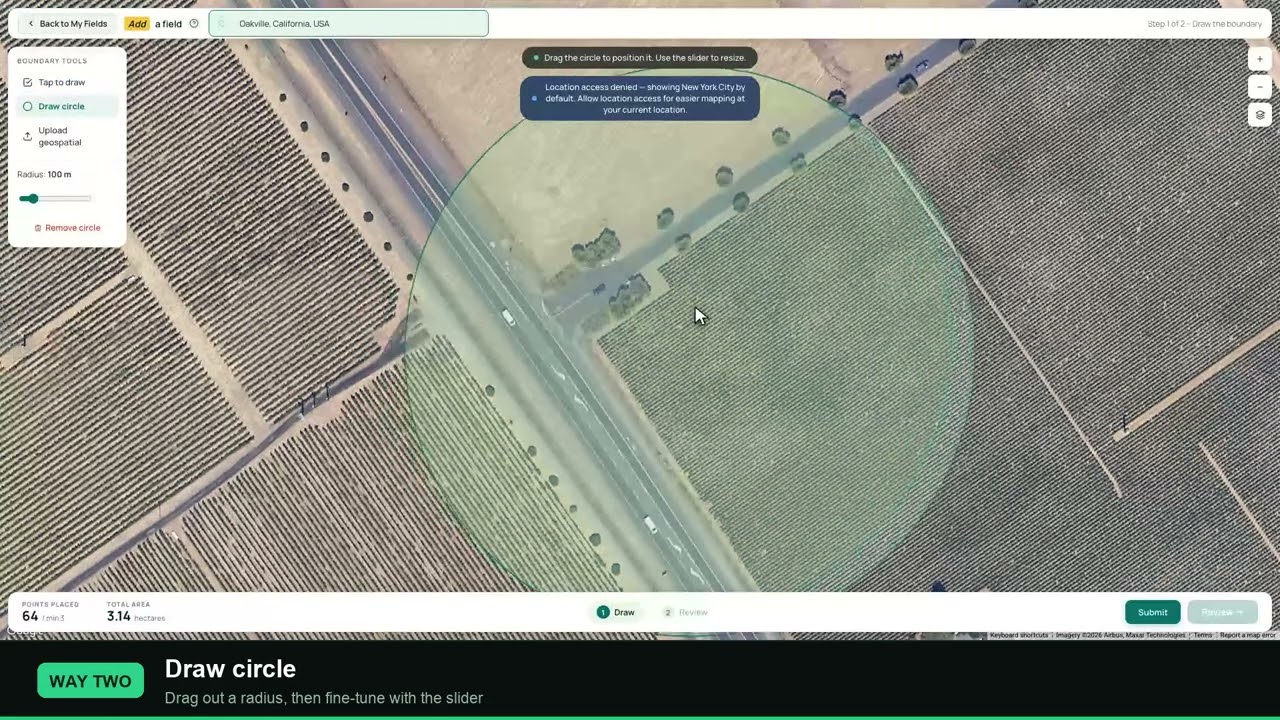
- Map each pivot circle separately. Four circles at four stages need four schedules; one boundary around the farm cannot produce them.
- Keep the crop and sowing date current. The whole result here — the wheat ramp, the oat stop, the single fertiliser prescription — follows from the stage model being right.
- Read the irrigation-days count first. On an arid holding, days the pump does not run is where the money is.
- Trust the zeros. A field at maturity or just cut genuinely needs nothing, and applying anyway costs twice — once for the input, once for the delayed harvest.
- Watch salinity per circle. It moves slowly and unevenly, and a farm-wide average will hide the pivot that is drifting.
Explore the platform at sat.farmonaut.com, read more about our satellite and AI-based farm advisory in the JEEVN AI overview, or talk to our team about monitoring a pivot-irrigated holding. JEEVN AI is a paid product; plan detail is on the platform.
Know which pivot to switch off
Map each circle, set its crop and stage, and get per-field irrigation and nutrient guidance from satellite passes over your own ground.
Frequently asked questions
What is a satellite irrigation advisory and what does it deliver?
A satellite irrigation advisory is a per-field schedule built from satellite passes over your own boundary, giving a day-by-day water quantity in millimetres, a recommended delivery method and a best time window, alongside fertiliser rates, pest and disease risk, soil chemistry and a yield estimate. On this Algerian farm four pivot circles each received their own, at a median revisit of five days.
How can switching irrigation off be the recommendation?
Because crop water demand ends before the season does. A cereal at maturity should be drying down, and a forage just cut has no canopy to support — irrigating either wastes water and can delay harvest or raise disease risk. On this farm the oat circle was set to 0.0 mm for seven consecutive days and the maturing durum wheat was tapered from 2.5 mm down to zero.
How much water did the schedule actually save?
Across the four fields, 17 of 28 field-days carried a zero. Against a baseline of running all four pivots every day at each field’s own peak rate, following the schedule applies 51.2% less water. The saving comes from stage-aware timing rather than from under-watering — the barley, the one crop still growing, received the largest allocation on the farm.
Why was only one of the four fields prescribed fertiliser?
Only the barley was still in active vegetative growth, at stem elongation. The durum wheat had reached maturity and the oats and alfalfa were at or past harvest, so none of the three had remaining nutrient uptake to support. Applying the barley programme uniformly across all 190.6 acres would have meant roughly 38,100 kg of nutrient instead of the 13,100 kg actually prescribed.
Does the advisory work with centre-pivot irrigation?
Yes — centre pivot was the recommended method on this farm, because that is the infrastructure in place. The report also lists alternatives with their own quantities, and on these fields drip came in 14–21% lower, which quantifies what a future conversion would be worth without pushing an upgrade the grower has not asked for.
Are the pest probabilities confirmed infestations?
No — they are modelled risk scores from satellite indices, weather and regional pest pressure, and they function as a scouting priority list. Their value on this farm is specificity: Puccinia hordei on the barley and Puccinia triticina on the wheat are different rust species correctly matched to their hosts, and Eurygaster integriceps at 95% is the right headline threat for North African durum.
Can it monitor mixed cereal and forage on one account?
Yes. This account carries durum wheat, barley, oats and alfalfa on four circles, which in the week analysed sat at four different growth stages and received four different water regimes. Each field is resolved independently from its own crop, stage and satellite pass.
Glossary
- Centre pivot
- A wheeled irrigation machine rotating around a central point, producing the circular fields characteristic of arid mechanised agriculture. Each circle is managed as one unit, which is why per-circle guidance matters.
- Stem elongation
- The cereal growth stage at which stems extend rapidly and biomass accumulates. Peak water and nitrogen demand — the reason the barley was the only field on this farm still being fed.
- Terminal drydown
- The deliberate withdrawal of irrigation as a cereal reaches maturity, so the crop dries evenly for harvest. Visible here as the wheat schedule tapering 2.5 mm to zero.
- Sunn pest (Eurygaster integriceps)
- A shield bug that feeds on developing wheat grain and degrades milling and baking quality. The dominant wheat pest across North Africa and West Asia.
- Soil salinity
- Accumulated soluble salts in the profile. In irrigated arid basins evaporation concentrates salts faster than irrigation leaches them, so it is tracked per field rather than farm-wide.
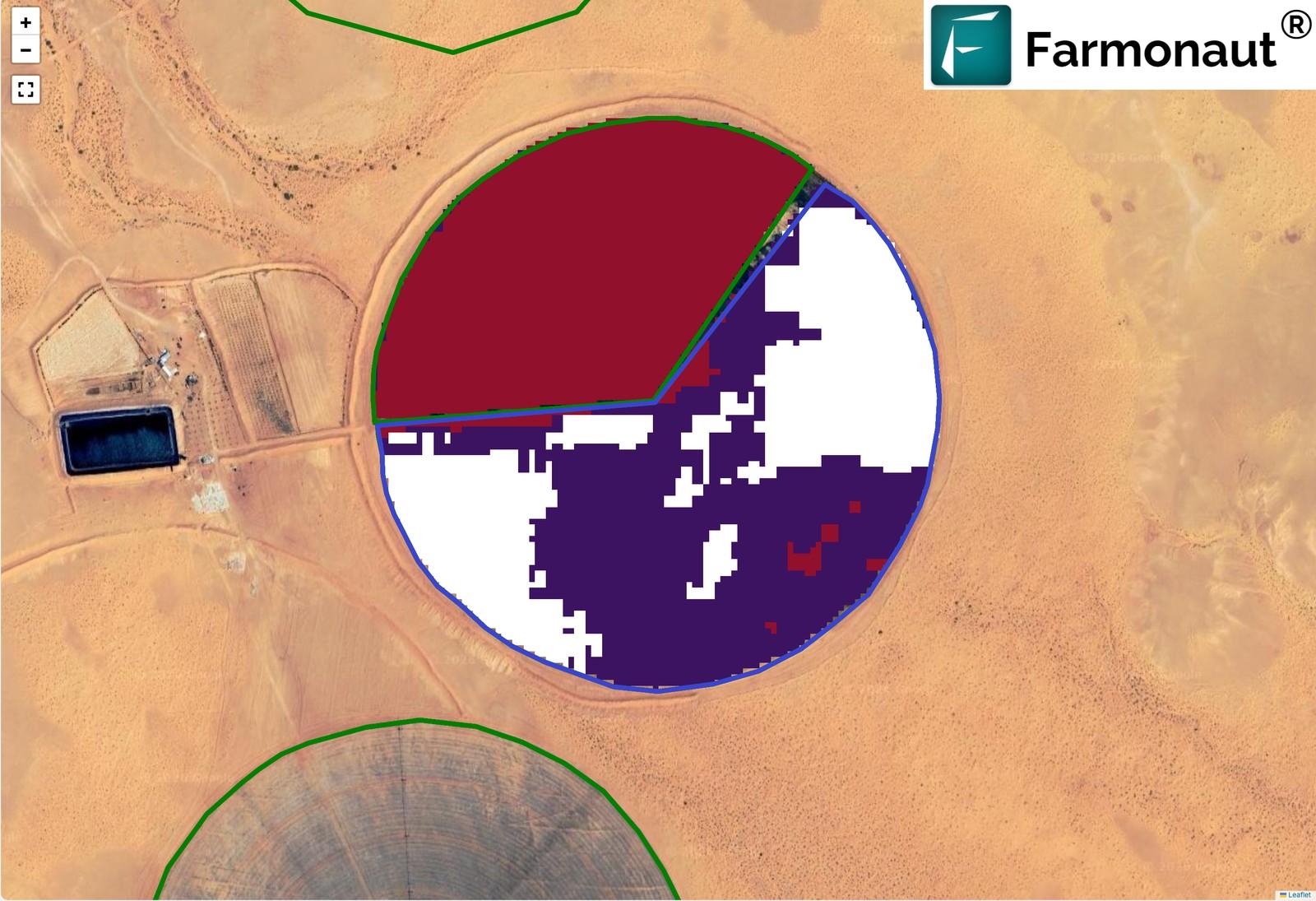
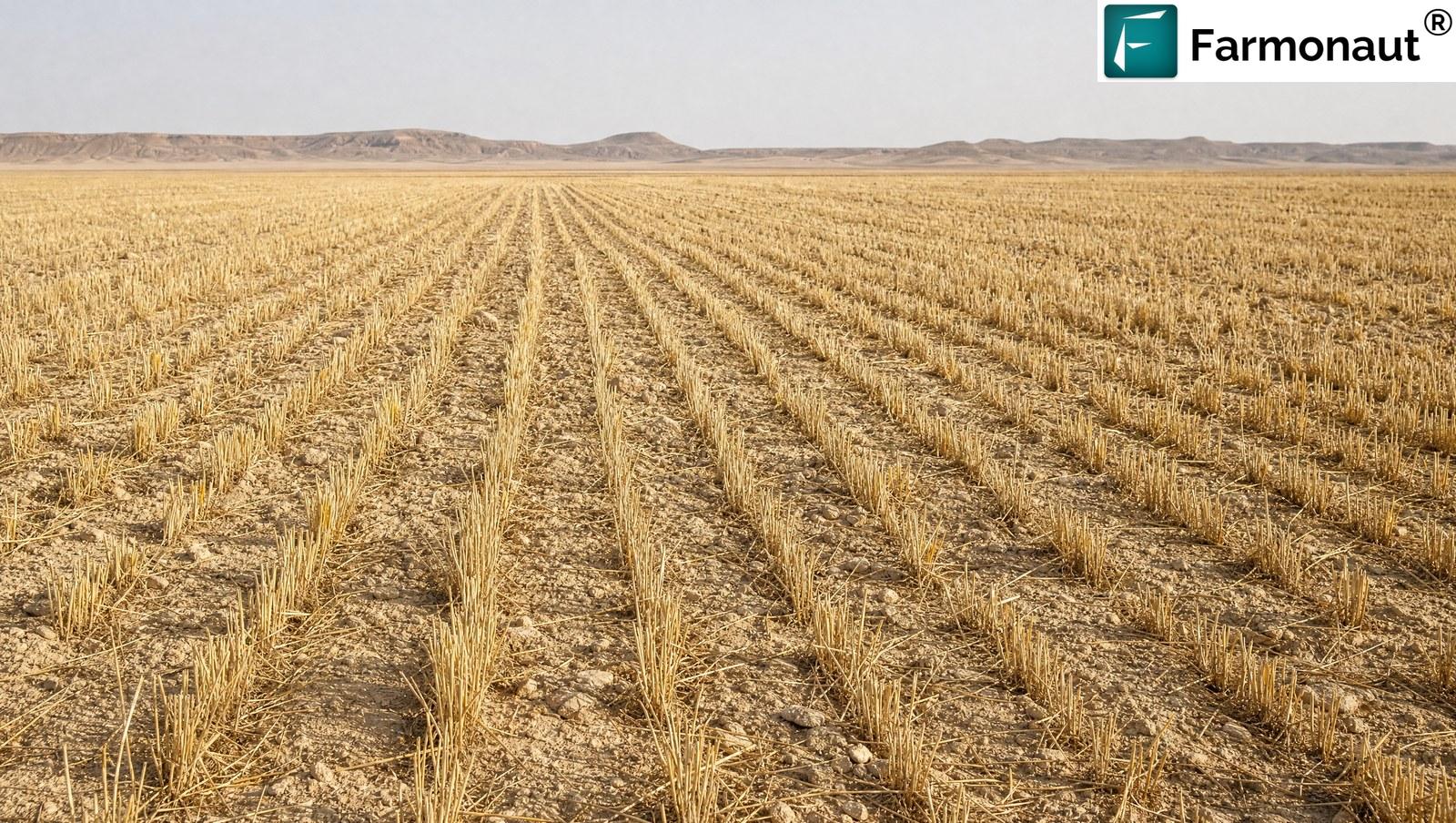
Case-study basis: JEEVN AI field advisories for a single Farmonaut account, taking each field’s most recent advisory as of the client’s feedback submission (portfolio state at 28 May 2026, four fields), plus the account’s in-app feedback submission for the advisory dated 29 May 2026. Region, crops, field count and area are reported from the account’s own records on the platform; the account holder is named as recorded on his Farmonaut account and precise field locations are withheld. The grower-reported outcome is a single confirmatory answer on a structured feedback form, with no percentage given; the 51.2% water figure is our own calculation against a stated baseline of running all four pivots daily at each field’s own peak recommended rate, and the nutrient comparison is against a stated baseline of applying the barley programme uniformly across the whole area. Pest, disease and weed percentages are modelled probabilities, not confirmed infestations. Yield figures are estimates, not guarantees. Imagery: the four platform screenshots and the crop-health zone map are genuine captures of this account’s own advisory and satellite data; the five wider field photographs are AI-generated illustrative imagery, each labelled as such in its caption, and do not depict the client or their fields. JEEVN AI is a paid product.
Discussion
Questions, corrections or field experience? Share them below. First-time comments are reviewed before they appear, and your email is never published.
No comments yet. Be the first to add a question or your experience.

 Raketla
 Polaris Digitech
 Teledarbas
 Wild Oak Farm
 SFX
SFX BACF Africa
 Doodlakine
 Exurbia Geospatial
 FieldZero
 Indico Company
 Kubota
 FFBS
FFBS Jontra
 Tucor
Tucor
