

Write for the Farmonaut blog
Agriculture guest posts and link insertions
You can publish an agriculture guest post on the Farmonaut blog, or add a link to an article that's already live. Our readers are agronomists, geospatial engineers, mining planners and growers working on climate-smart farming around the world. Both services are paid, both go through editorial review, and both are limited to agriculture and mining.
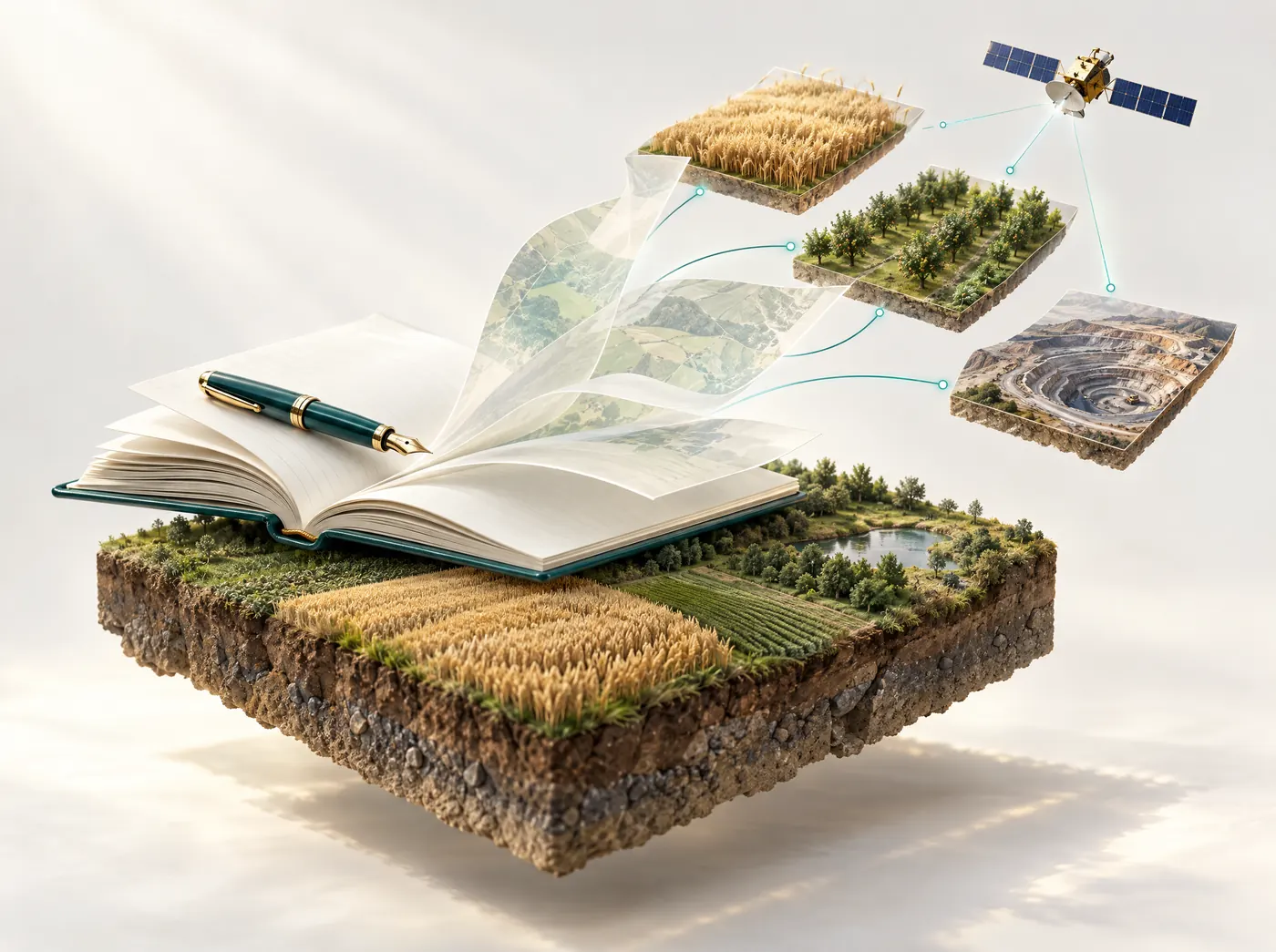
Two ways to appear on the blog
Pick the one that matches what you need. A guest article is a new piece with your byline. A link insertion adds your link to an article we've already published.
Guest article publication
Write an original article of 1,500–2,000 words for our blog. We review it before you pay: the fee is due only once the article is approved, and it goes live within 24–48 hours after that.
- Reviewed first, invoiced on approval
- Up to 2 do-follow backlinks inside the piece
- Your byline and author bio, with evergreen placement
Link insertion
Add your link to an article that's already live on our blog. Payment is 100% upfront. Placement is guaranteed, but traffic or ranking results are not.
- Paid in advance, with no refunds once the link is live
- Blog and article content only, never core site pages
- The quickest way to a live, relevant backlink
Scope
Topics we publish
Our readers make decisions about land and what lies under it, so every pitch has to sit inside agriculture or mining, seen through data, geospatial tools or sustainability.
- Agriculture
- AgriTech
- Precision agriculture
- Remote sensing
- GIS
- Satellite technology
- Sustainability
- Climate-smart agriculture
- Mining
- Mining exploration
- Geospatial technology
Articles unrelated to agriculture or mining, such as general technology, finance or lifestyle pieces, won't be reviewed, however well they're written.
Not sure whether your idea fits? Look at what's already on the blog. Our farming guides and mining guides group our articles by topic, and the closer your pitch is to those subjects (without repeating them), the better its chances.
Contributor guidelines
Every guest article has to meet these before it goes to an editor.
- Original content only. We check every draft for plagiarism.
- 1,500–2,000 words.
- Clear headings, short paragraphs and bullet lists where they help.
- Topics related to agriculture, precision agriculture, remote sensing, AI and machine learning in farming, climate-smart practices or agritech startups, or to mining and mineral exploration.
- At least one high-resolution image, chart or infographic, with proper attribution.
- No affiliate, promotional or commercial links.

How to submit a guest article
Submissions come in by email. Our editorial team reviews each one within 5–7 business days and lets you know the status.
Prepare your draft
Write the article as a Google Doc or Word file, following the guidelines above.
Email it to us
Send it to [email protected] with the subject line "Guest Blog Submission – [Your Topic]".
Add a short bio
Include a 2–3 line author bio and, if you like, one link to your profile or research work.
Payment
Pay through the payment link and keep the transaction ID for your records.
Guest article fees are due on approval. If you pay before review and your article is rejected, we refund the payment within 7 business days, minus applicable processing charges.
Link insertion rules
A link insertion places your link inside an article that's already published on the Farmonaut blog.
- Payment is 100% upfront, through the payment link.
- The link goes into blog and article content only, never into core site pages such as product or company pages.
- The link has to be relevant to the article it sits in, and the same scope rules apply: agriculture or mining.
- Placement is guaranteed. Traffic, rankings and other results are not.
- There are no refunds once the link is live.
Terms and conditions
These apply to every submission.
- Submission doesn't guarantee publication.
- Articles may be edited for SEO, clarity and formatting before publishing.
- No affiliate, promotional or commercial content is allowed.
- If an article is rejected, your payment is refunded within 7 business days, minus applicable processing charges.
- By submitting, you grant Farmonaut the right to publish and keep the content on our website.
Editorial process
What happens after you hit send
The details vary from article to article, but every guest post goes through the same broad stages.
Scope check
An editor confirms the topic is about agriculture or mining. Anything outside that stops here.
Originality check
The draft is checked for plagiarism and for overlap with articles already on the blog.
Editorial review
We read for accuracy, structure, sources, image credits and links, and may suggest changes.
Edit and publish
Approved articles are edited for SEO, clarity and formatting and go live 24–48 hours after approval.
What makes a good agriculture guest post
The articles that do well on our blog have one thing in common: they help a specific reader make a decision. An agronomist deciding when to switch from NDVI to a red-edge index. A farm manager weighing a soil moisture probe against satellite moisture data. An exploration geologist working out which parts of a license deserve a field visit. If you can name the reader and the decision in a sentence, you have the start of a good agriculture guest post.
What doesn't work is the generic overview. "The future of agriculture" and "10 benefits of technology in farming" have been written thousands of times, and our readers skip them. Narrow topics with real detail beat broad ones with none. A piece on irrigation scheduling for drip-irrigated orchards in hot, dry summers is far more likely to be read to the end than a piece on "smart irrigation" in general.
If you're pitching several agriculture guest posting sites with the same idea, write a different article for each. We check drafts for overlap with content that's already published elsewhere as well as for plagiarism. Our own roundup of agriculture guest posting sites and blogs shows how different the audiences are, and why one article rarely fits them all.
Topic ideas that fit our readers
These are the kinds of subjects that sit squarely in scope. Treat them as starting points, not titles.
Agriculture and agritech
- Field experience with a precision agriculture practice: variable-rate fertilizer, deficit irrigation, cover cropping, controlled traffic.
- How a farm, cooperative or agritech startup adopted a technology, including what didn't work.
- Climate-smart practices and how their results are measured.
- AI and machine learning in farming, explained for practitioners rather than data scientists.
Remote sensing and GIS
- Comparing vegetation or moisture indices for a particular crop or stage.
- Practical GIS workflows, such as preparing field boundaries or building management zones.
- The limits of satellite data and how to work around them.
Mining and exploration
- How remote sensing fits into early-stage mineral exploration.
- Geospatial data in mine planning, rehabilitation or environmental monitoring.
- Explainers on exploration terminology for non-geologists.
Before you write, search the blog for your topic. If we've covered it, pitch a new angle on it and link to the existing article where it helps the reader.
Structuring 1,500–2,000 words
Within that length you have room for an introduction, four to six sections and a short close. A structure that works for most practical articles:
- An opening of two or three short paragraphs that states the problem and who it affects. Skip the history lesson.
- The core explanation: how the practice or technology works, in enough detail that a reader could explain it to a colleague.
- An example. A worked calculation, a field scenario, a before-and-after. This is the part readers remember.
- Trade-offs and limitations. When is this the wrong choice? What does it cost in time, money or skill?
- Next steps the reader can take, in order.
Use descriptive headings so a reader scanning the page can find their part. Keep paragraphs to three or four sentences, and use a list only when the items really are a list. One well-made table, comparing methods or summarizing numbers, is often worth several paragraphs.
Our editors may edit approved articles for SEO, clarity and formatting. Clear headings and short paragraphs in your draft mean fewer changes and a faster turnaround.
Writing accurately about satellite data
Many of our readers work with satellite imagery every day, so errors here get noticed quickly. A few points that trip up writers:
- Get formulas right. NDVI is (NIR − Red) / (NIR + Red), and its values run from −1 to +1. If you introduce another index, give its formula or link to a source that does.
- Be specific about resolution and revisit. The European Space Agency's Sentinel-2 mission revisits a location about every five days with two satellites and has 10 m visible and near-infrared bands. Landsat 8 and 9 provide 30 m multispectral imagery.
- Avoid "real time" for satellite monitoring. Satellites capture an area when they pass over it, and optical sensors can't see through cloud. Radar satellites such as Sentinel-1 can, which is worth explaining if your article deals with cloudy regions.
- Distinguish what an index shows from what causes it. Low NDVI tells you the canopy is sparse or stressed. It doesn't tell you whether the cause is water, nitrogen, pests or a planting problem.
If you want a reference point for the level of detail our readers expect, our guide to the NDVI formula and the hub on satellite crop monitoring and remote sensing are good examples.
Writing about mineral exploration
Mining readers are careful about terminology, because terms like "resource" and "reserve" have formal definitions under reporting codes. Under the JORC Code used in Australia, an Exploration Target is a statement of exploration potential, with quantity and grade given as ranges, that is conceptual in nature: there hasn't been enough exploration to estimate a Mineral Resource. In Canada, NI 43-101 sets the rules for disclosing scientific and technical information about mineral projects, and potential quantities and grades can only be given as ranges with a cautionary statement.
In practice, that means a guest article shouldn't describe a satellite anomaly or a geochemical target as a "deposit" or a "resource". Describe what was observed, how it was interpreted and what would be needed to confirm it. Our mining case studies show how we describe Exploration Targets ahead of a JORC or NI 43-101 resource estimate.
Sources, images and attribution
Every statistic in your article needs a source, and the best sources are primary ones: government agencies, research institutions, peer-reviewed papers and official statistics. Link to the page where the number appears, not to an article that quotes it, and give the year the figure refers to.
Your article needs at least one high-resolution image, chart or infographic, with proper attribution. Use images you made or have the right to use, and credit them under the image. Satellite imagery has its own rules. Copernicus Sentinel data is open, but it asks for a credit such as "Contains modified Copernicus Sentinel data [year]". Landsat data from the US Geological Survey is in the public domain, and USGS asks that it be credited as the source. Commercial imagery usually comes with a license that limits where it can be republished, so check before you include it.
Links
A guest article can contain up to two do-follow backlinks. They should point to resources that genuinely help the reader, such as your research, a dataset or a tool explained in the article. Affiliate, promotional and commercial links aren't allowed. Links to sources you cite are separate from those two and are part of good practice.
Why submissions get turned down
Most rejections come down to a handful of reasons:
- The topic is outside agriculture and mining.
- The draft isn't original, or it overlaps heavily with content published elsewhere.
- The article is under 1,500 words, or well over 2,000 without a reason.
- It reads as an advertisement, or carries affiliate or promotional links.
- Facts or figures have no sources, or the technical details are wrong.
- Images are missing, low resolution or uncredited.
Submission doesn't guarantee publication, so it's worth checking your draft against the guidelines on this page before you send it. Reading two or three recent articles on the blog is the quickest way to see the level of detail our editors look for.
Questions about guest posts
Does Farmonaut accept agriculture guest posts?
Yes. We publish paid agriculture guest posts and mining guest posts that meet our guidelines. Articles must be original, 1,500–2,000 words long and about agriculture or mining.
How do I write for us?
Email your draft as a Google Doc or Word file to [email protected] with the subject line "Guest Blog Submission – [Your Topic]". Include a 2–3 line author bio and, optionally, one link to your profile or research.
Is guest posting on the Farmonaut blog paid?
Yes, both services are paid. For a guest article, the fee is due once the article is approved. For a link insertion, payment is 100% upfront.
How long does the review take?
Our editorial team reviews submissions within 5–7 business days and updates you on the status. Approved guest articles go live within 24–48 hours of approval.
How many backlinks can I include?
Up to two do-follow backlinks per guest article. Affiliate, promotional and commercial links aren't allowed.
What topics do you accept?
Agriculture, agritech, precision agriculture, remote sensing, GIS, satellite technology, sustainability, climate-smart agriculture, mining, mining exploration and geospatial technology. Articles outside agriculture and mining aren't reviewed.
What is a link insertion?
It's a paid placement of your link inside an article that's already live on our blog. Links go into blog and article content only, never core site pages, and placement is guaranteed but results are not.
Can I get a refund?
If a guest article is rejected, your payment is refunded within 7 business days, minus applicable processing charges. Link insertions aren't refunded once the link is live.
Will you edit my article?
We may edit approved articles for SEO, clarity and formatting before publishing. Your byline and author bio stay with the piece.
Can I republish my article elsewhere?
Send us original work that hasn't been published elsewhere. By submitting, you grant Farmonaut the right to publish and keep the content on our website.
Do I need to include images?
Yes, at least one high-resolution image, chart or infographic, with proper attribution. Satellite images should carry the credit their provider asks for.
Where do I pay?
Use the payment link and keep the transaction ID for your records.
Send us your article
Email your draft to [email protected] with the subject "Guest Blog Submission – [Your Topic]". We'll get back to you within 5–7 business days.