

Bauxite mining · Cost guide
Bauxite Production Cost per Tonne: Mine Cost Breakdown
Public sources give no single bauxite cost: Alcoa averaged US$17 per dry tonne shipped in 2020, and some Guinea mines were above US$35 FOB in August 2026. This guide itemises the cost lines, two capital examples and a calculator for your own mine.
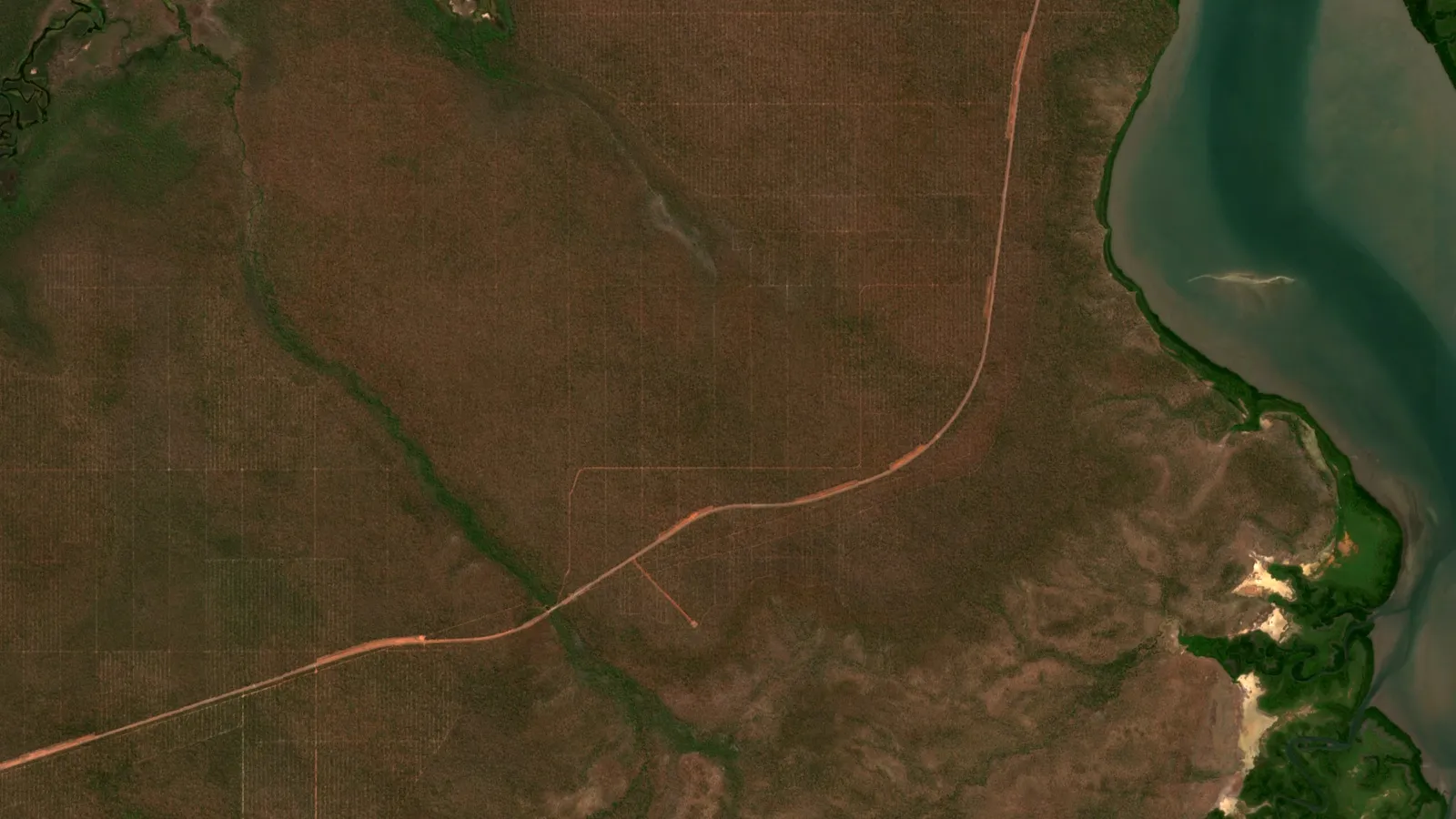
Key takeaways
- Alcoa’s average cost was US$19, US$18 and US$17 per dry metric tonne of bauxite shipped in 2018, 2019 and 2020 (Alcoa Form 10-K, SEC, 2021).
- In a report of 13 August 2026, Mysteel put the full FOB cost at some Guinean mines above US$35 per dry tonne; its 12 August spot price for Guinean ore was US$71 and Guinea to China freight reached US$38 per tonne the week before.
- Rio Tinto approved its Amrun project at US$1.9 billion in 2015 for 22.8 million tonnes a year; a 2012 study put the Koumbia mine, rail and port at US$812 million.
- Queensland charges the higher of 10% of value or A$2.00 per tonne on bauxite mined for consumption outside the state (Queensland Revenue Office); royalty rules differ by country.
- Bauxite is cheap next to alumina: the USGS import values were about US$32 and US$590 per ton in 2025 (estimate).
In this article
- Bauxite production cost per tonne: what public sources show
- Aluminum deposits: what a new mine is built on
- New bauxite mine capital cost: two dated examples
- The seven cost lines of a new bauxite mine
- Mine cost versus refinery cost: where the big money sits
- Bauxite price against cost: the margin picture
- Bauxite mine economics calculator
- How to build your own bauxite cost estimate: 6 steps
- Screening a licence area before you spend on drilling
- What to check before funding or buying a bauxite project
- Frequently asked questions
No public source gives one cost for a new bauxite mine, because the figure depends on the deposit, the haul to a port and the royalty. The dated numbers that do exist give a useful frame. Alcoa reported an average cost of US$17 per dry metric tonne of bauxite shipped in 2020 across its own mines. In August 2026, Mysteel put the full FOB cost (cost loaded on the ship) at some Guinean mines above US$35 per dry metric tonne, with spot ore near US$71.
This page is written for mining business owners and licence holders who need to judge what a new bauxite operation costs to build and run. It sorts the public data by cost line, shows two real capital-cost examples, explains how aluminum deposits turn into a mine plan, and ends with a calculator where you enter your own numbers. A dry metric tonne (dmt) is a tonne of ore with the moisture removed, which is how bauxite is priced.
We cover a connected topic in Aluminum Mines in USA: Where Bauxite and Smelters Are.
For a closer look at a related question, see our guide: Porphyry Copper Ore Grade: Chile vs Japan, by Mine.
Bauxite production cost per tonne: what public sources show
Bauxite is the ore that almost all aluminum comes from. Three public data points describe what it costs to produce, and they are not the same thing, so read the basis for each one.
Chart
Alcoa average cost per tonne of bauxite shipped
US$ per dry metric tonne, 2018 to 2020
- Alcoa, 2018 to 2020: the company reported an average cost per dry metric tonne of bauxite shipped of US$19, US$18 and US$17. Its filing says this figure includes labor, materials, utilities, depreciation and plant administration. It is an average over a mature mine portfolio, not a new project (Alcoa Form 10-K for 2020, SEC).
- Koumbia feasibility study, 2012: the developer forecast operating costs of around US$11 per tonne for a Guinea project, (the article does not say what the figure includes) (AL Circle, 2012). A forecast made in 2012 is a planning number, not a measured cost.
- Mysteel, August 2026: the full FOB cost at some Guinean mines was above US$35 per dmt, which Mysteel linked to higher fuel and freight costs (AL Circle, 13 August 2026). It says “some” mines, so it is a high-end reading and not a market average.
The gap between US$11 and above US$35 is not an error. It comes from different years, different places and different bases (a forecast operating cost, an audited average that includes depreciation, and a full cost loaded on a ship). That is the main lesson of this page: always ask what a quoted bauxite cost includes before you compare it to anything else.
For scale, the United States Geological Survey (USGS) put the average import value of bauxite arriving in the US at US$32 per metric ton in 2025 (estimate). The same table shows metallurgical alumina, the next product in the chain, at US$590 per ton. Mining the ore is the cheap step. The expensive steps come after it.
Aluminum deposits: what a new mine is built on
Aluminum is a common element in rock, but it is only mined at a profit as bauxite, a surface layer that forms by deep weathering in warm, wet climates. The USGS describes two main deposit types. Laterite-type bauxite forms in the subsoil on well-drained plateaus, typically in stable regions, and sits under a thin soil layer on top of weathered rock, with Australia, Brazil and Guinea as examples. Karst-type bauxite forms on carbonate rock, and its ore tends to collect in depressions on the karst surface.
The deposit type matters for cost. A flat laterite plateau with a thin cover can be stripped and mined in wide, shallow cuts with ordinary earthmoving equipment. Karst pockets are irregular, so mine planners need tighter drilling and more selective mining to separate ore from clay and rock. Both types need grade control, because the quality of the ore (see the cost lines below) decides what a refinery will pay.
Scale and location decide the rest. USGS counts world bauxite reserves at 29 billion tons, with Guinea at 7.4 billion and Australia at 3.7 billion. World mine output was 440 million tons in 2025 (estimate), led by Guinea at 150 million, Australia at 97 million and China at 87 million. The United States holds 20 million tons of reserves and reports its mine output as withheld, so a new US-based bauxite mine would be a rare project. For where aluminum occurs in the crust and which countries mine it, see our guide to aluminum extraction, top mines and processes worldwide.
New bauxite mine capital cost: two dated examples
Capital cost for a new mine is mostly infrastructure, not the pit. Bauxite is a bulk, low-value ore, so a project needs a haul road or rail line, a port with a ship loader, power and a camp before it earns a dollar. Two public examples show how large that bill is.
| Project | Year of figure | Capital cost | Scope and size | Source |
|---|---|---|---|---|
| Amrun, Queensland (Rio Tinto) | Approved 2015 | US$1.9 billion | Project to replace East Weipa output; starting output 22.8 million tonnes a year; hoped to grow to 50 million | Reuters via Yahoo News |
| Koumbia, Guinea (Alliance Mining Commodities) | Feasibility study, 2012 | US$812 million | Mine, rail and port; 305 million tonnes at 48% (grade as stated in the report); 40-year mine life | AL Circle |
Dividing Amrun’s US$1.9 billion by its starting 22.8 million tonnes a year gives about US$83 of capital for each annual tonne of capacity. That is our own arithmetic, and it applies to a very large, port-linked project. Reuters reported at the time that the cost was up to US$500 million lower than some analysts expected, helped by cheaper labor and equipment during the downturn. A small project that ships a few million tonnes a year, or one that must build a long road, can sit well above or well below that ratio. Koumbia’s study did not give a starting capacity in the article we read, so we do not compute a ratio for it.
Capital figures from 2012 and 2015 are not today’s prices. Costs for steel, fuel and labor have moved since then, and the Koumbia number is a study figure. Use them as a sense of scale and rebuild the estimate with current quotes. Both examples also include rail or port works, which is why a mine-only budget will always look smaller.
The seven cost lines of a new bauxite mine
Owners usually budget in seven areas. The table gives what public documents say for each one. Where no public per-tonne figure exists, the table says so rather than guessing.
Chart
Three bauxite cost figures on three different bases
US$ per tonne. Forecast operating cost; audited average incl. depreciation; FOB cost floor
| Cost line | What it covers | What public sources say |
|---|---|---|
| 1. Exploration and studies | Drilling, sampling, scoping and feasibility work, plus environmental baselines | No public per-tonne benchmark. Cost depends on deposit size and drill spacing. Satellite screening can narrow the area before drilling. |
| 2. Site development | Roads, power, water, camp, clearing and first stripping | Part of the US$1.9 billion Amrun total (2015) and the US$812 million Koumbia study (2012), mixed with rail and port. |
| 3. Mining and ore handling | Clearing, stripping, digging, crushing or washing, stockpiling | Forecast operating cost of around US$11 per tonne at Koumbia (2012); Alcoa average of US$17 per dmt shipped (2020), which includes processing and depreciation. |
| 4. Haul, rail and port | Truck or rail haul, stockpile, ship loading | Rail and port are inside the Koumbia and Amrun capital figures. Per-tonne running cost is project specific. |
| 5. Ocean freight | Capesize ship from mine port to the refinery | Capesize rates on the Guinea to China route rose to a high of US$38 per tonne in the week before 12 August 2026, close to the May and June peak (Mysteel). |
| 6. Royalties and taxes | Mineral royalty, export duty, local levies | Queensland: the higher of 10% of value or A$2.00 per tonne for bauxite mined for consumption outside Queensland (Queensland Revenue Office). Rules differ by country and change. |
| 7. Rehabilitation, community and residue | Land restoration, water, community programs; red mud if a refinery is built | Refining leaves 1.23 tonnes of residue per tonne of alumina on average (International Aluminium Institute). Mine rehabilitation cost is project specific. |
Cost line 3: mining and ore handling
Mining bauxite is usually open-cut work. The ore is near the surface, so there is little or no blasting on a laterite plateau, and the main costs are clearing land, removing the thin cover, loading and hauling. The quality of the ore changes the real cost per useful tonne: Mysteel’s August 2026 quotes show Guinea ore (Al 45%, Si 3%) priced at US$71, and Australian ore (Al 50%, Si 6.5%) priced at US$66.5 per dmt. Reactive silica raises caustic soda use in the refinery, so buyers discount it. A deposit with high silica or thin ore layers costs more per tonne of alumina delivered.
Cost lines 4 and 5: haul, port and ocean freight
For ore shipped overseas, distance can cost as much as digging. When freight on the Guinea to China route rose to US$38 per tonne in the week before 12 August 2026, it was more than half the US$71 per dmt spot price Mysteel quoted for Guinean ore (the two figures are on different bases). A project near a deep-water port, or one that can use an existing rail line, starts with a large advantage. A project with a long new haul road carries that road in its capital cost for the whole mine life.
Cost line 6: royalties and export rules
Royalty rules can change the margin as much as a small change in ore price. In Queensland, bauxite mined for consumption outside the state (rate checked 15 October 2026) pays the higher of 10% of its value or A$2.00 per tonne, with lower rates for bauxite mined for use inside the state (Queensland Revenue Office). Other producing countries use different systems, and export policy can shift quickly. Check the mining code, the licence terms and any export rules with the regulator and a local lawyer before you build a model, and use their figures in the calculator below.
Cost line 7: rehabilitation, community and red mud
Mine rehabilitation, water control and community programs are real budget lines, and so is forest or farmland clearing. Our guide to how aluminum mining companies protect forests covers the practice side. If the project includes a refinery, bauxite residue (red mud) adds a large long-term cost. The International Aluminium Institute gives a typical global average of 1.23 tonnes of residue per tonne of alumina, with a range from 0.55 to 2.21, and says the residue is alkaline and must be held in stable storage facilities until they are closed and rehabilitated. A mine that only ships raw ore leaves this cost with the buyer’s refinery.
Mine cost versus refinery cost: where the big money sits
A buyer of bauxite is paying for the aluminum oxide (alumina) inside it. USGS reports that an estimated 63% of the bauxite used in the US in 2025 was refined by the Bayer process, the chemical process that dissolves alumina out of bauxite with hot caustic soda. The same report shows imported alumina valued near US$590 per ton against US$32 per ton for bauxite. The refining step adds most of the value and most of the energy and chemical cost, and the smelter after it adds more.
Chart
US import unit value: bauxite against alumina
US$ per metric ton, free alongside ship
For a mining business owner, this has two practical effects. First, a raw-ore mine lives or dies on the spread between its FOB cost and the price its refinery customers will pay. Second, governments that host bauxite often want local refining, which can add refinery capital to what a license holder must promise. Treat any plan that includes a refinery as a second, much larger project with its own budget.
Bauxite price against cost: the margin picture
A new mine is only as good as the margin between its delivered cost and the price in the market. The August 2026 data from Mysteel shows how thin that margin can become. Spot Guinean ore traded near US$71 per dmt, some mines had a full FOB cost above US$35, and freight to China reached US$38 per tonne. Mysteel also said that Chinese alumina refiners’ margins were negative and that this pressure was limiting how far ore prices could rise.
Chart
One tonne of Guinean bauxite, Mysteel report of 13 August 2026
US$ per tonne; price assessed 12 Aug, freight and cost as of the prior week; different bases
The article does not state the delivery basis of the US$71 price, so do not subtract costs from it line by line. It is a snapshot for one week in one trade lane. It does not set a price for your project. For longer price history and what moves it, see our page on the bauxite price trend.
Bauxite mine economics calculator
The calculator below turns your own cost lines into an all-in cost per tonne, a margin and a simple payback. Replace every example with a quote or study number for your project.
Calculator
What does your bauxite cost per tonne and when does it pay back?
Enter your own tonnes, costs, royalty and capital. Results update as you type.
- Margin per tonne at your price: $24
- Annual margin before tax (US$ m): 120.0
- Simple payback (years): 3.3
- Capital per annual tonne of capacity: $80
- Margin over mine life minus capital (US$ m): 2,000.0
Example values only, not benchmarks or forecasts. Use your own quotes and today’s price. Royalty is the higher of a percentage of price or a minimum per tonne, the same structure Queensland uses for exported bauxite (Queensland Revenue Office); enter your regulator’s rates. Costs are US$ per dry metric tonne shipped. Payback ignores tax, sustaining capital, working capital and discounting.
How to build your own bauxite cost estimate: 6 steps
- Fix the product and the buyer. Write down the aluminium and silica grade you expect to ship and who will buy it. Price depends on those two numbers.
- Size the deposit. Convert drill results to dry tonnes of ore with a qualified person. Moisture, thickness and the share of ore that is usable decide the real tonnage.
- Choose the route. Map the haul from pit to port or rail head. Get a quote for each leg and for ship loading. Add ocean freight from a current index, not from an old report.
- Add royalty and tax. Use the rate in your licence or the regulator’s schedule. Model both the percentage and any minimum per tonne, as Queensland does.
- Budget capital by block. List site development, mining fleet, crusher or washing plant, haul road, rail, port and power as separate lines. Add contingency and rehabilitation.
- Test the price. Run the calculator at a low, a middle and a high ore price. A project that only works at the top price is not ready to fund.
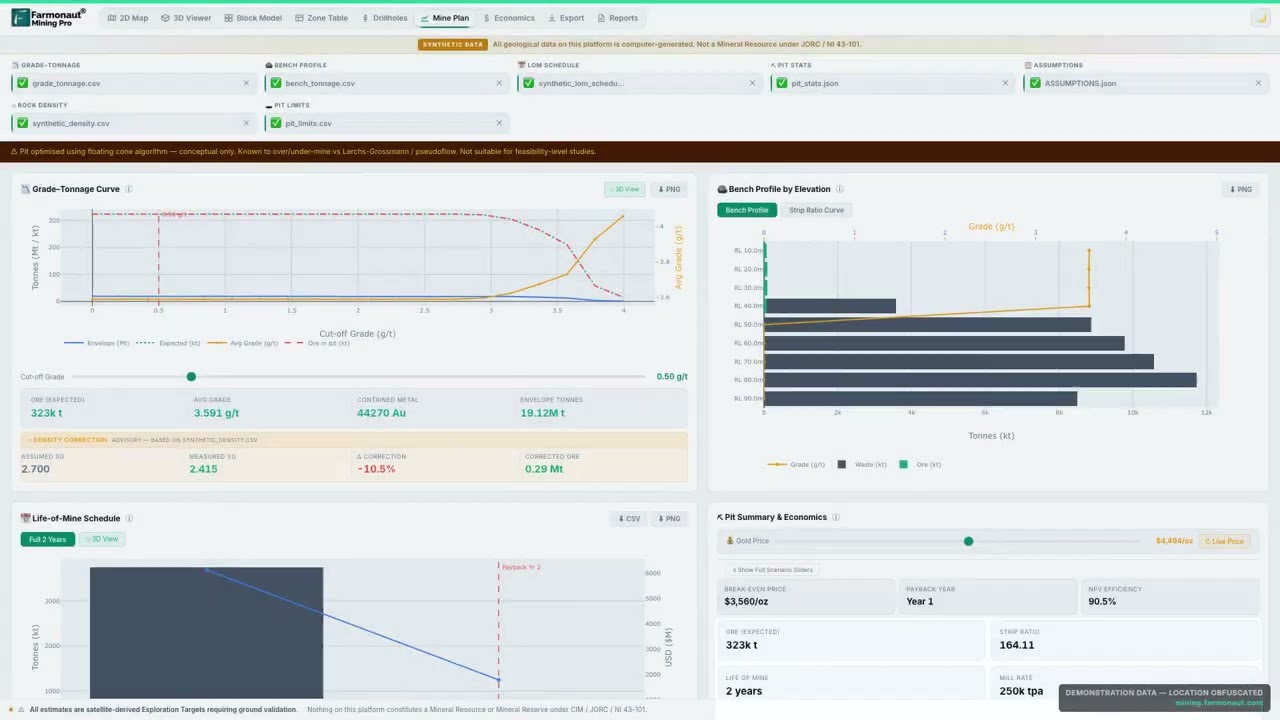
▶ Farmonaut course chapter on building a full cost picture, break-even price, NPV and payback. · 14:58
Screening a licence area before you spend on drilling
Exploration is the first cost line, and it is the one an owner can reduce with better targeting. Bauxite caps are wide surface features, so satellite data can show plateaus, vegetation and surface cover over a whole licence before any rig is booked. Farmonaut maps a licence boundary from satellite data and returns exploration targets, which are areas to test with drilling, not a resource estimate. If you want a quote for your own area, use the mining quote form or read about satellite-based mineral detection, or contact the team.
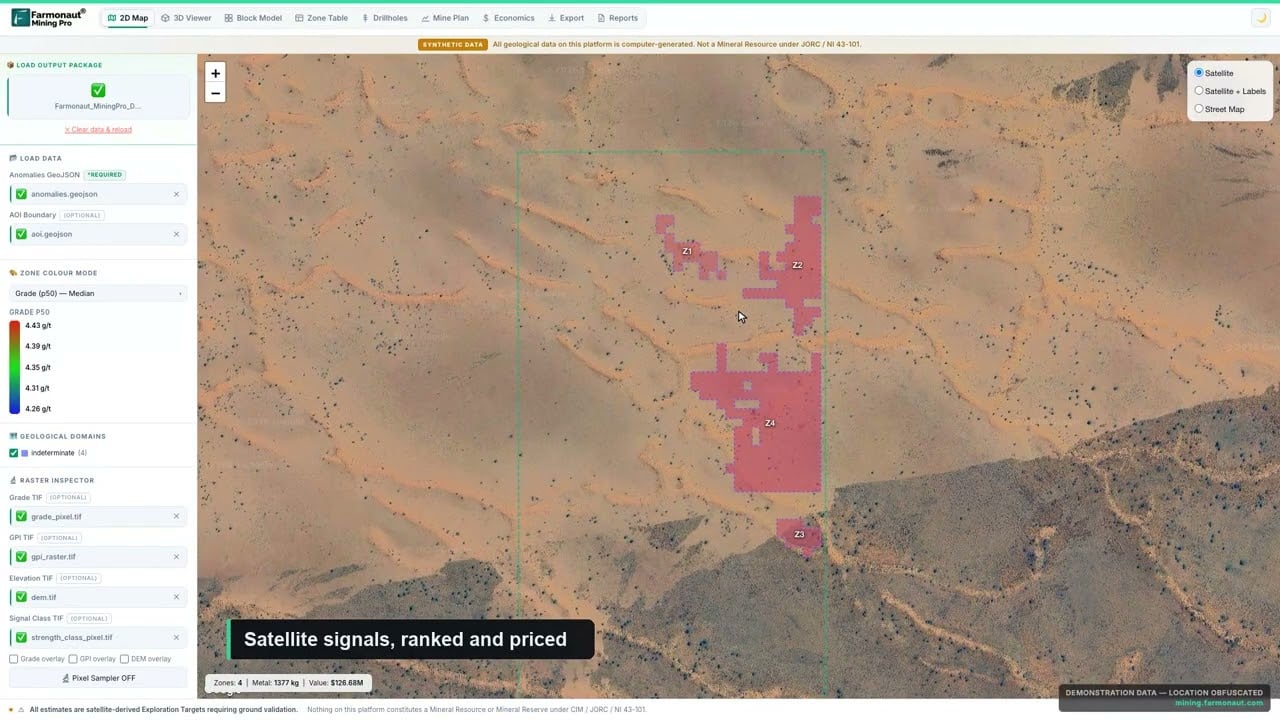
▶ Farmonaut video: what Mining Pro does with a licence boundary. · 4:56
What to check before funding or buying a bauxite project
- Cost basis. Is the figure operating cost at the mine gate, FOB, or delivered? A study that quotes US$11 and a market report that quotes above US$35 are not describing the same thing.
- Date and currency. Check the year, the currency and whether the numbers are in US dollars, Australian dollars or another currency.
- Infrastructure ownership. Does the project own its rail and port, share them, or pay tolls? Tolls become a per-tonne cost for life.
- Ore quality. Ask for the aluminium and silica grade and how much it varies. Refineries pay for consistency.
- Policy risk. Export limits, local-processing rules and royalty changes can alter returns after you invest.
- Standard of the resource estimate. Confirm the resource is reported under a recognized code by a qualified person.
- Closure cost. Ask what the plan says about rehabilitation and whether it is funded.
The USGS shows what is at stake for importers: the US imported 3.0 million tons of bauxite in 2025 (estimate), with Jamaica supplying 60% of imports over 2021 to 2024, and net import reliance above 75%. Costs in the supplier countries therefore reach US buyers directly. For related pages, see our guides to bulk-mineral exploration and mineral resource estimation.
Frequently asked questions
How much does it cost to open a new bauxite mine?
There is no single figure. Two public examples bracket the range: Rio Tinto’s Amrun project was approved in 2015 at US$1.9 billion for a mine, port and infrastructure producing 22.8 million tonnes a year to start, and the 2012 Koumbia study in Guinea put mine, rail and port capital at US$812 million. A small direct-shipping mine near an existing port can cost much less, and a project with a refinery costs much more.
What is the production cost of bauxite per tonne?
Alcoa reported an average of US$17 per dry metric tonne of bauxite shipped in 2020. A 2012 feasibility study forecast around US$11 per tonne of operating cost for a Guinea project, and Mysteel said some Guinean mines had a full FOB cost above US$35 per dmt in August 2026. The numbers differ because the dates, places and cost bases differ.
How much does a bauxite manufacturing plant cost?
Bauxite is mined, not manufactured. The plant that turns bauxite into alumina is a Bayer refinery, and it is a separate and much larger investment than the mine. We found no public, dated capital figure we could verify for a new refinery, so we do not quote one. Use a feasibility study or an engineer’s quote for the specific plant.
What is the biggest cost in a new bauxite mine?
For a project that ships ore overseas, infrastructure and freight are usually the largest items, because bauxite is a low-value bulk ore. In August 2026 freight on the Guinea to China route reached US$38 per tonne, which was more than half the price of Guinean ore that Mysteel quoted that month.
What is a dry metric tonne?
It is a tonne of ore with the water removed. Bauxite is priced per dry metric tonne (dmt) because wet ore weighs more but carries the same alumina. A wet metric tonne (wmt) includes moisture.
How is bauxite priced?
Buyers price bauxite by its aluminium and silica content. Mysteel’s assessment on 12 August 2026 was US$71 per dmt for Guinean ore (Al 45%, Si 3%) and US$66.5 per dmt for Australian ore (Al 50%, Si 6.5%). The USGS average import value for the US was US$32 per metric ton in 2025 (estimate).
What royalty does a bauxite mine pay?
It depends on the jurisdiction. In Queensland, Australia, bauxite mined for consumption outside the state pays (rate checked 15 October 2026) the higher of 10% of its value or A$2.00 per tonne. Check the regulator for the place you are working.
Does the US have bauxite mines?
The USGS reports that a limited amount of bauxite and bauxitic clay was produced for non-metallurgical use in Alabama, Arkansas and Georgia in 2025, and that mine output figures are withheld to protect company data. The country relies on imports for more than 75% of its bauxite.
What is red mud and why does it add cost?
Red mud is the alkaline residue left after the Bayer process. The International Aluminium Institute gives a typical average of 1.23 tonnes of residue per tonne of alumina. It must be stored in stable facilities and later rehabilitated, which is a long-term cost for refinery owners.
How can I estimate my own project before hiring a consultant?
Use the six steps above and the calculator on this page with quotes for each cost line. The result is a screening estimate that helps you decide whether a full study is worth paying for. It is not a feasibility study.
This page is for information only. It is not investment advice. Costs and royalty rules change; confirm them with the regulator and a qualified engineer before you commit capital.
Farmonaut mining
Get a quote to map your licence area from space
Send your licence boundary and get a quote for a satellite screening of the area before you plan drilling.
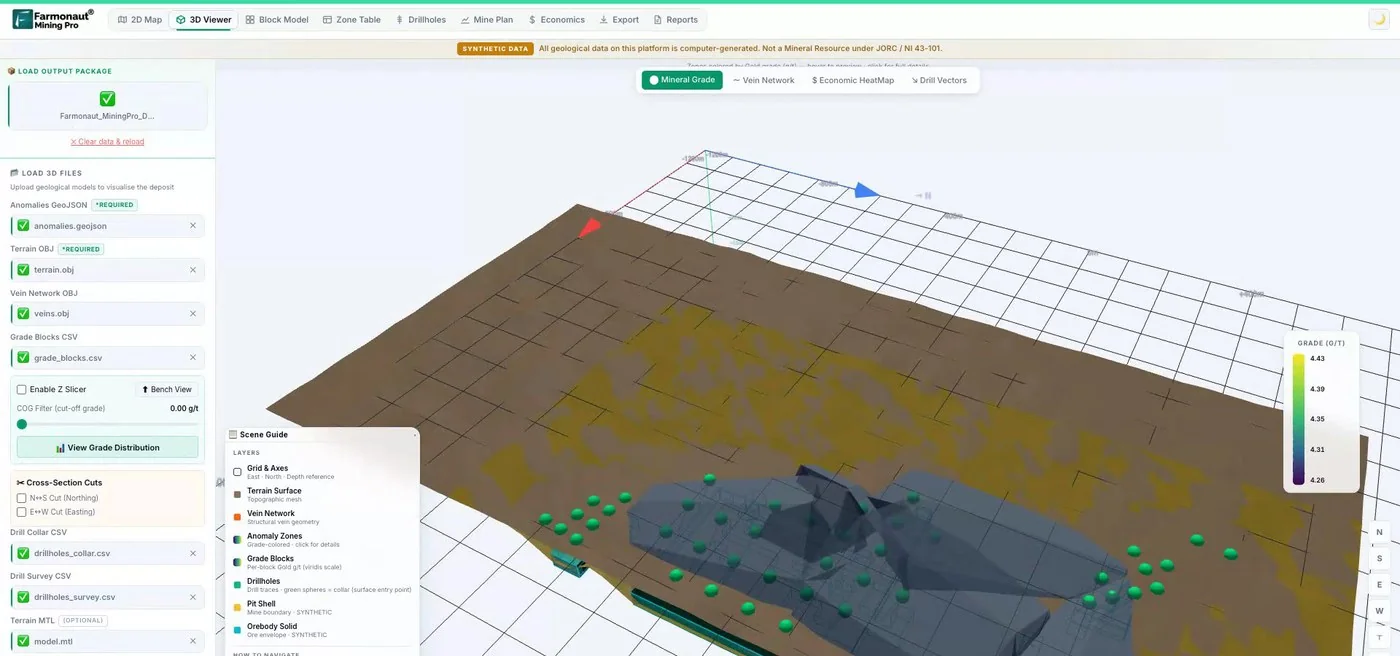
Mining Pro sample view, synthetic data
Keep reading
Sources
- USGS, Mineral Commodity Summaries 2026: Bauxite and alumina: pubs.usgs.gov
- USGS, Mineral Commodity Summaries 2026: Aluminum: pubs.usgs.gov
- Alcoa Corporation, Form 10-K for fiscal 2020 (SEC): sec.gov
- AL Circle / Mysteel, Seaborne bauxite prices rise further on elevated costs (13 Aug 2026): alcircle.com
- AL Circle, AMC puts US$812m price tag on bauxite mine in Guinea (27 Nov 2012): alcircle.com
- Reuters via Yahoo News, Rio Tinto to go ahead with $1.9 billion bauxite expansion (2015): au.news.yahoo.com
- Queensland Revenue Office, Mineral royalty rates: bauxite: qro.qld.gov.au
- International Aluminium Institute, Sustainable Bauxite Residue Management Guidance (2022): international-aluminium.org
- USGS Bulletin 1693, Descriptive model of laterite-type bauxite (Model 38b): pubs.usgs.gov
- USGS Bulletin 1693, Descriptive model of karst-type bauxite (Model 38c): pubs.usgs.gov
Discussion
Questions, corrections or field experience? Share them below. First-time comments are reviewed before they appear, and your email is never published.
No comments yet. Be the first to add a question or your experience.

 GKY Mining
 Alkimy SARL
 Double A Trading
 GemSprout Metals Limited
 Qader Group
 Ileys General Trading
 SG Gold Mining LLC
 VRV Global Pte Ltd
 Omsri International FZE
 G.I.T.T.
 Jaunita Erss Ltd
 Almosi SARL
 SRK Consulting
 Berks Gold Limited
 Mwerezi Minerals Company Limited
 Mining SARL
 SenGold Invest SAS
 Sean Mining Limited
 NTS Group (Pty) Ltd










