

Autonomous haulage · Supplier comparison
Autonomous Mining Transport: Top Solutions Compared
For large surface mines, Komatsu FrontRunner and Cat Command for hauling have the longest records. Underground, compare Sandvik AutoMine and Epiroc. GlobalData tracked 5,684 autonomous-capable trucks in July 2026.
Key takeaways
- GlobalData tracked 5,684 autonomous haul trucks on surface mines in July 2026, including autonomy-ready units; 3,843 were in China.
- Komatsu reported 1,000 ultra-class autonomous trucks and over 11.5 billion tonnes moved (April 2026).
- Caterpillar reported over 13 billion tonnes and 455 million km (September 2026).
- Published gains such as Rio Tinto’s 15% lower unit costs (2017) and Fortescue’s 30% productivity gain (2019) are company figures from large sites.
- Payback depends on your labour, quotes and mine life, so test your own numbers.
In this article
- The Short Answer: What Counts as an Effective Autonomous Mining Solution
- The Market: Truck Counts and Dollar Estimates
- Autonomous Mining Vehicles: What They Are and How They Differ
- Autonomous Mining Transport: Haulage, Not Just Trucks
- Provider Comparison: Who Actually Ships Working Systems
- Calculator: Estimate Your Fleet's Autonomy Payback Window
- Safety and Predictive Maintenance: Why Adoption Keeps Climbing
- Best Autonomous Mining Solutions for Quarries and Mixed Fleets
- Where Farmonaut Fits: Satellite Targeting Before Vehicles Ever Move
- A Durable Checklist: How to Test Any Supplier Claim
- FAQs on Driverless Haulage
- Useful Links and Resources
Autonomous mining transport means moving ore and waste between pit, crusher and stockpile with no driver in the cab. For large surface mines, the solutions with the longest record are Komatsu FrontRunner and Cat MineStar Command for hauling. Komatsu reported its 1,000th ultra-class autonomous truck in April 2026, and Caterpillar reported more than 13 billion tonnes hauled by September 2026. Underground, Sandvik AutoMine and Epiroc Deep Automation are the main names, and Chinese suppliers now lead the truck count.
The best choice depends on your truck class, your fleet mix, your mine life and how much of the change your site can absorb. This guide compares the suppliers on published evidence, gives the questions to put to each one, and includes a payback calculator you can fill in with your own numbers. For a wider view of automation across a mine site, see this guide to automated mining.
The Short Answer: What Counts as an Effective Autonomous Mining Solution
An effective autonomous haulage system (AHS) does three things. It runs the full load, haul and dump cycle with no onboard driver. It has been proven on sites like yours, at a scale you can check. And it connects to your fleet management, mine plan and maintenance systems, so the trucks follow what is really happening in the pit.
Three kinds of machine often get mixed together in searches:
- Fully autonomous haul trucks and underground loaders: no driver on board across the working cycle, with remote supervision. This is the most mature group for moving material.
- Semi-autonomous machines: part of the cycle is automated, such as the drilling sequence on a rig, while a person still sets up or supervises each step closely.
- Remote-operated machines: a person still makes the driving decisions, from a control room. This can be a useful bridge, but it is not autonomy.
When a supplier says “autonomous”, ask which of the three it means, and on which machine model.
The Market: Truck Counts and Dollar Estimates
The most useful count is trucks, not dollars. GlobalData was tracking 5,684 autonomous haul trucks on surface mines as of July 2026. That figure includes trucks that are autonomy-ready as well as those running autonomously, so the number actually driving themselves is lower. China has 3,843 of them, followed by Australia, Canada and Chile.
Chart
Report sellers do not agree on market size
US$ billion, base year to end year; scopes differ
Chart
Where autonomous haul trucks are
Trucks on surface mines tracked, July 2026, including autonomy-ready units
GlobalData ranks Tonly first among truck makers, then LGMG, Komatsu, Caterpillar, XCMG and Yutong. Together those six account for over 90% of the known brands it tracks. This matters for anyone reading older Western coverage, which often presents autonomous haulage as a two-supplier market.
Dollar estimates come from report sellers, and each one measures something different. Market.us puts the global autonomous mining equipment market at US$3.7 billion in 2024, rising to US$9.5 billion by 2034. Verified Market Research gives US$4.08 billion in 2025 and US$7.8 billion by 2033 in its main text, though its own FAQ dates the same figures 2024 and 2032. For the US alone, Sky Market Insights projects US$1,351 million in 2026 and US$2,723 million by 2034, and that wider scope includes drilling, crushing and software. It attributes only about a quarter of the 2026 figure, US$338.5 million, to autonomous haul trucks.
Use these as rough direction for the autonomous mining truck market, not as inputs to a business case. For scale, the US produced an estimated US$112 billion of nonfuel minerals in 2025, according to USGS Mineral Commodity Summaries 2026, including US$38.1 billion of metals, according to the USGS review published by SME.
Autonomous Mining Vehicles: What They Are and How They Differ
Several vehicle types are used within autonomous mining, and they do different jobs:
- Ultra-class haul trucks: the surface mine workhorses. Komatsu’s 930E-5AT, for example, carries a 290-tonne payload, and Komatsu says the 930E accounts for more than 500 of its autonomous trucks.
- Quarry-size trucks: smaller machines for aggregates. Luck Stone runs autonomous Cat 777 trucks at Bull Run in Virginia, and Cat 775 trucks are next.
- Underground loaders (LHDs): load-haul-dump machines that carry broken rock from the stope, the underground working area, to a truck or ore pass. These run in narrow tunnels, where satellite positioning does not work.
- Underground trucks: these carry rock up ramps and, increasingly, onto the surface.
- Support vehicles: Komatsu also offers autonomous water trucks, which reduce manual interaction with the fleet and support road maintenance.
Most systems combine positioning, mapped routes and obstacle detection using sensors such as LiDAR (laser ranging), radar and cameras. The hardware matters, but it is often the software that decides results: how trucks are assigned, how the system handles a blocked road, and how fast the map updates after a blast. Ask to see those functions working on a live site.
▶ What AI does in mining: finding places to look, planning the mine and running it · 3:52
Autonomous Mining Transport: Haulage, Not Just Trucks
Haulage is repetitive and high in volume, which makes it a natural job to automate. A transport solution has more layers than the truck itself, and a proper evaluation should separate them:
- Vehicle kit: the sensors, computers and drive controls on each truck, factory-fitted or added later.
- Fleet control: the central system that gives trucks their routes and reports on them.
- Loading and traffic tools: machine guidance for shovels and loaders, and rules for how manned vehicles enter autonomous areas.
- Communications: the site wireless network, which needs coverage across a pit that changes shape.
- People: controllers, maintenance staff and road crews, whose work changes more than the trucks do.
Fortescue shows how far this can extend. According to International Mining (March 2026), it renewed its Command for hauling agreement for Cloudbreak, Christmas Creek and Solomon, and manages the trucks from its Hive centre in Perth. Its own HaulX platform will ultimately combine AHS with fleet management, collision avoidance and machine guidance.
Provider Comparison: Who Actually Ships Working Systems
These are the top providers of autonomous mining solutions that a Western or African mine is likely to shortlist, plus the Chinese suppliers that lead the truck count.
Chart
Autonomous tonnes reported
Billion tonnes, cumulative, company-reported at different dates
How we chose
We included suppliers with a named autonomous product and a published deployment or validation. The figures are the suppliers’ own, reported at different dates. They are not audited or like for like, so this is a comparison and not a ranking.
| Provider | System | Best for | Published evidence | Limits to check |
|---|---|---|---|---|
| Komatsu | FrontRunner | Large surface mines, ultra-class electric drive trucks | 1,000 ultra-class trucks commissioned, over 11.5 billion tonnes moved (April 2026) | Fit with non-Komatsu trucks and your fleet software |
| Caterpillar | MineStar Command for hauling | Large surface mines and, now, quarries | Over 13 billion tonnes and 455 million km (September 2026) | Current truck count; dealer support near your site |
| Sandvik | AutoMine | Underground loaders and trucks | Codelco planned over 40 autonomous machines at El Teniente (2023); Kamoa-Kakula adding units (2026) | Tunnel layout and how areas are isolated from people |
| Epiroc | Deep Automation | Underground trucks that also travel on surface | Underground-to-surface demonstration in June 2026 | Demonstration versus production status on your model |
| Liebherr | Autonomous Haulage Solution | Buyers who want an open architecture | Four T 264 trucks began validation in Western Australia in 2023 | Number of production sites to date |
| Tonly, LGMG, XCMG, Yutong | Various | Sites buying from Chinese makers | Top places in GlobalData’s brand ranking (July 2026) | Local support, parts and approvals outside China |
Komatsu FrontRunner
Best for: large surface mines. Komatsu says it was first to market with a commercial system in 2008. Its 1,000th ultra-class truck went to Nevada Gold Mines, and it reports deployments in North America, South America, Australia and Europe. Strength: long history at scale, including 300 trucks at Rio Tinto’s Australian sites by August 2024. Watch: the 1,000 count covers ultra-class trucks, so ask what is available for smaller classes.
Cat MineStar Command for hauling
Best for: Cat fleets, from large mines to quarries. Caterpillar launched it commercially in 2013, and reported 276 trucks in operation in 2020. Its most recent release gives tonnes and distance rather than a truck count. Strength: the range now reaches quarry trucks, and Fortescue renewed after more than a decade of use. Watch: ask for the current number of trucks and sites in writing.
Sandvik AutoMine
Best for: underground loading and hauling. At El Teniente in Chile, a contract running from 2023 through 2027 starts with a first phase covering six Toro LH514 loaders and a fleet system for up to 13 machines, and Codelco was due to run over 40 autonomous Sandvik trucks and loaders on full implementation, according to the 2023 report at full implementation. In the DRC, Kamoa Copper has ordered more AutoMine units. Strength: named underground sites you can call. Watch: the Lite version and the full fleet version are not the same product, so compare like with like.
Epiroc Deep Automation
Best for: underground mines that truck to surface. In September 2026 Epiroc said its underground trucks can also work on surface using 3D LiDAR, after a June demonstration with a battery-electric truck. Strength: one system for the whole trip. Watch: this is a recent capability, so ask for production references.
Liebherr Autonomous Haulage Solution
Best for: buyers who want to pick their own automation and fleet software. Liebherr describes an open architecture, with options from autonomy-ready trucks to a full system. It is also working with Fortescue on autonomy for the T 264 battery-electric truck. Watch: it has a shorter public record than Komatsu or Caterpillar.
Chinese suppliers and others
Tonly, LGMG, XCMG and Yutong rank in GlobalData’s top six, mostly because of China’s large fleet. Market.us also lists Hitachi Construction Machinery, AB Volvo, BELAZ and Sany among companies active in this equipment market. Check each against the same questions, especially service coverage in your country.
Calculator: Estimate Your Fleet’s Autonomy Payback Window
Suppliers and miners publish utilisation and cost gains, but there is no standard payback figure, because labour rates, truck age and mine life vary so much. A simple payback sum is still a good first filter. Enter your own quotes and costs below. If the answer is longer than the remaining mine life, or close to it, the case needs much closer study.
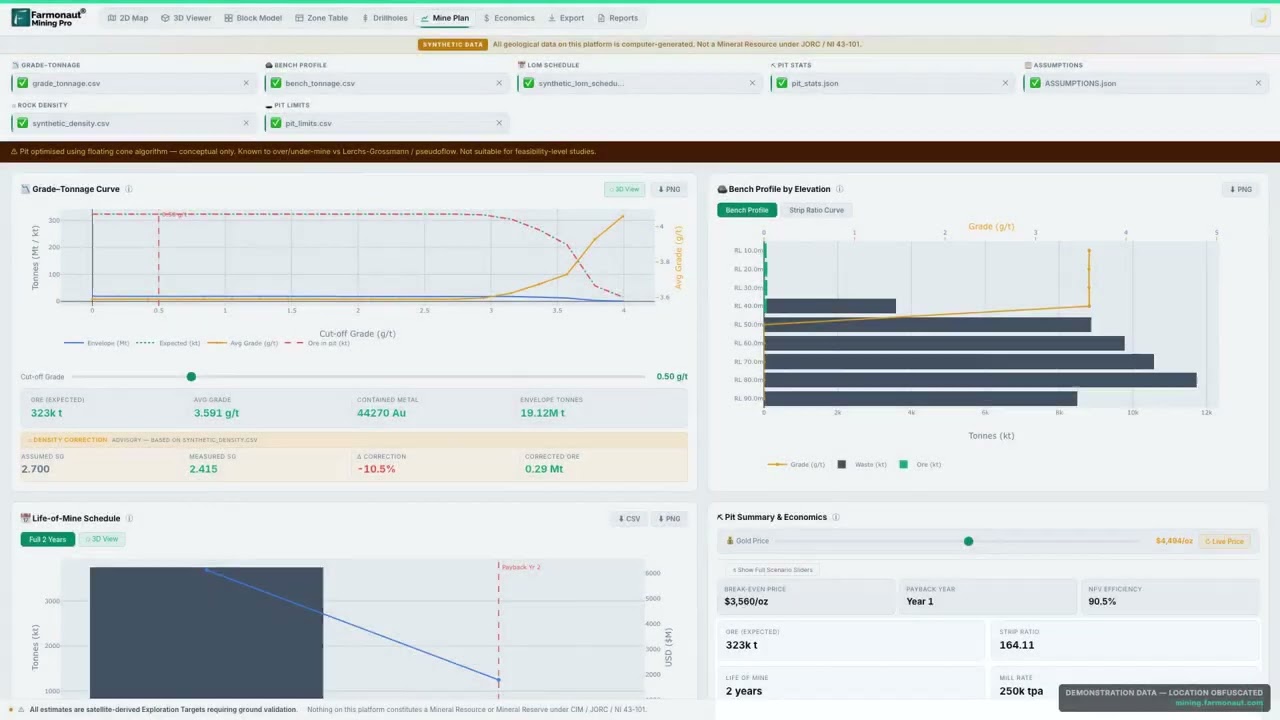
▶ How mine costs, break-even price and payback are built on a consistent basis · 14:58
Labour is often the largest line, so be honest about it. Some roles move to control rooms and maintenance rather than going away, which is why the calculator has an input for roles kept. The gains in the next section are also site results, so use your own estimate for extra output.
Calculator
How long could autonomy take to pay back on your fleet?
Enter your own fleet, quotes and labour costs.
- Upfront cost (US$): $15,000,000
- Net yearly benefit (US$): $7,220,000
All values are examples, not benchmarks or supplier prices; use your own quotes. Simple payback: no financing, residual value, ramp-up or lost output during the change. Money is in US$. If net yearly benefit is zero or negative, the project does not pay back, and the years shown mean nothing.
Safety and Predictive Maintenance: Why Adoption Keeps Climbing
The safety case is simple: fewer people sit in trucks or walk near them on haul roads. The published records are strong but self-reported. Caterpillar reports over 455 million km with no reported injuries while operating (September 2026). In 2018 Rio Tinto said there had been zero injuries attributed to its autonomous trucks since trials began in 2008.
Productivity results are also site-specific. Rio Tinto reported about 700 more operating hours and 15% lower unit costs in 2017. Komatsu in 2024 cited a 15% improvement in effective utilisation at Rio Tinto sites. Fortescue reported a 30% productivity improvement at its site in 2019. These are company numbers from large iron ore operations with many trucks, so treat them as what is possible, not as what your site will get. A small gold pit with a short mine life may see something very different.
In the US, the rules still apply to these fleets. MSHA’s final rule requires mine operators to keep written safety programs for surface mobile equipment, with input from miners and their representatives. Your autonomy plan should feed into that program. To check a site’s record, use the MSHA Mine Data Retrieval System, which you can search by mine.
Predictive maintenance is a related benefit. Autonomous trucks carry a lot of sensors, and operating data can flag wear before a failure. Ask how alerts reach your maintenance planners, who owns the data, and what uptime baseline any quoted improvement used. The wider trends are covered in our guide to technological innovations in mining, and in how automated mines use smart systems.
Best Autonomous Mining Solutions for Quarries and Mixed Fleets
Quarries were long left out, because most systems were built for much larger trucks. That is changing. Luck Stone’s Bull Run quarry has hauled more than 3.5 million tons autonomously since November 2024. The company is now expanding to its Boscobel and Bealeton sites in Virginia, and it will be the first time Caterpillar has deployed its system on the Cat 775.
For a quarry, the numbers can be tight because the fleet is small. A central control room and a site network must be paid for by fewer trucks. Get a quote for the whole site, and test it in the calculator.
Integration with existing equipment is the common question for a mixed fleet. Ask these before you shortlist:
- Which of my truck models and ages are supported, and which need replacing?
- Does the system work with my current fleet management and mine planning software, and through which published interfaces?
- How do my shovels, graders, water trucks and light vehicles work alongside it?
- Can I run manned and autonomous trucks together during the change, and on which roads?
Underground operations should also compare their wider equipment plan with this guide to the underground mining equipment market.
Where Farmonaut Fits: Satellite Targeting Before Vehicles Ever Move
Farmonaut does not build vehicles. Its satellite-based mineral detection sits much earlier in a project, using multispectral and hyperspectral imagery to flag exploration targets before drilling. Results are exploration targets ahead of a resource estimate. They do not replace one, and they do not size a fleet.
▶ Remote sensing for mining explained in plain words · 2:01
A Durable Checklist: How to Test Any Supplier Claim
This is what mining companies should compare when choosing autonomous haulage, and the questions to ask before choosing a supplier for driverless trucks:
Infographic
Moving to autonomous haulage in 5 steps
- 1ScreenCheck mine life, truck class and fleet size.
- 2CompareAsk suppliers the same dated questions.
- 3ModelPrice the whole system and the people plan.
- 4TrialTest one area on matched routes and shifts.
- 5ScaleExpand once results hold on your site.
- Get a dated count. Ask for trucks commissioned and trucks running today, with a site list. Check whether the number includes autonomy-ready machines.
- Ask for a similar site. Match the commodity, truck class, climate, road grades and pit size, then call that site.
- Check the market scope. A dollar figure means little until you know whether it is global or one country, and whether it counts only trucks.
- Ask how a result was measured. Get the baseline, period, route and shift pattern behind any productivity, fuel or tyre claim.
- Pull site safety records. For US mines, check MSHA data by mine, not a supplier’s summary.
- Price the whole system. Include vehicle kits, network, control room, road upgrades, training, licences and lost output during the change.
- Plan the people. Set out which roles change and how you will train controllers, technicians and road crews.
- Agree the exit. Ask who owns the data, and what happens if you change suppliers or the mine closes early.
A short trial on a limited area can test many of these claims, as long as the trial uses the same route, load and shift length for manned and autonomous trucks.
FAQs on Driverless Haulage
What are the most effective autonomous haulage solutions available?
For large surface mines, Komatsu FrontRunner and Cat Command for hauling have the longest published records. For underground work, look at Sandvik AutoMine and Epiroc Deep Automation. The best fit depends on your trucks and site.
Who offers autonomous mining solutions?
Komatsu, Caterpillar, Sandvik, Epiroc and Liebherr all have named products. GlobalData’s top truck brands also include Tonly, LGMG, XCMG and Yutong.
How many autonomous haul trucks are there?
GlobalData tracked 5,684 on surface mines as of July 2026, including autonomy-ready trucks. China had 3,843.
What vehicles are used within autonomous mining?
Haul trucks, underground loaders and trucks, drill rigs and some support vehicles such as water trucks.
What is the difference between autonomous mining vehicles and autonomous mining transport?
Vehicles is the wider group, including drills and support machines. Transport refers to the haulage job: moving ore and waste between pit, crusher and stockpile.
What is the average payback period for autonomous transport investments in the mining sector?
There is no standard published average, because costs and labour rates vary widely by site. Use your own quotes in the calculator above, then test the result with a full site model.
What are the best autonomous mining solutions for quarries?
The clearest public example is Cat Command for hauling on Cat 777 trucks at Luck Stone’s Bull Run quarry, with Cat 775 trucks to follow. Small fleets should check the fixed site costs closely.
Which autonomous mining solutions integrate best with existing equipment?
No independent test settles this. Liebherr promotes an open architecture, but you should ask every supplier to show its interfaces working with your own trucks and fleet software.
How big is the autonomous mining truck market?
Report sellers put all autonomous mining equipment at about US$3.7 billion in 2024 (Market.us) and US$4.1 billion in 2025 (Verified Market Research). Sky Market Insights puts US autonomous haul trucks at US$338.5 million in 2026.
Do autonomous trucks make mines safer?
Caterpillar and Rio Tinto both report no injuries attributed to autonomous trucks in the periods they cite. Those are company figures, so check site records as well.
Useful Links and Resources
- Satellite-based mineral detection for early exploration targets
- Get a quote for an assessment of your own area
- Contact the Farmonaut team
This page is for information only. It is not investment or legal advice. Confirm safety rules with the regulator. Supplier and operator figures are self-reported; confirm them directly before you decide anything.
Farmonaut mining
Map your mining site from space
Consultants can see how satellite data screens a licence area for exploration targets, ahead of a resource estimate.

Mining Pro sample view, synthetic data
Keep reading
Sources
- Komatsu, 1,000 ultra-class autonomous haul trucks (April 2026): komatsu.com
- International Mining, Komatsu commissions 1,000 trucks (April 2026): im-mining.com
- GlobalData, Development of Autonomous Trucks in the Global Mining Sector (2026): globaldata.com
- Global Mining Review, Luck Stone and Caterpillar (September 2026): globalminingreview.com
- International Mining, Caterpillar and Fortescue agreement (March 2026): im-mining.com
- MINING.COM, Fortescue one billion tonnes (2019): mining.com
- MINING.COM, Rio Tinto autonomous trucks (2018): mining.com
- AlCircle, Rio Tinto 300th Komatsu truck (2024): alcircle.com
- KHL, Caterpillar autonomous hauling milestone (2020): khl.com
- Liebherr, onsite validation of Autonomous Haulage Solution (2023): liebherr.com
- International Mining, Epiroc surface operation (September 2026): im-mining.com
- Mining Technology, Sandvik automation at El Teniente: mining-technology.com
- Mining Technology, Sandvik order for Kamoa Copper (2026): mining-technology.com
- MSHA, Final Rule: Safety Program for Surface Mobile Equipment: msha.gov
- MSHA, Mine Data Retrieval System: msha.gov
- Market.us, Autonomous Mining Equipment Market: market.us
- Verified Market Research, Autonomous Mining Equipment Market: verifiedmarketresearch.com
- Sky Market Insights, US Automated Mining Equipment Market: skymarketinsights.com
- SME Mining Engineering, USGS 2025 mining review: me.smenet.org
- USGS, Mineral Commodity Summaries 2026: pubs.usgs.gov
- autonomous Cat 777 trucks at Bull Run in Virginia: globalminingreview.com
- 3.5 million tons autonomously since November 2024: skillings.net
Discussion
Questions, corrections or field experience? Share them below. First-time comments are reviewed before they appear, and your email is never published.
No comments yet. Be the first to add a question or your experience.

 G.I.T.T.
 Jaunita Erss Ltd
 Almosi SARL
 SRK Consulting
 Berks Gold Limited
 Mwerezi Minerals Company Limited
 Mining SARL
 SenGold Invest SAS
 Sean Mining Limited
 NTS Group (Pty) Ltd
 Mine4Africa
 Lithspo Minerals Limited
 Tintina Mining Group
 Dalgety Minerals Pty Ltd
 Vortex Minerals Pty Ltd

 Licence holder · Nigeria · Gold + lithium










