

Herbicides · Field guide
What Is 2,4-D Used For? Uses, Risks and Safe Spraying
This selective herbicide kills broadleaf weeds in cereals, corn, pasture, turf and rights-of-way while leaving most grasses alive. EPA says it has been in use since the 1940s; drift is a major risk.
Key takeaways
- Often searched as chemical D, 2,4-D removes broadleaf weeds and has little effect on most grasses (NPIC).
- More than a thousand US products contain it, in acid, salt and ester forms that behave differently (NPIC).
- Grapes have shown symptoms at 1/800th of the labeled rate (Ohio State), which makes drift a major financial risk.
- Half of it is usually gone from soil in 1-14 days, but it lasts far longer in low-oxygen water (NPIC).
- IARC classes it as possibly carcinogenic (Group 2B, 2015); EPA says it is not Agent Orange.
In this article
- What is 2,4-D used for?
- How much is used in the US
- How it kills broadleaf weeds
- Amine, ester or choline: which form?
- How to work out your spray rate
- Drift: the costliest risk
- Is 2,4-D safe for people, pets and water?
- How long it lasts in soil and water
- Weed resistance and Group 4 herbicides
- Before you spray: a pre-application check
- Frequently asked questions
2,4-D (chemical D) is a selective herbicide used to kill broadleaf weeds in cereal crops, corn, pastures, lawns, roadsides, forestry sites and some waters, while leaving most grasses alive. If you searched for “24D”, this is almost certainly the product you mean. Its full name is 2,4-dichlorophenoxyacetic acid, and the US EPA says it has been used as a pesticide since the 1940s.
This guide is for growers, ranchers and the agronomists who advise them. It covers where 2,4-D fits, how the product forms differ, why drift is the main business risk, and what the health evidence says. A calculator turns your label rate into product, tank loads and cost.
What is 2,4-D used for?
The job is the same almost everywhere: remove broadleaf plants from a stand of grass or a grass crop. The National Pesticide Information Center (NPIC) says more than a thousand US products contain it, often mixed with other herbicides. It lists farms, home lawns, roadsides, industrial areas and pastures as places these products may be used. EPA adds rights-of-way, aquatic sites, forestry sites, and field, fruit and vegetable crops. It also notes one use that is not weed control: regulating the growth of citrus plants.
| Setting | What 2,4-D does there | What to check first |
|---|---|---|
| Corn, small grains, sorghum, rice, sugarcane | Removes broadleaf weeds competing with the crop | Crop growth stage allowed on the label |
| Hay fields and pastures | Takes out broadleaf weeds in grass stands | Any legumes you want to keep, and grazing or haying intervals |
| Before planting (burndown) | Clears existing broadleaf weeds ahead of the crop | Interval before planting a sensitive crop |
| Enlist corn, cotton and soybean | Over-the-top weed control in tolerant varieties | Only products labeled for that use are legal |
| Lawns and turf | Controls broadleaf weeds in grass | Keep people and pets off until leaves are dry |
| Roadsides, rights-of-way, industrial sites | Controls unwanted broadleaf vegetation | Neighboring gardens, orchards and vineyards |
| Forestry sites | Controls competing broadleaf vegetation | Tree species and the site listing on the label |
| Lakes and canals | Controls plants such as water hyacinth and water milfoil | Aquatic label, permits and swimming restrictions |
Timing matters as much as place. Ohio State and Purdue specialists describe it as a post-emergence herbicide, meaning it is sprayed on weeds that have already come up. It is not a tool for weed seeds that have yet to sprout. Ohio State’s soybean guide also suggests fall mixtures containing this herbicide for marestail, winter annuals, dandelion and other perennial weeds in no-till, non-GMO soybean ground.
The Florida water use has its own long history. The University of Florida records it first being applied in Florida waters in 1959 against water hyacinth, and calls it the oldest organic herbicide registered in the US.
How much is used in the US
The newest national breakdown from EPA’s sales and usage report covers 2012. In that year it ranked fifth among conventional active ingredients on farms, first in homes and gardens, and third in the industrial, commercial and government sector. The ranges are in millions of pounds of active ingredient. Farm use had risen from 21-31 million pounds in 2005 to 30-40 million pounds in 2012.
Chart
US 2,4-D use by market sector
Million pounds of active ingredient, midpoint of EPA’s range, 2012
These figures predate the Enlist crops, so treat them as a picture of the older market. Ohio State notes that tolerant soybeans have since raised use during May, June and July, which is when vulnerable neighboring crops are in leaf.
How it kills broadleaf weeds
The product belongs to the auxin mimics. Auxins are natural plant hormones that control growth. NPIC explains that the herbicide makes the cells in the tissues carrying water and nutrients divide and grow without stopping. Weed scientists class it as Group 4 in the WSSA resistance management system, which is the number to look for when rotating products.
It is systemic, so it moves inside the plant after uptake. That is why treated weeds twist rather than simply burn. Typical signs are cupped or narrowed leaves, bent stems and stunted growth. Mississippi State Extension notes that tomato injury can range from mild crinkling to severe distortion of leaves and stems, and that the signs can look like cucumber mosaic virus. A lab or Extension check is worth it before you blame a neighbor.
Grasses tolerate it far better than broadleaf plants, but tolerance is not immunity. The label’s crop stage limits exist because a grass crop can still be injured if it is sprayed at the wrong time.

▶ Symptoms of herbicide injury in crops and how to tell them apart. · 17:24
Amine, ester or choline: which form?
The name on a label rarely means the plain acid, which dissolves poorly in water. NPIC’s technical fact sheet, an archived document, says the dimethylamine salt and 2-ethylhexyl ester account for about 90-95% of global use. The form changes how the product enters the plant, how readily it turns to vapor and what it does to fish.
| Form | Behavior | Main caution |
|---|---|---|
| Dimethylamine salt (amine) | Water-soluble; the salt forms are taken up by roots | Severe eye irritation; acid and salt forms carry this warning |
| 2-ethylhexyl ester and other esters | Penetrate leaves; some esters turn to vapor readily | Can be highly toxic to fish and other aquatic life |
| Choline salt (Enlist One, Enlist Duo) | Sold for use on tolerant corn, cotton and soybean | Approved nozzles, tank mixes and county limits apply |
| Granular butoxyethyl ester | Sinks and slowly releases herbicide in water | Aquatic use only under its label; can stay long in sediment |
The fish numbers show the gap. For the acid and amine salts, the concentration that kills half of test fish (LC50) ranges from above 80 to 2,244 mg acid equivalent per liter. For esters it ranges from under 1.0 to 14.5 mg, according to NPIC. A lower number means more toxic, so never choose an ester next to water without checking the label.
How to work out your spray rate
There is no single correct rate, and an old rate chart is a poor guide. Products differ in strength, and the label is a legal limit for that crop, weed size and region. As one reference point, a North Carolina study reported by Iowa State used 540 g per hectare as the label rate for this herbicide. That was its study figure, not a recommendation for your field.
Compare products by acid equivalent (ae), the amount of active acid regardless of the salt or ester attached. Two products with the same pints per acre can deliver different amounts of ae. Take the rate and ae figure from your label and enter them below.
Calculator
How much product does this job need?
Enter the rate and strength printed on your own label.
- Acid equivalent applied per acre (lb ae): 0.50
- Total spray volume (gal): 1,500
- Tank loads: 5.0
- Product cost (US$): $375
Example values only, not a recommendation or a benchmark. Your label sets the legal rate. Fixed constant: 8 pints per US gallon. The price is an input: use today’s price.
Drift: the costliest risk
For many users the largest financial risk is a neighbor’s crop rather than the weed they missed. Ohio State’s working group reports injury symptoms on grapes at 1/800th of the labeled rate, and on tomatoes, peppers and watermelon at 1/300th. Symptoms are not the same as yield loss: the same group says early-season damage can sometimes disappear within weeks, while other cases do cost yield.
Chart
Soybean sites with yield loss, by fraction of label rate
Number of locations out of four, North Carolina experiments
Soybean research shows dose and stage matter. In the North Carolina trials, it cut yield at one of four locations at 0.12X and at two of four at half the label rate, while dicamba cut yield at two locations at just 0.03X. In Indiana and Illinois, regression analysis predicted a 5% soybean yield loss at 87 g per hectare at the V5 growth stage, against 116 g at earlier or later stages, as Iowa State summarizes.
There are three ways the herbicide leaves the field:
- Droplets in wind. This is most drift, and it usually reaches only adjacent fields.
- Vapor. A spike in air temperature can turn these herbicides into gas even after they land on target.
- Temperature inversions. Cool air sits under warmer air, so fine droplets stay suspended. With a 2-3 mph breeze, Ohio State says drift in an inversion could move several miles overnight.
Calm is therefore not automatically safe. North Dakota State explains that inversions generally resist mixing when wind is under 4 to 5 mph, and they commonly form on calm, clear evenings. Ohio State adds that Midwestern summer inversions typically begin in late afternoon or evening and last until 1-2 hours after sunrise.
Enlist products carry the most explicit rules. EPA’s Enlist page lists these requirements: no aerial application, no ground spraying in winds over 15 mph, approved nozzles and tank mixes only, a 30-foot downwind in-field buffer, and no application when rain is expected within 48 hours or the soil is at field capacity. Other products have their own labels, so do not assume these numbers transfer.
Using the wrong product on a tolerant crop is also a legal problem. The Nebraska Department of Agriculture warned in its Winter 2022 newsletter that only Enlist One and Enlist Duo were registered for over-the-top use on tolerant soybean, and that using another product of this type there was illegal.
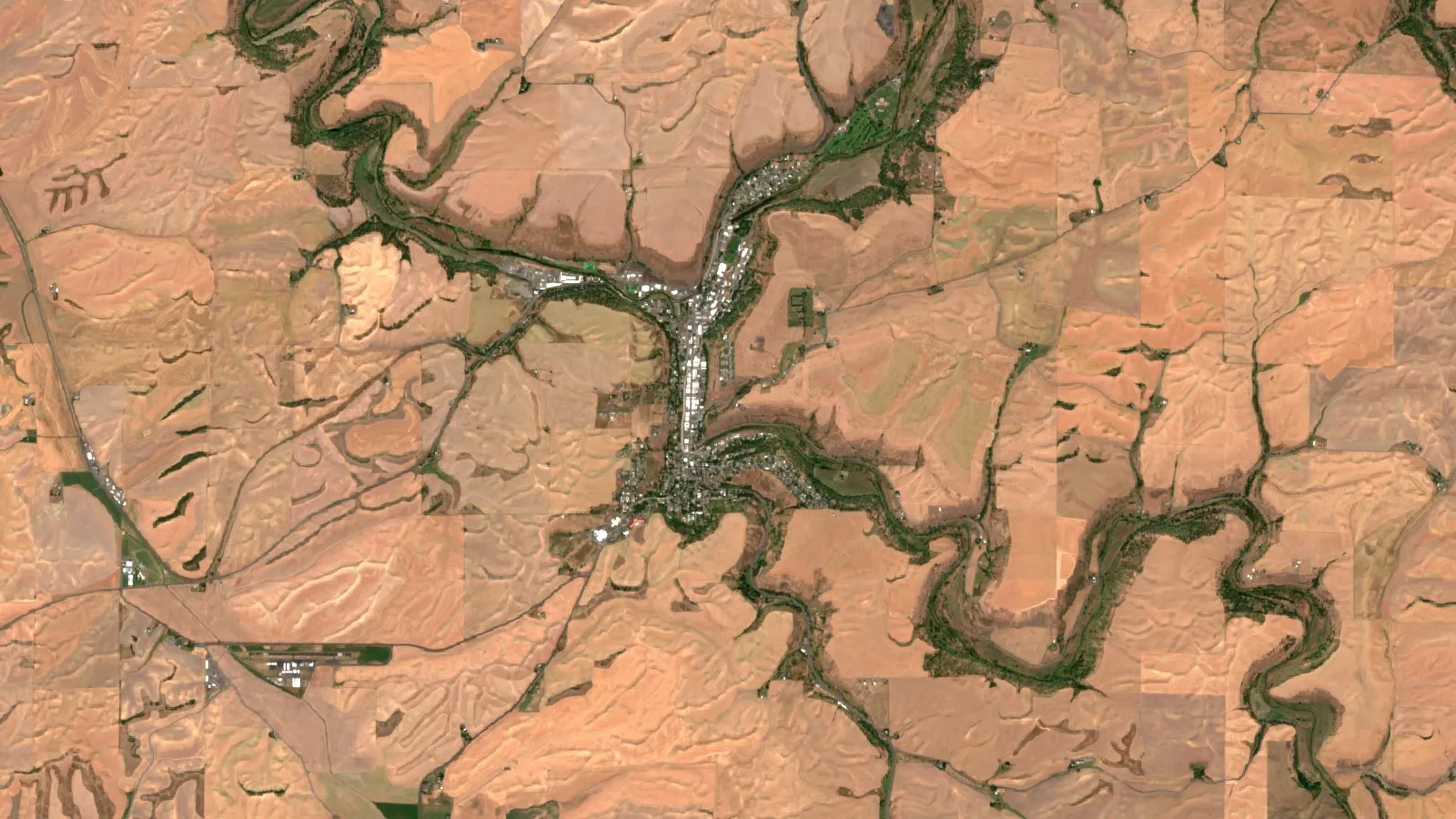
If you grow a sensitive crop, keep photos and dated records from the first sign of injury. Satellite imagery can help show where a field fell behind and when, but it cannot name the cause. Only a field visit and, where needed, a residue test can do that. Farmonaut’s satellite farm monitoring is one way to see those patches between scouting trips.
Is 2,4-D safe for people, pets and water?
Safety depends on the form, the dose and how you handle it. The main bodies do not use identical wording, so here is what each says.
- Acute toxicity: EPA says it generally has low toxicity for humans, except that certain acid and salt forms can irritate the eyes.
- Cancer: The International Agency for Research on Cancer classed it in 2015 as possibly carcinogenic to humans (Group 2B), based on inadequate evidence in humans and limited evidence in animals. NPIC says scientists have not found a clear link to cancer in people, and that some studies suggest a link to non-Hodgkin lymphoma while others do not.
- Pets: NPIC says dogs may be more sensitive than other animals. They can be exposed by touching wet grass and then grooming.
- Bees and birds: EPA calls it practically nontoxic to honeybees and moderately toxic to birds and mammals.
- Fish: EPA rates it slightly toxic to fish in general, while esters can be highly toxic.
- Water: NPIC reports low levels found in shallow groundwater and streams. Swimming is restricted for 24 hours after certain aquatic products are applied, according to EPA.
On the most common confusion, EPA states plainly that this herbicide is not Agent Orange. Agent Orange was a mixture of 2,4,5-T and this herbicide, and the 2,4,5-T contained high levels of dioxin. EPA canceled all 2,4,5-T uses in 1985 and says dioxins are no longer found at detectable levels in the products sold in the US.
For regulation, EPA comprehensively reviewed the ingredient in 2005 and says it is under registration review, its 15-year re-evaluation cycle (EPA page updated January 2026). Rules differ by country, so confirm that a product is registered where you farm.
Handling points that reduce exposure
- Wear exactly what the label’s personal protection section lists. Eye protection matters with acid and salt forms.
- Wash hands before you eat or smoke. NPIC names both as exposure routes.
- NPIC says sunscreen, insect repellent and drinking alcohol may increase skin absorption.
- Keep people and pets off treated plants until the leaves are dry.
- Clean the sprayer thoroughly, since Iowa State flags contaminated sprayers as an injury route for non-target crops.
- Store and dispose of containers and rinsate as the label and local rules require. For poisoning in the US, call Poison Control at 800-222-1222.
How long it lasts in soil and water
In most soils it breaks down quickly. NPIC reports half of the original amount is usually gone in 1-14 days, and bacteria are a main cause of the breakdown. A half-life of 6.2 days was estimated for aerobic mineral soils. Ohio State’s specialists say it and dicamba typically persist in soil for a month or less, so soil carryover is a smaller concern than drift on leaves.
Chart
Estimated 2,4-D half-life by setting
Days; the anaerobic bar is the low end of a 41-333 day range
Water with little oxygen is different. Laboratory half-lives run from 41 to 333 days in anaerobic aquatic conditions, and a granular butoxyethyl ester remained in sediment for 186 days after application. That gap is the reason water buffers and label setbacks deserve attention even though field persistence is short.
Weed resistance and Group 4 herbicides
Resistance to auxin mimics is real and has a long record. The International Herbicide-Resistant Weed Database lists more than 40 species resistant to this group, as read in November 2026. Entries include wild carrot (1957), kochia (1994), tall waterhemp (2009) and Palmer amaranth (2015). A listing covers the group, so it does not prove resistance to this exact ingredient in that population.
The stakes grew after glyphosate-resistant weeds spread and Enlist crops arrived. EPA now requires Enlist users to scout before application, to match herbicides and rates to the weeds and sizes present, and after application, to find escapes or shifts in species. Those two steps are good practice on any program.
- Rotate or combine effective sites of action, using the group number on the label.
- Spray weeds at the size the label names. Survivors of an under-dose are the ones that set seed.
- Add non-chemical pressure such as crop rotation, cover crops, tillage or mowing where they suit the system.
- Record product, rate, date, weather and result by field, so a decline in control shows up early.
- Stop escapes from setting seed, and ask Extension to test anything that survives a correct application.

▶ The shift from chemical-only control to integrated pest management. · 14:45
Before you spray: a pre-application check
Run through the same questions on every job. Most expensive mistakes come from a skipped step rather than a wrong herbicide.
Infographic
Pre-spray check in 6 steps
- 1IdentifyConfirm the weed is broadleaf and at a size the label covers.
- 2Read the labelCheck crop, stage, rate, mix partners and protective gear.
- 3Map neighborsNote vineyards, orchards, vegetables, non-tolerant soybean and water.
- 4Check the skyCheck wind direction, rain forecast, heat and any inversion.
- 5Set upFit the required nozzle and pressure, and start with a clean tank.
- 6Record and scoutLog the job, then go back to look for escapes.
Related reading: the triazine and atrazine market, another major herbicide class, and choosing used, skid and mist sprayers. For more on soil, see this guide to highly weathered ultisols.
A separate note for readers who also hold mineral ground: Farmonaut’s satellite mineral detection service has nothing to do with weed control. Questions go through the mining query form or the contact page.

▶ Seven simple farming practices that protect soil and water. · 4:34
Frequently asked questions
What is chemical D?
“Chemical D” and “24D” are informal searches that usually mean 2,4-dichlorophenoxyacetic acid, a broadleaf herbicide. Check the active ingredient on your own container, since “D” is not an official product name.
What is 24D herbicide used for?
It controls broadleaf weeds in crops such as corn and small grains, and in pastures, turf, rights-of-way, forestry sites and some aquatic sites. It is often sold mixed with other herbicides.
Does this herbicide kill grass?
It has little effect on most grasses, which is why it is used on lawns and in cereals. Label growth-stage limits still apply, because a grass crop can be injured at the wrong stage.
Will this herbicide kill clover and alfalfa?
Expect damage, as they are broadleaf plants. Ohio State says virtually all broadleaf crops without engineered resistance can be injured at high enough doses. Check the label before spraying a mixed stand you want to keep.
How long does this herbicide take to work?
On sensitive plants, Ohio State says symptoms can show within hours if they are growing quickly, or within a few days when growth is slow. Complete kill takes longer and depends on the weed and conditions.
How soon is it safe for pets after spraying?
NPIC advises staying away from treated grass and plants until the leaves are dry. Dogs may be more sensitive than other animals, so follow any longer interval on the product label.
Is this herbicide banned?
Not in the US: EPA lists it as a registered ingredient under registration review. Status differs by country and product, so check with your national or state pesticide regulator.
Is 2,4-D the same as Agent Orange?
No. Agent Orange combined this herbicide with 2,4,5-T, and dioxin in the 2,4,5-T was the central concern. EPA states that the two are not the same.
Does this herbicide cause cancer?
The evidence is not settled. The International Agency for Research on Cancer classes it as possibly carcinogenic (Group 2B), and said epidemiological studies did not show strong or consistent increases in risk. NPIC reports no clear link in people.
Can I spray this herbicide on any Enlist crop?
No. Over-the-top use on Enlist crops requires a product labeled for it, such as Enlist One or Enlist Duo, and EPA limits apply by county. Confirm the current list with your state agency.
Can this herbicide be mixed with other herbicides?
Yes, many products already are, and mixes with glyphosate or other active ingredients are common in burndown programs. Use only mixes the label allows, and run a small jar test for compatibility if the label suggests one.
This page is for general information. The product label is the legal guide to use. Confirm registration and rules with your pesticide regulator or Extension office.
Farmonaut
Watch your fields from space
See which parts of a field are lagging between scouting trips, then check the cause on the ground.

Mining Pro sample view, synthetic data
Keep reading
Sources
- US EPA, 2,4-D ingredient page (updated January 2026): epa.gov
- US EPA, Registration of Enlist One and Enlist Duo: epa.gov
- US EPA, Pesticides Industry Sales and Usage 2008-2012 Estimates (2017): epa.gov
- National Pesticide Information Center, 2,4-D Fact Sheet: npic.orst.edu
- National Pesticide Information Center, 2,4-D Technical Fact Sheet (archived): npic.orst.edu
- IARC, Monographs evaluate DDT, lindane and 2,4-D, press release 236 (2015): iarc.who.int
- Ohio State and North Central IPM Center, Changes in Dicamba and 2,4-D Use: ipm-drift.cfaes.ohio-state.edu
- Ohio State and North Central IPM Center, Overview of Dicamba and 2,4-D Drift Issues: ipm-drift.cfaes.ohio-state.edu
- Ohio State and North Central IPM Center, Drift Frequently Asked Questions: ipm-drift.cfaes.ohio-state.edu
- Iowa State University, Soybean response to sublethal doses of 2,4-D and dicamba: crops.extension.iastate.edu
- North Dakota State University, Air Temperature Inversions (AE1705): ag.ndsu.edu
- University of Florida, Background on Registered Aquatic Herbicides: plants.ifas.ufl.edu
- Ohio State Ohioline, Herbicide Programs for non-GMO Soybeans: ohioline.osu.edu
- Mississippi State Extension, Herbicide Damage in Tomatoes: extension.msstate.edu
- Nebraska Department of Agriculture, Winter 2022 newsletter: nda.nebraska.gov
- International Herbicide-Resistant Weed Database, Auxin Mimics (read November 2026): weedscience.org
Discussion
Questions, corrections or field experience? Share them below. First-time comments are reviewed before they appear, and your email is never published.
No comments yet. Be the first to add a question or your experience.

 Fresh Platter
 Andex
 FCF India
 Unifrutti Gulf
 Deluxe Conseil
 TVS Electronics
 BW Pipelines
 WICO
 Gen Chayat
 Chimera Innovation
 SkyHarvest
 Polaris Digitech
 Teledarbas
 Wild Oak Farm
 SFX

 Licence holder · Niger · Gold
 Client · Tanzania · Gold










