

Mining · Exploration guide
Difference Between a Lead and a Prospect: WA Rules
A lead is an early, loosely defined sign of mineralisation; a prospect has direct evidence and is ready for a drill programme. This guide adds the stage gates and the Western Australian tenement costs for each.
Key takeaways
- A lead is not yet drill-ready; a prospect is. Under the JORC Code a prospect has Exploration Results but no Mineral Resource (JORC Code, 2012).
- The USGS ladder runs from mineral occurrence to mineral deposit to ore deposit, as size, grade and testing improve (USGS Bulletin 1693).
- A WA prospecting licence covers up to 200 ha: A$478 to apply, A$4.40 per ha rent, A$40 per ha minimum spend (at least A$2,000) on the 2026-27 schedule (DMPE).
- Mechanised ground disturbance needs an approved Programme of Work; rehabilitation is due within six months of finishing (DMPE, 8 June 2026).
- In the June 2026 quarter Australians spent A$274.5 million on new-deposit exploration and A$915.3 million on existing deposits (ABS).
In this article
- Lead versus prospect: what each term means
- Where leads come from and how they are screened
- How a lead becomes a prospect: the stage gates
- Quartz as a lead in Western Australian goldfields
- Which WA tenement fits a lead and which fits a prospect
- What a WA prospecting licence costs
- Exploration licence minimum spend per block
- Ground disturbance: the Programme of Work and rehabilitation
- Regulator names: DMIRS, DEMIRS and DMPE
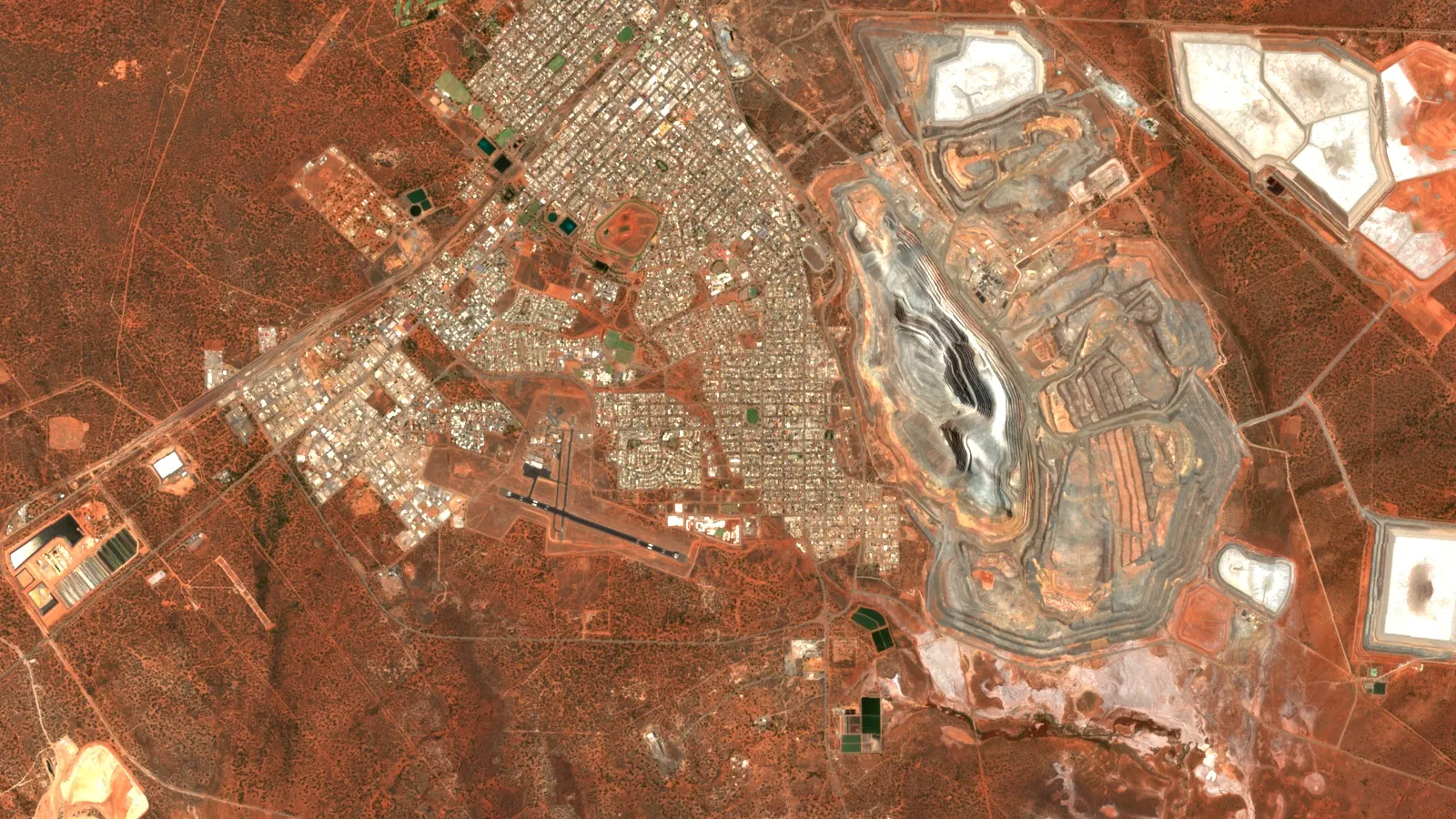
- Screening leads from space before pegging
- Frequently asked questions
A lead is an early, loosely defined sign of mineralisation, such as a soil anomaly, a geophysical feature or an old working. A prospect is a lead that now has enough evidence, such as mapping, sampling and first drill results, to justify a defined drill programme. Neither word has a single legal definition in mining, so this guide uses the standard reporting and geological-survey terms around them and then ties each stage to the Western Australian (WA) tenement that normally fits it.
The WA tenement rules come from the Mining Act 1978 and are administered by the Department of Mines, Petroleum and Exploration (DMPE), which took over from the Department of Energy, Mines, Industry Regulation and Safety (DEMIRS, earlier DMIRS) in 2025. Fees quoted below are from the schedule effective 1 July 2026 and reset every 1 July.
Lead versus prospect: what each term means
Geologists use the words as steps on a ladder of confidence. The lower the step, the cheaper the work and the more targets you carry. The higher the step, the fewer targets remain and the more each one costs to test.
| Feature | Lead | Prospect |
|---|---|---|
| Evidence | One or two indirect signs: a stream-sediment or soil anomaly, a magnetic or radiometric feature, a satellite alteration pattern, an old shaft or a nearby discovery | Direct evidence on the ground: mapped host rocks and structure, rock-chip or auger assays above background, and usually first drill intersections |
| Shape of the target | Loosely drawn area; position and size are uncertain | Defined zone with a strike length, width and a reason to expect continuity |
| Typical next step | Mapping, geochemical sampling, ground geophysics | Drilling, then a resource estimate if results hold |
| Money at stake | Low; spread across many leads | Higher; concentrated on a few targets |
| Usual WA tenure | Exploration licence or prospecting licence | Prospecting licence, exploration licence or, after a resource is defined, a retention licence or mining lease |
Neither word appears as a defined term in the JORC Code 2012, which sets the rules for public reports in Australia. The Code does define the steps around them. Exploration Results are data and information generated by exploration programmes that do not form part of a Mineral Resource declaration. An Exploration Target is an estimate, quoted as a range of tonnes and grade, for mineralisation where there has been insufficient exploration to estimate a Mineral Resource. In plain terms, a lead sits before reportable Exploration Results, and a prospect is where Exploration Results exist but a Mineral Resource does not. The US Geological Survey draws a similar ladder: a mineral occurrence is any concentration someone finds valuable, a mineral deposit is one of enough size and grade to have economic potential, and an ore deposit has been tested and shown to be profitable to produce.
Where leads come from and how they are screened
A lead usually starts from data that already exists. Common sources are regional geophysics and geology maps from the geological survey, historic open-file exploration reports, old workings, stream or soil geochemistry, and satellite imagery that shows iron staining, clay alteration or structure. The WA Geological Survey and the tenement register publish much of this material, and tenement and geology layers can be searched in GeoVIEW before any ground is pegged.
Screening a lead means asking three cheap questions before spending on fieldwork:
- Is the host rock right for the commodity you want? Gold in the Yilgarn, for example, tends to follow major shear zones in greenstone belts.
- Is the ground open? Check the tenement register for existing titles and pending applications.
- Does a second, independent data set agree with the first? A magnetic feature that also shows an alteration pattern on satellite images is a stronger lead than either alone.
Most leads fail these checks, and that is the point of the step. Palisade Research, writing in Mining.com in 2016, put the often-quoted odds at just 1 out of 3,000 mineralised anomalies becoming a mine. That is an industry rule of thumb, not a measured rate for WA, but it explains why explorers hold large portfolios of cheap leads and spend heavily on only a few prospects.

▶ Explains how AI reads maps, satellite pictures and old drill data in mineral exploration, and where it fails. · 4:37
How a lead becomes a prospect: the stage gates
Each gate asks for more proof than the one before. A lead moves up only when the new data agrees with the old.
Chart
Exploration spend: new deposits vs existing deposits
Australia, June quarter each year, original series, A$ million
- Desk review. Compile geology, geophysics, historic assays and the tenement position. Output: a ranked list of leads.
- Reconnaissance. Walk the ground, map outcrop and sample soil or stream sediment. Output: anomalies with a size and a grade range.
- Follow-up. Infill sampling, trenching where permitted, and ground geophysics. Output: a defined zone, now a prospect.
- First drilling. Reverse-circulation or diamond holes on a section. Output: intersections that either confirm continuity or end the work.
- Resource drilling. Closer spacing and a resource estimate by a competent person. Output: a deposit, not a prospect.
The Australian Bureau of Statistics (ABS) splits exploration spending in a way that mirrors this ladder. Its “new deposits” category covers work on previously unknown mineralisation or on known mineralisation not yet classed as an Inferred Mineral Resource or higher, while “existing deposits” covers work to delineate or prove up an already classified deposit (ABS methodology, June 2026). In the June 2026 quarter, A$1,189.8 million was spent on mineral exploration nationally on the original series, of which A$274.5 million went to new deposits and A$915.3 million to existing ones. Put simply, most money in Australia goes into targets that are already past the lead stage. These are national figures, not WA-only.
Quartz as a lead in Western Australian goldfields
Quartz is a common clue in gold exploration because gold-bearing fluids often deposit quartz in veins along faults and shears. Quartz alone is not a prospect. Barren quartz veins are widespread, and the useful signs are what travels with the quartz: carbonate and sulphide minerals, altered wall rock, and a structure that can carry fluid.
The Kalgoorlie Gold Field shows the pattern. A review in Geoscience Frontiers describes the Mt Charlotte deposit as a pipe-shaped, coarse-grained quartz, carbonate and scheelite vein stockwork, and the nearby Golden Mile as a field of lodes with quartz-carbonate veining, with the gold described as orogenic. Our guide to milky quartz covers how white massive quartz looks in the field and why it is a pathfinder rather than proof.
What to record when you find quartz
- Vein orientation, thickness and how far it can be followed.
- Wall-rock alteration next to the vein, and any sulphide staining.
- Whether the vein sits in a mapped shear or fault.
- Assay results from a sample taken with the landholder’s or tenement holder’s permission.
Gem or crystal quartz varieties such as clear, smoky or rose quartz are a different market from gold exploration. They may be worth recording, but they do not move a gold lead up the ladder.
Which WA tenement fits a lead and which fits a prospect
WA lists its main exploration and mining titles in one fee schedule. The table is built from the DMPE Fees and Charges 2026-27 schedule, effective 1 July 2026, and from the Australian Business Licence and Information Service (ABLIS) pages for the exploration licence and the prospecting licence.
| Tenement | Best stage | Maximum area | Term | Application fee (A$) |
|---|---|---|---|---|
| Prospecting licence | Reconnaissance and first drilling of a small, well-defined prospect | 200 hectares | 4 years, one 4-year extension | 478 |
| Exploration licence (graticular) | Screening many leads over a district | 70 blocks (200 blocks outside areas designated as mineral fields) | 5 years, then extensions | 493 for a 1-block licence; 1,800 for more than one block |
| Retention licence | A resource exists but cannot yet be mined | Not capped | Up to 5 years, renewable | 1,080 |
| Mining lease | Defined deposit moving to production | Not capped | 21 years, renewable | 703 |
The rule of thumb that follows is simple. Hold a wide exploration licence while you have many leads and little detail. Once one lead has become a compact, drilled prospect, a prospecting licence can cover it for a lower annual commitment. When drilling defines a resource, move to a retention licence or mining lease.
What a WA prospecting licence costs
A prospecting licence is limited to 200 hectares and must be marked out unless the licence says otherwise. It lets the holder extract or disturb up to 500 tonnes of material, including overburden, and a larger tonnage needs ministerial approval. There is no limit on how many licences one person or company may hold, but each needs A$5,000 in security, and the term is four years with one four-year extension (WA Government, prospecting licences, updated 9 April 2025).
Chart
Annual rent per hectare by WA tenement
A$ per hectare or part of a hectare, schedule effective 1 July 2026
The 2026-27 schedule sets an application fee of A$478, annual rent of A$4.40 per hectare or part of a hectare (minimum A$40.70 for 9 hectares or less) and a minimum annual expenditure of A$40 per hectare, with a floor of A$2,000. A one-year exemption from the expenditure condition costs A$494 per tenement, and approval is not automatic.
Expenditure is the larger cost. A 100-hectare licence pays about A$440 a year in rent but must show A$4,000 of genuine exploration spend. Rent is a fee to the state; expenditure is money you must spend on the ground and report. The calculator below adds the lot up for your own area and term.
Calculator
What will your prospecting licence cost over its term?
Enter your own area and term. Results update as you type.
- Annual rent (A$): $440
- Annual minimum spend (A$): $4,000
- First-year cash and spend (A$): $4,918
- Cost per hectare per year (A$): $44
Example values only, not a forecast. Rent, spend and fee defaults are from the DMPE Fees and Charges 2026-27 schedule (effective 1 July 2026) and change each 1 July. Rent is charged per hectare or part, with a minimum of A$40.70 for 9 ha or less, which this calculator ignores. Spend is the larger of area times the per-ha rate and A$2,000. Security of A$5,000 per licence, survey and access costs are not included. All money in A$.
Exploration licence minimum spend per block
An exploration licence is measured in graticular blocks. The licence runs five years and can be extended; it allows the holder to extract or disturb up to 1,000 tonnes of material (ABLIS). The expenditure commitment rises as the licence ages, which pushes holders to drill, sell or drop ground rather than sit on it. Under the 2026-27 schedule the per-block commitment is A$1,000 in years 1 to 3, A$1,500 in years 4 and 5, A$2,000 in years 6 and 7 and A$3,000 from year 8, with minimums that depend on how many blocks are held. A one-block licence, for example, carries a minimum of A$10,000 in years 1 to 3 and A$20,000 from year 8.
Chart
Exploration licence: minimum spend per block each year
A$ per graticular block, by licence year band
That step-up is why a lead that never progresses becomes expensive to hold. Dropping a weak lead is a decision as important as drilling a good one.
Ground disturbance: the Programme of Work and rehabilitation
Holding a tenement is not the same as being allowed to dig. The DMPE exploration and prospecting approval page (updated 8 June 2026) says the Mining Act 1978 requires a Programme of Work (PoW) to be lodged and approved before ground-disturbing activities with mechanised equipment. DMPE has a target of completing 80 per cent of assessments within 15 business days, provided the application has enough information.
- Drilling water supply needs separate approval from the Department of Water and Environmental Regulation.
- DMPE may withhold a decision where the area overlaps an Aboriginal heritage site and the applicant has not begun consultation with the Department of Planning, Lands and Heritage.
- If a PoW is approved, rehabilitation must be completed within six months of finishing the disturbance, or by an approved extension.
Good lead work, which is mostly desk study, satellite data and hand sampling, avoids most of this process. It is one reason explorers push as much screening as possible ahead of the first drill hole.
Regulator names: DMIRS, DEMIRS and DMPE
Searches for WA tenements still use three names for one regulator. DMIRS and DEMIRS are older names. Changes announced in March 2025 created a standalone Department of Mines, Petroleum and Exploration, with the machinery-of-government changes due by 1 July 2025 according to the Association of Mining and Exploration Companies. The current fee schedule and approval pages carry the DMPE name. Some forms and web addresses still show the old names, so check the date on any fee page you use. For a wider look at WA titles, see our guide to the Dept of Mines WA tenement types and fees, and for the whole exploration sequence see mineral exploration stages, methods, costs and timelines.
Screening leads from space before pegging
Satellite images cannot confirm a prospect, but they can rank leads by showing alteration, structure and surface change across a licence area without any ground disturbance. Farmonaut offers satellite-based mineral detection from a KML, KMZ or polygon boundary, with results as exploration targets that sit ahead of any resource estimate. Reports take 5 to 20 business days. To scope your own area, use the mining quote form or contact the team.
Whatever screening you use, keep a single register of every lead and prospect: location, evidence, tenement, next step and the date you will drop it if nothing changes. That register is what lets you move the right target up and drop the wrong one.

▶ Shows what a mineral management system should hold: maps, samples and targets in one place. · 3:21
Frequently asked questions
What is the difference between a lead and a prospect in mining?
A lead is an early, loosely defined sign of mineralisation. A prospect is a defined zone with direct evidence, such as mapped geology, assays above background and often first drill results, that justifies a drilling programme. Mining has no single code for the two words, so companies define them in their own reports.
Is a prospect the same as a deposit?
No. A prospect has no declared Mineral Resource yet, while a deposit is large and rich enough to have economic potential. A prospect becomes a deposit only after enough drilling to estimate a resource.
What is the next step after a lead?
Check that the ground is open, confirm the host rocks suit the commodity, and look for a second independent data set that agrees. Then plan low-cost reconnaissance such as mapping and soil sampling.
How many prospects become mines?
Few do. One widely quoted industry figure, reported by Mining.com in 2016, is about 1 in 3,000 mineralised anomalies. It is a rule of thumb, not a measured WA rate.
How big can a prospecting licence be in Western Australia?
Up to 200 hectares. It must be marked out unless the licence says otherwise, and it allows up to 500 tonnes of material to be extracted or disturbed unless the Minister approves more.
How much does a WA prospecting licence cost?
The 2026-27 schedule lists an application fee of A$478, rent of A$4.40 per hectare (minimum A$40.70 for 9 hectares or less) and minimum annual expenditure of A$40 per hectare, at least A$2,000. A$5,000 security applies per licence.
How long does a prospecting licence last?
Four years, with one extension of four years.
Can I drill on a prospecting licence straight away?
Not without approval. A Programme of Work must be lodged and approved before ground-disturbing activities with mechanised equipment, and rehabilitation is due within six months of finishing, unless extended.
Is DMIRS the same as DEMIRS and DMPE?
They are successive names for the WA mines regulator. The current department is the Department of Mines, Petroleum and Exploration, and its fee schedule is the one to use.
Does quartz mean there is gold?
No. Quartz veins are common and mostly barren. They matter when they sit in a mapped shear or fault with altered wall rock and sulphide minerals, as at Kalgoorlie.
This page is for information only. It is not legal advice. Confirm the rules with the regulator, the Department of Mines, Petroleum and Exploration, before you peg, apply or disturb ground. Fees reset each 1 July. Always get permission before prospecting, follow safety rules and do not use mercury.
Farmonaut mining
Get a quote to rank your leads from space
Send a KML, KMZ or polygon and Farmonaut screens the area from satellite images before ground crews go in.

Mining Pro sample view, synthetic data
Keep reading
Sources
- DMPE, Fees and Charges 2026-27, Mining Act 1978 tenements: wa.gov.au
- WA Government, Prospecting licences: wa.gov.au
- DMPE, Exploration or prospecting approvals (Programme of Work): wa.gov.au
- ABLIS, Exploration Licence, Western Australia: ablis.business.gov.au
- ABLIS, Prospecting Licence, Western Australia: ablis.business.gov.au
- ABS, Mineral and Petroleum Exploration, Australia, June 2026: abs.gov.au
- ABS, Mineral and Petroleum Exploration methodology, June 2026: abs.gov.au
- USGS, Bulletin 1693, Introduction to mineral deposit models: pubs.usgs.gov
- Palisade Research, Prospect generation (Mining.com, 2016): mining.com
- Geoscience Frontiers, The giant Kalgoorlie Gold Field revisited (2016): geosciencefrontiers.com
- AMEC, Exploration elevated in Western Australia department reform (31 March 2025): amec.org.au
- DMPE, GeoVIEW: wa.gov.au
- JORC Code 2012, Australasian Code for Reporting of Exploration Results, Mineral Resources and Ore Reserves: jorc.org
Discussion
Questions, corrections or field experience? Share them below. First-time comments are reviewed before they appear, and your email is never published.
No comments yet. Be the first to add a question or your experience.

 SMA Investments Ltd
 NTS Group (Pty) Ltd
 Mine4Africa
 Lithspo Minerals Limited
 Tintina Mining Group
 Dalgety Minerals Pty Ltd
 Vortex Minerals Pty Ltd
 Faith At Work (Pty) Ltd
 Geotech Mining Solutions plc
 Vulcan International Limited
 Kidepo Associates
 GKY Mining
 Alkimy SARL
 Double A Trading
 GemSprout Metals Limited
 Qader Group
 Ileys General Trading
 SG Gold Mining LLC
 VRV Global Pte Ltd
 Omsri International FZE
 G.I.T.T.
 Jaunita Erss Ltd
 Almosi SARL
 SRK Consulting
 Berks Gold Limited











