

Uranium mining · Impact assessment guide
Environmental Impacts of Uranium Mining by Method
Impacts depend on the mining method: conventional mines leave waste rock and tailings, while in situ leach (55% of 2024 world output) leaves an aquifer to restore. This guide compares them, with cleanup costs and a tailings calculator.
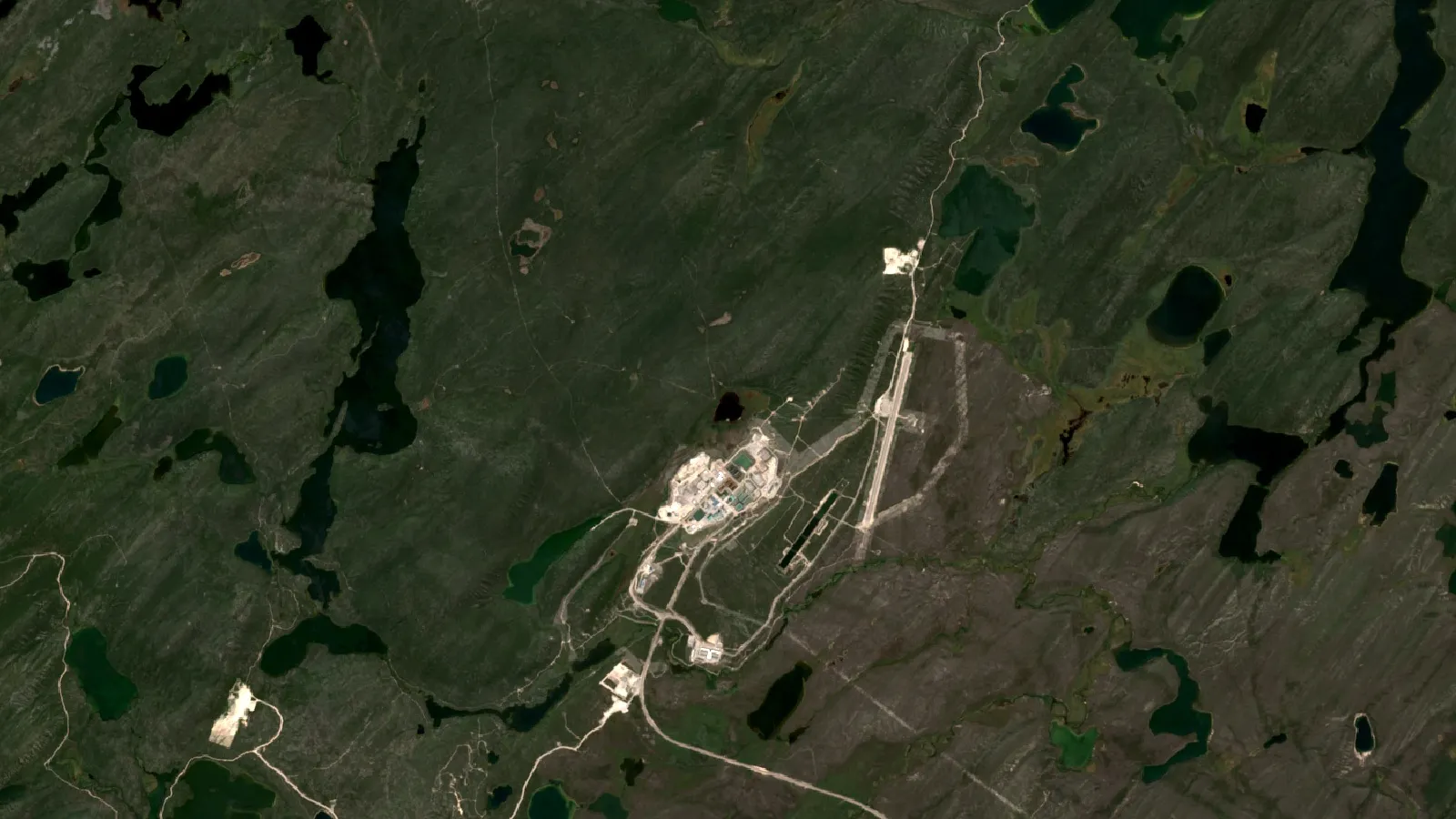
Key takeaways
- In situ leach supplied 55% of world uranium in 2024, underground and open pit mines 40% and by-product recovery 5% (World Nuclear Association, 2026).
- Right after milling, tailings hold about 85% of the ore’s original radioactivity (a little over 70% after several months) and all of its radium, so they are covered and monitored after closure (WNA).
- The EPA counts 523 abandoned uranium mines on Navajo land; settlements of over US$1.7 billion fund work at 230 of them (US EPA).
- Germany’s Wismut cleanup is expected to reach about €8.9 billion in total, with water treatment continuing after the physical work (WISE Uranium register, citing the 2027 draft federal budget).
- A cumulative effects assessment adds other past, present and foreseeable activities to a single project’s EIA (Impact Assessment Agency of Canada).
In this article
- Uranium mining impacts by method
- Which mining methods and countries dominate production
- Land disturbance, waste rock and tailings
- Radon, dust and radiation
- Groundwater and surface water
- What abandoned uranium mines cost to clean up
- How an environmental impact assessment for a uranium mine works
- Cumulative effects when several mines share a region
- Where satellite data helps an assessment
- Frequently asked questions
The environmental impacts of uranium mining depend mostly on the mining method. Conventional open pits and underground mines leave waste rock and mill tailings, and the tailings hold most of the ore’s radioactivity, while in situ leach (ISL) wells leave a treated aquifer instead. ISL supplied 55% of world uranium in 2024, with underground and open pit mines at 40% and by-product recovery at 5% (World Nuclear Association, updated 9 October 2026). So the first question for any project is which method it uses, because that decides which impacts the assessment has to cover.
This guide is written for consultants and licence holders who have to scope or review an environmental impact assessment (EIA) for a uranium project. It compares the impacts method by method, shows what legacy sites in the United States and Germany have cost to clean up, walks through how an EIA and a cumulative effects assessment are built, and ends with a calculator that turns a production target into ore, waste rock and tailings volumes. Each figure carries its source and date.
Uranium mining impacts by method
The table sets the main impact pathways against the mining method. It summarises the World Nuclear Association (WNA) mining overview, the US Environmental Protection Agency (EPA) pages on uranium mining wastes and the US Nuclear Regulatory Commission (NRC) generic study on ISL facilities, all cited in the sections below. Uranium projects share most impact categories with other mines (land, water, air, waste, biodiversity, noise and community effects); the uranium-specific additions are radiation pathways and the long life of the tailings. For another mineral compared the same way, see our lithium mining environmental effects guide.
Chart
World uranium production by mining method
Share of world production, 2024
| Method | Main land and waste impacts | Main water and air issues | Usual controls |
|---|---|---|---|
| Open pit | Large pit, overburden and waste rock; tailings from the mill | Dust; radon from exposed ore and tailings; pit and dump drainage | Dust suppression; tailings placed in worked-out pits where possible; cover on closure |
| Underground | Less waste rock than a pit; tailings from the mill; surface plant and shafts | Radon in the workings; mine water pumped to surface | Forced ventilation; water treatment; tailings returned underground or to engineered dams |
| In situ leach | Well fields, pipelines, processing plant and ponds; no pit and no tailings dam | Changes to aquifer chemistry; spread of leach solution beyond the ore zone; brine from reverse osmosis treatment | Pre-mining baseline; monitoring wells; restoring groundwater to the baseline standard |
| Heap leach | Stacked ore on an impermeable pad; spent ore to be placed securely | Acid or alkaline solution that must not reach surface water or groundwater | Lined pads; spent ore emplaced in mined-out pits |
| By-product (copper, gold, phosphate) | Impacts set by the host mine; uranium is recovered at the plant | More complex processing circuit than a uranium-only mill | Host mine’s own permits and plans |
▶ The seven general environmental impacts of mining, explained in plain words. · 2:31
Which mining methods and countries dominate production
Three countries supply about three-quarters of the uranium mined: Kazakhstan, Canada and Namibia, with 39%, 24% and 12% of world supply in 2024 (WNA). In the same year over 60% of world output came from just 10 mines in four countries. That concentration matters for assessment work: a large share of the world’s uranium impacts sit in a few regions, namely the sandstone ISL fields of Kazakhstan, the high-grade Athabasca Basin of northern Saskatchewan and the open pits of Namibia.
Chart
Uranium from mines, three largest producers and Australia
Tonnes of uranium (tU) per year, 2015 to 2024
The method mix has also moved. Underground mines supplied 55% of world production in 1990, fell to 33% by 1999, then rose again when new Canadian mines opened from 2000; by 2024 ISL was the largest single method (WNA). Production also swings with the market: Canadian output fell from 14,039 tonnes of uranium (tU) in 2016 to 3,885 tU in 2020 and was back to 14,309 tU in 2024.

▶ A short explainer on uranium in Africa, including the Kanyemba deposit in Zimbabwe. · 4:27
Land disturbance, waste rock and tailings
Where the orebody is close to the surface, it is mined from a large open pit with much overburden (the soil and rock above the ore) and waste rock. Deeper orebodies, up to about 600 metres at mines such as McArthur River and Cigar Lake, are mined underground, which moves less waste rock and has less impact on the surface (WNA uranium mining overview). The EPA lists overburden, weakly enriched waste rock, subgrade ore (ore below the cut-off grade), excavated topsoil and evaporation pond sludges as the bulk wastes of uranium mining, and notes they typically contain uranium, radium, radon and thorium (US EPA, TENORM: uranium mining residuals).
Chart
Ore to be mined per tonne of uranium
Tonnes of ore per tonne of uranium, before recovery losses
Tailings are the sandy and silty solids left after the uranium has been leached out of the milled ore. They make up most of the original ore and hold most of its radioactivity, including all of the radium (WNA). The WNA notes that once the uranium is removed, the tailings have about 85% of the ore’s original radioactivity at that point, falling to a little over 70% after several months as short-lived decay products disappear. The long-lived radium stays. Because ore grade sets how much rock has to be milled for each tonne of uranium, grade is the number that most changes the size of the waste footprint. Some Canadian mines have ore averaging up to 20% uranium, while other mines operate on ore down to about 0.02% uranium (WNA).
Typical controls on land and tailings
- During operation, tailings are often kept under water to reduce surface radioactivity and radon release, and the process water is recycled or evaporated because radium is fairly soluble. Most Australian mines and many others adopt a “zero discharge” policy for pollutants (WNA).
- At closure the tailings dam is normally covered by about two metres of clay and topsoil with rock to resist erosion, so that gamma radiation and radon release fall to levels near those normal around the orebody, and vegetation can be established (WNA).
- Tailings can be placed in a worked-out pit, as at Ranger and McClean Lake, or in an engineered dam. In Canada tailings are emplaced in mined-out pits wherever possible (WNA).
- Governments in many parts of the world hold rehabilitation bonds, so that closure is paid for if the company becomes insolvent (WNA).
Calculator
How much ore, waste rock and tailings for your target?
Enter your own production target, ore grade, recovery and strip ratio.
- Waste rock moved per year (tonnes): 2,777,778
- Mill tailings per year (tonnes): 554,556
- Tailings volume per year (cubic metres): 396,111
Example values only, not benchmarks or any mine’s figures. Grade is % U3O8 in ore. Tailings tonnes are taken as ore milled minus the U3O8 recovered (water and reagents ignored). Waste rock applies to open pits only: enter 0 for underground. Strip ratio and density are site-specific inputs. Not for ISL, which has no mill tailings.
Radon, dust and radiation
Uranium itself is only slightly radioactive. The radiation risk comes from its decay products, mainly radium and the radon gas that radium releases. The EPA’s Region 6 brochure on abandoned uranium mines states that the radium in mill tailings will not decay entirely for thousands of years, and that radon inhalation is linked to lung cancer (US EPA Region 6, November 2011).
For workers, open pits are naturally ventilated, and underground mines use powerful fans. Standard controls are forced ventilation, dust control (dust can carry radioactive material), and dose limits for people in the mine, mill and tailings areas. In Canada, mining of very high-grade ore is done solely by remote control techniques. Canadian mine and mill facilities are designed to handle ore of up to 26% uranium (WNA). An EIA sets a baseline for radon in air and gamma dose rates before any work starts, so that later monitoring has something to be compared with.
Groundwater and surface water
Water is where ISL and conventional mines differ most. In ISL, a leach solution is pumped through the ore in the aquifer and recovered at the surface. Most of the orebody’s radioactivity stays deep underground, so radon release rises very little and there is no ore dust (WNA, in situ leach mining). The trade-off is the aquifer itself. After ISL mining ends, groundwater quality must be restored to a baseline standard set before mining began, so that earlier uses can resume. In the United States the water must be usable for the same purposes as before, usually potable or stock water of less than 500 parts per million total dissolved solids, even if not every chemical returns to its pre-mining level. Treatment often uses reverse osmosis, which leaves a concentrated brine that has to be disposed of (WNA).
Site conditions change the answer. At Beverley in Australia the original groundwater was too saline and too high in radionuclides for any permitted use. At Honeymoon it was even more saline and high in sulfates and radium, and post-mining monitoring there is for a minimum of three years on pH, sulfates and uranium. At Irkol in Kazakhstan a field test measured four parameters from 1985 to 1997: the affected area halved in four years and had recovered naturally after 12 years (WNA). These are reported results at particular sites, not a guarantee for another aquifer, which is why the baseline matters. In Kazakhstan, ISL needs large quantities of sulfuric acid, and supply of acid was a production constraint over 2007 to 2010 (WNA).
The NRC prepared a generic environmental impact statement (NUREG-1910) for ISL facilities in four regions of the western United States. It covers construction, operation, aquifer restoration and decommissioning, and aims to identify which impacts are essentially the same for all ISL facilities, so that project reviews can focus on site-specific issues (US NRC, NUREG-1910).
What abandoned uranium mines cost to clean up
Legacy sites show what happens when closure is not planned or funded at the start. Two well-documented cases are the Navajo Nation in the United States and the Wismut mines in eastern Germany.
Chart
Wismut cleanup cost estimates over time
Billion euros: amount spent versus total estimate, at each review
Navajo Nation, United States
From 1944 to 1986 nearly 30 million tons of uranium ore were extracted from Navajo lands. The EPA counts 523 abandoned uranium mines there, and enforcement settlements worth over US$1.7 billion make funds available to begin assessment and cleanup at 230 of them. The EPA and the Navajo Nation Environmental Protection Agency ranked 46 priority mines by gamma radiation level, closeness to homes and the potential for water contamination (US EPA, Navajo Nation abandoned uranium mines cleanup). The agency’s own page lists lung cancer from inhaling radioactive particles among the potential health effects.
Wismut, Germany
Wismut’s own site reports an investment of more than €7 billion over three decades in remediation in Saxony and Thuringia (Wismut GmbH). The state-owned company has been restoring former uranium mining and milling sites in Saxony and Thuringia since 1991. In February 2021 the federal economics ministry approved a reclamation plan for 2020 to 2050 that needed another €2.1 billion on top of the €6.8 billion already spent, and treatment of contaminated water was expected to continue after the physical work. The 2027 draft federal budget puts the total at €8.9 billion (as reported by the WISE Uranium Project decommissioning register, citing Wismut and the budget document). The estimate has grown at each review: €7 billion with €5.4 billion spent at the end of 2010, then about €8 billion in a 2016 estimate.
The lesson for new projects is practical: water treatment and long-term monitoring are the cost items that last longest, so a good assessment prices them into the closure plan from the first study.
How an environmental impact assessment for a uranium mine works
An EIA is the formal study of what a project will change, what can be done about it and what will be monitored. For uranium it is done under national law. In the United States the NRC treats an environmental impact statement as a requirement for a uranium milling licence under the National Environmental Policy Act, and Canada uses the Impact Assessment Act. The steps are broadly the same everywhere.
- Screening and scoping. Decide whether an assessment is required and which topics, boundaries and time periods it will cover.
- Baseline studies. Measure the starting condition of air, radon and gamma dose, surface and groundwater, soil, vegetation, wildlife and communities, before any disturbance.
- Impact prediction. Model dust, radiation dose, water quality, land take and waste volumes for the chosen method.
- Mitigation. Design controls: ventilation, tailings cover, water treatment, aquifer restoration and rehabilitation bonds.
- Review and consultation. Regulators, Indigenous and local communities and the public comment on the draft.
- Decision and follow-up. Licence conditions, monitoring programmes and reporting through operation and closure.
The list below sets out what a baseline for a uranium project can include. It is a working list for scoping, not a regulator’s template; confirm the required content with the agency that will decide the application.
- Radon and gamma background at several points, over a full year where possible.
- Surface water and groundwater chemistry, including uranium, radium-226 and sulfate, with well depths and flow direction.
- Soil and sediment samples that can be repeated at closure.
- Land cover, habitat and species surveys, with the project’s footprint mapped over them.
- Land use and traditional food sources of nearby communities.
- The location, status and monitoring records of any older mines, pits and tailings nearby.
Cumulative effects when several mines share a region
An EIA covers one project. A cumulative effects assessment adds the effects of other past, present and foreseeable activities in the same area. Canada’s Impact Assessment Act requires an assessment to consider the cumulative effects likely to result from a designated project combined with other physical activities. The agency’s policy framework sets five steps: scoping, analysis, mitigation, describing the effects and follow-up. Future activities that are certain must be included, and reasonably foreseeable ones should generally be included (Impact Assessment Agency of Canada, policy framework).
The Eastern Athabasca Regional Monitoring Program in northern Saskatchewan shows how this looks in a uranium region. It was set up in 2011 as a partnership between industry and government, with support from the Saskatchewan Ministry of Environment, the Canadian Nuclear Safety Commission, Cameco and Orano, to identify potential cumulative effects downstream of uranium mining and milling. It tests water, fish, berry and mammal samples from seven communities. Cumulative effects can be spatial, for example where two exposed watersheds converge, or over time if contaminants build up (Eastern Athabasca Regional Monitoring Program, 2019 to 2020 report).
For consultants the practical points are to set the regional boundary by watershed or aquifer rather than by the licence line, to list every operating, closed and proposed site inside it, and to agree the valued components (the water, species, foods and places that matter to people) with communities before modelling.
Where satellite data helps an assessment
Satellite images are useful at the scoping and baseline stages. Sentinel-2 imagery, with a five-day revisit and four bands at 10 metre resolution (Copernicus Sentinel-2 mission page), can map land cover, bare ground, standing water and the footprint of old workings and tailings across a whole basin, and a time series shows when each change happened. That helps a cumulative assessment list every disturbance in a region and gives a repeatable measure for follow-up. It does not measure radon, dose rates or water chemistry: those need field sampling and laboratory work, and a satellite screen is never an environmental or social clearance. Farmonaut maps licence areas from satellite data for mineral exploration targets; see our page on satellite-based mineral detection, or ask for a quote through the mining query form or contact us.
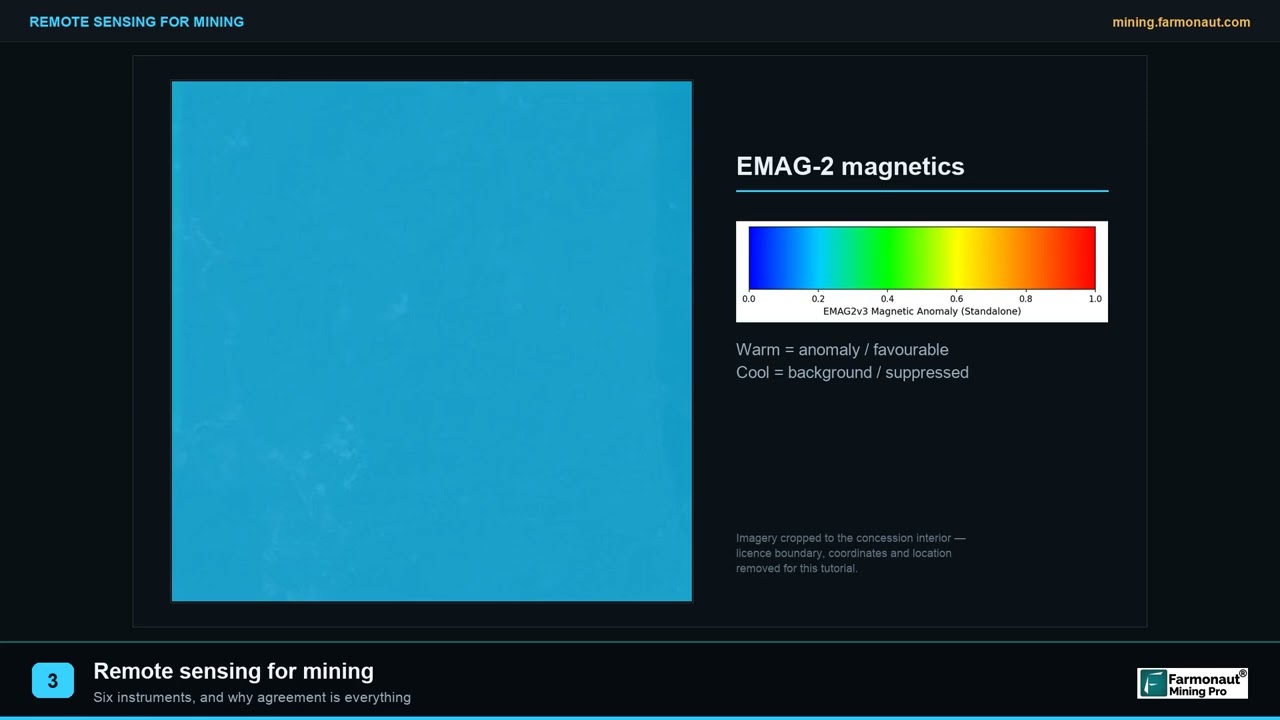
▶ What remote sensing for mining measures, in three minutes. · 2:01
Frequently asked questions
What are the main environmental impacts of uranium mining?
Land disturbance from pits, waste rock and tailings; radon and dust; and effects on groundwater and surface water. Which of these dominates depends on the method: tailings for conventional mines and aquifer chemistry for ISL (WNA, 2026).
Is in situ leach mining better for the environment than open pit mining?
It removes the pit, waste rock and tailings dam and leaves most of the radioactivity underground, but it changes aquifer chemistry, so the groundwater must be restored to a baseline standard set before mining began (not every chemical returns to its old level). Neither method is better in every case; the result depends on the aquifer, the ore grade and the closure plan.
Why are uranium mill tailings a long-term issue?
They hold about 85% of the ore’s original radioactivity (a little over 70% after several months), and the EPA states that the radium in them will not decay entirely for thousands of years. Tailings are therefore covered, monitored and managed after the mine closes.
How much waste does a uranium mine produce?
It depends mainly on ore grade. A 20% grade means about 5 tonnes of ore per tonne of uranium, and a 0.02% grade means about 5,000 tonnes before recovery losses. The calculator on this page lets you test your own numbers.
What is a cumulative effects assessment?
It is an assessment of the effects of a project combined with other past, present and foreseeable activities in the same area, such as several mines in one watershed (Impact Assessment Agency of Canada).
What does an EIA for a uranium project include?
Baseline studies, impact prediction for radiation, water, air, land and communities, mitigation and monitoring plans, public consultation, and plans for closure and rehabilitation.
How much did the Wismut cleanup in Germany cost?
The 2027 draft federal budget expects about €8.9 billion in total, according to the WISE Uranium register, with water treatment continuing after the physical work.
How many abandoned uranium mines are on Navajo land?
The EPA counts 523, and settlements worth over US$1.7 billion fund assessment and cleanup work at 230 of them.
Can satellites replace field surveys in an EIA?
No. Satellites map land cover and change over large areas. Radon, radiation dose and water chemistry still need field and laboratory measurements.
Which countries mine the most uranium?
Kazakhstan (39%), Canada (24%) and Namibia (12%) in 2024, according to the World Nuclear Association.
This page is for information only. It is not legal advice and not an environmental clearance. Confirm assessment requirements with the regulator that will decide the project. Satellite data does not measure radon, radiation dose or water chemistry.
Farmonaut mining
Map your mining site from space
Farmonaut screens a licence area from satellite data and cuts exploration timelines from months to days; it gives exploration targets, not an environmental clearance.
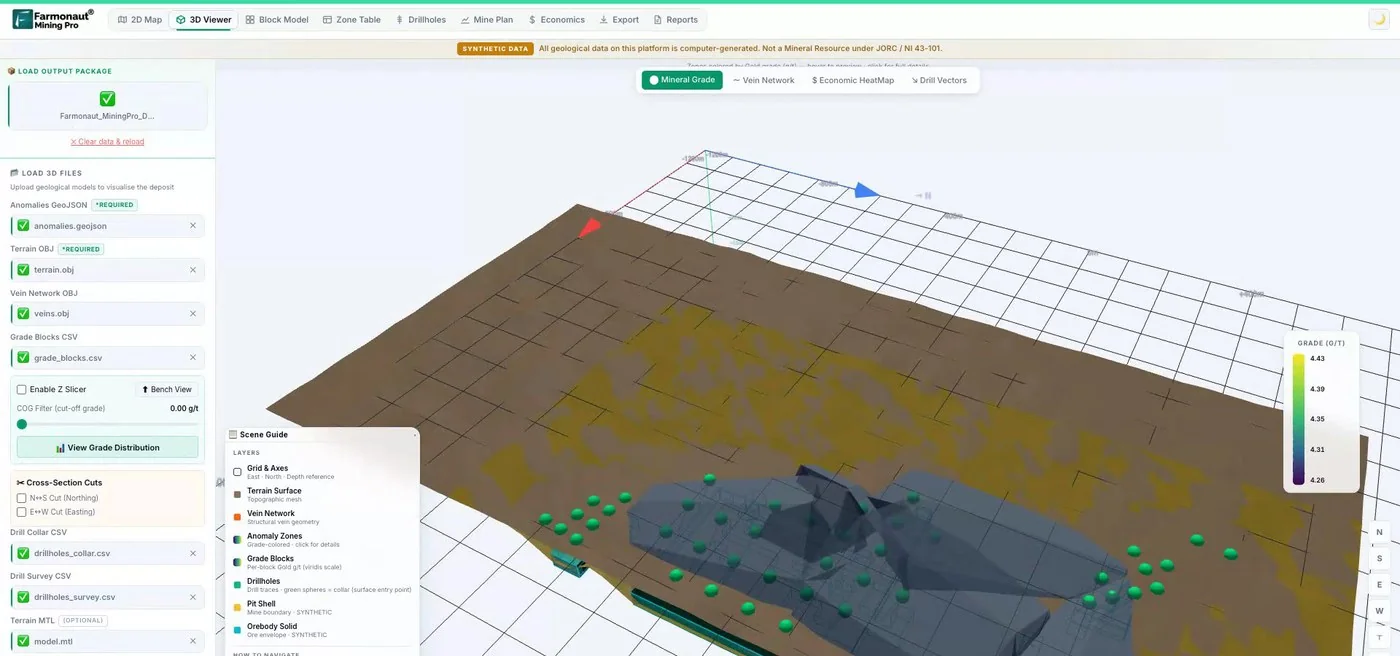
Mining Pro sample view, synthetic data
Keep reading
Sources
- World Nuclear Association, World Uranium Mining Production: world-nuclear.org
- World Nuclear Association, Uranium Mining Overview: world-nuclear.org
- World Nuclear Association, In Situ Leach Mining of Uranium: world-nuclear.org
- US EPA, TENORM: Uranium Mining Residuals: epa.gov
- US EPA Region 6, The Legacy of Abandoned Uranium Mines in the Grants Mineral Belt (2011): epa.gov
- US EPA, Navajo Nation Abandoned Uranium Mines Cleanup: epa.gov
- US NRC, NUREG-1910 Generic EIS for In-Situ Leach Uranium Milling Facilities: nrc.gov
- Impact Assessment Agency of Canada, Policy Framework for Assessing Cumulative Effects: canada.ca
- Eastern Athabasca Regional Monitoring Program, 2019 to 2020 report: cameconorth.com
- WISE Uranium Project, Decommissioning Projects in Europe (Wismut): wise-uranium.org
- Copernicus, Sentinel-2 mission (SentiWiki): sentiwiki.copernicus.eu
- Wismut GmbH, company website: wismut.de
Discussion
Questions, corrections or field experience? Share them below. First-time comments are reviewed before they appear, and your email is never published.
No comments yet. Be the first to add a question or your experience.

 African Venture Partners Holding
 Congo Mining Solutions
 Mining SARL
 SenGold Invest SAS
 Sania Corporation
 Sean Mining Limited
 NTS Group (Pty) Ltd
 Mine4Africa
 Lithspo Minerals Limited
 Tintina Mining Group
 Dalgety Minerals Pty Ltd
 Vortex Minerals Pty Ltd
 Faith At Work (Pty) Ltd
 Geotech Mining Solutions plc
 Vulcan International Limited
 Kidepo Associates
 GKY Mining
 Alkimy SARL
 Double A Trading
 GemSprout Metals Limited










