

Placer dredges · Design guide
Gold Dredge Design: Nozzle, Pump and Sluice Sizing
A 5-inch dredge pairs with about 13 hp, a 400 GPM pump and a 20-inch box, and Washington caps the nozzle at 5.25 inches. This page sizes the nozzle, pump head, sluice and capacity from sourced data, with two calculators.
Key takeaways
- Washington caps a dredge nozzle at 5 inches (5.25 at most); Oregon caps the hose on a motorized dredge at 4 inches; Alaska’s general permit allows a 6-inch intake and 18 hp (state rules and permits, checked October 2026).
- Keene lists a balanced 4-inch dredge at 6.5 hp, a 275 GPM pump and a 16-inch box; a power jet needs 180 GPM against 106 GPM for a suction nozzle on a 3 or 4-inch dredge (Keene, 2019).
- The BGS sluice handbook targets about 2 m/s over angle-iron riffles for coarse gold and about 1 m/s over expanded metal for fine gold, with feed under 15% solids (BGS, 2002).
- Maker maximums run from 1.4 to 20 cubic yards per hour by size (Oregon DEQ), while Keene’s own 5-inch field test estimated 3.01 cubic yards per dredging hour.
- USGS says as much as 90% of stream placer gold sits in the lowest 3 feet of gravel and the top foot of bedrock, so the design must reach bedrock (USGS, 1998).
In this article
- How a suction gold dredge works, from nozzle to tailings
- Start with the nozzle: the size limits that cap your design
- Match the pump to the nozzle: flow, head and engine power
- Size the sluice box: width, slope and flow speed
- Choose traps for the gold in your gravel
- How much gravel can a dredge move per hour?
- Floats, frame, engine and wear parts
- When a custom gold dredge design is worth paying for
- Large-scale dredges: what changes and what stays the same
- Where to put a dredge: reading the river first
- Tailings, turbidity, intake screens and mercury
- Design mistakes that cost suction and gold
- Frequently asked questions
A gold dredge is designed from the nozzle backwards: the nozzle size sets the water flow, the flow sets the pump and engine, and the same flow decides how wide the sluice box must be to catch gold. One maker, Keene Engineering, pairs a 5-inch dredge with about 13 hp, a 400 gallon-per-minute pump and a 20-inch-wide sluice, while another, Proline, rates its 5-inch machine at up to 16 cubic yards of gravel per hour. This page walks through each design choice with sourced numbers, then gives two calculators: one for sluice width and one for the break-even grade of a dredging program.
It is written for consultants, licence holders and operators who have to specify, review or compare a dredge, not for people shopping for a first machine. Buying is covered in our portable gold dredge buyer guide, and permits in our Washington dredge rules page. US units (inches, gallons per minute, cubic yards, troy ounces) are used throughout, with metric where the source is metric.
How a suction gold dredge works, from nozzle to tailings
A placer is a deposit of gold in sand and gravel laid down by water. Because gold is heavy, it lags behind lighter material and settles low in the deposit: the US Geological Survey says as much as 90% of gold recovered from stream placers sits in the lowest 3 feet of gravel and in cracks in the top foot of bedrock. A suction dredge exists to lift that gravel and wash it over a trap.
Infographic
A suction dredge in 5 steps
- 1Engine and pumpThe engine drives a pump that sets water flow and head.
- 2Nozzle or jetWater through the nozzle or jet lifts gravel from the bed.
- 3HoseThe slurry travels up the hose to the floating sluice.
- 4Sluice and rifflesHeavy gold and black sand settle behind riffles and in mats.
- 5TailingsLighter gravel leaves the back of the box and returns to the bed.
Oregon’s Department of Environmental Quality describes the machine plainly: placer material is carried from the stream bottom through a suction hose to a sluice box on a floating platform that also carries the engine and pump. The sluice (a long, sloped trough) catches the heavy gold and black sand with metal riffles (raised bars), screens and textured mats, and the waste rock leaves the back end as tailings.
There are two ways to create the suction, and Keene explains the difference in its design notes. A suction nozzle draws water through the hose from the intake end. A power jet sends pump water into the discharge end of the hose, which pulls gravel up behind it. The maker says a power jet loses less energy to friction, so it can lift through a hose over 100 feet long with a bigger engine, while a suction nozzle should not run a hose much longer than about 20 feet.
Start with the nozzle: the size limits that cap your design
In most places the first design decision is made by the regulator. Washington’s rule says a suction dredge nozzle should have an inside diameter of 5 inches or less and never more than 5.25 inches, and the hose may be no more than 1 inch larger than the nozzle. Oregon limits the suction hose on a motorized dredge to 4 inches, and motorized in-stream mining is banned in essential salmon habitat (Oregon DEQ, 700-PM fact sheet). Alaska’s general permit covers intakes up to 6 inches with engines up to 18 hp in fresh water (Alaska DEC, permit AKG375000, modified 30 January 2026). In California the state wildlife agency says suction dredging is unlawful in rivers, streams and lakes and that it may not issue permits.
Chart
Largest nozzle or hose a permit allows
Inches, inside diameter; Washington and Alaska limit the intake nozzle, Oregon limits the suction hose on a motorized dredge
| Place | Size limit | Engine limit | Source |
|---|---|---|---|
| Washington | Nozzle 5 in (5.25 in absolute maximum) | No engine limit in that rule | WAC 220-660-305 |
| Oregon | Suction hose 4 in on a motorized dredge | 30 hp under the general permit | DEQ 700-PM fact sheet |
| Alaska | Intake 6 in | 18 hp fresh water, 23 hp marine | DEC permit AKG375000 |
| Idaho (DEQ permit, effective 21 June 2024) | See the permit (the 2018 EPA permit allowed a 5 in nozzle) | See the permit (the 2018 EPA permit allowed 15 hp) | Idaho DEQ |
| California | Not permitted in rivers, streams and lakes | Not applicable | CDFW |
Idaho now runs its own permit. After the EPA permit expired on 31 May 2023, the Idaho Department of Environmental Quality issued its IPDES general permit for small suction dredge mining on 24 May 2024, effective 21 June 2024. The 2018 EPA permit allowed a 5-inch nozzle and 15 hp, but read the 2024 DEQ permit for the current limits. Rules also change faster than equipment, so treat the table as a starting point and confirm with the regulator.
The design lesson is to size the dredge to the permit, not to the biggest catalogue model. A 6-inch nozzle is over Washington’s cap, and a 4-inch hose is the ceiling in Oregon. The chart below compares the caps.
▶ Explains that owning a gold claim gives mineral rights, not title to the land, and how to check the ground first. · 3:19
Match the pump to the nozzle: flow, head and engine power
Pump head is the height in feet that a pump can lift water, and Keene gives a quick conversion: pressure in psi multiplied by 2.31 equals head in feet, so a 65 psi pump has about 150 feet of head. The maker says a suction nozzle needs at least 140 feet of head, while a power jet works from about 130 feet but needs more volume. Flow alone is not enough: a high-volume, low-pressure pump will not lift gravel, which is why Keene advises against cheap trash pumps for dredging.
Chart
Water flow used by a nozzle and by a jet
Gallons per minute at the working pressures in the maker’s table
The same notes list the flow each nozzle type uses, which shows why a power jet needs a bigger pump.
| Dredge size | Pump rating | Suction nozzle | Power jet |
|---|---|---|---|
| 2 in | 100 GPM, up to 160 ft head | 45 GPM at 35 psi | 63 GPM at 30 psi |
| 2.5 in | 200 GPM, up to 160 ft head | 78 GPM at 45 psi | 106 GPM at 40 psi |
| 3 and 4 in | 250 GPM, up to 160 ft head | 106 GPM at 45 psi | 180 GPM at 35 psi |
GPM is gallons per minute. These are one maker’s figures for its own pumps, so use them to see how the pieces relate rather than as a standard. The same maker lists what it calls well-balanced setups: a 2-inch dredge with a 2.5 hp engine and 100 GPM pump, a 3-inch with 5.5 hp and 250 GPM, a 4-inch with 6.5 hp and 275 GPM and a 5-inch with 13 hp and 400 GPM. A 6-inch dredge is listed at 13 to 26 hp depending on the pump.
Three smaller details decide whether the numbers hold up in the water. Keene says the end of the sluice should touch the water, because a box raised even a few inches above it can cut suction sharply. The jet or nozzle opening has to match the pump, and the maker says an error of 1/8 inch changes suction a lot. And friction in the pressure hose is a power loss, so the pressure hose should be kept on the larger side.
Size the sluice box: width, slope and flow speed
The sluice is where recovery is won or lost, and the best public engineering guide is a British Geological Survey handbook on large sluice boxes, written from field trials in Guyana. It treats box width as a critical setting that is often overlooked: for a given flow, a narrower box makes the slurry faster and deeper, and slope is used to fine-tune it. The handbook says most boxes run at a slope of around 10 to 15 degrees, and the US Environmental Protection Agency describes small-scale sluices as usually inclined 5 to 15 degrees.
Speed matters more than most people expect. If the slurry is too slow, the box blocks with fine material; if too fast, it scours the traps clean. The handbook gives target speeds of about 2 metres per second over angle-iron riffles (coarse gold, larger than 1 mm) and about 1 metre per second over expanded-metal riffles (finer gold). It also says the feed should be under 15% solids by weight per volume, because thick slurry holds gold up and carries it over the end. You can measure speed in the field by timing a piece of wood over a measured length of box.
| Trap type | Best for | Flow speed | Stream depth over riffles | Slope |
|---|---|---|---|---|
| Angle-iron riffles (25 mm angle, 40 to 60 mm gaps) | Gold coarser than 1 mm | About 2 m/s | 25 to 30 mm | 12 to 15 degrees |
| Expanded metal over matting | Gold finer than 1 mm | About 1 m/s | 15 to 20 mm | 7 to 12 degrees |
The handbook recommends sections of 3 to 5 metres, with a smooth plate with no riffles between sections so the slurry can settle out again, and it advises using one riffle type for coarse gold and another for fine gold. It also warns that most of the gold is caught in the first third of the box whatever the overall recovery, so a heavy first section does not prove the box is efficient. The trials it describes are land boxes fed by slurry pumps, and its appendix pairs a 4-inch pump with fine-gold sections 3 feet wide and a coarse-gold section 1 foot 6 inches wide.
That is much wider than the boxes that Keene pairs with similar pumps (a 16-inch box for a 275 GPM, 4-inch dredge). The two sources describe different machines, so do not mix their tables. On a dredge the box carries pump flow plus entrained water, so Keene’s 16-inch box runs at about 2.4 metres per second at 275 GPM and 18 mm depth (see the speed line in the calculator). Use the calculator below to see what width a flow needs at a chosen speed, then time a float in your own box.
Calculator
How wide must the sluice box be for a given flow?
Enter the flow reaching the box and your target speed and depth.
- Speed in the box you have: 2.37 m/s
- Intake screen area at 1 sq in per GPM (use the pump flow): 275 sq in
Geometry only: width = flow divided by speed times depth. Defaults follow the BGS handbook for expanded-metal riffles (about 1 m/s, 15 to 20 mm deep); use 2 m/s and 25 to 30 mm for angle iron. Flow is an example, not a rating. Measure real speed with a float. The screen line is Washington’s rule for fish-bearing waters (WAC 220-660-305). It counts the water the pump draws, so if the pump flow is lower than the flow reaching the box, the screen you need is smaller than shown.
Choose traps for the gold in your gravel
The right riffle depends on the size of the gold, and it is cheap to find out. The BGS handbook describes sieving a gold concentrate into size ranges, counting and weighing the grains. In its Guyana example, three grains coarser than 1 mm made up about a third of the gold by weight, while about 620 grains finer than 0.25 mm made up about 21%. The handbook also says recovery in big sluice boxes drops quickly for gold finer than about 100 microns.
Chart
Gold by weight in each size class, one Guyana sample
Per cent of gold weight by particle size in mm; one 250 kg sample
One sample from one deposit is not a rule, but the pattern is common: a few coarse grains carry much of the weight, and a long tail of fine grains is where losses happen. A design for gold like this needs a coarse-gold section and a fine-gold section, not one riffle type for everything.
Mats wear, and wear is a design input. In Guyana, carpet-type mats lasted about a month under pump-fed flows, while Nomad-type matting under expanded-metal riffles was still in use after 15 months, because the riffles protect the mat from sharp stones and sand.
How much gravel can a dredge move per hour?
Capacity is where makers and field tests disagree, and the gap is worth knowing about. Oregon DEQ lists maker maximum ratings in its permit fact sheet: Proline gives 2 cubic yards per hour for a 2-inch dredge, 8 for a 3-inch, 12 for a 4-inch and 20 for a 6-inch, while Keene lists 1.4, 3, 5.2 and 17. A cubic yard is about 0.76 cubic metres. DEQ adds that the real amount depends on the bed, with less material moved over rocky ground than over gravel.
Chart
Maker maximum gravel rate by dredge size
Cubic yards per hour, as listed by Oregon DEQ
The only field test we found is Keene’s own report on a 5-inch dredge with a 9 hp engine, run in the East Fork of the San Gabriel River in California. Over 100 hours of running across 20 working days, the report estimates that 241 cubic yards of material came out of the hole (part of it too big for the nozzle, so moved by hand or winch). That is 2.41 per running hour and, assuming 4 dredging hours a day (80 hours), 3.01 per dredging hour. The report states that it found no identifiable loss of gold in the tailings it monitored, and it gives fuel use of 0.42 gallons per hour. The report is undated and is the maker’s own, so read it as one example, not a rating.
Oregon DEQ also notes that in-water dredging typically runs 2 to 8 hours a day and that the typical amount processed with a non-motorized hand sluice is 5 cubic yards a year, which puts the machine rates in context. The calculator below turns an hourly rate into a break-even grade.
Calculator
What grade does a dredging season need to break even?
Enter your own rate, cost, recovery and gold price.
- Gravel moved in the season: 240 cu yd
- Gold recovered at your grade: 2.7 oz
- Value of that gold: $10,803
- Operating cost for the season: $3,200
Example values only, not a benchmark or forecast. The gravel rate follows Keene’s estimate from its 5-inch field test (3.01 cubic yards per dredging hour, which includes some material moved by hand); cost, recovery and price are examples, and the price is an input: use today’s price in US$ per troy ounce. Break-even grade covers operating cost only, not labour, permits, tax or royalties.
Floats, frame, engine and wear parts
A 5-inch dredge is a small machine. Proline lists a 20 by 60 inch sluice, a 5-inch by 20-foot suction hose, four polyethylene floats and a weight of about 300 pounds for the single-engine model and 325 pounds for the twin, with a frame that bolts together for transport. The twin-engine layout uses two small engines that are easier to carry and refuel than one large one, and it can drive an air compressor. These are maker specifications, and a consultant should ask for the engine, pump and weight list rather than the headline size.
Keene also compares pump mounting. A direct-mount pump bolts straight to the engine, which the maker says is lighter and more reliable, while a pedestal pump runs on a belt or coupler and adds bulk and bearing wear. The maker reserves pedestal pumps for its 8-inch size, where a slow diesel engine must be geared up to pump speed.
When a custom gold dredge design is worth paying for
Catalogue dredges cover the common sizes. A custom design earns its cost when a site has a constraint the catalogue ignores: a permit that caps the nozzle or engine, deep gravel, very fine gold, a remote access route where every part must be carried, or a throughput target that no standard sluice train meets. We do not design or sell dredges. We can help a consultant decide where a dredge belongs, and if you want to talk about a property, you can contact us.
A fabricator can only build what the brief says. A useful brief for a custom dredge includes:
- The permit caps: nozzle or hose size, engine power, work windows and discharge limits.
- Depth to bedrock and the thickness of the pay layer, from pits or probe holes.
- The gold size distribution from a sieved concentrate, so the trap sections match the gold.
- Target feed rate in cubic yards per hour, and the water available.
- Transport limits: the heaviest piece that can be carried to the site.
- Wear parts and spares to carry, especially mats and pump parts.
- Tailings plan: where the discharge goes and how turbidity will be monitored.
Large-scale dredges: what changes and what stays the same
Industrial dredges solve the same problem at a different scale. Parks Canada describes Dredge No. 4, built in 1912, as the largest wooden-hulled bucket-line dredge in North America. It dug with a chain of 66 buckets on a ladder 32.6 metres long, reached 17 metres below the water, drew about 920 horsepower from a hydroelectric plant, and moved forward on a pond of its own making. The gravel then went through a revolving screen called a trommel and over sluice tables with riffles, and a stacker belt carried the tailings out the back.
The recovery logic matches the small machines: screen out the oversize, slow the flow over riffles, catch the heavy fraction. What changes is the support system: Parks Canada notes that the companies built hydroelectric stations, dams and ditches for steady power and water, and the bucket line was pulled out for maintenance every season. Our earlier overview of newer gold dredge technology covers modern equipment, and our guide to Yukon placer claims covers the Klondike ground these dredges worked.
Where to put a dredge: reading the river first
A well-designed dredge on the wrong gravel recovers little. The USGS fact sheet says gold settles where water slows down, such as the insides of river bends, deep pools below rapids and the downstream sides of large boulders. That tells a designer two things: the nozzle and pump must be able to reach bedrock, and the machine must be able to clean cracks in it, because that is where much of the gold sits.
Satellite imagery can help screen a river reach and its catchment before anyone sets up a machine: channel bends, bars, valley width and access can be seen, and so are the rock types and alteration upstream that may have supplied the gold. It does not see gold in the bed, so a result is an exploration target to confirm with sampling, not a recovery estimate. Farmonaut offers satellite-based mineral detection, and you can request a quote for a polygon you supply. For regional rules that affect where you can work, our Oregon permits and claims guide is one example.

▶ Explains how satellites map the rock and alteration around gold rather than the gold itself. · 4:25
Tailings, turbidity, intake screens and mercury
Discharge is a design input because regulators limit it. Oregon DEQ says its permit allows no more than a 10% cumulative increase in natural stream turbidity (how cloudy the water gets) and keeps the mixing zone to 300 feet, and it says a 2004 field study found that a 4-inch dredge is more likely to meet that 300-foot zone. Where the sediment is fine, the plume may be longer with the same hose, so the design must match the ground as well as the nozzle.
Intakes are also regulated. Washington requires a fish guard on any pump removing water from fish-bearing waters, with openings no larger than 5/64 inch (square) or 3/32 inch (round) and at least 1 square inch of screen for every gallon per minute drawn. The first calculator shows the screen area for a flow you enter; use the pump’s flow, because the rule counts the water drawn through the screen.
Mercury does not belong in any design. The EPA says gravity methods such as sluicing can eliminate or greatly reduce the need for mercury, and Oregon DEQ notes that sluice boxes can catch old mercury from earlier mining, which has to be disposed of properly. If you find mercury, stop and follow your regulator’s disposal rules.

▶ Follows a gold nugget from rock to ring, including the small-scale mining and mercury step. · 5:27
Design mistakes that cost suction and gold
- A box too small or too fast for the pump. Keene’s example is a 3-inch dredge on a cheap trash pump with a 10-inch box: the speed is too high to catch gold.
- A sluice raised above the water. Even a few inches can cut suction sharply.
- A long suction hose on a suction nozzle. The maker’s limit is about 20 feet; use a power jet for long runs.
- A jet opening that does not match the pump. An error of 1/8 inch can change suction a lot.
- One riffle type for all gold sizes. Coarse-gold and fine-gold sections need different speeds.
- Feed that is too thick. Over 15% solids by weight per volume holds gold up and carries it over the end.
- Mats not held down. The BGS handbook says riffles should hold the lining firmly, or gold migrates under the matting.
Frequently asked questions
What size gold dredge should I choose?
Choose a size your permit allows and your pay layer needs, then check that the pump and sluice match it. Washington’s cap is a 5-inch nozzle (5.25 inches at most), Oregon’s cap is a 4-inch hose on a motorized dredge and Alaska’s general permit allows up to a 6-inch intake. Smaller dredges move less gravel per hour, so the size should follow the permit and the pay layer, not the catalogue.
How much does a gold dredge cost?
Keene’s price list dated 2 May 2025 shows its 5-inch jet-flare dredge with a Honda GX270 engine at $8,650, a 5-inch with a 10 hp Yanmar diesel at $12,750 and a 2-inch backpack jet flare at $2,695. Prices change without notice, and a custom build costs more. Our buyer guide has more price detail.
How does a gold dredge work?
A pump drives water through a nozzle or jet, which lifts gravel up a hose to a sluice box. Heavy gold and black sand settle behind riffles and in mats, and the lighter gravel flows out the back of the box as tailings.
What is the difference between a suction nozzle and a power jet?
A suction nozzle draws material through the hose from the intake end, while a power jet puts pump water in at the discharge end. Keene says a jet runs with less friction and can lift through a longer hose, but it uses more water: for a 3 or 4-inch dredge it lists 180 GPM for a jet against 106 GPM for a suction nozzle.
What slope should a dredge sluice have?
The BGS handbook says most sluice boxes run at about 10 to 15 degrees, with 12 to 15 degrees for angle-iron riffles and 7 to 12 degrees for expanded metal. The EPA gives 5 to 15 degrees for small-scale sluices. Set the slope together with the width and test it with a float.
How many cubic yards per hour can a dredge move?
Maker maximums listed by Oregon DEQ run from 1.4 to 2 cubic yards per hour for a 2-inch dredge and from 17 to 20 for a 6-inch. Keene’s field test of a 5-inch dredge estimated 3.01 cubic yards per dredging hour. Real rates depend on the gravel and the crew.
What engine size does a 4-inch dredge need?
Keene lists a well-balanced 4-inch dredge at a 6.5 hp engine, a 275 GPM pump and a 16-inch box. Other makers pair different engines and pumps, so compare flow and head, not horsepower alone.
Why does my dredge lose suction?
The usual causes the maker lists are a weak pump, a sluice raised above the water, a long or small hose, and a jet or nozzle opening that does not match the pump. Check these in that order.
Can I use a trash pump on a dredge?
Keene says trash pumps and semi-trash pumps move high volume at low pressure and wear out quickly when they pump slurry. That is the maker’s view, and the maker also sells pumps, so test any pump for head as well as volume.
Do I need a permit to run a gold dredge?
Yes in most places, and in some it is not allowed at all. California prohibits suction dredging in rivers, streams and lakes, Washington requires a hydraulic project approval and Oregon requires registration under a general permit. See our Washington rules page and confirm with the regulator before you build.
Can a dredge recover fine gold?
Partly. The BGS handbook says recovery in big sluice boxes falls quickly below about 100 microns and recommends expanded-metal riffles at about 1 m/s for gold finer than 1 mm. A design for fine gold needs a longer, slower, shallower train than one for nuggets.
Do I need mercury to recover gold with a dredge?
No. The EPA says sluices and other gravity methods can eliminate or greatly reduce mercury use, and mercury is dangerous to handle.
This page is for information only. It is not legal advice. Confirm the rules with the regulator. Get permission and any permit before you dredge, stay off other people’s claims and protected land, follow safety rules for work in water, and never use mercury.
Farmonaut mining
Map your mining site before you spec a machine
Send us a polygon and we screen that area by satellite for mineral targets, so planning starts from mapped targets.
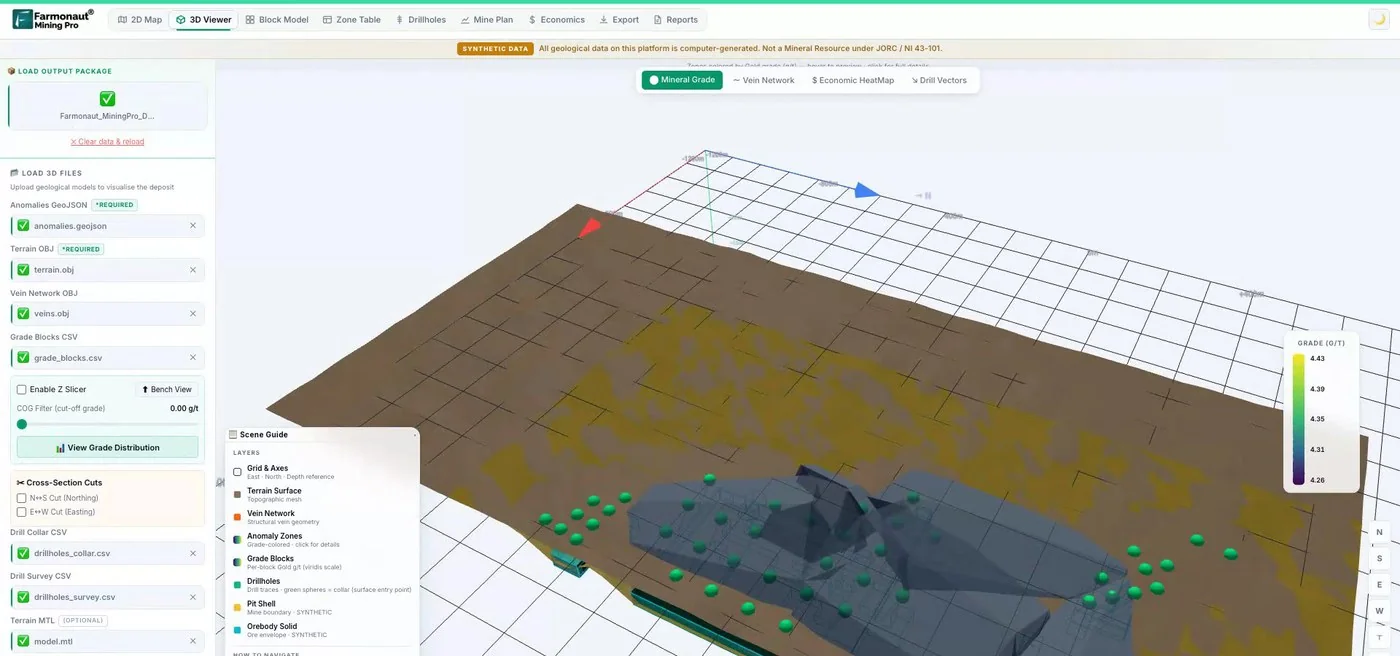
Mining Pro sample view, synthetic data
Keep reading
Sources
- Keene Engineering, dredge and pump notes: keeneeng.com
- Keene Engineering, 5-inch dredge model 5109H product report: keeneeng.com
- Keene Engineering, master price list 2 May 2025: keeneeng.com
- Proline Mining Equipment, 5-inch gold dredges: prolinemining.com
- Washington, WAC 220-660-305 (mineral prospecting with motorized or gravity siphon equipment): app.leg.wa.gov
- Oregon DEQ, 700-PM permit renewal fact sheet: oregon.gov
- Alaska DEC, general permit AKG375000 (modified 30 January 2026): dec.alaska.gov
- California Department of Fish and Wildlife, Suction Dredge Permits: wildlife.ca.gov
- Idaho DEQ, IPDES general permit for small suction dredge mining (issued 24 May 2024); earlier EPA permit IDG370000 (2018): deq.idaho.gov
- British Geological Survey, Good practice in the design and use of large sluice boxes (CR/02/029N, 2002): nora.nerc.ac.uk
- US EPA, Artisanal and small-scale gold mining without mercury: epa.gov
- USGS, Rivers of Gold: Placer Mining in Alaska (Fact Sheet 058-98, 1998): pubs.usgs.gov
- Parks Canada, Dredge No. 4 National Historic Site: parks.canada.ca
Discussion
Questions, corrections or field experience? Share them below. First-time comments are reviewed before they appear, and your email is never published.
No comments yet. Be the first to add a question or your experience.

 VRV Global Pte Ltd
 Omsri International FZE
 G.I.T.T.
 Jaunita Erss Ltd
 Almosi SARL
 SRK Consulting
 Berks Gold Limited
 Mwerezi Minerals Company Limited
 Mining SARL
 SenGold Invest SAS
 Sean Mining Limited
 NTS Group (Pty) Ltd
 Mine4Africa
 Lithspo Minerals Limited
 Tintina Mining Group
 Licence holder · Nigeria · Gold + lithium










