

Gold detectors · Product review
Minelab Gold Monster 1000: Price, Specs, Verdict
The Minelab GM1000 is a 45 kHz single-frequency gold detector priced at US$899 with a 5-inch coil on Minelab’s US store (16 October 2026). It is not a Multi-IQ machine. This page checks the specs, compares three rivals and shows when it repays its cost.
Key takeaways
- Minelab USA lists the GM1000 with the 5-inch coil at US$899.00; Kellyco showed an MSRP of US$1,079.00 and the same US$899.00 sale price (both 16 October 2026).
- It is a single-frequency VLF detector at 45 kHz with a 24-bit processor. It is not a Multi-IQ detector (Minelab USA; Kellyco).
- It weighs 1.33 kg (2.94 lb) without the battery; the 5-inch coil is waterproof to 1 m, but the control box is only rainproof (Minelab USA).
- At an example gold price of US$4,150 per troy ounce, a 5-grain nugget is worth about US$43 as metal, so repayment takes many finds.
- On US Bureau of Land Management land, federal rules class metal detector use as casual use, but parks, wilderness, claims and private land have separate limits (43 CFR 3809.5).
In this article
- Minelab Gold Monster 1000 specs at a glance
- Minelab Gold Monster 1000 price and where it varies
- How the GM1000 finds gold: one frequency, not Multi-IQ
- Gold Monster 1000 vs Gold Bug 2, AT Gold and Gold Kruzer
- Who should buy this detector and who should not
- Will a GM1000 pay for itself?
- How to set up and use the GM1000 in the field
- Where you may use a gold detector
- Gold Monster 1000 official website, manual and where to buy
- What a hand detector cannot do: detector versus satellite
- Frequently asked questions
The Minelab Gold Monster 1000 (often shortened to GM1000) is an entry-level gold detector that costs US$899 with a 5-inch coil on Minelab’s US store (checked 16 October 2026). It runs on one fixed frequency of 45 kHz, weighs 1.33 kg (2.94 lb), and sets its own ground balance, sensitivity and noise cancel. This page gives the maker’s specifications, dated prices, a comparison with three rival detectors, a payback calculator and the rules that decide where you may use one. It is written for prospectors, consultants and licence owners who want to know what a hand-held detector can and cannot do.
Many pages about this detector repeat claims that do not match the maker’s data. The most common mistake is calling it a “Multi-IQ” detector. It is not. We corrected that and several other figures from older pages.
Minelab Gold Monster 1000 specs at a glance
Minelab introduced the detector in 2017 and it is still in production, according to a long-time prospector’s review on DetectorProspector. Minelab’s own product page describes it as combining a 24-bit signal processor with a 45 kHz VLF frequency. VLF means very low frequency, the common type of detector that sends a continuous signal into the ground and listens for a response from metal. Frequency is the number of signal cycles per second; 45 kHz is 45,000 cycles per second.
| Feature | What the maker and retailers state |
|---|---|
| Technology | Single-frequency VLF at 45 kHz, 24-bit processor (Minelab USA) |
| Weight | 1.33 kg (2.94 lb) (Minelab USA; excluding battery per Kellyco); collapses to 94.4 cm (37.2 in) |
| Coils | 5-inch round double-D (GM05) and 10 x 6-inch elliptical double-D (GM10); the 5-inch coil is waterproof to 1 m (3.3 ft) (Minelab USA) |
| Control box | Rainproof, not submersible (Minelab USA) |
| Ground balance | Automatic (Easy-Trak); no manual control |
| Sensitivity | Manual levels 1 to 10, Auto (11) and Auto+ (12) |
| Detect modes | Gold (iron reject) and Deep All-Metal (Kellyco spec sheet) |
| Target display | Gold Chance Indicator, a gauge that moves right for likely gold and left for iron or hot rocks |
| Power | Rechargeable Li-ion battery included, or 8 AA cells (not included); 20 hours quoted in the DetectorProspector table |
| Warranty | 2 years on control box and coil (Kellyco) |
Two points matter for buyers. First, the detector has no manual ground balance and no true threshold control, so you cannot tune it by hand the way you can a Fisher Gold Bug 2. Second, only the coil is waterproof. Keep the control box out of deep water.
Minelab Gold Monster 1000 price and where it varies
The price depends on the coil, the retailer and the date. On 16 October 2026 Minelab’s US store listed the detector with the 5-inch coil at US$899.00. The same day, Kellyco showed a manufacturer’s suggested retail price (MSRP) of US$1,079.00 and a sale price of US$899.00, with a US$180 saving. A separate retail listing on Metal Detecting World showed US$799.00, and the 2018 DetectorProspector table listed an internet price of US$849.00. The older prices are not today’s prices; use them only to see how the market has moved.
Chart
GM1000 listings seen, US$
US dollars, 5-inch coil package unless noted; each bar is labelled with its source and date (MDW = Metal Detecting World, DP = DetectorProspector)
Prices in Australia, the UK and Africa differ because of import duty, tax and exchange rates, so check a local Minelab dealer. Bundles that add the 10 x 6-inch coil, a pinpointer or a shovel cost more. A new buyer should compare the same coil package at two or three authorised dealers, not just the headline price.
How the GM1000 finds gold: one frequency, not Multi-IQ
Detector makers pick a frequency as a trade-off. According to Minelab’s own comparison, quoted on the Kellyco product page, an 18 kHz detector has a depth advantage on nuggets of 1.0 g or more over a basic mid-frequency machine, and a 71 kHz detector has an advantage on nuggets of 0.1 g or less. The GM1000 sits between them at 45 kHz. Minelab says this suits a wide range of nugget sizes. The maker’s claim is a design goal, not a lab result you can check, so treat it as a description of intent.
Higher frequencies find tiny gold more easily but cope worse with mineralised ground. The DetectorProspector review notes that the GM1000 is still a single-frequency machine and cannot match both extremes at once. The reviewer says its automatic ground tracking is what lets a 45 kHz detector work in hot rocks and wet alkali ground.
Multi-IQ is a different Minelab technology that transmits several frequencies together. It appears in the Equinox and Vanquish ranges, for example 5 to 40 kHz on the Vanquish 540. The GM1000 is not on that list. If a page says this model uses Multi-IQ, it is wrong.
The detector cannot see gold. It senses how metal and mineralised soil disturb its signal, and a Gold Chance Indicator estimates whether the target is likely to be gold. The indicator is a guide, not proof. Dig the signals, because a small gold nugget and a bit of lead shot can read similarly.
Gold Monster 1000 vs Gold Bug 2, AT Gold and Gold Kruzer
This comparison uses only figures from maker pages, maker spec sheets and the named reviews. We chose three popular single-frequency gold detectors that compete on price or on tiny-gold sensitivity, plus one pulse induction machine to show the next step up. We left out detectors with no published spec sheet. Rival prices change often, so check each maker or dealer.
Chart
Operating frequency of four VLF gold detectors
Kilohertz (kHz), single-frequency VLF models
| Detector | Technology and frequency | Stated weight | Water rating | Source |
|---|---|---|---|---|
| Minelab GM1000 | VLF, 45 kHz, automatic ground balance | 1.33 kg (2.94 lb), no battery | Coil 1 m; control box rainproof | Minelab USA |
| Fisher Gold Bug 2 | VLF, 71 kHz, manual ground balance | 2.9 lb | Dust and moisture resistant; waterproof coil | Metal Detecting World |
| Garrett AT Gold | VLF, 18 kHz, manual and automatic ground balance | 2.8 lb | Submersible to 10 ft (3 m) | DetectorProspector, Garrett |
| Nokta Gold Kruzer | VLF, 61 kHz, automatic, manual and tracking ground balance | 1.4 kg (3 lb) with coil and batteries | Waterproof coils | Nokta spec sheet |
| Minelab GPX 6000 (pulse induction) | Pulse induction, not VLF | 2.1 kg (4.6 lb) | Coil waterproof to 1 m | Kellyco |
Pulse induction (PI) detectors send short pulses instead of a steady signal. They are a separate class of machine, built for ground where VLF detectors struggle. The GPX 6000 is included to show the step up in weight; the Kellyco page also lists an 8-hour battery life.
Best for, with honest pros and cons
- GM1000. Best for a beginner who wants a light, automatic machine for small gold. Pros: low weight, automatic setup, rechargeable battery. Cons: no manual ground balance, no threshold control, only the coil is fully waterproof.
- Fisher Gold Bug 2. Best for a user who wants manual control and the highest frequency. Pros: 71 kHz for tiny gold, a 5-year warranty on most retailer listings. Cons: needs manual ground balancing and has no rechargeable battery option on the listing, since it uses two 9-volt batteries.
- Garrett AT Gold. Best for creek work where you may wade deep. Pros: submersible to 10 ft, a true all-metal mode, manual and automatic ground balance. Cons: a lower frequency of 18 kHz favours larger nuggets over very small ones, and a reviewer on DetectorProspector says it is not well suited to highly mineralised ground.
- Nokta Gold Kruzer. Best for a user who wants a high-frequency machine with several ground balance choices. Pros: 61 kHz, waterproof coils, a 2-year warranty. Cons: as the DetectorProspector review explains for high frequencies in general, ground handling suffers in mineralised soil.
Who should buy this detector and who should not
Buy it if you are new to nugget hunting, hike long distances with your gear, or want a machine that stays quiet without constant tuning. The DetectorProspector reviewer says it is designed for gold prospecting and that expecting it to match machines that cost many times more is unrealistic.
Look elsewhere if you need depth on larger gold in very mineralised ground, want to wade past the control box, or need to work on a licence area where an operator expects a survey. A pulse induction machine suits ground with heavy iron staining. A detector also cannot tell you whether a district is worth a licence; it only covers the ground under the coil.
Will a GM1000 pay for itself?
Gold is priced per troy ounce, and one troy ounce is 480 grains or 31.1035 g. The DetectorProspector review notes that a skilled user found nuggets under one grain with the 5-inch coil, and one grain is about 0.065 g. At an example gold price of US$4,150 per troy ounce (the Kitco live quote was near this level when we looked on 16 October 2026; check today’s price), a 5-grain nugget (0.32 g) is worth about US$43 as raw metal. The figure moves with the price. The USGS lists a price of US$3,300 per troy ounce for 2025 (estimate) in its Mineral Commodity Summaries 2026.
Chart
Gold price per troy ounce, 2021 to 2025
US dollars per troy ounce; 2025 is a USGS estimate
Use the calculator below with your own numbers. The default result shows why most owners treat a detector as a hobby tool, not a business plan: at 8 small nuggets a year the machine takes about nine years to repay once running costs are counted. Nuggets sold as specimens or jewellery can sell above their metal value, so enter your own realised price if that applies.
Calculator
How many nuggets repay the detector?
Enter your own detector price, gold price, nugget size, finds per year and running costs.
- Metal value of one nugget: $43
- Weight of one nugget in grams: 0.32
- Gold found per year: $346
- Net per year after running costs: $96
- Years to repay the detector: 9.4
Example values only, not a forecast or typical finds. The detector price is a US$899 example from Minelab USA (16 October 2026). The gold price is an example, use today’s price. One troy ounce is 480 grains (31.1035 g). Raw metal value only: specimen premiums, tax and selling fees are not included. If net income is zero or negative, the years figure is not meaningful.
How to set up and use the GM1000 in the field
- Charge the battery and pick a coil. Minelab sells a 5-inch round coil and a 10 x 6-inch elliptical coil; the 5-inch version is the US$899 package.
- Switch on away from metal. The detector cancels electrical noise automatically at start-up, so do not hold it near phones, vehicles or power lines when you turn it on.
- Start in Gold mode with Auto sensitivity. The DetectorProspector reviewer used Auto+ in wet alkali ground, and manual levels 1 to 10 are there for targeting small areas.
- Read the Gold Chance Indicator. A reading toward the right favours gold; toward the left suggests iron or a hot rock.
- Use Deep All-Metal for faint targets. Gold mode adds iron reject; All-Metal does not, so expect more iron signals.
- Fill every hole. Leave the ground as you found it, and never use mercury to recover gold.
Where you may use a gold detector
Permission comes first. On US public land managed by the Bureau of Land Management, federal rules define “casual use” as activities that cause no or negligible disturbance, and they say it generally includes metal detectors and battery-operated devices that sense minerals, as set out in 43 CFR 3809.5. Casual use excludes mechanised earth-moving equipment, explosives and chemicals. That is the federal minimum; states, national parks, wilderness areas, archaeological sites and private land have their own rules, and an active mining claim belongs to its owner. Check the local land manager before you go.
Outside the US, rules differ by country. Many jurisdictions require a prospecting or fossicking permit for any gold detecting, and private land always needs the owner’s consent. Our short video explains why owning a claim is not the same as owning the land.
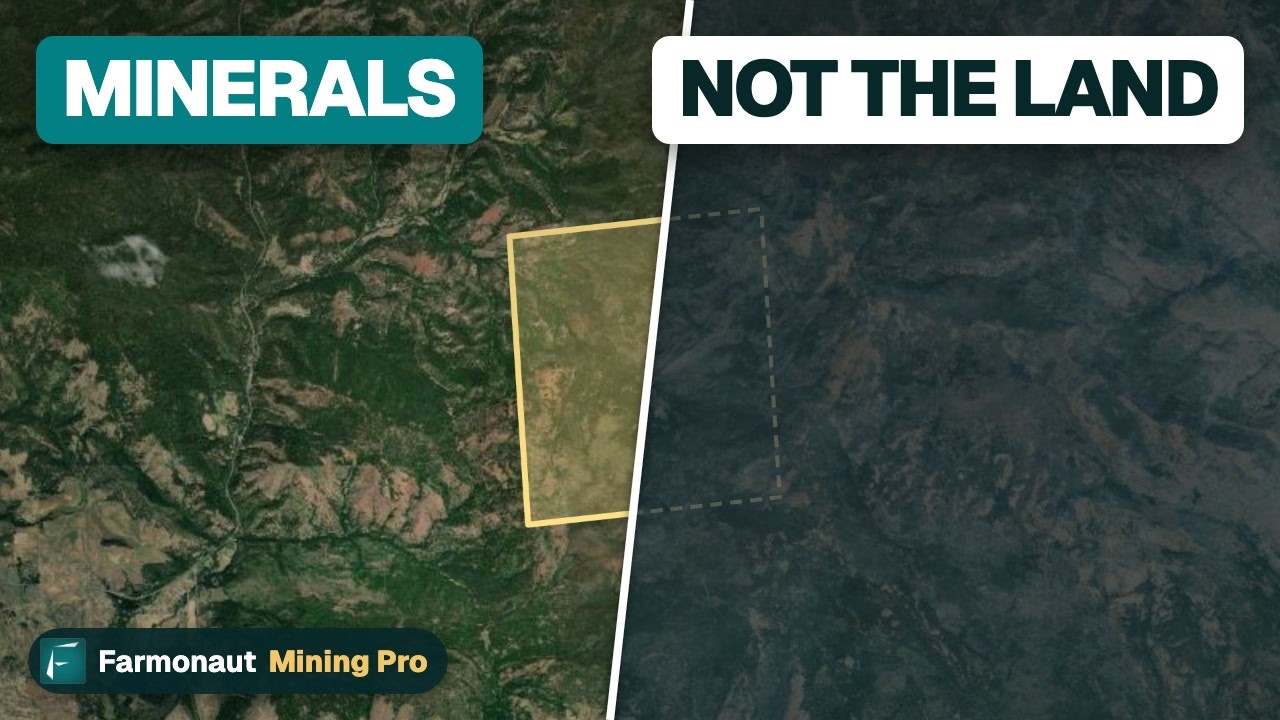
▶ Explains that a gold claim gives mineral rights, not ownership of the land, and how to check the ground first. · 3:19
Gold Monster 1000 official website, manual and where to buy
The official product page is on Minelab’s website. The US store is at usa.minelab.com and lists the technical specifications, product downloads and the two coils. For a dealer near you, use the “Find a Dealer” link on Minelab’s site. Retailers such as Kellyco show stock and bundles but may price differently, so compare against the maker’s list.
What a hand detector cannot do: detector versus satellite
A detector covers a strip a few centimetres wide, one swing at a time. It suits a known nugget patch. It cannot show which hill, creek or fault zone deserves a licence. At the district scale, satellites such as Sentinel-2 record 13 spectral bands at 10, 20 and 60 m resolution (10 m for the visible and near-infrared bands), according to the European Space Agency. No satellite sees gold itself; it maps rock and alteration patterns that guide where to put boots and detectors. Farmonaut’s Mining Pro workflow screens a licence boundary from space to rank areas for ground follow-up, and our satellite gold map guide explains how to read one.
For a wider comparison of detector brands, see our gold detector specs and prices, the shorter Gold Monster feature list, and our guide to where to find gold nuggets.
▶ An honest answer on whether a satellite can detect gold: it maps the alteration halo, not the metal. · 2:00
Frequently asked questions
Is the Minelab GM1000 waterproof?
Only partly. The 5-inch coil is waterproof to 1 m (3.3 ft), but the control box is rainproof, not submersible, according to Minelab USA.
What frequency does the GM1000 use?
It uses a single 45 kHz VLF frequency with a 24-bit signal processor. It is not a multi-frequency or Multi-IQ detector.
How much does the Minelab Gold Monster 1000 cost?
Minelab USA listed the 5-inch coil version at US$899.00 on 16 October 2026. Kellyco showed an MSRP of US$1,079.00 and a sale price of US$899.00 the same day. Prices differ by coil, bundle, dealer and country.
How much does the GM1000 weigh?
Minelab states 1.33 kg (2.94 lb), and Kellyco says this excludes the battery. DetectorProspector lists 3.2 lb with the rechargeable battery and the 10-inch coil.
How long does the battery last?
DetectorProspector’s specification table gives 20 hours of operating time, and a Metal Detecting World listing gives 20 to 25 hours. Real run time depends on volume, temperature and battery age, so treat both as maker-style figures. Older web pages that say 8 to 12 hours do not match these sources.
Is the GM1000 good for beginners?
Yes, that is its design purpose. Ground balance, sensitivity and noise cancel are automatic, and the Gold Chance Indicator gives a visual hint before you dig. It still takes practice to learn what weak signals mean.
Can the GM1000 find deep gold?
Depth depends on nugget size, ground and settings, and Minelab’s own comparison shows that other frequencies do better on some nugget sizes. The Deep All-Metal mode is the option for faint targets.
Does the GM1000 work in salty or mineralised ground?
A reviewer reports it working in hot rocks and wet alkali ground using automatic ground balance and Auto+ sensitivity. Very heavy mineralisation can still favour a pulse induction detector.
Where is the official Gold Monster 1000 website?
Minelab’s US product page is usa.minelab.com/gold-monster-1000-5-inch. It carries the specifications, downloads and accessories. Use it to check any claim you read elsewhere.
Do I need a permit to use a gold detector?
It depends on the land and country. On US Bureau of Land Management land, metal detecting is generally treated as casual use under federal rules, but wilderness areas, archaeological sites, private land and active claims have separate limits. Ask the land manager.
Which is better, the GM1000 or the Gold Bug 2?
The GM1000 is fully automatic and weighs 1.33 kg without the battery; the Gold Bug 2 lists 2.9 lb. The Gold Bug 2 runs at 71 kHz with manual ground balance and suits users who want full control for the smallest gold. Neither is better in every ground.
This page is for information only. It is not investment advice, and prices change daily. Confirm the rules with the land manager or regulator before you detect, get permission before you enter any land, and never use mercury to recover gold.
Farmonaut mining
Map your mining site from space
Consultants and licence owners can have a licence area screened by satellite to rank ground for follow-up, as an exploration target ahead of any resource estimate.

Mining Pro sample view, synthetic data
Keep reading



Sources
- Minelab USA, GM1000 with 5-inch coil (16 October 2026): usa.minelab.com
- Kellyco, Minelab GM1000 with 5-inch coil (16 October 2026): kellycodetectors.com
- DetectorProspector, Minelab GM1000 review and specifications: detectorprospector.com
- Metal Detecting World, Minelab GM1000 specifications: metaldetectingworld.com
- Metal Detecting World, Fisher Gold Bug 2 specifications: metaldetectingworld.com
- DetectorProspector, Garrett AT Gold database entry: detectorprospector.com
- Garrett, AT Gold product page: garrett.com
- Nokta, Gold Kruzer specification sheet: gpscentral.ca
- Kellyco, Minelab GPX 6000: kellycodetectors.com
- Kellyco, Minelab Vanquish 540 (Multi-IQ): kellycodetectors.com
- Cornell Law School LII, 43 CFR 3809.5 definitions (casual use): law.cornell.edu
- USGS, Mineral Commodity Summaries 2026: Gold: pubs.usgs.gov
- European Space Agency, Sentinel-2: esa.int
Discussion
Questions, corrections or field experience? Share them below. First-time comments are reviewed before they appear, and your email is never published.
No comments yet. Be the first to add a question or your experience.

 Klusetic Mining Investments
 Mine4Africa
 Lithspo Minerals Limited
 Tintina Mining Group
 Dalgety Minerals Pty Ltd
 Vortex Minerals Pty Ltd
 Faith At Work (Pty) Ltd
 Geotech Mining Solutions plc
 Vulcan International Limited
 Kidepo Associates
 GKY Mining
 Alkimy SARL
 Double A Trading
 GemSprout Metals Limited
 Qader Group
 Ileys General Trading
 SG Gold Mining LLC
 VRV Global Pte Ltd
 Omsri International FZE
 G.I.T.T.
 Jaunita Erss Ltd
 Almosi SARL
 SRK Consulting
 Berks Gold Limited
 Mwerezi Minerals Company Limited











