

Mine haulage · Selection guide
Haulage System in Mining: Types, Costs and How to Choose
A haulage system moves rock from the working face to a crusher, dump or shaft by truck, conveyor, rail or hoist. A 2023 University of Alberta paper puts it at about 50-60% of mining costs. Compare the options and test your own numbers.
Key takeaways
- Trucks suit changing layouts; conveyors suit high tonnage on fixed routes; rail and hoists serve large or deep underground mines.
- Haulage is about 50-60% of mining costs, according to a 2023 University of Alberta mine-optimization paper.
- Powered haulage accidents accounted for 13 of 33 US mining deaths in 2025 (MSHA).
- Komatsu reported 1,000 autonomous ultra-class trucks commissioned by April 2026; large battery trucks remained mainly in trials or commissioning in the 2025-26 reports cited.
- Published shaft versus ramp rules of thumb fall mostly between 250 m and 500 m, and the changeover gets shallower as output rises.
In this article
- Types of Haulage Systems in Mining: Trucks vs. Conveyors, Rail and Hoists
- Underground Mining Haulage Systems: How Depth Changes the Choice
- Comparative Table of Traditional vs. Advanced Haulage Systems
- Technological Advancements Shaping Haulage Systems
- Key Design Considerations and Challenges in Modern Haulage Systems
- How to Choose a Haulage System: 6 Steps
- Haulage Costs: What the Numbers Show
- The Role of Haulage Systems in Sustainable Mining
- Satellite-Driven Mineral Intelligence: The Farmonaut Approach
- The Future of Haulage Systems: What to Watch
- Frequently asked questions
A haulage system in mining is the equipment and route that move rock from the working face to a crusher, stockpile, waste dump or shaft. The main options are trucks, conveyors, rail and shaft hoists, and most large mines combine two or more. A 2023 University of Alberta mine-optimization paper puts haulage at about 50-60% of mining costs, so this choice shapes a project’s economics for decades.
This guide compares each system, gives dated results from working mines, sets out the US safety rules and lets you test a truck and conveyor cost on your own numbers. It is written for owners, consultants and mine staff who have to choose or defend a material-handling plan.
Types of Haulage Systems in Mining: Trucks vs. Conveyors, Rail and Hoists
Haulage splits first by where the mine is. Open pits rely mainly on trucks, sometimes feeding a conveyor. Underground mines add loaders, rail, inclined conveyors and shafts. The right system depends on tonnes per year, distance, lift, mine life and how often the working face moves.
Truck haulage
Mining haulage trucks are rigid or articulated off-highway vehicles. Their advantage is flexibility: a truck can follow the pit as it changes, and capacity grows one truck at a time. The drawbacks are fuel or power use, tyre and road costs, and the empty return trip, which carries nothing but the truck’s own weight.
Best for: changing pit layouts, shorter mine lives, several active loading points and small to medium underground mines reached by a ramp.
Conveyor haulage
Continuous haulage means material moves without a load-and-return cycle. A belt conveyor is the usual example. In-pit crushing and conveying (IPCC) places a crusher inside the pit so that rock can travel out on a belt. The University of Alberta paper lists lower emissions, less deadweight transport, lower road maintenance and, in most cases, lower labor and fuel costs. It also lists the price: high capital paid up front, a layout that is hard to change, and a single stream in which one failed component can stop all production.
Best for: high, steady tonnage along a route that will stay fixed for many years.
Rail haulage
Rail suits very high tonnage over fixed underground or surface routes. At Grasberg Block Cave in Indonesia, the design published in 2016 calls for 160,000 tonnes of ore per day from 119 chutes over 28 km of track to underground crushers. A 2020 project update describes the system as automated. The mine had a mud rush in September 2025, and Freeport reported it was still in a phased ramp-up in October 2026. The mine had a mud rush in September 2025, and Freeport reported it was still in a phased ramp-up in October 2026.
Best for: block caves and other long-life operations with a large, predictable flow.
Shaft hoisting and other mine shaft transport systems
A hoist lifts rock in containers called skips up a vertical shaft. It costs a lot to sink a shaft, but operating costs can be low at depth. Shafts also usually carry people and materials, so they are part of the wider access plan as well as the ore route.
Best for: deep mines and higher production rates, where a long truck climb becomes slow and expensive.
Hybrid systems
Many plans mix these methods: loaders or trucks gather rock at the face, and a conveyor, train or hoist handles the long trunk route. Trucks keep the flexibility where the mine changes daily, while the fixed system takes over where the route is stable.
Underground Mining Haulage Systems: How Depth Changes the Choice
Underground haulage has two stages. Load-haul-dump machines (LHDs, low loaders that dig and carry) move broken rock to an orepass or truck. A main system then takes it to surface. The key decision is usually truck ramp or shaft.
Chart
Published truck ramp depths from shaft versus ramp rules of thumb
Metres of vertical depth; each rule assumes a different deposit or output
A 2012 paper in Archives of Mining Sciences gathers published rules of thumb. These are older screening figures, and they differ because each author assumes a different deposit size and production rate. The same paper says the best changeover depth gets shallower as the production rate rises.
Modern studies test more options. SRK Consulting’s trade-off study for ABB compares hoisting, trucks and conveyors at 600 m, 900 m and 1,400 m on net present value, cost per tonne, energy, ventilation and development. Those are the right measures for a site study. Ventilation matters especially, because diesel exhaust underground has to be diluted with fresh air, and moving that air costs money.
Custom underground haulage systems are normal rather than unusual, because the orebody shape, rock quality and shaft position differ at every mine. Treat a published depth as a starting question for an engineer, not as the answer.
Comparative Table of Traditional vs. Advanced Haulage Systems
This table compares traits rather than scores. Cost and availability depend heavily on the site, so a single percentage for each system would mislead.
| System | Main strength | Main limit | Typical setting | What to test in a study |
|---|---|---|---|---|
| Diesel trucks | Flexible; capacity added in small steps | Fuel, tyres, roads and empty return trips | Open pits; ramps in smaller underground mines | Cycle time, fuel price, road upkeep |
| Autonomous trucks | Longer operating hours; fewer people in the loading and dumping areas | Software, site mapping, workforce change | Large open pits | Utilization gain against conversion cost |
| Battery-electric or trolley-assist trucks | Lower site diesel use | Charging or overhead lines; few production-scale results so far | Long uphill hauls; decarbonizing sites | Power supply, charging time, payload |
| Conveyor or IPCC | Continuous flow; can cut diesel sharply | High capital; less flexible; single stream | High tonnage on a stable route | Relocation plan, downtime, feed trucks still needed |
| Rail | Very high tonnage on a fixed route | Fixed track and limited grade | Block caves; long-life mines | Chute layout, track upkeep, automation |
| Shaft hoist | Fast vertical lift at depth | Long development time; high capital | Deep or high-output underground mines | Timing of the shaft decision, depth, output |
Technological Advancements Shaping Haulage Systems
Autonomous haulage systems for the mining industry
An autonomous haulage system (AHS) runs trucks without an operator on board, under central control. It has moved well beyond trials. Komatsu said in April 2026 that it had commissioned its 1,000th autonomous ultra-class truck, at Nevada Gold Mines, and that customers had moved over 11.5 billion tonnes with its system since 2008. Nevada Gold Mines’ July 2025 release covers its 300 and 230 tonne trucks at its surface operations.
Results reported by operators are useful, but they are company figures from specific sites. Rio Tinto said in 2018 that its Pilbara autonomous trucks ran 700 hours longer the previous year, at 15% lower unit cost. A 2019 report on Fortescue cited a 30% productivity improvement at site. Newmont approved US$150 million in 2020 for autonomous trucks at Boddington, forecasting an internal rate of return above 35%. That was a forecast at approval, not a measured result.
Battery-electric trucks and trolley assist
Electric haulage is at an earlier stage. Trolley assist means a truck draws power from overhead lines on part of the route. At Kansanshi in Zambia, a Hitachi full-battery truck ran from June 2024 to August 2025 in a feasibility trial, covering more than 4,000 km and hauling over 30,000 tonnes.
Other trials include two Cat 793 XE trucks at Jimblebar in Western Australia and an eight-truck battery-swap fleet at Oyu Tolgoi in Mongolia. Fortescue reported in May 2026 that it had fitted its first 240-tonne Liebherr T 264 with its own power system and begun commissioning 6 MW chargers. These milestones show technical progress. They do not yet prove the economics of a whole production fleet, so ask for cycle time, availability and energy data rather than headlines.
Monitoring and dispatch software
Fleet software assigns trucks to loaders and dump points, while sensors track belts, motors and tyres so that repairs can be planned. Our own report on drill and blast monitoring software covers a related step, since rock fragmentation also affects loading and belt wear. Ask any vendor for before-and-after data from a mine like yours.

▶ What AI software in mining really does, and questions to ask its makers · 3:52
Key Design Considerations and Challenges in Modern Haulage Systems
Open-pit design: haul roads and cycle time
Truck output comes down to payload and cycle time: load, loaded haul, dump and empty return. Steep or rough roads slow every cycle, and soft surfaces also add tyre wear and fuel use. Good roads, drainage and regular grading are therefore production tools. Road width, grade and turning radii should come from the truck maker’s data and the site’s engineer.
Chart
Powered haulage share of US mining harm
Percent of US totals, 2025
In US surface metal and nonmetal mines, 30 CFR 56.9300 requires berms or guardrails where a drop-off could overturn a vehicle, at least mid-axle height of the largest self-propelled equipment that usually uses the road. Other countries set their own limits.
Underground design: ventilation, clearance and derailment prevention
Underground, the opening has to fit the equipment and leave safe clearance. Diesel fleets add to ventilation demand. For mine haulage derailment prevention, track condition sets the safe speed. US criteria for underground coal mines in 30 CFR 75.1403-8 tie speed to the roadbed, rails, joints and switches, keep clearance spaces clear of loose material, and call for stopblocks or derails at the top and landings of shafts, slopes and surface inclines. These points are a useful inspection list for rail haulage elsewhere too, but check the rules that apply to your mine type.
Load-out and transfer points
Mine load-out operations move product onto road trucks, trains or ships. Like underground chutes and belt transfers, they can limit the whole chain, because no haulage system moves more than its slowest point. Check surge capacity at crushers, bins and stockpiles before buying more trucks or a larger belt.
Safety: what the record shows
The US Mine Safety and Health Administration (MSHA) reports that powered haulage accounted for 13 of 33 US mining deaths in 2025 (39%) and 426 of 4,792 nonfatal injuries (9%). The equipment involved includes locomotives, shuttle cars and front-end loaders. MSHA’s final rule, filed for publication in December 2023, requires written safety programs for surface mobile equipment. It leaves belt conveyors outside that requirement, so conveyor hazards need their own controls. Our guide to mine safety solutions covers wider site measures.
How to Choose a Haulage System: 6 Steps
- Fix the tonnage and life. Estimate tonnes per year of ore and waste, and how long each route will last.
- Map the routes. Measure horizontal distance and vertical lift for each stage of the mine plan.
- Build the shortlist. Rule out options that cannot meet the rate, depth or terrain.
- Price the whole life. Include capital, replacement, power, tyres, roads, ventilation and labor. The Alberta paper notes that IPCC equipment may last 20-25 years, while trucks need major replacement after about seven to ten.
- Stress-test it. Run lower production, higher energy prices, plan changes and a long stoppage on any single-stream system.
- Get an engineering study. Use a qualified mining engineer before committing capital, and use contractors’ mining haulage services quotes as real inputs where you may outsource.
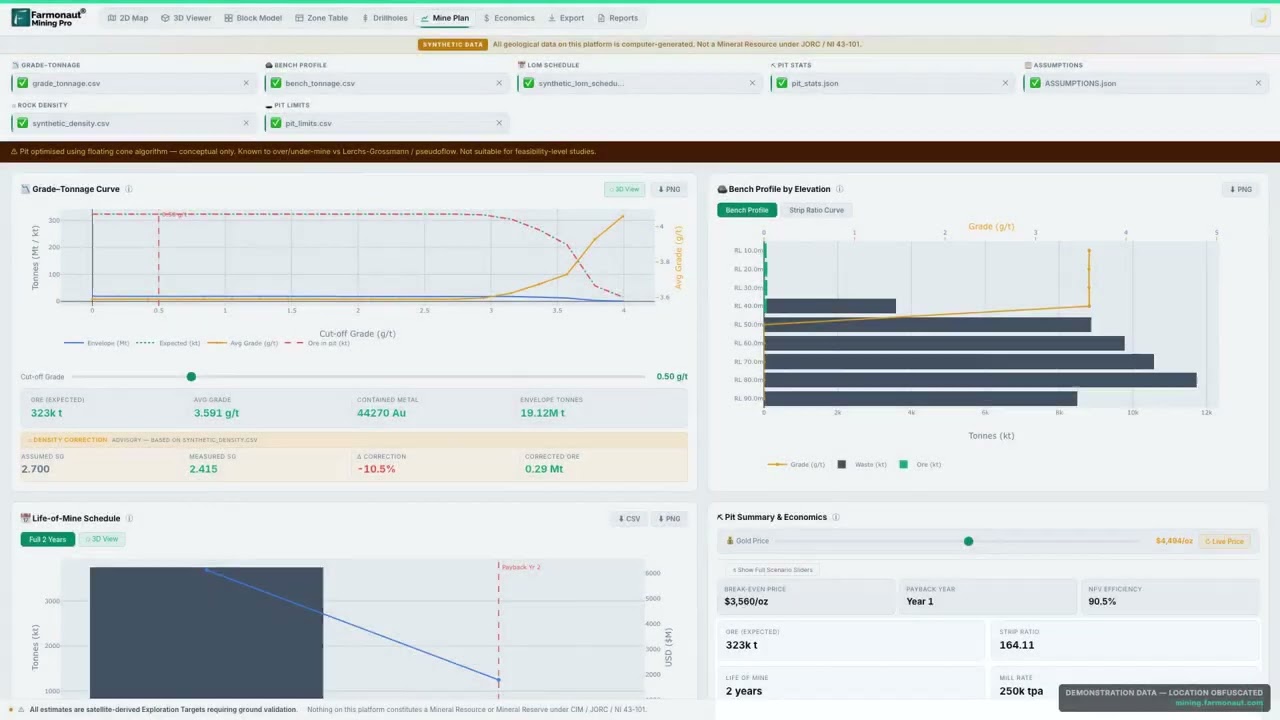
▶ How a mine plan builds a full cost picture, including engineering parameters · 14:58
Haulage Costs: What the Numbers Show
Public haulage costs are hard to compare because mines report on different bases. One detailed public benchmark is Natural Resources Canada’s open-pit energy study, built on calendar-2000 data from nine mines. Energy cost for hauling ranged from C$65 to C$158 per kilotonne of material removed, and from C$50 to C$162 per kilotonne of ore mined, for hauling ore to the crusher or stockpile. The figures are old, so the spread is more useful than the level: hauling cost more than twice as much at the highest mine as at the lowest, across a sample of gold, iron ore and oil sands sites. The study also found no energy saving per kilotonne at the larger mines despite their very large trucks.
Chart
Projected savings from IPCC at one copper mine
Percent reduction against diesel truck haulage; supplier projection
Chart
Hauling energy cost varied widely across Canadian open pits
C$ per kilotonne, calendar 2000, nine-mine study
For conveyors, equipment maker FLS published a study of a copper mine in Kazakhstan using over 50 million litres of diesel a year. It projects a 93% drop in diesel use, a 73% drop in Scope 1 CO2e and a 15% drop in operating costs from a relocatable crushing station. This is a supplier’s projection for one copper mine haulage system, so treat it as one example, not a norm. Note the gap: a very large fall in diesel gave a much smaller fall in operating cost.
Use the calculator below for a first comparison. A haulage result then feeds into wider mining profitability.
Calculator
How do trucks compare with a conveyor on your numbers?
Enter your own tonnage, truck and conveyor figures.
- Truck cost per tonne (US$): 1.50
- Conveyor cost per tonne (US$): 1.50
Example values only, not benchmarks or forecasts. Simple first pass: truck cost per operating hour covers all truck costs, and conveyor capital is spread evenly over its life with no discounting. Add any feed trucks to the conveyor running cost.
The Role of Haulage Systems in Sustainable Mining
Haulage is often the biggest target for cutting direct emissions at a surface mine. The International Copper Association Australia says, in a note on a ConnectOre briefing, that diesel haul fleets typically make up 30-80% of a site’s direct Scope 1 emissions at open-cut mines, with haul trucks alone at 30-50%. The practical options are shorter hauls, better roads, conveyors, trolley lines and battery trucks.
Electrifying only cuts total emissions as far as the power supply allows, so assess the grid or on-site generation together with the trucks. Conveyors and enclosed transfer points can also reduce truck dust and traffic, but each site still needs its own permits and impact assessment.
▶ The main environmental impacts of mining, explained simply · 2:31
Satellite-Driven Mineral Intelligence: The Farmonaut Approach
Haulage planning follows geology and terrain, so location questions come first. Farmonaut’s satellite-based mineral detection screens a licence area for exploration targets ahead of field work; these are targets, not a resource estimate or a haulage design. You can send questions through our contact page or request a quote.
The Future of Haulage Systems: What to Watch
- Autonomy in more commodities. Gold mines have followed, with Newmont approving a fleet for Boddington in 2020 and Komatsu’s system now at Nevada Gold Mines.
- Autonomy combined with electrification. Operators are testing whether the two can run together across a full fleet.
- Charging method. Static charging, in-motion trolley charging and battery swapping are all on trial, and the published trial reports do not show one winner.
- Production data. Published availability and cost per tonne from full fleets will matter more than demonstration milestones.
Frequently asked questions
What is a haulage system in mining?
It is the equipment and route used to move ore and waste from the working face to a crusher, stockpile, dump or shaft, such as trucks, conveyors, rail or hoists.
What are the types of haulage in mining?
The main types are truck, conveyor, rail and shaft hoisting. Underground mines also use load-haul-dump machines for the first stage, and many mines combine several types.
What is a continuous haulage system?
It moves material in a steady flow with no load-and-return cycle. Belt conveyors are the common example, including those fed by a crusher inside the pit.
Which is better, trucks or conveyors?
Neither wins everywhere. Trucks suit changing layouts and lower up-front spending. Conveyors suit high tonnage on stable routes if the mine can accept higher capital and less flexibility.
What is the best haulage system for underground mining?
It depends on depth, output and orebody shape. Ramps and trucks often suit small and medium mines, while shafts and conveyors gain ground as depth or output rises. A site trade-off study should decide it.
At what depth does a shaft beat a truck ramp?
Published rules of thumb gathered in a 2012 paper fall mostly between 250 m and 500 m, with one author putting break-even at 300-400 m. The depth tends to get shallower as the production rate rises.
How much of mining cost is haulage?
A 2023 University of Alberta paper says about 50-60% of mining costs. That refers to mining costs, not the total cost of producing metal, and it varies by site.
Do autonomous haul trucks save money?
Operators have reported gains, such as Rio Tinto’s 15% lower unit cost in 2018. Those are company figures from large sites, so a smaller mine should run its own conversion case.
Are electric mining haul trucks in production?
Large battery trucks were still mainly in trials or commissioning in the 2025-26 reports cited above. Ask suppliers for current data, because this area changes quickly.
How can a mine prevent haulage derailments?
Set speed by track condition, inspect the roadbed, rails, joints and switches, keep clearances clear of loose material, and use stopblocks or derails where the rules call for them.
This page is for information only. It is not engineering, legal or investment advice. Confirm designs with a qualified engineer and rules with your regulator.
Farmonaut mining
Screen your licence area from space
Get a quote for a satellite screen of your licence area before you commit to field work and infrastructure planning.

Mining Pro sample view, synthetic data
Keep reading
Sources
- Fahl et al., IPCC in long-term mine planning, MOL Report Eleven, University of Alberta (2023): sites.ualberta.ca
- Automated Train Ore Transport, MassMin 2016, AusIMM: ausimm.com
- Lara et al., Grasberg block cave mine rail project update, MassMin 2020, ACG: papers.acg.uwa.edu.au
- Archives of Mining Sciences 57(3), underground ore transport comparison (2012): czasopisma.pan.pl
- SRK Consulting, Hoisting trade-off study for an underground gold mine: srk.com
- International Mining, Komatsu commissions 1,000 autonomous ultra-class trucks (April 2026): im-mining.com
- Nevada Gold Mines and Komatsu press release (July 2025): s25.q4cdn.com
- MINING.COM, Rio Tinto autonomous trucks (January 2018): mining.com
- MINING.COM, Caterpillar and Fortescue (November 2019): mining.com
- Canadian Mining Journal, Newmont autonomous fleet at Boddington (February 2020): canadianminingjournal.com
- Mining Technology, Hitachi and FQM at Kansanshi (2026): mining-technology.com
- Mining Frontier, Battery electric haulage trials (2026): miningfrontier.com
- The Driven, Fortescue 240-tonne electric haul truck (May 2026): thedriven.io
- eCFR, 30 CFR 56.9300 Berms or guardrails: ecfr.gov
- Cornell LII, 30 CFR 75.1403-8 Track haulage roads: law.cornell.edu
- MSHA, Powered Haulage Safety: msha.gov
- MSHA, Safety Program for Surface Mobile Equipment final rule (December 2023): public-inspection.federalregister.gov
- Natural Resources Canada, open-pit mining energy benchmarking study (2000 data): natural-resources.canada.ca
- FLS, In-pit crushing and conveying performance study, Kazakhstan (2023): fls.com
- International Copper Association Australia, Haulage electrification: copper.com.au
Discussion
Questions, corrections or field experience? Share them below. First-time comments are reviewed before they appear, and your email is never published.
No comments yet. Be the first to add a question or your experience.

 Kidepo Associates
 GKY Mining
 Alkimy SARL
 Double A Trading
 GemSprout Metals Limited
 Qader Group
 Ileys General Trading
 SG Gold Mining LLC
 VRV Global Pte Ltd
 Omsri International FZE
 G.I.T.T.
 Jaunita Erss Ltd
 Almosi SARL
 SRK Consulting
 Berks Gold Limited
 Mwerezi Minerals Company Limited
 Mining SARL
 SenGold Invest SAS
 Sean Mining Limited

 Exploration consultancy · South Africa · Gold
 Client · Oregon, USA · Gold










