

Lonsdaleite · Evidence guide
Lonsdaleite Uses in Mining Tools: What Is Proven
Lonsdaleite, or hexagonal diamond, has no proven use in mining tools yet. Bulk pieces made in 2025 and 2026 are only slightly harder than cubic diamond. This page ranks the possible uses by evidence.
Key takeaways
- Lonsdaleite is a hexagonal form of carbon first reported in the Canyon Diablo meteorite (Nature, 1967); its established use is as an impact marker.
- A 2009 calculation predicted 58% higher indentation strength than diamond (Physical Review Letters); measured bulk samples are only slightly harder (Nature, 2025 and 2026).
- Lab pieces are 100 micrometres to millimetres in size; no cutter, bit or coating test is reported in the Nature abstracts.
- About 97% of US industrial diamond use is synthetic cubic diamond (USGS, 2026), so any new material must beat that on cost per metre.
- Heating cycles to 650 degrees C raised PDC cutter wear about 4.7 times in one 2026 lab study, which is where a heat-stable phase could matter.
In this article
- Where lonsdaleite comes from and how it was named
- Is lonsdaleite a real mineral? The 2014 challenge
- How lonsdaleite has been made in laboratories
- Lonsdaleite hardness: calculated, measured and claimed
- Lonsdaleite uses in mining tools ranked by evidence
- What diamond tools do today and what a new material must beat
- How much extra life would justify a higher bit price
- Seven checks before buying a "lonsdaleite" tool
- Where satellite data fits when the target is an impact structure
- Frequently asked questions
Lonsdaleite is a rare hexagonal form of carbon, also called hexagonal diamond. Today it has no proven use in mining tools. Labs in China made millimetre-sized pieces in 2025 and 2026, and the two Nature papers report a hardness only slightly above ordinary cubic diamond, far less than the 58% gain that a 2009 calculation predicted. No drill bit, saw or coating made of it is on sale from any source we cite. The tools that cut rock today use synthetic cubic diamond. This page separates what peer-reviewed research shows from what sales pages claim, ranks the possible uses by strength of evidence, and gives you a calculator to test what a longer-lived cutter could be worth.
Two terms first. Allotrope means a different arrangement of the same element: graphite, cubic diamond and lonsdaleite are all pure carbon. Vickers hardness (HV) is a test where a diamond pyramid is pressed into a surface and the dent is measured; results are quoted in gigapascals (GPa), where 1 GPa is about 145,000 pounds per square inch. In cubic diamond the carbon atoms sit in a cubic pattern. In lonsdaleite the same atoms are stacked in a hexagonal pattern, which is what could make the bonds between layers shorter and stronger.
Where lonsdaleite comes from and how it was named
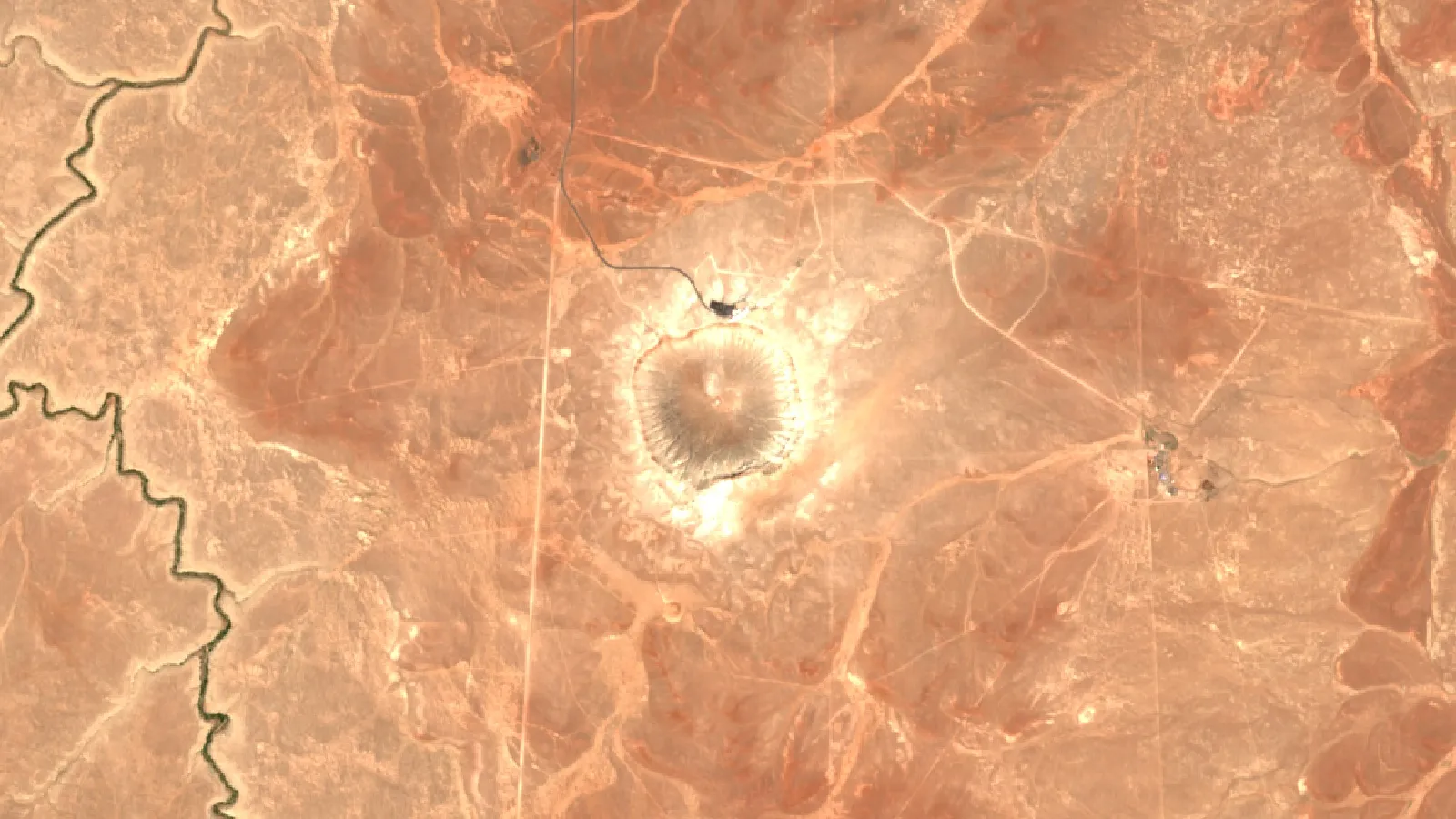
A hexagonal form of diamond was predicted by researchers in 1962. In 1967 it was reported in a meteorite found in Arizona, a piece of the space rock that made Meteor Crater. The team suggested that the shock of the impact turned graphite in the meteorite into this new form, and named it after the crystallographer Kathleen Lonsdale. The original report was a short paper in Nature in 1967; it describes the new phase as a wurtzite-like polymorph of diamond, meaning a hexagonal cousin of the cubic form, in the same way zinc sulphide has both a cubic form (sphalerite) and a hexagonal one (wurtzite).
The meteorite is known as Canyon Diablo, the iron meteorite from the Barringer impact in northern Arizona. Natural samples are tiny. The Canyon Diablo material studied in a 2014 Nature Communications paper was made of grains split into domains only 1 to 3 nanometres wide. A nanometre is one millionth of a millimetre, so this is not something a geologist picks out of a core tray. Lonsdaleite has therefore been used mainly as a marker of impacts: where it is reported, geologists read it as a sign that a shock event hit carbon-bearing rock. The same 2014 paper describes it as a widely used marker of asteroidal impacts.
That marker role is real but narrow. It matters to impact-structure geology, and to explorers who study impact craters for the ore they can host. It does not make lonsdaleite a deposit type you can mine. Nobody mines lonsdaleite, and nothing in the cited literature suggests any deposit holds it in volumes a processing plant could use.
Is lonsdaleite a real mineral? The 2014 challenge
For decades the answer was less certain than the textbooks implied. In 2014 a team led by Péter Németh published a paper whose title says it plainly: lonsdaleite is faulted and twinned cubic diamond and does not exist as a discrete material. Their electron microscope images of samples that had been called lonsdaleite showed cubic diamond full of twins and stacking faults. Those defects reproduce the X-ray peaks that earlier workers had taken as proof of a hexagonal phase. Their conclusion was that lonsdaleite had never been produced or described as a separate, pure material.
The argument turns on X-ray diffraction, where crystals scatter X-rays into a pattern of peaks. According to Oliver Tschauner, a mineralogist who reviewed one of the 2026 papers, a very defective cubic diamond can produce a pattern that closely mimics the hexagonal one, and a few extra telltale peaks are needed to prove the hexagonal structure, as Scientific American reported in March 2026. That is why a buyer should treat any “lonsdaleite” label on a product with care: the label is only as good as the diffraction data behind it.
The state of play in October 2026 is that the question has largely moved on. The 2026 Nature paper “Bulk hexagonal diamond” says its results resolve the long-standing controversy on whether hexagonal diamond exists as a discrete carbon phase, using millimetre-sized, phase-pure samples. Material of that size and purity can be tested directly, which natural samples never allowed. The 2014 view that the natural Canyon Diablo material is mostly defective cubic diamond is not overturned by this work; what changed is that a hexagonal phase now exists in the lab as a separate material.
How lonsdaleite has been made in laboratories
Two laboratory routes appear in the peer-reviewed record: shock compression and static high pressure with heat. They produce very different amounts of material.
Chart
Shock pressures in the graphite experiment
Gigapascals (GPa); pyrolytic graphite shock-compressed with X-ray diffraction
Shock compression. A 2016 study in Nature Communications shocked graphite to pressures from 19 up to 228 GPa and watched the structure with X-rays on nanosecond timescales. Diamond began to form from 50 GPa in both types of graphite tested. Lonsdaleite formed directly above 170 GPa, in pyrolytic graphite samples only. The authors say this explains why natural lonsdaleite is found close to meteor impact sites. The amounts are microscopic and exist for a fraction of a second, so this route teaches us about impacts rather than manufacturing.
Static high pressure and heat. In 2025 a team led by Ho-kwang Mao reported in Nature (volume 644, published 30 July 2025) that compressing and heating high-quality graphite single crystals under controlled, near-uniform pressure gave hexagonal diamond pieces from 100 micrometres up to millimetre size. The crystals were threefold intergrowths of tightly knitted 100-nanometre crystals, mostly hexagonal diamond with trace amounts of cubic diamond. In March 2026 a Zhengzhou University team published a second route in Nature. The university release says they made millimetre-sized pure hexagonal diamond from highly oriented pyrolytic graphite at 20 GPa and 1,300 °C, using a graphite-layer sliding strategy. For scale, 20 GPa is about 200,000 times atmospheric pressure, as the Scientific American report notes.
| Step | What was reported | Source type |
|---|---|---|
| 1962 | Hexagonal diamond predicted | Reported in Scientific American, 2026 |
| 1967 | Described from the Canyon Diablo meteorite | Nature, 1967 |
| 2009 | Calculation: indentation strength 58% above diamond | Physical Review Letters (theory) |
| 2014 | Natural samples shown to be faulted cubic diamond | Nature Communications |
| 2016 | Direct lonsdaleite formation seen above 170 GPa shock | Nature Communications |
| 2025 | Bulk pieces, 100 micrometres to millimetres | Nature |
| 2026 | Millimetre-sized phase-pure pieces | Nature |
The sizes matter for tool makers. A polycrystalline diamond cutter is made from many small diamond grains sintered together. Millimetre-sized single pieces are a long way from that, and none of the cited abstracts reports a way to make such pieces at tonne scale.
Lonsdaleite hardness: calculated, measured and claimed
Most of the excitement comes from one number. A 2009 paper in Physical Review Letters used first-principles computer modelling to show that, under an indenter, lonsdaleite undergoes a bond-flipping structural change that gives an indentation strength 58% higher than diamond. That figure is a calculation for a perfect crystal, not a test of a real sample. The authors’ own wording is that the effect sets a new record in the model.
Measured numbers have been lower. A 2021 preprint from Mao’s group, still on arXiv, reported Vickers hardness of 164 ± 11 GPa and 124 ± 13 GPa on two different faces of a bulk sample. The peer-reviewed Nature version published in 2025 describes the result differently: the abstract says the hardness of hexagonal diamond is only slightly higher than cubic diamond. The 2026 Nature abstract also says slightly higher hardness, with high thermal stability, and the Scientific American report adds that the material was stiffer and more resistant to oxidation. Mao told the magazine that trace cubic diamond in both teams’ samples could explain why the hardness falls short of the prediction.
| Claim | Basis | Status |
|---|---|---|
| 58% higher indentation strength | Computer model, 2009 | Prediction for a perfect crystal |
| 164 and 124 GPa Vickers hardness | Measured, 2021 preprint | Preprint; the published paper words the result as slightly higher |
| Slightly higher hardness than cubic diamond | Measured, Nature 2025 and 2026 | Peer reviewed |
| More oxidation resistant, high thermal stability | Measured, Nature 2026 | Peer reviewed, one team |
The practical reading: the best-supported claim is “slightly harder, probably more stable”, not “58% harder”. If a supplier quotes the 58% figure, ask which paper it came from, because the source is a calculation.
Lonsdaleite uses in mining tools ranked by evidence
Here are seven possible uses, ranked by how much published evidence exists today. The ranking metric is the strength of the peer-reviewed record for that use, from established to not yet shown. This is not a market ranking, because there is no market yet.
1. Impact marker in geology (established)
Best for: geologists reading impact structures. Lonsdaleite is widely used as a marker of asteroidal impacts, according to the 2014 paper, although that same paper warns that earlier identifications may need re-examining. Pros: real, cited use. Cons: it needs lab identification, not field tools, and it is not a tool material.
2. Drill-bit cutters (research target)
Best for: long-lived rock drilling in abrasive or hot ground. Scientists describe cutting tools among the hoped-for applications; Chongxin Shan of Zhengzhou University named cutting tools, thermal management materials and quantum sensing in the Scientific American interview. Pros: slightly higher hardness and good thermal stability were measured in the 2026 paper. Cons: the papers report millimetre pieces, not sintered cutters, and no cutter test is reported in their abstracts.
3. Heat-resistant cutting edges (research target)
Best for: hot wells and high-friction cutting. The 2026 abstract reports high thermal stability and the Scientific American report adds oxidation resistance. Conventional cobalt-bonded cutters lose life to heat (leached, heat-stable grades are made to resist this), which makes this the use with the clearest technical logic, covered with data in the next section. Cons: thermal stability of a millimetre piece is not the same as stability of a cobalt-bonded cutter in a bit.
4. Wear parts and liners (not shown)
Best for: nothing yet. Hard coatings and liners would need thin layers over large areas. The cited papers make bulk crystals from graphite under high pressure, a different process from coating. Pros: none established. Cons: no coating process is reported.
5. Abrasive grit and powder (not shown)
Best for: polishing and grinding. Diamond grit is already cheap: USGS gives a unit value of US$0.21 per carat in 2025 (estimate) for imported bort, grit and dust, natural and synthetic together. A new material would have to beat that on cost per unit of work, and no paper reports a lonsdaleite grit.
6. Sensors and thermal management (outside mining)
Best for: electronics and quantum sensing. These uses are named in the same interview but they are not mining tools.
7. Core-drilling bits and saw blades (not shown)
Best for: diamond core drilling. Switching a bit to a new diamond phase would need that phase as grains or sintered layers in large quantities, which none of the cited papers reports.
Items 4, 5 and 7 are plausible ideas, but none of the cited abstracts reports them as a result.
What diamond tools do today and what a new material must beat
To judge a new material you need the baseline. According to the USGS Mineral Commodity Summaries 2026, the major uses of industrial diamond include drilling for minerals, natural gas and oil, stone cutting and polishing, construction and machinery. About 97% of US industrial diamond apparent consumption was synthetic, because its quality can be controlled and its properties customised. Natural diamond accounts for less than 1% of all industrial diamond used worldwide, and at least 15 countries can make synthetic diamond.
Chart
PDC cutter wear rate before and after heating cycles
Specific wear rate, units of 10^-8 cubic mm per newton-metre; granite pin-on-disc test
Chart
US manufactured diamond bort, grit and powder
Million carats produced per year; 2025 is an estimate
Chart
World natural industrial diamond mine production, 2025 estimate
Million carats; named countries only (other countries add 1; world total 38)
The US made an estimated 160 million carats of manufactured diamond bort, grit and powder in 2025, up from 132 million carats in 2021 (USGS). One carat is 0.2 gram. The natural supply is much smaller: world mine production of natural industrial diamond was an estimated 38 million carats in 2025, and Russia alone gave 16 million.
The big wear problem in rock drilling is heat. A polycrystalline diamond compact (PDC) cutter is a layer of sintered diamond grains bonded with a metal, usually cobalt, on a tungsten carbide base. A 2026 conference study by researchers from Kazakhstan and Ukraine heated commercial PDC cutters up to 650 °C for up to 30 cycles, then ran an abrasion test against granite. The specific wear rate rose from 1.29 to 6.04 in units of 10-8 cubic millimetres per newton-metre, about 4.7 times. The authors blame differences in thermal expansion between diamond and the cobalt binder, early graphitisation at hot spots, and stress at microcracks.
That test is a simplified laboratory method, and the authors say so. It still shows where a hexagonal diamond with better thermal stability might help, and where it will be judged: wear rate after heating cycles, in a bonded cutter, against a PDC product that already exists.
How much extra life would justify a higher bit price
A longer-lived cutter is only worth more if the extra life saves money at the rig. The calculator below works out your cost per metre and the highest bit price that would break even for a given gain in life. Replace every example number with your own quotes. It does not assume that any lonsdaleite product exists; it is a way to test a supplier’s claim.
Calculator
What bit price does a longer-lived cutter justify?
Enter your own bit quote, rig cost and metres drilled. Results update as you type.
- Cost per metre now: $55
- Bit and trip cost per metre now: $15
- Highest price premium that breaks even: 46.0%
Example values only, not benchmarks. Bit price and rig cost are inputs: example, use today’s price. Cost per metre = (bit price + rig cost during the trip) divided by metres per bit, plus rig cost divided by penetration rate. Break-even price keeps cost per metre the same when the bit lasts longer. All money in US$.
Seven checks before buying a “lonsdaleite” tool
If a seller offers a tool, coating or powder under this name, ask these seven questions. They follow the evidence trail in the papers above.
- What phase is it? Ask for X-ray diffraction data that show the extra peaks expected for a hexagonal structure, not only broad peaks that a defective cubic diamond can also give.
- How big is each piece? The published bulk samples are 100 micrometres to a few millimetres. Powders sold in kilograms need an explanation.
- Who measured the hardness, and how? Vickers numbers should come with load, orientation and number of tests. The peer-reviewed result is “slightly higher”, so a 58% claim needs a source other than the 2009 calculation.
- Where is the independent test? At least two teams have reported bulk samples (Scientific American also mentions a third group in 2025); a supplier’s own datasheet is not independent.
- What is the binder and the limit in temperature? Conventional cobalt-bonded cutters lost wear resistance after heating cycles; the authors blame the difference in thermal expansion between diamond and cobalt, among other causes. Leached, heat-stable grades exist, so ask what grade the comparison uses.
- How was it tested on rock like yours? Ask for wear rate on your rock type, not only a lab hardness.
- What does it cost per metre drilled? Put the quote into the calculator above and compare it with your current bit.
▶ Explains what a spectral signature is and what it can never tell you, which is the same question to ask of any identification claim. · 1:49
Where satellite data fits when the target is an impact structure
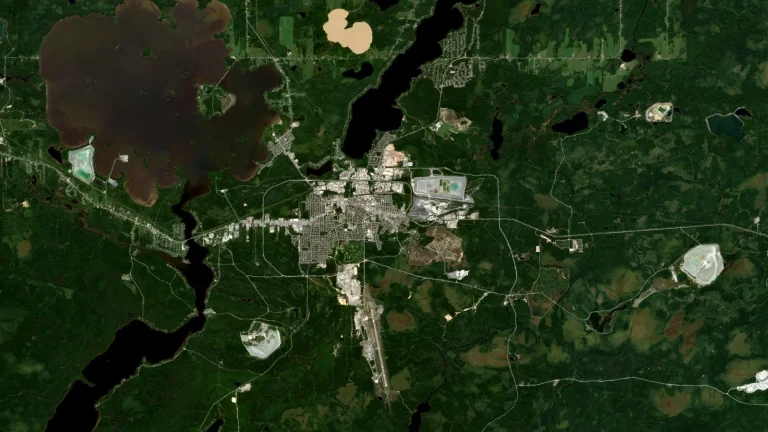
Satellites cannot see lonsdaleite. The grains are nanometres to millimetres wide and are identified in a laboratory with diffraction or electron microscopy. What orbital data can do is map the ground around an impact structure or other target: terrain, rock and alteration patterns, structures, and access, before a field team is sent. That is the scale at which a mining consultant can use it.
Farmonaut screens a licence area from satellite images and returns exploration targets from a KML, KMZ or polygon, with results in 5 to 20 business days, and the minerals it works with are listed on the satellite-based mineral detection page. Lonsdaleite is not one of them. If you are weighing a crater or a diamond-bearing area, the guide to diamond exploration covers kimberlite and alluvial targets, and the post on diamond drilling companies in Canada covers permits, seasons and costs. For drilling problems in the field, see top drilling challenges and solutions. To ask about a specific site, use the mining query form or contact us.
▶ Explains remote sensing for mining in three minutes: what satellites measure from a distance and what they cannot see. · 2:01
Frequently asked questions
What is lonsdaleite used for?
Today its only established use is as a geological marker of meteorite impacts. It is not used in any commercial tool. Researchers hope to use it in cutting tools, heat-management parts and sensors, as one co-leader of the 2026 study told Scientific American.
Is lonsdaleite harder than diamond?
Calculations say yes, by up to 58% in indentation strength. Measurements on real bulk samples published in Nature say slightly harder. The two figures are not the same kind of evidence.
Where is lonsdaleite found in nature?
The type material is from the Canyon Diablo meteorite in Arizona, found after the impact that formed Meteor Crater. Natural grains are nanometre-scale: the Canyon Diablo study found domains 1 to 3 nanometres wide.
Is lonsdaleite a real mineral?
The status was disputed after 2014, when researchers argued the natural material is faulted cubic diamond. The 2026 Nature paper reports phase-pure millimetre-sized hexagonal diamond made in the lab and says this settles whether it exists as a separate phase. Whether the natural samples are the same material is a separate question.
Can lonsdaleite be made synthetically?
Yes, in tiny amounts. Shock compression of graphite above 170 GPa produced it in a 2016 experiment. Static high-pressure runs in 2025 and 2026 made pieces up to millimetre size.
Are there lonsdaleite drill bits for sale?
None is documented in the sources cited here. Drill bits that cut rock use polycrystalline diamond or impregnated diamond grains, which are cubic diamond.
Why is hexagonal diamond expected to be harder?
In cubic diamond the bonds between atomic layers are slightly weaker than those within layers. In the hexagonal form the bonds between layers are shorter and stronger, according to Scientific American.
Is natural diamond or synthetic diamond used in mining tools?
Mostly synthetic. USGS reports that about 97% of US industrial diamond use is synthetic and that natural diamond is less than 1% of industrial diamond used worldwide.
Can satellite imagery find lonsdaleite?
No. It can help map an impact structure or its surroundings, but the mineral itself is identified under a microscope or by X-ray diffraction.
Will lonsdaleite make drilling cheaper?
That depends on price, size and bonding, which are unknown. Use the calculator to see how much extra life a higher bit price needs to pay off.
This page is for information only. It summarises published research and is not engineering, purchasing or investment advice. Check any supplier claim against the original papers.
Farmonaut mining
Map your mining site from space
Send a KML, KMZ or polygon and Farmonaut screens the area from satellite images so a consultant can plan field work with better targets.
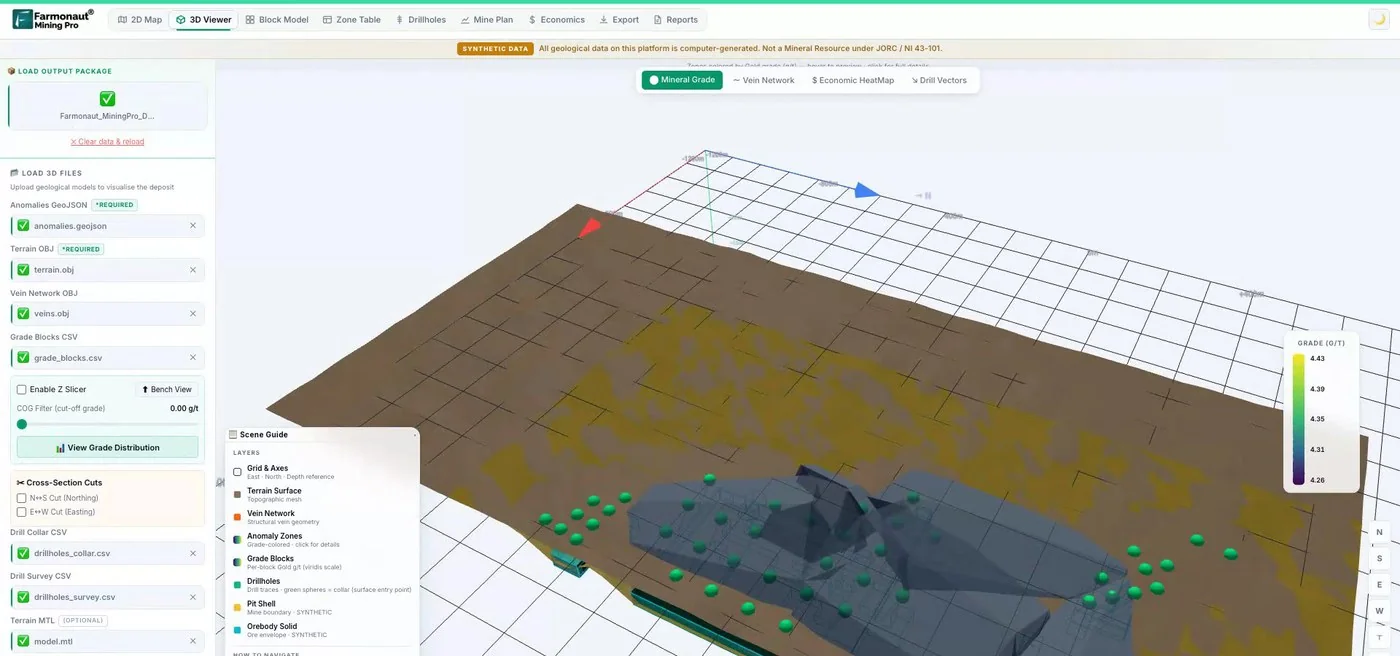
Mining Pro sample view, synthetic data
Keep reading
Sources
- Nature, Lonsdaleite, a Hexagonal Polymorph of Diamond (1967): nature.com
- Nemeth et al., Lonsdaleite is faulted and twinned cubic diamond and does not exist as a discrete material, Nature Communications (2014): nature.com
- Pan et al., Harder than Diamond: Superior Indentation Strength of Wurtzite BN and Lonsdaleite, Physical Review Letters (2009): journals.aps.org
- Kraus et al., Nanosecond formation of diamond and lonsdaleite by shock compression of graphite, Nature Communications (2016): nature.com
- Synthesis of bulk hexagonal diamond, Nature 644 (2025): nature.com
- Bulk hexagonal diamond, Nature (March 2026): nature.com
- Yang et al., Lonsdaleite: the diamond with optimized bond lengths and enhanced hardness, arXiv preprint (2021): arxiv.org
- Zhengzhou University, ZZU team synthesizes bulk hexagonal diamond (March 2026): english.zzu.edu.cn
- Scientific American, Fresh claim of making elusive hexagonal diamond is the strongest yet (March 2026): scientificamerican.com
- USGS, Mineral Commodity Summaries 2026: Diamond (Industrial): pubs.usgs.gov
- Ratov et al., Influence of thermo-cyclic loads and abrasive wear on durability of PDC cutters, Engineering for Rural Development (May 2026): erdev.lbtu.lv
Discussion
Questions, corrections or field experience? Share them below. First-time comments are reviewed before they appear, and your email is never published.
No comments yet. Be the first to add a question or your experience.

 Congo Mining Solutions
 Mining SARL
 SenGold Invest SAS
 Sania Corporation
 Sean Mining Limited
 NTS Group (Pty) Ltd
 Mine4Africa
 Lithspo Minerals Limited
 Tintina Mining Group
 Dalgety Minerals Pty Ltd
 Vortex Minerals Pty Ltd
 Faith At Work (Pty) Ltd
 Geotech Mining Solutions plc
 Vulcan International Limited
 Kidepo Associates
 GKY Mining
 Alkimy SARL
 Double A Trading
 GemSprout Metals Limited
 Qader Group
 Ileys General Trading
 SG Gold Mining LLC
 VRV Global Pte Ltd










