

Soil health · Practice guide
Soil, Water and Carbon: 6 Farm Practices With Results
Keep the ground covered, disturb it less and put water only where the crop can use it. In 2022 no-till covered 27.5% of US cropland and cover crops 4.7% (Choices, Census of Agriculture data). Here is what each practice does, what it costs and how to start.
Key takeaways
- No-till rose from 25.3% of US cropland in 2012 to 27.5% in 2022; cover crops rose from 2.7% to 4.7% (Choices, 2024, Census of Agriculture data).
- No-till alone lowers yields on average, but with residue and rotation it raised rainfed yields in dry climates (Nature, 2014).
- FAO planning values put field application efficiency at 60% for surface irrigation, 75% for sprinklers and 90% for drip.
- NRCS Pennsylvania pays $76.94 per acre for a single-species cover crop under EQIP in fiscal year 2026; rates vary by state.
- Switching back to tillage can release stored soil carbon, so results need several years of steady practice.
In this article
- Why soil, water and carbon belong in one plan
- Six soil, water and carbon practices with results
- Soil and water tips to boost land productivity
- How the practices compare
- Where US farmers use these practices
- How to start: a step-by-step plan
- Irrigation savings: run your own numbers
- Soil, water and carbon on mined and disturbed land
- FAQ
Soil, water and carbon practices that hold up under drought and heavy rain are simple to name: keep the ground covered, disturb it less, and put water only where the crop can use it. In the US, cover crops were on 4.7% of cropland and no-till on 27.5% in 2022, according to a Choices analysis of the Census of Agriculture. This guide covers six practices, what the research says each one does, what it costs, and a calculator for irrigation savings.
We wrote it for farm owners and managers in the US, Canada, the UK, Europe, Australia and New Zealand. Each practice has a “Best for” line, a short note on the evidence, and the trade-offs. Rules, payment rates and prices change, so check them with your local conservation office or adviser before you act.
Why soil, water and carbon belong in one plan
The three are linked. Soil organic matter is mostly carbon. More organic matter helps soil hold water and nutrients. Better water use means more crop growth, more roots and more residue, which feeds organic matter again. When one link breaks, the others suffer. Bare, tilled soil loses topsoil to wind and water, and the carbon in that topsoil goes with it.
The FAO soils portal notes that farm soils are among the largest carbon stores on the planet, and estimates that soils could take up around 20 Pg of carbon in 25 years. It also points out that long-term conversion of grassland and forest to cropland caused large historic losses of soil carbon. For a single farm, the point is practical: the same steps that rebuild soil carbon usually also cut erosion and help the soil soak up and store rain.
Resilience here means a farm that keeps producing through a dry spell, a wet spring or a price shock, without losing its soil base. Soil, water and carbon management is one of the few levers a grower controls directly.
▶ Why soil carbon matters for plant health, soil structure and water holding. · 12:15
Six soil, water and carbon practices with results
The list below runs from the practices with the widest US use to those that fit fewer farms. It is not a ranking of value; the right mix depends on your soil, climate, crops and cash flow.
Chart
US cropland under no-till and cover crops
Percent of total cropland in each Census year, 48 contiguous states
1. No-till and reduced tillage
Best for: erodible fields, rainfed grain in drier areas, and farms that want to cut fuel and labour passes.
No-till plants straight into last season’s residue. The residue shields the surface from rain and wind, and fewer passes mean less fuel. In the US, no-till covered 27.5% of cropland in 2022, up from 25.3% in 2012, per the Choices study of Census of Agriculture data. The same study found that 1,261 counties cut no-till area between 2017 and 2022, so national growth almost stalled.
The yield effect depends on climate. A global meta-analysis in Nature by Pittelkow and colleagues (2014) found that no-till on its own lowers yields on average, but the response varies. Used with residue retention and crop rotation, no-till raised rainfed crop yields in dry climates. In wetter, cooler places, expect a learning period, slower spring warming and a possible yield dip at first.
Trade-offs: weed control often leans more on herbicides, planters may need new parts, and residue can slow soil warming. If you switch back to full tillage later, much of the stored soil carbon can be lost again.
2. Cover crops
Best for: fields left bare over winter, farms with erosion or nutrient runoff issues, and growers with grazing animals that can use the forage.
A cover crop is planted to protect and feed the soil rather than to sell. Cereal rye, oats, clovers, radish and mixes are common. Living roots hold soil, take up spare nitrogen, feed soil life and add carbon. Cover crops were on 4.7% of US cropland in 2022, up from 2.7% in 2012 (Choices, Census of Agriculture data). The highest regional rate was the Southern Seaboard at 11.0%, which the authors link to state cost-share programmes for the Chesapeake Bay.
Cover crops have a cost. The Choices authors cite studies showing negative net returns in some cases, from lower yields in the next cash crop and higher seed costs. SARE’s Cover Crop Economics bulletin uses five years of national survey data to show when covers tend to start paying back, for example with grazing, herbicide-resistant weed pressure, or cost-share support.
Cost-share helps. In the USDA NRCS Pennsylvania fiscal year 2026 EQIP and CSP payment schedule, the cover crop rate is $76.94 per acre for a single species and $80.15 for a multi-species mix. Rates differ by state and by year, so check with your local NRCS office.
3. Efficient irrigation and scheduling
Best for: irrigated farms with rising pumping costs, limited water rights or falling groundwater.
Irrigation matters for the whole farm economy. The USDA Economic Research Service page on irrigation and water use reports that farms with some irrigation produced more than 50% of US crop sales value in 2022, from less than 17% of harvested cropland. It also says irrigation took 47% of US freshwater withdrawals between 2010 and 2020, citing the US Geological Survey.
Method matters. FAO’s guide on irrigation efficiencies lists indicative field application efficiencies of 60% for surface irrigation, 75% for sprinklers and 90% for drip. These are planning values, not measured results for your farm. In the western US, ERS reports that pressurized systems (sprinkler and drip) rose from 37% of irrigated cropland in 1984 to 74% in 2023.
Scheduling matters as much as hardware. Soil moisture probes, weather-based crop water use and satellite maps all help you water when the crop needs it, not by the calendar. Overwatering wastes pumping energy and can wash nitrogen below the root zone.
4. Organic matter: compost, manure and residue
Best for: farms with livestock or a nearby compost supply, sandy soils that hold little water, and worn-out fields.
Adding compost or manure, and leaving crop residue in place, feeds soil life and builds organic matter over years. Manure also supplies nutrients, so test it and count it in your fertilizer plan. Too much can push phosphorus and nitrogen into streams. Follow your nutrient management plan and local manure rules.
Why it pays: an Ohio State University Extension fact sheet, Understanding Soil Microbes and Nutrient Recycling, says each 1% of soil organic matter holds about 1,000 pounds of nitrogen, 100 pounds of phosphorus, 100 pounds of potassium and 100 pounds of sulfur per acre in the top six inches. It valued those nutrients at about $680 per acre for each 1% at fertilizer prices of the time. The same sheet notes that tillage burns organic matter off as carbon dioxide, so compost works best when combined with less tillage and a living cover.
Support exists here too. The Pennsylvania NRCS fiscal year 2026 list sets the Soil Carbon Amendment (practice 336) rate at $267.49 per acre for compost made on the farm and $279.77 per acre for compost brought in. Testing manure or compost before you spread it has its own payment line.
5. Perennials, buffers and trees
Best for: field edges along streams, steep or wet corners that never yield well, and grazing land.
Grass strips, riparian buffers, windbreaks and trees in or around fields keep roots in the ground all year. They trap sediment, slow runoff, shade streams and store carbon in wood and soil. A global study in Scientific Reports on tree cover on farmland estimated that trees hold more than 75% of the biomass carbon on agricultural land worldwide. Taking a poor corner out of crops can cost less than farming it at a loss each year.
The Pennsylvania NRCS fiscal year 2026 list shows what these practices pay. A filter strip of introduced grasses pays $590.41 per acre for foregone income, or $651.88 per acre with native species. A riparian forest buffer on a small area with tree shelters pays $5,367.07 per acre. A single-row windbreak without tree protection pays $1.45 per foot. These are cost-share payments in one state for one year, not the full cost, so ask your local office for your rates.
6. Rainwater capture and drainage management
Best for: farms with seasonal dry spells, or tile-drained land where water leaves too fast in spring.
Ponds, swales and tanks store rain for later use on small farms and livestock operations. On drained land, control structures can hold water in the soil profile after planting and release it before field work. Check local water rights and permit rules before you build any dam or storage, as these differ by state, province and country.
Drainage water management has good evidence behind it. A Purdue University Extension guide written with Iowa State, Illinois and other Midwest universities reports that studies found annual nitrate loads in drain flow fell by about 15% to 75%, depending on site, climate and how the outlet was managed. The same guide reports average yield gains of about 5% in some studies, though results vary from year to year. The practice suits flat fields, generally under 0.5% slope. In Pennsylvania’s fiscal year 2026 list, NRCS pays $7.81 per acre per year for drainage water management (practice 554), with separate rates for the water control structures.
Chart
Pressurized irrigation in the western US
Sprinkler and drip as percent of irrigated cropland
Soil and water tips to boost land productivity
Readers who came here for quick tips on land productivity can start with this short list. Each item fits inside one of the six practices above.
- Test soil every two to three years. Track pH, organic matter, phosphorus and potassium. Lime acid soils before spending more on fertilizer.
- Keep the surface covered. Residue or a cover crop on the ground over winter cuts erosion and crusting.
- Cut needless passes. Each tillage pass costs fuel and dries out the topsoil.
- Avoid driving on wet soil. Compaction can lower yields and is slow to fix. Use controlled traffic lanes if you can.
- Match water to crop need. Check soil moisture before you irrigate, and fix leaks and worn nozzles.
- Rotate crops. Different root systems and residues help break pest cycles and feed soil life.
- Watch problem zones. Compare satellite or yield maps across seasons to find patches that always lag, then test the soil there.
Fertilizer and lime rates should come from a soil test and your local extension guide. Follow product labels and local rules.
▶ Seven simple ways to protect soil and water, from cover crops to smarter watering, explained with humour. · 4:34
How the practices compare
| Practice | Main soil effect | Main water effect | Carbon effect | Main cost or risk |
|---|---|---|---|---|
| No-till | Less erosion, more residue cover | More infiltration, less evaporation | Can build surface carbon; lost if tilled again | Weed control, possible early yield dip |
| Cover crops | Living roots, less erosion | Less runoff and nitrate loss | Adds root and shoot carbon | Seed, planting and termination cost |
| Efficient irrigation | Less waterlogging and salt build-up | Less water per unit of crop | Less pumping energy | Upfront equipment cost |
| Compost and manure | More organic matter and life | Better water holding | Adds carbon directly | Hauling cost, nutrient runoff risk |
| Buffers and trees | Traps sediment | Slows runoff, shades streams | Stores carbon in wood and soil | Land out of crop production |
| Rain capture | Less gully erosion | Stores water for dry spells | Small | Build cost, permits |
This table is a summary of the direction of effects described by the sources on this page, not a measured score. Size of effect depends on soil, climate and how well a practice is run.
Where US farmers use these practices
Adoption differs a lot by region. The Choices analysis found the highest 2022 no-till rates in the Northern Great Plains (34.7% of cropland), the Heartland (32.1%) and the Prairie Gateway (30.1%). The authors suggest this may reflect large areas of highly erodible land, where no-till is often part of the conservation plan needed for USDA programmes.
Chart
No-till share of cropland by region
Percent of 2022 cropland, selected USDA Farm Resource Regions
The same study warns about stop-start use. Many counties dropped cover crops or no-till between 2017 and 2022 even as others added them. For anyone selling soil carbon, that matters: switching back to tillage can release stored carbon, which is why carbon programmes ask for long contracts and checks.
How to start: a step-by-step plan
- Map your fields. Mark erosion spots, wet areas, low-yield zones and bare ground over winter.
- Test the soil. Get a baseline for organic matter, pH and nutrients in each management zone.
- Pick one practice on one field. A cover crop before soybeans, or no-till on one erodible field, is a common first step.
- Ask about cost-share. In the US, talk to your NRCS office about EQIP and CSP. In other countries, check national or regional farm schemes.
- Measure results. Compare yields, input costs, soil tests and water use with a nearby untreated strip for at least three seasons.
- Scale up what works. Expand on fields where the numbers held up, and adjust or drop what did not.
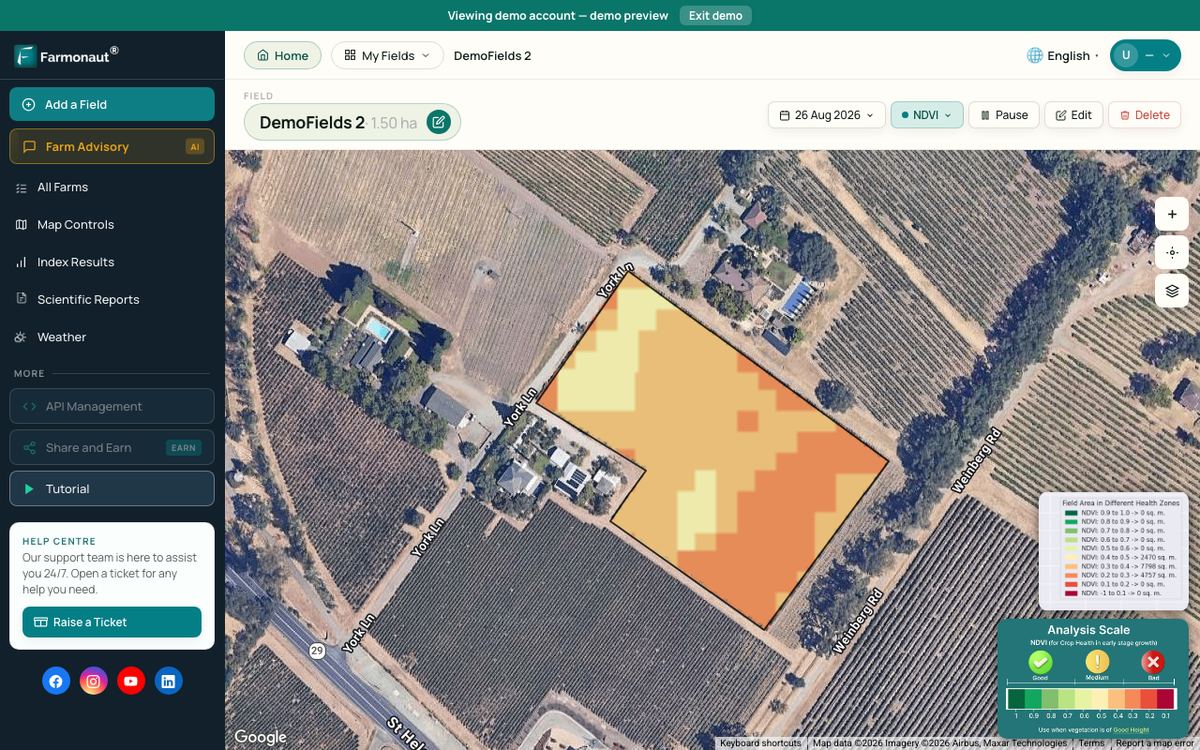
Satellite crop maps can help with steps 1 and 5 by showing which parts of a field grow well or lag through the season. Farmonaut Satellite + AI Farm Monitoring System is one such tool; any map should be checked on the ground.
▶ What a satellite can show about soil moisture across a field, and where a probe still does better. · 2:11
Irrigation savings: run your own numbers
The calculator below estimates how much water and money you could save by moving to a more efficient irrigation method. Enter your own area, crop water need, efficiencies, water cost and upgrade cost. The default values are round examples only.
Chart
Field application efficiency by irrigation method
Indicative planning values, percent of applied water
Try the numbers for your own farm below.
Calculator
How much could a more efficient irrigation method save?
Enter your own field, water and cost numbers.
- Water applied now: 250.0 acre-ft
- Water applied after upgrade: 200.0 acre-ft
- Water saved: 50.0 acre-ft
- Simple payback: 10.0 years
Example values only, not a benchmark or a forecast. Water applied = crop water need divided by application efficiency. FAO lists indicative efficiencies of 60% (surface), 75% (sprinkler) and 90% (drip) (FAO, Irrigation Water Management, Annex I); your system may differ. 12 inches per foot is fixed in the formula. Savings ignore changes in yield, labour and energy beyond the water cost you enter.
Soil, water and carbon on mined and disturbed land
The same ideas apply when land is restored after mining or construction: rebuild topsoil, get roots growing fast, and control water on site. Mine operators who want to check a site from space can see our satellite-based mineral detection page or use the mining query form. For farm questions, contact our team.
FAQ
What are the main soil, water and carbon practices for farms?
The main ones are no-till or reduced tillage, cover crops, efficient irrigation and scheduling, adding compost or manure, buffers and trees, and rain capture or drainage control. Most farms combine two or three.
Does no-till reduce yields?
On average it can, per the 2014 Nature meta-analysis by Pittelkow and colleagues, but results vary. With residue retention and crop rotation, no-till raised rainfed yields in dry climates.
How much does a cover crop cost, and is there support?
Costs include seed, planting and termination. In the US, NRCS EQIP pays a per-acre rate; Pennsylvania’s fiscal year 2026 rate is $76.94 per acre for a single species. Rates differ by state.
How much water does drip save compared with furrow irrigation?
FAO planning values put field application efficiency at about 60% for surface methods and 90% for drip. Real savings depend on design, upkeep and scheduling, so use the calculator with your own numbers.
Can these practices earn carbon credits?
Some carbon programmes pay for no-till and cover crops, but rules, prices and contract lengths vary. Read the contract closely and get independent financial and legal advice before you sign.
How long until soil organic matter rises?
Changes are slow and often take several years to show in soil tests. Ohio State University Extension notes that soil organic matter is slow to build, while fresh, low-carbon residues such as manure break down and release nutrients in about 4 to 8 weeks. That early nutrient release is not the same as a lasting rise in organic matter. Sample the same spots, to the same depth, at the same time of year, and compare results over several years to track the trend.
Farmonaut crop monitoring
See your own fields from space
Draw your fields once and Farmonaut shows satellite crop and moisture maps for them through the season, on web, Android or iOS.



Sources
- Choices Magazine (AAEA), Pervasive disadoption substantially offsets new adoption of cover crops and no-till (2024): choicesmagazine.org
- Pittelkow et al., Productivity limits and potentials of the principles of conservation agriculture, Nature (2014): nature.com
- FAO, Soil carbon sequestration, FAO Soils Portal: fao.org
- FAO, Irrigation Water Management training manual, Annex I: Irrigation efficiencies: fao.org
- USDA Economic Research Service, Irrigation and Water Use: ers.usda.gov
- USDA NRCS Pennsylvania, FY2026 EQIP and CSP published cost list and payment caps (2026): nrcs-prod.azureedge.us
- SARE, Cover Crop Economics: Opportunities to Improve Your Bottom Line in Row Crops: sare.org
- Zomer et al., Global tree cover and biomass carbon on agricultural land, Scientific Reports (2016): pmc.ncbi.nlm.nih.gov
- Pennsylvania State University Extension, Soil acidity and aglime: extension.psu.edu
- US EPA, Greenhouse Gas Equivalencies Calculator: calculations and references: epa.gov
- Ohio State University Extension, Understanding Soil Microbes and Nutrient Recycling (SAG-16): ohioline.osu.edu
- Purdue University Extension, Questions and Answers About Drainage Water Management for the Midwest (WQ-44): extension.purdue.edu
Discussion
Questions, corrections or field experience? Share them below. First-time comments are reviewed before they appear, and your email is never published.
No comments yet. Be the first to add a question or your experience.

 Krishi GK
 Geno
Geno Hayleys Agriculture
 Linx Agritech
 Adinet
 Save Your Soils
 Grandstream Algérie
 XOS Realty
 Geospatial Lab Africa
 Agro La Gándara
 HIPSAC
 ZOL Zimbabwe
 Juligerm
 AdBio
AdBio MISE Maroc
 NWNS
NWNS
 Licence holder · Niger · Gold










