

Uranium · Price and production guide
Yellow Cake Uranium: Price per Pound and Calculator
Yellow cake uranium is a powder of about 85% uranium by mass, sold by the pound. Cameco’s September 2026 month-end averages were US$89.63 spot and US$96.50 long-term.
Key takeaways
- Yellowcake is mostly U3O8, about 85% uranium by mass, usually khaki rather than yellow (World Nuclear Association).
- Cameco’s September 2026 month-end averages: US$89.63 per pound spot, US$96.50 long-term. US utilities paid US$58.46 per pound on average for 2025 deliveries (EIA).
- Kazakhstan, Canada and Namibia mined about three-quarters of world uranium in 2024; the world total was 60,213 tonnes of uranium (World Nuclear Association).
- In-situ leach gave 55% of 2024 output; acid leach recovers 70 to 90% of the uranium, alkaline 60 to 70%.
- In the US, yellowcake is licensed source material; the 0.05% exemption in 10 CFR 40.13 does not reach a powder that is about 85% uranium.
In this article
- What yellow cake uranium is made of, and why it is rarely yellow
- What a pound of yellow cake uranium costs
- Uranium price history: spot against long-term, year by year
- Can you buy yellow cake uranium?
- Who makes the world's yellow uranium
- From ore to uranium cake: in-situ leach against conventional milling
- Calculator: how many pounds of yellowcake does your ore make?
- What happens to the powder next
- How dangerous is yellowcake?
- Mill waste, water and the rules that apply
- Check any uranium figure yourself
- Where satellites fit in uranium exploration
- Frequently asked questions
Yellow cake uranium is the powder that a uranium mill ships out: a uranium oxide concentrate, mostly U3O8, that is about 85% uranium by mass and is sold by the pound. It is usually khaki or brown rather than yellow (World Nuclear Association, uranium mining overview). On the Cameco price page, September 2026 month-end averages were US$89.63 per pound for spot and US$96.50 per pound for long-term contracts (Cameco, uranium price).
Yellowcake is not reactor fuel and it is not weapons material. It is the product a mine and mill hand to a converter, and every uranium price quoted in the news is really a price for it. This page covers what it is made of, what it costs on each of the four price measures, who produces it, whether anyone can buy it, how it is made, how risky it is to handle, and what rules apply. A calculator turns your ore tonnes and grade into pounds and dollars.
What yellow cake uranium is made of, and why it is rarely yellow
Uranium ore is rock. A mill crushes it, dissolves the uranium with acid or alkaline solution, pulls the uranium back out of that solution, precipitates it as a solid, then dries or calcines it. The dried solid is yellowcake. Three points are often reported wrongly.
- Colour. Products dried at high temperature are about 85% uranium by mass as U3O8 and are usually khaki. The World Nuclear Association says the powder is sometimes called yellowcake, though it is usually khaki. Colour is not a quality grade.
- Chemistry. Peroxide products dried at ambient temperature hold about 80% U3O8. Purity differs from mill to mill, so the assay certificate matters more than the colour.
- Form. It is a powder, not a cake. The powder is packed into sealed 200-litre steel drums.
Ore grade drives how much rock becomes how much cake. The World Nuclear Association records that most mines now supporting production average above 0.10% uranium (1,000 parts per million), that some Canadian deposits average up to 20% uranium, and that other mines work much leaner ore. That spread is more than a hundred-fold, so there is no single answer to “how much ore makes a drum”, which is why the calculator below asks for your own grade.
The same powder goes by many names. “Uranium cake”, “yellow uranium”, “uranium yellowcake”, “uranium oxide concentrate” and “powdered uranium” all point to the same U3O8 concentrate, although technical papers use “uranium oxide concentrate”.
What a pound of yellow cake uranium costs
There is no single uranium price. Uranium does not trade on an open exchange like gold; buyers and sellers negotiate privately, and Cameco builds its published averages from the month-end prices published by UxC and TradeTech. Four different numbers circulate, and mixing them up is the most common error in yellowcake reporting.
Chart
Yellowcake prices: market against what utilities paid
US$ per pound of U3O8
- Spot price. Small, near-term parcels. Cameco’s September 2026 month-end average was US$89.63 per pound of U3O8. Trading Economics showed US$90.00 per pound on 14 October 2026 for its benchmark, which tracks the market through contracts for difference. A newer quote, from the retail data page Public.com, showed US$90.10 per pound at 6:21 am Eastern on 26 October 2026; it is indicative only, not a UxC or TradeTech price.
- Long-term price. The benchmark for multi-year utility contracts. Cameco’s September 2026 month-end average was US$96.50 per pound.
- What utilities actually paid. The U.S. Energy Information Administration reports that US reactor owners bought 46.9 million pounds of U3O8 equivalent for delivery in 2025 at a weighted average of US$58.46 per pound, 11% more than in 2024. Spot-contract deliveries made up 13% of volume at US$76.01 per pound. Long-term contract deliveries made up 87% at US$55.91 per pound.
- What a producer books. In its second-quarter 2026 report, Cameco shows that at a spot price of US$100 per pound its expected realised price would be US$67 per pound in 2026 and US$88 per pound in 2030, because older contracts are still being delivered (Cameco, second-quarter 2026 report).
The gap between the US$55.91 that utilities paid on older contracts and the US$96.50 long-term price is the story of the market. New contracts are being written well above the average price of the existing book. EIA also puts the maximum deliveries already contracted for 2026 to 2035 at 174 million pounds, against 186 million pounds of requirements for 2025 to 2035 not yet covered by any contract at the end of 2025.
Uranium price history: spot against long-term, year by year
Spot prices swing; long-term prices climb in steps. Cameco’s series shows the long-term price rising from US$51.00 per pound in September 2022 to US$96.50 in September 2026, while spot went from US$48.38 to US$89.63. In these five Septembers spot sat below the long-term price in 2022, 2025 and 2026, and above it in 2023 and 2024.
Chart
Spot against long-term price, September of each year
US$ per pound of U3O8, month-end average
Two things move the price most. The first is utilities returning to the market for contracts: Yellow Cake plc noted in July 2026 that the UxC long-term price had risen nearly 10% in the first half of the year (Yellow Cake plc quarterly update, 27 July 2026). The second is financial buyers of physical pounds, who are described in the next section.
Can you buy yellow cake uranium?
Not without a licence, and not in a drum from a website. Yellowcake is source material under US nuclear law, and the US Environmental Protection Agency states that its possession, use and transport are regulated by the Nuclear Regulatory Commission or by an Agreement State (US EPA, uranium mining residuals). The only general exemption in 10 CFR 40.13(a) covers mixtures in which source material is less than 0.05% by weight (10 CFR 40.13, Cornell Legal Information Institute). Yellowcake is about 85% uranium, so that exemption does not reach it. Other countries run their own licensing systems, so a buyer or seller anywhere needs the regulator’s permission first.
In practice, physical pounds change hands between miners, traders, utilities and converters under written contracts. Most of it is term business. The standard futures contract unit is 250 pounds of U3O8 (Trading Economics, uranium).
Investors who want exposure to the pound price without holding material have a listed route. Yellow Cake plc buys and holds physical U3O8. Its July 2026 update reported 23,214,230 pounds held at 30 June 2026 and a purchase of 1,160,766 pounds from Kazatomprom at US$86.15 per pound, which would take the holding to 24,374,996 pounds. The material is stored at Cameco’s facility in Canada and Orano’s facility in France. Search listings that offer “yellow cake for sale” should be treated with suspicion, because a real sale needs a licensed buyer, assay certificates and a licensed storage location.
Who makes the world’s yellow uranium
World uranium mine production was 60,213 tonnes of uranium in 2024, up from 54,433 in 2023, according to the World Nuclear Association’s production table (page updated 9 October 2026). About 90% of reactor demand was met from mines that year, against 83% in 2023. The remainder came from inventories and secondary supply. Reactor requirements for 2025 were estimated at about 68,920 tonnes of uranium (World Nuclear Association, World Nuclear Fuel Report 2025), which is roughly 81,000 tonnes of U3O8 at 84.8% uranium.
Chart
Uranium mined by country, 2024
Thousand tonnes of uranium, six largest producers
Three countries mined about three-quarters of the world’s uranium in 2024: Kazakhstan with 39%, Canada with 24% and Namibia with 12% (World Nuclear Association, world uranium mining production). Australia produced 4,598 tonnes in 2024.
The United States mines little of the yellowcake it burns. US mines produced 2.1 million pounds of U3O8 in 2025, the most since 2017 and more than triple 2024, while utilities bought 46.9 million pounds. Foreign origin accounted for most deliveries: Canada 32%, Kazakhstan 28% and Australia 15%, with US-origin material at 7% (EIA, Today in Energy, 28 August 2026). In the second quarter of 2026, EIA recorded 1,087,504 pounds from six facilities: Ross CPP, Lost Creek, Smith Ranch-Highland and Willow Creek in Wyoming, Alta Mesa in Texas and White Mesa in Utah (EIA, Domestic Uranium Production Report). At that pace, annual domestic output would be about 4.3 million pounds, around 9% of 2025 purchases.

▶ Uranium in Africa explained: what is known about uranium at Kanyemba in Zimbabwe. · 4:27
From ore to uranium cake: in-situ leach against conventional milling
More than half of world yellowcake never involves digging. In the World Nuclear Association’s 2024 split, 55% came from in-situ leach (also called in-situ recovery, ISR), 40% from underground and open-pit mines, and 5% as by-product from other mining. In-situ leach pumps a solution through the ore body where it lies and brings the dissolved uranium to the surface. Conventional mining moves the rock to a mill first. Both routes end in the same dried U3O8.
Chart
Uranium recovery range by leaching method
Percent of uranium recovered, low to high
| Factor | In-situ leach | Conventional mine and mill |
|---|---|---|
| Share of 2024 output | 55% | 40% (plus 5% by-product) |
| Rock moved | None; the ore stays in place | All of it, to a crusher |
| Leach chemistry | Acid (pH 2.5 to 3.0) where the ore holds under 2% calcium minerals; alkaline where limestone or gypsum is present | Sulfuric acid in agitated tanks after crushing and grinding |
| Recovery | 70 to 90% acid; 60 to 70% alkaline; about 60 to 80% overall in US operations | Set by the ore and the mill design |
| Well pattern life | 1 to 3 years in the US; 6 to 18 months in Australia | Years to decades per pit or stope |
| Waste left behind | Little surface disturbance; about 0.5% of flow bled off as waste | Tailings, which hold most of the ore’s original radioactivity |
Sources: World Nuclear Association, in-situ leach mining of uranium, and its production page above.
Whichever route feeds the plant, the back end is the same. Ion exchange or solvent extraction strips uranium from solution, a precipitation step makes a solid, and the solid is dried, calcined and drummed. In project economics, recovery is the number to challenge. A ten-point swing in recovery changes revenue by more than most price views do.
Calculator: how many pounds of yellowcake does your ore make?
Use the calculator below with your own tonnage, grade and recovery.
Calculator
How much yellowcake does your ore make?
Enter your own tonnage, grade, recovery, price and cost.
- Yellowcake produced (tonnes U3O8): 127.5
- Uranium contained (tonnes U): 108.1
- Gross value at your price (US$): $25,298,014
- Margin after your cost (US$): $14,054,452
Example values only, not a benchmark. Grade is % U3O8 in the ore. 1 kg = 2.20462 lb; U3O8 is taken as 84.8% uranium by mass (World Nuclear Association gives about 85%). Price and cost are inputs: example, use today’s price. Excludes royalties, transport, conversion and capital repayment.
What happens to the powder next
A drum of yellowcake cannot power anything. The World Nuclear Association describes the next step as conversion: the concentrate is dissolved in nitric acid, purified, and turned into uranium hexafluoride gas, which cools to a white crystalline solid in thick-walled steel cylinders (World Nuclear Association, conversion and deconversion). Conversion plants run commercially in Canada, China, France, Russia and the United States.
Enrichment follows. Natural uranium holds 0.7% of the U-235 isotope, and most reactors need fuel enriched to 3 to 5% (World Nuclear Association, uranium enrichment). Weapons use needs at least 90% U-235, made in plants designed for it. That is why yellowcake trades openly under safeguards while enrichment capacity is closely controlled. Yellowcake is natural uranium; the distance between a drum of it and a weapon is measured in centrifuge halls.
How dangerous is yellowcake?
Less than most people expect on radiation, and more than most expect on chemistry. The World Nuclear Association gives a simple yardstick: the radiation level one metre from a drum of freshly processed U3O8 is about half the cosmic-ray dose of a commercial jet flight. The material is only mildly radioactive.
The real hazard is swallowing or breathing the powder. The same source states that uranium oxide taken into the body has chemical toxicity similar to lead oxide, so mills apply the hygiene precautions of a lead smelter in the drying and packing areas. That means keeping powder out of the air and off skin in the drying and packing areas.
Mill waste, water and the rules that apply
Most of the environmental questions about yellowcake concern what is left behind, not the powder. At a conventional mill, the solids that remain after leaching are tailings. They make up most of the original ore and hold most of its radioactivity, including all the radium. Tailings management and land rehabilitation are subject to government regulation and inspection in producing countries.
In the United States, regulation splits by stage. Yellowcake production, including in-situ leach plants, falls under the Nuclear Regulatory Commission or an Agreement State. Waste rock and overburden from conventional mines are not covered by that authority; states, tribes and land agencies such as the Bureau of Land Management or the Forest Service regulate them, and they are classed as technologically enhanced naturally occurring radioactive material (US EPA). EPA’s uranium location database lists about 15,000 mine locations with known or possible uranium in 14 western states, most in Colorado, Utah, New Mexico, Arizona and Wyoming.
Four questions are worth asking of any uranium site: where the tailings are stored and how seepage is caught, how the wellfield or pit water is monitored, how bled-off solution is treated, and who pays for closure. In-situ leach sites bleed off about 0.5% of circulating flow as waste to keep a pressure gradient, so the question there is groundwater restoration rather than tailings.
Check any uranium figure yourself
Every number on this page will move. This table lists where each figure is published and how often, so you can pull a fresher one.
| What you need | Where to look | How often | Last value used here |
|---|---|---|---|
| Spot and long-term U3O8 price | Cameco uranium price page | Monthly | US$89.63 and US$96.50, Sep 2026 |
| What US utilities paid | EIA Uranium Marketing Annual Report | Annual | US$58.46 per pound, 2025 |
| US mine output | EIA Domestic Uranium Production Report | Quarterly | 1,087,504 pounds, Q2 2026 |
| World production by country | World Nuclear Association production table | Annual | 60,213 tonnes of uranium, 2024 |
| Physical holdings of a listed buyer | Yellow Cake plc quarterly update | Quarterly | 23,214,230 pounds, 30 Jun 2026 |
Three habits keep you out of trouble. First, check whether a tonnage is in tonnes of uranium or tonnes of U3O8: the ratio is about 1.18, and mixing them shifts a resource by 18%. Second, never compare a spot price with a realised price; Cameco’s table shows the gap at US$33 per pound for a US$100 spot price in 2026. Third, check the year on every country-level figure, because uranium statistics arrive with a one-to-two-year lag.
Where satellites fit in uranium exploration
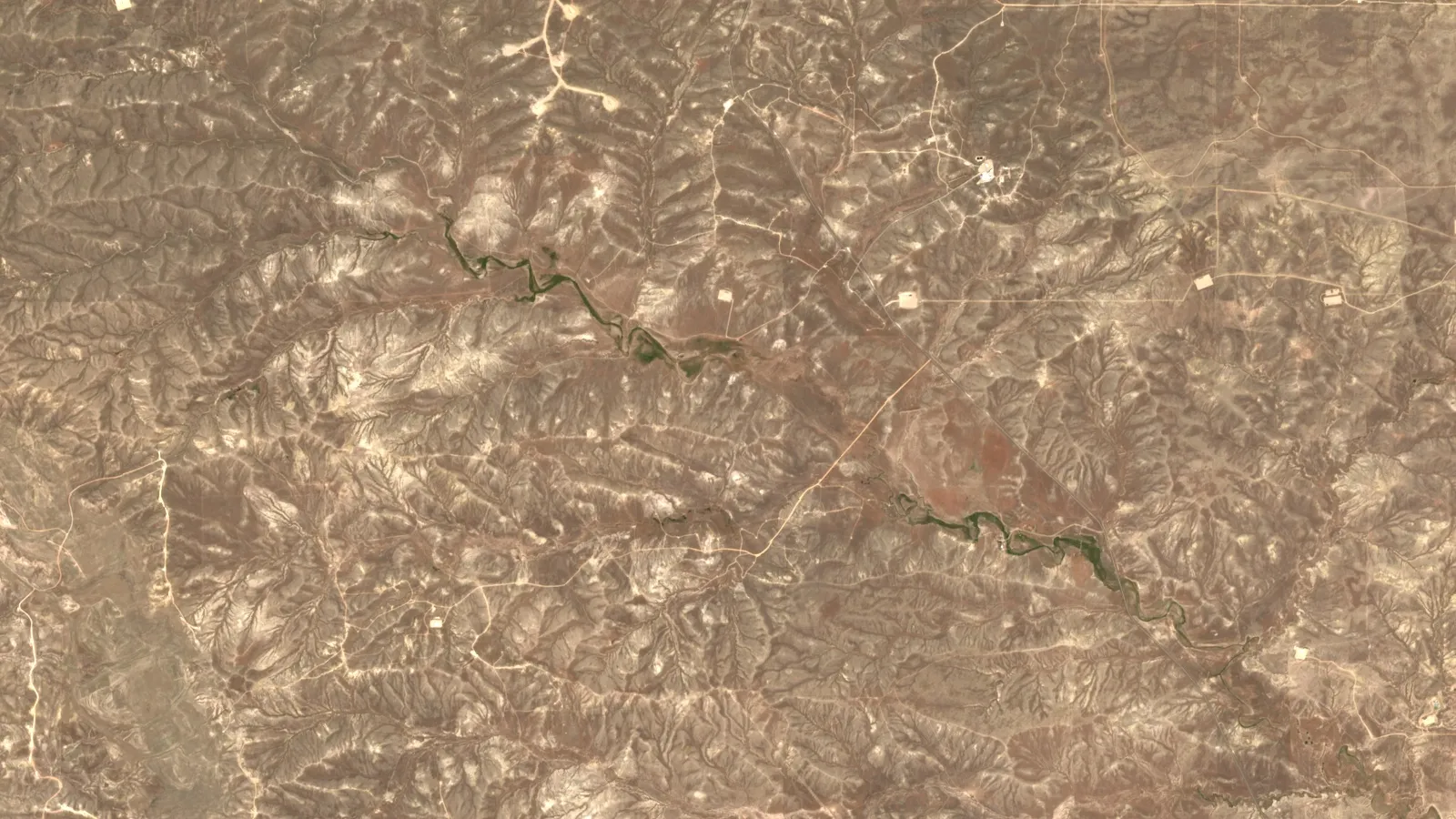
With US mines running at around 4.3 million pounds a year against 46.9 million pounds of purchases, and 186 million pounds of requirements uncovered through 2035, the pressure on exploration budgets is real. The most expensive way to be wrong about a licence area is still a drill rig.
Farmonaut’s satellite-based mineral detection works the step before drilling. It runs multispectral and hyperspectral analysis over a defined area and ranks zones by alteration signature and structural setting, so field teams sample the top-ranked ground first. It does not assay rock and it does not replace drilling or a resource estimate. Teams can outline an area through the satellite mineral detection service. For related reading, see our guide to the rare earth elements map and our overview of

▶ How satellites help find mineral targets: they map the rock around a deposit, not the metal itself. · 4:25
Frequently asked questions
What is yellow cake uranium in one sentence?
Yellowcake is the dried uranium oxide concentrate produced at a uranium mill, sold as U3O8 and holding about 85% uranium by mass (World Nuclear Association).
Is yellow cake uranium actually yellow?
Usually not. The World Nuclear Association says the product is usually khaki. Colour depends on drying temperature and impurities and is not a measure of purity; the assay certificate is.
Is uranium cake the same as yellowcake?
Yes. “Uranium cake”, “yellow uranium”, “uranium yellowcake”, “cake uranium” and “powdered uranium” all describe the same U3O8 concentrate.
What is yellow cake nuclear material used for?
It is the feedstock for nuclear fuel. After conversion to uranium hexafluoride and enrichment to 3 to 5% U-235, it is fabricated into fuel for power reactors. It cannot be used as fuel as it is.
What is the yellow cake uranium price today?
Cameco’s month-end averages for September 2026 were US$89.63 per pound spot and US$96.50 per pound long-term. Trading Economics showed US$90.00 on 14 October 2026, and Public.com showed an indicative US$90.10 on 26 October 2026. Check the Cameco page for the latest month-end figures, because spot moves daily.
How much is a drum of yellowcake worth?
Multiply the contained pounds of U3O8 by the price. At US$89.63 per pound, 1,000 pounds is worth about US$89,630. Fill weight differs by mill, so use the shipment’s assay certificate rather than a rule of thumb.
Is yellowcake the same as uranium ore?
No. Ore is rock with usually 0.1% uranium or more at present mines; yellowcake is the concentrate made from it at a mill, at about 85% uranium.
Can yellowcake be used to make a bomb?
Not without enrichment. Yellowcake is natural uranium with 0.7% U-235, and weapons-grade material needs at least 90%. The barrier is enrichment capacity, which is why enrichment, not yellowcake, is the focus of international controls.
Is yellowcake the same as a yellow diamond?
No. Yellowcake is a uranium powder; a yellow diamond is a gemstone coloured by nitrogen. Searches for a “yellow diamond mine” lead to diamond producers, not to uranium.
Where does yellow cake uranium come from?
Mostly Kazakhstan, Canada and Namibia, which together supplied about three-quarters of world mine output in 2024. The United States produced 2.1 million pounds in 2025.
How can I get a satellite report on my own ground?
Ask for a scope and a quote through the Farmonaut mining query form, or reach the team through contact us.
This page is for information only. It is not investment advice. It is not legal advice either: confirm licensing rules for source material with the regulator. Satellite results are exploration targets that sit ahead of a resource estimate.
Farmonaut mining
Get a quote to map your licence area from space
Request a quote for a satellite mineral detection report on your own licence area, ahead of drilling.

Mining Pro sample view, synthetic data
Keep reading
Sources
- Cameco, Uranium price (UxC and TradeTech month-end averages): cameco.com
- Cameco, second-quarter 2026 management discussion and notes: cameco.com
- U.S. EIA, Uranium Marketing Annual Report: eia.gov
- U.S. EIA, Today in Energy: U.S. uranium production more than tripled in 2025: eia.gov
- U.S. EIA, Domestic Uranium Production Report (quarterly): eia.gov
- World Nuclear Association, Uranium Mining Overview: world-nuclear.org
- World Nuclear Association, World Uranium Mining Production: world-nuclear.org
- World Nuclear Association, In-Situ Leach Mining of Uranium: world-nuclear.org
- World Nuclear Association, World Nuclear Fuel Report 2025: world-nuclear.org
- World Nuclear Association, Conversion and Deconversion: world-nuclear.org
- World Nuclear Association, Uranium Enrichment: world-nuclear.org
- US EPA, TENORM: Uranium Mining Residuals: epa.gov
- 10 CFR 40.13, Cornell Legal Information Institute: law.cornell.edu
- Yellow Cake plc, Quarterly Operating Update (27 July 2026): investegate.co.uk
- Trading Economics, Uranium: tradingeconomics.com
- Public.com, Uranium price today: public.com
Discussion
Questions, corrections or field experience? Share them below. First-time comments are reviewed before they appear, and your email is never published.
No comments yet. Be the first to add a question or your experience.

 Tipareth Mines
 GemSprout Metals Limited
 Qader Group
 Ileys General Trading
 SG Gold Mining LLC
 VRV Global Pte Ltd
 Omsri International FZE
 G.I.T.T.
 Jaunita Erss Ltd
 Almosi SARL
 SRK Consulting
 Berks Gold Limited
 Mwerezi Minerals Company Limited
 Mining SARL
 SenGold Invest SAS
 Sean Mining Limited
 NTS Group (Pty) Ltd
 Mine4Africa











