

Copper mining · Training guide
Copper Mining Training Programs: 8 Options Compared
A new US miner needs 40 hours of safety training underground or 24 on the surface, then 8 hours a year (MSHA). Compare that legal floor with degrees, leaching courses, simulators and satellite skills, with a crew cost calculator.
Key takeaways
- US law (30 CFR Part 48) requires at least 40 hours for new underground miners, 24 hours for new surface miners and 8 hours of refresher training a year.
- Chile’s large mines employed about 209,000 people in 2024 and need almost 37,000 new workers by 2034, most in maintenance and equipment operation (CCM-Eleva study, December 2025).
- Chile mined an estimated 5.3 million tonnes of copper in 2025, ahead of Congo (Kinshasa) at 3.2 million and Peru at 2.7 million (USGS, 2026).
- Evidence that virtual reality training cuts mining accidents is thin: a 2011 review found no satisfactory study, and a 2025 quarry study of 40 people measured scores, not accidents.
- NASA’s 2-hour Fundamentals of Remote Sensing course gives satellite basics, with a certificate, but does not cover mineral mapping.
In this article
- Copper mining training programs: eight options at a glance
- How these eight options were chosen
- US safety training for copper miners: the legal minimum
- What US mine safety data show about training hours
- Where copper mining jobs are: output and workforce by country
- Degrees and diplomas: Arizona and Copperbelt University
- Short courses for leaching and processing
- Simulator and VR training: what the evidence shows
- Chile's national skills plan for large mines
- Satellite and GIS skills for mining teams
- What a crew training budget looks like
- How to choose a course: seven checks
- Frequently asked questions
A new miner at a US copper mine must receive at least 40 hours of safety training before going underground, or at least 24 hours for surface work, and every miner then needs 8 hours of refresher training each year, under 30 CFR Part 48 (the US Mine Safety and Health Administration, MSHA, rules). Beyond that legal floor, the choices are degrees, short technical courses, simulators and data skills. This page compares eight of them by length, format and what to check before you enrol.
It is written for people who work at copper operations and for the supervisors who plan their training. Every figure carries its source and date, the options are not ranked, and where a provider does not publish a price or a date, the table says so.
Copper mining training programs: eight options at a glance
The table covers the three legal courses a US copper miner meets first, then five routes that build skills beyond the minimum. “Check first” is the question to ask before you commit time or money.
| Option | Where | Length and format | Best for | Check first |
|---|---|---|---|---|
| New-miner safety course (Part 48) | United States | 40 hours underground, 24 hours surface | New hires at US mines | The mine’s MSHA-approved training plan and instructor |
| Annual refresher (Part 48) | United States | 8 hours every year | All working miners | Topics must match your tasks and site |
| New-task training (Part 48) | United States | Before the first shift on a new task | Equipment operators, drillers, blasters | Not needed if you showed safe operation on that task within 12 months |
| BS in Mining Engineering, University of Arizona | Arizona, US | Four-year plan with four tracks | School leavers aiming at engineering or processing roles | Which track fits: operations, geomechanics, sustainability or processing |
| School of Mines and Mineral Sciences, Copperbelt University | Zambia | Diplomas, degrees, postgraduate study and tailor-made courses | Zambian and regional mine staff at any career stage | Entry requirements and fees, set by the university |
| Hydrometallurgical Process Training Course, SGS | Chile | Course on leaching and laboratory tests | Plant and laboratory staff | Dates, length and fee: contact SGS |
| Simulator-based operator training | At the mine or a training centre | Hands-on practice on a haul-truck or machine simulator | Equipment operators | What the provider measured at a comparable site |
| Fundamentals of Remote Sensing, NASA ARSET | Online | 2-hour self-paced course with certificate | Geologists, planners and environment teams | It teaches satellite basics, not mineral mapping |
How these eight options were chosen
Each option has a public page, regulation or study and each applies to copper operations or to skills those operations use. Only options with a named provider and published content are included. The order in the table is by type of training, not by quality.
Two terms appear below. A training plan is the document a mine operator files with MSHA that sets out how it will train miners. Hydrometallurgy is the use of liquids to dissolve metal out of ore or concentrate, and leaching is the dissolving step. For a wider view of the ores themselves, see our guide to copper minerals and copper ore minerals.
US safety training for copper miners: the legal minimum
The rules split by type of mine. Subpart A of Part 48 covers underground miners and Subpart B covers surface mines and the surface areas of underground mines.
Chart
Minimum Part 48 training hours
Hours required by US federal mine safety rules
- New underground miners: no less than 40 hours before being assigned work duties, under conditions that match real underground work as closely as practical, with about 8 hours at the mine site (30 CFR 48.5).
- New surface miners: no less than 24 hours, of which at least 8 hours must come before the miner is assigned work duties. The district manager can allow the remaining hours, up to 16, within 60 days (30 CFR 48.25).
- Annual refresher: a minimum of 8 hours for every miner, built around hazards and rules that relate to the miner’s tasks (30 CFR 48.8 underground, 30 CFR 48.28 surface).
- Experienced miners who are newly employed, transferred, or back after more than 12 months away must finish a set course before starting work. Anyone returning after five years or more needs at least 8 hours (30 CFR 48.6).
- New-task training: mobile equipment operators, drill operators, haulage and conveyor operators and blasters must complete task training before they start a new task in those categories. It is not required if they were trained and showed safe procedures on that task within the previous 12 months (30 CFR 48.7; surface rules in 30 CFR 48.27).
Operators must file a training plan and get it approved, and they record completed training on MSHA Form 5000-23, according to MSHA’s Part 48 reference guide (February 2017 edition). The guide is written for operators and for independent contractors who fall under Part 48. Outside the United States, regulators set their own hours, so ask the mine’s safety department which national rule applies.
What US mine safety data show about training hours
MSHA counts deaths across all metal and nonmetal operations: metal mines, stone and sand and gravel, and mills. Copper is only one part of that total. In the MSHA table, fatalities fell from 53 in 1995 to 17 in 2015, reaching a low of 15 in 2019, and has varied between 18 and 31 a year since (24 in 2020 and 25 in 2025), while employment grew from about 229,500 miners to about 266,000 (MSHA, Metal/Nonmetal Fatalities).
Chart
US metal and nonmetal mine deaths, every five years
Fatalities per calendar year, all metal and nonmetal mining (not copper alone)
The data cannot isolate training from other changes such as equipment, ground-control rules and enforcement. They do show why refresher hours and task training stay on the legal list: deaths have not kept falling, and each one is a person at work.
Where copper mining jobs are: output and workforce by country
Jobs, and so training needs, sit where copper is mined. Chile mined an estimated 5.3 million tonnes of copper in 2025, the most of any country, ahead of Congo (Kinshasa) at 3.2 million and Peru at 2.7 million (USGS, Mineral Commodity Summaries 2026). The United States produced about 1.0 million tonnes, with Arizona accounting for roughly 70 percent, and copper mines and plants there employed about 13,000 people. Zambia produced an estimated 940,000 tonnes. For the producers behind these numbers, see our list of the largest copper producers.
Chart
Copper mine output, leading countries
Thousand tonnes of copper content of mine output, 2025 estimates (eight largest producers)
The USGS figures are estimates for 2025 and were published in February 2026. For where deposits of each type sit, read our guides to copper deposit types and top countries and porphyry copper deposits.
▶ A video on why electric vehicles need so much copper and how one country dominates its supply. · 6:03
Degrees and diplomas: Arizona and Copperbelt University
The University of Arizona’s School of Mining Engineering and Mineral Resources offers one BS in Mining Engineering with four tracks: Mine Operations, Geomechanics, Sustainable Resource Development and Mineral Processing. The Mineral Processing track prepares process engineers and metallurgists to run smelting, leaching and refining operations. The school also lets exceptional students earn a bachelor’s and a master’s degree in as few as five years. The state matters for copper: Arizona is the leading US copper-producing state (USGS, 2026).
In Zambia, the Copperbelt University mining engineering department offers a Diploma in Mining Engineering, a Diploma in Mine Ventilation, a Small Scale Mining programme and a Bachelor of Engineering in Mining Engineering, which began in 2001. Postgraduate options include MSc, MPhil and PhD routes in mine planning and design, rock mechanics and mining. It also runs tailor-made courses in drilling and blasting, ventilation monitoring, dust and noise monitoring, mine management and production scheduling. The school’s programmes page also lists Metallurgical, Chemical and Environmental Engineering degrees.
Both degrees cover mining in general, so check the course list for copper content. Both are multi-year routes rather than short courses, so they suit people planning a career change or promotion.
▶ A short clay-animation explainer of the seven environmental impacts of mining, a topic that sustainability tracks in mining degrees cover. · 2:31
Short courses for leaching and processing
SGS Chile lists a Hydrometallurgical Process Training Course. Its outline covers the hydrometallurgical process, methods of leaching, the different types of leaching solutions and laboratory tests. SGS says finishing the course helps teams apply good practice and improve plant productivity, and it asks interested buyers to contact the company for details.
That fits staff in leach pads, solvent-extraction plants and laboratories. Before you book, ask for the number of days, the language, the class size, the price per person and whether the sessions are held on site. If you are choosing between several providers, ask each for the same list so the answers compare directly.
Simulator and VR training: what the evidence shows
Simulators are sold for haul trucks and other mobile equipment. A concrete copper example: in December 2011 Oyu Tolgoi, the copper and gold mine in Mongolia, announced the purchase of a PRO3 surface-mining simulator from Immersive Technologies to train Komatsu haul-truck operators, and said it was investing US$85 million in training (Oyu Tolgoi statement, reproduced by Immersive Technologies). That statement describes an investment, not a result.
The research is thinner than the marketing. A review in the Journal of Health and Safety Research and Practice found that almost all mining evaluations of virtual reality up to 2011 measured usability and trainee opinion, with no satisfactory study of performance change or transfer to the job (Tichon and Burgess-Limerick, 2011). A 2025 study of virtual reality safety training in marble quarrying tracked completion, time, errors and scores for 40 participants (Pireddu and colleagues, 2025). It did not measure accident rates.
So treat any claim such as “accidents fell by a set percentage after VR” as unproven until the provider shows who was measured, over what period and against what comparison group. Simulators are a safe way to practise rare events, and the research does not yet prove they cut injuries.
Chile’s national skills plan for large mines
Chile publishes a detailed workforce study for its large mines. The tenth Large-Scale Mining Workforce Study from the CCM-Eleva alliance (the Mining Skills Council and Fundación Chile), presented in December 2025, drew on 70,250 workers, 13 mining companies with 36 operations and 11 supplier firms (Fundación Chile).
- Large-mine employment nearly doubled in eight years, to 209,000 people in 2024.
- Chile needs almost 37,000 new workers by 2034, mainly to replace retirees and to staff an investment pipeline above US$51 billion.
- The roles in most demand are mechanical maintainers, operators of mobile and fixed equipment, and maintenance professionals.
- Three of four workers now have technical or university study, whereas ten years ago half had only secondary school.
- The number of autonomous trucks is expected to rise from 178 to 550 over the next decade, and women made up 23.1 percent of the large-mine workforce in 2025.
The council points to the Mining Qualifications Framework, continuing education, dual training (classroom plus paid work) and learning by doing as the tools for this shift (Fundación Chile study page). For a worker in Chile, the practical lesson is that maintenance, equipment operation and technology skills are where employers expect to hire.
Satellite and GIS skills for mining teams
Environment, planning and exploration teams increasingly work with satellite maps. NASA’s Fundamentals of Remote Sensing is a 2-hour self-paced online course with a certificate. It is aimed at professionals and students with no earlier experience and shows how to view a dataset for a chosen region and date in NASA Worldview. The wider ARSET programme lists air quality, agriculture, disasters, water and climate among its topics, so expect general skills here rather than mineral mapping.
Teams who have the basics can then see how the data is used on a licence. Farmonaut turns a licence boundary into a satellite-based map of alteration and structure, with results delivered as exploration targets, not a resource estimate. For those starting a new site our walk-through on how to start a mine shows where training fits in the sequence.
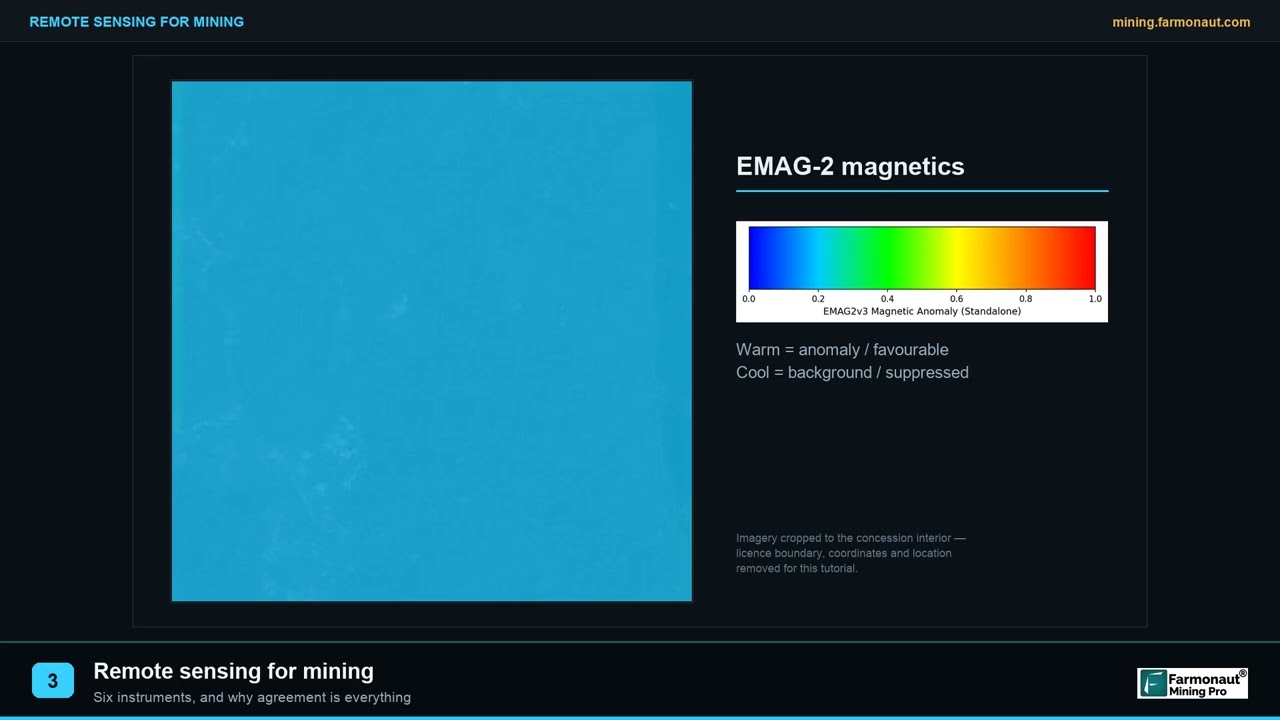
▶ Remote sensing for mining explained in three minutes, without jargon. · 2:01
What a crew training budget looks like
Training cost has two parts: the paid hours a worker spends away from the job, and any outside fee. Fees depend on the provider and the country, so there is no single price per worker. Use the calculator below with your own numbers. The default hours follow the Part 48 minimums above (24 for a new surface miner and 8 for the annual refresher), while wages and fees are placeholders for you to replace.
Calculator
What will a year of crew training cost?
Enter your own headcount, hours, wage cost and course fees.
- Paid time cost: $93,600
- Outside fees: $66,000
- Total training budget: $159,600
- Cost per worker: $725
Example values only, not a benchmark. Defaults of 24 and 8 hours follow the Part 48 minimums for new surface miners and annual refreshers (30 CFR 48.25 and 48.28); underground new miners need 40. Wage cost and fees are placeholders: use your own.
How to choose a course: seven checks
- Hours and syllabus. Ask for the course outline and the hours in writing, and compare them with the legal minimum if one applies.
- Instructor. For Part 48 courses the instructor must be approved by MSHA, so ask for the approval.
- Site fit. A course that covers your mine’s hazards, equipment and emergency plans counts for more than a generic one.
- Assessment. Look for a test or a practical sign-off, not attendance alone.
- Certificate. Check who recognises it: the regulator, your employer or only the training company.
- Evidence. For simulators and VR, ask what was measured at a comparable site and over what period.
- Cost and dates. Get the fee, the dates and the cancellation terms in writing before you pay.
Frequently asked questions
How many hours of training does a new copper miner need in the United States?
At least 40 hours for underground work, completed before assignment to work duties, and at least 24 hours for surface work, of which 8 hours must come before assignment (30 CFR 48.5 and 48.25). The mine’s approved training plan may require more topics.
How often do miners need refresher training?
Every miner needs a minimum of 8 hours of annual refresher training (30 CFR 48.8 and 48.28). The course must cover hazards and rules that relate to the miner’s tasks, such as first aid, electrical hazards and accident prevention.
Who must get new-task training?
Miners starting a new task as mobile equipment operators, drill operators, haulage and conveyor operators, ground-control machine operators or blasters. They must finish task training first unless they were trained and showed safe procedures on that task in the previous 12 months.
Does US law require a degree to work at a copper mine?
Part 48 sets safety-training hours, not an education level. Degrees matter mainly for engineering, geology and processing roles, and employers set their own requirements.
Which degree suits someone who wants to work in copper processing?
The University of Arizona’s Mineral Processing track covers smelting, leaching and refining, and Copperbelt University lists a Bachelor of Engineering in Metallurgical Engineering. Compare the course lists for copper content before you apply.
Is there a short course on copper leaching?
SGS Chile lists a Hydrometallurgical Process Training Course covering leaching methods, leaching solutions and laboratory tests. Contact SGS for dates, length and fee.
Does virtual reality training reduce accidents?
The evidence is limited. A 2011 review found no satisfactory study of performance change in mining, and a 2025 quarry study of 40 participants measured scores and completion, not accident rates. Ask any provider for results from a comparable site.
How large is Chile’s mining workforce?
Chile’s large mines employed about 209,000 people in 2024, and the CCM-Eleva study expects almost 37,000 new workers to be needed by 2034 (Fundación Chile, December 2025).
Which countries produce the most copper?
Chile, Congo (Kinshasa) and Peru lead, at an estimated 5.3, 3.2 and 2.7 million tonnes in 2025 (USGS, 2026).
Where can I learn the basics of satellite remote sensing?
NASA ARSET offers a 2-hour self-paced Fundamentals of Remote Sensing course with a certificate. It covers general satellite principles and the NASA Worldview tool, not mineral exploration.
How much does mining training cost per worker?
There is no single figure, because it depends on provider, country and wages. Add paid hours to any outside fee for your own crew, using the calculator on this page.
Do contractors need the same training?
MSHA’s Part 48 reference guide is written for operators and for independent contractors regulated under Part 48, so contractors working at a regulated mine should confirm their duties with the mine and the MSHA district office.
This page is for information only. It is not legal advice. Confirm training rules with your regulator and the mine’s approved training plan.
Farmonaut mining
Map your mining site from space
Send your area of interest as a KML, KMZ or polygon and receive a satellite-based mineral detection report in 5 to 20 business days. Results are exploration targets, not a resource estimate.

Mining Pro sample view, synthetic data
Keep reading
Sources
- eCFR, 30 CFR 48.5, new underground miners (via Cornell LII): law.cornell.edu
- eCFR, 30 CFR 48.25, new surface miners: law.cornell.edu
- eCFR, 30 CFR 48.8, annual refresher (underground): law.cornell.edu
- eCFR, 30 CFR 48.28, annual refresher (surface): law.cornell.edu
- eCFR, 30 CFR 48.6, experienced miners (underground): law.cornell.edu
- eCFR, 30 CFR 48.26, experienced miners (surface): law.cornell.edu
- eCFR, 30 CFR 48.7, new-task training (underground): law.cornell.edu
- eCFR, 30 CFR 48.27, new-task training (surface): law.cornell.edu
- MSHA, Part 48 Reference Guide (February 2017): msha.gov
- MSHA, Metal/Nonmetal Fatalities, 1900 to 2025: msha.gov
- USGS, Mineral Commodity Summaries 2026: Copper (February 2026): pubs.usgs.gov
- Fundación Chile, Estudio de Fuerza Laboral de la Gran Minería Chilena (4 December 2025): fch.cl
- Fundación Chile, news release on the workforce study (4 December 2025): fch.cl
- University of Arizona, School of Mining Engineering and Mineral Resources, undergraduate degrees: mining.arizona.edu
- Copperbelt University, Mining Engineering department: cbu.ac.zm
- Copperbelt University, School of Mines and Mineral Sciences programmes: cbu.ac.zm
- SGS Chile, Hydrometallurgical Process Training Course: sgs.com
- Oyu Tolgoi statement on simulator purchase (16 December 2011), Immersive Technologies: immersivetechnologies.com
- Tichon and Burgess-Limerick (2011), virtual reality for safety training in mining, QUT ePrints: eprints.qut.edu.au
- Pireddu et al. (2025), virtual reality safety training in quarrying, Int J Environ Res Public Health: ncbi.nlm.nih.gov
- NASA Earthdata, ARSET Fundamentals of Remote Sensing: earthdata.nasa.gov
- NASA Earthdata, Applied Remote Sensing Training Program: earthdata.nasa.gov
Discussion
Questions, corrections or field experience? Share them below. First-time comments are reviewed before they appear, and your email is never published.
No comments yet. Be the first to add a question or your experience.

 Rains of Favour
 Tintina Mining Group
 Dalgety Minerals Pty Ltd
 Vortex Minerals Pty Ltd
 Faith At Work (Pty) Ltd
 Geotech Mining Solutions plc
 Vulcan International Limited
 Kidepo Associates
 GKY Mining
 Alkimy SARL
 Double A Trading
 GemSprout Metals Limited
 Qader Group
 Ileys General Trading
 SG Gold Mining LLC
 VRV Global Pte Ltd
 Omsri International FZE
 G.I.T.T.
 Jaunita Erss Ltd
 Almosi SARL
 SRK Consulting
 Berks Gold Limited
 Mwerezi Minerals Company Limited

 Exploration consultancy · South Africa · Gold










