

Mining technology · Business case
Autonomous Haulage Systems: The Business Case in Numbers
Driverless haul trucks cut load-and-haul cost per tonne by about 15% at Rio Tinto and raised productivity 30% at Fortescue. Here is what the published numbers show, what autonomy costs, and how to test payback for your own fleet.
Key takeaways
- About 3,832 autonomous haul trucks were operating worldwide in July 2025, up 84% in a year (GlobalData).
- Rio Tinto reported about 15% lower load-and-haul unit costs and about 700 more operating hours per truck in 2017.
- Fortescue reported a 30% productivity gain from autonomous haulage at its Pilbara hubs.
- Komatsu commissioned its 1,000th FrontRunner truck in April 2026; Caterpillar’s autonomous trucks have hauled over 13 billion tonnes.
- The case is strongest for large fleets, long mine life and repeatable haul routes; small pits carry the same fixed network and control-room costs.
In this article
- What an autonomous haulage system is
- How autonomous haulage works in a mine
- How many autonomous haul trucks are running
- Autonomous haulage systems: the business case in numbers
- What autonomous haulage costs
- Autonomous vs manned haulage compared
- Safety rules and standards for driverless trucks
- Is autonomous haulage right for your mine? A step-by-step check
- Where satellite data fits in an autonomous mine
- Autonomous haulage business case calculator
- Outlook: what to watch
- Frequently asked questions
The business case for autonomous haulage systems (AHS) rests on three published results: lower load-and-haul cost per tonne (about 15% at Rio Tinto’s Pilbara iron ore mines, per Global Mining Review), more operating hours per truck (about 700 extra hours a year in the same report), and higher fleet productivity (30% at Fortescue, per Mining Technology). Against that sit the conversion cost, a new site network, retrained staff and a long change programme. Whether the numbers work depends mostly on how many tonnes your fleet moves and how long the mine will run.
This guide sets out what an autonomous haulage system is, how many driverless trucks now run worldwide and where, the published savings and their limits, the costs a budget must carry, the safety rules that apply, and a step-by-step way to test the case for your own pit. A calculator lets you plug in your tonnage, haul cost and conversion quote to see a rough payback period.
What an autonomous haulage system is
An autonomous haulage system is a fleet of driverless haul trucks, plus the software and site network that control them, that moves ore and waste in an open-pit mine or quarry with no operator in the cab. A haul truck is the large off-road dump truck that carries broken rock from the loading face (where an excavator or shovel fills it) to the crusher, a stockpile or a waste dump. One full trip is the haul cycle.
In an AHS, each truck knows its exact position from high-precision satellite positioning (GNSS, the family of systems that includes GPS), senses obstacles with radar, lidar and cameras, and follows routes and speed limits sent by a central fleet-management system. People supervise the fleet from a control room, which may sit at the mine or hundreds of kilometres away. Other machines in the pit, such as shovels, dozers, graders and light vehicles, carry tracking units so the trucks know where they are.
AHS is different from two technologies it is often confused with:
- Operator-assist systems (collision warning, fatigue monitoring, speed limiting) still need a driver in the cab.
- Tele-remote operation means a person steers the machine in real time from a console. In an AHS nobody steers; controllers set the plan and handle exceptions.
The main commercial systems are Komatsu FrontRunner, Caterpillar MineStar Command for hauling, and Chinese systems supplied with trucks from makers such as Tonly and LGMG. Hitachi and Liebherr also supply autonomous-ready trucks. Some systems, Caterpillar’s included, can be fitted to other brands of truck, which matters for a mine with a mixed fleet.
How autonomous haulage works in a mine
A working AHS has five parts. All of them have to be in place before the first truck runs without a driver.
- Autonomous trucks: new autonomous-ready trucks, or existing trucks retrofitted with drive-by-wire controls, sensors and on-board computers.
- Positioning: GNSS with real-time correction, accurate to a few centimetres, so trucks hold their lane and stop at the right spot at the shovel and the dump.
- Site communications: a mine-wide wireless or private LTE network that keeps every truck in constant contact with the control system. If a truck loses contact it stops.
- Fleet management and dispatch: software that assigns each truck to a loader and a dump, sets speeds and spacing, and keeps manned and unmanned machines apart.
- Control room and people: controllers who supervise the fleet, and a site team that keeps the mine map current, maintains roads and repairs trucks.
In practice the system works inside a fenced “autonomous operating zone”. Light vehicles and other manned machines that enter it must carry tracking units and follow access rules. This is why the change at a mine is as much about rules and people as about trucks.
How many autonomous haul trucks are running
About 3,832 autonomous haul trucks were in operation worldwide in July 2025, up from 2,080 a year earlier, an 84% rise, according to GlobalData figures reported by Mining Technology. GlobalData expects the count to approach 5,000 by the end of 2030. Three years earlier the total was much smaller: 1,068 trucks in May 2022 and 769 in May 2021, per GlobalData.
Chart
Autonomous haul trucks by country
Number of trucks, July 2025
Chart
Autonomous haul trucks in operation worldwide
Number of trucks
The growth has shifted from Australian iron ore to Chinese coal. In July 2025 China had 2,090 autonomous trucks (up from 562 a year earlier), Australia 1,024, Canada 344 and Chile 208, according to GlobalData. GlobalData says major additions are coming from Chinese coal miners, which it expects to have 500 autonomous haul trucks across their mines by 2027.
Largest autonomous fleets by operator
Ranked by trucks in service in July 2025 (GlobalData, via Mining Technology), the largest fleets were CHN Energy Investment Group with 509 trucks, Guanghui Energy with 420, BHP with 360 and Rio Tinto with 305. The Baishihu coal mine in China held the record for the largest fleet at one site, with 420 trucks. Fortescue, which converted its Pilbara fleets early, reported 183 autonomous trucks across its Solomon and Chichester hubs when it completed its Chichester conversion, per Mining Technology.
Supplier milestones
- Komatsu commissioned its 1,000th FrontRunner ultra-class autonomous truck in April 2026, a 290-tonne 930E-5AT at Nevada Gold Mines in the United States; FrontRunner trucks had moved over 11.5 billion tonnes since commercial launch in 2008 (Komatsu, April 2026).
- Caterpillar says its autonomous trucks have hauled more than 13 billion tonnes and travelled over 455 million kilometres without a reported injury while operating autonomously, and in 2026 extended Command for hauling to the smaller Cat 775 for Luck Stone quarries in Virginia (Skillings Mining Review).
- Caterpillar, Komatsu, Tonly and LGMG together supplied 88% of the trucks tracked by GlobalData in July 2025.
For a wider view of driverless drills, loaders and trucks, see our guide to how autonomous vehicles are changing mining.

▶ What AI does in mining today, and who builds it. · 3:52
Autonomous haulage systems: the business case in numbers
The published evidence comes mostly from large iron ore and coal fleets. The table lists the figures that operators and suppliers have released, with the date and source of each. They are company-reported results, not audited studies, and each one applies to the site that produced it.
Chart
Reported gains from autonomous haulage
Percent change versus manned trucks, as reported by each company
| Measure | Reported result | Where and when | Source |
|---|---|---|---|
| Load-and-haul unit cost | About 15% lower than manned trucks | Rio Tinto Pilbara, 2017 | Global Mining Review (Jan 2018) |
| Operating hours per truck | About 700 more hours a year | Rio Tinto Pilbara, 2017 | Global Mining Review (Jan 2018) |
| Fleet productivity | 30% higher | Fortescue Solomon and Chichester hubs | Mining Technology; MINING.COM (2019) |
| Tyre and brake life | 40% longer on average | Komatsu FrontRunner fleets | Komatsu AHS page (figures as of Oct 2025) |
| Overall maintenance | 13% lower | Komatsu FrontRunner fleets | Komatsu AHS page (figures as of Oct 2025) |
| Injuries while autonomous | None reported over 455 million km | Caterpillar fleets worldwide | Skillings Mining Review (2026) |
Where do these gains come from? Mostly from time. A manned truck stops for shift changes, meal breaks, operator fatigue and absenteeism, and its driver varies speed and spacing. An autonomous truck runs the same route at the same speed through the whole roster, and stops only for fuel, maintenance and blasting. Smoother driving is why Komatsu reports longer tyre and brake life; at mines where a single large tyre is a major consumable, that alone is a real line in the budget.
What the numbers do not tell you
- They come from very large fleets. Rio Tinto and Fortescue run hundreds of trucks on long, wide, well-maintained iron ore haul roads. The fixed cost of the network, control room and software is spread over many trucks. A ten-truck gold pit carries much of the same fixed cost on far fewer tonnes.
- Productivity is not profit. More tonnes only help if the shovels, crusher and plant can take them. If the bottleneck is the mill, extra haulage capacity can mean fewer trucks rather than more ore.
- Baselines differ. A 15% cost saving against a well-run manned fleet is not the same as 15% against a fleet with high driver turnover. Measure your own cost per tonne before comparing.
What autonomous haulage costs
Suppliers do not publish list prices for autonomy, and every quote depends on truck class, the number of trucks, the site network and the contract model. The cost lines below are the ones a budget has to carry.
- Trucks: a large diesel mining truck costs roughly US$5 million, according to Reuters reporting carried by MINING.COM. Autonomy is either built in on a new truck or retrofitted to an existing one.
- Autonomy kit and licences: sensors, controls and on-board computers per truck, plus software licences that may be charged per truck, per tonne or per year.
- Site network: GNSS correction stations and a mine-wide wireless or LTE network with enough coverage for every haul road and dump.
- Fleet tracking: units for every manned machine and light vehicle that enters the autonomous zone.
- Control room: building or fit-out, screens, servers and backup power.
- People and change: training controllers and maintainers, new safety procedures, a project team for 12 to 24 months, and redeployment or redundancy costs for drivers.
- Roads and mine plan: better haul-road maintenance, wider separation at intersections and dumps, and an accurate, up-to-date digital mine map.
Fortescue’s US$2.8 billion agreement with Liebherr for 360 battery-electric autonomous trucks, 55 electric excavators and 60 battery dozers, reported by MINING.COM, shows the scale of capital involved when a miner combines autonomy with electrification. A smaller miner usually starts with a retrofit of part of its fleet.
Autonomous vs manned haulage compared
| Factor | Manned haul trucks | Autonomous haulage |
|---|---|---|
| Hours per truck | Lost to shift changes, breaks and absent drivers | Runs through breaks; about 700 more hours a year at Rio Tinto (2017) |
| Driving consistency | Varies by operator | Same speed and spacing every cycle |
| Labour | Drivers on every shift, often hard to recruit at remote sites | Fewer drivers; more controllers, technicians and network staff |
| Up-front cost | Truck only | Truck plus autonomy kit, network, tracking, control room and change programme |
| Flexibility | Drivers adapt to rain, dust and changes at once | Needs current mine maps and good roads; stops when unsure |
| Best fit | Short mine life, small or changing pits, mixed manned traffic | Long life, large fleets, repeatable routes, remote sites |
Safety rules and standards for driverless trucks
Western Australia published the first code of practice for autonomous mining in 2015. The current version, Safe mobile autonomous mining in Western Australia, is hosted by WorkSafe WA and sets out what a mine must show before an autonomous system is approved: hazard analysis, separation of manned and unmanned equipment, change management and the role of a competent person. Many mines outside Australia use it as a reference. The Australian Business Licence and Information Service lists it as guidance that helps mines meet their work health and safety duties.
Haulage is where the safety case starts. In the United States, powered haulage accidents caused 13 of the 33 mining deaths in 2025 (39%) and 426 of 4,792 non-fatal injuries, according to the Mine Safety and Health Administration (MSHA). MSHA’s general rules for surface haulage apply to autonomous fleets, and operators work site plans out with MSHA district offices. Before committing to a timeline, ask your regulator what it will require to see. For broader safety technology, see our review of mine safety solutions.
Is autonomous haulage right for your mine? A step-by-step check
- Measure today’s haul cost per tonne. Include fuel, tyres, maintenance, drivers and supervision, split by pit and by truck class.
- Check the remaining mine life. Payback depends on years of steady haulage. A pit with three years left rarely justifies a new network and control room.
- Count the trucks and tonnes. Fixed costs are spread over the fleet; the more trucks and the longer the hauls, the better the case.
- Find the real bottleneck. If the crusher or plant limits output, the gain will be fewer trucks and lower cost, not more ore.
- Review roads, dumps and traffic. Tight ramps, frequent layout changes and heavy light-vehicle traffic reduce autonomous gains.
- Ask two or more suppliers for quotes for both new autonomous trucks and retrofits, including network, licences, support and training.
- Plan the workforce change. Decide early which drivers move into control-room, maintenance or other roles, and agree the plan with your people and their representatives.
- Run a pilot zone with a few trucks on one route, then scale up once the cost per tonne is measured against the manned fleet.
Infographic
Testing the autonomous haulage business case
- 1BaselineMeasure haul cost per tonne today.
- 2FitCheck mine life, fleet size and bottleneck.
- 3QuotesGet supplier quotes for trucks, network and licences.
- 4PilotRun a few trucks in one zone.
- 5ScaleExpand once cost per tonne is proven.
For background on cost and margin per tonne, see our explainer on mining profitability.
Where satellite data fits in an autonomous mine
An autonomous fleet depends on an accurate, current map of the mine: pit walls, ramps, dumps and roads. Drone and survey data handle day-to-day changes. Satellite imagery helps at a larger scale, for example by tracking how dumps and pits grow, spotting drainage and water problems on haul roads, and checking site boundaries and rehabilitation over years. Earlier in the mine’s life, satellite mapping of alteration and structures can help a licence owner screen ground before drilling, long before any haulage plan exists. Drilling and blasting quality also affects how well trucks are loaded; our review of drill and blast monitoring software covers that stage.
Farmonaut provides satellite-based mineral exploration mapping for licence owners and mining companies through its satellite-based mineral detection service; it does not make trucks or autonomy systems. For the wider shift to automation across drills, loaders and processing, see automated mining.

▶ How AI and satellite data are used in mineral exploration. · 4:37
Autonomous haulage business case calculator
Use the calculator to test a rough payback period. Enter your own annual tonnes hauled, current load-and-haul cost per tonne, the saving you expect (Rio Tinto reported about 15% in 2017), and the total conversion cost from a supplier quote. The result is a planning estimate, not a quote. It ignores financing, tax and the time needed to ramp up.
Calculator
Rough payback on an autonomous haulage conversion
Enter your tonnes, haul cost, expected saving and conversion quote.
- Annual saving (US$): $9,000,000
- Total conversion cost (US$): $60,000,000
- Saving per tonne (US$): $0.23
Example values only, not a benchmark. The 15% default saving is Rio Tinto’s reported 2017 Pilbara result (Global Mining Review, 2018). Haul cost and conversion cost are inputs: example, use today’s price and your supplier quote. Excludes financing, tax, ramp-up time and workforce transition costs.
Outlook: what to watch
- Fleet growth in China. Chinese coal miners added most new autonomous trucks in 2024 and 2025, and GlobalData expects major additions from Chinese coal miners through 2027.
- Smaller trucks and quarries. Caterpillar’s move to the Cat 775 for Luck Stone shows autonomy reaching aggregates sites with shorter cycles and smaller fleets.
- Autonomy plus electrification. Fortescue is buying battery-electric autonomous trucks from Liebherr.
- Gold and copper mines. The 1,000th FrontRunner truck went to Nevada Gold Mines, a sign that autonomy is spreading beyond iron ore and coal.
Chart
Largest autonomous truck fleets by operator
Number of trucks, July 2025
Mining equipment makers update their fleet numbers often. Check the supplier’s latest release, or ask for reference sites similar to yours, before using any figure in a board paper. If you need a contact for a site-mapping quote, use our mining query form or contact us.
Frequently asked questions
What is the business case for autonomous haulage systems?
It rests on lower cost per tonne, more operating hours and higher productivity. Rio Tinto reported about 15% lower load-and-haul unit costs and about 700 more hours per truck in 2017, and Fortescue reported 30% higher productivity. Against that sit conversion, network, software and change costs.
What is autonomous haulage?
Autonomous haulage is the use of driverless haul trucks, guided by high-precision GNSS, sensors and a central fleet-management system, to carry ore and waste in a mine with no operator in the cab.
How many autonomous haul trucks are there worldwide?
About 3,832 were in operation in July 2025, up from 2,080 in July 2024, according to GlobalData. China had the most, followed by Australia, Canada and Chile.
What is the average payback period for autonomous haulage?
No public, independent average exists, because payback depends on fleet size, tonnes, haul cost and mine life. Large fleets with long mine lives recover costs fastest. Use the calculator on this page with your own figures and supplier quote.
How much does an autonomous haul truck cost?
A large diesel mining truck costs roughly US$5 million, per Reuters reporting in September 2024. Autonomy adds the kit, licences, site network, tracking units and control room; suppliers quote these per project.
Which companies make autonomous haulage systems?
The main suppliers are Komatsu (FrontRunner), Caterpillar (MineStar Command for hauling), Tonly and LGMG. Together these four supplied 88% of autonomous trucks tracked by GlobalData in July 2025. Hitachi and Liebherr also supply autonomous-ready trucks.
Which mining companies run the largest autonomous fleets?
In July 2025 the largest were CHN Energy (509 trucks), Guanghui Energy (420), BHP (360) and Rio Tinto (305), according to GlobalData.
How does autonomous haulage work on mining dump trucks in Australia?
Trucks follow routes set by a fleet-management system, use GNSS to hold position, and stop if their sensors detect an obstacle or they lose contact with the network. Mines must meet the Western Australian code of practice for safe mobile autonomous mining before approval.
Does autonomous haulage cut jobs?
It removes most driver roles on autonomous trucks and adds roles for controllers, technicians and network staff. Barrick says autonomy at Nevada moved operators away from haulage into more skilled roles. The net effect depends on each site’s plan.
Can a small mine or quarry use autonomous haulage?
Yes, though the case is harder because fixed costs are spread over fewer trucks. Luck Stone’s quarries in Virginia run autonomous Cat 777 trucks and are adding Cat 775 trucks.
This page is for information only. It is not investment or engineering advice. Savings figures are company-reported results from specific sites; get supplier quotes and site studies before budgeting.
Farmonaut mining
Map your mine site from space
Get a quote for satellite mapping of your licence area, pits and dumps to support exploration and mine planning.
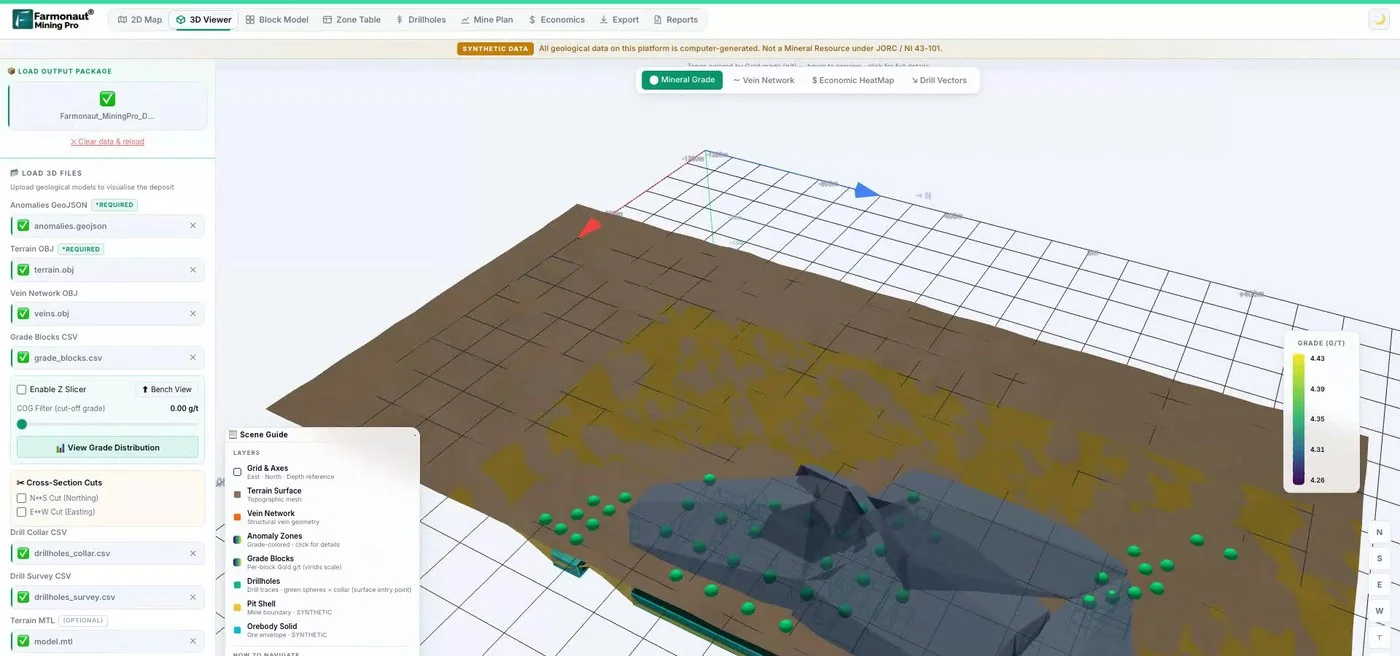
Mining Pro sample view, synthetic data
Keep reading

Sources
- GlobalData via Mining Technology, China emerges as global leader in autonomous surface mining trucks (2025): mining-technology.com
- GlobalData, Global autonomous mining truck population tops 1,000 (2022): globaldata.com
- Global Mining Review, Rio Tinto reaches autonomous truck fleet milestone (January 2018): globalminingreview.com
- Mining Technology, Fortescue completes Chichester automation project: mining-technology.com
- MINING.COM, Caterpillar moves a billion tonnes autonomously at Fortescue Metals (November 2019): mining.com
- Komatsu, Komatsu becomes first OEM to commission 1,000 ultra-class autonomous haul trucks (April 2026): komatsu.com
- Komatsu, FrontRunner Autonomous Haulage System: komatsu.com
- International Mining, Komatsu commissions 1,000 autonomous ultra-class trucks (April 2026): im-mining.com
- Skillings Mining Review, Caterpillar puts autonomous haulage on Cat 775 trucks (2026): skillings.net
- MINING.COM (Reuters), Fortescue, Liebherr secure orders for 100 electric mining trucks (September 2024): mining.com
- MSHA, Powered Haulage Safety: msha.gov
- WorkSafe WA, Safe mobile autonomous mining in Western Australia: Code of practice: worksafe.wa.gov.au
- Australian Business Licence and Information Service, Safe Mobile Autonomous Mining in Western Australia Code of Practice: ablis.business.gov.au
Discussion
Questions, corrections or field experience? Share them below. First-time comments are reviewed before they appear, and your email is never published.
No comments yet. Be the first to add a question or your experience.

 Dalgety Minerals Pty Ltd
 Vortex Minerals Pty Ltd
 Faith At Work (Pty) Ltd
 Geotech Mining Solutions plc
 Vulcan International Limited
 Kidepo Associates
 GKY Mining
 Alkimy SARL
 Double A Trading
 GemSprout Metals Limited
 Qader Group
 Ileys General Trading
 SG Gold Mining LLC
 VRV Global Pte Ltd
 Omsri International FZE
 G.I.T.T.
 Jaunita Erss Ltd
 Almosi SARL
 SRK Consulting
 Berks Gold Limited
 Mwerezi Minerals Company Limited
 Mining SARL
 SenGold Invest SAS

 Exploration consultancy · South Africa · Gold
 Client · Oregon, USA · Gold










