

Rock drilling · History and buyer guide
Denver Rock Drill: History and 5 Bit Makers Today
Denver Rock Drill Manufacturing Co. built pneumatic rock drills on a Denver site from 1910; that land is now being redeveloped and the company does not sell bits today. This page compares five makers that do.
Key takeaways
- The Denver Rock Drill site was established in 1910 and employed more than 600 people at its peak (Sasaki, Rock Drill RiNo).
- In 1927 the Gardner Governor Company merged with the Denver Rock Drill Company to form Gardner-Denver, now part of Ingersoll Rand (Wikipedia).
- Five makers with rock tools today: Epiroc (US head office in Broomfield, Colorado), Sandvik, Boart Longyear, Mincon and Robit (company pages, filings and Wikipedia, 2019-2026).
- Tungsten concentrate averaged US$380 per dry metric ton unit in 2025 (estimate), up from US$252 in 2024 after a sharp rise during the year; China mined about 79% of world tungsten (USGS, 2026).
- Colorado hard-rock prospecting needs a notice of intent before entry, and drill holes must be plugged, sealed or capped (C.R.S. 34-32-113).
In this article
- What was Denver Rock Drill, and does it still sell bits?
- Denver Rock Drill timeline: from the 1910 factory to RiNo
- Where the company went: Gardner-Denver, Ingersoll Rand and other Colorado drill makers
- How we chose five rock drill bit makers
- Five rock drill bit and tool makers you can buy from today
- Drill bits for hard rock: carbide buttons, diamond and PDC
- Diamond drilling tools for hard rock: what to ask a supplier
- How hard is your rock? Test results from a published drillability study
- Why bit costs move: tungsten and synthetic diamond
- Cost per metre calculator for a drill bit
- Drilling rock in Colorado: notice, plugging and dust rules
- Drill maintenance and safety checks before every shift
- Before you drill: pick the target first
- Frequently asked questions
Denver Rock Drill was a real Denver manufacturer of pneumatic rock drills for mining, but it is not a supplier of drill bits today. The company’s factory site opened in 1910, and the same land in the River North (RiNo) district is now being redeveloped for homes, shops and offices. If you landed here looking for diamond drilling tools or bits for hard rock, this page explains the history, then compares five makers that sell bits and rock tools now.
Terms used below: a drill bit is the cutting head at the end of the drill string; a core bit is a hollow bit that leaves a solid cylinder of rock (the core) for geologists to assay; DTH means down-the-hole, a drilling method where the hammer sits right behind the bit; top hammer means the hammer stays on the rig and sends its blows down the rods. Each term is explained again where it matters.
What was Denver Rock Drill, and does it still sell bits?
The Denver Rock Drill Manufacturing Company built a line of pneumatic (compressed-air) rock drills known as Waugh drills, which the redevelopment team’s history page says were used in mining operations worldwide in the first half of the 20th century. At its peak the plant filled nearly two city blocks and employed more than 600 workers. A separate Denver Public Library photograph shows the Denver Rock Drill and Machinery Company in a three-story building at 18th and Blake Streets, with signs for mining machinery, pumping machinery and air compressors.
No source we opened shows a company of that name selling bits or diamond tools now. The factory buildings stand mostly empty, and the owners are planning a mixed-use district. Searching for that name plus a bit price will therefore not lead to a catalogue. The sections below show who makes the same kind of tools today.
Denver Rock Drill timeline: from the 1910 factory to RiNo
Sources disagree on small details. Developer pages and the city’s 2025 planning memo give 1910 as the start of the site, so we use 1910. The table uses only dated statements from the pages we opened.
| Year | What happened | Source |
|---|---|---|
| 1849 | J. J. Couch of Philadelphia receives the first US patent for a rock drill. | Wikipedia, Rock drill |
| 1899-1901 | Newspapers report rock-drilling contests at a Denver festival, at Colorado Springs and at the Central City fair. | Denver Public Library index |
| 1902 | J. George Leyner founds his engineering works in Littleton; it later moves to Denver. | Wikipedia, J. George Leyner |
| 1910 | The Rock Drill site is established as home of the Denver Rock Drill Manufacturing Company. | Sasaki |
| 1910-1961 | The company keeps adding facilities on the RiNo site. | Rock Drill RiNo |
| 1927 | The Gardner Governor Company merges with the Denver Rock Drill Company to form Gardner-Denver. | Wikipedia, Ingersoll Rand |
| 1932 | Ingersoll-Rand acquires the Leyner company. | Wikipedia, J. George Leyner |
| 1970s-1988 | Mentor Corporation buys the property; Butler Fixture & Manufacturing Co. occupies it until its bankruptcy in 1988. | Rock Drill RiNo |
| 1992 | The Weiss family buys the site. Sasaki, Rock Drill RiNo, the city planning memo and the Denver Gazette say 1992; Naked Denver and the district page say 1993. | Sasaki |
| 2016 | The RTD A Line opens with a stop two blocks away. | Naked Denver |
| March 2026 | Byron Weiss dies at 86. Naked Denver reports that the city approved rezoning, a development agreement and tax-increment financing in 2025, and that construction was still months from starting. | Naked Denver |
Where the company went: Gardner-Denver, Ingersoll Rand and other Colorado drill makers
The city’s redevelopment memo dates Waugh drill production on the RiNo site from 1910 to 1961, and the sources we opened do not say whether the company name was kept after the 1927 merger. The Denver name lives on in an industrial brand. After the 1927 merger, Gardner-Denver grew through acquisitions and, in 2020, merged with the industrial segment of Ingersoll-Rand plc to form Ingersoll Rand Inc., which is based in Davidson, North Carolina. The product list on its profile (compressors, vacuum and blower products, pumps, power tools and lifting equipment) does not mention rock drill bits.
Colorado had other drill makers. J. George Leyner, born in Left Hand Canyon, began building mining equipment in a Colorado machine shop in 1891. His water-fed drill reduced the dust that causes silicosis, and many states ended up requiring the Leyner design. Dust control is still a core part of drilling safety, as the Colorado section below shows.
How we chose five rock drill bit makers
This page is for mine employees, consultants and project owners who want to know who to call. We used four rules.
- Sells rock bits or rock tools now. Each company’s own pages, filings or a trade report show bits, hammers, rods or other rock tools in its range.
- A real corporate record. We give the listing or ownership, and where it manufactures, from the company’s own pages or a dated filing.
- Different strengths. The five cover top hammer, DTH, rotary and diamond core drilling, so every buyer finds one that fits.
- Facts, not rankings. The order is not a ranking. “Best for” is our reading of each company’s product list, not a test result. Nothing here is a quote, and no prices are listed.
Distributors and smaller regional makers also sell bits. This list covers makers whose pages and filings we could check.
Five rock drill bit and tool makers you can buy from today
1. Epiroc
Best for: buyers who want rigs, rock drilling tools and raise boring from one maker, with a US head office in the Denver area.
Epiroc is a Swedish company created when Atlas Copco split off its mining and infrastructure business; it became an independent company when it was listed on Nasdaq Stockholm on 18 June 2018. Its range covers drilling rigs, rock drilling tools, trucks and loaders, raise boring and rock reinforcement. In July 2019 it moved its US headquarters from Commerce City to Broomfield, Colorado, a Denver suburb; the 2019 announcement said more than 70 people work there.
- Strengths: a US head office in the Denver region, and rigs and tools from one supplier.
- Limits: rock tools are one division among several, so confirm the bit range for your rig. Epiroc’s website blocked our automated check, so the facts above come from its Wikipedia entry and a trade report.
2. Sandvik
Best for: buyers who want DTH, top hammer and rotary tools from one maker.
Sandvik was founded in Sweden in 1862 and trades on Nasdaq Stockholm. Its rock tools page lists down-the-hole, top hammer, rotary and raise boring tools, a family of carbide grades it calls PowerCarbide, and a carbide recycling service that it says is included with all of its carbide rock tools.
- Strengths: a wide tool range and a stated take-back route for worn carbide.
- Limits: the rock tools page lists no diamond core bits, so ask Sandvik’s exploration business about core bits and confirm the current range.
3. Boart Longyear
Best for: diamond core bits for exploration drilling.
Boart Longyear traces back to 1890, when Edmund Longyear drilled the first diamond core hole on Minnesota’s Mesabi Range and then formed a contract diamond drilling company, according to the company’s own history page. It is headquartered in Salt Lake City, Utah, and since April 2024 it has been owned by American Industrial Partners after a take-private deal. Its engineers developed the impregnated-diamond bit, in which synthetic diamonds are spread through the crown rather than set on its face.
- Strengths: more than a century of work in diamond core drilling, and a US base.
- Limits: as a private company it files less public data than listed rivals, so confirm the current catalogue with the maker.
4. Mincon
Best for: DTH hammers and bits for construction, mining and water-well work.
Mincon Group plc is incorporated in Ireland and its shares trade on Euronext Growth Dublin and on London’s AIM. Its half-year report for the six months to 30 June 2026 gives revenue of EUR 87.8 million, up 19%, with manufacturing and sales sites in Ireland, Sweden, Finland, South Africa, Australia, the United States and Canada. The Americas region grew 48% in that half, all of it in North America. Its product page lists DTH hammers and bits, rotary bits, reverse-circulation products and drill pipe.
- Strengths: manufacturing in North America, and a DTH focus.
- Limits: no core bits on its product list, and the company says it has absorbed a sharp rise in carbide cost without passing all of it on yet, so list prices may move.
5. Robit
Best for: buyers who want a consumables specialist (bits, rods and casing) that sells through dealers.
Robit Plc is a Finnish company listed on Nasdaq Helsinki. Its own description says it manufactures in Finland, South Korea and the UK, sells through dealers in more than 100 countries, and splits its range into top hammer, DTH and geotechnical tools. Its news page reports supply agreements in Australia, North America and South Africa announced on 4 June 2026, with deliveries starting in the third quarter of that year.
- Strengths: a narrow focus on consumables, and a dealer network.
- Limits: you buy through a dealer rather than from the factory, and the product list shows no diamond core bits.
Drill bits for hard rock: carbide buttons, diamond and PDC
A plain steel bit wears out quickly in rock, so bits carry a harder cutting material. Two families do most of the work.
- Carbide button bits. Hard cemented-carbide buttons are set into a steel body. Mining and tunnelling tools most often carry cemented carbide tips, and button bits remain the most used type worldwide.
- Diamond bits. Rotary rock drills often use bits coated or set with diamond. The diamonds sit in a softer metal so that the metal wears away and exposes fresh diamond. This is the technology behind exploration core drilling, as the next section shows.
A third type, the polycrystalline diamond compact (PDC), was pioneered by General Electric in the late 1970s as a replacement for natural diamonds in drill bits. A PDC cutter is made from diamond powder, and the USGS says at least four US companies make polycrystalline diamond from it.
Which one to use depends on the rock, the hole size and the method, not on a single best bit. Our page on common drilling problems in mining and their fixes covers wear, deviation and lost circulation in more detail. Dust is a hazard of every method; modern rock drills flood the hole with water, which captures dust and also cools and lubricates the bit, as the rock drill history notes.
▶ Follows a gold nugget from rock to ring, including the drilling stage where bits do their work. · 5:27
Diamond drilling tools for hard rock: what to ask a supplier
A diamond core bit is a hollow ring with diamonds embedded in a metal matrix. The Kentucky Geological Survey describes the rim as coated with tungsten carbide or diamond chips, cutting with the help of water, while the core passes up the centre into a core barrel. The matrix is meant to wear slowly so that new diamonds keep appearing. A bit designed for a specific rock type has many channels that wash cuttings away.
Chart
Standard core diameters by Q size
Inches
Core bits come in standard “Q” sizes. Larger cores give more sample and need more drill power, so the size is a trade-off between the core you want and the depth your rig can reach.
| Size | Hole diameter (mm) | Core diameter (mm) |
|---|---|---|
| AQ | 48 | 27 |
| BQ | 60 | 36.5 |
| NQ | 75.7 | 47.6 |
| HQ | 96 | 63.5 |
| PQ | 122.6 | 85 |
NQ (47.6 mm core) and HQ (63.5 mm core) are the two most common wireline sizes, according to the exploration drilling overview. The chart uses the Kentucky Geological Survey’s rounded inch sizes, which differ slightly from the millimetre table (AQ core is 27 mm, about 1.06 in, in the table).
When you talk to a supplier of diamond drilling tools for hard rock, ask these questions:
- Which Q size and thread fit my barrel and rods? Confirm the fit with the maker before you order.
- Which matrix suits my rock? The matrix has to wear at a rate that keeps exposing diamonds, so ask the maker which one it recommends for your rock and how abrasive it is.
- What water flow does the bit need? Flushing removes cuttings and cools the bit.
- How is the price quoted? Ask for the price per bit, the expected metres per bit on rock like yours, and whether worn bits are taken back for their diamond or carbide.
- What is the lead time? A drill rig waiting for bits costs more than the bits.
Exploration drilling is also where the choice of target matters most. Our guide to channel and chip sampling shows what to do with the surface samples before you spend on core.
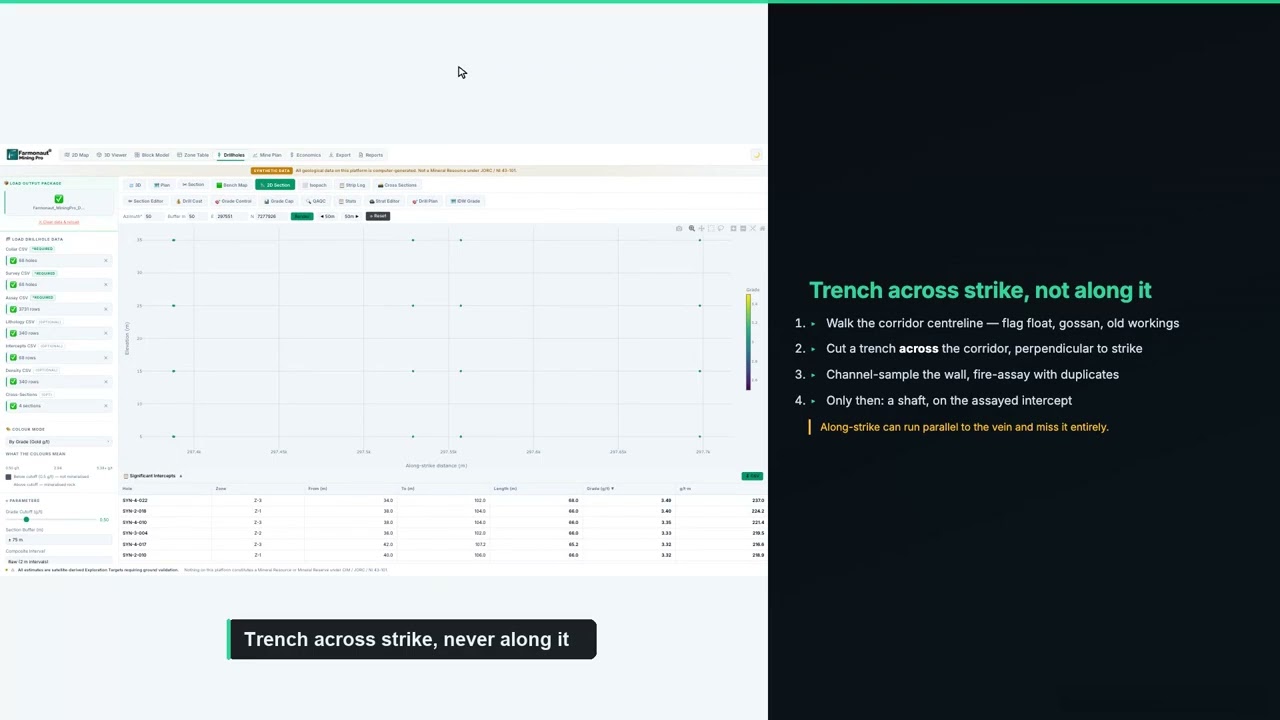
▶ Explains how a drill program is planned, from the drillhole database to hole placement. · 12:13
How hard is your rock? Test results from a published drillability study
Uniaxial compressive strength (UCS) is the load a rock sample carries before it fails, measured in megapascals (MPa). The 1969 paper “A rock drillability index” by C. G. White, in the Quarterly of the Colorado School of Mines, tabulated strength next to other hardness tests for unweathered rock samples; the table is reproduced by AusIMM.
Chart
Compressive strength of unweathered rock samples
MPa; range across test specimens of one sample; selected samples from one study
The study shows two things. Strong rocks are very strong: hornfels averaged 327.0 MPa and a diorite sample 221.6 MPa. And one rock name covers a wide spread: one sandstone sample averaged 20.6 MPa while another averaged 98.8 MPa. The table says some values are based on a limited number of tests, so use it to see the pattern, not as a design value for your site. Test your own core before you choose a bit.
Why bit costs move: tungsten and synthetic diamond
Bit costs follow two raw materials. Tungsten makes the carbide, and diamond makes the diamond bits and PDC cutters.
Chart
US manufactured industrial diamond production
Million carats of bort, grit, dust and powder (2025 is an estimate)
Chart
Tungsten mine production, selected countries, 2025
Tonnes of contained tungsten (estimates)
Tungsten. The USGS says an estimated 60% of the tungsten used in the United States goes into cemented carbide parts for cutting and wear-resistant uses, including mining and oil- and gas-drilling. The US has not mined tungsten commercially since 2015. Worldwide mine output is concentrated: China produced about 67,000 of the world’s 85,000 tonnes in 2025 (estimates), roughly 79%. The USGS gives the average price of tungsten concentrate in Rotterdam as US$252 per dry metric ton unit of tungsten trioxide in 2024 and US$380 in 2025 (estimate), a rise of about 51%. The same report says prices rose sharply through 2025, with Rotterdam 65% concentrate going from US$266 to US$551 per metric ton unit, so the yearly average is below the late-2025 level. Mincon’s half-year report calls the carbide price move a sharp rise that squeezed its margin on bits.
Diamond. Synthetic diamond is made, not mined. The USGS puts US output of manufactured industrial diamond bort, grit and powder at an estimated 160 million carats in 2025, and says about 97% of US industrial diamond use is synthetic; worldwide, natural diamond is less than 1% of all industrial diamond used. At least two US companies recover diamond from used drill bits and other waste for recycling.
This page does not list bit prices, because they change with the rock, size, quantity and supplier. If price is your question, see our page on drill bit prices for rock, diamond and PDC bits.
Cost per metre calculator for a drill bit
The price of the bit is only part of what a hole costs. Rig time often matters more, so a cheaper bit that drills slowly or wears quickly can cost more per metre. Use the calculator to compare two bits: enter the quoted price, the metres you expect from it, your penetration rate and your rig cost per hour.
Calculator
What does a metre of hole cost with this bit?
Enter your own bit price, bit life, penetration rate and rig cost.
- Hours on one bit, drilling plus change: 30.5 hours
- Total cost over the life of one bit: 8,125 US$
- Bit price as share of that cost: 6.2 %
Example values only, not benchmarks or quotes. Bit price and rig cost are inputs: example, use your own quote and today’s rig rate (US$). Formula: (bit price + rig cost per hour x (metres per bit / penetration rate + change time)) / metres per bit.
Drilling rock in Colorado: notice, plugging and dust rules
Colorado law asks anyone who wants to prospect for hard-rock minerals to file a notice of intent with the Mined Land Reclamation Board before entering the land, on a form the board approves, with a fee. The text of C.R.S. 34-32-113 says the notice must name the operator, describe the work, list the land by township and range, give a start date and set out the reclamation measures. Information about the deposit’s location, size or nature is kept confidential.
Infographic
Colorado hard-rock prospecting drill holes in 5 steps
- 1File a notice of intentSend the board’s form with the fee before you enter the land.
- 2Provide a financial warrantyThe statute text sets US$2,000 per acre to be disturbed, or another amount the board decides.
- 3Drill the holesUse dust control and follow the landowner’s conditions.
- 4Plug, seal or cap each holeDo this right after drilling; cap below the surface and backfill.
- 5File a notice of completionThe board then has 90 days to say which reclamation steps are needed.
The same section requires a financial warranty at filing, set in the text at US$2,000 per acre to be disturbed or another amount the board decides, and it requires prospecting drill holes to be plugged, sealed or capped. Each hole must be capped at a depth that suits local cultivation or at least two feet below the original surface or the collar of the hole, whichever is lower, and the site backfilled. The Division of Reclamation, Mining and Safety (DRMS) lists new hard rock rules effective 14 April 2026, so confirm the current fee, warranty and form with DRMS before you file. You also need the landowner’s permission, and other land managers set their own rules. For claim timing and permits for gold ground, see our page on gold mining in Colorado.
On dust, the Mine Safety and Health Administration (MSHA) says it continues to enforce the existing silica standards at metal and nonmetal mines (30 CFR 56.5001, 56.5005, 57.5001 and 57.5005) because a court stayed the 2024 silica rule on 11 April 2025. Use water or dust collection on every rig, and wear respiratory protection if the maker’s manual or your site plan calls for it.
Drill maintenance and safety checks before every shift
Whatever the maker, the same checks protect people and bits. Follow the maker’s manual first; where a rule below conflicts with it, the manual wins.
- Inspect connections, seals and hoses before and after each shift, and replace worn parts before they fail.
- Check each bit for wear: rounded or chipped buttons, a worn gauge (the outer edge that sets hole size) or a polished diamond crown mean it is time to change.
- Keep the flushing system working: blocked water or air passages overheat bits and lose core.
- Lock out and tag out the rig before you change a bit or work on the feed.
- Log metres per bit. The log is the data you need for the calculator above and for your next quote.
Before you drill: pick the target first
A hole in the wrong place costs the same as a hole in the right place, so exploration teams narrow down the ground before the rig arrives. Surface mapping, sampling and satellite screening all do that job. Satellite-based mineral detection analyses multispectral and hyperspectral imagery for the spectral signatures of mineralised zones and alteration; our page on satellite-based mineral detection explains the method, and a satellite result is an exploration target that sits ahead of a resource estimate, not a drilling instruction. Our guide to geological mapping methods covers the field side.
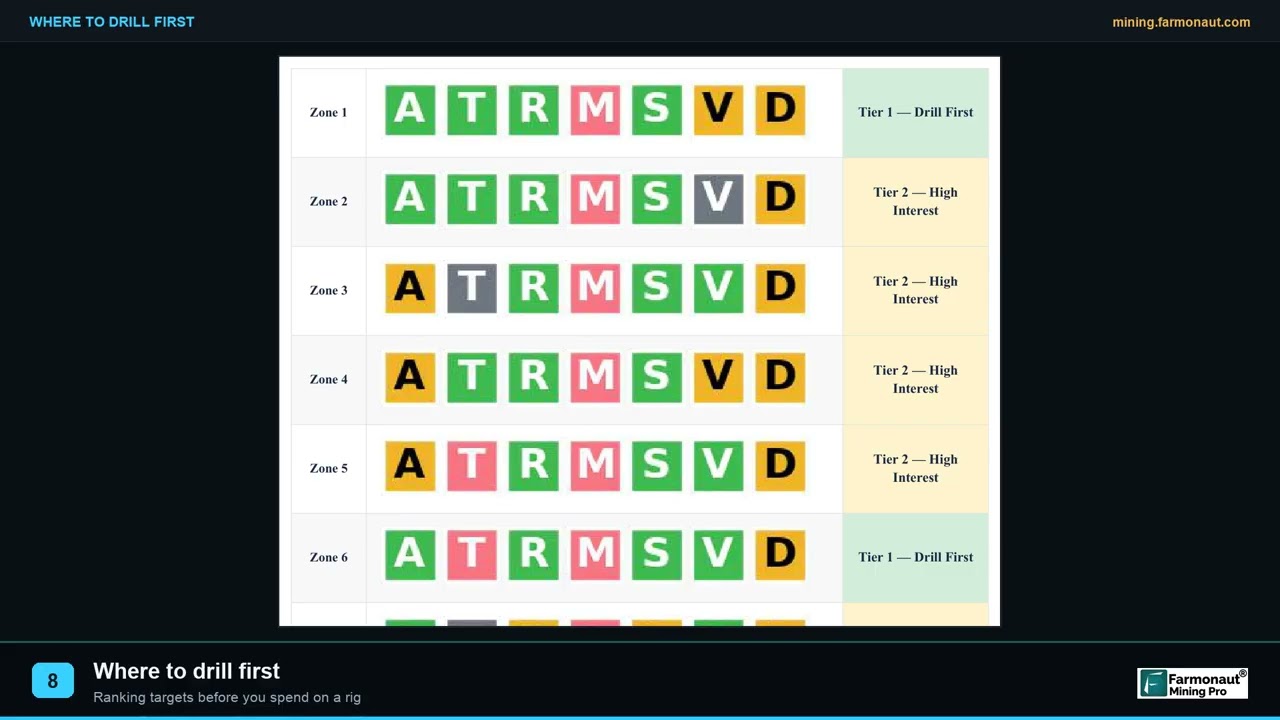
▶ Shows how satellite targets are ranked into a drill order. · 2:19
Frequently asked questions
Is Denver Rock Drill still in business?
Not as a drill maker, according to the pages we opened. The manufacturing company dates to 1910 on the RiNo site, and the buildings are now part of a redevelopment led by OliverBuchananGroup and the Weiss family. The Denver Rock Drill Metropolitan District, a local government body, now carries the name for the new project.
What did the company make?
Pneumatic rock drills, sold as Waugh drills, for mining. A Denver Public Library photo of a similarly named firm, the Denver Rock Drill & Machinery Co. at 18th and Blake Streets, shows signs for mining machinery, pumping machinery and air compressors; the sources we opened do not say how the two companies were related.
Where was the Denver Rock Drill factory?
At the north end of Denver’s Cole neighborhood, in the River North Art District next to the railroad, the RTD A Line and the 39th Avenue Greenway, according to the redevelopment website. Site size depends on the source: Sasaki says 7 acres, the Denver Gazette 8.4 acres, and the city’s 2025 planning memo describes an area of about 8.1 acres that includes right-of-way.
What is happening to the Denver Rock Drill site now?
The Denver Gazette reported in August 2025 that the site had mostly sat empty since 2010 and that the city’s urban renewal authority had found it eligible for tax-increment financing. In March 2026 Naked Denver said the approvals were in place and construction was months away. The plan calls for 700 to 800 homes, a hotel and up to 150,000 square feet of retail.
Who makes drill bits for hard rock today?
Epiroc, Sandvik, Mincon and Robit sell rock drilling tools, and Boart Longyear is known for diamond core bits. The comparison above gives the facts we could check for each.
What is the difference between a button bit and a diamond bit?
A button bit has carbide buttons set into a steel body and is used with hammering methods. A diamond bit has diamonds set in a metal matrix and cuts by rotation, which is why it is used for core drilling.
What size core bit should I use?
NQ and HQ are the usual wireline sizes. A larger core gives more sample but needs more drill power, so the size is a trade-off between core diameter and the depth your rig can reach.
How long does a diamond core bit last?
There is no single figure. Bit life depends on the rock, the matrix, the water flow and the operator. Keep a log of metres per bit on your own site, and use it in the cost calculator.
Do I need a permit to drill exploration holes in Colorado?
Hard-rock prospecting in Colorado needs a notice of intent filed with the state board before you enter the land, and holes must be plugged, sealed or capped. Check the current rules and fees with DRMS, and get the landowner’s permission.
How can I lower my cost per metre?
Raise the metres you get from each bit, increase penetration rate, and cut changeover time. Rig hours can outweigh the bit price, as the calculator’s example values show, so test one change at a time. Choosing the hole location with mapping first avoids holes that were never going to find anything.
This page is for information only. It is not legal advice or a recommendation to buy from any company, and it lists no prices. Confirm the rules with the regulator. Drilling needs the landowner’s permission, any permit that applies, dust control and trained operators.
Farmonaut mining
Map your mining site before the rig moves
Mine employees can ask for a satellite screen of a licence area to see which parts are exploration targets, ahead of any resource estimate.

Mining Pro sample view, synthetic data
Keep reading

Sources
- Sasaki, Denver Rock Drill Redevelopment Plan: sasaki.com
- Rock Drill RiNo, site history: rockdrillrino.com
- Denver Public Library, Denver Rock Drill and Machinery Company photograph: digital.denverlibrary.org
- Denver Public Library, Rock drilling index card: digital.denverlibrary.org
- Naked Denver, Byron Weiss obituary and project status (March 2026): nakeddenver.com
- Denver Gazette, Rock Drill RiNo redevelopment (August 2025): denvergazette.com
- Denver Rock Drill Metropolitan District, In memory of Byron Weiss: denverrockdrillmd.specialdistrict.org
- Wikipedia, Ingersoll Rand (Gardner Denver history): en.wikipedia.org
- Wikipedia, J. George Leyner: en.wikipedia.org
- Wikipedia, Rock drill: en.wikipedia.org
- Wikipedia, Exploration diamond drilling: en.wikipedia.org
- Wikipedia, Cemented carbide: en.wikipedia.org
- Wikipedia, Epiroc: en.wikipedia.org
- Roads & Bridges, Epiroc moves headquarters to Broomfield (July 2019): roadsbridges.com
- Wikipedia, Sandvik: en.wikipedia.org
- Sandvik, Rock tools: rocktechnology.sandvik
- Wikipedia, Boart Longyear: en.wikipedia.org
- Mincon Group plc, Half year results to 30 June 2026: investegate.co.uk
- Mincon, Products: mincon.com
- Robit Plc, About us: robitgroup.com
- Kentucky Geological Survey, Coal core glossary: uky.edu
- AusIMM, Physical properties for unweathered rocks (after C. G. White, 1969): ausimm.com
- USGS, Mineral Commodity Summaries 2026: Tungsten: pubs.usgs.gov
- USGS, Mineral Commodity Summaries 2026: Diamond (industrial): pubs.usgs.gov
- Colorado statutes, C.R.S. 34-32-113 Prospecting notice: colorado.public.law
- Colorado Division of Reclamation, Mining and Safety: drms.colorado.gov
- MSHA, Program Information Bulletin P26-01 (April 2026): msha.gov
- Boart Longyear, Company history: boartlongyear.com
Discussion
Questions, corrections or field experience? Share them below. First-time comments are reviewed before they appear, and your email is never published.
No comments yet. Be the first to add a question or your experience.

 Klusetic Mining Investments
 Mine4Africa
 Lithspo Minerals Limited
 Tintina Mining Group
 Dalgety Minerals Pty Ltd
 Vortex Minerals Pty Ltd
 Faith At Work (Pty) Ltd
 Geotech Mining Solutions plc
 Vulcan International Limited
 Kidepo Associates
 GKY Mining
 Alkimy SARL
 Double A Trading
 GemSprout Metals Limited
 Qader Group
 Ileys General Trading
 SG Gold Mining LLC
 VRV Global Pte Ltd
 Omsri International FZE
 G.I.T.T.
 Jaunita Erss Ltd
 Almosi SARL
 SRK Consulting
 Berks Gold Limited
 Mwerezi Minerals Company Limited











