

Drilling costs · Price guide
PDC Drill Bit Price: Chart, Ranges and Cost per Metre
Listed PDC bit prices run from about US$60 for a small non-coring bit to US$8,800 for a 17.5-inch oilfield-size bit (supplier lists, 2025 to 2026). The cost that decides a budget is cost per metre, and this page includes a calculator for it.
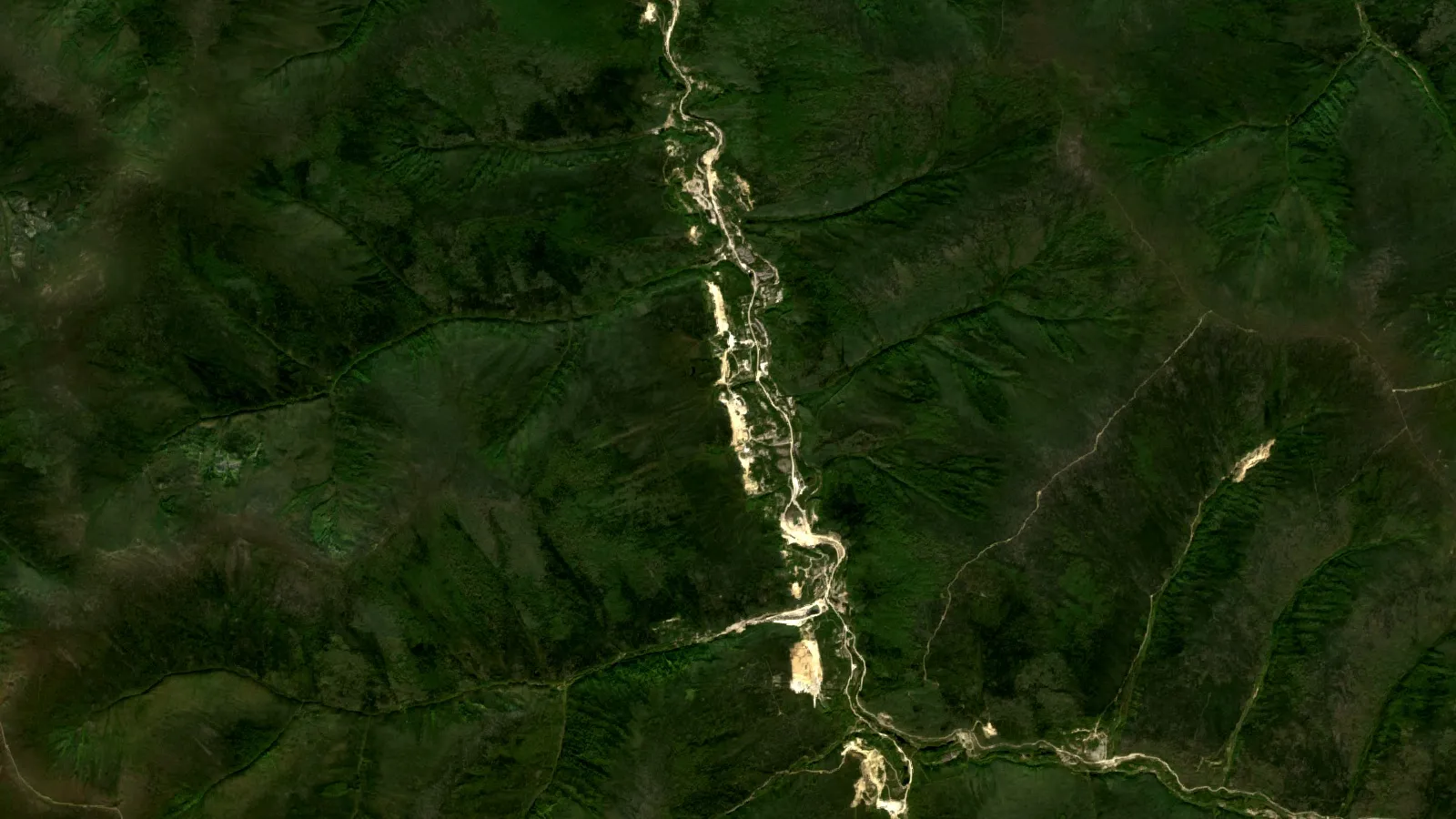
Key takeaways
- Listed PDC bit prices span US$60 to 180 (small non-coring, FSDRILL guide, December 2025) to US$3,000 to 8,800 (6.75 to 17.5 inch, Ackerman Drilling list, 15 October 2026).
- NREL says public data on real PDC bit costs is thin; it assumed about twice a roller-cone bit’s cost in a 2025 geothermal model (NREL, 2025).
- At The Geysers, California, a PDC run averaged 62 ft/hr against 29 for roller cone in one hole interval (NREL, 2025). That is geothermal, not mineral exploration.
- A Yukon gold project budgets C$400 to 700 per metre all-in for diamond drilling, so rig hours outweigh the bit price (RC Gold technical report, July 2026).
- Compare bits on cost per metre: bit cost plus rig cost for drilling and trip hours, divided by metres drilled.
In this article
- How much does a PDC drill bit cost? Price by bit type
- PDC drill bit price by size: listed prices for oilfield-size bits
- PDC core bit and small exploration bit prices
- What drives the price of a PDC bit
- PDC bit versus roller-cone and rock bits: price and speed
- Cost per metre: why the cheapest PDC bit is not the cheapest hole
- Oil well drill bit price compared with mining bits
- Tricone and foundation bit prices
- How to get a PDC bit quote you can compare
- Drill where it counts: choose targets before you buy bits
- Frequently asked questions
A PDC drill bit (polycrystalline diamond compact bit, a bit with lab-made diamond cutters) costs from about US$60 for a small non-coring bit in a manufacturer’s price guide to US$8,800 for a 17.5-inch oilfield-size bit on a US supplier’s list. Mid-size oilfield bits (6.75 to 8.5 inches) were listed at US$3,000 to US$4,800 on 15 October 2026 at one Houston bit supplier. The price gap is large because “PDC bit” covers a US$100 core bit for a small exploration rig and a US$30,000 bit for a deep well.
This page puts those prices side by side, shows what drives them, and then does the sum that matters to a licence owner or a project manager: the cost of each metre drilled, not the cost of the bit. It is written for people who budget drilling programmes, not for people who buy bits all day. Prices below are listed or published prices on named dates. They are not quotes, and they exclude freight, duty and tax.
How much does a PDC drill bit cost? Price by bit type
The table gathers every price point we could open and date. Read the last column first: a manufacturer’s guide and a retail list are different kinds of evidence. The manufacturer figures are guide ranges that a Chinese maker publishes for buyers who order direct, while the Houston figures are prices for bits that match the sizes used on oil and geothermal wells.
| Bit type | Listed price (US$) | What to know | Source and date |
|---|---|---|---|
| Small non-coring PDC bit, 50 to 113 mm | 60 to 180 | Used for water, grouting and geotechnical holes | FSDRILL guide, 16 December 2025 |
| Small PDC bit for water well or mining | 90 to 210+ | Budget range, before freight | Drillingbucket guide, 22 July 2026 |
| PDC core bit (geological sampling) | 100 to 300 | Leaves a solid core for assay | FSDRILL guide, 16 December 2025 |
| Medium PDC bit, 130 to 200 mm | 150 to 350 | Water wells and shallow exploration | FSDRILL guide, 16 December 2025 |
| Large PDC bit, 220 to 350 mm | 300 to 800 | Depends on cutter quality | FSDRILL guide, 16 December 2025 |
| Rerun 8.5-inch, 5-blade matrix PDC bit | 2,595 | Refurbished, one listing | Murphy’s Bits, seen 15 October 2026 |
| Oilfield-size PDC bit, 6.75 to 17.5 inches | 3,000 to 8,800 | 16 priced listings, brands such as Smith, NOV, Ulterra and Varel | Ackerman Drilling, 15 October 2026 |
| Oilfield-grade PDC bit (API) | 3,000 to 30,000+ | Deep and directional wells | Drillingbucket guide, 22 July 2026 |
Two things stand out. First, the same label spans three orders of magnitude, so a quote is only useful if it names the diameter, the number of blades and the cutter size. Second, nobody publishes a transaction price. The US Department of Energy’s National Renewable Energy Laboratory (NREL, renamed National Laboratory of the Rockies in December 2025) says in a 2025 geothermal drilling-cost paper that public information on actual PDC bit costs is thin. Treat every number here as a starting point for a quote request.
PDC drill bit price by size: listed prices for oilfield-size bits
Prices trend up with diameter because a larger bit needs more steel or matrix body (a body cast from hard powder metal), more cutters and more machining. A blade is one of the raised ribs that carry the cutters. The chart plots eight of the 16 priced listings on the Houston supplier’s PDC page on 15 October 2026. The supplier sells new and rerun bits (rerun means used and refurbished), and not every listing states the condition, so read the chart as a spread of asking prices rather than a price list for new bits.
Chart
Listed PDC bit prices by hole size
US$ per bit, eight of 16 priced listings at one Houston supplier, 15 October 2026 (new and rerun not always stated)
Within one diameter the spread is as wide as between diameters. Two 8.5-inch bits on the same list were priced at US$3,000 (a NOV 8-blade bit with 16 mm double-row cutters) and US$4,500 (a Smith 6-blade matrix bit). A 12.25-inch Ulterra 7-blade bit was listed at US$5,500, only US$1,000 above the 8.5-inch Smith. Blade count, cutter size, body type and brand all move the price.
PDC core bit and small exploration bit prices
Most mineral exploration holes are drilled for core. A diamond core bit is a ring-shaped bit that cuts around a solid column of rock, and the geologist splits that core and sends half for assay. The two most common wireline core sizes are NQ (47.6 mm core) and HQ (63.5 mm core), according to the reference summary of exploration diamond drilling. A larger core is preferred but costs more to drill.
Chart
Published price ranges for small PDC and core bits
US$ per bit, low and high of each range, manufacturer and buyer guides, before freight and duty
The chart shows the ranges that FSDRILL (a Chinese maker) and Drillingbucket publish for small bits. The top of the FSDRILL range is for special cutters and custom matrix bodies. Quantity changes the picture: FSDRILL says wholesale buyers typically get 10 to 25 percent off at 20 to 100 pieces and 25 to 40 percent off at container size. The Drillingbucket guide adds that a one-piece price is usually much higher than a bulk price and that a price quoted FOB (the buyer pays ocean freight and insurance) from China leaves out freight, insurance and import duty.
A standard “diamond” core bit, with diamonds set in a soft metal matrix that wears away to expose fresh stones, is a different tool from a PDC cutter bit, and both are sold for coring. Which one suits your rock is a question for the driller and the bit supplier. We do not have a source that ranks them by rock type, so we do not rank them here.
What drives the price of a PDC bit
A PDC cutter is a disc of lab-made diamond bonded to a tungsten-carbide stud, and many cutters are set in a body in a pattern designed for the rock, according to Sandia National Laboratories. That description points to the main cost drivers.
Chart
Tungsten concentrate price, 2021 to 2025
US$ per dry metric ton unit of WO3, average in-warehouse Rotterdam (2025 is an estimate)
- Diameter and body. A bigger body needs more material. NREL notes that the cost of a PDC bit depends on bit size and, more importantly, on whether the body can be repaired after a run.
- Cutters. More blades and bigger or premium cutters cost more. FSDRILL gives US$500 to US$1,500+ for premium OEM bits (original-manufacturer designs with special cutters) against US$100 to US$300 for core bits. Its figure is well below the US$3,000+ that other sources list for oilfield bits, so treat the guides as covering different products.
- Tungsten. Cemented carbide holds the cutters on the bit. The US Geological Survey (USGS) estimates that 60 percent of the tungsten consumed in the United States went into cemented carbide parts, used in construction, metalworking, mining and oil and gas drilling (USGS, 2026). Its average price for tungsten concentrate was US$380 per metric ton unit in 2025 (estimate), against US$252 in 2024.
- Diamond. About 97 percent of US industrial diamond use is synthetic, and the USGS puts the unit value of imported industrial diamond grit at US$0.21 per carat in 2025 (estimate). That is the price of diamond grit, not of a finished cutter or bit.
- New, rerun or repaired. A refurbished matrix-body bit listed at US$2,595 sits at the bottom of the 8.5-inch range above.
- Quantity, standard and freight. API certification (the American Petroleum Institute’s quality standard for oilfield tools), order size and landed cost all change the final number.
Tungsten concentrate and imported diamond grit are the only inputs in this list with a public yearly series, and neither is a bit price. It rose sharply in the 2025 USGS estimate, which is one reason to ask for a quote with a validity date rather than relying on last year’s list.
PDC bit versus roller-cone and rock bits: price and speed
A roller-cone (tricone) bit crushes rock with rotating toothed cones. A PDC bit shears it with fixed cutters. NREL cites limited cost data from the Fallon area drilling project suggesting that a PDC bit may cost about twice a roller-cone bit, and it used a cost multiplier of 2 in its model. That is a modelling assumption, not a measured price.
Chart
Average rate of penetration, PDC against roller cone
Feet per hour, deviated geothermal well at The Geysers, California (heterogeneous igneous and metamorphic rock)
The speed difference can pay for the higher price. In the first intermediate interval of a deviated geothermal well at The Geysers in California, a 2,014-ft PDC run averaged 62 ft per hour, against 29 ft per hour for a 100-ft roller-cone run in the same well and 12 ft per hour in offset wells, according to NREL’s summary of the project. In the 8.5-inch hole the PDC bits averaged 32.3 ft per hour against 21.2 ft per hour for roller cone. The rock there was mixed igneous and metamorphic, and the well is geothermal, not a mineral exploration hole, so read the chart as evidence for the method, not as a promise for your ground.
The same Sandia release makes a warning: early diamond bits wore out too fast in hard rock and hot ground, and only newer designs and operating methods made them workable at the Utah FORGE geothermal site. The US Department of Energy adds that PDC bit designs vary widely and are adapted to each well and formation.
Cost per metre: why the cheapest PDC bit is not the cheapest hole
Drillers compare bits by cost per metre (or per foot), not by bit price. The standard formula adds the bit price to the rig cost for the hours spent drilling and tripping (pulling the string out and running it back in), then divides by the length drilled. In symbols: cost per foot equals the bit cost plus the rig cost per hour times drilling and trip hours, divided by footage, as set out in the DrillingFormulas worked example. A paper by Delta State University authors uses the same method to compare nine bits on one well.

▶ A short explainer on why a hole in the wrong place costs as much as one in the right place, and how satellite screening ranks where to drill. · 4:26
Rig time is the part that surprises people. Sandia’s engineers say a big cost in deep drilling is how long it takes to get in and out of the hole, so the aim is to extend bit life rather than only to go fast. In NREL’s cost model the bit life is 50 hours, and the longest average on-bottom time in its three case studies was 34 hours, because the bits were pulled before significant wear.
For exploration the bit is only a small part of the bill. The July 2026 technical report for the RC Gold project in the Yukon budgets all-in diamond drilling at C$400 per metre in summer and C$700 per metre in the winter programme. All-in includes helicopter support, fuel, analysis, camp costs, mobilisation and equipment rentals. At those rates the 60,000-metre Phase I programme is budgeted at C$25.8 million. A bit that costs US$3,500 and drills 160 metres (example numbers) adds about US$22 to each metre, so a bit that saves rig hours can matter more than a bit that is cheap.
A rule of thumb follows: if two bits drill the same ground, the one with the lower cost per metre wins, even if it costs twice as much to buy. A bit that drills the same ground faster but wears out sooner may lose. Use the calculator with your own driller’s rate and your own bit run record.
Calculator
What does each metre cost with your bit?
Enter your own bit price, rig rate and bit run data.
- Bit cost per metre: 21.88 US$/m
- Bit share of cost per metre: 13.2 %
- Bits needed for the programme: 31.2 bits
- Programme cost at this rate (US$): $828,125
Example values only, not a benchmark or a quote. Formula: (bit cost + rig cost per hour x (drilling hours + trip hours)) / metres drilled, as in the standard cost-per-foot method (DrillingFormulas). The rig rate should include all hourly costs, not only the contractor rate. Metres per bit is rate of penetration times drilling hours. Defaults are exploration-style example values (4 m/h, 40 hours on bottom); the geothermal oilfield-size speeds in chart 4 are much faster.
Oil well drill bit price compared with mining bits
Oil well bits are priced for deep, expensive holes where a failed run costs days of rig time. That is why oilfield-grade PDC bits run from US$3,000 up to US$30,000 or more in the Drillingbucket guide, while mining and water-well bits sit in the hundreds. A mineral exploration hole is shallower and the rig is smaller, so the cost of a bit failure is lower, but the cost of a wrong hole is not.
Sandia notes that PDC bits have proven more cost effective than roller bits in oil and gas drilling, but the geothermal results above measure drilling speed, not cost, so they are only a pointer. The gap in price between the oilfield and the mining end of the market mostly reflects hole size, depth and the cost of failure, not a different kind of diamond.
Tricone and foundation bit prices
Foundation, water-well and shallow-drilling bits are a separate market from PDC bits. They are mostly tungsten-carbide tools, and the Drillingbucket guide lists approximate budget ranges per piece: bullet teeth US$10 to US$20 in bulk, drag or claw bits US$50 to US$500, commodity tungsten-carbide-insert tricone bits US$200 to US$3,000, and large API tricone bits US$5,000 to US$15,000 or more. Rerun tricones, the guide says, typically cost 30 to 60 percent less than new ones, but their remaining life is harder to predict.
If you buy for a mine in the Denver region, see our guide to drill bits and diamond tools suppliers around Denver. For contractor rates, planning holes and the cost of core drilling underground and on the surface, see our exploration drilling guide and diamond drilling costs per metre, underground and surface.
How to get a PDC bit quote you can compare
Quotes are only comparable when every supplier prices the same bit. A short checklist avoids the problem described in the Drillingbucket guide, where three suppliers quoted US$2,100, US$3,800 and US$5,500 for what looked like the same 9.5-inch tricone bit.
- State the hole diameter and the thread or connection (for example, 4.5-inch API Reg).
- Name the rock, the expected hardness and any abrasive layers.
- Give the blade count and cutter size you want, or ask the supplier to propose a design and explain it.
- Say whether you accept rerun or repaired bits, and ask for the repair history.
- Ask for a landed price to your site: freight, insurance, duty and tax.
- Ask for a quote validity date, the minimum order and the lead time.
- Ask for the run record of the same design in similar rock: metres drilled and hours on bottom.
- Compare offers on cost per metre, using your rig rate, not on the bit price alone.
Equipment makers and distributors sell these bits, and every bit price in this article comes from one of them. Farmonaut does not sell drill bits.
Drill where it counts: choose targets before you buy bits
A bit that costs US$3,500 is small beside a wrong 300-metre hole, which at the RC Gold budget rates of C$400 to C$700 per metre would cost C$120,000 to C$210,000. Exploration teams therefore rank targets before the drill rig arrives. Satellite imagery, geophysics and geochemistry can show which parts of a licence deserve the first holes, and for that step Farmonaut produces satellite mineral detection reports that treat results as exploration targets, ahead of any resource estimate. Our guide to picking a drilling contractor covers the next step.
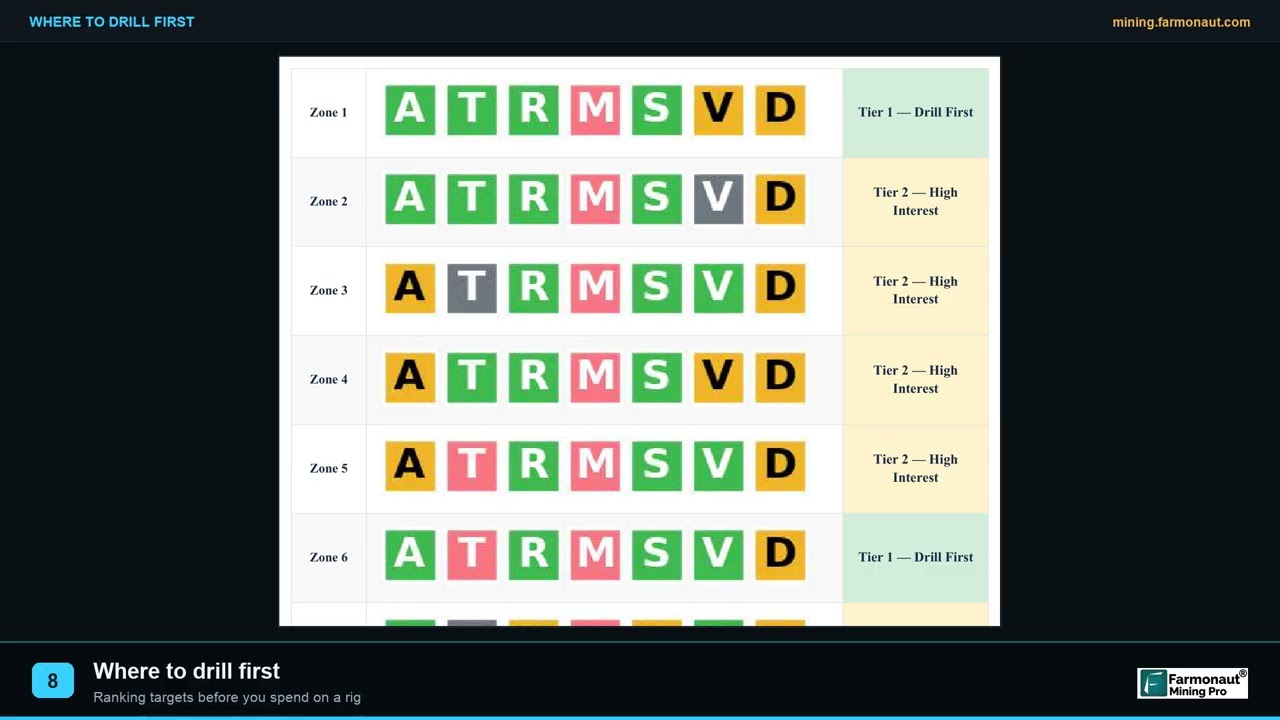
▶ How satellite targets are ranked into a drill order, from the same Farmonaut channel. · 2:19
If this topic matters to you, read Induced Polarisation Survey Cost: Per Line-km Ranges next.
Related reading on this site: Dysprosium Mines Worldwide: List and Price Chart.
Frequently asked questions
How much does a PDC drill bit cost?
Published ranges run from about US$60 for a small non-coring bit to US$8,800 for a 17.5-inch oilfield-size bit on a US supplier’s list, and up to US$30,000 or more for deep-well bits, per the sources in the table above. The diameter, blade count, cutter quality and whether the bit is new or rerun decide where a bit falls.
How much does an oil well PDC bit cost?
Oilfield-grade PDC bits were budgeted at US$3,000 to US$30,000 or more in a July 2026 price guide. A Houston supplier listed bits from 6.75 to 17.5 inches at US$3,000 to US$8,800 on 15 October 2026. Bits for deep or directional wells with premium cutters sit at the top of the range.
How much does a PDC core bit for mineral exploration cost?
One manufacturer’s guide puts PDC core bits for geological sampling at US$100 to US$300. That is a factory-direct guide range before freight and tax. The guide gives no distributor prices, so ask for a delivered quote. The cost of a bit is small next to the all-in cost of the metre.
Why does a PDC bit cost more than a roller-cone bit?
The cutters are lab-made diamond discs bonded to carbide, and the body has to be built for the rock. NREL cites limited data suggesting about double the price of a roller-cone bit and used that as a modelling assumption.
Is a PDC bit worth the higher price?
It can be, when it drills faster or lasts longer in the same rock. In a California geothermal well a PDC bit averaged 62 ft per hour where roller-cone runs averaged 29 and 12. Whether it pays in your rock depends on the cost per metre, not the sticker price.
How long does a PDC bit last?
It depends on the rock, the weight and speed applied, and the cutters. In one geothermal well a single 17.5-inch PDC bit drilled 2,014 ft in 32.5 hours on bottom. NREL reports that bits in its three case studies were pulled before significant wear, so the figures show operating choices as much as the limit of the bit.
Are rerun PDC bits cheaper?
One 8.5-inch rerun matrix bit was listed at US$2,595, and other 8.5-inch listings at another supplier ranged from US$3,000 to US$4,500. The bits are different makes and designs, so this is not a like-for-like saving. Ask for the repair record.
What is the difference between a PDC bit and a diamond core bit?
A diamond core bit is a ring-shaped bit with industrial diamonds set in a soft metal matrix that wears to expose new stones, and it leaves a solid core for assay. A PDC bit cuts with fixed polycrystalline diamond cutters. PDC core bits exist, so the two overlap.
Can a PDC bit drill hard rock?
Yes, with modern designs. Sandia says early diamond bits wore out too fast in hard, hot geothermal rock and that newer designs and ways of running them made PDC bits viable at Utah FORGE. Test the design on your rock before you buy in volume.
What is a good cost per metre for exploration drilling?
It depends on country, access and hole type. The 2026 RC Gold technical report in the Yukon budgets C$400 per metre in summer and C$700 per metre in winter, all-in with helicopter support, camp and analysis. Use your own contractor’s rate sheet.
Does the price of tungsten affect drill bit prices?
Cemented carbide is made from tungsten, and the USGS estimates 60 percent of US tungsten use in 2025 went into cemented carbide, including mining and oil and gas drilling parts. Its average concentrate price rose to US$380 per metric ton unit in 2025 (estimate) from US$252 in 2024. We found no published link between that price and bit list prices, so ask suppliers how they price.
How do I choose between bit quotes?
Compare cost per metre, not bit price: bit cost plus rig cost for drilling and tripping time, divided by metres drilled. Ask each supplier for run records in similar rock. For help with the target step before the rig arrives, send us your area for a quote or contact the team.
This page is for information only. It is not investment advice or a purchase recommendation. Listed prices are not quotes and exclude freight, duty and tax. Drilling needs the landholder’s permission, the regulator’s licence and a safe site plan.
Farmonaut mining
Rank drill targets from space before the rig arrives
See how satellite data screens a licence area for exploration targets, ahead of any resource estimate.
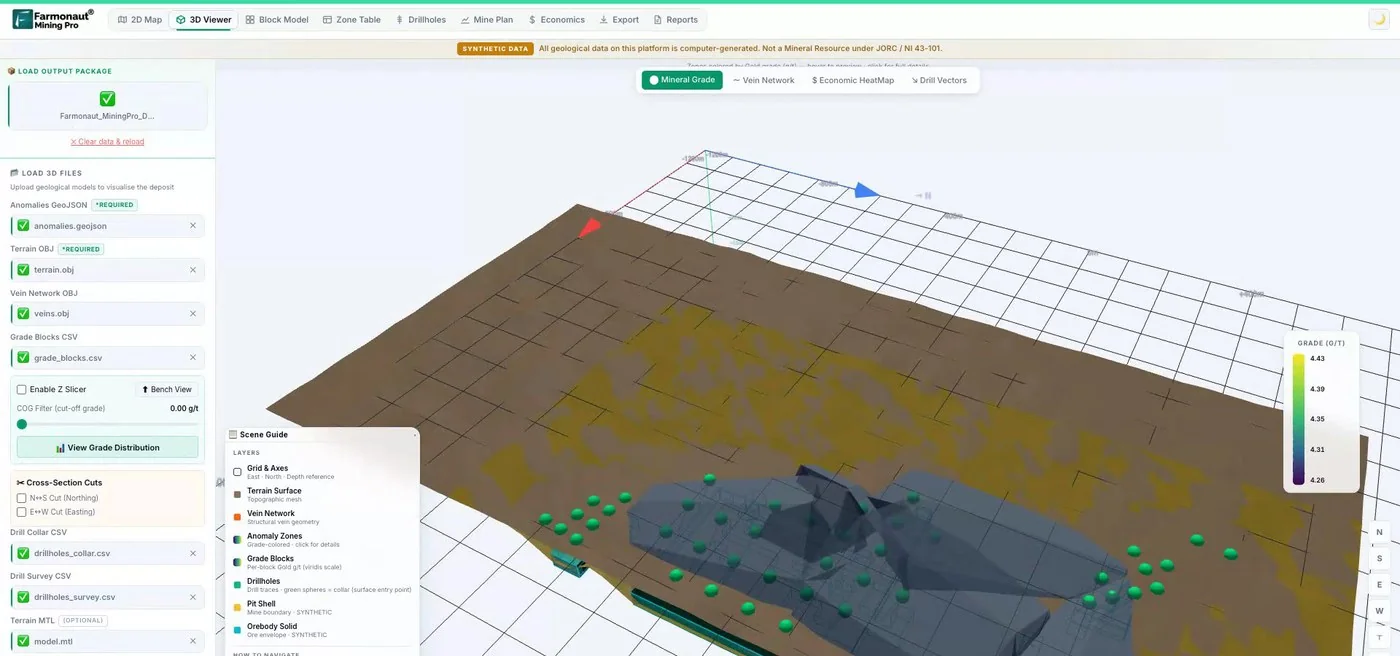
Mining Pro sample view, synthetic data
Keep reading
Sources
- Ackerman Drilling, PDC Drill Bits product list (seen 15 October 2026): ackermanbit.com
- Murphy’s Bits, 8.5-inch rerun matrix PDC bit (seen 15 October 2026): murphysbits.com
- FSDRILL, How Much Does a PDC Drill Bit Cost (16 December 2025): fsdrill.com
- Drillingbucket, Rotary Drilling Bit Price Guide (22 July 2026): drillingbucket.com
- NREL, 2025 Geothermal Drilling Cost Curves Update (2025): docs.nlr.gov
- Sandia National Laboratories, Sandia study supports superior bits: newsreleases.sandia.gov
- US Department of Energy, How PDC Drill Bits are Helping Geothermal Shine: energy.gov
- USGS, Mineral Commodity Summaries 2026, Tungsten: pubs.usgs.gov
- USGS, Mineral Commodity Summaries 2026, Diamond (Industrial): pubs.usgs.gov
- Sitka Gold, RC Gold Project NI 43-101 Technical Report (10 July 2026): wp-sitkagold-2024.s3.ca-central-1.amazonaws.com
- DrillingFormulas, Drilling cost per foot: drillingformulas.com
- Oloro, Ukrakpor and Ikhalea, Drilling bit performance using cost per foot and breakeven equations (2011): cenresinjournals.com
- Exploration diamond drilling, core sizes and bit design (reference summary): en.wikipedia.org
Discussion
Questions, corrections or field experience? Share them below. First-time comments are reviewed before they appear, and your email is never published.
No comments yet. Be the first to add a question or your experience.

 CIMISCO SARL
 Mining SARL
 SenGold Invest SAS
 Sania Corporation
 Sean Mining Limited
 NTS Group (Pty) Ltd
 Mine4Africa
 Lithspo Minerals Limited
 Tintina Mining Group
 Dalgety Minerals Pty Ltd
 Vortex Minerals Pty Ltd
 Faith At Work (Pty) Ltd
 Geotech Mining Solutions plc
 Vulcan International Limited
 Kidepo Associates
 GKY Mining
 Alkimy SARL
 Double A Trading
 GemSprout Metals Limited
 Qader Group
 Ileys General Trading
 SG Gold Mining LLC
 VRV Global Pte Ltd
 Omsri International FZE










