

Most satellite crop advisory stories follow one farmer, one field, one crop. This one doesn’t. A single JEEVN AI account has spent seven months running potato and sugarcane side by side across three separate fields in western India — and checking in on the satellite dashboard far more often than most growers do.
A grower who signs up for one satellite-monitored field and checks in occasionally is the typical satellite crop advisory customer. A grower who adds a second and third field, plants two different crops in two different states, and logs in often enough to rack up 74 satellite visits in seven months is a different kind of customer — the kind whose usage pattern tells you more about whether a product actually works than any single testimonial can. This is the story of that account: what it grows, how JEEVN AI treated three fields differently even though two of them share a crop, and what the grower said when asked, three separate times, whether any of it actually helped.
Background: A Multi-Plot, Multi-Crop Portfolio
The account behind this case study is not a single-field hobby grower. Public JEEVN AI advisory records show a portfolio of three separate fields totalling roughly 4.6 acres (1.84 hectares), spanning two crops — potato and sugarcane — and, by field address, two states in western India: Gujarat and Maharashtra. That is an honest description of what the data shows, and it is worth stating plainly rather than flattening it into a single tidy location: this is a multi-plot operation, the kind increasingly common among growers who lease or manage land in more than one place, or who split acreage between a staple field crop and a longer-duration cash crop.
The grower joined JEEVN AI in February 2026. The first field onboarded was under potato, sown the previous November and already well into its bulking phase by the time satellite tracking began. Two sugarcane fields followed in the same account roughly six months later, sown ten days apart from each other in late June and early July. Across all three, the account logged 74 satellite visits to date — by a wide margin the heaviest platform engagement of any customer feedback record reviewed in this batch, where comparable accounts logged anywhere from 4 to 25 visits over similar or longer periods. That gap matters: a grower who checks the advisory dashboard rarely is trusting the product on faith. A grower who checks it constantly, across three fields, for seven straight months, is using it as a working tool.
Multi-field, multi-crop accounts are the harder test for a satellite advisory product. A single-field customer only has to see one crop’s phenology tracked correctly to be convinced. This account had to see three independent fields, two crop calendars six months apart, and two different soil-and-weather contexts all tracked coherently before it kept coming back — and it came back 74 times.
The Challenge: Coordinating Irrigation, Nutrition and Pest Timing Across Three Very Different Fields
Running one field well is hard enough. Running three — at different growth stages, under different crops, on different soils, hundreds of kilometres apart — multiplies the number of decisions a grower has to get right every week. A potato crop nearing tuber maturity needs a completely different irrigation and nutrient regime than a sugarcane crop that is barely past germination. A single blanket schedule for “irrigate every few days” or “apply the standard nitrogen-phosphorus-potassium dose” makes sense for neither field, and applying one anyway is how growers over-water a crop that’s already saturated, or under-feed a crop that’s still building its root system.
The three fields in this account illustrate the problem well:
- ✔ Field 1 — Potato, 2.86 acres, sown in November 2025, tracked weekly by satellite since February 2026 — the longest-running field in the account, now approaching the end of its season.
- ✔ Field 2 — Sugarcane, 0.35 acres, sown in late June 2026, tracked weekly since August 2026 — still in its early tillering stage.
- ✔ Field 3 — Sugarcane, 1.34 acres, sown ten days after Field 2, also tracked weekly since August 2026 — same crop, same rough calendar, different plot.
A grower managing this by memory or a fixed weekly routine has to mentally re-derive, every single week, what stage each field is at and what that stage actually calls for. That is exactly the coordination problem a per-field, satellite-refreshed advisory is built to remove.
The Farmonaut Satellite Approach: One Advisory Cycle per Field, Every Week
JEEVN AI (available at sat.farmonaut.com) runs a fresh advisory cycle for each monitored field on its own schedule, drawing on Sentinel-2 optical imagery (vegetation-health and moisture indices) and Sentinel-1 radar (soil-moisture and vegetation-structure signals that see through cloud cover — useful in a monsoon-affected sugarcane season). Irrigation timing is derived from a standard FAO-56 crop-water-balance approach — reference evapotranspiration and a crop-stage coefficient — adjusted by the satellite’s own read on current soil moisture and canopy condition, rather than a fixed calendar. Fertilizer guidance is built from each field’s own soil-nutrient status against crop-specific ideal ranges published by public agronomy references (India’s potato research institute guidance for the potato field; standard agronomic nutrient tables for sugarcane), broken down nutrient by nutrient rather than issued as one blanket number. Pest-risk flags are matched to the crop’s current growth stage rather than issued as a generic seasonal bulletin.
None of this requires the grower to know any of that underlying mechanics — it shows up simply as a weekly card: irrigate today or skip, how much of each nutrient (if any) to apply, and which pests to watch for right now. What makes it useful for a multi-field account specifically is that every field gets its own independent read. The potato field’s cycle doesn’t borrow anything from the sugarcane fields’, and the two sugarcane fields — sown ten days apart — don’t get identical instructions just because they share a crop.
If you manage more than one field, don’t run them on the same mental checklist even when they share a crop. Sowing date, local soil-moisture history and even a ten-day age gap can shift the irrigation and pest calendar meaningfully — which is exactly what shows up when each field gets its own satellite-refreshed advisory instead of one shared plan.
Results and Findings: What 62 Tracked Advisory Cycles Actually Show
Across the three fields, the account’s satellite advisory history shows 62 distinct weekly advisory cycles generated to date — 43 for the long-running potato field, 9 for the smaller sugarcane plot, and 10 for the larger one — consistent with the account’s own reported 74 total satellite visits once additional monitoring check-ins between full advisory cycles are counted in. That cadence alone is the differentiator for this account: most customers check in occasionally; this one has effectively run a season-long, three-field field trial of its own satellite advisory.
Irrigation: how often “skip” was the right call
Reverse-engineering the irrigation history is the clearest way to see where a self-reported savings estimate comes from. Every scheduled irrigation check in the advisory history carries a recommended water quantity — and on a meaningful share of those checks, across all three fields, that quantity came back as zero: rainfall already covered the crop’s need, or soil moisture (read from radar) was already sufficient, so the advisory told the grower to skip watering rather than run the pump anyway.
The pattern makes agronomic sense rather than looking like a coincidence. The potato field was tracked through its tuber-bulking and maturation stages, when water demand tapers and any rainfall goes further; the near-monsoon timing of the sugarcane fields’ establishment meant even a “skip” call still had to be earned roughly half the time, because a young cane field on shallow roots can still need supplemental water between rain events. The grower’s own self-reported estimate — irrigation optimized by 30–50%, given as their own answer on the in-app feedback form — sits inside a plausible range once you look at how often the satellite advisory’s own history returned a skip for these fields, without pretending that a single reverse-engineered percentage validates their number to the decimal. It is the grower’s own estimate, not a metered reading, and it is presented as such throughout.
Every skipped irrigation cycle is also a runoff and groundwater-draw event that didn’t happen. Across three fields and 62 tracked cycles, a meaningful share of scheduled irrigation didn’t run — not because the grower cut back on faith, but because the satellite read said the crop didn’t need it that week.
Fertilizer: nutrient-by-nutrient, and stage-aware
The fertilizer side of the advisory tells an even more specific story, because it changes shape as each field matures. Early in the potato field’s tracked history, the advisory flagged moderate shortfalls across nitrogen, phosphorus, potassium, sulphur and zinc and recommended a calibrated, nutrient-specific correction for each one — not a single “apply X kg of fertilizer” instruction. By the most recent tracked cycle, as that same field entered its final maturation window ahead of harvest, the recommended top-up for every one of those nutrients had tapered to zero — even where the underlying soil test still read below the textbook ideal band. That is a deliberately stage-aware call: pushing more fertilizer into a potato crop this close to harvest doesn’t raise yield and can delay tuber maturity, so the advisory stopped recommending it rather than mechanically chasing the soil number.
The two younger sugarcane fields, still in early growth, are still receiving active nutrient guidance — but again nutrient-by-nutrient rather than as one blanket figure, and at rates calibrated to each field’s own soil test rather than a single fixed number applied regardless of what the soil actually shows. Publicly published sugarcane fertilizer guidance in India commonly quotes a single blanket nitrogen-phosphorus-potassium figure to use “when soil test data is not available” — the whole point being that it’s a fallback for growers who have no better information. This account’s fields, by contrast, get five separately-tracked nutrients (N, P, K, sulphur, zinc), each compared against its own ideal range and dosed accordingly. The grower’s self-reported fertilizer savings of “up to 20%” — deliberately the more modest of their two figures — reads as a plausible, non-inflated estimate of what per-nutrient, per-field dosing saves over a single blanket program, and it is presented here exactly as they gave it: their own estimate, not ours.
Pest alerts: same crop, ten days apart, different second-priority pest
The clearest evidence that this account is getting genuinely per-field treatment — not a copy-pasted regional bulletin — sits in the pest data. The potato field, in its tuber-maturation stage, is currently flagged for Potato Tuber Moth (high probability) and cutworms (moderate) — both pests whose pressure specifically rises as tubers approach harvest. Both sugarcane fields, sown ten days apart and now in early growth, are flagged for Early Shoot Borer (high probability on both) — a pest that specifically targets young cane shoots, matching where both fields actually are in their growth cycle. But the two sugarcane fields don’t get identical second-tier alerts: one is flagged for white grub, the other for internode borer, a small but telling difference between two plots growing the same crop within ten days of each other.
Two sugarcane fields, one shared primary alert, two different secondary ones
That divergence is exactly what per-field satellite monitoring is supposed to deliver: two plots close enough in crop and calendar to look identical on paper, still assessed individually rather than lumped into one instruction sheet.
| Field | Crop | Area | Sown | Tracked advisory cycles | Irrigation “skip” rate | Top pest alert (current) |
|---|---|---|---|---|---|---|
| Field 1 | Potato | 2.86 ac | Nov 2025 | 43 | 93% | Potato Tuber Moth (high) |
| Field 2 | Sugarcane | 0.35 ac | Jun 2026 | 9 | 49% | Early Shoot Borer (high) |
| Field 3 | Sugarcane | 1.34 ac | Jul 2026 | 10 | 55% | Early Shoot Borer (high) |
| Portfolio total | 4.55 ac | — | 62 | — | — | |
What the Grower Actually Said
No customer quote is invented here — there is none on file for this account, and inventing one from a set of Yes/No form answers would misrepresent what a real person actually said. What exists is the grower’s own literal answers on the in-app feedback form, submitted in September 2026 after seven months and 74 satellite visits across three fields:
| Question | Grower’s answer |
|---|---|
| Did the irrigation advisory help? | Yes — self-reported water savings band: 30–50% |
| Did the fertilizer advisory help? | Yes — self-reported savings band: Up to 20% |
| Did the pest advisory help? | Yes |
Both savings bands are the grower’s own estimate, entered on an in-app feedback form — not a metered before/after measurement. Pest-risk scores are modelled probabilities based on crop stage and satellite signals, not confirmed lab-diagnosed infestations. We present both exactly as given, alongside the mechanism that plausibly produces them.
Impact: Why a Heavy-Usage, Multi-Field Account Is the Strongest Kind of Evidence
A single glowing quote from one satisfied customer is easy to dismiss as an outlier. A behavioral pattern — one account, unprompted, choosing to add a second and third field, plant a second crop, and check the dashboard 74 times over seven months — is much harder to wave away. Products that don’t deliver real week-to-week value get abandoned after the novelty wears off; they don’t get scaled up to more land. This account did the opposite: it started with one potato field and grew into a three-field, two-crop, two-state operation still checking in every week.
- 📊 Coordination at scale: three fields, two crops, two states, one dashboard — instead of three separate mental schedules.
- ✔ Consistent “Yes” across every category asked: irrigation, fertilizer and pest advisories all rated as helpful, not just one favorite feature.
- 🌱 Stage-aware nutrient tapering: fertilizer guidance backed off automatically as the potato crop approached harvest, rather than mechanically chasing a soil-test number.
- ⚠ Field-level pest differentiation: two sugarcane plots sown ten days apart still received two different secondary pest calls, not one shared bulletin.
- 📈 Sustained engagement: 74 satellite visits over seven months — the heaviest usage pattern in this review batch, and the strongest indirect evidence that the advisory was actually being used to make decisions, not just glanced at once.
The most reliable signal a product works isn’t what a customer says in a survey — it’s what they do next. This account expanded from one field to three and kept both crops running on the platform through an entire season. That is usage voting with acreage.
How Multi-Field Monitoring Actually Works on JEEVN AI
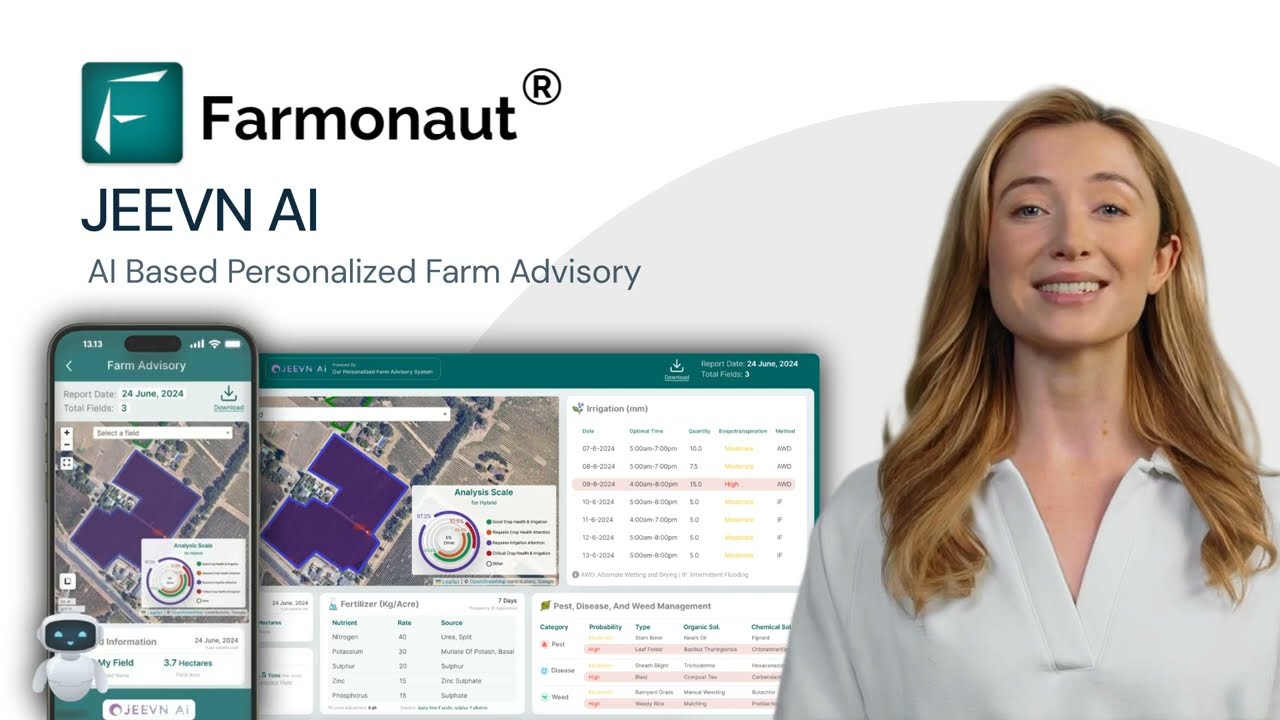
For growers weighing whether to bring more than one field onto a single satellite advisory account, the mechanics matter more than the marketing. Each field is mapped once — by drawing a boundary, uploading a shape file, or dropping a pin and letting the boundary auto-detect — and from that point on it runs its own independent advisory clock. Sowing date, crop type and location are set per field, so a potato field sown in November and a sugarcane field sown the following July are never compared against the same calendar. Every weekly satellite pass — Sentinel-2 optical, Sentinel-1 radar — refreshes each field’s own vegetation, moisture and soil-nutrient read, and the irrigation, fertilizer and pest sections regenerate independently for that field alone.
That independence is what let this account’s potato field wind down its fertilizer program while its two sugarcane fields ramped theirs up in the same week — and what let two sugarcane fields sown ten days apart still get two different pest calls. Nothing about running three fields under one login forces them onto a shared schedule.
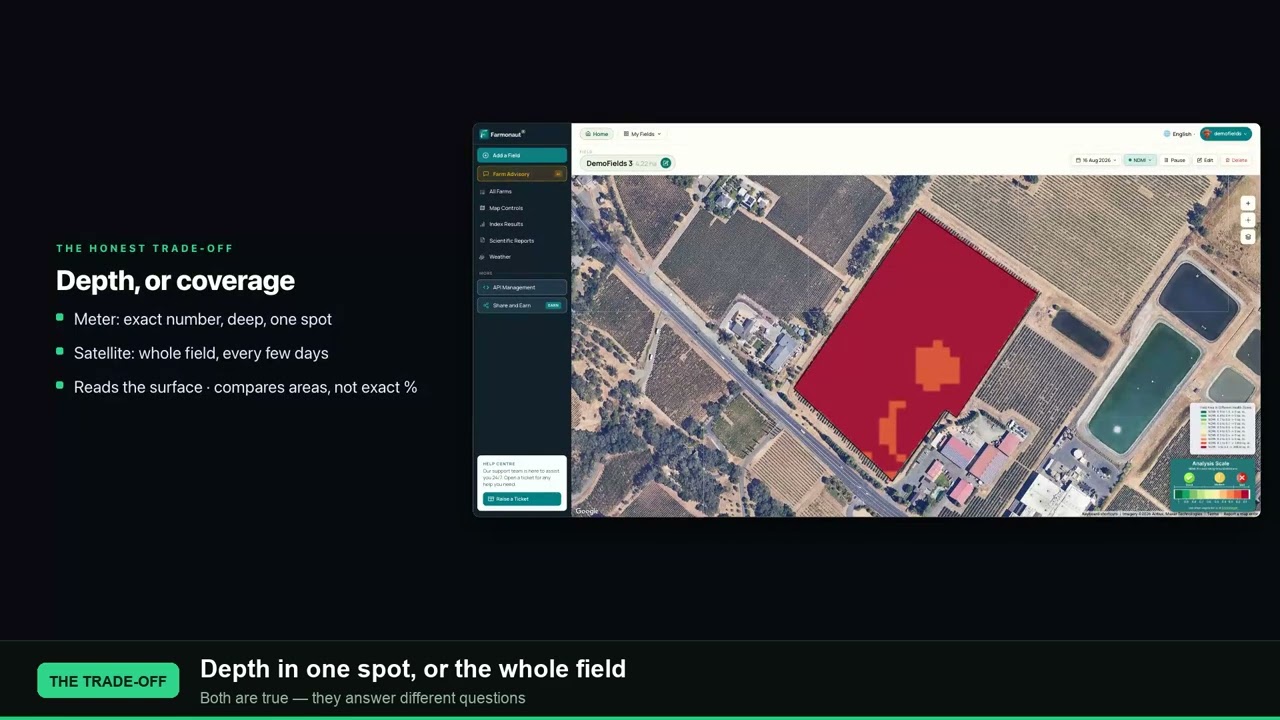
Soil moisture from orbit, cross-checked against the crop calendar
A common objection to satellite-based irrigation guidance is that a moisture reading from space can’t possibly be as reliable as a probe stuck in the ground. In practice, the satellite read isn’t used in isolation — it’s cross-checked against a standard evapotranspiration model built on the field’s own coordinates and the crop’s own growth-stage water-use coefficient, so a “skip irrigation” call has to be backed by both the radar-derived soil-moisture signal and the water-balance math agreeing that the crop doesn’t need it yet. That combination is what let the mature potato field skip watering on the vast majority of its checks while the two younger sugarcane fields — still building root systems through the monsoon — only skipped roughly half the time.
Building Toward Harvest, Not Just Reacting to a Soil Test
The single most instructive part of this account’s history is what happened to the potato field’s fertilizer recommendations as the season progressed. Rather than treating a below-ideal soil nutrient reading as an automatic trigger to keep recommending more fertilizer, the advisory recognized that the field had entered its final pre-harvest window and tapered every nutrient recommendation to zero — because additional feeding this late in a potato crop’s life doesn’t raise yield and can push back tuber maturity. That is a genuinely useful distinction for a grower to have made for them automatically: knowing when to stop feeding a crop is as valuable as knowing when to start.
The two sugarcane fields, by contrast, are still early enough in their growth that active, nutrient-specific correction makes sense, and that’s exactly what their advisories are still issuing — sulphur, phosphorus, potassium, zinc and nitrogen each dosed against its own soil-test band rather than folded into one number. Seeing both behaviours in the same account, on the same login, in the same week, is a clean illustration of a system responding to where each crop actually is rather than applying one rule everywhere.
Get This for Your Own Fields
Whether you manage one field or several, across one crop or many, the same weekly satellite cycle that produced this account’s 62 tracked advisory cycles is available through JEEVN AI. Explore JEEVN AI to map your own fields and start receiving field-specific irrigation, fertilizer and pest guidance — each field tracked on its own clock, the way this account’s three fields have been for seven months.
Bring Every Field Onto One Satellite-Backed Dashboard
Potato, sugarcane, or any other crop — map each field once and let weekly Sentinel-1/Sentinel-2 advisory cycles carry the irrigation, nutrient and pest calls from there.
Frequently Asked Questions
Can one JEEVN AI account monitor multiple fields and different crops at the same time?
Yes. This case study is built on exactly that pattern: one account running three separately-mapped fields — one under potato, two under sugarcane — each with its own sowing date, its own weekly satellite cycle, and its own irrigation, fertilizer and pest recommendations. Nothing about adding a second or third field merges their advisories.
How does satellite crop advisory decide when to skip an irrigation cycle?
Each scheduled check combines a standard reference-evapotranspiration and crop-stage water-need calculation with the field’s current satellite-read soil moisture and canopy condition (from Sentinel-1 radar and Sentinel-2 optical imagery). When rainfall or existing soil moisture already covers the crop’s need, the recommended irrigation quantity comes back as zero — a “skip” — rather than running the pump on a fixed calendar regardless of conditions.
Why would two fields growing the same crop get different fertilizer or pest advice?
Because each field’s own soil-nutrient status, sowing date and satellite-read crop condition feed its advisory independently. In this account, two sugarcane fields sown just ten days apart shared the same primary pest alert (Early Shoot Borer, matching their shared early growth stage) but differed on their secondary pest flag — a small but real difference that a single shared bulletin for “sugarcane in this region” would have missed.
Does fertilizer guidance change as a crop nears harvest?
It should, and in this account’s potato field it clearly did — every nutrient’s recommended top-up tapered to zero as the crop entered its final maturation window, even where the underlying soil test still read below the ideal band, because additional feeding that late doesn’t help yield and can delay tuber maturity. The advisory is built to weigh crop stage alongside the raw soil numbers.
Are the reported water and fertilizer savings independently metered?
No — both figures (30–50% on irrigation, up to 20% on fertilizer) are the grower’s own estimate, entered directly on the in-app feedback form. We present them attributed as such, alongside the underlying advisory-history mechanism that plausibly produces savings in that range, rather than claiming an independently audited number.
Is JEEVN AI free to use?
No — JEEVN AI is a paid satellite crop advisory platform. There is no free-trial claim made here or elsewhere; growers can Explore JEEVN AI at sat.farmonaut.com to see current plans for their own fields.
How often does JEEVN AI actually check a field?
Advisory cycles in this account refreshed roughly weekly per field, aligned to satellite revisit frequency (Sentinel-2 revisits any given point on Earth approximately every 5 days). Across three fields over seven months, that produced 62 separately tracked weekly advisory cycles in this account’s history alone.
Glossary
- NDVI / NDWI
- Satellite vegetation and moisture indices derived from optical imagery (Sentinel-2), used to read canopy health and water status without a site visit.
- Radar soil moisture (RSM)
- A soil-moisture signal derived from Sentinel-1 radar, which can see through cloud cover — useful during monsoon-season crop stages when optical imagery may be obscured.
- Reference evapotranspiration (ET₀)
- A standard, weather-driven estimate of how much water a well-watered reference crop would use in a day; combined with a crop-stage coefficient to estimate a specific crop’s actual water need.
- Crop coefficient (Kc)
- A multiplier applied to reference evapotranspiration to reflect a specific crop’s water use at its current growth stage — different for potato at tuber-bulking than for sugarcane at germination.
This case study is built from the customer’s own in-app feedback (submitted September 2026) and their account’s weekly satellite advisory history. No customer name, email, exact field coordinates, or precise village/town location is published; the account’s fields are described only at state level (Gujarat and Maharashtra, India). Reported irrigation and fertilizer savings percentages are the customer’s own self-reported estimates, not independently metered figures. Pest-risk levels shown in the advisory are modelled probabilities based on crop stage and satellite signals, not confirmed lab diagnoses. This post is published as a draft pending the customer’s consent for a public case study.

 Godrej Agrovet
 Hayleys Agriculture
 Linx Agritech
 Adinet
 Save Your Soils
 GalaxEye Space
 Grandstream Algérie
 XOS Realty
 Geospatial Lab Africa
 Agro La Gándara
 HIPSAC
 ZOL Zimbabwe
 Juligerm
 AdBio
AdBio MISE Maroc
 NWNS
NWNS Red August Group
 Farm Inc
 WeMe Global
 Agrotoken
 Blue BearX
 Insignito
 DnCubed
 Indosistim Teknologi
 Liquify Digital
 CU Foods
 BeyondTech Global
 Rouge VC
 AgroRisk
 Oath Inc
 Esri North East Africa
 MDCV UK
 Etech Consulting Madagascar
 Vestlandsforsking
 WB Dev
 Sama Premium
 Tres Valles
 Blickwinkel
 Agricultural Credit Policy Council
 eKGIS
eKGIS Mostas Tech
 Andex
Andex Deluxe Conseil
 WICO
WICO Chimera Innovation
 SkyHarvest
 Teledarbas
 Exurbia Geospatial
 FieldZero
