

Mine timeline · Stage guide
How Long Does It Take to Build a Mine? Stage Timeline
A new mine takes about 16 years from discovery to first production on average, and nearly 12 of them are spent on exploration and studies. See the years by stage and country, and test your own licence clock.
Key takeaways
- S&P Global found 15.7 years from discovery to first production across 127 mines that started up since 2002; 11.9 years were exploration, studies and discovery (S&P Global, 2024).
- The IEA found over 16 years for major mines online in 2010-2019: more than 12 years for exploration and feasibility and 4-5 years for construction (IEA, 2021).
- US mines average almost 29 years, Canada 27 and Australia 20 once projects still in development are counted (S&P Global, July 2024).
- Licence terms are short next to the project clock: Western Australia grants five years plus extensions, Tanzania up to eight years in total for a prospecting licence (official sources).
- Before a renewal, list what each block has had done, rank the untested ground by evidence and fit the work to the renewal date.
In this article
- How many years from discovery to first production?
- Mine development timeline by stage
- Where the years go: exploration, studies, permits, construction
- How long does mineral exploration take?
- Why the timeline differs by country and metal
- Permitting: the stage that stretches
- Exploration licence terms versus the real timeline
- Mining lease renewal and mining licence renewal
- Your licence is expiring: have you explored the whole concession?
- How to prioritise exploration before renewing a licence
- What shortens the early stages
- Licence clock calculator
- Frequently asked questions
How long does it take to build a mine? From the day a deposit is found to the day the first ore is processed, a new mine takes roughly 16 years on average. S&P Global Market Intelligence measured 15.7 years across 127 mines that started up since 2002 (a 2023 analysis, published in its 2024 report), and nearly 12 of those years went on discovery, exploration and studies before anyone decided to build (S&P Global, Mine Development Times, 2024). The International Energy Agency reached a similar figure for major mines that came online between 2010 and 2019: over 16 years in total, more than 12 of them on exploration and feasibility work and 4 to 5 on construction (IEA, 2021). Individual projects run far shorter or far longer, so treat these as averages, not promises.
This page breaks that time into stages, shows what drives it up in different countries, and then covers a problem that hits licence owners in the middle of the timeline: an exploration licence usually expires long before the project reaches a decision to build. If you hold a licence or claim block, the sections on renewal rules and on prioritising ground before a renewal are written for you.
How many years from discovery to first production?
Two large datasets give the best numbers, and they agree more than they differ.
- S&P Global 2023 analysis, published in its 2024 report; 127 mines that started up since 2002 (data compiled April 2023): 15.7 years from discovery to first production. Of that, 11.9 years covered discovery, exploration and studies, 2.3 years covered the stage labelled “construction decision”, and 1.5 years ran from the start of construction to start-up (S&P Global, 2024).
- Mines that started in 2020 to 2023: 17.9 years on average, in a smaller sample cited in the same report.
- IEA, major mines that came online between 2010 and 2019: more than 16 years in total, exploration plus feasibility over 12 years, construction 4 to 5 years (IEA, 2021).
- Copper, January 2026: 17 years on average for a new copper mine to go from discovery to production (S&P Global press release).
The split matters more than the total. Building the mine is the short part, about 1.5 to 5 years depending on the study. The long part is everything before a construction decision: finding the deposit, proving it up with drilling, and passing through a sequence of studies that each cost more than the last.
A note on the figures. Averages of mines that have already started are biased towards the successes. Projects that stall, fail a permit or lose financing never enter those datasets, so the real wait for a typical discovery is longer than the headline. The 2024 report addresses this by adding projects that are still in development (268 mines in total) and using each project’s projected start-up year, or 2030 where none is available, which pushed the US average to almost 29 years.
Mine development timeline by stage
Mining regulators describe the same sequence in slightly different words. Ontario’s Ministry of Mines lists five stages: early exploration, advanced exploration, mine development, mine production and closure (Ontario Ministry of Mines, mining sequence). That sequence is also what people mean by the mine life cycle. Our guide to the stages of the mining process walks through each one in detail; this page adds the time dimension.
Chart
Where the 15.7 years go
Average years per stage, 127 mines that started up since 2002
| Stage | What gets done | Time evidence |
|---|---|---|
| Early exploration | Pick a target area, register claims, map, sample, run surveys, drill first holes | Part of the 11.9-year block; one discovery can take years of field seasons |
| Advanced exploration | Larger drill programmes, bulk samples, bigger permits, a lease of the claim | Part of the 11.9-year block |
| Studies | Resource estimate, preliminary economic assessment, pre-feasibility, feasibility | Part of the 11.9-year block; the IEA counts exploration plus feasibility at over 12 years |
| Construction decision | Environmental review, permits, financing, final decision to build | S&P labels this stage “construction decision”: 2.3 years in the 127-mine sample; permitting on US federal land often takes longer |
| Construction to start-up | Site works, plant, infrastructure, commissioning | 1.5 years in that sample; 4 to 5 years in the IEA’s study |
| Production and closure | Mining, processing, progressive rehabilitation, closure | Set by the ore body; closure planning starts before production |
The report does not split the 11.9-year block into separate exploration and study years, and we do not either. What can be said from the sources is that exploration and studies together fill most of the clock. If a seller or promoter quotes you a precise “exploration phase length” for a deposit that has not been drilled, ask where the number comes from.
Where the years go: exploration, studies, permits, construction
Discovery and early exploration
Early exploration begins with choosing a target area and registering a claim or licence, then looks for evidence of mineralisation: prospecting, geological mapping, sampling, airborne and ground surveys, trenching and first drilling. Ontario’s guidance notes that if early work finds a deposit, moving it to development typically takes a large investment and years of work (Ontario Ministry of Mines). Most programmes find nothing worth following up, and the ones that do rarely do so in the first season. For the techniques and the order they are used in, see our mineral exploration guide.
Chart
Years by metal: exploration share versus total
Average years, 127 mines that started up since 2002 (gold 70, copper 34, nickel 13)
Advanced exploration and the resource estimate
Once early results look good, the work scales up: closely spaced drilling to outline the deposit, metallurgical tests to see if the metal can be recovered, and sometimes bulk sampling. In Ontario, advanced exploration cannot start until the holder has leased the claim, filed a closure plan with financial assurance and obtained the required permits (Ontario Ministry of Mines). The output is a mineral resource estimate, usually a technical report under a recognised code such as NI 43-101 in Canada or JORC in Australia.
Studies: from a rough economic check to a bankable decision
Evaluation moves through a preliminary economic assessment, a pre-feasibility study and a final, or bankable, feasibility study; a final decision on whether to develop a mine is generally made at that point (Ontario Ministry of Mines). Each step repeats work at higher accuracy, which is why this part is slow and expensive. Our guide to the pre-feasibility study explains what each level must prove.
Permits and the construction decision
Permitting runs alongside the studies and often continues after them. The report describes the sequence on US federal land: a detailed plan of operations is submitted, agencies issue a completeness determination (which can take years), then an environmental impact statement under the National Environmental Policy Act, which the government estimates takes approximately four years (S&P Global, 2024). Indigenous and public consultation runs through the same period in most jurisdictions.
Construction and start-up
This is the visible part. Clearing the site, building the plant and infrastructure, and commissioning take about 1.5 years in the 127-mine sample, while the IEA’s study of major mines puts construction at 4 to 5 years. The gap comes from sample differences: large mines with complex infrastructure take longer than small open pits. Both agree that construction is the shortest big block of time in the whole sequence.
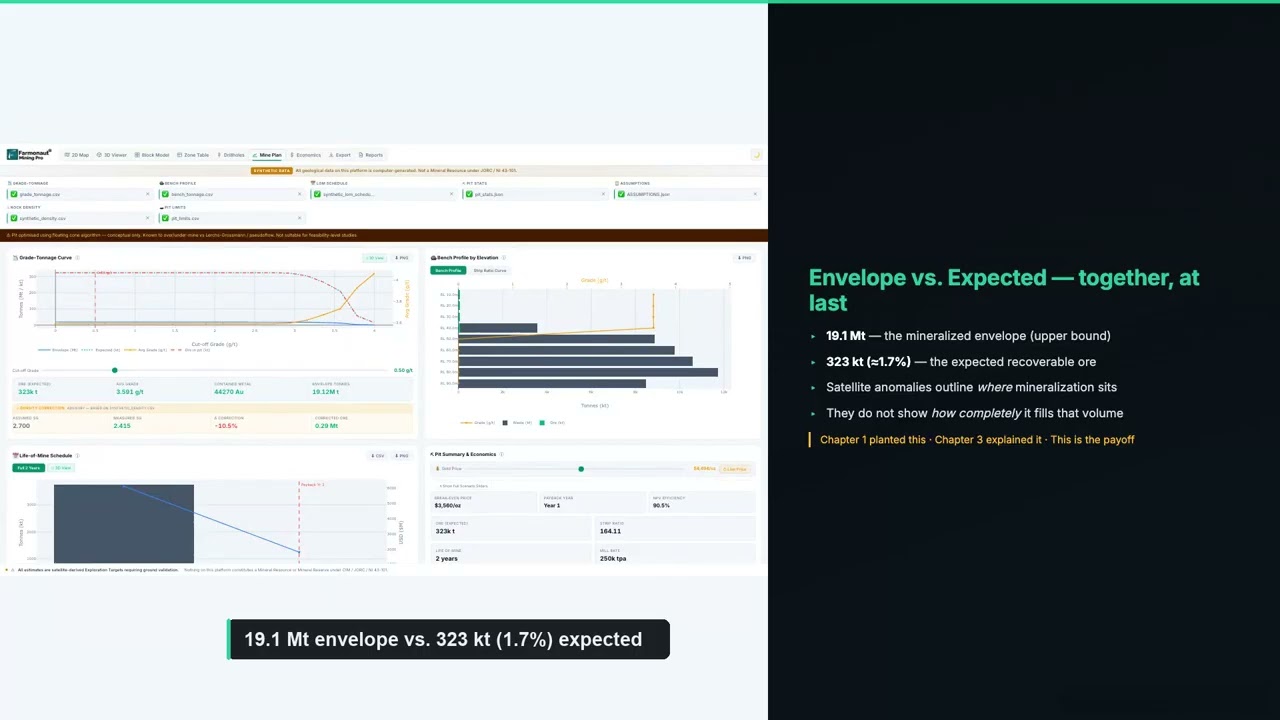
▶ Mine plan walkthrough: how a pit shell and grade-tonnage curve are built from the data, the kind of work the studies stage runs on. · 18:56
How long does mineral exploration take?
For a single project, mineral exploration from first claim to a decision to build usually takes the largest share of 12 years, based on the two datasets above (11.9 years for discovery, exploration and studies; IEA: over 12 years for exploration and feasibility). A single programme is much shorter. A mapping and sampling season, a geophysical survey or a first drill campaign each fits inside one to a few field seasons, and the time between programmes is spent on assays, interpretation, funding and permits.
The reason the total is so long is the cycle, not any one step. Each stage produces a result, the result needs money for the next stage, and each step up in cost needs a stronger case. Weather windows, drill rig availability, assay laboratory queues, land access agreements and consultation all add waiting time that does not show up in the technical plan.
Two practical points follow for a licence holder:
- Time on the licence is not the same as time on the project. Exploration time is spent in bursts, and a lot of calendar time passes between them.
- The cost of a mistake is mostly lost time. A drill programme aimed at the wrong place uses a season and a budget and moves the clock forward without moving the project forward.
Why the timeline differs by country and metal
The averages hide large differences. In its 2024 study of 268 mines (including projects still in development), S&P found that US mines take almost 29 years on average from first discovery to first production, second only to Zambia at 34 years, with Canada at 27 years and Australia at 20 years (S&P Global press release, July 2024). The study points to permitting on federal land, litigation risk and, in the US, a lack of a single coordinating agency as reasons. Because the sample includes projects not yet producing, these numbers are higher than the 15.7 years for mines that have started.
Chart
Discovery to first production by country
Average years, mines including projects still in development (projected start-up year, or 2030 where none is available); selected countries with at least two mines
The US example shows how a sample can mislead. In the 127-mine analysis, only three US mines appear: Eagle (online in 2014), Ruby Hill (2007) and Pogo (2006). None are on federal land, and Eagle’s permit was granted by the state of Michigan one year after its feasibility study. It describes Eagle as unusually fast, not typical (S&P Global, 2024). The same report lists US projects that have been in development for decades: Resolution in Arizona (discovered 1995), Pebble in Alaska (1990) and Lithium Nevada (1978), which are counted at 29, 34 and 46 years from discovery to the date of its analysis.
Metal matters too. In the 127-mine sample, gold mines (70 of them) average 15.2 years, copper (34 mines) 16.2 years and nickel (13 mines) 17.5 years. The discovery, exploration and study phase is longest for copper at 12.4 years, and nickel loses its extra time mainly to a longer construction decision stage (3.9 years) and construction (2.6 years).
Permitting: the stage that stretches
If a project stalls, it usually stalls here. The same report notes that on private or state land in the US, permitting is generally more predictable, while on federal land it is characterised by delays, unpredictability and rising costs. The IEA’s advice to governments is to streamline permitting procedures to shorten lead times (IEA, 2021).
For an owner, three habits are worth building in, based on how the process is described above. Start baseline studies (water, ecology, heritage) early, because they need a full seasonal cycle. Consult landholders and affected communities before filing, not after. And file complete applications, since the report notes that the completeness determination on a federal plan of operations can itself take years.
Exploration licence terms versus the real timeline
This is the mismatch that catches licence holders out. Governments grant exploration rights in terms of a few years, renewable on conditions. The project, as the averages show, needs about 12 years to get from discovery to a decision to build. A licence therefore expires, and is renewed or converted, several times before a mine is built. The chart below compares maximum or initial terms in two jurisdictions with the average exploration-and-study time.
Chart
Licence terms against the exploration clock
Years: Western Australia initial term and first extension, Tanzania prospecting maximum, against the average time spent on exploration and studies
The rules differ by country, and the examples below come from official sources. They are examples of how rules generally work, not advice for your licence; check with the ministry before you apply or renew.
- Western Australia, exploration licence. The initial term is five years. For licences applied for or granted after 10 February 2006, it can be extended once for five years and then for further periods of two years. The Minister must be satisfied that a prescribed ground exists, such as land being unworkable for all or a substantial part of a year, or work already done under the licence justifying further exploration (Government of Western Australia, extensions of term). The application is made before the expiry date, and the licence stays in force while it is decided.
- Tanzania, prospecting licence. The Mining Act provides an initial period not exceeding four years, a first renewal of up to two years and a second renewal of up to two years. A prospecting licence is not renewable after the second renewal, so the maximum is eight years. The holder must also spend a prescribed minimum per square kilometre each year (Tanzania Mining Act, Cap. 123 R.E. 2023).
- Ontario, mining claims. The ministry says a claim is kept in good standing by completing and reporting assessment work. In a June 2023 policy decision the ministry describes the requirement as $400 per cell of assessment work annually, and a holder may instead make a payment in place of work (Environmental Registry of Ontario, assessment work policy notice; Ontario Ministry of Mines). Development cannot take place on an unpatented claim; the holder must first obtain a lease.
- United States, federal unpatented claims. Claims are held by paying an annual maintenance fee: $200 for each lode claim, and $200 for each 20 acres or part of a placer claim, due on or before 1 September (BLM, assessment year 2027). Claimants with 10 or fewer claims nationwide can file a waiver certificate instead if they performed $100 worth of work on each claim; non-payment leads to forfeiture by operation of law (Bureau of Land Management, mining claim fees; BLM mining packet). Fees can change, so check the BLM page before paying.
Our guide to prospecting and exploration licence rules in eight jurisdictions compares more countries side by side.
Mining lease renewal and mining licence renewal
A mining lease or licence is the next step after exploration and normally runs for a longer term, tied to the life of the ore body. The renewal rules reflect that. In Tanzania, the holder of a special mining licence applies to the Commission not later than one year before expiry, and the renewal period requested must not exceed the estimated life of the ore body; the application must report how licence conditions have been implemented (Tanzania Mining Act). Other jurisdictions set different lead times and tests, so read your own statute and licence conditions, and keep a calendar of the date by which a renewal must be lodged.

▶ Licence basics in Africa: who can hold a small scale licence and which routes are open. · 5:16
Your licence is expiring: have you explored the whole concession?
Many licence holders reach a renewal with part of the ground never properly tested. Renewal rules ask what has been done and what is planned. In Western Australia an exploration licence extension is considered by the Minister against prescribed grounds, and Tanzania’s Act requires a report on the licence conditions at renewal. If you cannot show where work has been done, the renewal argument is weaker and your options narrow.
Before a renewal, make an honest inventory of the ground. For each block or sub-area, record:
- what was done (mapping, soil or rock sampling, geophysics, drilling), when, and by whom;
- what the results showed, including negative results, with the assay certificates and survey files;
- what stopped work (access, weather, funding, security, a landholder dispute);
- what has not been touched at all.
The fourth list is the one that decides how you spend the next term. A concession with a quarter of its area never visited is not a finished concession. Our guide to checking your licence area shows a way to screen the whole boundary before committing field budget.
How to prioritise exploration before renewing a licence
When the licence clock is shorter than the exploration clock, the job is to rank the ground so the best targets are tested first and the remaining area can be kept or released on purpose. A simple order works for most holders.
- List every block and what is known about it. Gather the inventory above into one map with the licence boundary, existing samples, drill collars and surveys.
- Score blocks on evidence, not hope. Look for several independent signals on the same ground: a geological host, structure, alteration, geochemical anomalies, geophysical response, old workings. One signal is a lead; three that overlap are a target.
- Find the gaps. Mark areas with no data at all, and check whether satellite or public regional data can screen them cheaply before a field crew goes in.
- Rank by cost to test and value if right. Cheap tests on strong signals go first. Expensive drilling goes to targets that have passed cheaper tests.
- Fit the work to the date. Count backwards from the renewal date: results must be in hand, with a report, before the application. Leave time for assays and for rain.
- Decide what to hold and what to release. Keeping low-ranked ground costs fees and work commitments every year. Releasing it on your terms is better than being forced to.
The aim is not to finish exploring in one term. It is to arrive at renewal with a documented, ranked programme and results that justify the next term.
What shortens the early stages
The 12-year block cannot be cut by wishing, but parts of it respond to better decisions. The clearest wins are in the first years, when choices about where to look are cheapest to get right.
- Screen before you spend. Satellite imagery, public geological maps and open geophysics show surface and near-surface signatures such as alteration, structure and rock type across a whole licence before field work starts, so field crews and drill rigs go to ranked targets. Satellites map the surface and the near-surface; sampling and drilling confirm what is below. Our explainer on how satellite mineral exploration works covers what the data can and cannot show, and a Farmonaut satellite mineral report marks high-potential zones inside your licence boundary.
- Keep data in one place. Lost assay files and duplicated surveys cost time in every later stage. A tidy database also speeds up the technical report.
- Test the cheap questions first. Rank targets by what it costs to prove them wrong.
- Start permitting baselines early. Water and ecology work needs seasons, so it belongs on the critical path from the first drill programme.
- Work with the landholder from day one. Access and consultation failures cost far more time than any technical delay.
None of this removes the need for drilling or the long studies that follow. It reduces the number of seasons spent on ground that was never going to host a deposit.

▶ Mineral exploration from space: how screening the ground helps decide where the first drill holes go. · 4:26
Licence clock calculator
Use the calculator below to compare the years left on your licence with the years you still need to reach a decision to build. The defaults are examples, not benchmarks; the 11.9-year figure for discovery, exploration and studies is an average across many mines, not a prediction for yours.
Calculator
Does your licence outlast the exploration clock?
Enter your own licence terms and the years you still need.
- Years left on the licence: 5.0
- Years of exploration and studies still needed: 7.0
- Years from now to a construction decision: 9.0
Example values only, not a benchmark or a forecast. S&P Global (2024) reports 11.9 years on average for discovery, exploration and studies across 127 mines; your project may differ. Use the maximum your own regulator allows. Ontario and US claims run on annual work or fees, not a fixed term: for those, enter the years you plan to hold the ground.
Frequently asked questions
How long does it take to build a mine from discovery?
On average about 16 years. The 127-mine analysis found 15.7 years across mines that started up since 2002, with 11.9 years spent on discovery, exploration and studies, 2.3 years on the construction decision and 1.5 years from construction to start-up (S&P Global, 2024). The IEA found over 16 years for major mines that came online between 2010 and 2019.
How long does it take to open a mine once construction starts?
Construction to start-up averages 1.5 years in the 127-mine sample and 4 to 5 years in the IEA’s study of major mines. Size and infrastructure explain most of the gap. Permits and financing are normally settled before construction begins.
What is the mine life cycle?
Ontario’s Ministry of Mines lists five stages: early exploration, advanced exploration, mine development, mine production and closure. Evaluation studies sit between advanced exploration and development, and progressive rehabilitation runs throughout, not only at the end.
What are the stages of mineral exploration?
Early exploration covers target selection, claim registration, mapping, sampling, surveys and first drilling. Advanced exploration adds larger drilling, bulk samples and bigger permits. Studies follow: a resource estimate, preliminary economic assessment, pre-feasibility study and feasibility study. See our guide to the stages of the mining process for each step.
How long does mineral exploration take?
Exploration plus studies averages 11.9 years in that sample, and the IEA reports over 12 years. A single programme, such as a survey or a drill campaign, usually fits inside one or two field seasons; the long total comes from repeating the cycle with larger budgets.
What is a mineral exploration timeline for a small licence holder?
Plan in licence terms, not in project years. Count the years left on your licence, list the work that must be done and reported before renewal, and fit it to field seasons. The calculator above does the arithmetic with your own numbers.
How long is an exploration licence valid?
It depends on the jurisdiction. Western Australia grants an initial five years, extendable once for five years and then in two-year periods on prescribed grounds. Tanzania grants up to four years, with two renewals of up to two years each. Ontario claims have no fixed term but need annual assessment work. Check with the regulator for your own licence.
Can an exploration licence be renewed?
Often yes, within limits. The usual pattern is an application lodged before expiry, with a report on work done and a programme for the next term; the details are set by each jurisdiction. Tanzania’s Act allows two renewals of a prospecting licence and then no further renewal; Western Australia allows extensions on prescribed grounds.
What happens to a mining lease at renewal?
The holder normally applies before expiry, shows compliance with licence conditions and asks for a period matched to the remaining life of the ore body. In Tanzania a special mining licence holder applies not later than one year before expiry, and the period requested must not exceed the estimated life of the ore body; a holder of a (smaller) mining licence applies not later than six months before expiry.
What should I do if my licence is about to expire and I have not explored it all?
Inventory the ground, find the blocks with no data, rank blocks by evidence, test the cheapest strong targets first and file a renewal that shows a documented programme. If a renewal is refused or not possible, ask the ministry what options exist, such as a different title type.
Why do US mines take longer than mines in Australia?
The 2024 study found almost 29 years in the US against 20 in Australia (samples include projects still in development). It points to complex federal permitting, higher litigation risk and the lack of a single coordinating agency.
Is this timeline a Farmonaut forecast?
No. The timings come from S&P Global, the IEA and the cited regulators. Farmonaut satellite reports are exploration targets, not resource estimates under JORC or NI 43-101.
This page is for information only. It is not legal advice or investment advice. Licence terms, fees and renewal rules change; confirm them with the regulator before you apply or renew. Satellite results are exploration targets, not resource estimates under JORC, NI 43-101 or SAMREC.
Farmonaut mining
Rank the ground before your next renewal
Send your licence boundary to get a Farmonaut satellite mineral report that marks high-potential zones inside it.

Mining Pro sample view, synthetic data
Sources
- S&P Global Market Intelligence, Mine Development Times: The U.S. in Perspective (2024): cdn.ihsmarkit.com
- S&P Global press release, US ranks next to last in development time (18 July 2024): press.spglobal.com
- S&P Global press release, copper supply shortfall study (January 2026): press.spglobal.com
- IEA, The Role of Critical Minerals in Clean Energy Transitions: reliable supply (2021): iea.org
- Ontario Ministry of Mines, mining sequence: ontario.ca
- Environmental Registry of Ontario, New Assessment Work Policies notice: ero.ontario.ca
- Government of Western Australia, extensions of term for exploration licences: wa.gov.au
- Tanzania Mining Act, Cap. 123 R.E. 2023 (Tume ya Madini): tumemadini.go.tz
- Bureau of Land Management, mining claim fees: blm.gov
- Bureau of Land Management, 2027 mining packet: blm.gov
Discussion
Questions, corrections or field experience? Share them below. First-time comments are reviewed before they appear, and your email is never published.
No comments yet. Be the first to add a question or your experience.

 Omsri International FZE
 G.I.T.T.
 Jaunita Erss Ltd
 Almosi SARL
 SRK Consulting
 Berks Gold Limited
 Mwerezi Minerals Company Limited
 Mining SARL
 SenGold Invest SAS
 Sean Mining Limited
 NTS Group (Pty) Ltd
 Mine4Africa
 Lithspo Minerals Limited
 Tintina Mining Group
 Dalgety Minerals Pty Ltd

 Licence holder · Nigeria · Gold + lithium
 Client · Somalia · Gold










