

Reviewed August 2026 against FAO Ethiopia country data and IMARC Group market research.
Try it: Estimated result: Enter your field details above. →
Agriculture accounts for 34.6% of Ethiopia’s GDP and supports roughly 80% of the population’s livelihoods, according to the FAO’s Ethiopia country office. The country’s agritech sector — the software, sensors, and satellite tools built on top of that farming base — was valued at $29.46 million in 2025 and is projected by IMARC Group to reach $74.75 million by 2033. This article lays out the current numbers behind Ethiopian agriculture and where precision farming, smart irrigation, and API-driven tools fit into that trajectory, with links to the primary sources so you can pull the next update yourself.
Table of Contents
- The State of Ethiopian Agriculture: Core Numbers
- Ethiopia’s Agritech Market Size and Growth
- Precision Farming and Smart Irrigation in Ethiopia
- Regenerative Agriculture Market and Programme Data
- Drones, APIs, and Developer Tools for Ethiopian Agriculture
- Traditional vs. Precision Farming: A Structured Comparison
- Irrigation Water Savings Calculator
- Challenges to Ethiopian Agricultural Modernization
- Where Farmonaut Fits
- FAQs
- Try it: Estimated result: Enter your field details above.
The State of Ethiopian Agriculture: Core Numbers
Ethiopian agriculture is built on smallholder production, coffee exports, and a workforce still overwhelmingly tied to the land. The FAO’s Ethiopia country profile puts agriculture’s share of GDP at 34.6%, a figure that has anchored discussion of “agriculture in Ethiopia” for years because it captures how central farming remains to the national economy even as services and industry grow. That same profile records that roughly 80% of Ethiopians depend on agriculture for their livelihoods — not necessarily as their sole income, but as the base layer of household survival across rural regions.
Coffee is the clearest single-crop illustration of that dependency. Ethiopia produced 496,200 tonnes of coffee in 2022, per FAO data, and an estimated 15 million Ethiopians have livelihoods tied to coffee farming, from smallholder growers in Oromia and the Southern Nations region to cooperative processors and exporters. Coffee is Ethiopia’s signature export crop, and its production volume is one of the few Ethiopian agricultural statistics tracked consistently enough at FAO level to cite with a specific year attached.
What is genuinely not published at a reliable, current level: national grain production volumes for maize, teff, sorghum, and wheat broken out by region for the most recent growing season. The most complete cross-referenced Ethiopian crop production data sits in FAO’s FAOSTAT database, and as of this review the most recent complete figures available there predate the current growing year. If you need current maize, teff, or wheat tonnage by region, go to FAOSTAT directly (faostat3.fao.org), select “Production” → “Crops,” and filter to Ethiopia — the database is updated annually, and pulling it live will always beat a cached figure printed here.
Similarly, there is no published national figure for the irrigated-versus-rainfed split of Ethiopian cropland, or a peer-reviewed post-2020 dataset on soil carbon outcomes from conservation agriculture trials in Ethiopia specifically. Where that data does not exist in citable form, the honest answer is that it has to be requested from Ethiopia’s Ministry of Agriculture or a specific field study, not inferred from adjacent market-sizing reports.
This dependency structure — a large share of GDP, a large share of the population, and one dominant export crop — is exactly why agriculture, and technology partnerships matter disproportionately here: small efficiency gains at the farm level scale to a large share of the national economy.
Ethiopia’s Agritech Market Size and Growth
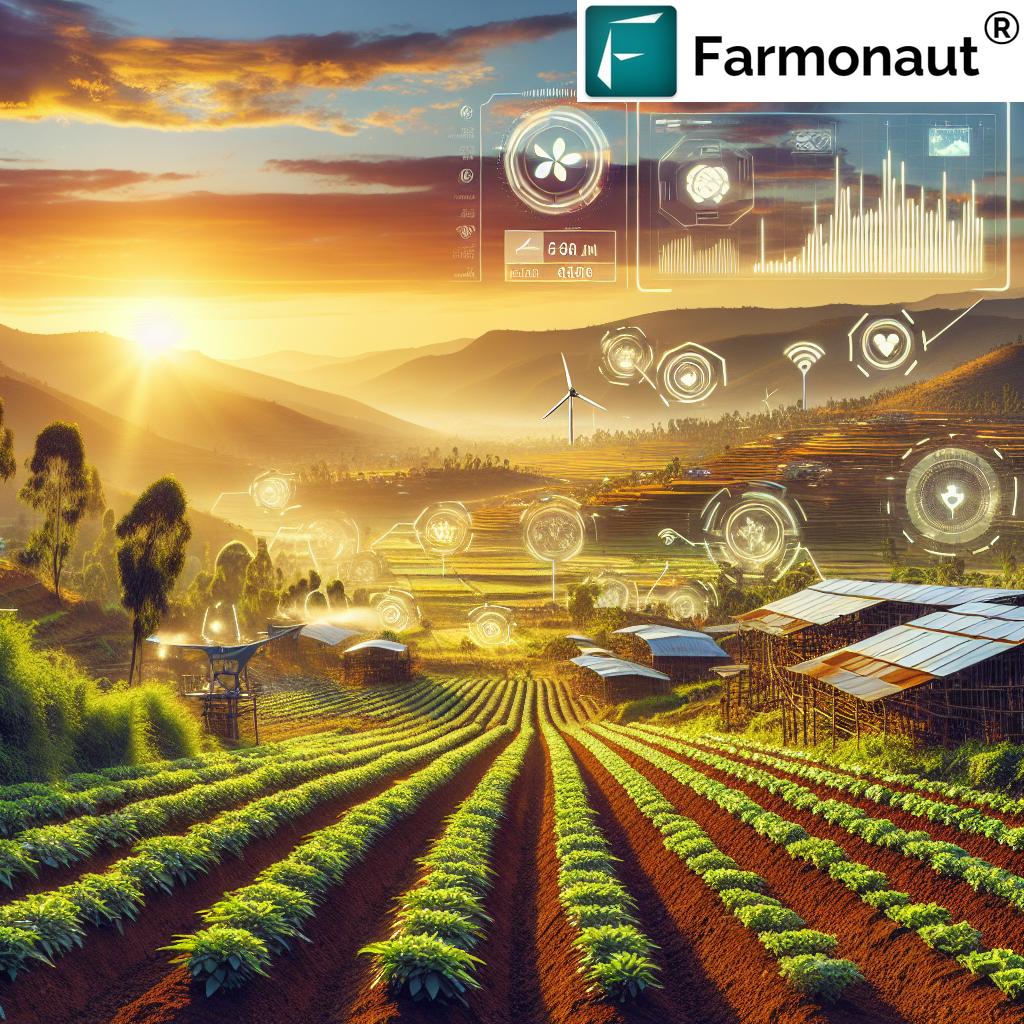
The Ethiopian agritech market — precision agriculture software, farm-management platforms, sensor networks, and satellite-data services sold into Ethiopian farming operations — was sized at $29.46 million in 2025 by IMARC Group. IMARC’s forecast projects the market growing to $74.75 million by 2033, implying a compound annual growth rate of 10.90% across the 2026–2033 forecast window. That is a meaningfully faster growth rate than most mature agritech markets in North America or Europe, precisely because the current base is small and adoption is still in its early stages.
Adoption data from the same research shows only 18% of smallholder farmers in Ethiopia currently have formal training in digital agriculture tools. That 18% figure is the real constraint on the market’s growth curve: software and satellite platforms can scale instantly, but farmer training capacity scales much more slowly, and IMARC’s own CAGR projection implicitly assumes that training gap narrows over the forecast period.
For readers tracking “ethiopia agritech market” and “ethiopia precision farming market” as distinct queries: IMARC’s agritech figure is the broader category (any digital tool sold into Ethiopian agriculture), while precision farming — GPS-guided equipment, variable-rate input application, and satellite-driven field monitoring — is a subset of that spend. There is no separately published Ethiopia-specific precision-farming-only market size in the sources reviewed for this article; if you need that narrower figure, the method is to request IMARC’s or a comparable market-research firm’s full segmented report rather than estimate it from the blended agritech total.
To refresh these figures yourself: IMARC and similar firms (Market Data Forecast is another that covers African agritech) typically republish Ethiopia agritech and precision-agriculture sizing reports annually in Q1–Q2, with revised CAGR and base-year figures. The World Bank’s DataBank (data.worldbank.org) is the complementary source for the macro side — filter to “Ethiopia” and the indicator “Agriculture value added (% of GDP)” for a quarterly-updated read on how the sector’s GDP share is trending relative to the 34.6% figure cited above.
The precision agriculture technology category itself — satellite imagery, IoT soil sensors, and data-driven irrigation and fertilizer scheduling — is the mechanism by which that $29.46 million is expected to compound into $74.75 million. Four capability areas make up most of that spend:
- Crop Monitoring Technology: Real-time tracking of crop health and growth stages via satellite vegetation indices, enabling earlier intervention on stressed fields.
- Smart Irrigation Systems: Weather-data and soil-moisture-driven scheduling, relevant to Ethiopia’s water-scarce highland and lowland farming zones.
- AI-powered Pest Management: Predictive pest-outbreak modeling that shifts pest control from reactive spraying to targeted, timed treatment.
- Precision Input Application: Variable-rate seeding and fertilizer application tied to field-level data rather than blanket application.
Farmonaut’s own platform sits in this category: satellite-based crop health monitoring (via NDVI) and soil moisture tracking, designed to give farmers the same category of data-driven irrigation and fertilizer decisions that underpin the market growth IMARC projects.
Explore our innovative agricultural solutions: 
Precision Farming and Smart Irrigation in Ethiopia
Smart irrigation is one of the more immediately relevant precision-farming applications for Ethiopia, given the country’s mix of rain-dependent highland cropping and water-constrained lowland zones. The core technique is straightforward: pair soil-moisture sensing or satellite-derived moisture estimates with local weather forecasts to schedule irrigation to actual crop water demand rather than a fixed calendar.
There is no Ethiopia-specific smart-irrigation market-size figure in the sources reviewed for this article — it is not broken out separately from the broader $29.46 million agritech total in the IMARC data cited above. Readers researching “ethiopia smart irrigation market” specifically should treat the agritech total as the closest available proxy until a segmented report is published, and check IMARC’s Ethiopia agritech report page directly for any update that breaks out irrigation technology as its own line item.
Sustainable farming practices that pair naturally with precision irrigation and monitoring include:
- Conservation Agriculture: Minimizing soil disturbance, maintaining soil cover, and rotating crops to improve soil health and water retention — directly reducing irrigation demand.
- Agroforestry: Integrating trees and shrubs into croplands and pastures to enhance biodiversity and soil fertility.
- Integrated Pest Management: Combining biological, cultural, and chemical methods to control pests while minimizing environmental impact.
- Water Conservation Techniques: Rainwater harvesting and efficient irrigation systems to maximize water-use efficiency in water-scarce zones.
Farmonaut’s Jeevn AI Advisory System is built around this exact pairing — real-time weather forecasts and crop-management guidance layered on top of satellite field data, intended to help farmers apply conservation-agriculture and water-conservation practices with field-specific timing rather than generic seasonal rules.
Ethiopia’s numerous lakes and rivers — despite the country being landlocked — also support water-resource applications adjacent to irrigation: sustainable aquaculture as a supplementary protein and income source, integrated water-resource management to balance agricultural and ecosystem needs, and eco-tourism around water bodies as a diversified rural income stream. These efforts complement, rather than replace, traditional agriculture across Ethiopia’s farming regions.
Regenerative Agriculture Market and Programme Data
Ethiopia’s regenerative agriculture market — practices like reduced tillage, cover cropping, and rotational grazing aimed at rebuilding soil health rather than just sustaining yields — was valued at $11.18 million in 2024, per IMARC Group, with a projection to $32.15 million by 2033 at a 12.45% compound annual growth rate over 2024–2033. That growth rate is higher than the broader agritech CAGR (10.90%), suggesting regenerative practices are scaling from an even smaller base but faster relative pace.
On the ground, IMARC’s data references a regenerative agriculture programme engaging 37,000 farmers in Ethiopia as of 2024. That is the only concrete farmer-participation figure available in the sources reviewed for this article — there is no published national total for regenerative-agriculture acreage under practice (hectares enrolled or certified) in Ethiopia. If you need an acreage figure specifically, that gap has to be filled by requesting programme-level data directly from the implementing organization behind the 37,000-farmer initiative, since IMARC’s public report covers market value and participant counts but not certified area.
For readers tracking “ethiopia regenerative agriculture market” specifically: the $11.18 million 2024 base and 12.45% CAGR are the two numbers to cite; anything beyond that (soil carbon sequestration outcomes, yield deltas from conservation agriculture trials) is not yet published in peer-reviewed form for Ethiopia specifically as of this review, and should be sourced from a dedicated field study rather than a market-sizing report.
Drones, APIs, and Developer Tools for Ethiopian Agriculture
Drone-based crop monitoring, precision spraying, and field mapping are frequently discussed as part of Ethiopia’s agritech trajectory, but there is no published Ethiopia-specific drone adoption rate (units deployed, hectares covered, or percentage of farmers using drones) in the sources available for this article. That figure sits in the GAPS category: if you need drone-adoption numbers for Ethiopia, the closest available proxy is the overall $29.46 million agritech market figure, and a direct request to equipment distributors or the Ethiopian Ministry of Agriculture would be needed for a drone-specific breakout.
What is concrete and available today is the API infrastructure that developers can build on. Farmonaut’s satellite and weather API gives developers programmatic access to the same NDVI, soil-moisture, and weather-forecast data referenced throughout this article, for integration into third-party farm-management systems, lending platforms, or insurance products:
Explore our API for integrating advanced agricultural data into your systems: Farmonaut API
For developers looking to leverage our technology: API Developer Docs
This is directly relevant to the “api development ethiopia” query: agritech API development for the Ethiopian market is less about building new satellite infrastructure from scratch and more about integrating existing global satellite-data APIs (Farmonaut’s included) into locally relevant products — loan verification, insurance underwriting, cooperative-level crop reporting — tailored to Ethiopian crop calendars and regions.
Traditional vs. Precision Farming: A Structured Comparison
The table below compares typical traditional smallholder farming inputs and outcomes against precision-farming approaches. These are illustrative operational ranges used to frame the decision, not Ethiopia-specific measured averages — no national study cited in this article’s research measures Ethiopian yield-per-hectare or water-use-per-hectare at this granularity, so treat the ranges as a planning framework rather than a national statistic.
| Aspect | Traditional Farming | Precision Farming |
|---|---|---|
| Crop Yield (tons/hectare) | 2–3 | 4–6 |
| Water Usage (liters/hectare) | 8,000–10,000 | 5,000–7,000 |
| Fertilizer Efficiency | 40–50% | 70–80% |
| Pest Management | Reactive, broad-spectrum applications | Proactive, targeted treatments |
| Labor Requirements (person-hours/hectare) | 200–250 | 100–150 |
| Initial Investment (USD) | $500–$1,000 | $2,000–$5,000 |
| Long-term Profitability | Baseline | 30–50% increase |
The gap between these two columns is the market IMARC is projecting growth into: as more Ethiopian smallholders cross from the left column to the right, the $29.46 million agritech base expands toward the $74.75 million 2033 projection. The 18% smallholder digital-training rate cited earlier is the practical bottleneck on how fast that crossing happens.

Irrigation Water Savings Calculator
Use the table above as your baseline: enter your field size and current per-hectare water use to estimate the liters saved per season by moving toward the precision-farming range.
Estimated result: Enter your field details above.
Challenges to Ethiopian Agricultural Modernization
The gap between Ethiopia's current $29.46 million agritech market and its 2033 projection is not purely a technology-availability problem. Several structural constraints determine how fast that gap closes:
- Digital training gap: Only 18% of smallholder farmers currently have formal training in digital agriculture tools, per IMARC's adoption data — the single clearest bottleneck on adoption speed.
- Climate Change Adaptation: Building farming systems resilient to shifting rainfall patterns and extreme weather events across Ethiopia's varied agroecological zones.
- Smallholder Integration: Ensuring smallholders — who represent the majority of the 80% of the population dependent on agriculture — are not left behind as modernization proceeds.
- Rural Infrastructure: Roads, storage facilities, and internet connectivity gaps that limit how far digital agriculture tools can reach beyond well-connected regions.
- Sustainable Resource Management: Balancing productivity gains with long-term preservation of land and water resources.
Rural development programmes addressing these gaps typically combine digital literacy training, agricultural extension services delivered via mobile platforms, and value-chain development that lets rural communities capture more value beyond primary production — for instance through agricultural export processing rather than raw commodity sale.

At the household level, this matters most for the estimated 15 million Ethiopians whose livelihoods trace back to coffee farming specifically — a population for whom yield stability and export-price transparency are not abstract market-growth statistics but direct income determinants. Cold-chain infrastructure, agro-processing facilities, and blockchain-based supply-chain traceability are the categories of investment most frequently discussed as levers to move value further down the chain toward these growers, rather than concentrating it at export and processing stages.
Where Farmonaut Fits
Farmonaut's platform is designed for the adoption curve described above: satellite-based crop health monitoring (NDVI) and soil-moisture tracking that does not require farm-level hardware installation, positioned to be accessible to smallholder farmers as well as larger operations. That matters directly against the 18% digital-training figure cited above — tools that require less specialized training reach a larger share of that gap faster.
Specific capabilities relevant to the data in this article:
- Affordable Precision Agriculture: Satellite-based crop monitoring accessible via mobile devices, reducing the hardware-cost barrier implied by the $2,000–$5,000 precision-farming investment range in the comparison table above.
- Data-Driven Decision Making: Real-time crop health, soil moisture, and weather insight for irrigation, fertilizer, and pest-management decisions.
- Sustainable Farming Tools: Resource-use tracking aligned with the conservation-agriculture and regenerative-agriculture practices covered above.
- Supply Chain Transparency: Blockchain-based traceability relevant to boosting confidence in agricultural exports, including coffee.
- Financial Inclusion Support: Satellite-based verification for crop loans and insurance, addressing a common financing barrier for smallholders.
Mobile access is central to this, since Ethiopian smallholders reaching these tools do so predominantly via phone rather than desktop:
Download our mobile apps for on-the-go farm management:



The throughline across all of these figures — 34.6% of GDP, $29.46 million growing to $74.75 million, 18% training penetration, 37,000 farmers in a regenerative programme — is that Ethiopian agriculture is a large, structurally important sector still in the early stages of digital adoption. Whichever agritech innovations reach that 82% of untrained smallholders fastest will capture the bulk of the growth between now and 2033.
FAQs
- Q: What percentage of Ethiopia's GDP comes from agriculture?
A: 34.6%, per the FAO's Ethiopia country office. This figure is tracked at the World Bank's DataBank (data.worldbank.org) as well, updated quarterly under "Agriculture value added (% of GDP)" for Ethiopia — check there for any revision. - Q: How big is the Ethiopian agritech market?
A: IMARC Group sized it at $29.46 million in 2025, projecting growth to $74.75 million by 2033 at a 10.90% CAGR (2026–2033). Check IMARC's Ethiopia agritech market report directly for the most current revision. - Q: What share of Ethiopian farmers use digital agriculture tools?
A: 18% of smallholder farmers currently have formal training in digital agriculture, per adoption data underlying IMARC's market report — the main constraint on faster agritech adoption. - Q: How large is Ethiopia's regenerative agriculture market?
A: $11.18 million in 2024, projected to reach $32.15 million by 2033 at a 12.45% CAGR, per IMARC Group. A dedicated programme referenced in that data engaged 37,000 farmers as of 2024. - Q: How many people depend on coffee farming in Ethiopia?
A: An estimated 15 million, per the FAO, against 2022 national production of 496,200 tonnes of coffee — Ethiopia's signature export crop. - Q: Is there a published drone-adoption rate for Ethiopian agriculture?
A: No — this is not currently published in the sources reviewed for this article. The closest available proxy is the overall $29.46 million agritech market figure; a drone-specific breakout would need to come from equipment distributors or Ethiopia's Ministry of Agriculture directly. - Q: Where can I get current Ethiopian crop production data by region?
A: FAO's FAOSTAT database (faostat3.fao.org), filtered to "Production" → "Crops" → Ethiopia, updates annually and is the most complete cross-country source for maize, teff, sorghum, and wheat volumes.
Explore Farmonaut's Agricultural Solutions
Ready to apply precision farming to your own operation? Farmonaut's satellite-based tools are built to make the data-driven approach described throughout this article — crop monitoring, soil moisture tracking, and irrigation guidance — accessible regardless of farm scale.
Sources cited in this article: FAO Ethiopia country office and IMARC Group's Ethiopia agritech market report, plus IMARC's Ethiopia regenerative agriculture market report.


