

Mine safety law · State-by-state guide
Mining Safety Regulations in Australia: By State and Data
Australia has no single national mining safety law: each state and territory sets its own Acts and regulator. This guide compares them, explains the duties that matter on site, and shows fatality and injury data with a rate calculator.
Key takeaways
- The Australian Government does not regulate work health and safety in mining; states and territories do (Safe Work Australia, mining page).
- Western Australia uses the Work Health and Safety Act 2020 and Mines Regulations 2022, in effect since 31 March 2022; Queensland keeps two mining Acts (WorkSafe WA; Safe Work Australia).
- Mining recorded 10 worker deaths in 2024, 39% above its five-year average of 7.2, a rate of 3.4 per 100,000 workers, third highest of any industry (Safe Work Australia, October 2025).
- NSW coal, metalliferous and extractives mines logged 841 recordable injuries over 74.9 million hours in 2024-25, about 11.2 per million hours (NSW Resources Regulator, February 2026; rate calculated by Farmonaut).
- Industrial manslaughter is now an offence in every Australian state and territory; this guide covers Queensland (mining Acts), Western Australia (since 31 March 2022) and New South Wales (since 16 September 2024) in detail.
In this article
- Which law sets mining safety rules in Australia
- Mining safety regulations in Australia by state and territory
- What mine operators must put in place
- Fatigue, drugs, psychosocial risk and remote-controlled plant
- Dust, silica and diesel exposure limits
- Penalties and industrial manslaughter in mining
- Closing, suspending and rehabilitating a mine safely
- How dangerous is mining in Australia
- What NSW mine injury data shows
- Calculate your site's injury frequency rate
- Mining safety claims that circulate online, checked
- Where satellite data fits in mine safety
- Checklist before you start work on a licence
- Frequently asked questions
Which law sets mining safety rules in Australia
No single national law governs mine safety in Australia. The Australian Government does not regulate work health and safety (WHS) in the mining industry; each state and territory does, through its own Acts, regulations and regulator (Safe Work Australia, mining topic page). Safe Work Australia wrote the model WHS laws in 2011, but it is not a regulator and cannot advise on a workplace; your state or territory authority does that.
That matters if you hold a licence in more than one state, manage a contractor fleet that moves between sites, or are a mine worker asking which rulebook protects you. In Western Australia the core instruments are the Work Health and Safety Act 2020 and the Work Health and Safety (Mines) Regulations 2022, which came into effect on 31 March 2022 (WorkSafe WA). In Queensland, mining sits under two stand-alone Acts. In New South Wales it sits under a mining-specific WHS Act that works alongside the general WHS Act.
This guide is written for licence owners, mine operators and mine workers. It sets out who regulates what, the duties that matter most on site, the penalties, and what the injury data shows, with a calculator for your own site’s injury rate.
Mining safety regulations in Australia by state and territory
The table lists the mining safety laws that Safe Work Australia shows for each jurisdiction, with the regulator named on that jurisdiction’s own site.
| Jurisdiction | Mining safety laws listed by Safe Work Australia | Mine safety regulator |
|---|---|---|
| New South Wales | WHS Act 2011 and Regulation 2017; WHS (Mines and Petroleum Sites) Act 2013 and Regulation 2022 | NSW Resources Regulator |
| Queensland | Mining and Quarrying Safety and Health Act 1999 and Regulation 2017; Coal Mining Safety and Health Act 1999 and Regulation 2017 | Resources Safety & Health Queensland (RSHQ) |
| Western Australia | WHS Act 2020; WHS (Mines) Regulations 2022 | WorkSafe WA, a division of the Department of Local Government, Industry Regulation and Safety |
| Victoria | Occupational Health and Safety Act 2004; Chapter 5.3 (Mines) of the Occupational Health and Safety Regulations 2017 | WorkSafe Victoria |
| South Australia | WHS Act 2012 and Regulations 2012; Mines and Works Inspection Act 1920 and Regulations 2013 | SafeWork SA |
| Tasmania | WHS Act 2012 and Regulations 2022; Mines WHS (Supplementary Requirements) Act 2012 and Regulations 2025 | WorkSafe Tasmania |
| Northern Territory | WHS (National Uniform Legislation) Act 2011; Chapter 10 (Mines) of its Regulations 2011 | NT WorkSafe |
| Australian Capital Territory | WHS Act 2011 and Regulation 2011 | WorkSafe ACT |
Two naming points trip people up. First, Western Australia’s regulator has been reorganised: the department’s own site says the reshaped Department of Local Government, Industry Regulation and Safety was previously the Department of Energy, Mines, Industry Regulation and Safety (Government of Western Australia). Older guides still use the earlier DMIRS or DEMIRS names. Second, Queensland’s regulator is a separate body: Resources Safety & Health Queensland (RSHQ) issues the state’s mine safety and health alerts and publishes its mining safety performance reports (Business Queensland).
What mine operators must put in place
The legal wording differs by state, but every system asks the operator to prove that it has found the hazards that can kill several people at once and has a written plan to control them. Western Australia and Queensland show the pattern clearly.
Western Australia: safety management system and principal mining hazards
Under the WA Mines Regulations the mine operator must establish and implement a mine safety management system, and must make sure no mining operations take place at any time when the relevant part of that system is not in place. The maximum fine for that offence is $7,000 for an individual and $35,000 for a body corporate (Work Health and Safety (Mines) Regulations 2022, regulation 621).
A principal mining hazard is any activity, process, plant, structure, substance or situation at a mine with reasonable potential to cause multiple deaths in a single incident or a series of recurring incidents. The regulations name geotechnical structure instability, inrush of any substance, mine shafts and winding systems, roads and areas where mobile plant operates, and fire or uncontrolled explosion. Underground coal mines add gas outburst and spontaneous combustion. Operators must identify every principal mining hazard, run a risk assessment on each, and prepare a management plan for each (regulations 612, 627 and 628).
Queensland: safety and health management system and the site senior executive
The Mining and Quarrying Safety and Health Act 1999 requires the operator of a mine to appoint a site senior executive, to make sure that person develops and implements a safety and health management system, and to audit that system and give it adequate resources. The Act defines the site senior executive as the most senior officer engaged by the operator who is located at or near the mine and has responsibility for it. The management system must be a single, auditable, documented system (Queensland Legislation, Mining and Quarrying Safety and Health Act 1999).
Coal mines have a matching Act. It defines a principal hazard at a coal mine as one with the potential to cause multiple fatalities and requires principal hazard management plans (Queensland Legislation, Coal Mining Safety and Health Act 1999).
| Idea | Western Australia | Queensland |
|---|---|---|
| Top-level safety document | Mine safety management system | Safety and health management system |
| Hazards that can kill many people | Principal mining hazard, with a management plan for each | Principal hazard at coal mines, with principal hazard management plans |
| Person on site who owns the system | Mine operator duties apply, and the mine operator must appoint a site senior executive before non-exploration mining starts (regulation 675ZH); operations must stop if the system is not in place | Site senior executive appointed by the operator |
| Events that must be reported | Reportable incidents to the regulator | Serious accidents (a death, or admission to hospital as an in-patient) and high potential incidents |
Queensland publishes safety statistics and high-potential incident data by sector, and its quarterly incident frequency rate series runs from July 2012 (Business Queensland, safety performance reports and statistics). The WA regulations place a duty on the operator to notify the regulator of reportable incidents and to file quarterly reports.
Fatigue, drugs, psychosocial risk and remote-controlled plant
Several rules that guides call new are written into the WA Mines Regulations as ordinary risk duties.
- Fatigue, alcohol and drugs. The mine operator must manage the risks linked to worker fatigue, to alcohol consumption by workers and to drug use (regulations 640 and 641).
- Psychosocial risk. A psychosocial hazard is one that arises from the design or management of work, a work environment, plant or workplace interactions and behaviours, and that may cause psychological harm. A person conducting a business or undertaking (which includes mine operators and employers) must eliminate psychosocial risks so far as is reasonably practicable and, if that is not possible, minimise them (regulations 55A to 55D, inserted in 2022). The regulation tells the person conducting the business to weigh the design of work, job demands, and how work is managed, organised and supported.
- Autonomous and remote-controlled plant. The regulations define externally-controlled plant to include autonomous, semi-autonomous and remote-controlled plant, and require the mine operator to make sure its use is without risk, so far as is reasonably practicable (regulation 631E).
- Geotechnical structures. The operator must manage the risk of instability or failure of structures such as pit walls, dumps and tailings dams, having regard to geology, hydrology, design and maintenance (regulation 631B).
All four sit inside the general duty in regulation 617 to manage risks. The rules set outcomes and duties; they do not list the equipment you must buy.
Dust, silica and diesel exposure limits
Respirable crystalline silica (RCS) is the fine dust made when rock containing quartz is crushed, drilled, cut or ground. It can reach deep into the lungs and cause irreversible damage. Safe Work Australia states the eight-hour time-weighted average workplace exposure standard for RCS as 0.05 mg/m3, meaning a worker must not be exposed above that level over an eight-hour day in a five-day week (Safe Work Australia, silica exposure standard). A health review recommended cutting it to 0.02 mg/m3, but ministers agreed 0.05 mg/m3 because 0.02 is hard to measure with current Australian equipment (Safe Work Australia, research page).
New South Wales has put mining-specific limits into its regulation. The Resources Regulator’s timeline lists workplace exposure standards for crystalline silica and respirable dust in coal mines, implemented on 1 July 2020, and a workplace exposure standard for diesel particulate matter, implemented on 1 February 2021 (NSW Resources Regulator, Mine safety performance report 2024-25). In Western Australia the mines regulations require monitoring of airborne contaminant levels (regulation 637), and WorkSafe WA publishes a Western Australia Silica Plan 2025-2030 that supports the national silica strategy (WorkSafe WA, silica).
Penalties and industrial manslaughter in mining
Penalties scale with the type of failure. The WA Mines Regulations carry fixed fines per offence, for example $7,000 for an individual and $35,000 for a body corporate for failing to prepare a principal mining hazard management plan. Larger breaches go to prosecution under the main WHS Act, and the most serious cases can be charged as industrial manslaughter, an offence in every state and territory.
- Queensland. Part 3A of both mining Acts creates an industrial manslaughter offence. An employer for a mine commits it if a worker dies in the course of work, the employer’s conduct causes the death, and the employer is negligent about causing it. The maximum is 20 years’ imprisonment for an individual or 100,000 penalty units for a body corporate, and a separate offence applies to senior officers (Mining and Quarrying Safety and Health Act 1999, sections 45C and 45D; Coal Mining Safety and Health Act 1999, section 48C).
- Western Australia. Industrial manslaughter became an offence on 31 March 2022 under section 30A of the Work Health and Safety Act 2020. The maximum for an individual is 20 years’ imprisonment and a $5 million fine; for a body corporate it is a $10 million fine (Holding Redlich, updated March 2025).
- New South Wales. The offence took effect on 16 September 2024 under section 34C of the WHS Act 2011 (same source).
- Other states and territories. The offence now exists everywhere else too: Victoria (“workplace manslaughter”, section 39G of the Occupational Health and Safety Act 2004, since 1 July 2020), the Northern Territory (section 34B of its WHS Act, since 1 February 2020), the ACT (since 2004, now in section 34A of its WHS Act), Tasmania (section 29C of its WHS Act, since 2 October 2024) and South Australia (section 30A of its WHS Act, in force from 1 July 2024) (Holding Redlich; SafeWork SA).
A recent WA case shows what regulators look for. On 6 October 2026 WorkSafe WA reported that mine owner and operator FQM Australia Nickel Pty Ltd was fined $810,000, plus $11,096.20 in costs, over an incident at its Ravensthorpe Nickel Operation processing plant on 18 March 2023, when a heavy plant component called a Roman Shield moved and struck a worker during maintenance. The company pleaded guilty to breaching sections 19(1) and 31(1) of the WHS Act 2020. The court heard that the task’s job hazard analysis lacked controls to secure the component and keep workers clear of the line of fire, and that the work was not directly supervised (WorkSafe WA, media release). The lesson is practical: the written task-level risk assessment is the document an inspector reads first.
Closing, suspending and rehabilitating a mine safely
A mine does not become safe because production stops. In Western Australia, when mining operations are suspended the mine operator must keep the mine safe and secure, including displaying a warning notice that operations are suspended and that unauthorised entry is prohibited. The regulations also require operators to give the regulator information about care and maintenance and about closure of the mine (regulations 675UG to 675UI). The FQM case above is a reminder: the Ravensthorpe operation was placed into care and maintenance in July 2024, and the company was still answering for a 2023 incident in October 2026.
Structures stay hazards after closure, which is why the geotechnical structures duty in regulation 631B matters for pit walls, waste dumps and tailings. Water is the other long-term risk; see our guide to acid mine drainage and the overview of the stages of a mining project. New South Wales describes its Resources Regulator as ensuring safe and sustainable mining and rehabilitation (NSW Resources), so one body covers both.
▶ The environmental impacts of mining, including land disturbance and water, which closure and rehabilitation plans must address. · 2:31
How dangerous is mining in Australia
In 2024, 188 workers died from traumatic injuries at work across Australia, a rate of 1.3 per 100,000 workers. Mining recorded 10 of those deaths. That was 39% above the industry’s five-year average of 7.2, and a rate of 3.4 deaths per 100,000 workers, the third highest of any industry behind agriculture, forestry and fishing (13.7) and transport, postal and warehousing (7.4) (Safe Work Australia, Key Work Health and Safety Statistics Australia 2025).
Chart
Mining worker deaths in Australia, 2015 to 2024
Number of traumatic injury fatalities per calendar year
Chart
Worker fatality rate by industry, 2024
Deaths per 100,000 workers; selected industries from the national table
Count and rate answer different questions. By count, transport had 54 deaths, agriculture 44 and construction 37, so mining is far from the top. By rate, mining sits in the top three because it employs relatively few people. For a licence owner, the rate is the useful figure: it tells you how risky the work is per worker, whatever the size of the industry.
Injuries that do not kill are common. Safe Work Australia’s preliminary 2023-24 workers’ compensation data shows 3,300 serious claims in mining, an incidence rate of 14.9 serious claims per 1,000 workers and a median of 11.1 weeks lost per claim. The long trend is better than the daily headlines suggest. Safe Work Australia’s mining page reports that the industry’s fatality rate fell 65% in the 12 years to 2015, from 12.4 per 100,000 workers in 2003 to 4.4, and that the main inherent risks are body stressing and manual handling, slips, trips and falls, being hit by moving objects or machinery, and work with high-risk plant.
What NSW mine injury data shows
New South Wales publishes the most detailed state data. In 2024-25 its mines recorded 1 fatal injury (up from 0 in 2023-24), 106 serious injuries, 260 lost time injuries and 841 total recordable injuries over 74.9 million hours worked, with 2,168 incident notifications and 2,678 notices issued by the regulator. Being hit by moving objects accounted for 50% of fatal and serious injuries and falls, trips and slips for 31%, so those two mechanisms made up 86 of 107 cases (NSW Resources Regulator, Mine safety performance report 2024-25).
Chart
Lost time injuries in NSW mines by sector
Number of lost time injuries per financial year
Chart
Fatal injuries in NSW mining by decade
Number of deaths; financial years, 1980-81 to 2024-25
The century view shows how far deaths have fallen. Fatal injuries in NSW mining ran at 70 to 72 per decade in the 1980s and 1990s and have fallen to 15 or 16 per decade since 2000. The five financial years from 2020-21 to 2024-25 total 4.
Within the latest year the sectors moved in different directions. Lost time injuries in coal mines rose from 157 to 198, an increase of 26%, while metalliferous mines fell from 54 to 43 and quarries and other extractives mines fell from 45 to 19. Enforcement rose too: notices issued increased from 1,750 to 2,678, including 1,863 improvement notices, 604 notices of concern and 199 prohibition notices. A rise in notices can mean more inspection effort as well as more problems on site, so read it alongside the injury counts.
Calculate your site’s injury frequency rate
Regulators and mining companies compare sites on injuries per million hours worked. The total recordable injury frequency rate (TRIFR) is the number of recordable injuries multiplied by 1,000,000 and divided by the hours worked. NSW’s recordable injuries cover deaths, permanent incapacity, lost time, restricted duty and medical treatment cases; the 2024-25 components add up to 841. Dividing 841 by the 74.9 million hours gives about 11.2 per million hours across NSW coal, metalliferous and extractives mines (the hours leave out exploration sites, petroleum and geothermal sites, opal mines, tourist mines, small gemstone mines and Tier 3 quarries), a figure we calculated from the report’s totals. Enter your own numbers below to see where your site sits against that reference.
Calculator
What is your site’s injury frequency rate?
Enter your own headcount, hours and recordable injuries.
- Hours worked: 0.40 M hours
- Your rate as a multiple of the comparison rate: 0.67 x
- Injuries you would log at the comparison rate: 4.5 injuries
Example values only, not a benchmark. The rate is injuries x 1,000,000 / hours worked. The default comparison rate of 11.2 is 841 recordable injuries divided by 74.9 million hours for NSW coal, metalliferous and extractives mines in 2024-25 (NSW Resources Regulator, February 2026; division by Farmonaut). Definitions of recordable injury differ by company and state.
Mining safety claims that circulate online, checked
Search results for Australian mine safety are full of claims that sound official. Here is what the primary texts say.
- “A uniform national mine safety standard.” Safe Work Australia states that the Australian Government does not regulate WHS in mining and that states and territories do. Rules share a model base but are not identical.
- “Smart helmets, AI hazard systems, virtual reality drills, blockchain reporting and cyber security are mandatory.” None of these terms appears in the consolidated text of the WA Mines Regulations or in the Queensland mining and coal mining Acts opened for this guide. The duties are written as risk management. Operators may use sensors, simulators and analytics, but they are a choice, not a listed requirement.
- “The Work Health and Safety (Mines) Act 2020.” No Act with that title appears in Safe Work Australia’s jurisdiction list. The WA instruments are the WHS Act 2020 and the WHS (Mines) Regulations 2022; NSW uses the WHS (Mines and Petroleum Sites) Act 2013.
- “DMIRS runs mine safety in Western Australia.” The Western Australian Government’s site now describes WorkSafe as part of the Department of Local Government, Industry Regulation and Safety.
What the rules do say about technology is narrower and more useful. They require the operator to manage the risk from autonomous and remote-controlled plant, to monitor airborne contaminants and to control geotechnical structures. How the operator does that is up to the operator, and it must stand up to inspection.
Where satellite data fits in mine safety
Satellite imagery is an exploration and site-context tool. It does not replace statutory inspections, gas monitoring, ground control or geotechnical instrumentation, and no regulation reviewed here accepts it as a substitute. The WA Mines Regulations do treat it differently from field work: they define exploration operations so as to exclude remote sensing carried out using airborne or satellite-mounted equipment, except for ground-based activity in support of it. Ground-based work done in support of remote sensing is not excluded, so it still counts as exploration operations.
That early stage is where Farmonaut works. It screens a licence area from satellite data for target zones before field crews are sent, which can reduce how much ground work is needed at the start. It is an exploration screening tool, not a safety management system.
▶ Remote sensing for mining in plain words: the six instrument families and why their agreement matters. · 2:01
Checklist before you start work on a licence
- Identify the regulator and the rulebook. Use the state table above, then open the current consolidated Act and regulations on the legislation register.
- Confirm who the operator is. In WA the mine operator for an exploration-only mine is the person with overall control and supervision; in Queensland the operator must appoint a site senior executive.
- Build the safety management system before operations begin. In WA, mining operations must not take place while a relevant part of the system is missing.
- List the hazards that can kill several people at once and write a plan for each: ground failure, inrush, fire or explosion, vehicle interaction, shafts and winding.
- Write task-level risk assessments for maintenance. The FQM case turned on one task with no secure-and-stay-clear step.
- Set exposure monitoring. Plan air monitoring and compare silica results with the 0.05 mg/m3 standard.
- Set up incident reporting. Know what your regulator counts as a notifiable event, such as a Queensland serious accident.
- Plan suspension and closure so the site is safe and secure when production stops.
- Track your injury rate per million hours and compare it each quarter.
Roads and areas where mobile plant operates are named principal mining hazards in the WA regulations. For how permitting steps compare outside Australia, see the MLAS Ontario guide and the guide to drilling permits, seasons and costs in Canada.
Frequently asked questions
Who regulates mine safety in Australia?
The states and territories do. Examples are the NSW Resources Regulator, Resources Safety & Health Queensland and WorkSafe WA, which sits within the Western Australian Department of Local Government, Industry Regulation and Safety. The Australian Government does not regulate mining WHS (Safe Work Australia).
Is there a national mining safety law in Australia?
No. Safe Work Australia publishes model WHS laws, but each jurisdiction passes its own Act and mine-specific regulations, and the lists differ by state.
What is the main mine safety law in Western Australia?
The WHS Act 2020 and the WHS (Mines) Regulations 2022, in effect since 31 March 2022, according to WorkSafe WA.
Which laws apply to mines in Queensland?
The Mining and Quarrying Safety and Health Act 1999 and the Coal Mining Safety and Health Act 1999, with their 2017 regulations, as listed by Safe Work Australia.
What is a principal mining hazard?
In WA it is any activity, plant, structure, substance or situation at a mine with reasonable potential to cause multiple deaths in one incident or a series of recurring incidents. Operators must assess each one and prepare a management plan.
Is mental health part of mining safety law?
Yes, as psychosocial risk. The WA Mines Regulations define psychosocial hazards and require employers to eliminate or minimise the risks so far as is reasonably practicable. They also require fatigue, alcohol and drug risks to be managed.
What is the silica exposure limit for Australian mine workers?
Safe Work Australia lists a workplace exposure standard of 0.05 mg/m3 for respirable crystalline silica as an eight-hour time-weighted average. Some mining regulators add their own rules, such as NSW’s coal mine silica and respirable dust standards.
Can a mine operator be charged with industrial manslaughter?
Yes, in every state and territory. For mines, the offence sits in Part 3A of Queensland’s two mining Acts, in section 30A of the WA WHS Act 2020 (since 31 March 2022) and in section 34C of the NSW WHS Act 2011 (since 16 September 2024). Victoria, the Northern Territory, the ACT, Tasmania and South Australia have their own versions. Maximum penalties differ: for example 20 years’ imprisonment in Queensland, and in Western Australia 20 years plus a $5 million fine for an individual or a $10 million fine for a body corporate.
How many people die in Australian mines each year?
Safe Work Australia recorded 10 mining worker deaths in 2024 against a five-year average of 7.2. Counts of 4 to 7 per year were typical in the preceding eight years.
How do I calculate an injury frequency rate?
Multiply recordable injuries by 1,000,000 and divide by hours worked. Use the calculator on this page and compare it with the NSW reference of about 11.2 per million hours.
Does satellite monitoring meet mine safety requirements?
No regulation reviewed here treats satellite imagery as a substitute for statutory inspection, air monitoring or geotechnical monitoring. It can inform exploration and site planning.
This page is for information only. It is not legal advice. Confirm the rules with the regulator.
Farmonaut mining
Get a quote to map your licence area from space
Request a quote for satellite mineral detection on your licence area, to screen target zones before field crews go in.
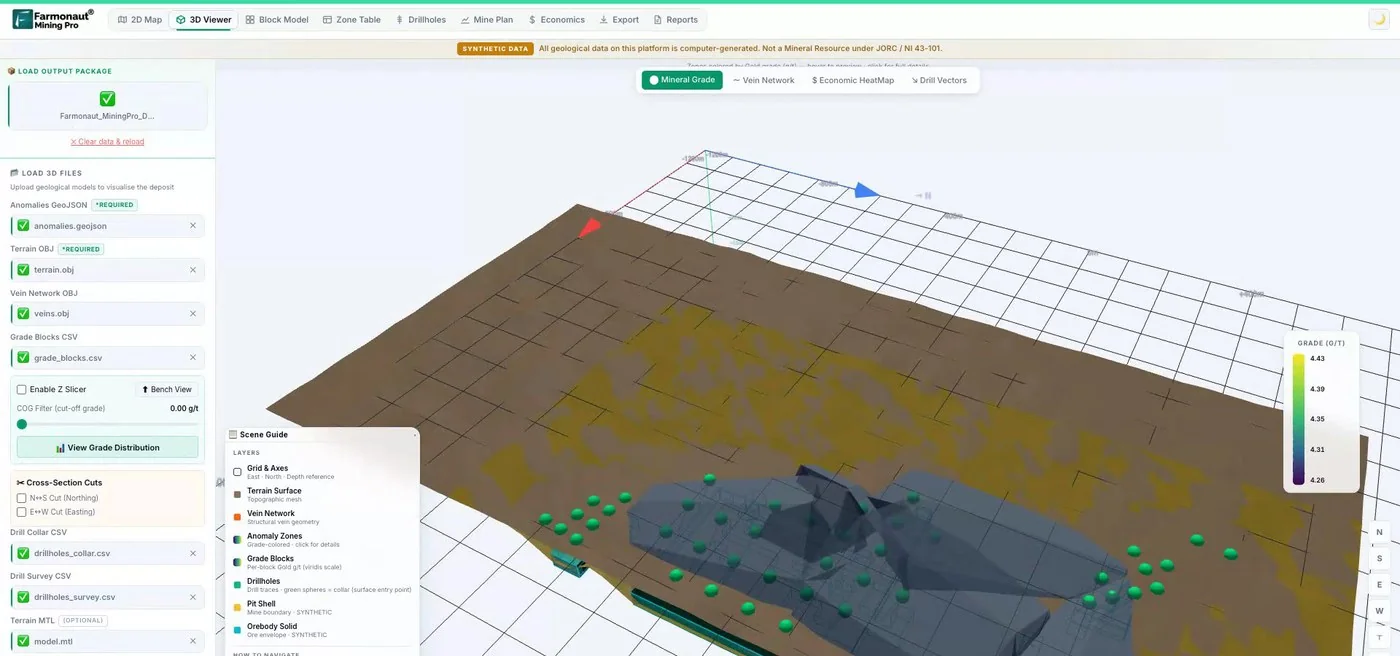
Mining Pro sample view, synthetic data
Keep reading
Sources
- Safe Work Australia, Mining (industry page with jurisdiction list): safeworkaustralia.gov.au
- Safe Work Australia, Key Work Health and Safety Statistics Australia 2025 (October 2025): data.safeworkaustralia.gov.au
- Safe Work Australia, Workplace exposure standard for respirable crystalline silica: safeworkaustralia.gov.au
- NSW Resources Regulator, Mine safety performance report 2024-25 (February 2026): resources.nsw.gov.au
- NSW Resources, home page (Resources Regulator): resources.nsw.gov.au
- Government of Western Australia, Work Health and Safety (Mines) Regulations 2022: legislation.wa.gov.au
- WorkSafe WA, Items of plant on a mine site (WHS laws commenced 31 March 2022): worksafe.wa.gov.au
- WorkSafe WA, Silica (Western Australia Silica Plan 2025-2030): worksafe.wa.gov.au
- WorkSafe WA, Mine owner and operator fined $810,000 over worker injury (6 October 2026): worksafe.wa.gov.au
- Government of Western Australia, Department of Local Government, Industry Regulation and Safety: demirs.wa.gov.au
- Queensland Legislation, Mining and Quarrying Safety and Health Act 1999: legislation.qld.gov.au
- Queensland Legislation, Coal Mining Safety and Health Act 1999: legislation.qld.gov.au
- Business Queensland, Safety and health (resources): business.qld.gov.au
- Business Queensland, Safety performance reports and statistics: business.qld.gov.au
- Holding Redlich, Industrial manslaughter offences across Australia (updated March 2025): holdingredlich.com
- The Duty Holder, Ten people died in Australian mines in 2024 (29 July 2026): australianworkplacesafety.com.au
- SafeWork SA, Tough new industrial manslaughter laws come into effect (2024): safework.sa.gov.au
- Safe Work Australia, Research into a lower WES and short-term exposure limit for respirable crystalline silica: safeworkaustralia.gov.au
Discussion
Questions, corrections or field experience? Share them below. First-time comments are reviewed before they appear, and your email is never published.
No comments yet. Be the first to add a question or your experience.

 Vulcan International Limited
 Kidepo Associates
 GKY Mining
 Alkimy SARL
 Double A Trading
 GemSprout Metals Limited
 Qader Group
 Ileys General Trading
 SG Gold Mining LLC
 VRV Global Pte Ltd
 Omsri International FZE
 G.I.T.T.
 Jaunita Erss Ltd
 Almosi SARL
 SRK Consulting
 Berks Gold Limited
 Mwerezi Minerals Company Limited
 Mining SARL
 SenGold Invest SAS
 Sean Mining Limited
