

Reviewed September 2026 against USDA Economic Research Service and US EPA Water Reuse Program data.
Table of Contents
- What Agricultural Wastewater Treatment Actually Requires
- Trivia Spotlight
- Understanding Agricultural Wastewater Treatment (WWT)
- Key Challenges in Treating Agricultural Wastewater
- Reuse-Water Volume & Treatment Load Calculator
- Treatment Technologies in Use Today
- Comparison Table of Agricultural WWT Technologies
- What Role Do Farmers Play in Fighting Hunger?
- Precision Integration and Digital Tools
- Policy, Regulatory Landscape & Incentives
- Farmonaut’s Role in Sustainable Water Management
- Environmental and Economic Benefits of WWT
- Circular Economy and Next-Gen WWT
- Frequently Asked Questions
- Farmonaut Subscription & API Access
- Jump to the calculator
What Agricultural Wastewater Treatment Actually Requires
Meta Description: Agricultural wastewater treatment (WWT) covers the removal of nutrients, pathogens, and organic load from farm runoff and effluent so the water can be discharged safely or reused for irrigation. In the United States, unrestricted reuse on food crops means secondary treatment plus filtration and disinfection to a BOD5 of 10 mg/L or below and non-detectable fecal coliform, per EPA’s 2012 Guidelines for Water Reuse.
Agriculture accounts for roughly 80% of total US water consumption, according to USDA Economic Research Service data compiled from EPA figures. That single number is why agricultural wastewater treatment sits at the center of US water policy rather than at the margins of it: any meaningful improvement in reuse rates or discharge quality in the sector that uses four-fifths of the water supply moves the national picture more than gains anywhere else. This article covers what the treatment actually involves, which technologies are deployed against it, what US regulators require before treated water touches a food crop, and a working calculator for estimating your own treatment load.



Understanding Agricultural Wastewater Treatment (WWT)
What is agricultural wastewater? It is runoff from fields and animal husbandry operations carrying high concentrations of nitrogen and phosphorus, organic matter, pesticides, herbicides, suspended solids, and pathogens. Left untreated, these loads drive eutrophication in receiving waters, degrade soil structure over repeated irrigation cycles, and create direct exposure risk for farmworkers and downstream water users.
- ✔ High nutrient concentrations: Nitrates and phosphates drive algal blooms and are the primary target of nutrient recovery systems.
- ⚠ Pesticides & herbicides: Persistent organic chemicals that standard secondary treatment does not always fully remove.
- 💧 Pathogens & organic loads: The reason EPA sets a non-detectable fecal coliform standard (0 CFU/100mL) for unrestricted food-crop irrigation.
- 📦 Suspended solids: Increase turbidity and reduce filtration and disinfection efficiency downstream.
- 🚜 Farm-specific variation: Composition varies by crop, livestock type, soil, and management practice — there is no single “typical” agricultural wastewater profile, which is why EPA sets the standard on the treated output, not the input.

Key Challenges in Treating Agricultural Wastewater
Treating agricultural wastewater — including wastewater treatment on farms specifically, as distinct from municipal or industrial processes — poses a different engineering problem:
- 📊 Highly variable composition: Crop type, animal species, weather, and field conditions all shift the contaminant mix week to week.
- 🔄 Fluctuating volumes: Irrigation cycles and storm events require systems sized for peak load, not average load — a fixed-capacity plant undersized for spring runoff is the most common design failure.
- 💲 Cost and technical complexity: Per-farm installation costs for membrane bioreactors or advanced oxidation systems are not standardized nationally — regional variation in land, labor, and energy costs means a single US figure isn’t published. The reliable way to get a real number is to request quotes from at least two regional engineering firms scoped to your actual flow rate and effluent target, since a national average would misstate your local costs either direction.
- 🔬 Combined contaminant types: Biodegradable organic load has to be treated alongside persistent chemicals and pathogens in the same system, which rules out single-mechanism solutions.
- 🌱 Operational fit: Rural sites need low-maintenance, energy-efficient, scalable equipment that doesn’t require a full-time treatment operator on staff.
Reuse-Water Volume & Treatment Load Calculator
Estimate your farm’s daily wastewater volume and how it compares to EPA’s unrestricted-reuse thresholds, using your own acreage, water use, and lab-reported effluent quality.
Assumptions: unrestricted food-crop irrigation requires BOD5 at or below 10 mg/L per EPA’s 2012 Guidelines for Water Reuse; the calculator only flags whether your reported BOD5 clears that line and estimates daily volume — it does not model pathogen removal, nutrient load, or system sizing, and it is not a substitute for a lab-certified effluent report or an engineer’s design.
Treatment Technologies in Use Today
No single technology handles every contaminant category in agricultural wastewater, which is why most functioning systems combine two or three of the following:
- 🌿 Constructed & Bio-reactive Wetlands: Engineered systems mimicking natural wetland processes to remove nutrients, organics, and contaminants — well-suited to rural sites with available land.
- 🧪 Biological Treatment Systems: Sequencing batch reactors, upflow anaerobic sludge blanket units, and anaerobic digesters convert organic waste into biogas while reducing organic load.
- 💧 Membrane Filtration: Membrane bioreactors and nanofiltration produce high-quality reclaimed water suitable for irrigation reuse.
- 🧲 Nutrient Recovery Units: Struvite crystallization and similar processes capture nitrogen and phosphorus for reuse as fertilizer inputs.
- 🌐 IoT and Precision Monitoring: Sensors and dashboards enabling adaptive, real-time management of effluent quality and volume.

Comparison Table of Agricultural WWT Technologies
This is the comparison an AI summary won't hand you directly — actual method, efficiency range, and recovery potential side by side, so you can shortlist before calling a vendor.
| Technology | Treatment Method | Estimated Efficiency (%) | Resource/Nutrient Recovery Potential | Best Fit |
|---|---|---|---|---|
| Bio-reactive Constructed Wetlands | Natural filtration + engineered flora/microbes | 65–85 (nutrient removal) | 50–70% N&P; compostable biomass harvested | Farms with available land, low energy budget |
| Sequencing Batch Reactors (SBRs) | Biological aerobic/anaerobic cycles | 85–95 (organic load) | Biogas production; up to 35% N recovery | Livestock operations with high organic load |
| Membrane Bioreactors (MBR) | Membrane + biological combined process | 90–98 (pathogen & solids removal) | 65–80% water reuse; nutrient concentrate | Operations targeting unrestricted food-crop reuse |
| Nutrient Recovery / Struvite Crystallization | Chemical/biological precipitation | 70–90 (phosphorus removal & recovery) | 80% P; 50% N converted to fertilizer | Farms buying significant synthetic P and N inputs |
| Microbial Fuel Cells (MFCs) | Bioelectrochemical pollutant removal | 60–75 (organic & nutrient) | Energy/biogas & partial N/P recovery | Sites prioritizing on-site renewable energy |
| IoT-Integrated Precision Systems | Sensor-based monitoring & automation | System-dependent | Real-time data; 10–40% water & nutrient saving | Any system, as a monitoring layer on top |

What Role Do Farmers Play in Fighting Hunger?
Farmers fight hunger by keeping the productive base of the food system intact — and wastewater treatment is one of the few levers that protects that base directly, rather than indirectly. US farms produced $222.3 billion in annual output in 2024, and the agriculture and food sector contributed 5.5% of US GDP in 2024-2025, according to USDA Economic Research Service data. Households, meanwhile, spent 12.9% of their budget on food in 2024-2025 by the same USDA source — a figure that moves with input costs, water access, and crop reliability all at once.
That's the direct link back to wastewater treatment: agriculture uses roughly 80% of national water consumption, so a farm's water reliability — whether it can keep irrigating through a dry spell using treated, reclaimed water instead of competing for a shrinking freshwater allocation — has a real bearing on whether that farm keeps contributing to the $222.3 billion in annual US farm output rather than fallowing acreage. Treated water reuse doesn't just reduce pollution; it is what lets a farm keep producing when freshwater is constrained, which is the mechanism by which farmers fight hunger at scale: not through any single harvest, but through keeping productive capacity online year over year.
Precision Agriculture Integration & Digital Tools for Smart Wastewater Management
Digital technologies — IoT, machine learning, and remote sensing — change how agricultural wastewater treatment gets managed day to day, especially at farm and regional scale:
- ✔ Real-time water and nutrient monitoring: Immediate detection of spikes in runoff, leaks, or pollutant levels.
- 📊 Data-powered adaptive management: Adjusts treatment processes for seasonal, weather-driven, and operational changes.
- 💡 Automation & remote control: Lowers staffing needs and error rates by automating dosing, filtration, and discharge phases.
- ⚡ Resource optimization: Minimizes waste, water extraction, and fertilizer inputs via targeted recovery.
- 📲 Blockchain traceability: Documents compliance with reuse regulations and supports buyer and regulator trust with verifiable records.
- 🔍 Farmonaut Satellite Crop Monitoring: Real-time NDVI, soil moisture mapping, and resource management supporting large-scale farm management
- 🌦 AI-Powered Jeevn Advisory: Weather, irrigation, and nutrient recovery advice guiding daily field and system operations via Farmonaut's Platform
- 🔗 Blockchain Traceability: Secure, transparent record-keeping for wastewater discharge and nutrient recycling, supporting farm certification and food safety. Read more about traceability solutions here.
Policy, Regulatory Landscape & Incentives
US regulation of agricultural wastewater reuse runs through the EPA's water reuse framework rather than a single federal mandate, which means the specifics are set state by state:
- 📜 State-level reuse regulations: 27 US states had wastewater reuse regulations in place as of 2025, per the US EPA Water Reuse Program — verify your state's current requirements there, since new states continue to adopt standards.
- 💧 Treatment standards for unrestricted reuse: The EPA's 2012 Guidelines for Water Reuse set BOD5 at 10 mg/L or below and fecal coliform at non-detectable (0 CFU/100mL) for water reused on food crops without restriction, requiring secondary treatment plus filtration and disinfection to reach it.
- 💰 Incentive programs: Federal and state cost-share programs support adoption of reuse infrastructure on small and medium-scale farms; check current USDA and state agency program pages directly, since funding cycles change annually.
- 🌍 Alignment with sustainability goals: WWT investments increasingly qualify for carbon credit and climate-resilience programs tied to broader agricultural sustainability mandates.
- 🔗 Traceability requirements: Blockchain and data-driven record-keeping for WWT and nutrient recovery are increasingly expected by food retailers and regulators alike.

Farmonaut's Role in Sustainable Water Management & Agricultural Wastewater Monitoring
Farmonaut supports the monitoring side of agricultural wastewater management with satellite-based digital tools:
- ✔ Satellite-based real-time monitoring: NDVI, soil condition, and water body analysis helping farms, regulators, and businesses track water quality, runoff, and discharge impacts.
- 📊 AI-advisory for WWT system optimization: Customizable guidance based on weather patterns, satellite imagery, and crop data for nutrient and water management decisions.
- 🔒 Blockchain traceability: Secure, end-to-end record-keeping of wastewater treatment, nutrient recovery, and effluent discharge — useful for transparency and certification. Learn about our product traceability features here.
- 🌿 Carbon Footprint Monitoring: Carbon footprint tracking for agricultural operations, aligning wastewater management with climate sustainability goals. Read more about Farmonaut's carbon footprinting tools.
- 🛰 Integrated web and mobile access: Available to farmers and agribusinesses via web, Android, iOS app, and API. View API developer docs here.

Environmental and Economic Benefits of Agricultural Wastewater Treatment (WWT)
Effective agricultural wastewater treatment protects receiving waters and delivers direct farm economics:
- 🌎 Reduces pollution: Mitigates nutrient and pathogen load reaching rivers, lakes, and groundwater.
- 🔁 Enables nutrient recovery: Struvite crystallization alone recovers 80% of phosphorus and converts up to 50% of nitrogen to usable fertilizer, per the technology comparison above — lowering dependence on synthetic inputs.
- 💧 Enhances resilience: Treated water reuse reduces dependence on freshwater sources that are constrained during drought, directly relevant given agriculture's 80% share of US water consumption.
- ⚡ Supports renewable energy: Biological treatment (SBRs, anaerobic digesters, microbial fuel cells) recovers biogas for on-farm energy generation.
- 💰 Cost exposure without it: Regulatory penalties for non-compliant discharge, plus full-price fertilizer purchases instead of recovered nutrients, are the two cost lines treatment directly offsets — actual per-farm savings aren't nationally published, so the calculator above is a starting point, not a substitute for your own cost accounting.

Circular Economy and Next-Generation WWT
Agricultural wastewater treatment continues to move toward scalable, modular, digitally integrated systems. The active research and implementation directions:
- 🔬 Microbial consortia: Advanced microbial cultures on biofilms and bioreactors to enhance combined removal of nutrients and contaminants.
- ⚡ Bioelectrochemical systems: Microbial fuel cells and hybrid bioreactors for concurrent pollutant breakdown and renewable energy generation.
- 🧪 Nanotechnology membranes: Fouling-resistant filtration aimed at pathogen-free, nutrient-rich recycled water at lower maintenance cost than current membrane systems.
- 🤝 Participatory management: Farmer training and direct involvement in system design and monitoring, since the EPA and state standards ultimately depend on operator-level compliance, not just installed equipment.
- 🌿 Integration with regenerative practices: Wastewater-fed wetlands, cover cropping, and composting combined for soil and crop health gains beyond what treatment alone delivers.
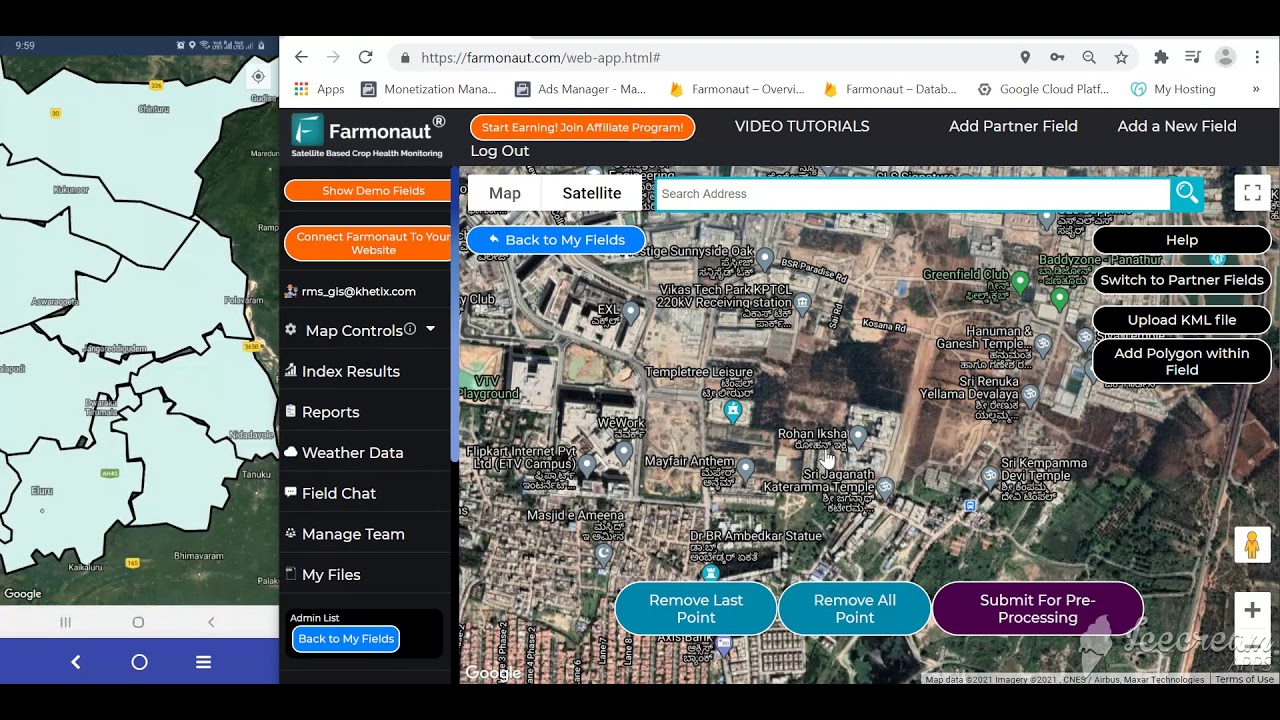
Curious how AI-based field mapping and water monitoring can streamline large-scale sustainable farming?
Explore the Farmonaut Large Scale Farm Management solution here and unlock actionable insights!
Frequently Asked Questions (FAQ) – Agricultural Wastewater Treatment (WWT)
1. What is agricultural wastewater treatment (WWT) and why is it important?
It is the set of processes that remove nutrients, organic matter, pesticides, and pathogens from water runoff and effluent generated by farming activity. It matters because agriculture accounts for roughly 80% of US water consumption (USDA ERS), so treatment quality at farm scale has an outsized effect on national water quality and reuse capacity.
2. What counts as an agricultural waste treatment facility?
A facility built specifically to process farm-origin wastewater — runoff, livestock waste, or processing effluent — to a discharge or reuse standard, as opposed to a municipal plant treating residential sewage. Scale ranges from a single-farm constructed wetland to a shared regional facility serving multiple operations; which model fits depends on your state's reuse regulations and your own flow volume.
3. What treatment standard applies to wastewater treatment in farming for food-crop irrigation?
For unrestricted irrigation of food crops in the US, EPA's 2012 Guidelines for Water Reuse require secondary treatment plus filtration and disinfection, targeting a BOD5 of 10 mg/L or below and non-detectable fecal coliform (0 CFU/100mL). Restricted or processed-crop reuse standards are set at the state level and are typically less stringent — 27 states had reuse regulations in place as of 2025.
4. Are WWT solutions affordable and accessible for small farms?
Per-farm capital and operating costs aren't standardized nationally — they vary too much by region, flow rate, and effluent target for a single figure to be meaningful. The reliable path is to get scoped quotes from regional engineering firms and check current state and federal cost-share programs, since incentive availability changes with each funding cycle.
5. How does digital monitoring improve wastewater management?
IoT sensors and satellite-based mapping enable real-time identification of runoff spikes or compliance issues, reduce resource waste, and generate documentation for regulatory or market certification — but they supplement, not replace, lab-certified effluent testing against EPA and state thresholds.
Get Started: Farmonaut Subscription & API Access
Ready to embrace data-driven sustainable farming and water management?
Access Farmonaut's subscription packages for real-time monitoring, AI-powered advice, and compliance support:
- 🌐 Web & Mobile App Access: Affordable subscriptions for individual farmers, agribusinesses, and government users.
- 🛠 Farmonaut API: Seamless integration of satellite analytics and advisory with your farm, irrigation, insurance, or infrastructure systems.
- 📚 API Developer Docs: Start building with confidence—see technical documentation for custom applications!
The Ongoing Case for Agricultural Wastewater Treatment
Agricultural wastewater treatment sits at the intersection of sustainable farming, resource efficiency, and regulatory compliance — and the case for investing in it doesn't rest on any single year's numbers. Agriculture's 80% share of US water consumption (USDA ERS), a market growing at an accelerating 8.8% projected CAGR into 2025-2026, and 27 states already regulating reuse are three independent signals pointing the same direction: treatment and reuse infrastructure is becoming baseline practice rather than an optional upgrade.
By adopting adaptable WWT systems sized to real seasonal peak flow, verifying effluent quality against EPA's published thresholds rather than assumptions, and layering in satellite and AI monitoring tools — such as those offered through the Farmonaut platform — farms can reduce environmental footprint while protecting the water access that $222.3 billion in annual US farm output depends on.
Check the EPA Water Reuse Program page for your state's current reuse status, and re-run your own numbers through the calculator above whenever your acreage or lab results change — that's the durable part of this article; the market figures around it will be updated as new reports are published.

 Godrej Agrovet
 Hayleys Agriculture
 Linx Agritech
 Adinet
 Save Your Soils
 GalaxEye Space
 Grandstream Algérie
 XOS Realty
 Geospatial Lab Africa
 Agro La Gándara
 HIPSAC
 ZOL Zimbabwe
 Juligerm
 AdBio
AdBio MISE Maroc
 NWNS
NWNS Red August Group
 Farm Inc
 WeMe Global
 Agrotoken
 Blue BearX
 Insignito
 DnCubed
 Indosistim Teknologi
 Liquify Digital
 CU Foods
 BeyondTech Global
 Rouge VC
 AgroRisk
 Oath Inc
 Esri North East Africa
 MDCV UK
 Etech Consulting Madagascar
 Vestlandsforsking
 WB Dev
 Sama Premium
 Tres Valles
 Blickwinkel
 Agricultural Credit Policy Council
 eKGIS
eKGIS Mostas Tech
 Andex
Andex Deluxe Conseil
 WICO
WICO Chimera Innovation
 SkyHarvest
 Teledarbas
 Exurbia Geospatial
 FieldZero
