

Customer case study · Oil palm
Oil Palm Plantation Monitoring: A Malaysia Case Study
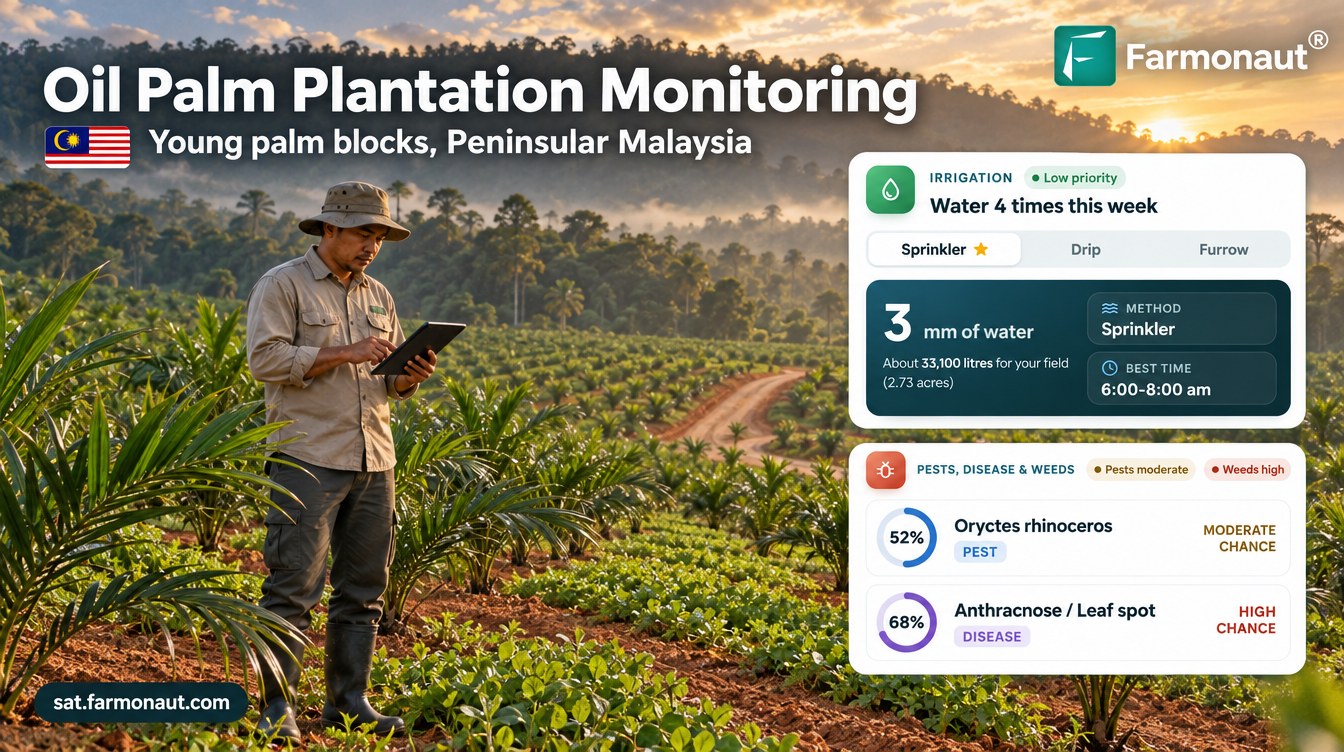
Oil palm plantation monitoring by satellite planned no water on 39% of block-days for four young palm blocks in Peninsular Malaysia, about 39% less than a same-dose daily routine, and scored rhinoceros beetle and leaf spot risk stage by stage.
Key takeaways
- A grower in Terengganu and Negeri Sembilan received 153 satellite advisories for four young oil palm blocks (about 20 ha) and a durian block from December 2025 to October 2026.
- 217 of 556 planned block-days (39%) had no irrigation, about 39% less water than giving each block the same dose every day.
- Rhinoceros beetle was scored in all 122 oil palm advisories (average 85%) and Curvularia leaf spot in 111 (average 87%); Ganoderma barely registered at this young stage.
- Every one of 443 nutrient recommendations came with an organic option, mostly compost, decanter cake and ash from the palm oil mill.
- Three of the four palm blocks are over 4 ha and already stored as polygons, the plot format the EU Deforestation Regulation asks for.
In this article
- The palm blocks and the brief
- Why young palms in these two states need close watching
- How oil palm plantation monitoring works on these blocks
- Ten months of advisories, stage by stage
- Pest and disease risk in young oil palm
- Water: planned dry days in a wet climate
- Nutrition and soil
- The durian block next door
- From nursery to field: the Peru palm blocks
- Oil palm plantation monitoring and EUDR buyers
- What other plantation managers can take from it
- FAQ
Oil palm plantation monitoring by satellite gave a Malaysian grower a fresh irrigation plan, pest and disease risk scores and a nutrient plan for four young oil palm blocks every few days. Across 153 advisories from December 2025 to October 2026, the plans left 39% of block-days dry, which used about 39% less water than giving each block the same dose every day. Rhinoceros beetle and Curvularia leaf spot were the threats scored most often, at average scores of 85% and 87%.
This case study follows the grower’s blocks in Terengganu and Negeri Sembilan, in Peninsular Malaysia, from their first advisory as newly established palms. It shows what the satellite saw, what each advisory recommended and how other plantation managers can use the same data. All farm figures come from the grower’s advisory records. Risk scores are modelled probabilities, not confirmed outbreaks, and water figures are planned amounts, not metered use.
The palm blocks and the brief
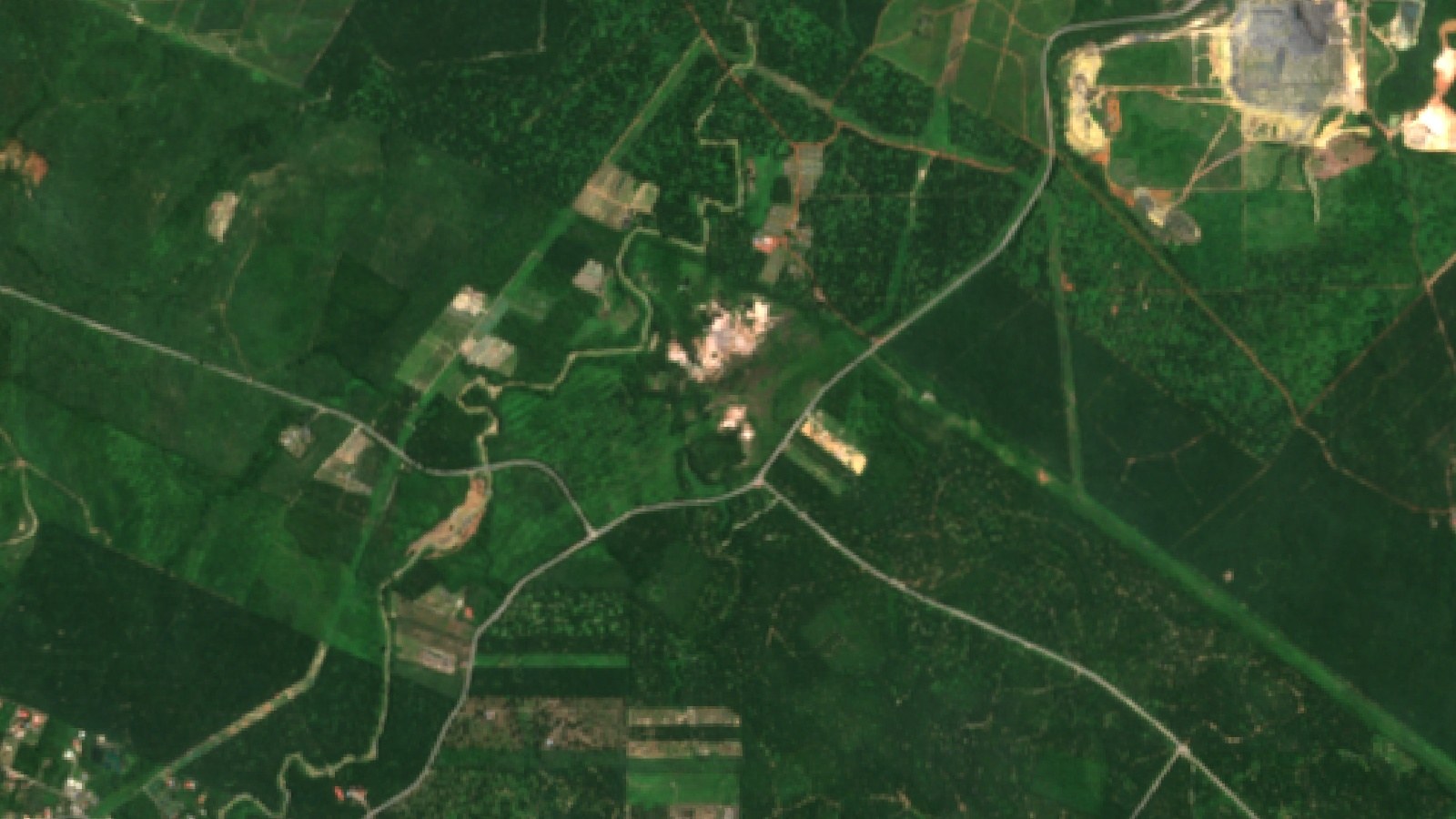
The grower runs four oil palm blocks and one durian block. Three palm blocks and the durian block sit on the east coast in Terengganu. The fourth palm block is inland in Negeri Sembilan, about 230 km to the south-west. The palm blocks add up to about 20.1 hectares, from a small 1.1 ha block to three blocks of about 6 ha each. The durian block adds 3.8 ha.
Where the palm blocks are
Terengganu and Negeri Sembilan shaded; markers show the approximate area only
The grower drew each block once in the Farmonaut app in mid-December 2025 and gave a December planting date. From then on, the advisories treated the palms as young plants in the nursery and early field stage. That is the riskiest time in a palm’s life. Young palms are small, their roots are shallow, and pests that would barely hurt a mature palm can set them back by months.
The grower wanted one view of crop vigour, water needs and pest risk for every block, including the block that is a long drive away from the others.
| Item | Detail |
|---|---|
| Region | Terengganu and Negeri Sembilan, Peninsular Malaysia |
| Crops | Oil palm (4 blocks), durian (1 block) |
| Oil palm area | About 20.1 ha in total |
| Block sizes | About 1.1 ha to 6.5 ha |
| Durian area | About 3.8 ha |
| Palm stage | Newly established, nursery to young palm |
| Monitoring period | December 2025 to October 2026 |
| Advisories | 153 in total, 122 for oil palm |
| Soil (modelled) | pH mostly 4.8 to 5.4, low salinity, low organic carbon |
Why young palms in these two states need close watching
Peninsular Malaysia is one of the world’s main palm oil regions, but yields vary a lot from state to state. The Malaysian Palm Oil Board’s estate survey puts the 2024 average yield at 16.70 tonnes of fresh fruit bunches (t FFB) per hectare across Malaysia. Negeri Sembilan estates averaged 19.44 t FFB/ha that year. Terengganu estates averaged 13.32 t FFB/ha, one of the lowest figures in the Peninsula.
Chart
Average FFB yield of oil palm estates by state
t FFB per hectare, selected Peninsular states and Malaysia, 2024
A palm only starts to bear fruit a few years after planting, and it keeps bearing for decades. Problems in the first years, such as beetle damage to the spear leaves or a slow start in a wet nursery, can delay the first harvest. That is why the early years matter so much on a new block, and why the grower chose to watch these palms from the start.
How oil palm plantation monitoring works on these blocks
Each advisory starts with fresh satellite images of the block. The Sentinel-2 satellites have a revisit time of five days from two-satellite constellation at the equator, with 10-metre detail in the visible and near-infrared bands. From these bands the system works out vegetation indices such as NDVI, which compares red and near-infrared light reflected by the land surface to show how much green leaf is present.
Infographic
How each block advisory is built in 4 steps
- 1Satellite passSentinel-2 images each block every few days; Sentinel-1 radar covers cloudy dates.
- 2Read the canopyNDVI and moisture indices show vigour and wetness block by block.
- 3Add stage and climateThe growth stage and local climate set water need and pest risk.
- 4Block planIrrigation, risk scores, nutrients with organic options, soil and yield cards.
Cloud is a constant problem over Malaysia, especially on the east coast during the monsoon. When cloud hides a block, the system switches to radar. Sentinel-1 radar can image the ground by day or night, whatever the weather, so the grower still received an advisory on 9 dates when the advisory was built from radar.
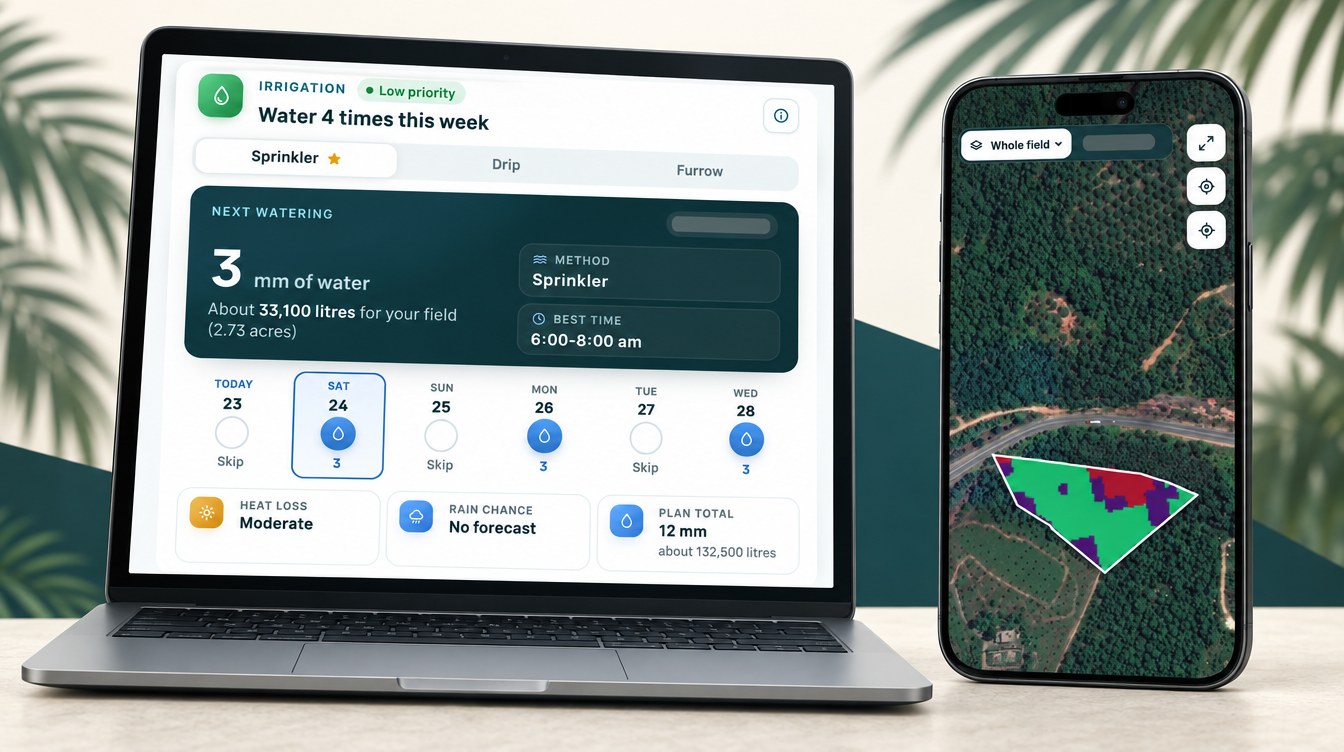
The images are combined with the block’s growth stage, the local climate and the crop’s known water and nutrient needs. The result is one advisory per block with five parts: an irrigation plan for the next week, pest and disease risk scores, weed risk, a fertilizer plan with organic options, and soil and yield cards.
The advisories also read the indices with care. In October 2026, one block’s NDVI dropped from about 0.55 to 0.20 for a single date while the radar signal stayed steady. The advisory flagged this as most likely cloud or shadow, and asked the grower to check the block on foot before acting. That kind of note saves a wasted spray round.
Ten months of advisories, stage by stage
The advisories ran from mid-December 2025 to March 2026, paused over the middle of the year, and picked up again from mid-September 2026. The growth stage in each advisory followed the young palms as they developed.
| Months | Main stage reported | What the advisories focused on |
|---|---|---|
| Mid-Dec | Newly established | First baseline images, rhinoceros beetle watch |
| Dec to Jan | Nursery stage | Monsoon rain, leaf spot risk, drainage |
| Feb to Mar | Nursery stage | Peak beetle and leaf spot scores, weeds |
| Sep | Main nursery | Fresh baseline, beetle and leaf spot risk |
| Oct | Main nursery seedling growth | Lower risk scores, nutrient top-ups, weeds |
Because each block gets its own advisory, the grower could compare the inland block in Negeri Sembilan with the three coastal blocks on the same day. The coastal blocks carry the full weight of the northeast monsoon, while the inland block does not.

▶ Why radar satellites can see crops through cloud · 2:37
Pest and disease risk in young oil palm
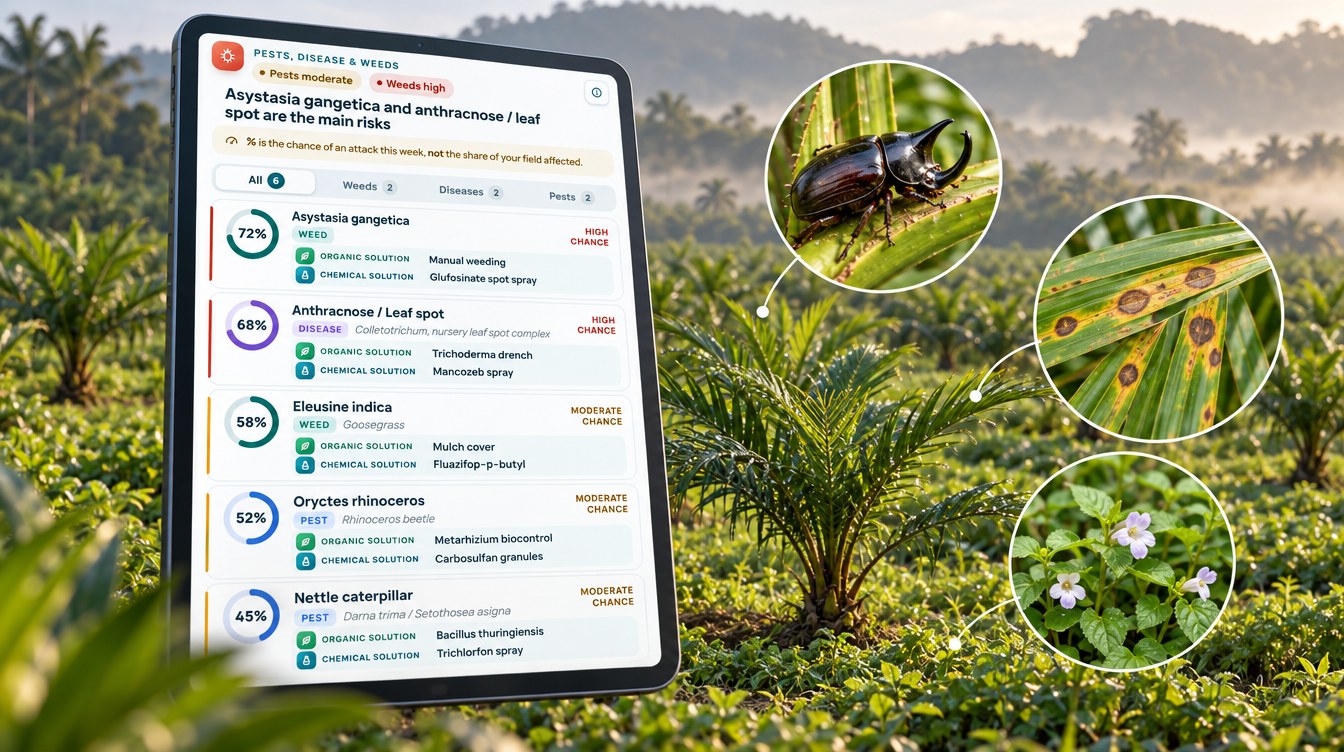
Young palms face a different set of threats from mature ones. The advisories scored rhinoceros beetle in every one of the 122 oil palm advisories, Curvularia leaf spot in 111, anthracnose in 81 and bagworm in 54. Each score is a modelled probability built from the block’s canopy, moisture and climate data. It tells the grower where and when to look first, not that an attack has happened.

▶ Protecting palm plantations from harmful pests · 17:47
From December to March, the average scores for the top threats stayed high, between about 85% and 95% for beetle and leaf spot. By October 2026, as the seedlings grew and the advisories had fresh images, the scores eased to 65% for rhinoceros beetle and 76% for leaf spot.
Rhinoceros beetle
The rhinoceros beetle (Oryctes rhinoceros) bores into the spear leaves of young palms. An MPOB study notes that it has become a key pest in immature oil palm, especially where there is extensive palm-to-palm replanting, because rotting palm trunks left on the ground are ideal breeding sites. The same study says serious beetle attacks often lead to growth setbacks and delayed maturity.
The beetle score averaged 85% over the season and peaked at 94% to 95% from January to March. The advisories paired it with biological options such as Metarhizium fungus and pheromone traps, plus a chemical option. MPOB researchers also describe the soil fungus Metarhizium and the Oryctes nudivirus as ways to manage the beetle. Always follow the product label and local rules.
Curvularia leaf spot and anthracnose
Curvularia leaf spot was the most severe threat by average score, at 87%. A 2024 study describes Curvularia leaf spot as one of the most common diseases in oil palm nurseries in South East Asia, and the same paper notes that outbreaks are common during the rainy season. That matches the advisories, which linked the high scores to wet soil and humid canopies during the monsoon. Anthracnose, another leaf disease of young palms, averaged 77%.
For both diseases the advisories suggested removing infected leaves, spacing seedlings for air flow and keeping drainage clear, with a fungicide as the chemical option. Follow the product label and local rules for any spray.
Ganoderma: why the score stayed low
Ganoderma basal stem rot is the disease most Malaysian planters fear. An MPOB paper calls it one of the most serious diseases in the industry and notes that BSR usually affects matured palms. On these blocks the advisories scored Ganoderma only 10 times in 122 advisories, at 30% to 70%. A recent advisory explained why: stem rot is not expected in nursery seedlings. The grower can keep Ganoderma checks for later years and spend the early effort on beetles and leaf spot.
Weeds and other pests
The weed card named mile-a-minute (Mikania micrantha) and cogon grass (Imperata cylindrica) most often, followed by Asystasia gangetica. Mikania climbs over young plants and smothers them, so the advisories asked for regular weeding rounds and clean bed edges. Rats were scored on some dates, and the advisory offered barn owls as the organic option. MPOB researchers point to barn owls as a natural control for rats in oil palm.
Chart
Modelled risk by month for three top threats
Average risk score across four oil palm blocks, %; no advisories April to August
Water: planned dry days in a wet climate
Malaysia is wet, but young palms in polybags or newly planted holes still need steady moisture. The irrigation part of each advisory plans an amount for each of the next several days. When advisories overlapped, we kept the newest plan for each block and day. That left 556 block-days of planned irrigation. On 217 of them, or 39%, the advisory planned no water at all.
Chart
Planned irrigation vs long-term rainfall by month
mm per month; advisory plan per block vs Kuantan 1991–2020 normals
The rest of the days got small, frequent doses, usually 2 to 4 mm, given early in the morning. The planned daily amount averaged 2.5 mm in December and about 2.0 to 2.3 mm from January to March. It fell to 1.7 to 1.8 mm in September and October, when the advisories planned more dry days.
Local rainfall puts these numbers in context. MetMalaysia says that over the east coast states, November, December and January are the months with maximum rainfall, while June and July are the driest months in most districts. At Kuantan, the nearest east coast station with long-term normals, mean rainfall is about 713 mm in December and about 3,000 mm a year (1991–2020 normals).
So why plan any water in December? The plan is a ceiling for a nursery with shallow roots and fast drainage, and on some dates the advisory had no rain forecast to work with. The advisories handled this with a clear rule: skip an event if more than 10 mm of rain falls or the soil stays wet. Used that way, the plan tells the crew when water is needed and rain tells them when to stand down.
Planned water compared with a daily routine
To compare, we worked out what each block would have received if it had been given its own average dose every day of the period. Against that same-dose routine, the advisory plan used 33% to 44% less water per block, and about 39% less across all four blocks. Over 139 planned days, each block’s plan came to about 2,560 to 3,320 cubic metres per hectare, against 4,460 to 4,960 m³/ha with a same-dose routine. This is a comparison of plans, not a metered saving.
Chart
Planned water vs a same-dose daily routine
% less water in the advisory plan, per block, over 139 planned days
Nutrition and soil
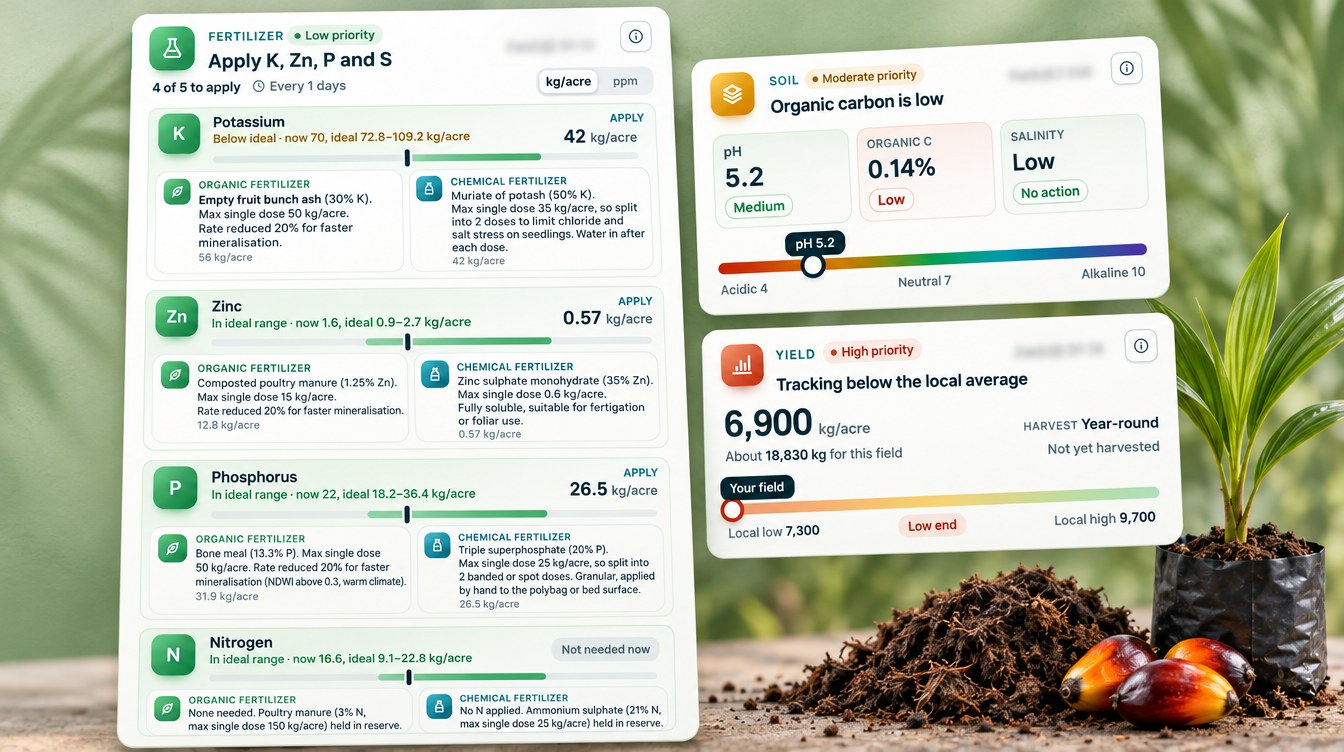
The fertilizer part of each advisory compares the block’s modelled nutrient levels with the ideal range for the growth stage, then gives a rate for each nutrient that is short. Over the period the advisories gave 443 nutrient recommendations for the palm blocks, mostly for phosphorus, sulphur, zinc and nitrogen, and every one came with an organic source as well as a conventional fertilizer.
The organic options lean on what palm estates already have. Composted empty fruit bunches were suggested most often, followed by decanter cake, chicken manure, bunch ash and palm oil mill effluent. All of these come from the mill or nearby farms, so they cut fertilizer bills and return nutrients to the field.
The soil card rated the blocks at pH 4.8 to 5.4 on most dates, which is acidic but within the 4.5 to 5.5 range the advisories treat as ideal for oil palm. Salinity was low and organic carbon was rated low on every block, which is another reason the compost-based options make sense. The yield card tracks a long-run estimate for mature palms. At this young stage it is a planning figure, not a harvest forecast.
The durian block next door
The grower’s durian block in Terengganu, about 3.8 ha, received 31 advisories over the same months. The stages ran from new leaf flushes in December and January, to flower induction and flowering in February and March, to harvest and fruit drop in September and October.
Phytophthora, a soil-borne disease of durian, was the most consistent threat, at an average score of 84%. The durian fruit borer averaged 76%, and the durian psyllid scored between 88% and 94% during the leaf-flush and flowering months. The irrigation plan left 48% of days dry, with micro-sprinklers as the main method. Running both crops in one account gave the grower one list of jobs for the whole farm.
From nursery to field: the Peru palm blocks
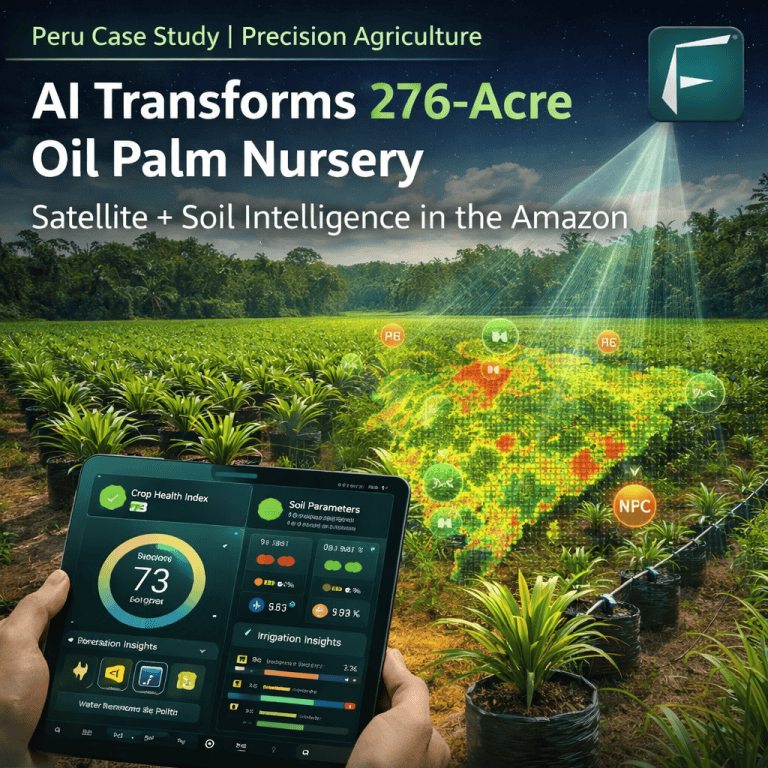
The same system has followed oil palm blocks on another continent for longer. In an earlier case study we first wrote about a 276-acre oil palm farm in Peru . That grower’s main block, about 112 ha in the Ucayali region, has now received 129 advisories since April 2025. Its stage has moved from the nursery in 2025, to vegetative establishment in the first half of 2026, to field establishment by October 2026.
The Peru advisories show what comes next for the Malaysian blocks. Once the palms leave the nursery, the threat list shifts. In Peru the South American palm weevil and bud rot became the top scores, each averaging close to 90%. Watching the same block for years lets a grower see those shifts as they come.
Oil palm plantation monitoring and EUDR buyers
For growers who sell to Europe, the block boundaries in the app have a second use. Under the EU Deforestation Regulation, palm oil placed on the EU market must not come from land deforested after the cut-off date of 31 December 2020. The European Commission’s FAQ says that for plots of land of more than 4 hectares, geolocation must be given as polygons, not single points. The Commission’s FAQ also says the rules are enforceable from 30 December 2026, and from 30 June 2027 for most micro and small operators.
Three of the four palm blocks in this case study are larger than 4 ha, and each one is already drawn as a polygon with a monitoring record behind it. That record shows what has grown on the block since the first image, which helps a buyer’s due diligence. A deforestation check itself compares the polygon with forest maps from before the cut-off date. For more background, see our guide to deforestation-free palm oil facts and figures.

▶ How satellites and AI support more sustainable palm oil · 8:26
What other plantation managers can take from it
Four lessons stand out from this grower’s first ten months of data.
Chart
Share of block-days planned with no irrigation
All four oil palm blocks, by month, %
- Plan for the young-palm threats first. Rhinoceros beetle and leaf spot led the scores in every month, while Ganoderma barely registered at this stage.
- Use the water plan as a ceiling. The plan left 39% of block-days dry and gave small doses on the rest. Skipping events after heavy monsoon rain saves more.
- Check single-date dips on foot. One-off NDVI drops with a steady radar signal were most likely cloud, and the advisories said so.
- Use mill by-products. Every nutrient recommendation came with an organic option, mostly compost and ash from the palm oil mill.
If you manage your own palm blocks, the calculator below estimates how much water planned dry days could save, and what that water costs at your own price in ringgit. You can also try the Farmonaut Satellite + AI Farm Monitoring System on your own blocks.
Try the numbers for your own farm below.
Calculator
How much water could planned dry days save on your palm blocks?
Enter your own block area, usual dose, season length, share of dry days and water cost.
- Water with a same-dose daily routine: 72,000 m³
- Water with planned dry days: 46,800 m³
- Cost of water not applied: 25,200 MYR
- Same, in US dollars: $6,000
Example values only, not a benchmark or forecast. Enter your own water or pumping cost and today’s exchange rate. 1 mm of water over 1 hectare is 10 cubic metres (fixed in the formula).
FAQ
What is oil palm plantation monitoring by satellite?
It uses regular satellite images of each block to track canopy vigour, moisture and change over time. Farmonaut turns those images, plus the palms’ growth stage and local climate, into a plan for irrigation, nutrition and pest and disease risk for each block.
Can a satellite see rhinoceros beetle or Ganoderma?
Not directly. A satellite sees changes in the canopy, not the beetle or the fungus. The advisory combines canopy data with the growth stage and conditions to score the risk, and the grower confirms any problem in the field.
Does it work through monsoon cloud?
Partly. Optical images need a clear view, so on cloudy dates the system used Sentinel-1 radar instead. In this case study 9 advisories were built from radar.
Does it work on small or young palm blocks?
Yes. The smallest palm block here is about 1.1 hectares, and all four blocks were monitored from their first weeks as newly established palms.
Can monitoring help with deforestation-free palm oil rules?
It helps with part of the work. Each block is stored as a polygon with a dated image record, which is the kind of plot geolocation EU buyers ask for. The deforestation check itself still needs a comparison with forest maps from before 31 December 2020.
Farmonaut plantation monitoring
Get a block-by-block plan for your palms
Draw your blocks once, and Farmonaut sends a satellite-based irrigation, nutrient and pest-risk plan for each one every few days on web, Android or iOS.




Keep reading

Sources
- Farmonaut advisory records for oil palm and durian blocks in Peninsular Malaysia (2025–2026): sat.farmonaut.com
- ESA, Sentinel-2 facts and figures: esa.int
- Copernicus SentiWiki, Sentinel-1 mission: sentiwiki.copernicus.eu
- NASA Earth Observatory, Measuring vegetation (NDVI and EVI): science.nasa.gov
- Malaysian Palm Oil Board, Average FFB yield of oil palm estates by state, January–December 2023 and 2024: bepi.mpob.gov.my
- MPOB Oil Palm Bulletin 59, Palm EW-cypermethrin against the rhinoceros beetle in oil palm (2009): palmoilis.mpob.gov.my
- Journal of Oil Palm Research 31(3), Sustainable control of oil palm pests and diseases through ecosystem services (MPOB, 2019): jopr.mpob.gov.my
- Journal of Oil Palm Research 25(1), Ganoderma basal stem rot study (MPOB, 2013): jopr.mpob.gov.my
- Frontiers in Plant Science, Molecular basis of resistance to leaf spot disease in oil palm (2024): frontiersin.org
- Malaysian Meteorological Department (MetMalaysia), Malaysia’s climate: met.gov.my
- Meteostat, Kuantan station (WMO 48657) climate normals 1991–2020: meteostat.net
- European Commission, EUDR frequently asked questions (5th iteration): environment.ec.europa.eu
Discussion
Questions, corrections or field experience? Share them below. First-time comments are reviewed before they appear, and your email is never published.
No comments yet. Be the first to add a question or your experience.

 Rashail Infotech
 Unifrutti Gulf
 Deluxe Conseil
 TVS Electronics
 BW Pipelines
 WICO
 Gen Chayat
 Chimera Innovation
 SkyHarvest
 Polaris Digitech
 Teledarbas
 Wild Oak Farm
 SFX
 Doodlakine
 Exurbia Geospatial

 Licence holder · Niger · Gold










