

Satellite Cotton Crop Advisory: Nine Passes, Five Growth Stages, Half the Water

Vilas Deshpande put two cotton fields in Maharashtra — ten acres, sown one day apart — under satellite monitoring from germination. Over nine consecutive passes the advisory walked both crops through five growth stages and revised the irrigation schedule at each one. The grower reports his irrigation optimised by 30–50%. The advisory’s own figures fall by 49%.
Cotton in Maharashtra is a crop with a narrow margin and a long list of ways to lose it. Water it on a calendar and you overwater the seedling and underwater the boll. Miss pink bollworm and the season is gone. This grower did something unusually clean: he mapped two fields before the crop was up, and let the advisory follow them from germination onward.
Nine satellite passes at five-day intervals, from 16 July to 25 August 2026, produced 19 field advisories. He submitted feedback on the 20 August advisory, covering both fields, and answered Yes to both questions he was asked: the report helped him take action on pest, disease or weed issues, and it helped optimise his irrigation — by an estimated 30–50%. That is the largest irrigation figure anyone in this series has reported, so it is worth checking against the advisory’s own numbers.
Across the five weeks in which the schedule was quoted against flood irrigation, the two fields averaged 22.8 mm of recommended water per week. Across the three weeks quoted against drip, they averaged 11.6 mm. That is a 49% fall — computed from the advisory’s own daily quantities, and sitting squarely inside the 30–50% band the grower reported independently.


Nine passes, five stages, two fields
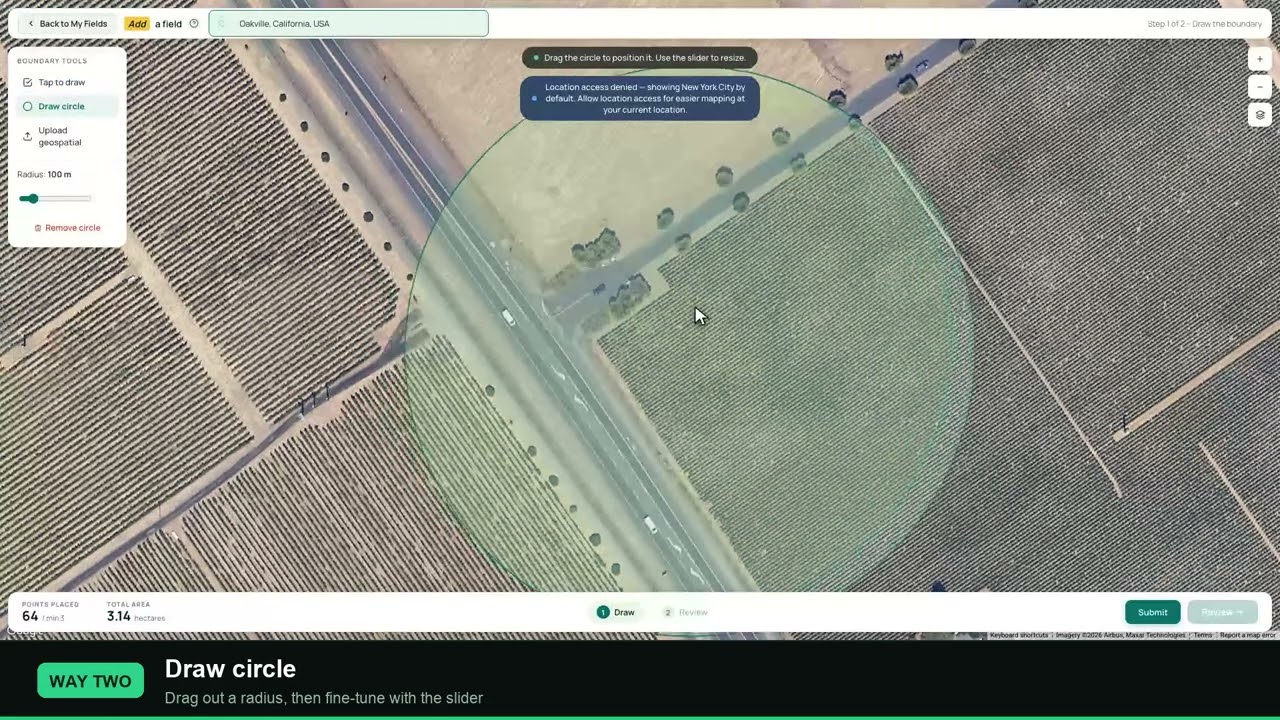
The two fields are 5.30 and 4.79 acres, sown on 25 and 24 June 2026 respectively — one day apart. Monitoring began on 16 July, when both were still at germination and seedling establishment. What followed is the clearest stage sequence in this series.
| Pass | Stage, both fields | Method quoted | Field A water | Field B water |
|---|---|---|---|---|
| 16 Jul | Germination & seedling establishment | — | 28.0 mm | 0 mm |
| 21 Jul | Germination & seedling establishment | Flood | 12.0 mm | 20.0 mm |
| 26 Jul | Vegetative growth (branching) | Flood | 40.0 mm | 20.0 mm |
| 31 Jul | Vegetative growth (branching) | Flood | 24.0 mm | 24.0 mm |
| 5 Aug | Vegetative growth (branching) | Flood | 24.0 mm | 20.0 mm |
| 10 Aug | Vegetative growth (branching) | Flood | 20.0 mm | 24.0 mm |
| 15 Aug | Squaring | Drip | 7.0 mm | 7.0 mm |
| 20 Aug | First flowering | Drip | 13.0 mm | 12.2 mm |
| 25 Aug | Bloom / boll development | Drip | 13.5 mm | 16.8 mm |
Two things are happening at once in that chart, and it is worth separating them honestly. The first is stage: cotton’s water requirement is not flat across the season, and the model’s crop coefficient changes as the plant moves from branching into squaring and flowering. The second is delivery method: from 15 August the schedule is quoted against drip rather than flood, and drip delivers less water for the same soil-moisture outcome because it wets the root zone rather than the whole field surface.
Both are real savings and both are in the advisory. What matters is that the second one is not a surprise the grower discovered after the fact — the advisory had been publishing the drip number beside the flood number on every prior pass.
What the satellite cotton crop advisory delivers per field
Each field receives its own report per satellite pass: a seven-day irrigation schedule with the delivery method quoted and two alternatives priced in millimetres per day, per-nutrient fertiliser rates with an organic and a chemical source for each and an application frequency, pest and disease risk as percentage scores with paired organic and chemical solutions, weed pressure, soil chemistry and a yield estimate with a harvest window.
Irrigation: the advisory priced drip against flood every single week
This is the mechanism behind the 49%, and it is the most quietly useful thing in the whole report.
On 10 August, while flood was still the method the schedule was quoted against, the same table listed drip below it: 5.0 mm for flood against 4.0 for drip on the larger field, and 6.0 against 4.5 on the smaller. Twenty and twenty-five per cent less water per event, for the same job, sitting in plain sight in every weekly report for five consecutive weeks.
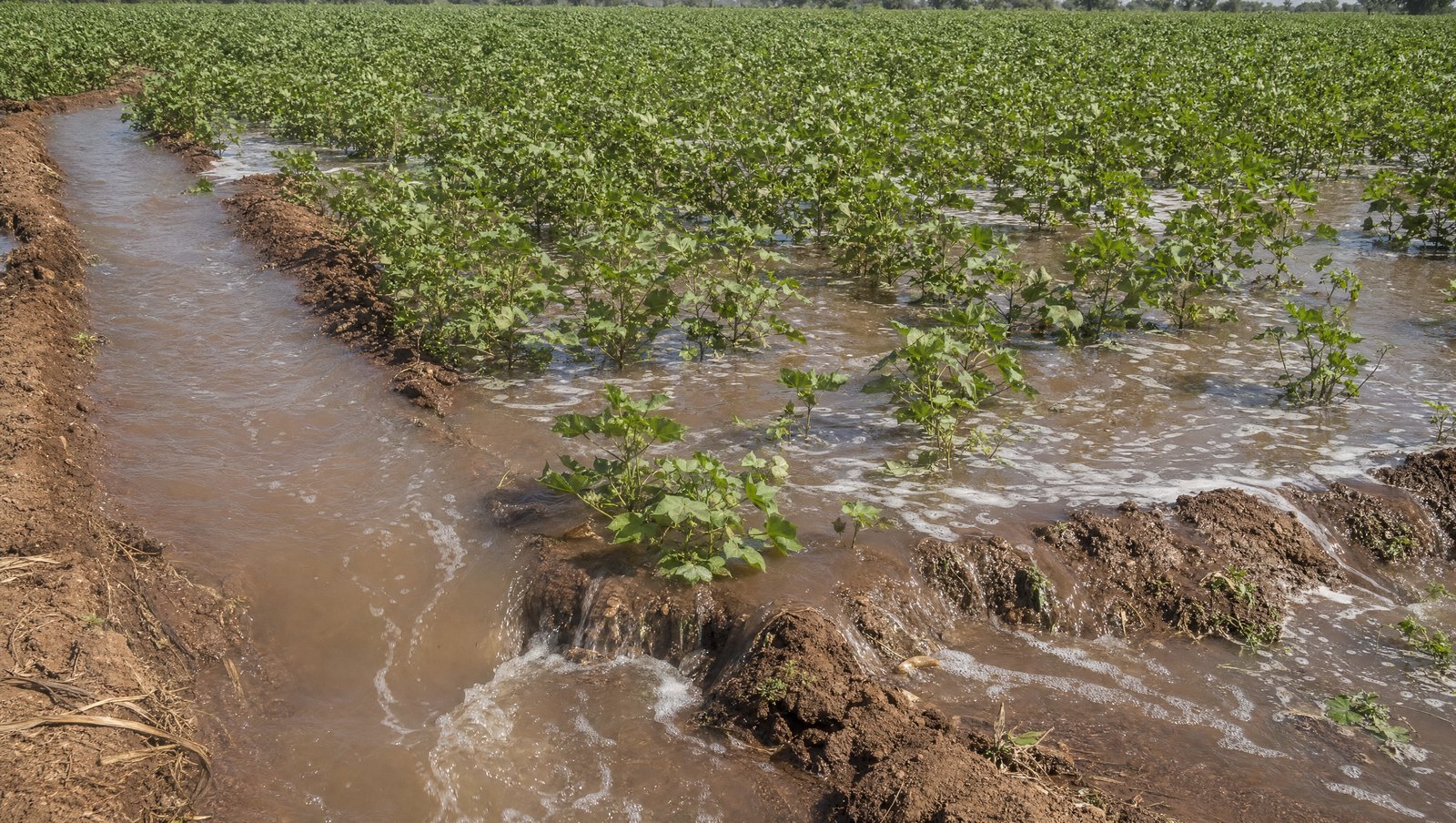
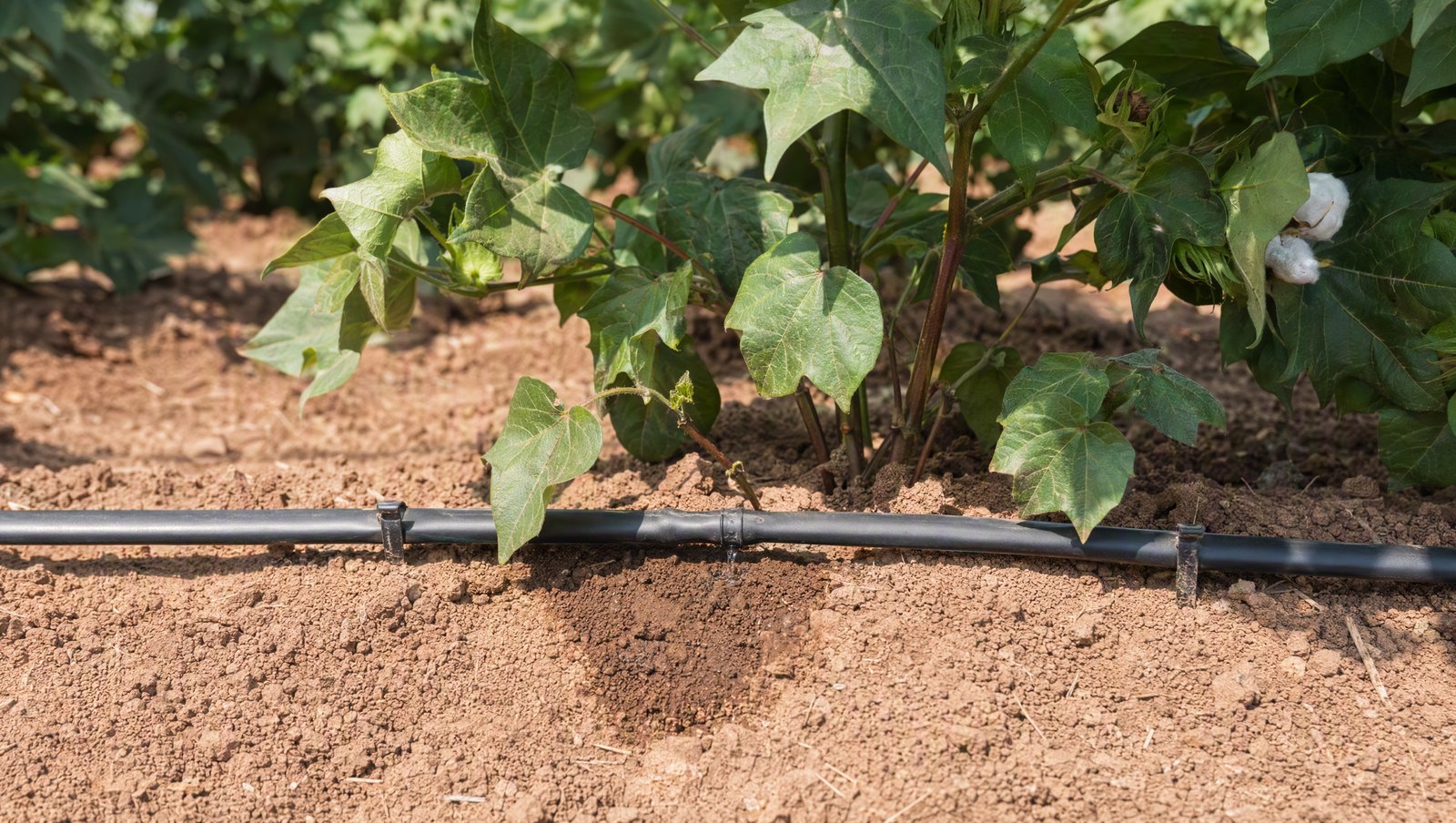
Note also that the event count fell, not just the volume. Under flood the schedule ran four irrigation days a week on both fields; under drip it runs three or four, at roughly a fifth of the volume per event — 4.2 to 4.5 mm against 5.0 to 6.0, on fewer or equal days. Fewer events at lower volume is also less pumping, and pumping is the cost a Maharashtra cotton grower actually pays.
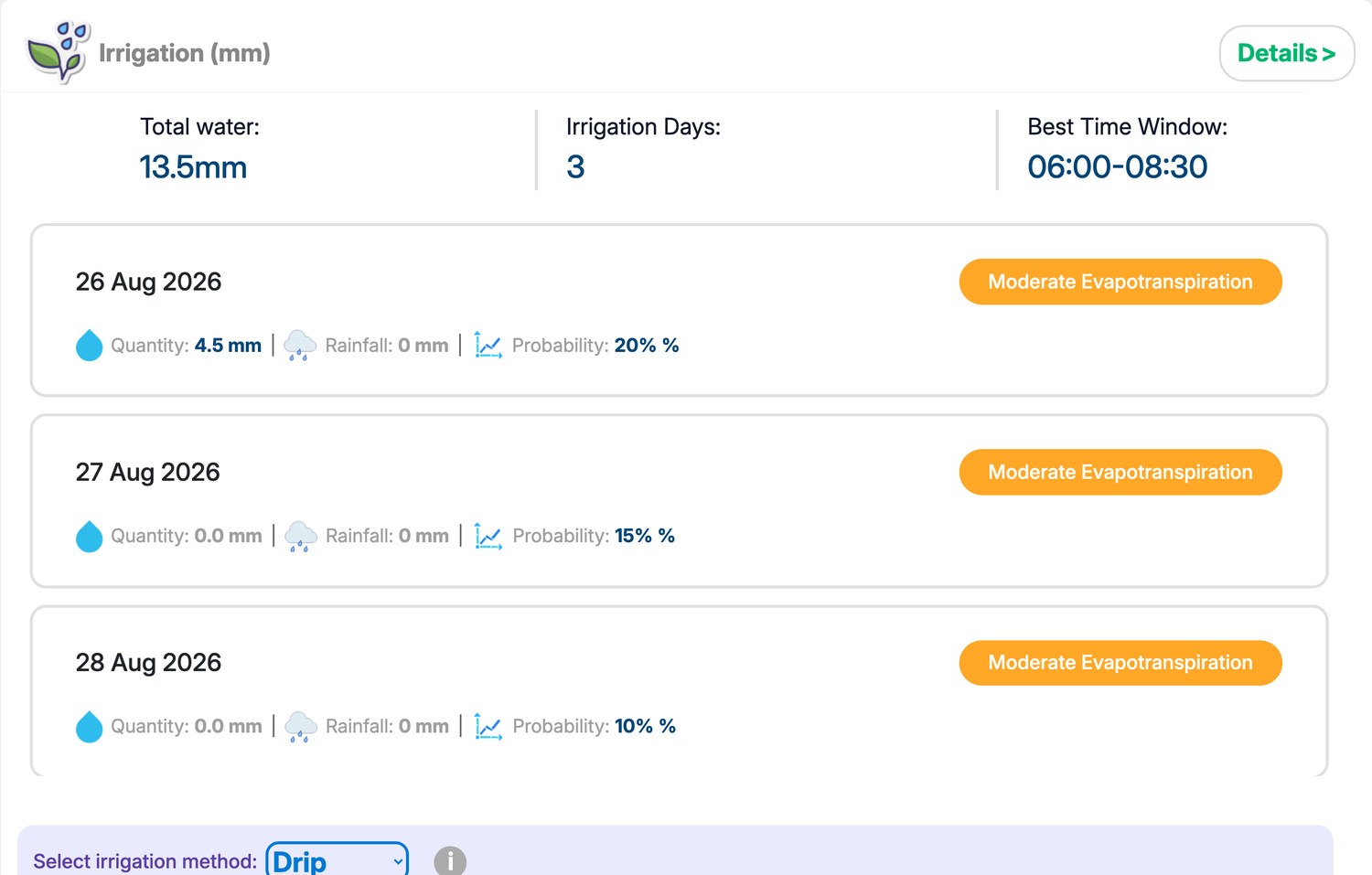
The most valuable number on an irrigation card is often the one that is not recommended. Every pass here priced three delivery methods against the same requirement — so the value of a conversion was visible as a weekly figure rather than as a sales pitch, for five weeks before anything changed.
Fertiliser: two fields, one day apart, 3.7× the potassium
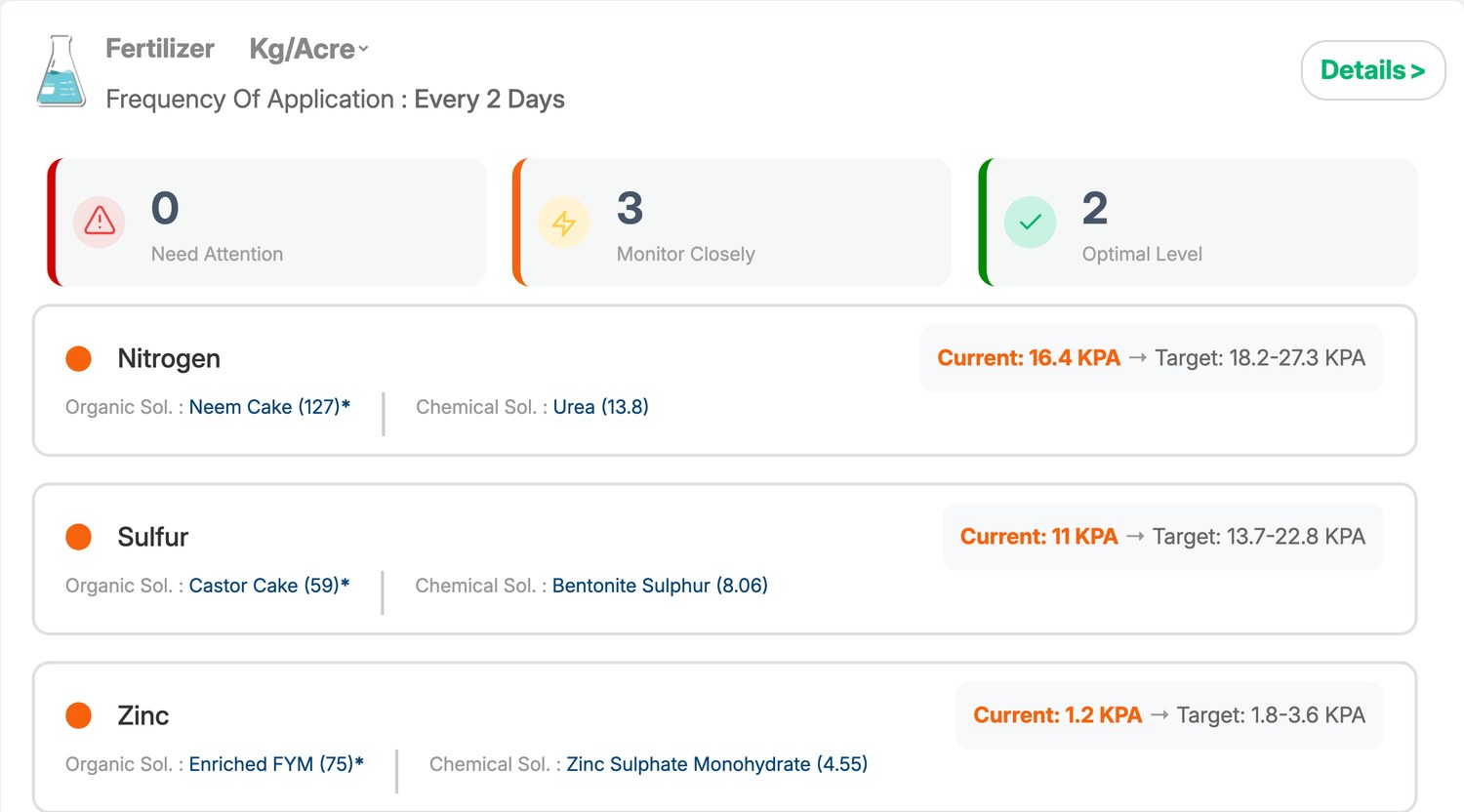
Cotton takes potassium hard through boll development, and the two fields are in different positions on it. On the 25 August pass the larger field was prescribed 20.7 kg/acre of potassium; the smaller field was prescribed 75.8 — three and a half times as much.
The reason is in the readings rather than the crop. The larger field’s potassium sat inside its target band; the smaller field’s sat below it. On the smaller field, nitrogen and phosphorus both came back at optimal level and nothing was prescribed for either — the card lists only potassium, sulphur and zinc, with the header reading 0 Need Attention, 3 Monitor Closely, 2 Optimal Level.
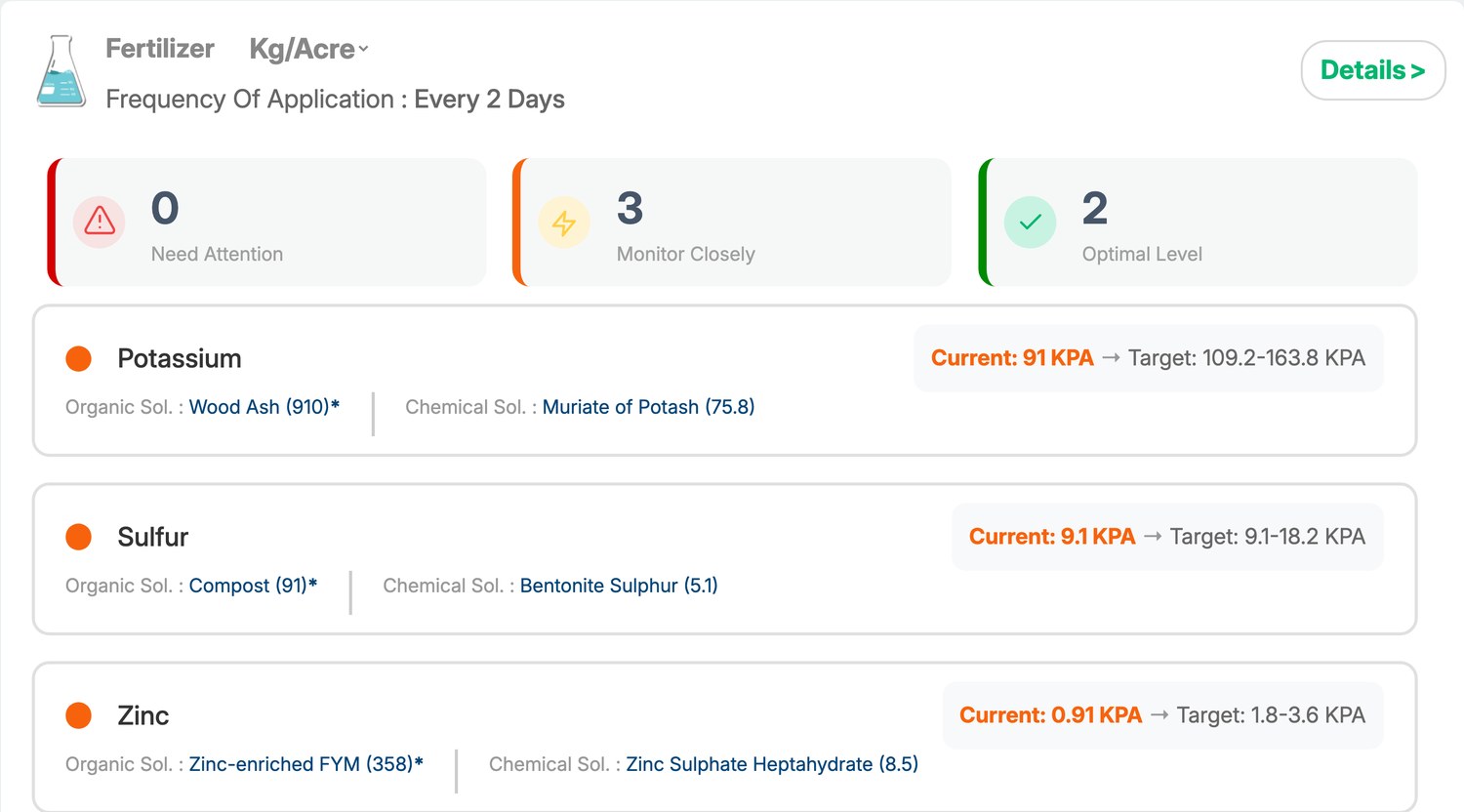
Zinc is prescribed on both fields — 4.55 and 8.5 kg/acre of zinc sulphate heptahydrate — and that is not incidental. Both soils read alkaline, at pH 7.8 and 7.6, and zinc availability falls sharply above about pH 7.5 regardless of how much total zinc the soil contains. A high-pH cotton soil with 0.10% organic carbon is close to a textbook setup for latent zinc deficiency, and the advisory picks it up on both fields.
Pest and disease: pink bollworm on both, and a different second insect on each
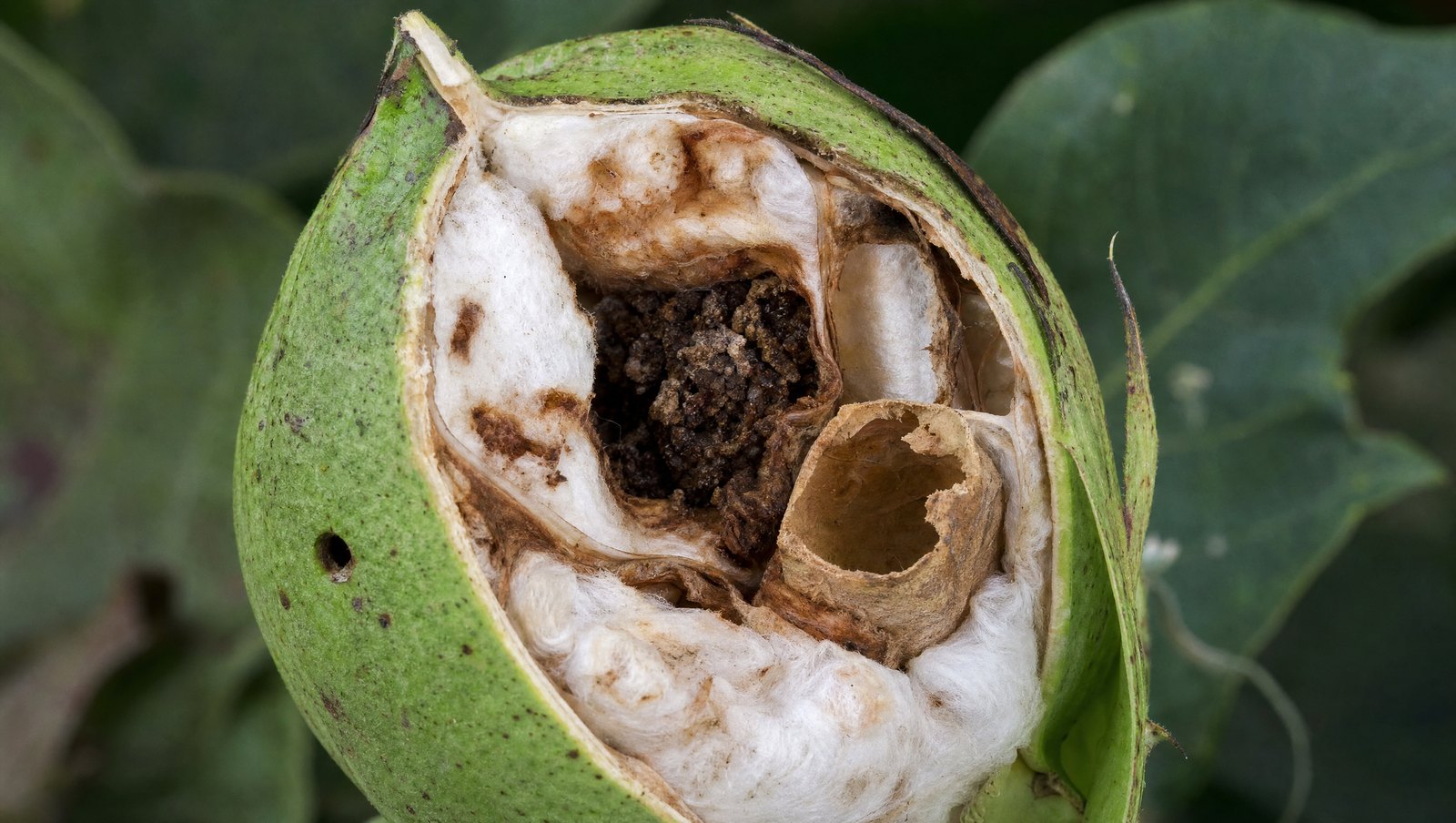
Pink bollworm (Pectinophora gossypiella) leads both fields — 75% on the larger, 80% on the smaller — and that is the correct answer for Maharashtra cotton at flowering. Pink bollworm is the pest that has reshaped Indian cotton economics over the last decade: it feeds inside the boll, so by the time damage is visible from outside it is already done.
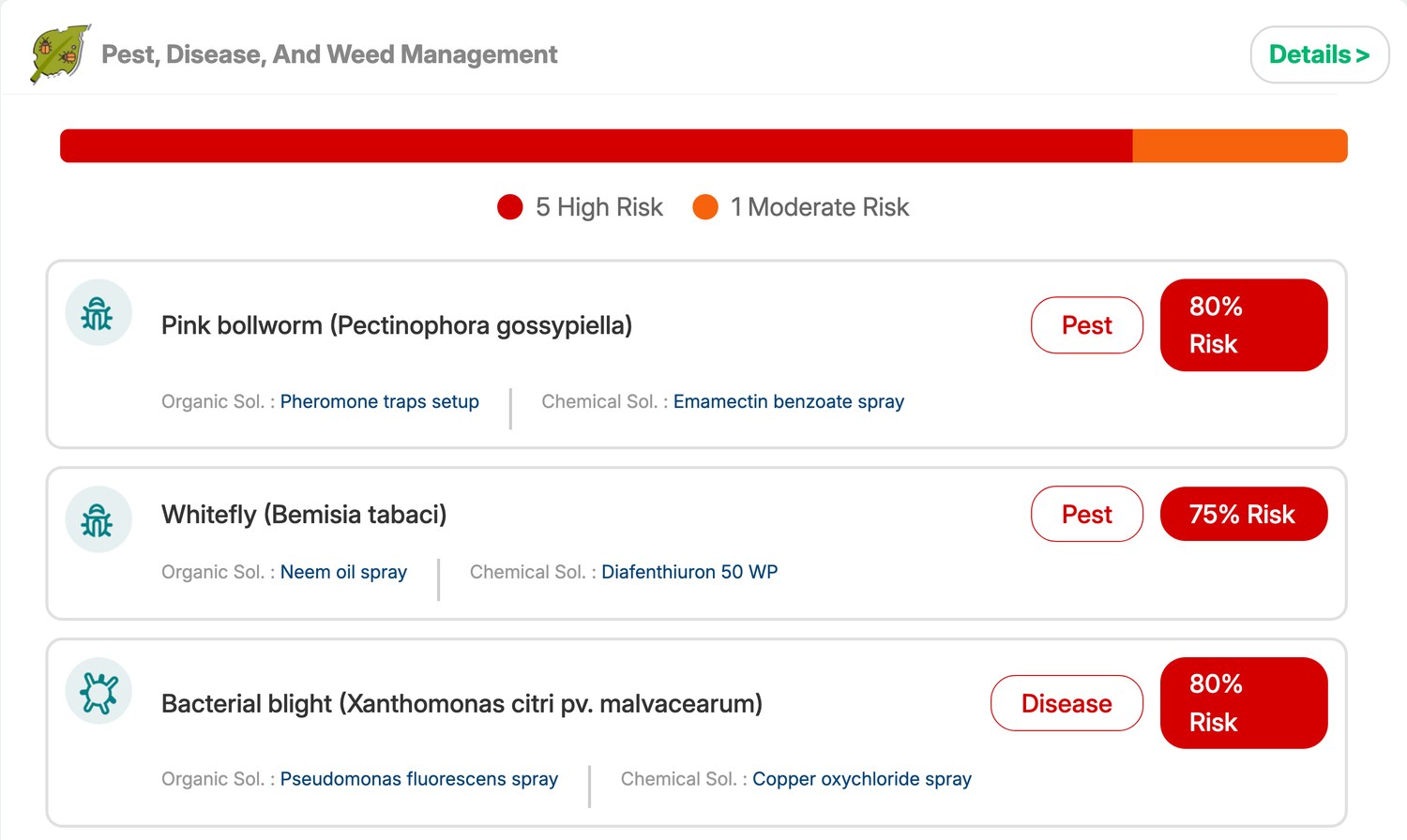
The organic solution offered against it is pheromone trap installation, with emamectin benzoate as the chemical route. That ordering matters: pheromone traps are the first line in every Indian pink bollworm IPM protocol precisely because they work on monitoring and mating disruption rather than on killing larvae that are already inside the boll.
The second insect differs between the fields. The larger field carries cotton aphid (Aphis gossypii) at 60%; the smaller carries whitefly (Bemisia tabaci) at 75%. Both are sucking pests but they are not interchangeable — Bemisia is the vector for cotton leaf curl virus and carries a much higher consequence than aphid feeding damage alone, and the chemical routes offered differ accordingly: acetamiprid against the aphid, diafenthiuron against the whitefly.
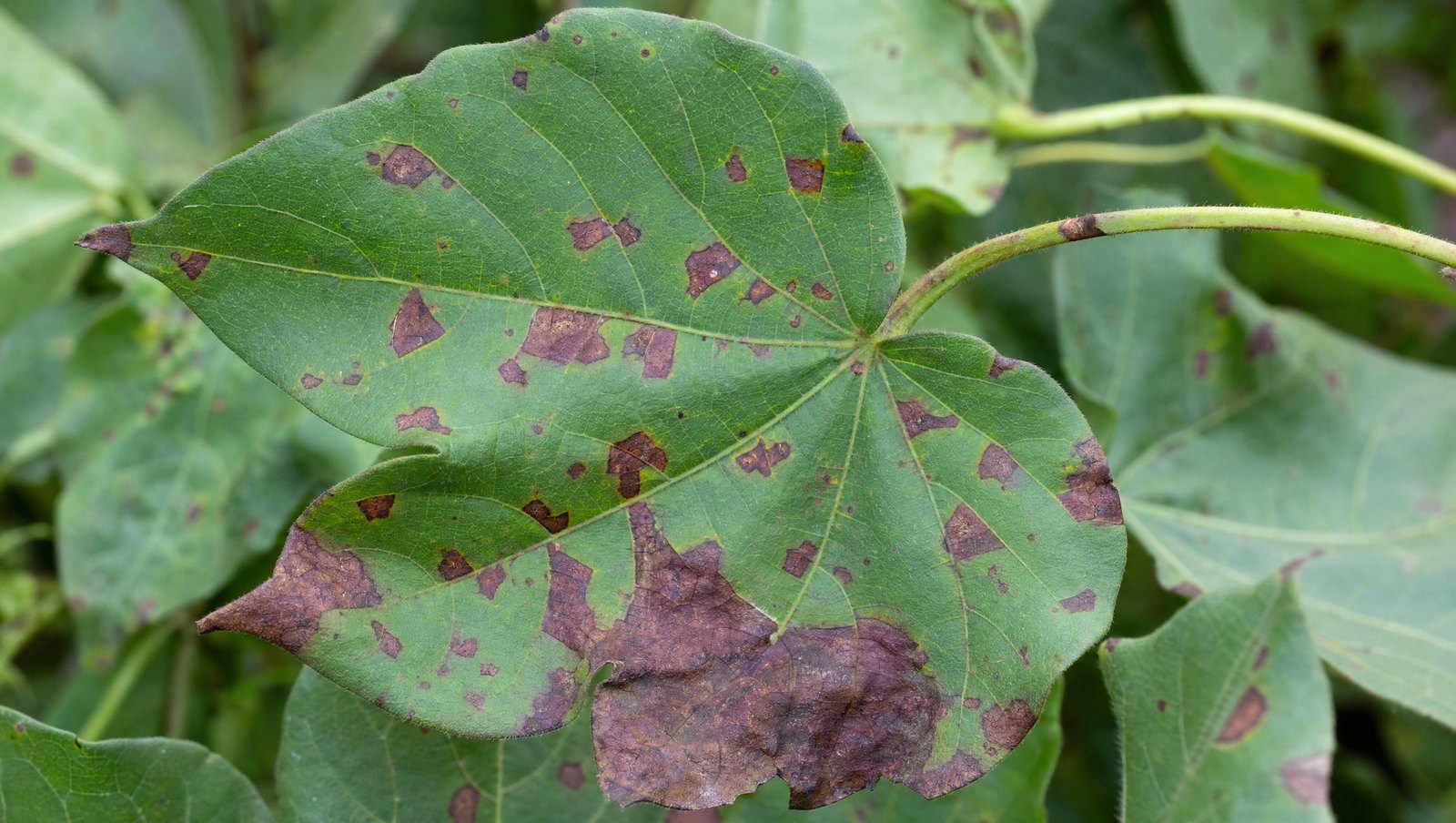
On disease both fields carry bacterial blight (Xanthomonas citri pv. malvacearum) — 70% on the larger, 80% on the smaller — and grey mildew (Ramularia areola) at 55% and 65%. Both are named to the pathovar and species rather than left as “leaf spot”, and the organic option in both cases is a biological (Pseudomonas fluorescens or Trichoderma viride spray) rather than a copper-only fallback.
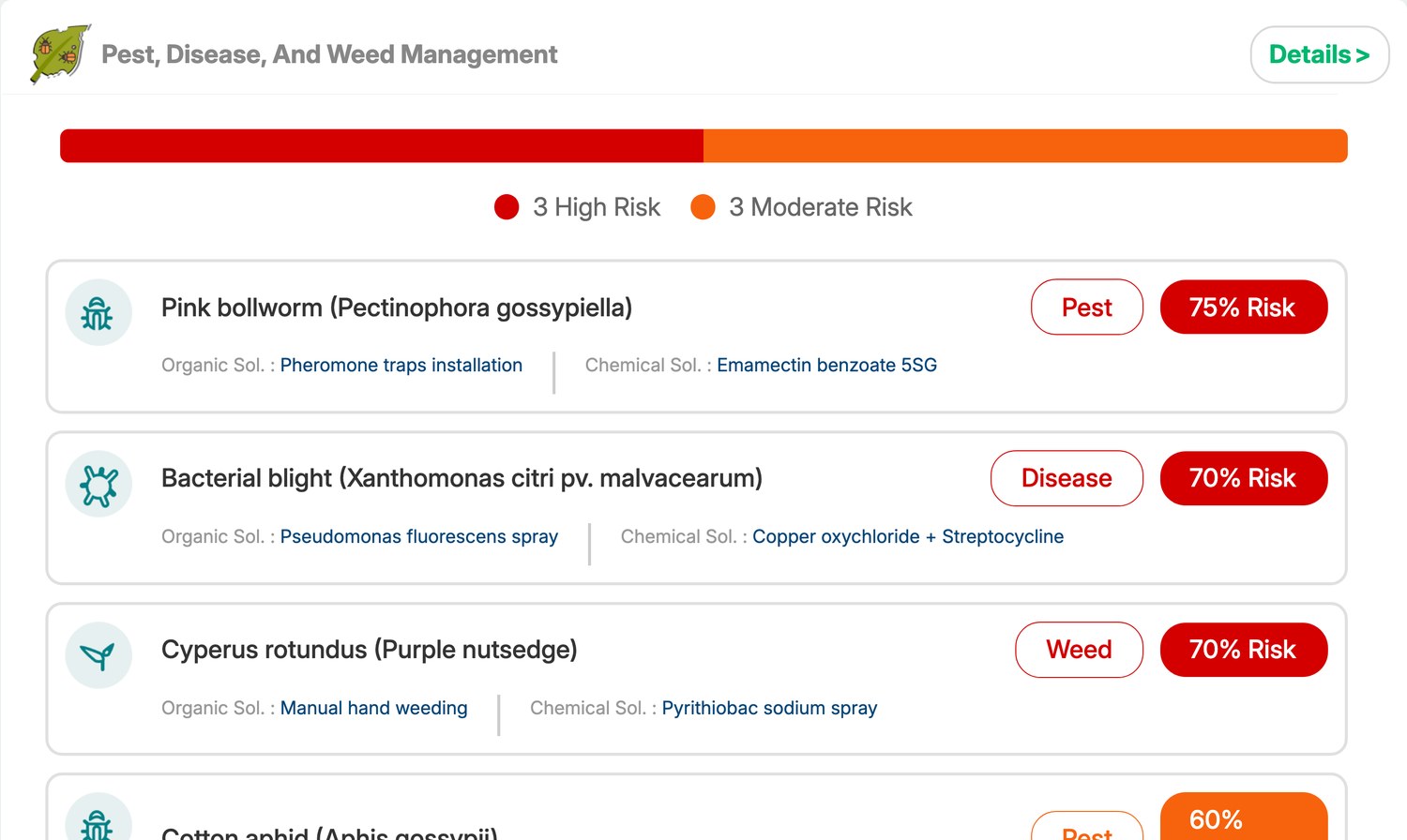
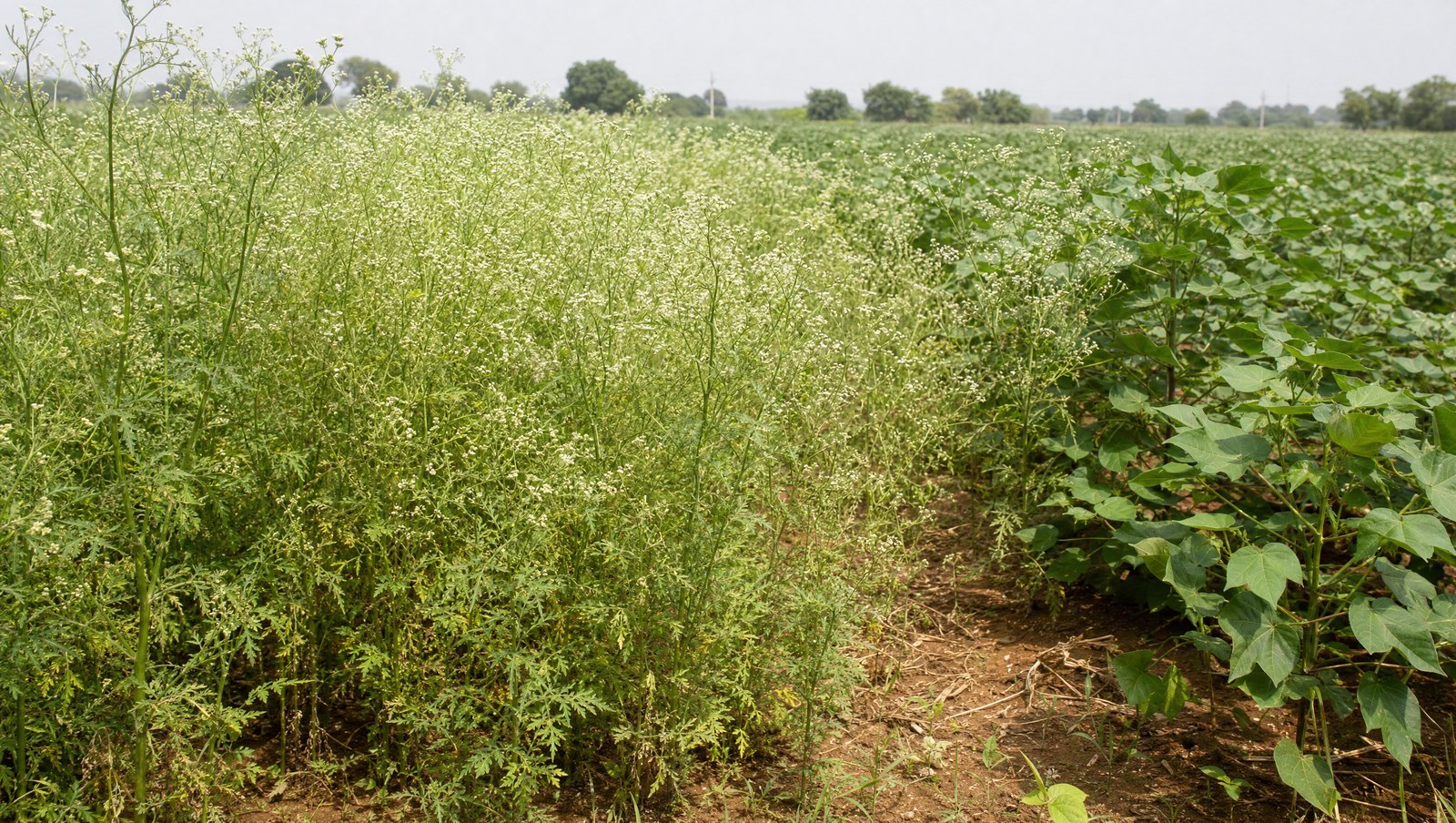
The weed lists diverge too, and the smaller field’s is the more serious. It leads with Parthenium hysterophorus at 80% — congress grass, the invasive that has colonised field margins across Maharashtra, is allelopathic, and is a recognised human health hazard as well as a crop competitor. The larger field leads with purple nutsedge at 70% and jungle rice behind it.

What the numbers add up to
| Mechanism in the advisory | What it delivers on these two fields |
|---|---|
| Monitoring started before the crop was up | Nine passes across five growth stages, germination to boll set |
| Delivery method priced in millimetres, every pass | Drip quoted 20–25% below flood for five consecutive weeks before anything changed |
| Water requirement reset at each stage change | Weekly average from 22.8 mm to 11.6 mm — a 49% fall |
| Nutrient set by each field’s own reading | Potassium 20.7 against 75.8 kg/acre on fields sown a day apart |
| Micronutrient screened against soil pH | Zinc prescribed on both — correct on alkaline soil at pH 7.6–7.8 |
| Pest resolved to species, per field | Pink bollworm on both; Aphis gossypii on one, Bemisia tabaci on the other |
| Organic option named first on every entry | Pheromone traps before emamectin; Pseudomonas before copper |
The advisory published the drip figure beside the flood figure for five weeks running. The saving was never hidden — it was a number in the weekly report.
Ten acres of cotton in Maharashtra is a serious commercial operation on a thin margin, and pumping is a cash cost paid weekly. Halving the recommended weekly volume changes the electricity or diesel bill immediately, and it does so without touching seed, fertiliser or spray budgets.
Grower-reported outcomes, as submitted
The cards below reproduce Vilas Deshpande’s answers to our in-app feedback questionnaire for the advisory dated 20 August 2026, which covered both fields, exactly as recorded.
The percentage is the grower’s own estimate from a structured form rather than a metered volume. What makes this case unusual in the series is that the advisory data supports it independently: the recommended weekly volume across the two fields fell by 49% between the flood-quoted and drip-quoted periods, which is inside the range he reported without knowing our number.
Two fields sown a day apart. In the first monitored week one was given 28 mm and the other was told to irrigate nothing at all.
Why starting at germination mattered
Most accounts in this series began monitoring mid-season, on a crop already established. This one began on 16 July, with both fields at germination and seedling establishment — and the difference shows in the first row of the table. Field A was given 28.0 mm that week; field B was given zero. Two fields sown a day apart, and one of them was told not to irrigate at all in its first monitored week.
That is the least intuitive instruction in the entire sequence and it is the one most likely to be ignored. Cotton at seedling stage needs enough moisture to establish and not much more; overwatering a young cotton crop encourages shallow rooting and rank vegetative growth at the expense of later fruiting. A grower irrigating on a calendar would have watered both.
Starting early also means the stage transitions were caught as they happened rather than inferred. The advisory recorded squaring on 15 August, first flowering on 20 August and bloom or boll development on 25 August — three stage changes in ten days, each with its own water and nutrient consequence. On a five-day satellite cadence those transitions land in the report within days of occurring in the field.
Maharashtra cotton is grown largely on groundwater in districts where the water table is under sustained pressure. The gap between the flood-quoted and drip-quoted schedules is about 11 mm per week across ten acres — repeated weekly through a five-month crop, that is the difference between a borewell that holds through the season and one that does not.
Not all of the fall is the delivery method. Cotton’s own water requirement changes with stage, and part of the step down at squaring is the crop coefficient rather than the emitter. Both effects are genuine and both are in the advisory — but a grower expecting a 49% cut purely from switching hardware would be reading the chart too generously.
Why per-field beats per-farm on two adjacent fields
The yield estimates are close — 680 kg/acre of seed cotton on the larger field and 640 on the smaller, both harvesting in December 2026 — which makes the divergence in everything else more striking rather than less. Two fields with almost the same expected output needed different potassium, faced a different second insect, carried a different leading weed, and by late August were reading at different growth stages despite being sown a day apart.
The soil explains part of it. Both fields read 0.10% organic carbon and low salinity, but pH differs — 7.8 on the larger field, flagged high, against 7.6 on the smaller, flagged medium. On alkaline soils that half-point matters for micronutrient availability, and it is visible in the zinc prescriptions being nearly double on the field with the marginally lower pH but the lower zinc reading.
Underneath sits a per-pixel read of each field from satellite, resolved through crop coefficients and regional pest models. Nineteen advisories over nine acquisition dates in six weeks is a fast cadence for a crop that changes stage this quickly — which is exactly why it caught three transitions in ten days.

Running this on your own cotton
- Map the field before the crop is up. The most valuable instruction in this sequence was a zero in the seedling week, and it would have been missed by starting mid-season.
- Read the alternative methods, not just the recommended one. Drip sat 20–25% below flood in the same table for five weeks. That is a conversion business case, computed weekly on your own field.
- Expect the schedule to change at every stage transition. Squaring, first flowering and boll set all landed within ten days here, each with a different requirement.
- Check potassium separately per field. 20.7 against 75.8 kg/acre on fields sown a day apart is the difference between feeding the boll and wasting the bag.
- Take the pink bollworm score seriously and early. The damage happens inside the boll, and pheromone traps are a monitoring and disruption tool — they have to go up before the score becomes a visible infestation.
Explore the platform at sat.farmonaut.com, read more about our satellite and AI-based farm advisory in the JEEVN AI overview, or talk to our team about monitoring a cotton block. JEEVN AI is a paid product; plan detail is on the platform.
Follow the crop, not the calendar
Map each field, set its crop and stage, and get per-field irrigation, nutrient and pest guidance from satellite passes over your own ground.
Frequently asked questions
What is a satellite cotton crop advisory and what does it deliver?
It is a per-field report built from satellite passes over your own boundary, giving a seven-day irrigation schedule with the delivery method quoted and two alternatives priced in millimetres per day, per-nutrient fertiliser rates with organic and chemical sources plus an application frequency, pest and disease risk as percentage scores with paired solutions, weed pressure, soil chemistry and a yield estimate with a harvest window. On this holding two fields each received their own across nine passes, producing 19 advisories in six weeks.
How was the 49% water reduction calculated?
From the advisories’ own daily quantities. Across the five passes on which the schedule was quoted against flood irrigation, the two fields averaged 22.8 mm of recommended water per week. Across the three passes quoted against drip, they averaged 11.6 mm. The fall combines two effects — cotton’s own requirement changing with growth stage, and drip delivering less water than flood for the same soil-moisture outcome — and both are visible in the advisory.
Does the advisory tell you what a different irrigation method would cost?
Yes, on every pass. Each daily entry carries three delivery methods with a quantity against each. On 10 August the larger field showed flood at 5.0 mm, sprinkler at 4.5 and drip at 4.0; the smaller field showed 6.0, 5.0 and 4.5. That makes the value of a conversion a weekly number on your own field rather than a general claim.
Why did two cotton fields sown a day apart get different potassium?
Because their own readings differ. The larger field’s potassium sat inside its target band and was prescribed 20.7 kg/acre; the smaller field’s sat below the band and was prescribed 75.8. On the smaller field nitrogen and phosphorus both came back at optimal level, so nothing was prescribed for either and the card lists only potassium, sulphur and zinc.
Why is zinc prescribed on both fields?
Because both soils are alkaline — pH 7.8 and 7.6 — and zinc availability drops sharply above about pH 7.5 regardless of total zinc content. Combined with 0.10% organic carbon, that is a standard setup for latent zinc deficiency in cotton, and the advisory prescribes 4.55 and 8.5 kg/acre of zinc sulphate heptahydrate against it.
What does the advisory say about pink bollworm?
It scored 75% on the larger field and 80% on the smaller, leading both lists. The organic solution named is pheromone trap installation, with emamectin benzoate as the chemical route — the order matters, because the larva feeds inside the boll and traps work through monitoring and mating disruption rather than by reaching larvae already inside.
Are the pest probabilities confirmed infestations?
No — they are modelled risk scores from satellite indices, weather and regional pest pressure, working as a scouting priority list. Their value here is specificity: the same bollworm on both fields, but Aphis gossypii behind it on one and Bemisia tabaci on the other, which are different pests with different consequences and different chemistry.
Glossary
- Squaring
- The stage at which cotton forms flower buds, called squares. The first reproductive stage, and where the water and nutrient requirement begins to shift away from vegetative growth.
- Boll
- The seed capsule that holds the lint. Boll development is potassium-hungry, which is why potassium dominates the fertiliser prescription on the field further into the stage.
- Pink bollworm (Pectinophora gossypiella)
- A moth whose larva feeds inside the developing boll, damaging both lint and seed before external symptoms appear. The defining pest of Indian cotton economics.
- Crop coefficient (Kc)
- The multiplier applied to reference evapotranspiration to get a crop’s actual water requirement at a given growth stage. It is why the same field’s schedule changes when its stage does.
- Parthenium hysterophorus
- Congress grass — an invasive weed widespread across Maharashtra that is allelopathic, suppressing germination of nearby plants chemically as well as competing for resources.
Case-study basis: JEEVN AI field advisories for a single Farmonaut account — all 19 advisories generated for the account’s two cotton fields across the nine satellite passes from 16 July to 25 August 2026 — plus the account’s in-app feedback submission for the advisory dated 20 August 2026, which covered both fields. Crop, region, field count and area are reported from the account’s own records on the platform; the account holder is named as recorded on his Farmonaut account and precise field locations are withheld. The reported percentage is the grower’s own estimate from a structured feedback form, not a metered or invoiced measurement; the 49% figure is our own calculation from the advisories’ own daily quantities, comparing the mean weekly recommended volume across the five passes quoted against flood irrigation with the three quoted against drip, and it reflects both the change in delivery method and the change in the crop’s own stage-dependent requirement. The delivery method quoted on an advisory reflects the method selected for that field on the platform. All nutrient, pest, soil and yield figures are read directly from the advisories. Pest, disease and weed percentages are modelled probabilities, not confirmed infestations. Yield figures are estimates, not guarantees. Imagery: the five platform screenshots are genuine captures of this account’s own advisory data; the six wider field photographs are AI-generated illustrative imagery, each labelled as such in its caption, and do not depict the grower or his fields. JEEVN AI is a paid product.
Discussion
Questions, corrections or field experience? Share them below. First-time comments are reviewed before they appear, and your email is never published.
No comments yet. Be the first to add a question or your experience.

 Sama Premium
 Mahaswami
 Prochecker
 Tres Valles
 LACOS Geoinformation
 Pulsar Supernova
 Magrifly
 LatConnect 60
 WebsEdge
 Blickwinkel
 Agricultural Credit Policy Council
 MCSOD
MCSOD Marei Nursery
 eKGIS
eKGIS Mostas Tech
 Andex
Andex FCF India
 Unifrutti Gulf
 Deluxe Conseil
