

Satellite Crop Advisory Central Asia: 10 Crops

AGROEX Consultancy runs a portfolio that no single spray plan or irrigation calendar can serve: apple, pear, peach, plum, apricot, cherry, grape, raspberry, melon and cotton, spread across Uzbekistan, Tajikistan and Turkmenistan. We opened the week of advisories it was reading and checked whether the guidance was genuinely different field by field — or merely repackaged.
A single farm growing a single crop is the easy case for any advisory system. The hard case is the one on this page. AGROEX Consultancy manages 15 separately mapped fields totalling 631.7 acres (255.6 hectares) for growers in three different countries, carrying ten different crops that were, in the week we examined, sitting at seven different points in their season. One field was at bud burst. Another was in full fruit development. A third was a cotton block at squaring. There is no version of a generic recommendation that is useful to all of them at once.
In June 2026 the consultancy completed the feedback form attached to its satellite crop advisory and reported that the reports had helped it optimise irrigation by 30–50% and fertiliser use by more than 70%, and had helped it act on pest, disease and weed pressure. This article shows exactly what the advisory told the consultancy, field by field — and traces the specific mechanisms in it that a ten-crop, three-country portfolio depends on.
Across 15 fields the advisory issued 39 pest, disease and weed alerts at 80% probability or higher, and every one of them was specific to the crop it was raised on — down to naming Venturia inaequalis on apple but Venturia pyrina on pear. Two different fungal species, same genus, correct host each time. That is the clearest evidence in this dataset that the guidance is genuinely per-crop.
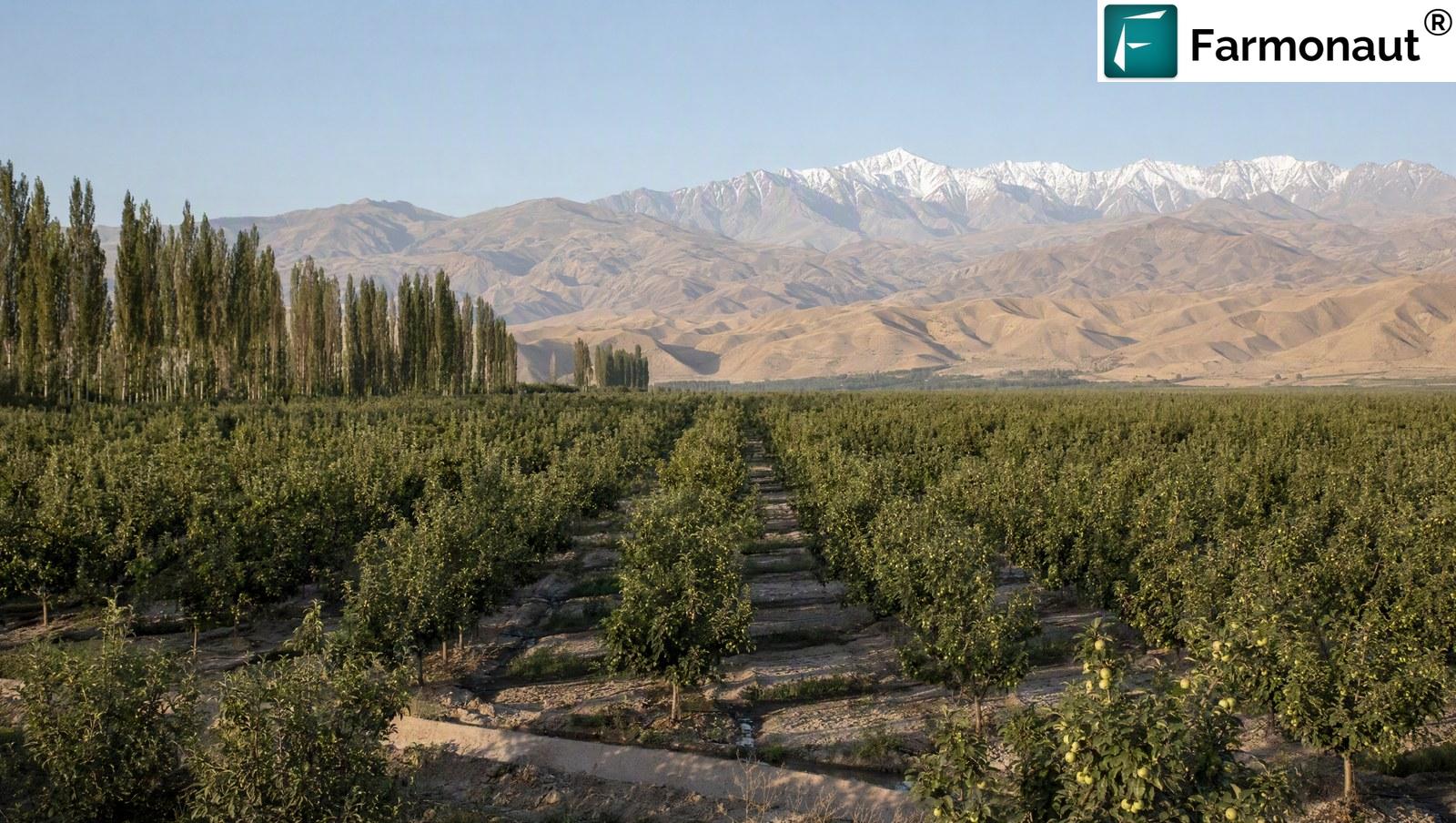
One account, three countries, ten crops
The portfolio is unusual enough to be worth laying out plainly. By field count it is mostly Uzbek; by area it is mostly Tajik, because the two largest blocks — a 224.8-acre melon field and a 96.9-acre peach orchard — are both in Tajikistan.
Each field carries its own satellite crop advisory, refreshed on every pass. The consultancy onboarded on 26 March 2026. By the date of the feedback, 9 June, the account had received 181 individual field advisories drawn from 46 separate satellite acquisition dates in 75 days. Because the fields sit at different longitudes across three countries, they are not all imaged on the same pass — so on most days of that period, a new advisory landed for some part of the portfolio.

| Crop | Country | Acres | Growth stage | Irrigation method | Top alert |
|---|---|---|---|---|---|
| Cantaloupe / Muskmelon | Tajikistan | 224.8 | Fruit Set | Furrow | Melon Fly 88% |
| Peach | Tajikistan | 96.9 | Fruit Development | Drip | Spider Mites 94% |
| Apple | Uzbekistan | 56.2 | Fruit Set | Drip | Codling Moth 95% |
| Apple | Turkmenistan | 46.9 | Pink Bud | Drip | Rosy Apple Aphid 95% |
| Apricot | Tajikistan | 29.4 | Fruit Development | Furrow | Codling Moth 91% |
| Peach | Uzbekistan | 26.1 | Fruit Set | Drip | Oriental Fruit Moth 92% |
| Apple | Uzbekistan | 25.8 | Pink Bud | Drip | Apple Scab 94% |
| Plum | Uzbekistan | 25.6 | Fruit Set | Drip | Plum Fruit Moth 92% |
| Cherry | Uzbekistan | 24.0 | Bud Burst | Drip | Cherry Fruit Fly 88% |
| Pear | Uzbekistan | 23.3 | Fruit Set | Drip | Codling Moth 94% |
| Pear | Uzbekistan | 17.4 | Flowering | Drip | Pear Psylla 92% |
| Cotton | Uzbekistan | 11.9 | Squaring | Furrow | Cotton Aphid 92% |
| Grape | Uzbekistan | 10.2 | Berry Development | Drip | Powdery Mildew 95% |
| Raspberry | Uzbekistan | 7.6 | Flowering | Drip | Two-spotted Spider Mite 92% |
| Apple | Uzbekistan | 5.6 | Fruit Development | Drip | Codling Moth 96% |
| Portfolio | 3 countries | 631.7 | 7 stages | 12 drip / 3 furrow | 39 alerts ≥80% |
Ten crops. Seven growth stages. Three countries. One week of advisories, and no two of them alike.
What the satellite crop advisory delivers per field
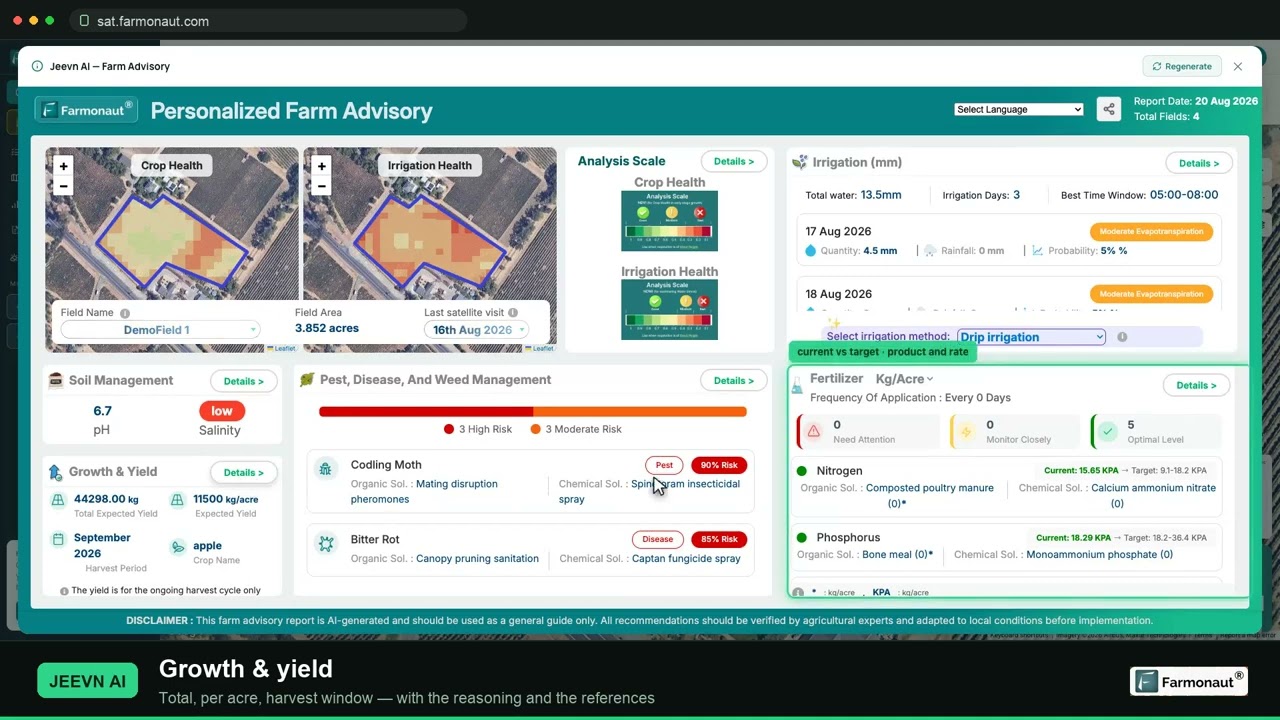
Every field on the account receives its own report per satellite pass, carrying five working sections: irrigation, fertiliser, pest and disease, weed, and soil management, plus a growth and yield estimate. The three sections below are the ones the consultancy credited — and the ones where a ten-crop portfolio makes differentiation impossible to fake.

Pest and disease: the model names the species, not the symptom
This is where a multi-crop portfolio either exposes a satellite crop advisory or validates it. A shallow model returns a plausible-sounding disease name. A useful one returns the pathogen that actually attacks that host at that stage — because the control product, the timing and the threshold all follow from the species, not from the symptom.
The clearest test in this dataset is scab. The advisory raised Apple Scab (Venturia inaequalis) on the apple blocks and Pear Scab (Venturia pyrina) on a pear block. Same genus, different species, each on its correct host. Powdery mildew behaved the same way: Podosphaera leucotricha on apple, Uncinula necator on grape, Sphaerotheca pannosa on peach — three different organisms that a generic “powdery mildew” label would have collapsed into one.
| Crop | Leading pest / disease the advisory raised | Probability |
|---|---|---|
| Apple | Codling Moth (Cydia pomonella) · Apple Scab (Venturia inaequalis) · Rosy Apple Aphid (Dysaphis plantaginea) | 88–96% |
| Pear | Pear Psylla (Cacopsylla pyri) · Pear Scab (Venturia pyrina) · Fire Blight (Erwinia amylovora) | 85–94% |
| Cherry | Cherry Fruit Fly (Rhagoletis cerasi) · Black Cherry Aphid (Myzus cerasi) · Monilinia laxa | 82–88% |
| Peach | Oriental Fruit Moth (Grapholita molesta) · Brown Rot (Monilinia fructigena) | 88–94% |
| Plum | Plum Fruit Moth (Grapholita funebrana) · Moniliosis · Shot Hole (Stigmina carpophila) | 72–92% |
| Apricot | Codling Moth · Spider Mites (Tetranychus urticae) · Brown Rot | 87–91% |
| Grape | Powdery Mildew (Uncinula necator) · Grape Berry Moth (Lobesia botrana) | 85–95% |
| Raspberry | Two-spotted Spider Mite · Gray Mold (Botrytis cinerea) · Raspberry Beetle (Byturus tomentosus) | 85–92% |
| Melon | Melon Fly (Bactrocera cucurbitae) · Melon Aphid · Powdery Mildew | 82–88% |
| Cotton | Cotton Bollworm (Helicoverpa armigera) · Cotton Aphid (Aphis gossypii) · Verticillium Wilt (Verticillium dahliae) | 78–92% |
Put two cards from the same account side by side and the differentiation stops being an argument and becomes an observation. Both fields belong to the same consultancy, in the same country, in the same week.
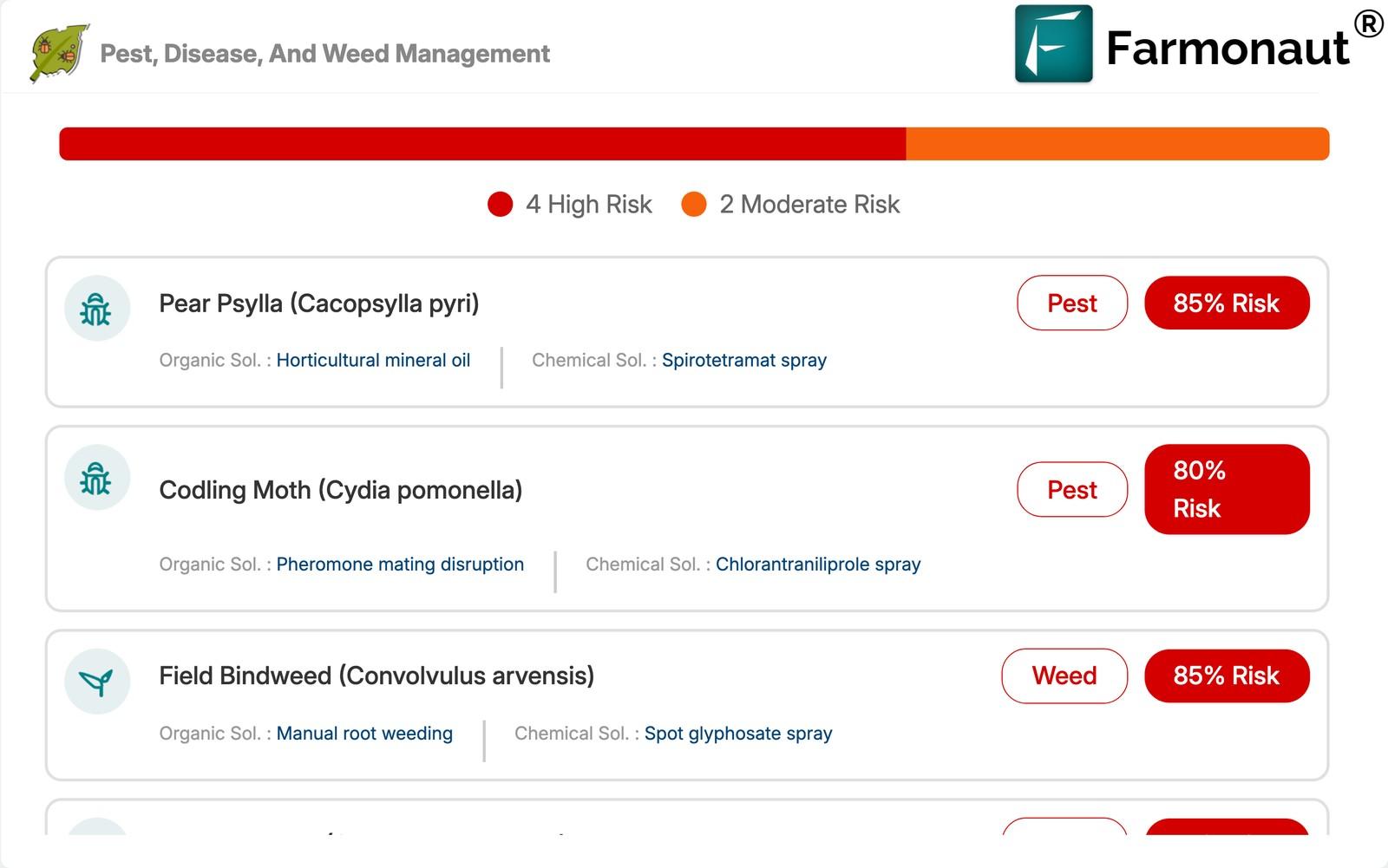
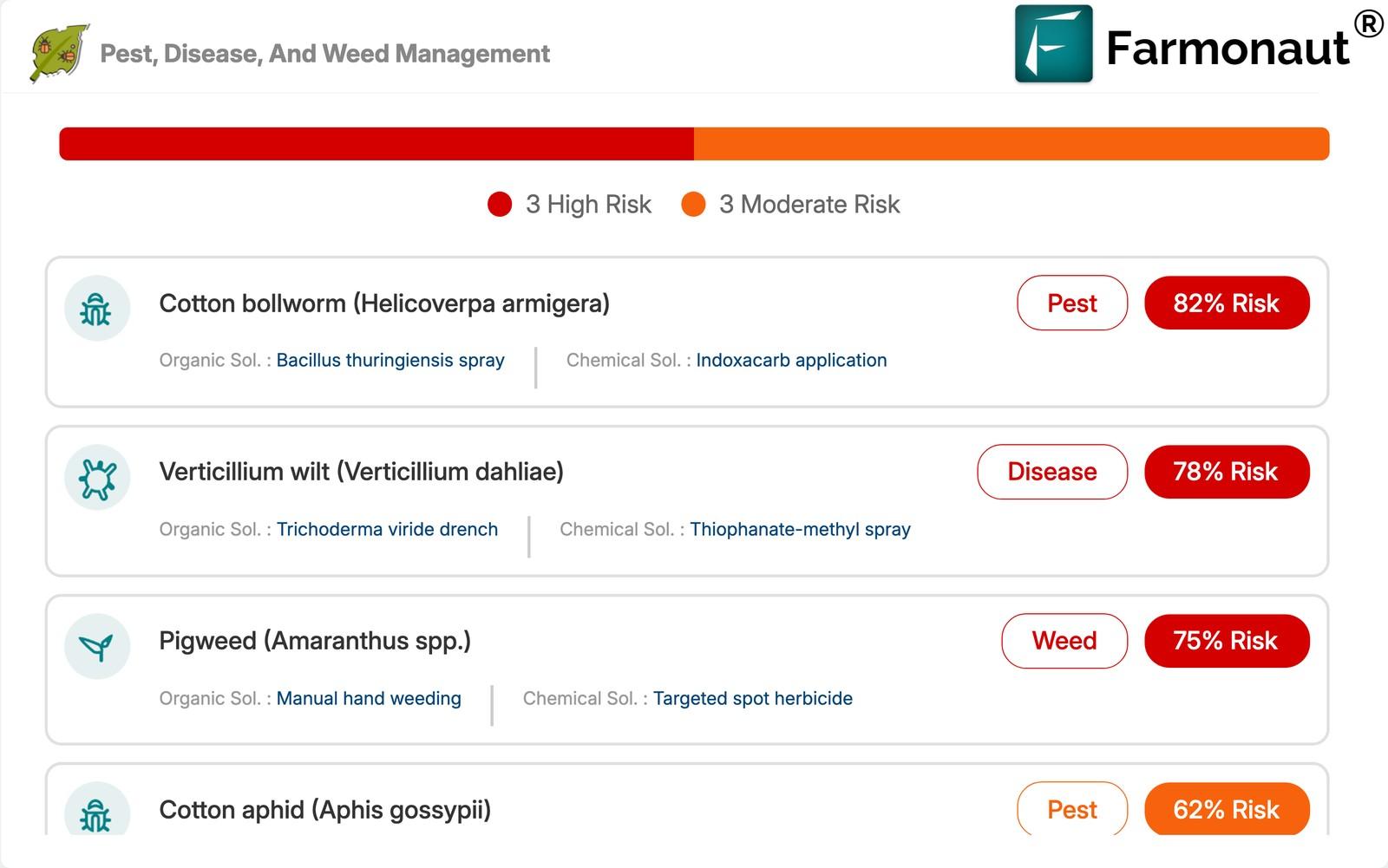
Weed pressure separated the same way. Field Bindweed (Convolvulus arvensis) — the classic perennial problem of Central Asian orchards — was flagged on nearly every tree-crop field, reaching 96%. The cotton block instead led with Pigweed (Amaranthus spp.) at 88%, and the melon field with Common Purslane (Portulaca oleracea) at 85%. Every alert carried both an organic and a chemical control option, from pheromone mating disruption for codling moth to Bacillus thuringiensis for bollworm.
Reading a high probability as a confirmed infestation. These are modelled risk scores built from satellite indices, weather and regional pest pressure — a scouting priority list, not a diagnosis. Their value on a 15-field portfolio is that they tell a consultant which field to walk first on Monday morning.
Irrigation: the method changes with the crop
Here the mechanism is not the one people expect. Only 22 of 105 field-days in the week carried a zero-irrigation instruction, so skipping days is not the story. The story is method.
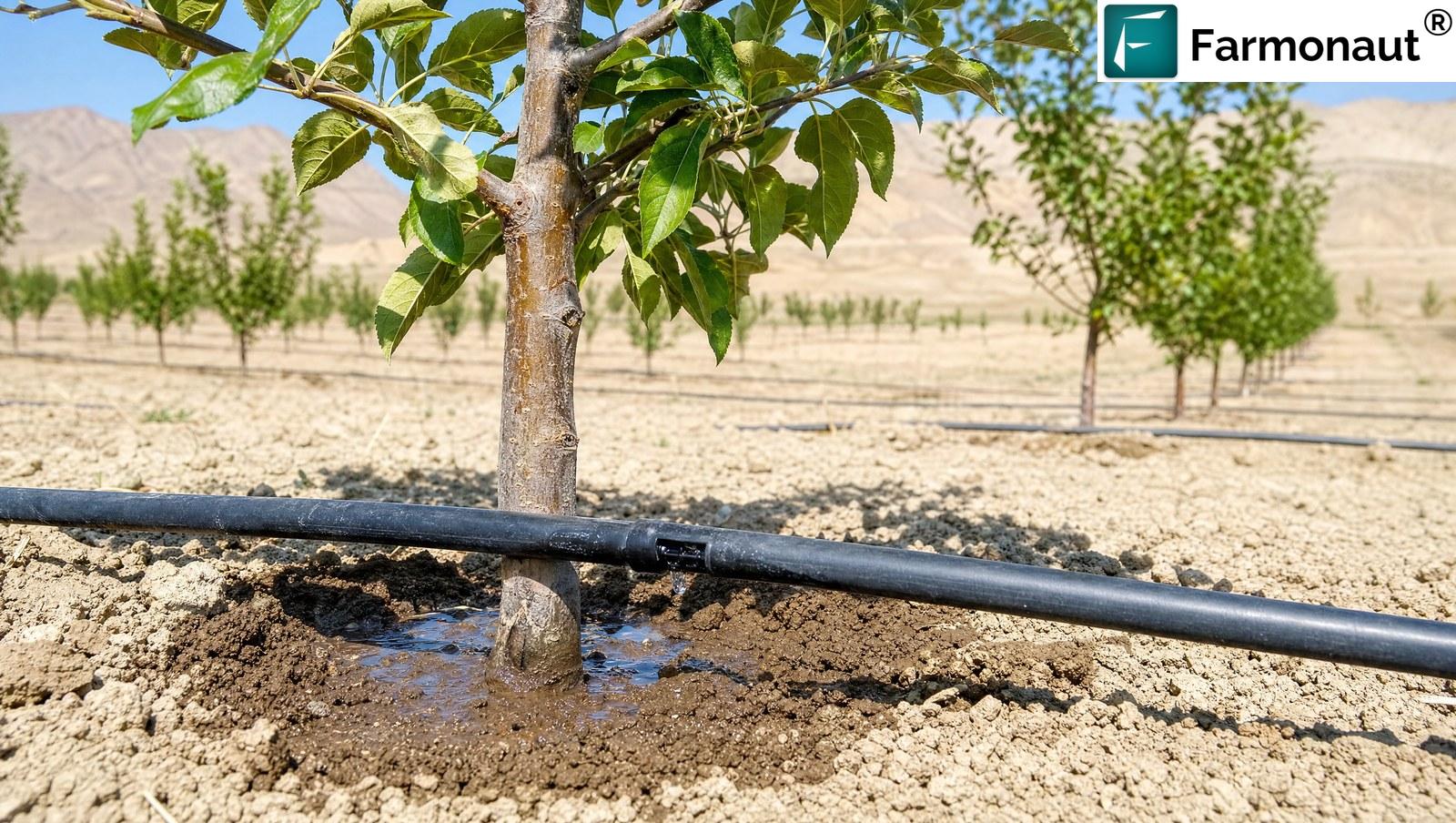
Across the portfolio the advisory recommended drip irrigation on 12 of the 15 fields, against the furrow and basin flood irrigation traditional to the region. On the fields where drip was recommended, the recommended daily quantity was 27.8% lower, area-weighted, than the flood alternative the same report listed — with per-field differences running from 18.8% to 40.0%.
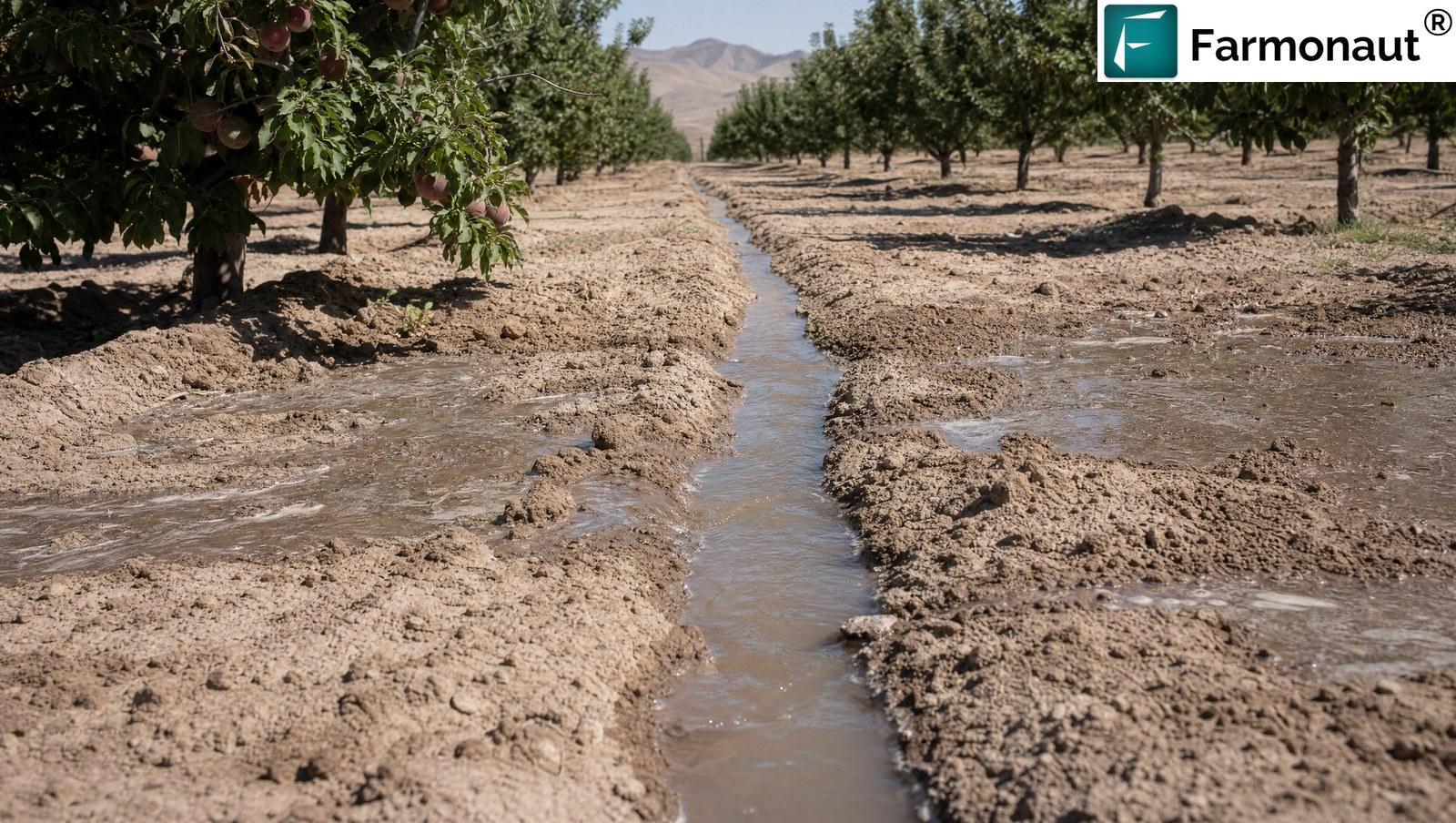
What makes this credible is the three fields where the model did not recommend drip. On the melon block, the cotton block and one apricot orchard, furrow irrigation was retained. A system that simply preferred the modern technology would have said “drip” fifteen times out of fifteen. This one recognises that a sprawling melon crop on raised beds and a furrow-irrigated cotton field are not orchard rows, and left them alone.
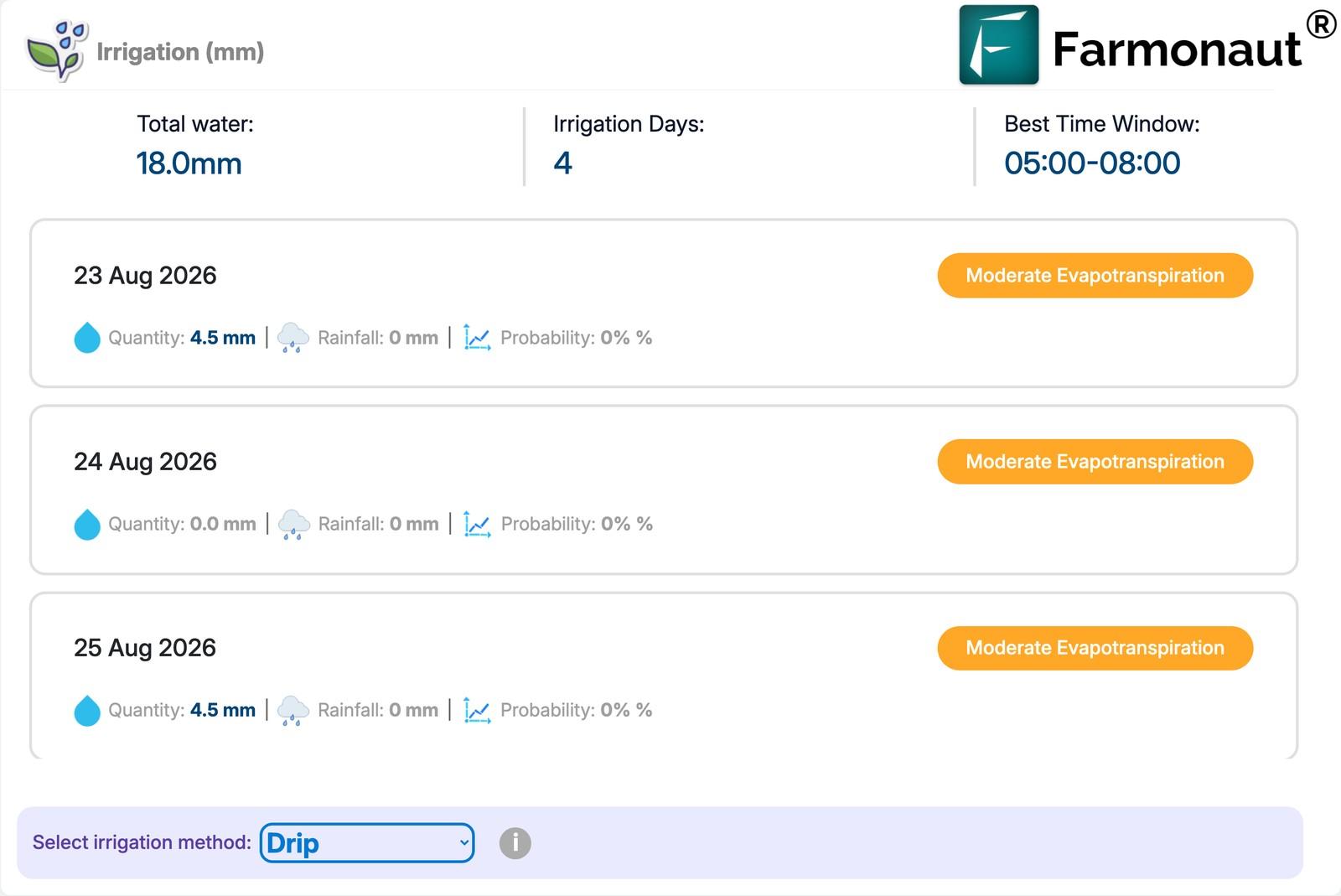
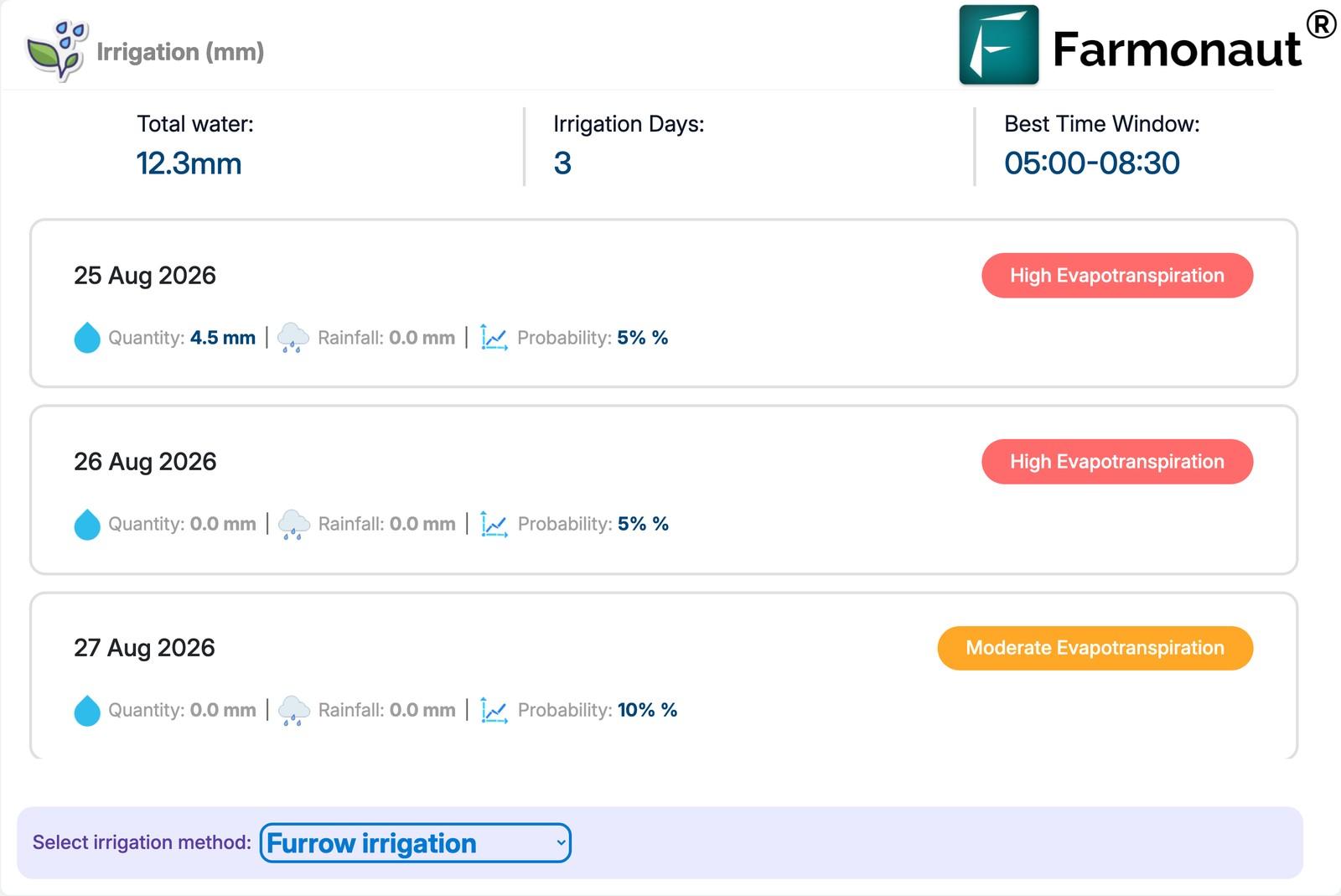
Irrigation windows across the whole portfolio fell between 05:00 and 08:30 — before the continental daytime heat drives evaporative loss. The underlying calculation is named in the report’s own references: FAO-56 Penman–Monteith reference evapotranspiration, crop coefficients for stone fruits, Sentinel-1 radar soil-moisture and vegetation indices, and Sentinel-2 NDVI, adjusted to regional irrigation norms.
Fertiliser: no two fields get the same mix
The fertiliser section reports five nutrients per field — nitrogen, phosphorus, potassium, sulphur and zinc — each with the modelled current level, the ideal range for that crop, a rate, and both an organic and a chemical source. The report even names the grades its arithmetic assumes: Ammonium Nitrate at 34% N, Superphosphate at 20% P, Potassium Sulfate at 50% K.
Nitrogen varied a relatively modest amount across the portfolio — 9.6 to 40.4 kg/acre, a 4.2-fold spread. The interesting variation is in the other two. Phosphorus ranged from 4.0 to 57.0 kg/acre, a 14.4-fold spread. Potassium ran from zero to 96.0 kg/acre — one apple block needed no potassium at all, while a plum block needed 96 kg/acre of it.
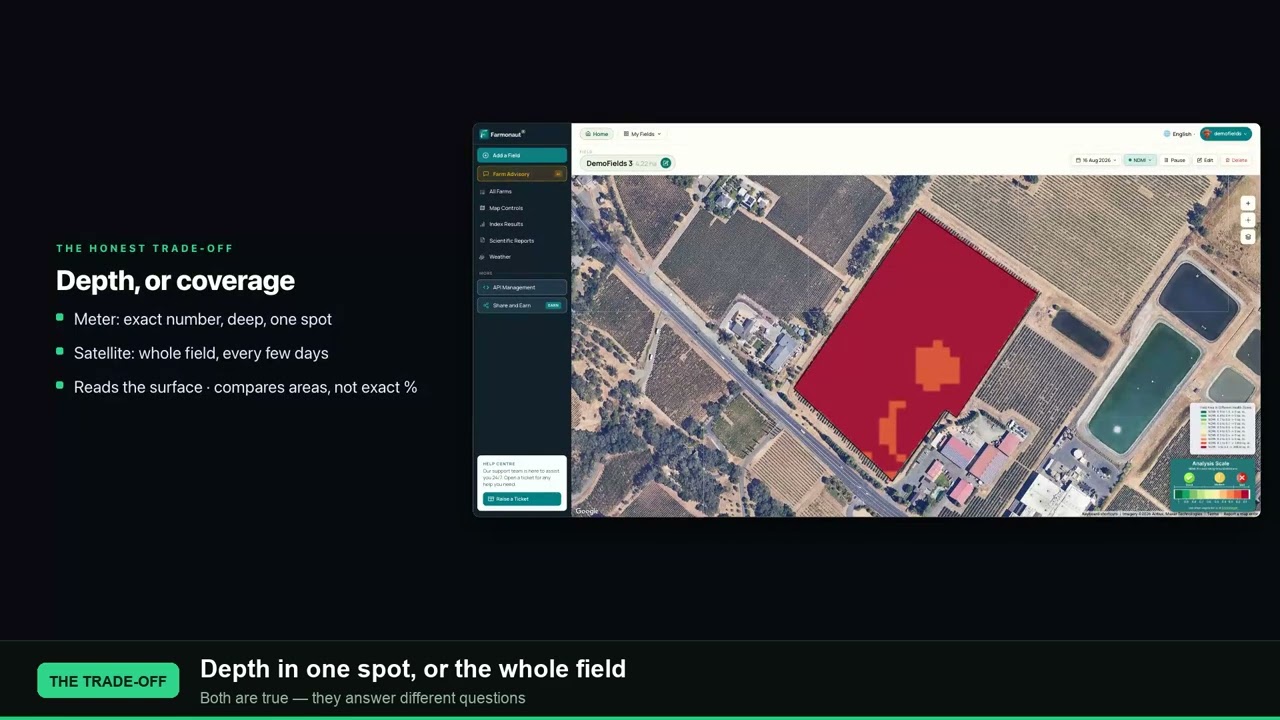
Summed across the portfolio the advisory prescribed roughly 76,700 kg of nutrient across all five elements. If the consultancy had instead applied one uniform, area-weighted average rate to every acre — a defensible thing to do without field data — then 34.0% of that programme would have landed in the wrong place: over-applied on the fields that needed less, under-applied on the fields that needed more. For potassium alone the misallocation would have been 48.8%.
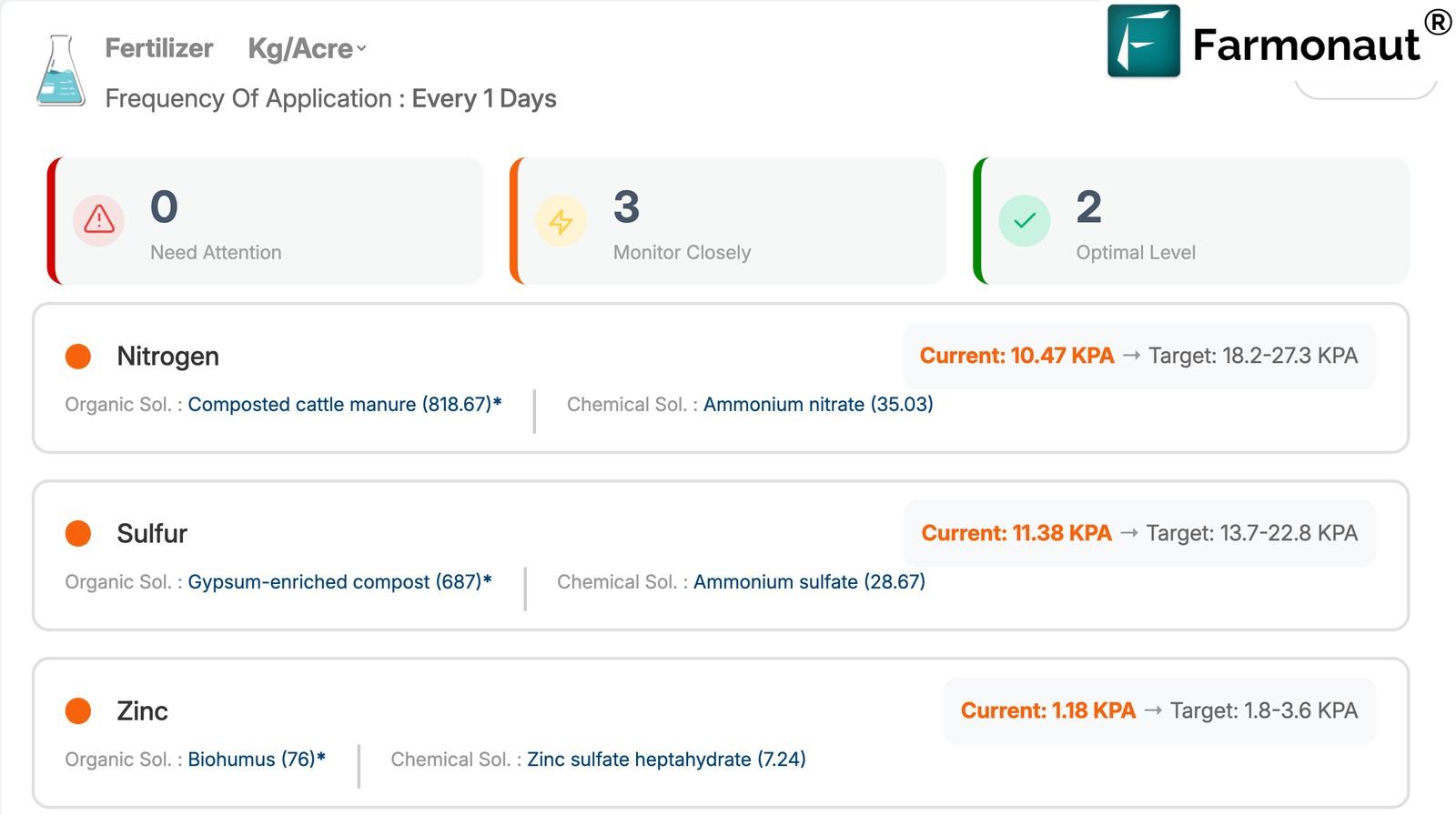
For a consultancy, the number that matters is not the tonnage total — it is the share of the programme a blanket rate would misplace. Totals can look identical while every individual field is being fed wrongly. Compare mixes field by field, not sums.
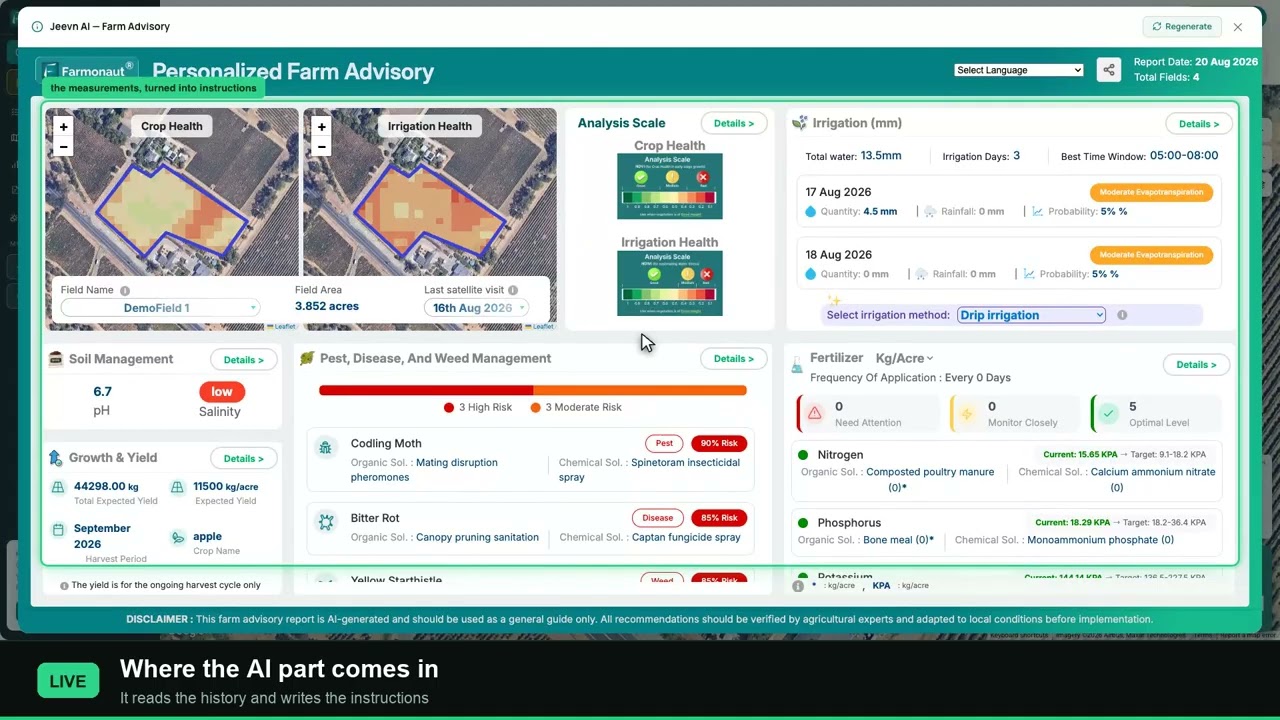
Potassium ran from zero on one apple block to 96 kg per acre on a plum block — same client, same country, same week.
What the numbers add up to
Pulling the three mechanisms together gives a clear picture of where a portfolio like this one gains, and each figure below is computed from the advisory itself rather than estimated.
| Mechanism in the advisory | What it delivers on this portfolio |
|---|---|
| Drip recommended over flood on 12 of 15 fields, with furrow deliberately retained on melon, cotton and apricot | 27.8% less water area-weighted on the drip-recommended fields, 18.8–40.0% per field |
| Every nutrient rated per field — phosphorus spanning 14.4×, potassium 8.9×, one block needing no potassium at all | 34.0% of the nutrient programme placed correctly that a uniform blanket rate would have misallocated — 48.8% for potassium alone |
| 39 alerts at ≥80% probability, each crop-specific and stage-appropriate, each with an organic and a chemical option | Scouting and spray effort directed to named fields and named organisms |
| Pre-dawn 05:00–08:30 irrigation windows across all 15 fields | Lower evaporative loss per millimetre applied, at no cost |
The two headline figures — a 27.8% water reduction on drip-recommended fields and 34.0% nutrient misallocation avoided — come from independent parts of the same report. One is a delivery-method change, the other is nutrient placement. A grower can adopt either without the other, and the second needs no new equipment at all.

Grower-reported outcomes, as submitted
The cards below reproduce AGROEX Consultancy’s answers to our in-app feedback questionnaire for the advisory dated 7 June 2026, exactly as recorded. They are structured survey responses, not paraphrases, and not verbatim quotations.
Building soil, not just applying fertiliser
One reading runs across all 15 fields in all three countries and shapes the entire nutrient strategy: soil organic carbon sits between 0.12% and 0.25%. Organic matter is what holds both water and nutrients in the root zone, so that reading changes what the right recommendation is. Soil pH came back between 6.8 and 7.8 — neutral to mildly alkaline, which for fruit trees is where iron and zinc availability becomes the thing to manage rather than the total applied.
On six of the fifteen fields salinity reads moderate rather than low — a well-known characteristic of long-irrigated Central Asian farmland, where evaporation concentrates salts in the upper profile faster than leaching clears them. The advisory tracks it per field and cites regional soil-profile studies and World Bank agriculture sector reporting, so the grower sees exactly which blocks to watch rather than a portfolio-wide guess.
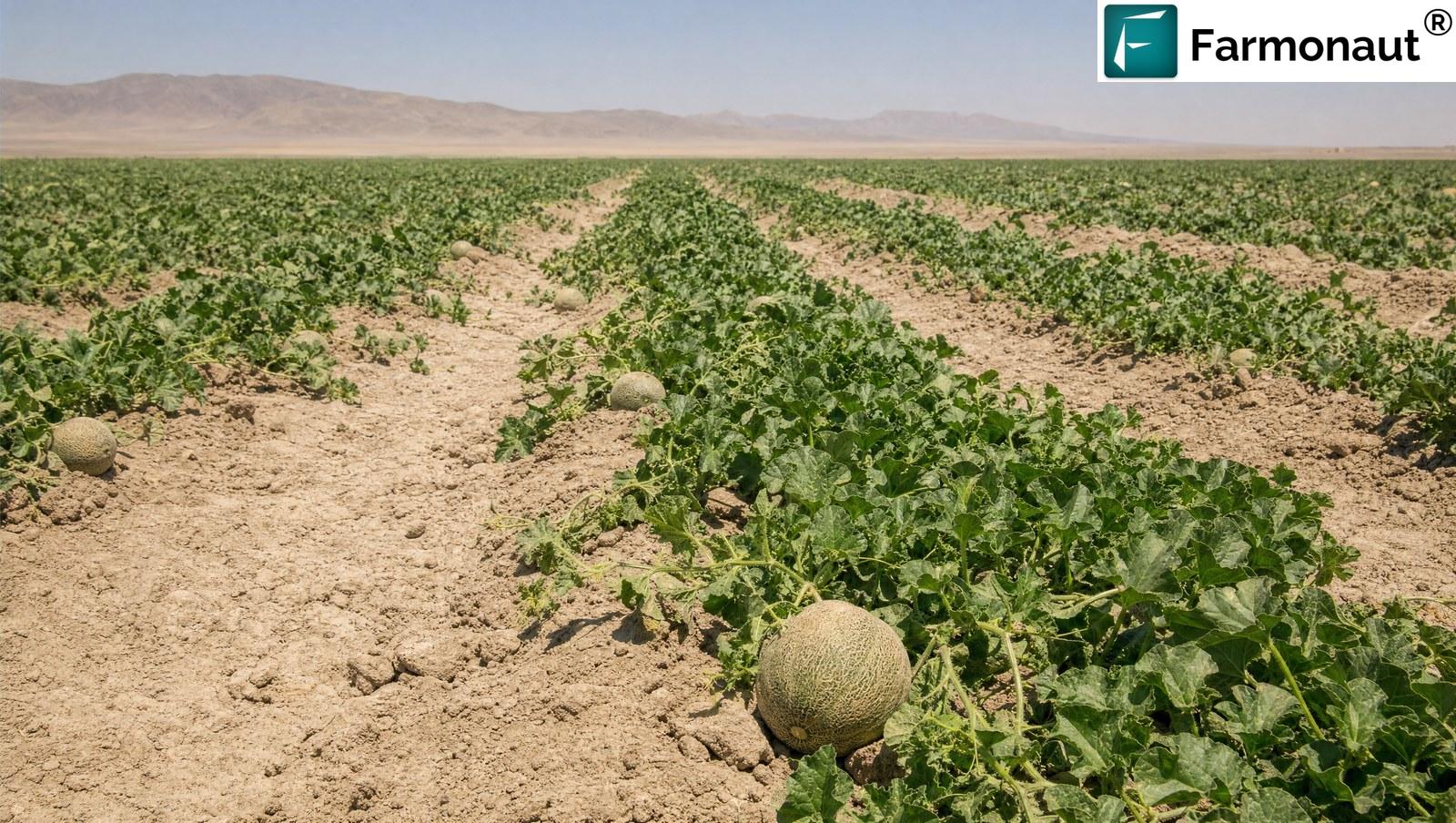
This is why the fertiliser guidance for these fields leans on organic-matter building alongside the mineral rates — composted pine bark is the organic source the advisory names for sulphur, and it does double duty on soil structure. Reading carbon and salinity per field is what turns a nutrient plan into a soil plan, and it arrives on every pass at no extra cost.
The two findings reinforce each other. Moving 12 fields from flood to drip cuts the volume of water passing through a saline profile, which slows salt accumulation — while the water saving itself matters in a basin where irrigation demand already exceeds supply. The efficiency case and the soil-health case point the same way.
Why per-crop beats per-farm at portfolio scale
The yield estimates make the final argument on their own. Across the portfolio, expected yields ran from 1,020 kg/acre on the cotton block to 9,100 kg/acre on an apple orchard — an 8.9-fold spread. Those two fields belong to the same client, sit in the same country, and were advised in the same week. Any metric averaged across them describes nothing that exists.
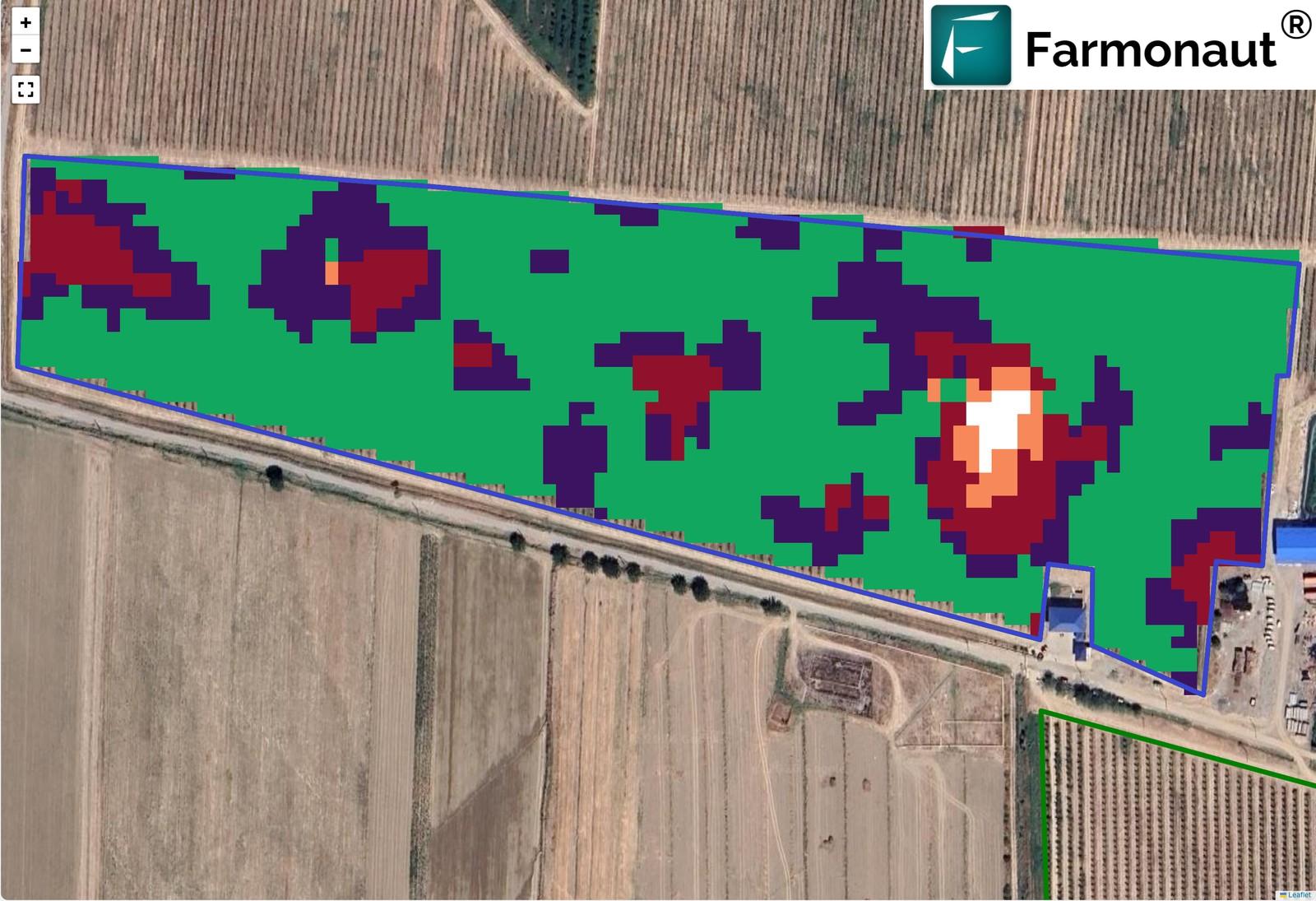

This is the practical case for a per-field satellite crop advisory in a consultancy rather than an owner-operator setting. The consultant’s problem is not “how is my farm doing” — it is “which of my fifteen fields, in three countries, needs me this week, and what specifically do I tell that grower”. Answering it requires the guidance to be resolved to the field, the crop and the growth stage. On the evidence here, it is.
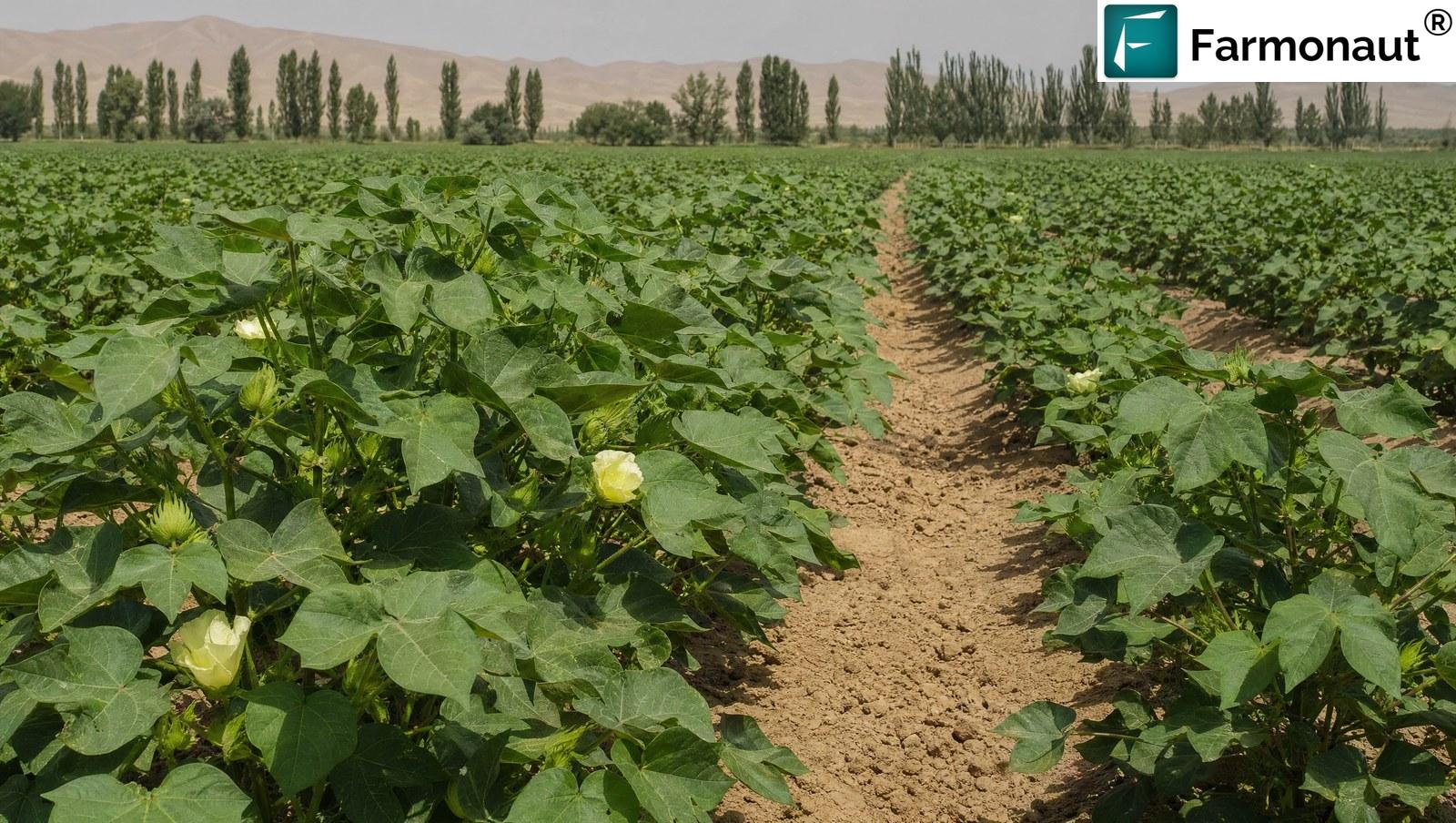
Running this on your own portfolio
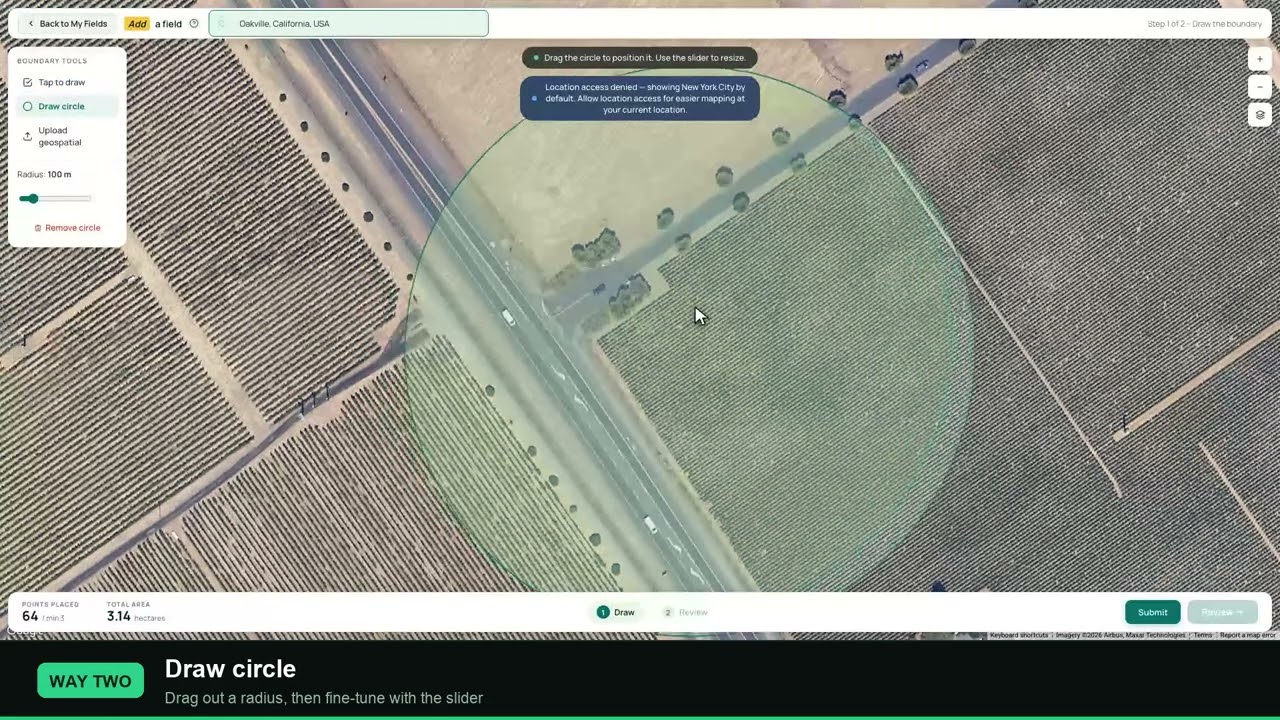
The workflow that produces a satellite crop advisory needs no hardware in the field.
- Map every field separately, even across borders. This account’s value comes from 15 boundaries in 3 countries, not one region. Fields in different countries are simply different fields.
- Set the crop and sowing date per field. Crop coefficient, phenological stage and pest model all key off this — it is what produced Venturia pyrina on the pear and Venturia inaequalis on the apple.
- Read the irrigation method selector, not just the millimetres. On this portfolio the method carried more saving than the schedule did.
- Compare nutrient mixes field by field. The totals hide the misallocation; the ratios expose it.
- Act on the soil warnings. Low organic carbon and creeping salinity are slow problems that only get more expensive.
Explore the platform at sat.farmonaut.com, read more about our satellite and AI-based farm advisory in the JEEVN AI overview, or contact our team about multi-country portfolio onboarding. JEEVN AI is a paid product; plan detail is on the platform.
Fifteen fields, three countries, one dashboard
Map each field once, set its crop, and get per-field irrigation, nutrient and pest guidance from satellite passes over your own ground — wherever those fields happen to be.
Frequently asked questions
What is a satellite crop advisory, and what does it deliver per field?
A satellite crop advisory is a per-field report generated from a satellite pass over your own boundary. Each one carries a day-by-day irrigation schedule in millimetres with a recommended delivery method, per-nutrient fertiliser rates for N, P, K, S and Zn with organic and chemical sources, pest and disease risk with control options, weed risk, soil pH, organic carbon and salinity, and a yield estimate. In this case study, 15 fields across three countries each received their own.
Can one account monitor fields in more than one country?
Yes. This consultancy runs 11 fields in Uzbekistan, three in Tajikistan and one in Turkmenistan under a single account, totalling 631.7 acres. Because the fields sit at different longitudes they are imaged on different satellite passes, which is why the account received 181 advisories across 46 acquisition dates in 75 days rather than one weekly batch.
How much water does switching from furrow to drip irrigation actually save?
On this portfolio, the advisory’s recommended drip quantity was 27.8% lower on an area-weighted basis than the flood alternative listed in the same report, with per-field differences from 18.8% to 40.0%. Across all 15 fields including the three where furrow was deliberately retained, the figure is 17.0%. The client’s own reported estimate was higher, at 30–50%.
Does the advisory just recommend drip irrigation everywhere?
No, and that is a useful check on it. Drip was recommended on 12 of 15 fields — but furrow irrigation was retained on the melon block, the cotton block and one apricot orchard, where the crop geometry and local practice make it the right method. A system biased toward the modern option would have recommended drip on all fifteen.
How can a fertiliser advisory save money if the total tonnage does not fall?
By placing it correctly. On this portfolio, phosphorus rates spanned 14.4× and potassium 8.9× across fields, and one apple block needed no potassium at all. A single uniform rate applied to every acre would have misallocated 34.0% of the nutrient programme — 48.8% for potassium alone — over-feeding some fields while starving others. The saving is in the misapplication avoided, not necessarily in the total purchased.
Are the pest probabilities confirmed infestations?
No. They are modelled risk scores combining satellite indices, weather and regional pest pressure, and they function as a scouting priority list. Each is paired with both an organic and a chemical control option so the decision stays with the agronomist. The evidence that the model is working on this portfolio is its specificity: 39 alerts at ≥80%, each correct for its host crop and growth stage.
How does the advisory handle ten different crops on one account?
Every field is resolved independently from its own crop, growth stage and satellite pass. On this portfolio that produced ten distinct nutrient mixes, twelve drip recommendations with three furrow retentions, and 39 crop-specific pest alerts in a single week — including Venturia inaequalis on the apple blocks and Venturia pyrina on the pear, two different fungal species correctly matched to their hosts.
Glossary
- Phenological stage
- Where a crop sits in its season — bud burst, pink bud, flowering, fruit set, fruit development, squaring. It determines water demand, nutrient demand and which pests are relevant. Seven stages were live across this portfolio at once.
- Crop coefficient (Kc)
- The multiplier that converts reference evapotranspiration into a specific crop’s water demand at a specific stage. Different for apple, melon and cotton, which is why one irrigation figure cannot serve all three.
- Furrow and basin irrigation
- Traditional gravity flood methods that deliver water along channels or into bunded areas. Simple and cheap, but a large share of the applied water never reaches the root zone.
- Soil organic carbon (SOC)
- A proxy for soil organic matter, governing structure, water-holding capacity and nutrient buffering. Flagged low on all 15 fields here, at 0.12–0.25%.
- Salinity (soil)
- Accumulated soluble salts in the profile. In long-irrigated arid regions, evaporation concentrates salts faster than irrigation leaches them. Six of these 15 fields returned moderate rather than low salinity.
Case-study basis: JEEVN AI field advisories for a single Farmonaut account, taking each field’s most recent advisory as of the client’s feedback submission (portfolio state at 7–9 June 2026, 15 fields), plus the account’s in-app feedback submission for the advisory dated 7 June 2026. Client organisation name, crops, countries, field count and area are reported from the account’s own records on the platform; individual grower names and field locations are withheld. The 30–50% irrigation and above-70% fertiliser figures are the client’s own estimates from a structured feedback form, not metered or invoiced measurements; the 27.8% water and 34.0% nutrient-misallocation figures are our own calculations from the advisory data against stated baselines. Pest, disease and weed percentages are modelled probabilities, not confirmed infestations. Yield figures are estimates, not guarantees. External agronomic references are attributed as cited within the advisory itself, including FAO crop guidelines, UC IPM pest management guidelines and regional soil-institute standards. Imagery: the five platform screenshots and the crop-health zone map are genuine captures of this account’s own advisory and satellite data; the five wider field photographs are AI-generated illustrative imagery, each labelled as such in its caption, and do not depict the client, its growers or their fields. JEEVN AI is a paid product.
Discussion
Questions, corrections or field experience? Share them below. First-time comments are reviewed before they appear, and your email is never published.
No comments yet. Be the first to add a question or your experience.

 Green Bite Farm
 FCF India
 Unifrutti Gulf
 Deluxe Conseil
 TVS Electronics
 BW Pipelines
 WICO
WICO Gen Chayat
 Chimera Innovation
 SkyHarvest
 Polaris Digitech
 Teledarbas
 Wild Oak Farm
 SFX
SFX Doodlakine
