

Satellite Turmeric Crop Advisory: Two Identical Fields, Opposite Instructions

Nikhil Deshpande runs five fields across just under six acres in Nagpur Division, Maharashtra — two of turmeric, two of soybean and one of pigeon pea. Two of those fields are the same crop at the same stage on the same pH, two days apart in sowing date. One was told to apply 105 kg of phosphorus per acre. The other was told to apply nothing at all.
Six acres is small enough that most advice treats it as one place. This holding shows why that fails. Its five fields carry three crops at three different stages — soybean filling pods, turmeric in vegetative tillering, pigeon pea building canopy — and they will be harvested across four separate windows between October 2026 and March 2027. On a farm this size, a single plan is not a simplification. It is three wrong answers.
The grower has been monitored since January 2026 and, by the time of the feedback in August, the account had received 150 field advisories across 44 satellite acquisition dates. He reported that the reports had helped optimise both his irrigation and his fertiliser application. This article opens the week he was reading — the advisory generated from the 20 August 2026 pass, covering 21 to 27 August — and traces where those savings sit.
The two turmeric fields were sown two days apart, sit at the same growth stage, and read the same pH of 6.8 with organic carbon of 0.13% and 0.14%. One was prescribed 41.3 kg/acre of nitrogen, 105.2 of phosphorus, 68.3 of potassium and 87.6 of sulphur. The other was prescribed nothing — not nitrogen, phosphorus, potassium, sulphur or zinc, because every one of its five readings was already inside its target band. Same crop, same week, opposite instructions.
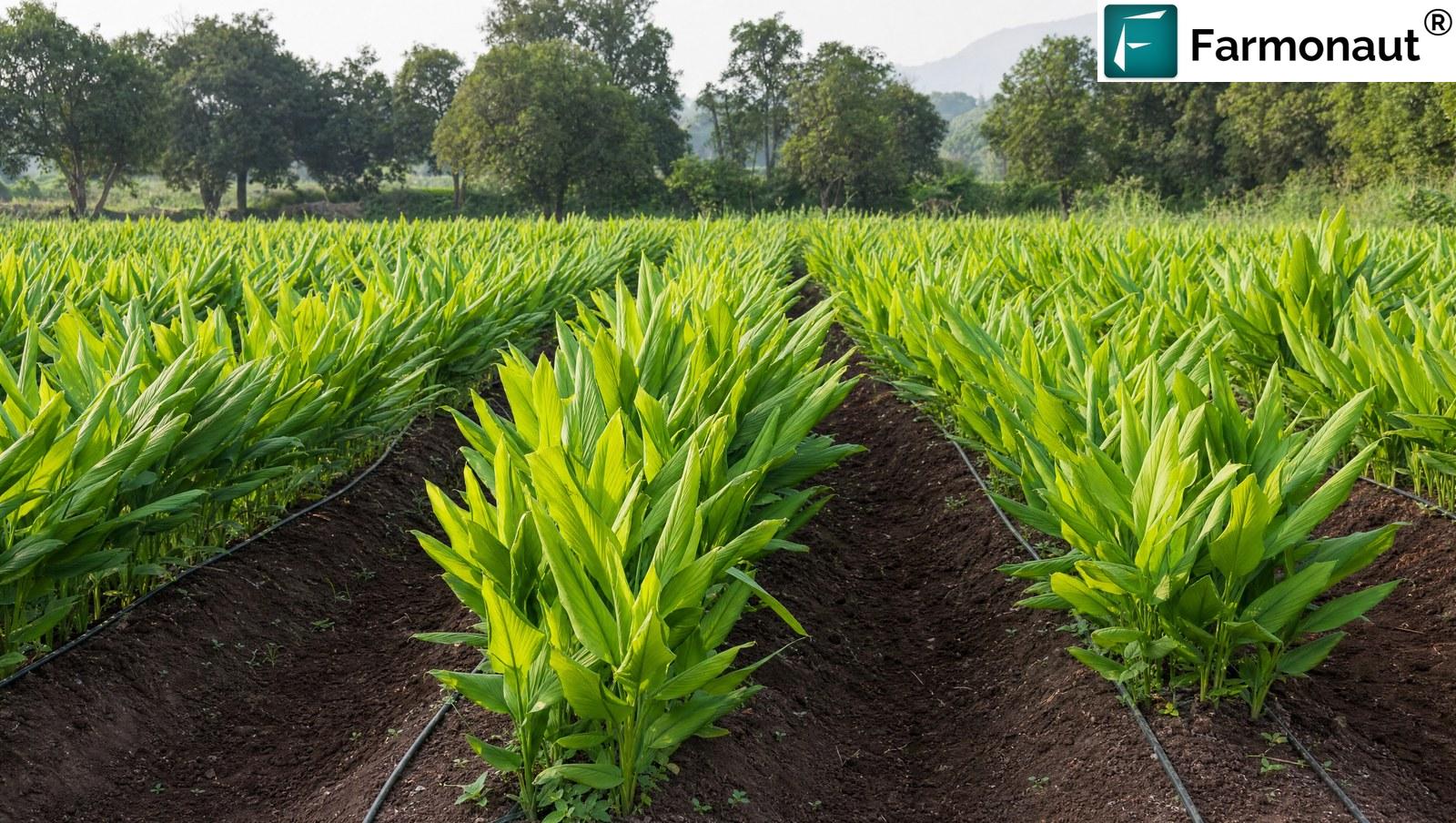

Five fields, three crops, four harvest windows
The holding is genuinely small — the largest field is 2.74 acres and the smallest, the pigeon pea plot, is 0.32 acres. What it lacks in scale it makes up in complexity, because those five fields are running three separate crop cycles simultaneously.
| Crop | Acres | Stage | Method | Water, 7 days | N | P | K | S | Harvest |
|---|---|---|---|---|---|---|---|---|---|
| Soybean | 2.74 | R3–R4 pod development | Drip | 13.5 mm | 19.0 | 27.7 | 68.3 | 7.1 | Oct 2026 |
| Turmeric | 1.20 | Vegetative / tillering | Drip | 10.5 mm | 41.3 | 105.2 | 68.3 | 87.6 | Feb 2027 |
| Turmeric | 1.00 | Vegetative / tillering | Drip, broad bed & furrow | 10.2 mm | 0 | 0 | 0 | 0 | Mar 2027 |
| Soybean | 0.69 | R3–R4 pod development | Sprinkler | 13.5 mm | 19.0 | 42.6 | 64.7 | 41.9 | Oct 2026 |
| Pigeon pea | 0.32 | Vegetative branching | Furrow | 0 mm | 19.8 | 25.8 | 75.8 | 7.1 | Jan 2027 |
| Portfolio — 5.95 acres | 47.7 mm | S spans 7.1 to 87.6 kg/acre | 4 windows | ||||||
Two turmeric fields, sown two days apart. One needs 105 kg of phosphorus. The other needs nothing at all.
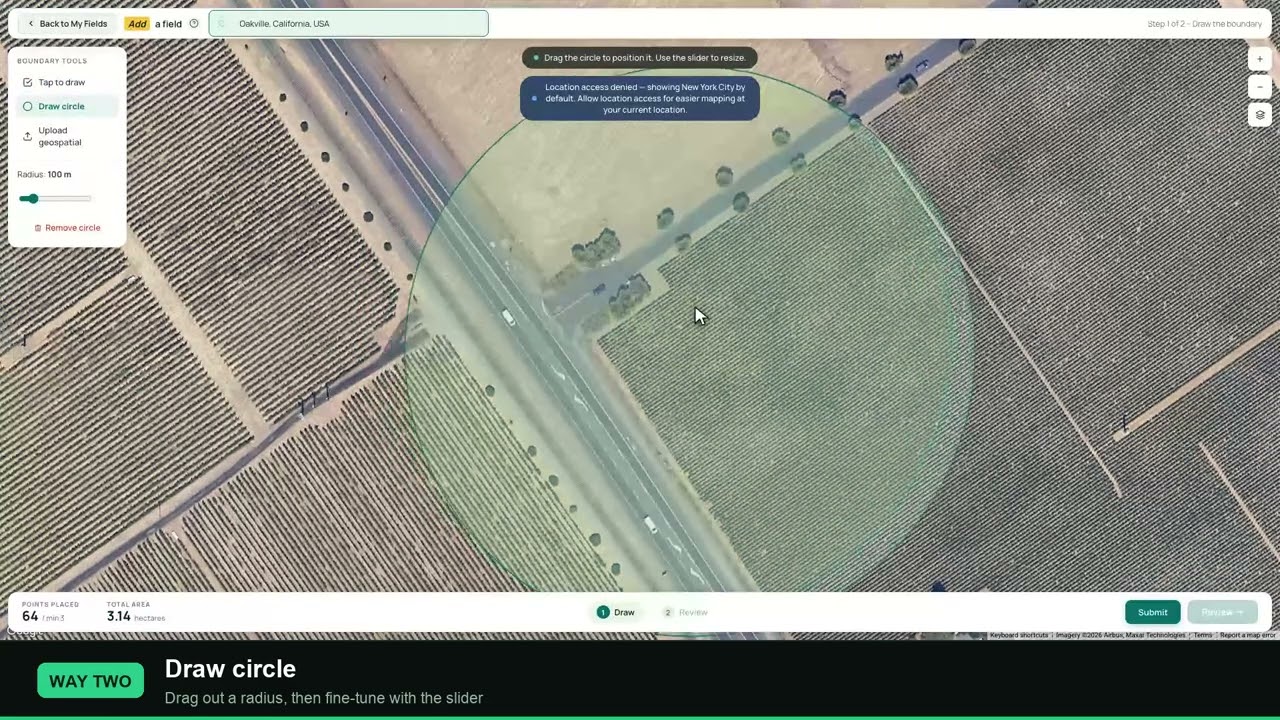
What the satellite turmeric crop advisory delivers per field
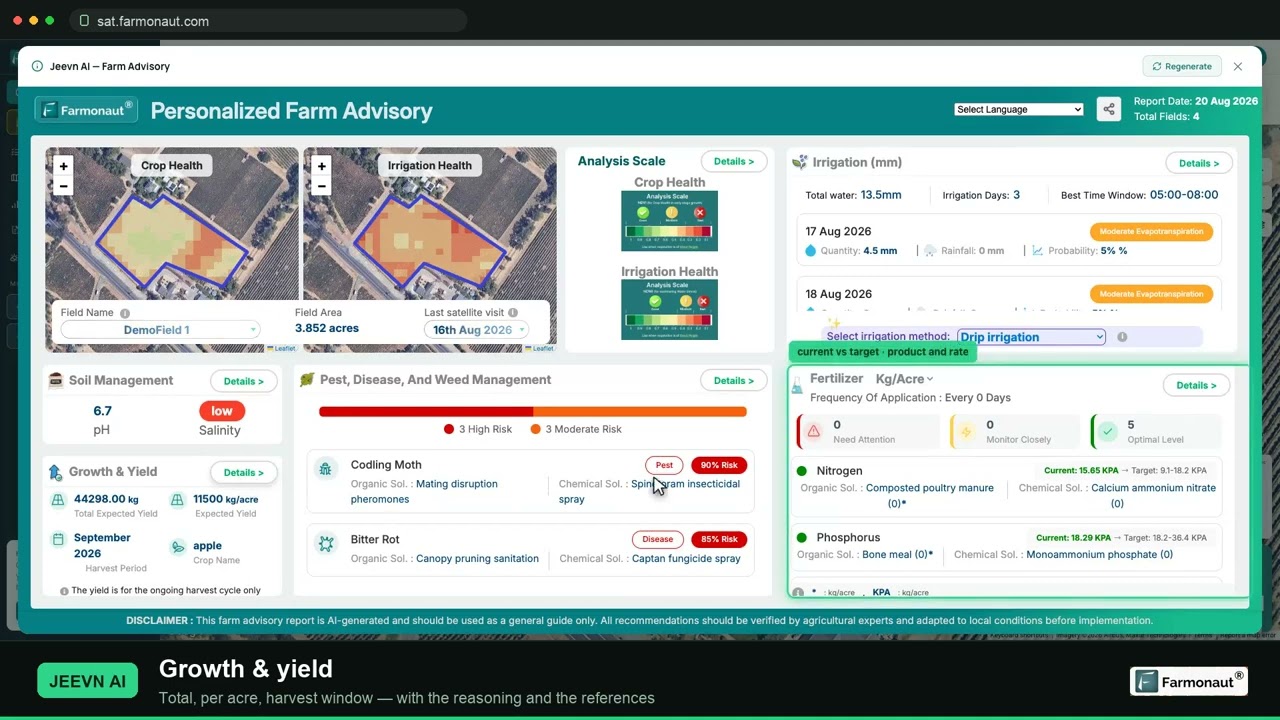
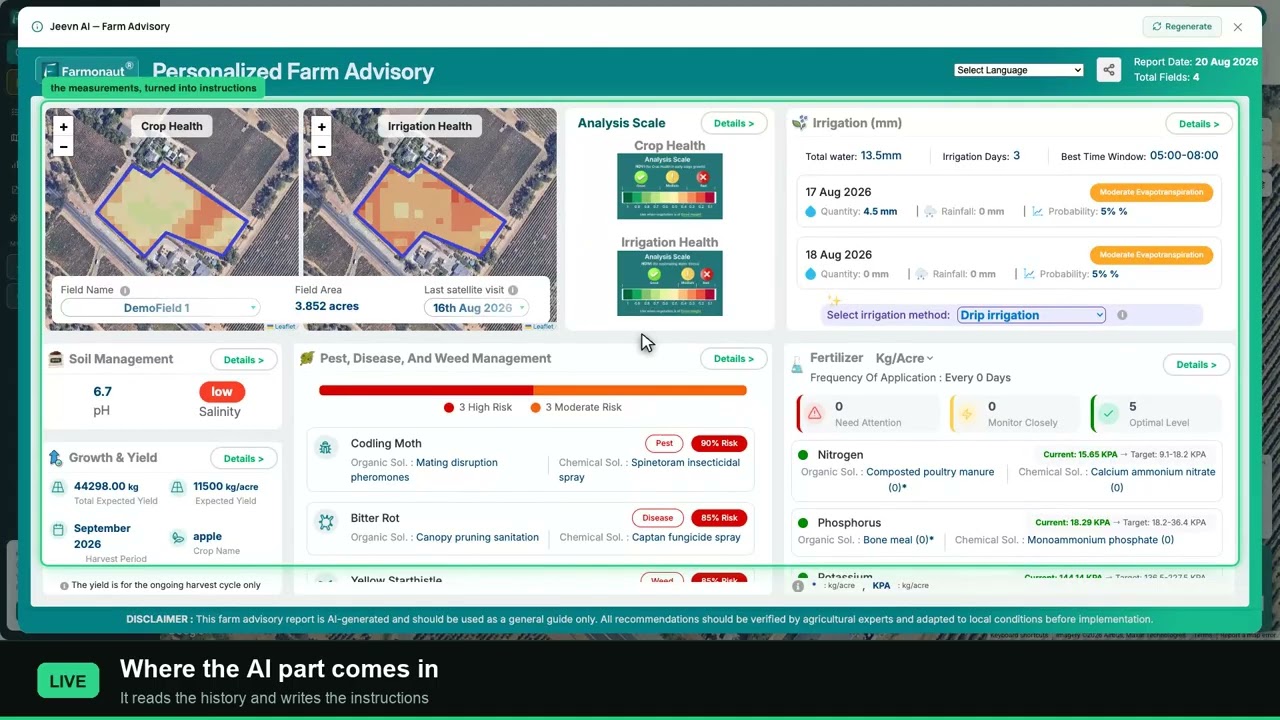
Each field receives its own report per satellite pass: a seven-day irrigation schedule with the delivery method named and alternatives priced in millimetres, per-nutrient fertiliser rates with an organic and a chemical source for each, pest and disease risk with percentage scores, weed pressure, soil chemistry and a yield estimate with a harvest window.
The word “own” is doing the work in that sentence. Nothing in the report is a regional average pushed out to every subscriber growing turmeric in Vidarbha. The boundary the grower drew is what gets read, the crop and stage he set is what the coefficients are applied to, and the soil chemistry is modelled for that polygon rather than inherited from a district table. That is why two fields of the same crop, sown in the same week, come back with different instructions — and why they should.
Across the seven months to the feedback date the account accumulated 150 of these reports across 44 acquisition dates. Five fields times forty-four passes does not come to exactly 150 because fields were added at different points and cloud cover removes individual passes, but the cadence works out at roughly a fresh read per field every four to five days through the growing season.
Fertiliser: turmeric is a phosphorus and sulphur crop — on the field that is short of them
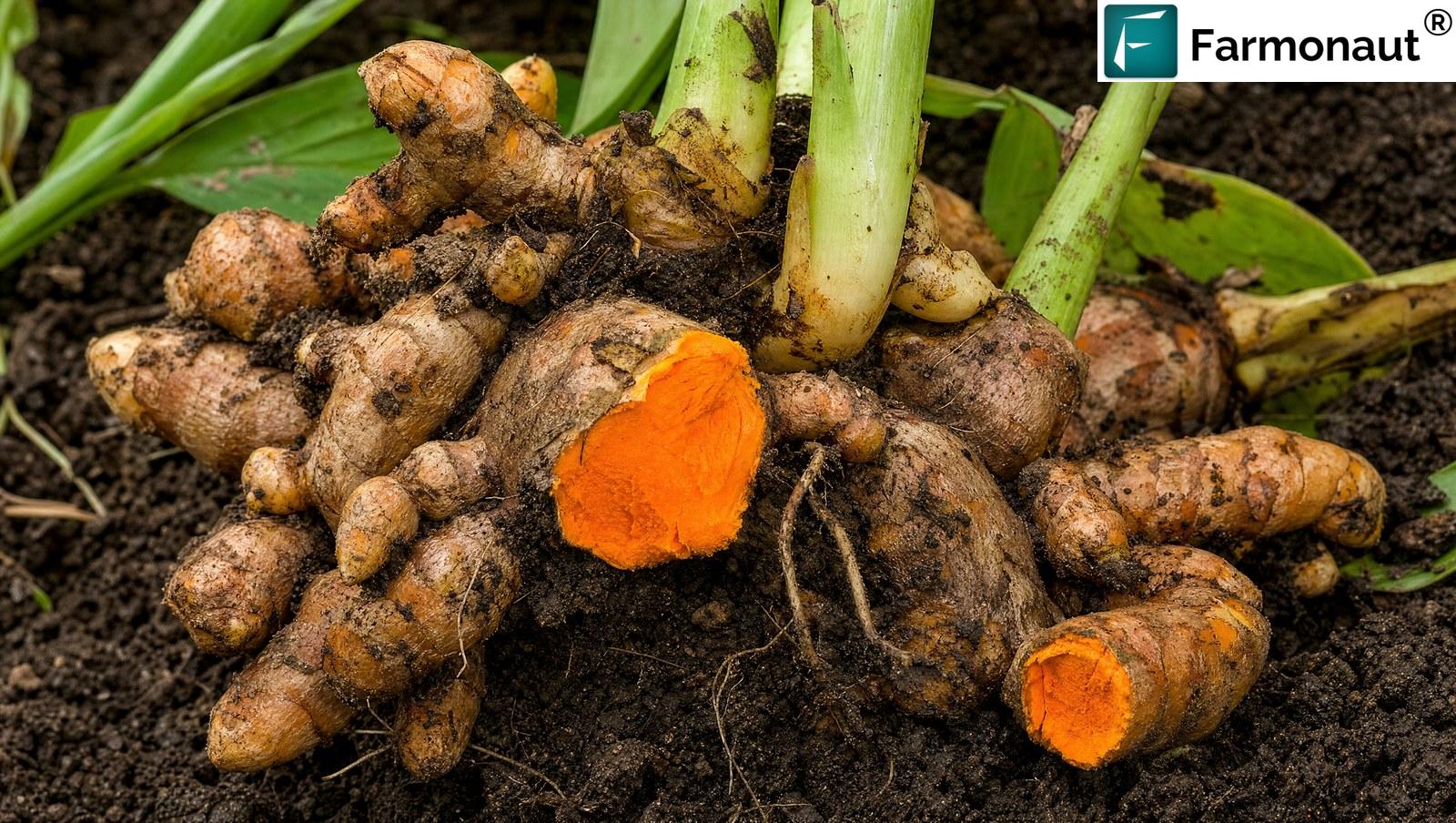
Turmeric is a rhizome crop, and rhizome crops are heavy phosphorus feeders: phosphorus drives the underground bulking that is the entire harvested product. Sulphur matters for the same reason, because it underpins the curcuminoid and essential-oil formation that determines quality. The advisory reflects both directly on the 1.20-acre turmeric field — 105.2 kg/acre of phosphorus and 87.6 kg/acre of sulphur, against 27.7 and 7.1 respectively on the large soybean field.
The second turmeric field is the more interesting case. It is the same crop, at the same stage, sown two days later, on the same pH — and it was prescribed zero nitrogen, zero phosphorus, zero potassium, zero sulphur and zero zinc. Not a reduced rate. Nothing.
The reason is in the readings rather than the crop. That field measured 45.0 ppm of nitrogen against a target band of 20–40, 45.0 ppm of phosphorus against 25–50, and 165 ppm of potassium against 110–180. Its neighbour measured 14.2 ppm nitrogen, 11.5 ppm phosphorus and 105 ppm potassium — roughly a threefold difference in available nitrogen and a fourfold difference in phosphorus between two fields of the same crop on one small holding. One is at or above the top of every band; the other is below the bottom of most.
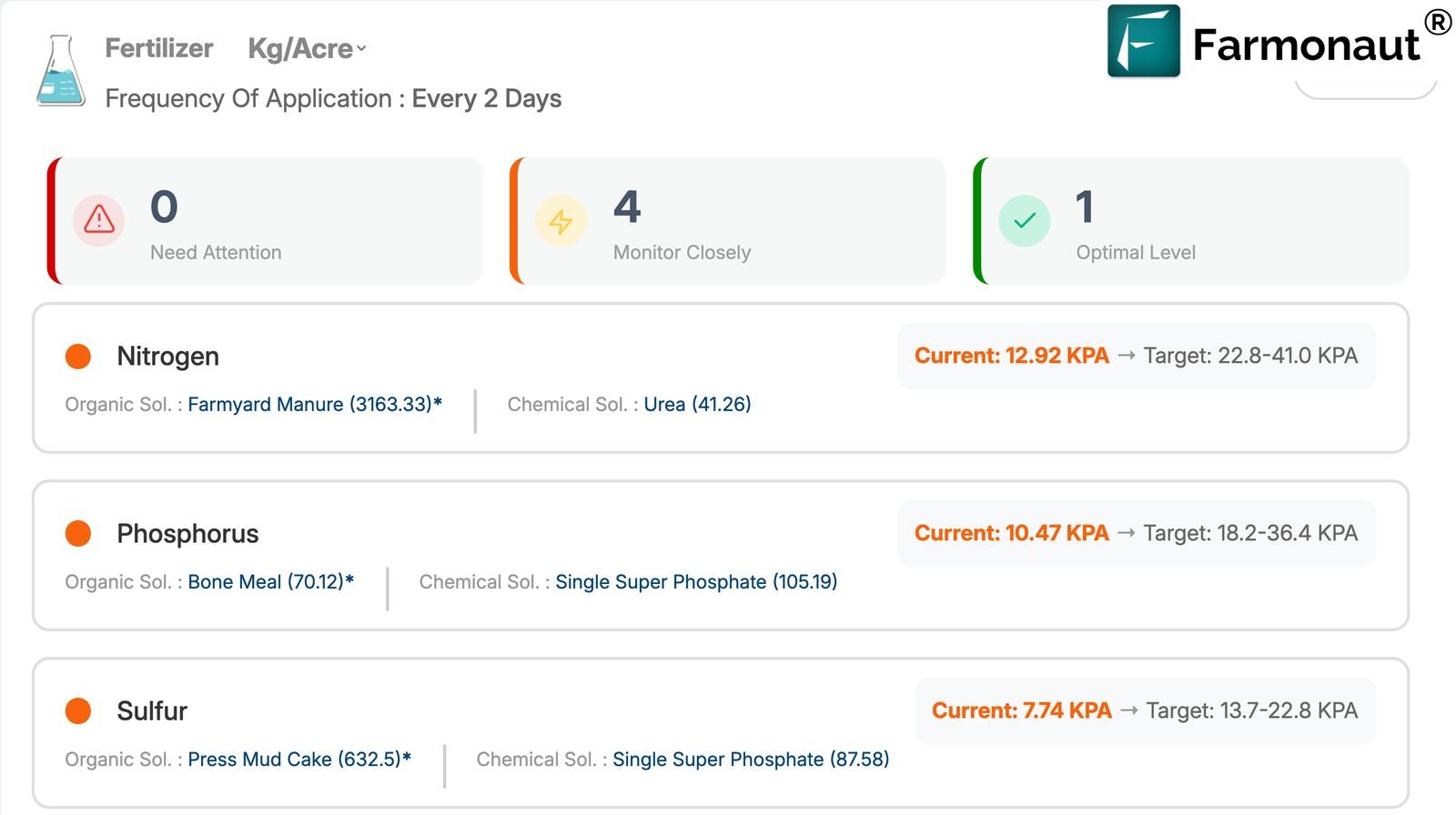
On a mixed smallholding, the fertiliser saving is rarely a smaller dose — it is a skipped field. One of these five needed nothing at all this week. Reading the zeros first is the fastest way to turn an advisory into money, and it takes about thirty seconds.

Irrigation: three crops, three rhythms, and rain that only fell on two fields
Twenty-three of thirty-five field-days carried a zero — 65.7% of the scheduled week. Against irrigating every field on every day at that field’s own highest recommended rate, following the schedule applies 57.4% less water: 47.7 mm rather than 112.0.
Two of the zeros are rainfall decisions, and they are the clearest illustration on this holding of what per-field means. The advisory forecast 12 mm of rain on the pigeon pea field on 21 August with an 80% probability of precipitation, and set the entire week to zero on that field as a result. It forecast 12 mm on the 1.00-acre turmeric field on the 23rd, and trimmed that field’s next application from 3.5 mm down to 3.2 mm — a small adjustment, but an adjustment the neighbouring turmeric field, which was given no rain, did not receive.
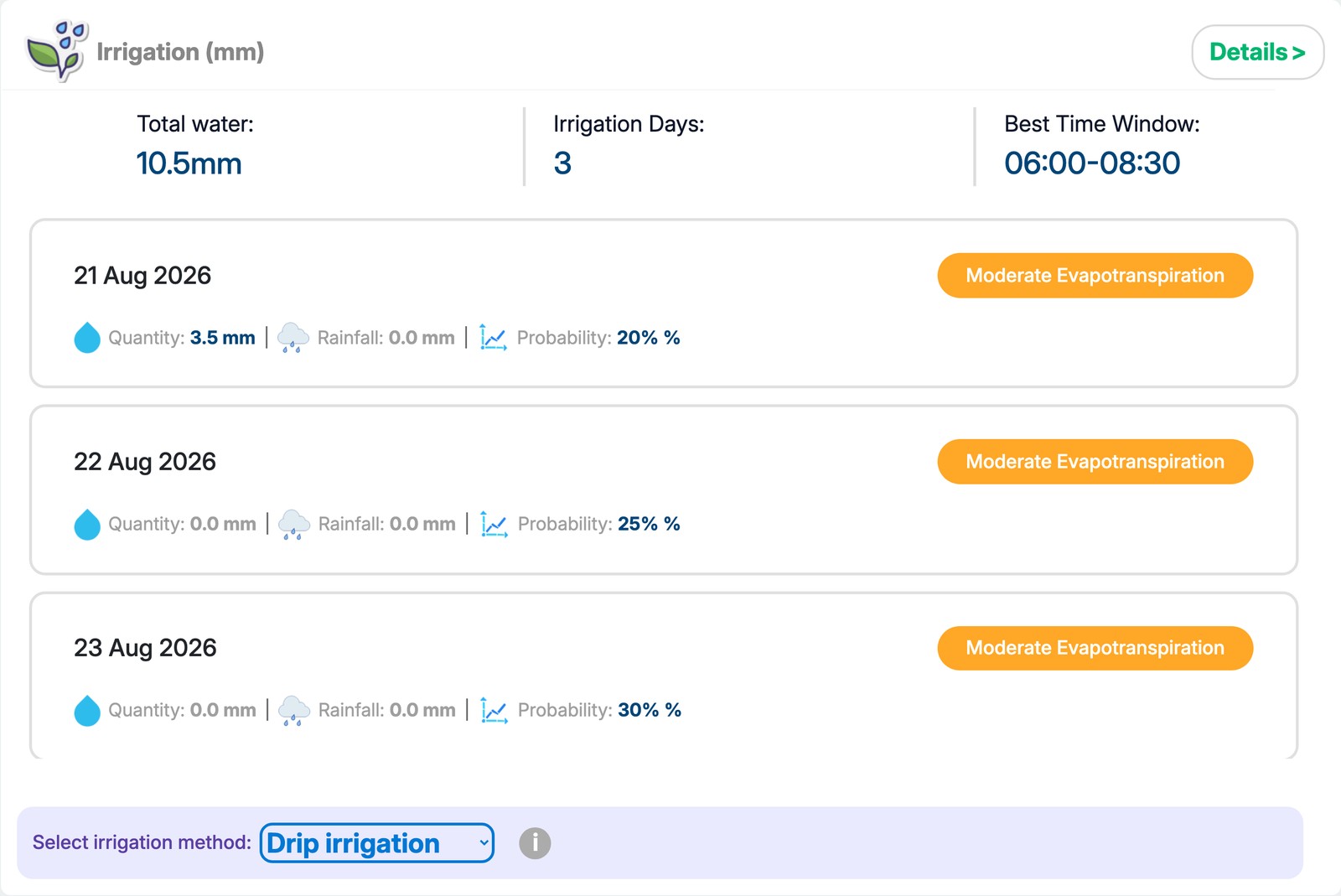
The method handling is worth a paragraph of its own, because the advisory prices the alternatives rather than simply naming a winner. On the 1.20-acre turmeric field drip is recommended at 3.5 mm, with micro-sprinkler listed at 4.2 and furrow at 5.5 — the flood option costs 57% more water for the same job. On the 1.00-acre field the recommended method is named as “drip irrigation (with broad bed and furrow system)”, which is the actual bed geometry turmeric is grown on across Vidarbha, rather than generic flat-field drip.
The two soybean fields differ from each other in a way that shows the model is reading installed reality rather than theory. On the 2.74-acre field drip is recommended at 4.5 mm, with sprinkler at 5.5 and furrow at 6.5. On the 0.69-acre field sprinkler is recommended at 4.5 mm — while drip is listed at 3.8, the lower figure. The advisory is recommending the system that field actually has, and publishing the cheaper alternative next to it so the grower can see exactly what a conversion would be worth.
The recommended method is not always the cheapest one on the card. On the 0.69-acre soybean field sprinkler is recommended at 4.5 mm while drip sits below it at 3.8 — the advisory is costing the system that field actually has, and publishing the 15% saving a conversion would buy rather than pretending the field already has it.
Pest and disease: three crops, three problem sets
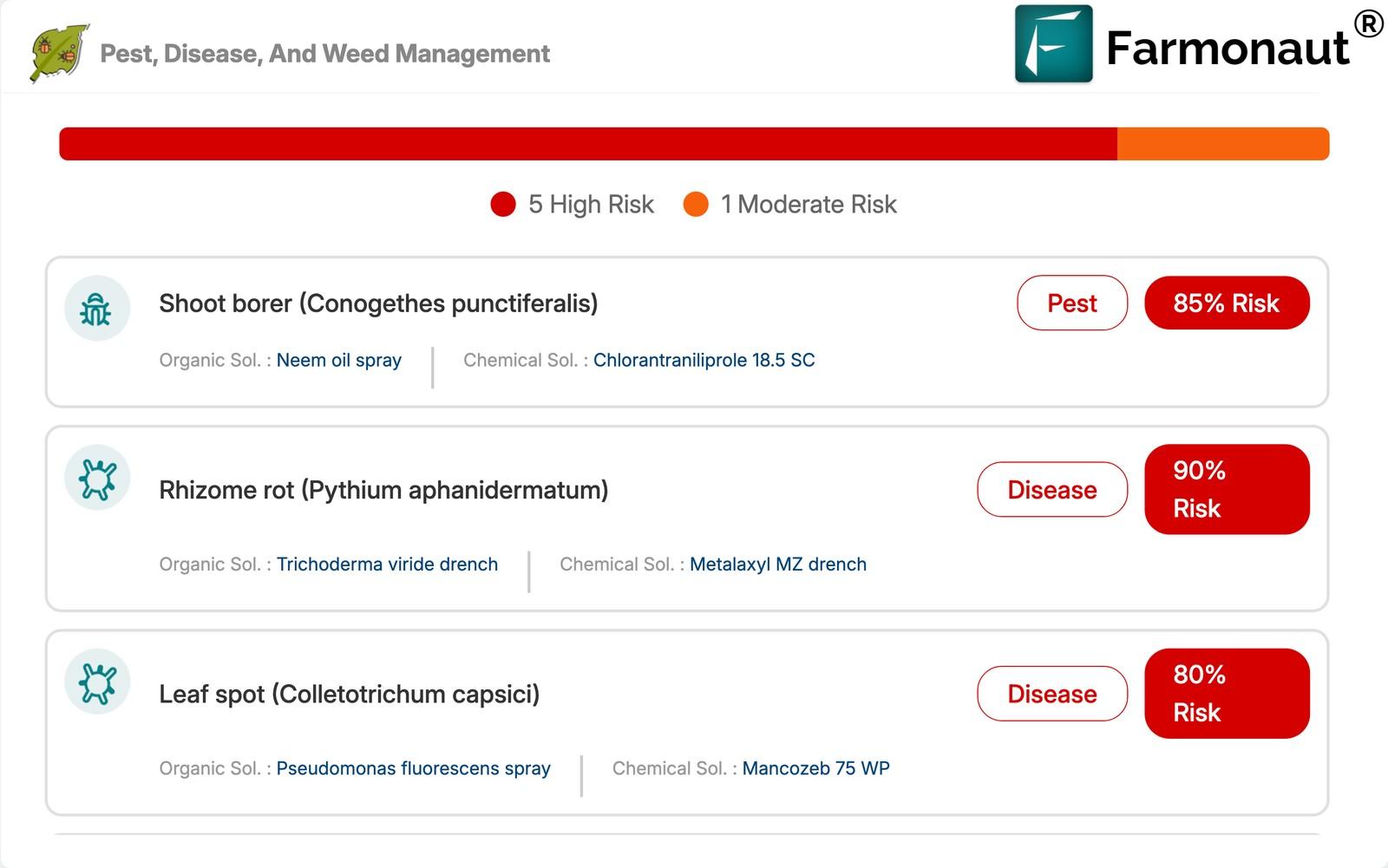
Across the five fields the pest lists share almost nothing. The turmeric fields led with rhizome rot (Pythium aphanidermatum) at 90 and 91%, shoot borer (Conogethes punctiferalis) at 85 and 87% and leaf spot (Colletotrichum capsici) at 80 and 83%, with rhizome scale behind them at moderate risk. Rhizome rot is the disease that destroys turmeric crops outright in a wet season, and it is soil-borne — so an early probability flag is worth considerably more than a late diagnosis.
The soybean fields led instead with girdle beetle (Obereopsis brevis) and anthracnose / pod blight (Colletotrichum truncatum) at 80 and 82%, with tobacco caterpillar (Spodoptera litura) at 84% on the smaller field and Rhizoctonia aerial blight behind on both. The pigeon pea field led with Phytophthora blight at 85% and Fusarium wilt at 75% — and both are named to the pigeon-pea-specific pathogen: Phytophthora cajani and Fusarium udum, not a generic Phytophthora or Fusarium.
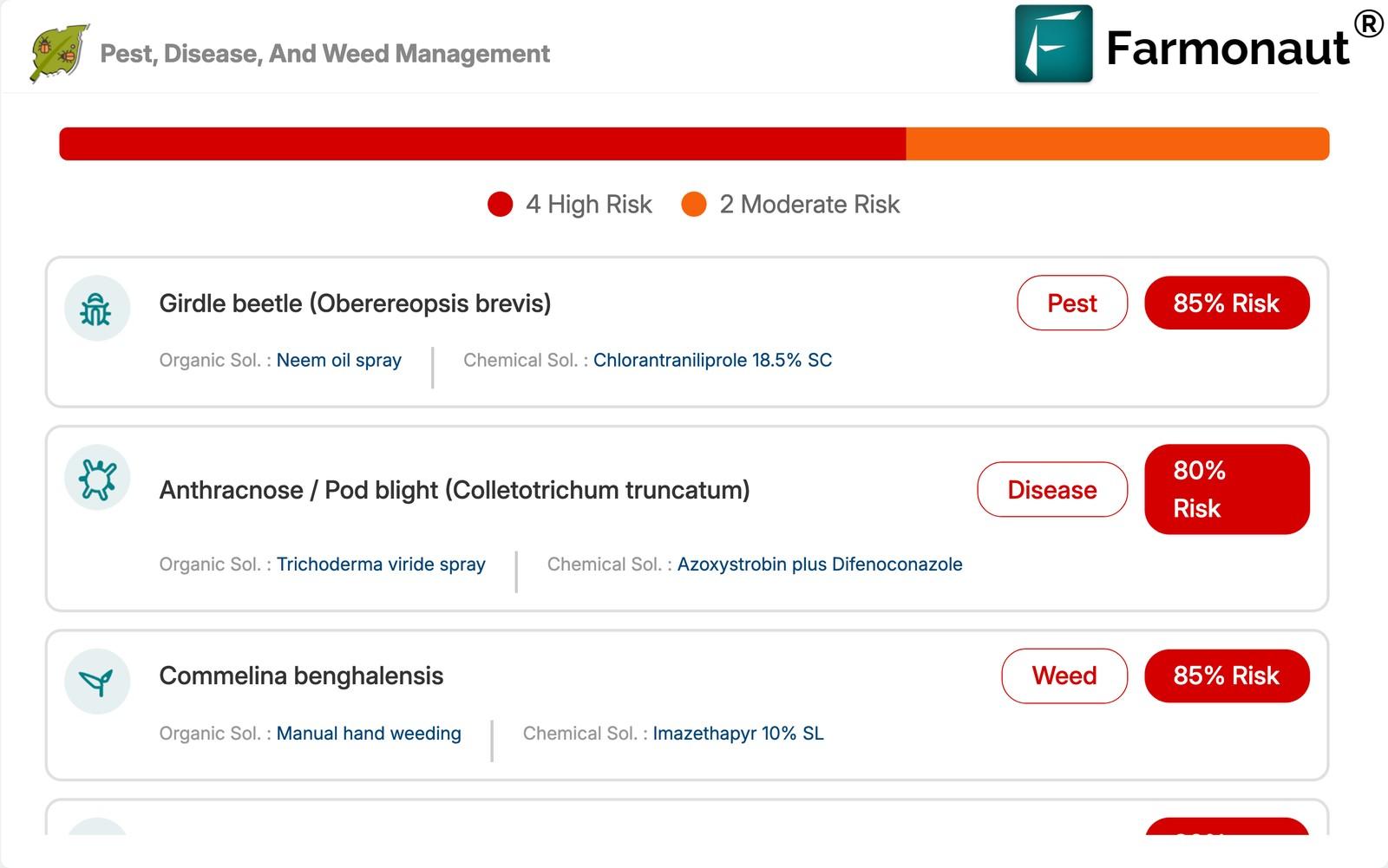
One detail is worth pausing on. The anthracnose on soybean is named Colletotrichum truncatum; the leaf spot on turmeric is named Colletotrichum capsici. Same genus, two different species, each on its correct host. A model working at genus level would have called both “anthracnose” and offered the same product; these two need different timing and different thresholds.
Weed pressure was consistent and regionally correct across the holding: Cyperus rotundus (purple nutsedge) at 76–86% on four of the five fields, and an Echinochloa grass on every one of them — E. colona on four, E. crus-galli on the small soybean field. Commelina benghalensis led on the large soybean at 85%, and Bermuda grass on the 1.00-acre turmeric at 80%. On a drip-irrigated raised bed, nutsedge is particularly costly because it colonises exactly the wetted strip the crop depends on.
What the numbers add up to
| Mechanism in the advisory | What it delivers on these five fields |
|---|---|
| Nutrient set by crop and by each field’s own soil reading | Sulphur from 7.1 to 87.6 kg/acre; phosphorus from 25.8 to 105.2 |
| One turmeric field found already in range on all five nutrients | One field in five prescribed nothing at all |
| 23 of 35 field-days set to zero irrigation | 57.4% less water — 47.7 mm rather than 112.0 |
| Rainfall applied per field, not per farm | A whole week withdrawn on one field; a 3.5 mm dose trimmed to 3.2 on another |
| Alternative delivery methods priced in millimetres | Furrow costs 57% more water than drip on the same turmeric field |
| Separate pest lists per crop, resolved to species | C. truncatum on soybean, C. capsici on turmeric, P. cajani and F. udum on pigeon pea |
On a six-acre holding the absolute rupee saving is modest — but so is the margin. Skipping one field’s entire nutrient application and cutting irrigation volume by more than half are both material against a smallholder’s input budget, and neither requires buying anything to implement.
Twenty-three of thirty-five field-days carried a zero. On a mixed holding, half the value of an irrigation schedule is the days it tells you to leave the pump off.
Grower-reported outcomes, as submitted
The cards below reproduce Nikhil Deshpande’s answers to our in-app feedback questionnaire for the advisory dated 20 August 2026, exactly as recorded.
The percentages are the grower’s own conservative estimates from a structured form rather than metered volumes. What the advisory data shows independently is that the guidance was resolved to the field, the crop and the stage — including one field where the correct action for the week was to spend nothing.

Building organic matter on a small holding
The soil reading is consistent and it is the one constraint shared across every field: organic carbon between 0.13% and 0.15%, flagged low on all five, with pH 6.8 on four fields and 7.2 on the pigeon pea, and salinity low throughout. Carbon at that level is low even by the standards of intensively cropped Vidarbha soils, and it changes what a fertiliser recommendation can achieve.
At 0.13% organic carbon the soil holds very little water and very little nutrient between applications. Two things follow. First, a large single dose is more likely to leach or fix than to reach the crop, which is an argument for splitting applications — and the fertiliser card’s own answer to “frequency of application” on the turmeric field is every two days, which only makes sense as a fertigation programme rather than a broadcast. Second, irrigation intervals have to be shorter and lighter than they would be on a heavier soil, which is visible in the schedule: modest applications every third day rather than occasional heavy ones, and drip or sprinkler throughout rather than flooding.
It also explains the pigeon pea in the rotation. Pigeon pea is a legume that fixes its own nitrogen and puts down a deep taproot that breaks compaction and lifts nutrients from below the plough layer. On 0.32 acres it is not a cash crop — it is a soil crop. The advisory prescribed it only 19.8 kg/acre of nitrogen, in line with the two soybean fields at 19.0 and less than half the turmeric field’s 41.3, which is consistent with plants that make most of their own.
The phosphorus figure cuts both ways. Turmeric genuinely needs 105.2 kg/acre on the field that is short of it — and genuinely needs none on the field reading 45 ppm against a 25–50 ppm band. Applying the high rate to both would have put roughly 105 kg of unnecessary phosphorus onto an acre of already-sufficient soil, where it becomes a runoff liability rather than a yield input.

Why per-field beats per-farm on six acres
The yield estimates put the range in perspective: 4,400 and 6,800 kg/acre on the two turmeric fields, 350 and 420 kg/acre on the soybean, 500 on the pigeon pea. Turmeric is an order of magnitude heavier per acre because it is a fresh rhizome rather than a dry seed — the numbers are not comparable, and averaging them describes nothing.
Note too that the two turmeric fields project 4,400 against 6,800 kg/acre — the better-supplied field is estimated 55% higher than its neighbour, and it is the one being told to apply nothing. That is the clearest argument on this holding for reading each field separately: the field that needs the spending and the field that will yield best are not the same field.
Underneath sits a per-pixel read of each field from satellite, resolved through crop coefficients and regional pest models. A hundred and fifty advisories over forty-four acquisition dates is what keeps three crop cycles on six acres in step rather than averaged into one.
Running this on your own holding
- Map each field separately even on a small holding. Two turmeric fields here needed opposite fertiliser decisions; one boundary would have produced one wrong answer.
- Read the zeros first. One field in five needed no nutrient at all — that is the fastest saving available and it costs nothing to act on.
- Set the crop and stage per field. The nutrient spread, the water rhythms and the pest lists all follow from getting this right.
- Compare the alternative methods, not just the recommended one. On the same turmeric field furrow costs 57% more water than drip, and on the small soybean field drip would cost 15% less than the sprinkler installed.
- Use the biological options. Trichoderma and Pseudomonas fluorescens are named because they are locally available and appropriate to soil-borne rhizome disease.
Explore the platform at sat.farmonaut.com, read more about our satellite and AI-based farm advisory in the JEEVN AI overview, or talk to our team about monitoring a mixed smallholding. JEEVN AI is a paid product; plan detail is on the platform.
Five fields, five answers
Map each field, set its crop and stage, and get per-field irrigation, nutrient and pest guidance from satellite passes over your own ground.
Frequently asked questions
What is a satellite turmeric crop advisory and what does it deliver?
It is a per-field report built from satellite passes over your own boundary, giving a seven-day irrigation schedule with the delivery method named and alternatives priced in millimetres, per-nutrient fertiliser rates with organic and chemical sources, pest and disease risk as percentage scores, weed pressure, soil chemistry and a yield estimate with a harvest window. On this holding five fields each received their own, producing 150 advisories over 44 acquisition dates.
Why does turmeric need so much more phosphorus and sulphur than the other crops?
Because the harvested product forms underground. Turmeric is a rhizome crop, phosphorus drives rhizome bulking and sulphur underpins curcuminoid and essential-oil formation. On the turmeric field short of both, the advisory prescribed 105.2 kg/acre of phosphorus and 87.6 of sulphur, against 27.7 and 7.1 on the large soybean field in the same week.
Why did one turmeric field get no fertiliser at all?
Because every one of its readings was already inside its target band — nitrogen at 45.0 ppm against a 20–40 target, phosphorus at 45.0 against 25–50, potassium at 165 against 110–180, plus sulphur and zinc in range. Its neighbour measured 14.2 ppm nitrogen and 11.5 ppm phosphorus. The two fields are the same crop, sown two days apart, at the same pH — the difference is in each field’s own nutrient levels, which is exactly what a per-field reading exists to find.
Is satellite monitoring worthwhile on a six-acre farm?
On this holding it produced five different answers where a farm-level plan would have produced one. Three crops at three stages with four harvest windows between October and March cannot share a schedule, and one field in five needed no fertiliser that week. The absolute saving is modest at this scale, but so is a smallholder’s input budget.
Does the advisory account for raised-bed and ridge-furrow turmeric?
Yes, and it names the geometry. On the 1.00-acre field the recommended method is given as “drip irrigation (with broad bed and furrow system)”, with micro-sprinkler and furrow listed as alternatives at 4.2 and 5.5 mm against drip’s 3.5. Turmeric is almost always grown on beds in Vidarbha, so a figure for flat-field drip would not transfer cleanly.
Which turmeric diseases does it cover?
On these fields it raised rhizome rot (Pythium aphanidermatum) at 90–91%, shoot borer (Conogethes punctiferalis) at 85–87%, leaf spot (Colletotrichum capsici) at 80–83% and rhizome scale at moderate risk. Rhizome rot is the one that destroys crops outright and it is soil-borne, so the organic option offered is a Trichoderma drench alongside the chemical drench.
Are the pest probabilities confirmed infestations?
No — they are modelled risk scores from satellite indices, weather and regional pest pressure, working as a scouting priority list. Their value on a mixed holding is specificity: the soybean anthracnose is named Colletotrichum truncatum and the turmeric leaf spot Colletotrichum capsici — same genus, different species, different timing and thresholds.
Glossary
- Rhizome
- An underground stem, and in turmeric the harvested product. Because value forms below ground, phosphorus rather than nitrogen dominates the nutrient prescription.
- R3 to R4 (soybean)
- Reproductive stages covering early pod formation through full pod development. The most moisture-sensitive window in the soybean cycle, which is why both soybean fields drew 4.5 mm where the turmeric drew 3.5.
- Rhizome rot (Pythium aphanidermatum)
- A soil-borne water mould that rots turmeric rhizomes from within, often destroying whole patches in a wet season. Managed preventively rather than curatively.
- Broad bed and furrow
- A land configuration where crops grow on wide raised beds separated by drainage furrows. Standard for turmeric in Vidarbha, and the geometry named in the 1.00-acre field’s irrigation method.
- Fusarium udum
- The Fusarium species that causes wilt specifically in pigeon pea. Naming the species rather than the genus matters because control and resistant-variety choices differ.
Case-study basis: JEEVN AI field advisories for a single Farmonaut account, taking each field’s most recent advisory as of the grower’s feedback submission — the five fields under active monitoring, all generated from the satellite pass of 20 August 2026 and covering 21 to 27 August — plus the account’s in-app feedback submission for that advisory. Crops, region, field count and area are reported from the account’s own records on the platform; the account holder is named as recorded on his Farmonaut account and precise field locations are withheld. The reported percentages are the grower’s own estimates from a structured feedback form, not metered or invoiced measurements; the 57.4% water figure is our own calculation against a stated baseline of irrigating every field on every day of the week at that field’s own highest recommended rate, and all nutrient, pest, soil and yield figures are read directly from the five advisories. Pest, disease and weed percentages are modelled probabilities, not confirmed infestations. Yield figures are estimates, not guarantees. Imagery: the four platform screenshots are genuine captures of this account’s own advisory data; the five wider field photographs are AI-generated illustrative imagery, each labelled as such in its caption, and do not depict the grower or his fields. JEEVN AI is a paid product.
Discussion
Questions, corrections or field experience? Share them below. First-time comments are reviewed before they appear, and your email is never published.
No comments yet. Be the first to add a question or your experience.

 Tres Valles
 LACOS Geoinformation
 Pulsar Supernova
 Magrifly
 LatConnect 60
 Disease Free Life
 WebsEdge
 Blickwinkel
 Agricultural Credit Policy Council
 MCSOD
 Marei Nursery
 eKGIS
 Mostas Tech
 Andex
 FCF India
 Unifrutti Gulf
 Deluxe Conseil
 WICO

 Licence holder · Niger · Gold
 Licence holder · Nigeria · Gold + lithium










