

Satellite Sugarcane Advisory: 65% Less Than Flooding

Sugarcane is the thirstiest crop in Maharashtra and the one most often flood-irrigated. Ruturaj runs five blocks of it across 11.9 acres near Gorewadi. On three of those blocks, the advisory’s own figures put flood irrigation at four to six times what drip needs for the same day — and he reported irrigation optimised by 50–70%.
There is no crop in western India where irrigation advice matters more than sugarcane. It occupies a small share of Maharashtra’s cropped area and a very large share of its irrigation water, and the reason is not the plant — it is the delivery method. Flood irrigation is still the default on a great many cane blocks, and the volumes involved are not marginally higher than drip. They are multiples higher.
This grower runs five sugarcane blocks totalling 11.91 acres near Gorewadi in Maharashtra, monitored since February 2026. Four are at grand growth — the tall, closed-canopy phase where cane lays down most of its stalk weight — and one quarter-acre plot is at germination and establishment. In late May 2026 he completed the feedback form attached to his satellite sugarcane irrigation advisory and reported that the reports had helped optimise his irrigation by 50–70%, and had helped him act on pest, disease and weed pressure.
The advisory publishes what the alternative delivery methods would need, block by block. On one 3.01-acre block it lists drip at 7.5 mm against flood at 45.0 mm; on a 0.98-acre block, 11.2 mm against 65.0 mm. Area-weighted across all five blocks, the recommended drip schedule needs 65.4% less water than the flood figure in the same report.
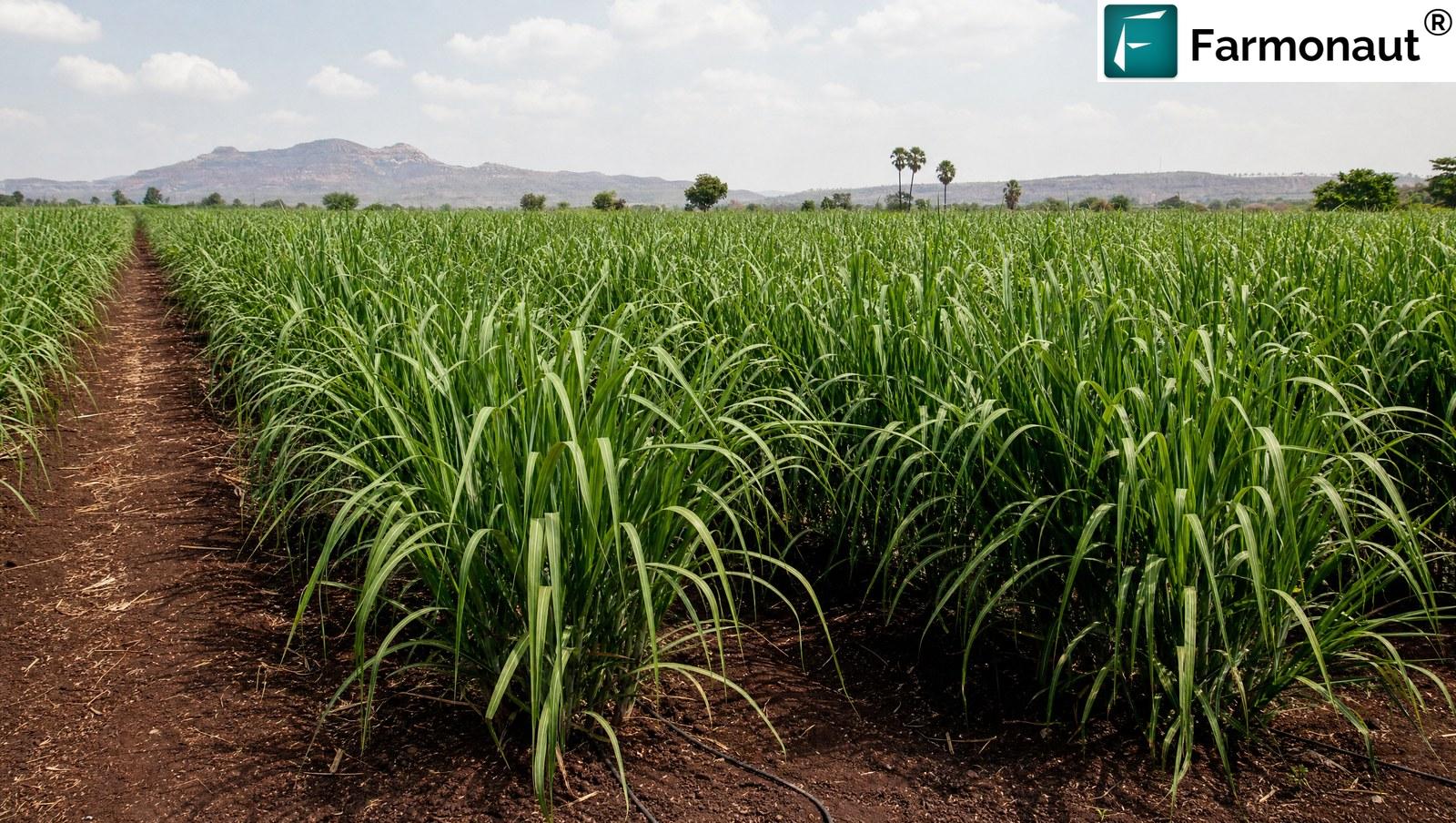

Five blocks, one crop, two stages
What makes this portfolio instructive is that it is almost a controlled experiment. One crop, one district, one soil type — the advisory reads pH 7.2 to 7.8 and organic carbon 0.14 to 0.17% across all five blocks. Four blocks are at the same growth stage. The fifth is not, and that single difference changes its entire advisory.
| Block | Acres | Stage | Irrigation days | Week’s water | Drip vs flood | Top alert |
|---|---|---|---|---|---|---|
| 1 | 5.36 | Grand growth | 3 of 7 | 33.0 mm | 10.5 vs 15.0 mm | Internode borer 94% |
| 2 | 3.01 | Grand growth | 4 of 7 | 31.5 mm | 7.5 vs 45.0 mm | Internode borer 95% |
| 3 | 2.31 | Grand growth | 4 of 7 | 26.0 mm | 6.5 vs 8.0 mm | Internode borer 95% |
| 4 | 0.98 | Grand growth | 3 of 7 | 34.5 mm | 11.2 vs 65.0 mm | Internode borer 95% |
| 5 | 0.25 | Germination | 7 of 7 | 37.0 mm | 5.2 vs 35.0 mm | Early shoot borer 94% |
| Portfolio | 21 of 35 | 40% zero days | 65.4% less | Stage-specific | ||
On one block the report puts flood at 65 mm and drip at 11.2 mm for the same day, the same cane, the same soil.

What the satellite sugarcane irrigation advisory delivers per block
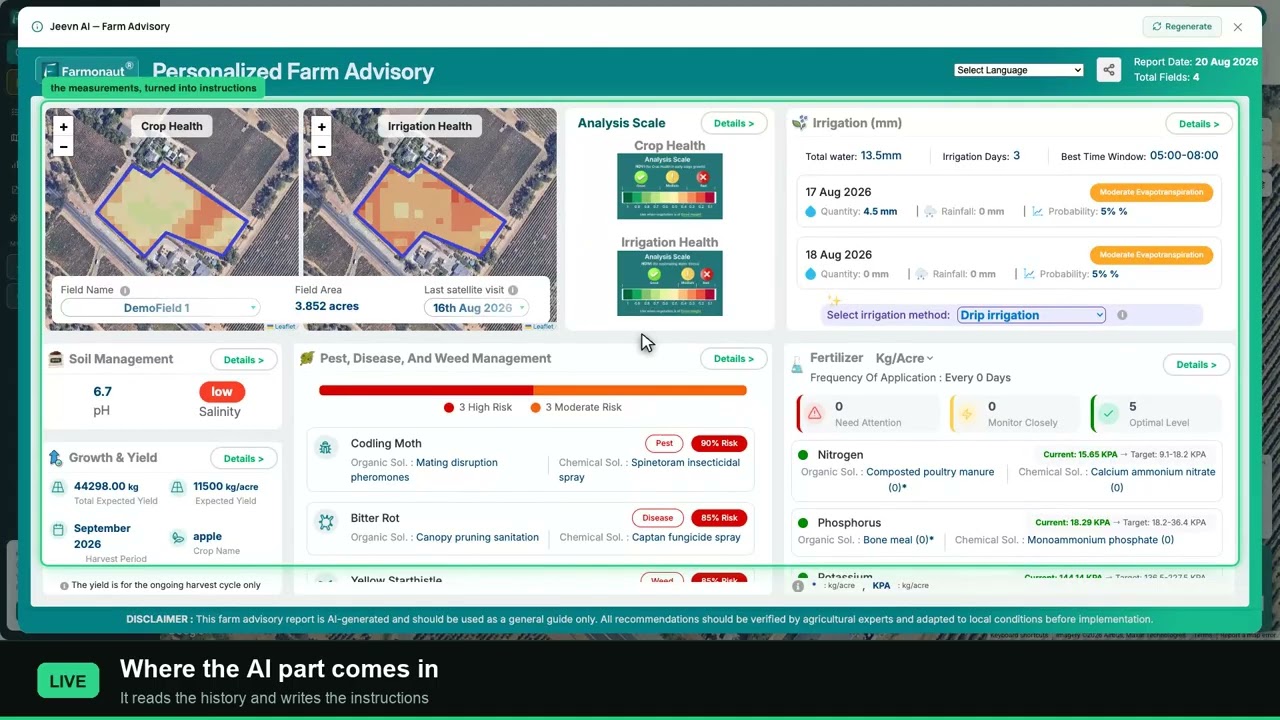
Each block receives its own report per satellite pass: a day-by-day irrigation schedule with the recommended method and the alternatives quantified alongside, per-nutrient fertiliser rates, pest and disease risk with organic and chemical options, weed pressure, soil chemistry and a yield estimate. By the date of the feedback the account had received 69 block advisories across 16 satellite acquisition dates.
Irrigation: the method gap, then the skip days
Two separate savings are stacked here, and it is worth keeping them apart.
The first is method. On every block the report lists drip, sprinkler and flood with their own quantities for the same day and the same crop demand. The flood figures are startling: 45.0 mm where drip needs 7.5, 65.0 mm where drip needs 11.2, 35.0 mm where drip needs 5.2. Those are not modelling artefacts — they reflect how much water a flooded cane block actually consumes to deliver the same amount to the root zone, once evaporation, deep drainage and run-off are counted. Area-weighted, the gap is 65.4%.
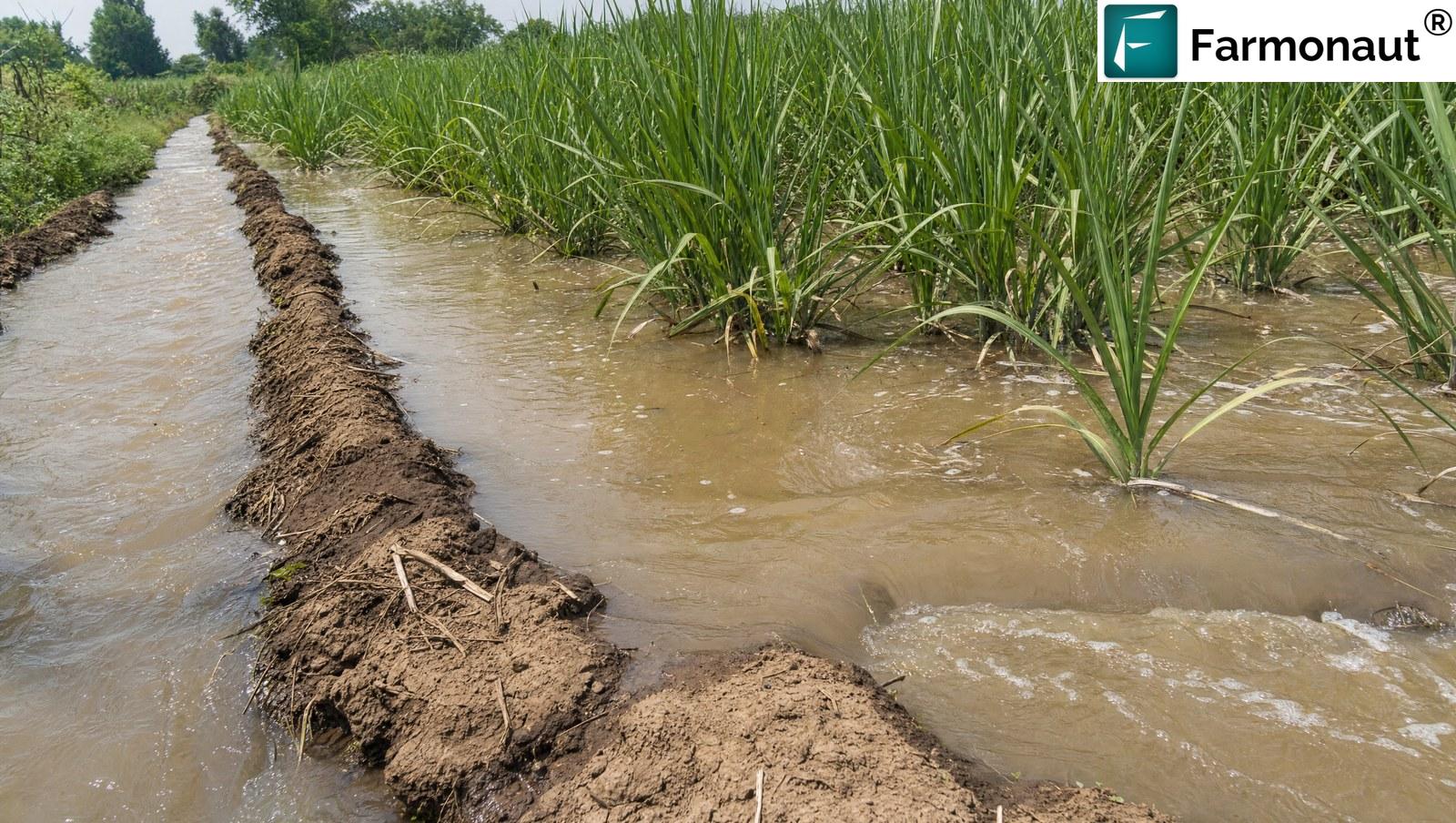
The second saving is scheduling. Even on drip, the four established blocks were not watered daily: they ran alternate-day or two-day-gap patterns, putting 14 of 35 block-days at zero. Against irrigating every block every day at its own peak rate, following the schedule applies 53.1% less water — and that figure sits squarely inside the 50–70% the grower reported.
That last row is the one to look at. The germination plot gets water seven days out of seven — the only block on the farm that does. Newly planted cane setts have no root system to buffer them, and letting the top few centimetres dry out during sprouting costs establishment permanently. The advisory waters it daily but lightly, at 5.2–5.5 mm against the established blocks’ 6.5–11.8 mm.
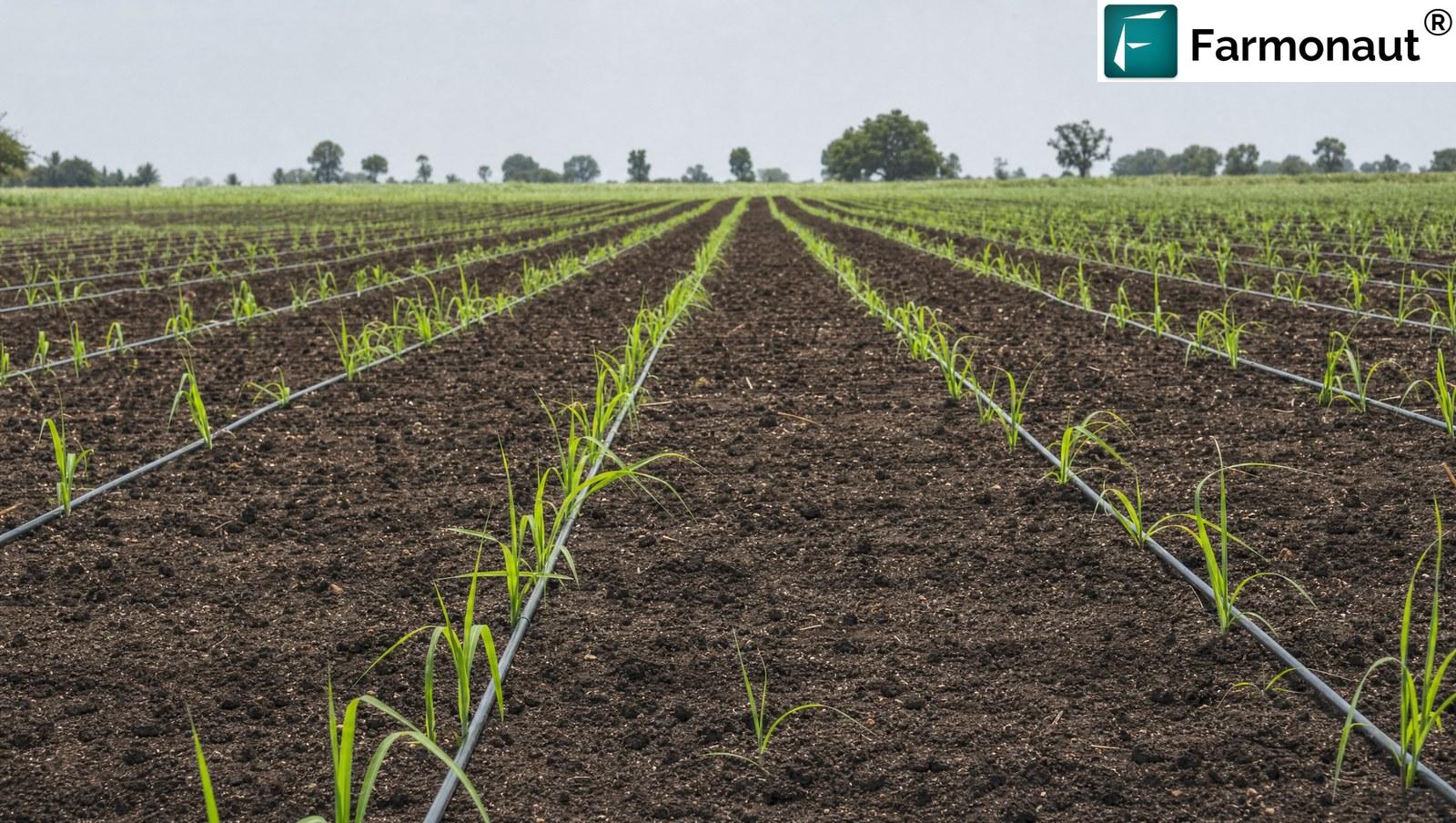
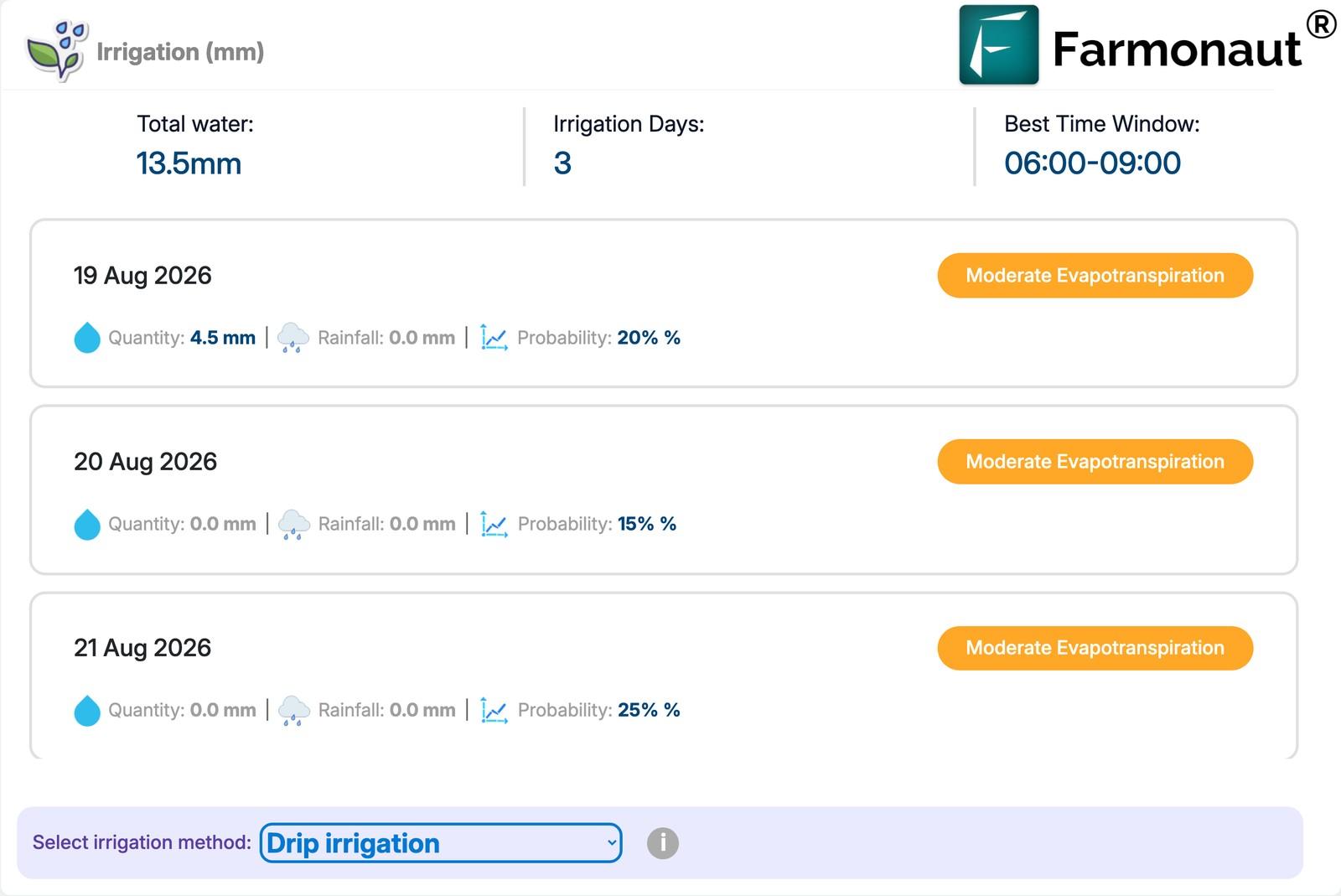
If you are still flooding cane, the number worth finding in your own report is not the drip figure — it is the flood figure sitting beside it. That is what you are currently applying, and the gap between the two is the entire business case for converting. On these blocks it ran to six times.
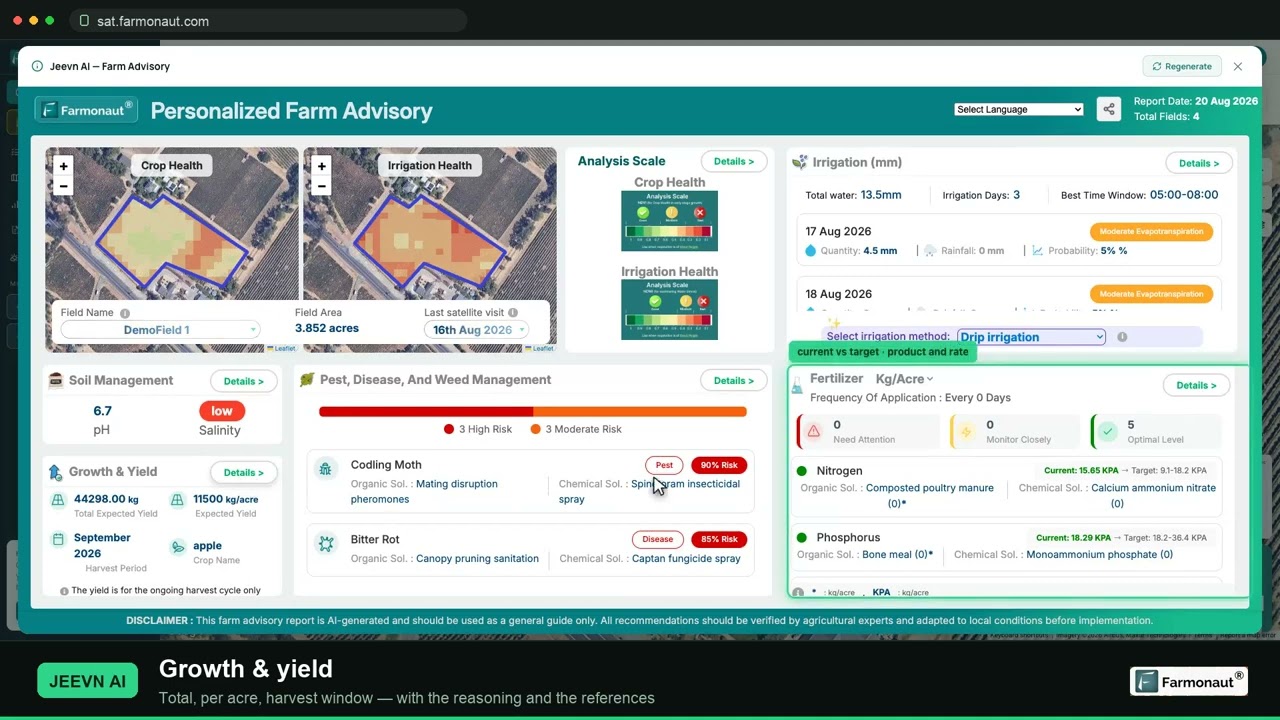
Pest and disease: the borer changes with the stage
This is the detail that shows the model is reading growth stage rather than just crop. All four grand-growth blocks led with internode borer at 94–95% — a pest that tunnels inside formed cane stalks and can only attack a plant that has internodes to bore. The germination plot led instead with early shoot borer at 94%, which attacks young shoots at the base and causes deadheart in cane under about four months old.
Those two are different insects with different windows, and swapping one for the other on the basis of stage is exactly right. A single crop-level pest list would have put internode borer on the germination plot, where it cannot yet do damage, and missed the pest that actually threatens it.
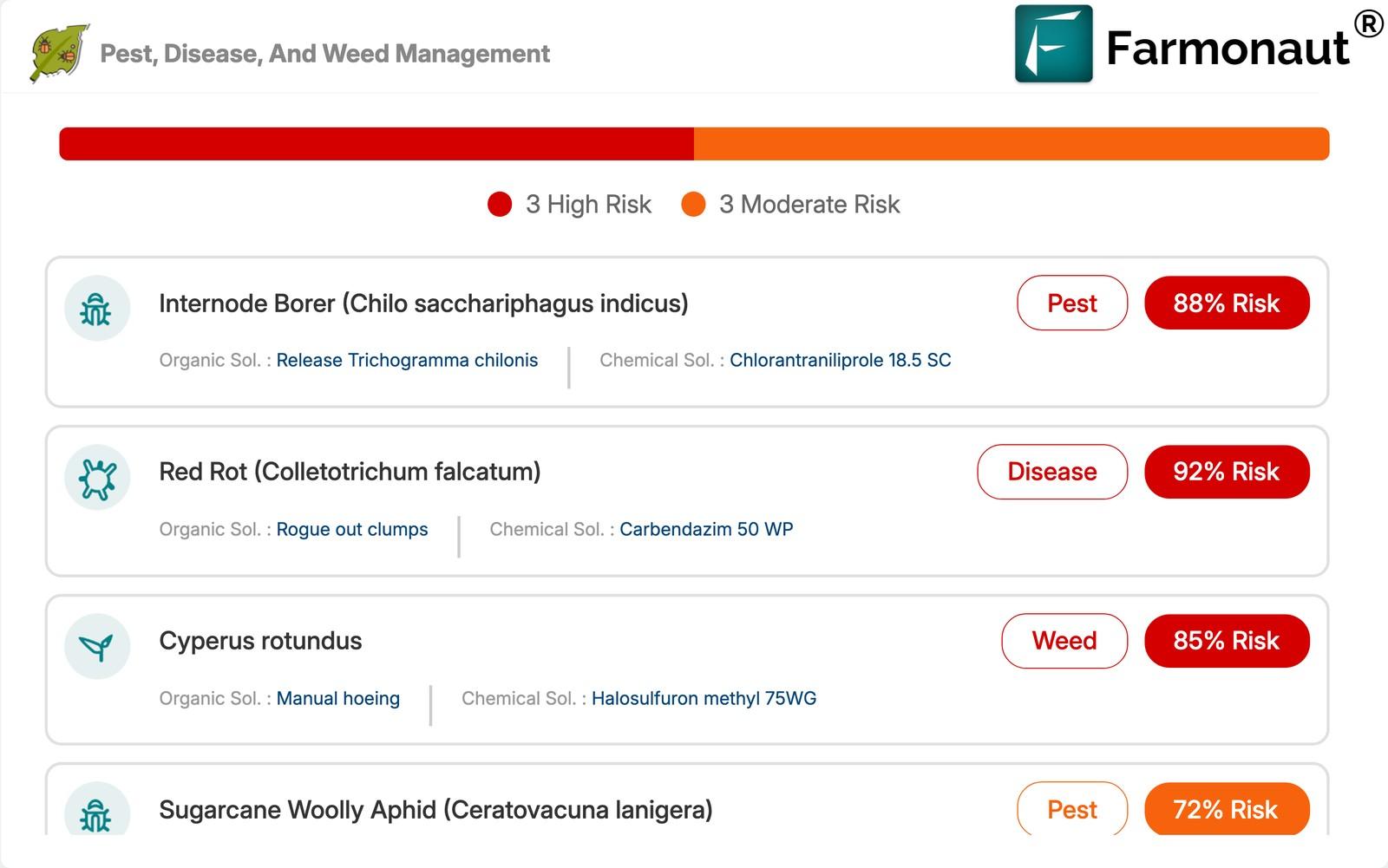
Behind the borers the disease list is thoroughly regional: Pokkah Boeng at 85–88%, red rot at 70–90%, and on individual blocks whip smut, grassy shoot disease, Pyrilla, mealybug and whitefly. Red rot in particular is the disease that ends cane varieties in India, and a per-block probability is more useful than a district advisory because it tells the grower which block to inspect first.
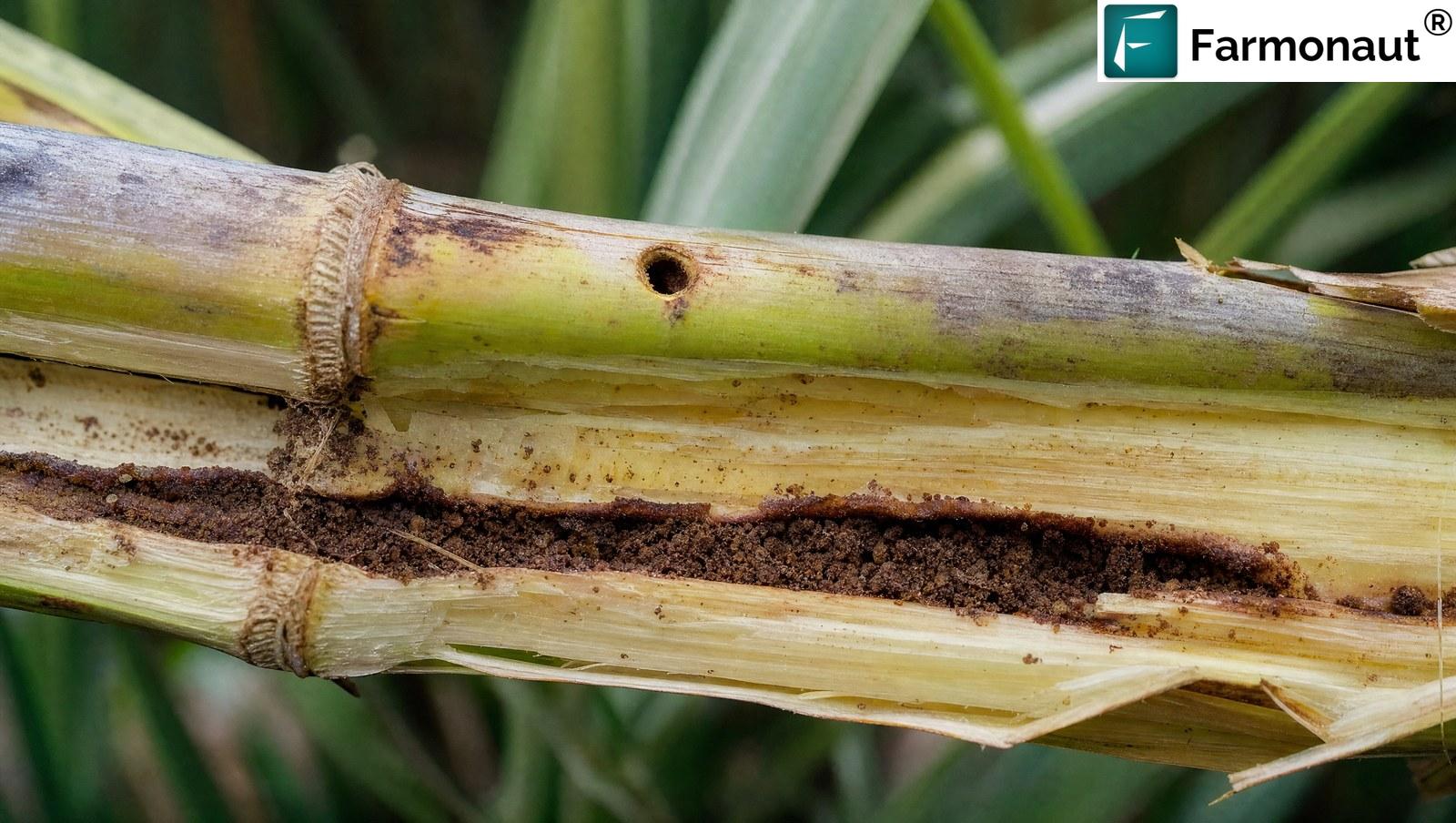
Weed pressure was consistent and correctly prioritised: Cyperus rotundus (purple nutsedge) at 78–90% and Cynodon dactylon (Bermuda grass) at 70–90% across the blocks. Those are the two hardest weeds to shift in Indian cane, both perennial and both spreading below ground, which is why an early flag matters more than a late one.
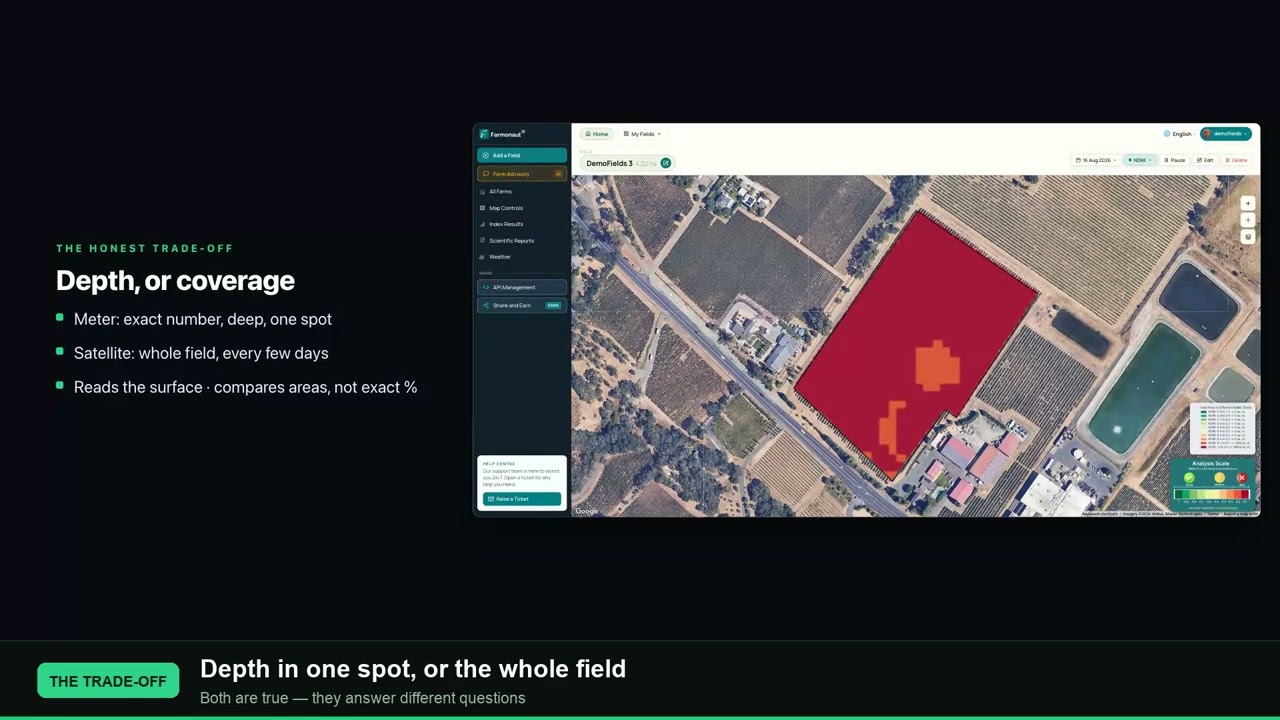
Fertiliser: nitrogen halves on the young plot
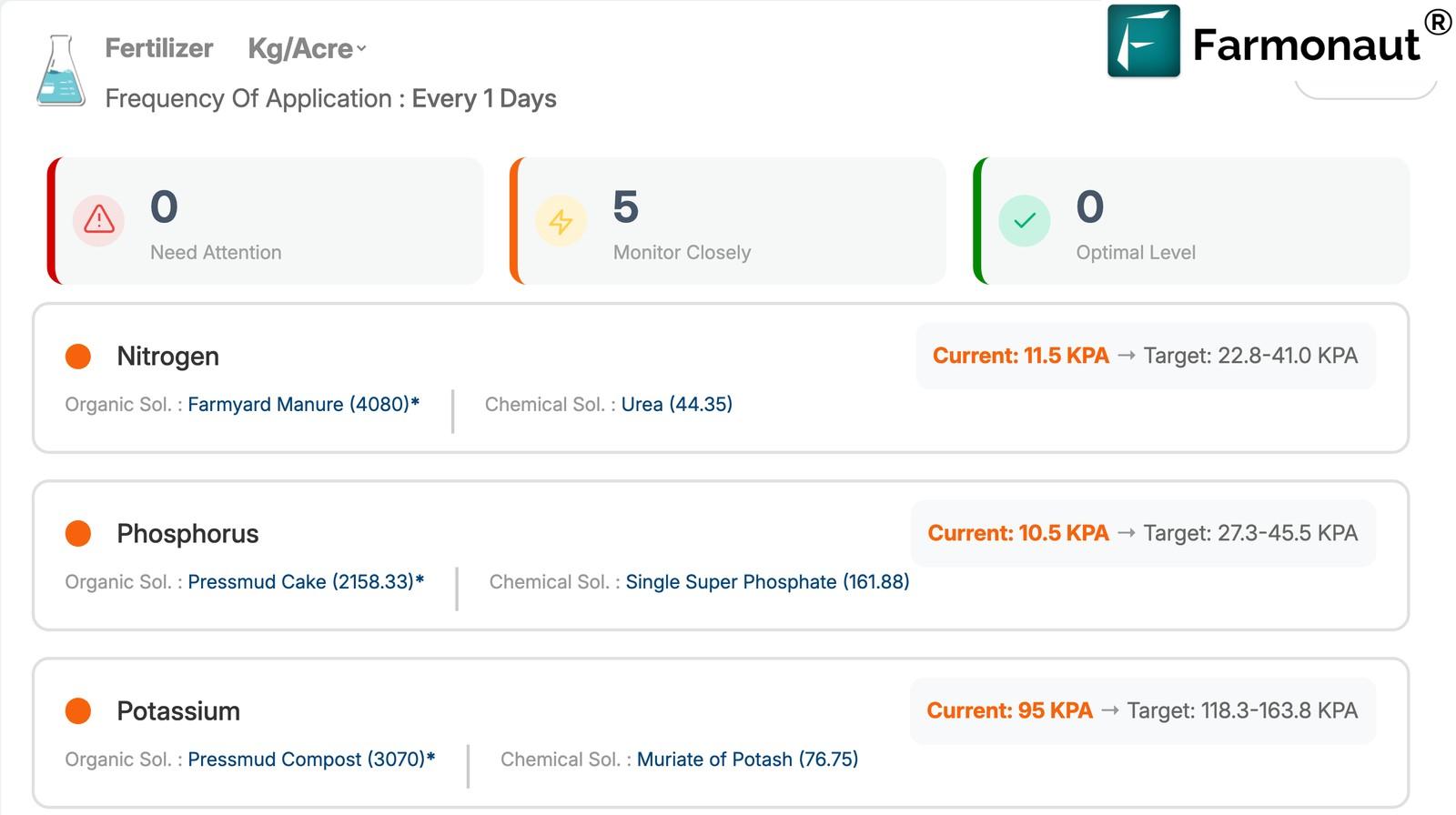
All five blocks were prescribed nutrient — cane is a heavy feeder and none of these blocks was near harvest — but the rates track the stage. The four grand-growth blocks were given 35.0 to 39.6 kg/acre of nitrogen. The germination plot was given 16.9, less than half, because a sprouting sett cannot use it yet and surplus nitrogen at establishment encourages soft growth rather than root development.
Potassium, by contrast, stayed high everywhere — 60.8 to 71.4 kg/acre, and highest of all on the germination plot at 71.4. That is correct for cane, which needs potassium for root establishment early and for sugar accumulation later, and it is the sort of distinction that a single blended fertiliser applied farm-wide cannot make.
What the numbers add up to
| Mechanism in the advisory | What it delivers on these five blocks |
|---|---|
| Delivery method quantified per block — drip, sprinkler and flood each priced for the same day | 65.4% less water area-weighted than the flood figure; up to 85% on individual blocks |
| Interval scheduling on established cane — 14 of 35 block-days set to zero | 53.1% less water than daily irrigation at each block’s peak rate |
| Daily light watering on the germination plot — the only block watered 7 of 7 | Establishment protected where drying out is irreversible |
| Nitrogen at 16.9 kg/acre on the young plot against 35.0–39.6 on grown cane | Roughly half the nitrogen where the crop cannot yet use it |
| Headline pest switched by stage — early shoot borer on young cane, internode borer on grown | Scouting aimed at the pest that can actually attack that block |
The two water savings are independent and they compound. Converting from flood to drip is a capital decision; scheduling the drip properly is a free one. This grower is already on drip, so the 53.1% from scheduling is the figure he can act on immediately — and it is the one that matches what he reported.
Grower-reported outcomes, as submitted
The cards below reproduce Ruturaj’s answers to our in-app feedback questionnaire for the advisory dated 25 May 2026, exactly as recorded.
The reported percentage and our own calculation agree. He estimated irrigation optimised by 50–70%; computing independently from the skip days in his advisory gives 53.1% against a daily-irrigation baseline. The percentage is his own estimate from a structured form rather than a metered volume, but the mechanism behind it is visible in the schedule.
Two savings sit on top of each other: the method, and then the schedule. Only one of them costs money.
Watering cane on a fixed weekly rota because the crop is famously thirsty. Thirst is not the same as constant demand: these four established blocks each wanted water on three or four days out of seven, not all seven, while the quarter-acre nursery plot wanted it every day. Applying the same rota to both would have over-watered the grown cane and under-watered the setts — the two errors that cost most, at once.
Salinity, and why it is a cane problem
Across the five blocks the advisory reads pH 7.2 to 7.8 and organic carbon 0.14 to 0.17%. One block — the largest, at 5.36 acres — returns moderate salinity while the other four read low.
That single flag is worth more than it looks. Salinity builds where irrigation water evaporates faster than it leaches, and heavy flood irrigation on a long-season crop like cane is one of the most reliable ways to create it. A block drifting toward moderate salinity is an early signal about how that block has been watered, and it is exactly the kind of finding that a farm-level average would dissolve — four low readings and one moderate average out to “fine”.
Sugarcane’s water footprint in western India is a basin-level issue, not a farm-level one. A 65% reduction against flood irrigation on 11.9 acres is small on its own and enormous if it is typical — and the same change that saves the water also slows the salinity accumulation that flooding drives.

It is worth being clear about which of the two water figures applies to whom. A grower already on drip — as this one is — cannot bank the 65.4%, because he is not flooding in the first place; for him the actionable number is the 53.1% that comes from the schedule. A grower still flooding cane has both available, and the larger one first. Publishing the two separately rather than as a single blended claim is the only way either number means anything.
Why per-block beats per-farm on one crop
It would be reasonable to assume that five blocks of the same crop in one district need one plan. This portfolio says otherwise. The yield estimates alone run from 25,400 kg/acre on the grand-growth blocks, harvesting in December 2026, to 36,200 kg/acre on the germination plot, harvesting in April 2027 — a different crop cycle entirely, on the same farm, four months apart.
Underneath sits a per-pixel read of each block from satellite, resolved through crop coefficients and regional pest models into instructions for that block at that stage. Sixty-nine advisories over sixteen acquisition dates is what keeps a five-block farm with two crop cycles in step rather than averaged.
The harvest dates make the same argument from a commercial angle. Four blocks are due in December 2026 and one in April 2027, which means this eleven-acre farm has two separate mill-supply commitments, two separate ripening windows and two separate points at which water should be withdrawn to let the cane mature. Managing that from one calendar would compromise whichever block was not the one the calendar was written for.
Running this on your own cane
- Map each block separately, including the new plantings. The germination plot on this farm needed the opposite of everything the grown cane needed.
- Find the flood figure in your own report. If you are flooding, that number is what you are applying and the drip figure beside it is what the crop actually needs.
- Read the irrigation-days count. Even on drip, 14 of 35 block-days here were zero — that is a free saving with no equipment change.
- Keep the planting date current. The nitrogen halving and the borer switch on the young plot both follow from the stage being right.
- Watch salinity block by block. One of these five is drifting while four are fine; a farm average would hide it.
Explore the platform at sat.farmonaut.com, read more about our satellite and AI-based farm advisory in the JEEVN AI overview, or talk to our team about monitoring cane blocks. JEEVN AI is a paid product; plan detail is on the platform.
Find out what flooding is costing you
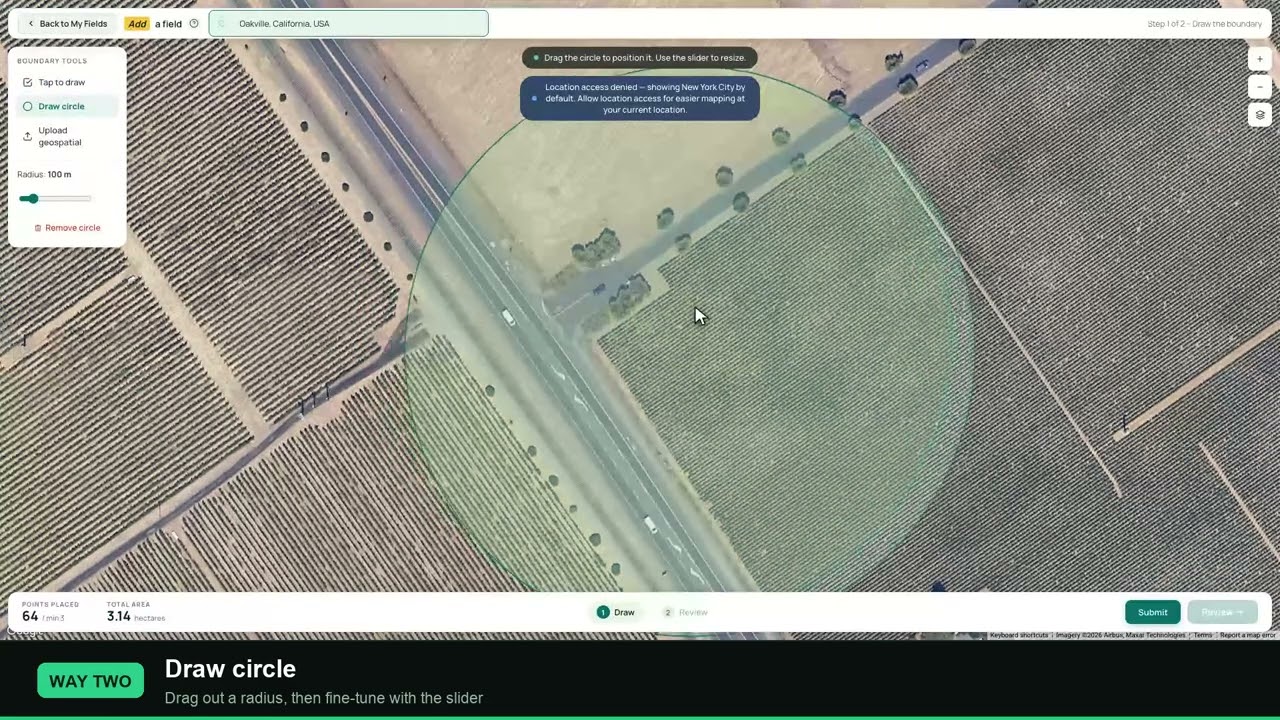
Map each block, set its crop and planting date, and see the drip, sprinkler and flood figures side by side for your own ground.
Frequently asked questions
What is a satellite sugarcane irrigation advisory and what does it deliver?
It is a per-block schedule built from satellite passes over your own boundary, giving a day-by-day water quantity in millimetres, a recommended delivery method with the alternatives quantified beside it, and a best time window — alongside fertiliser rates, pest and disease risk, weed pressure, soil chemistry and a yield estimate. On this farm five blocks each received their own, producing 69 advisories over 16 acquisition dates.
How can drip use 65% less water than flood irrigation on sugarcane?
Because flood irrigation loses most of what is applied. The advisory lists both figures for the same block on the same day: drip at 7.5 mm against flood at 45.0 mm on one block, 11.2 against 65.0 on another. The difference is evaporation from a wetted surface, deep drainage below the root zone and run-off — none of which reach the cane. Area-weighted across the five blocks the gap is 65.4%.
If I already use drip, is there still a saving?
Yes, and it is the one this grower acted on. Even on drip, 14 of 35 block-days in the week analysed carried a zero — the established blocks ran alternate-day or two-day-gap patterns rather than daily. Against daily irrigation at each block’s own peak rate, that scheduling alone applies 53.1% less water, and it costs nothing to implement.
Why was one block watered every day when the others were not?
Because it was at germination and establishment rather than grand growth. Newly planted setts have no root system to buffer them and cannot be allowed to dry out during sprouting, so the advisory watered that quarter-acre plot seven days out of seven — but lightly, at 5.2–5.5 mm against 6.5–11.8 mm on the established blocks.
Does the advisory distinguish early shoot borer from internode borer?
On this farm it did, by growth stage. The four grand-growth blocks led with internode borer at 94–95%, which needs formed internodes to attack. The germination plot led with early shoot borer at 94%, which attacks young shoots and causes deadheart in cane under about four months. A single crop-level list would have flagged the wrong insect on the young plot.
Which sugarcane diseases does it cover?
On these blocks it raised Pokkah Boeng at 85–88%, red rot at 70–90%, and on individual blocks whip smut, grassy shoot disease, Pyrilla, mealybug and whitefly. Weeds were led by purple nutsedge (Cyperus rotundus) and Bermuda grass (Cynodon dactylon), the two hardest perennials to shift in Indian cane. Each alert carries an organic and a chemical option.
Are the pest probabilities confirmed infestations?
No — they are modelled risk scores from satellite indices, weather and regional pest pressure, working as a scouting priority list. A 95% internode borer alert means split some stalks on that block this week, not that the block is infested. The value on a five-block farm is knowing which block to open first.
Glossary
- Grand growth
- The phase in which sugarcane lays down most of its stalk length and weight, with a closed canopy and peak water demand. Four of these five blocks were in it.
- Germination and establishment
- The first weeks after planting, when setts sprout and put out primary roots. Cannot be allowed to dry out, which is why that block was the only one watered daily.
- Internode borer
- A borer that tunnels inside formed cane internodes, reducing sugar recovery. Requires grown cane, so it is a grand-growth pest rather than an establishment one.
- Early shoot borer
- A borer that attacks young cane shoots at the base, killing the growing point and causing deadheart. A pest of cane under roughly four months old.
- Pokkah Boeng
- A fungal disease of sugarcane causing chlorotic, twisted top leaves and, in severe cases, stalk rot. Flagged at 85–88% on the grand-growth blocks here.
Case-study basis: JEEVN AI block advisories for a single Farmonaut account, taking each block’s most recent advisory as of the grower’s feedback submission (portfolio state at 25 May 2026, five blocks), plus the account’s in-app feedback submission for the advisory dated 25 May 2026. Crop, region, block count and area are reported from the account’s own records on the platform; the account holder is named as recorded on his Farmonaut account and precise block locations are withheld. The 50–70% figure is the grower’s own estimate from a structured feedback form, not a metered volume; the 53.1% figure is our own calculation against a stated baseline of irrigating every block daily at its own peak recommended rate, and the 65.4% figure compares the recommended drip quantity against the flood quantity the advisory itself lists for the same block and day. Pest, disease and weed percentages are modelled probabilities, not confirmed infestations. Yield figures are estimates, not guarantees. Imagery: the three platform screenshots are genuine captures of one of this account’s own block advisories; the five wider field photographs are AI-generated illustrative imagery, each labelled as such in its caption, and do not depict the grower or his blocks. JEEVN AI is a paid product.
Discussion
Questions, corrections or field experience? Share them below. First-time comments are reviewed before they appear, and your email is never published.
No comments yet. Be the first to add a question or your experience.

 AgriBazaar
 Geno
 Hayleys Agriculture
 Linx Agritech
 Adinet
 Save Your Soils
 Grandstream Algérie
 XOS Realty
 Geospatial Lab Africa
 Agro La Gándara
 HIPSAC
 ZOL Zimbabwe
 Juligerm
 AdBio
 MISE Maroc
 NWNS
 Red August Group
 Farm Inc
 WeMe Global

 Licence holder · Niger · Gold










