

Alaska gold · District and mine guide
Alaska Gold Deposits Map: Districts, Mines, Owners
Alaska’s gold sits in a few districts: Fairbanks, Nome, Juneau, Fortymile and the Kuskokwim. This guide maps them, lists the mines and who owned each in October 2026, and shows where to get the USGS and state data.
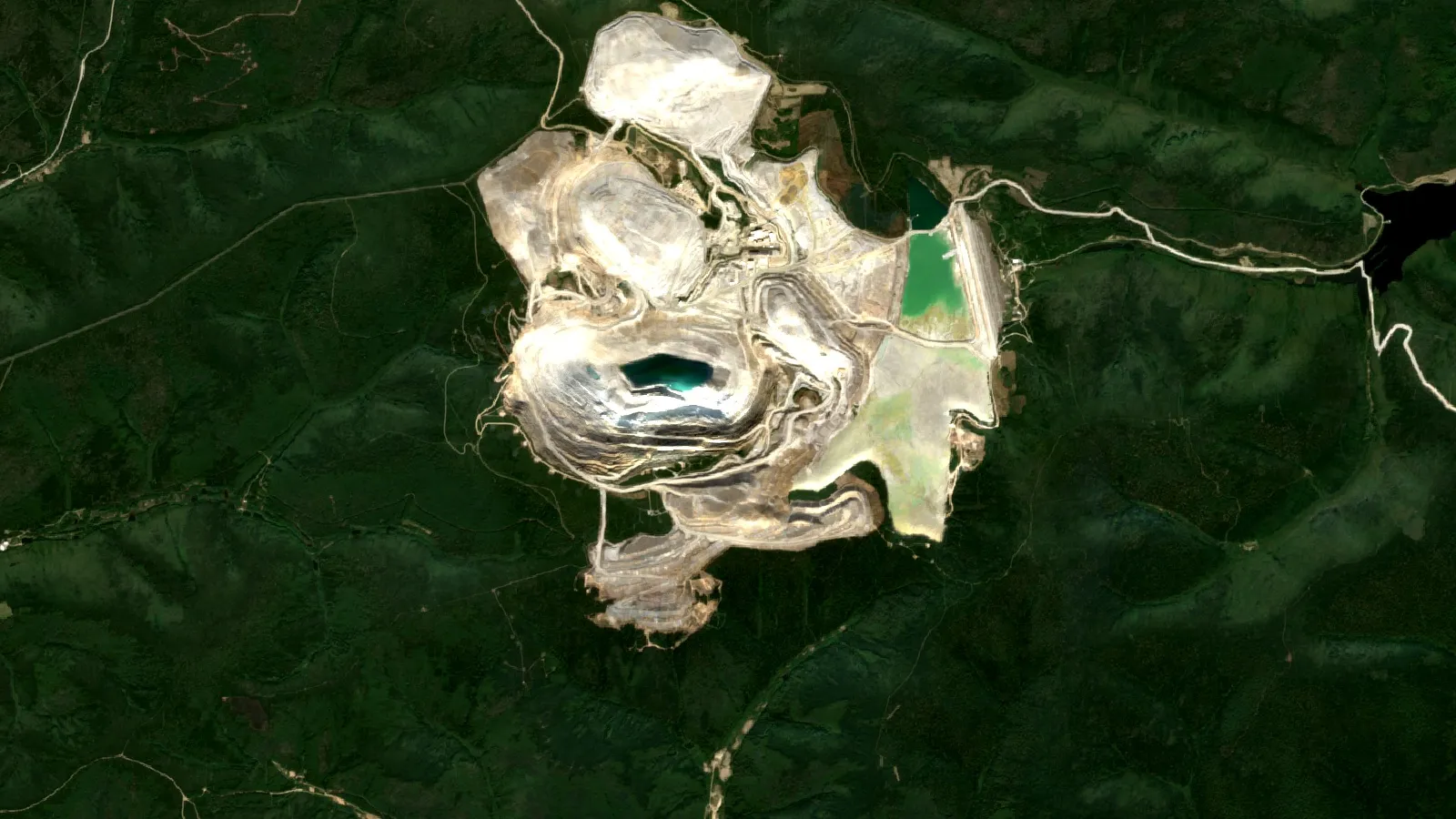
Key takeaways
- The state survey (DGGS) estimated Alaska’s 2025 gold output at 925,000 to 955,000 troy ounces, from about 150 placer mines and a few lode mines (DGGS, January 2026).
- In the USGS Alaska Resource Data File, 4,164 of the 7,687 records returned by its web service list gold as a main commodity (Farmonaut count, 15 October 2026); the Nome, Juneau and Seward sheets lead.
- Barrick no longer owns Donlin: NovaGold holds 60% and Paulson affiliates 40% since 3 June 2025, and NovaGold agreed in July 2026 to buy the 40% (pending approval).
- Fort Knox with Manh Choh produced 104,500 ounces of gold-equivalent in Q2 2026 (Kinross); Pogo sold 81,815 ounces in the June 2026 quarter (Northern Star).
- The Fairbanks district produced about 7.55 million fine ounces of placer gold through 1961, 37.2% of the recorded state total (USGS Bulletin 1374).
In this article
- Where to get an Alaska gold deposits map and its data
- What the ARDF says about where the gold records sit
- Alaska's main gold districts
- Alaska gold mines and their owners
- Types of gold deposit on an Alaska map
- How to check an Alaska map point before you use it
- Check a deposit's gold content yourself
- Land and permits behind each point
- Using satellite data with the Alaska map
- Frequently asked questions
Alaska’s gold sits in a handful of districts: the Fairbanks area and the eastern Interior, the Seward Peninsula around Nome, the Juneau belt in the Southeast, and the Kuskokwim region in the southwest. The state geological survey (DGGS) estimated Alaska’s 2025 gold output at 925,000 to 955,000 troy ounces, a preliminary figure from about 150 placer operations and a few lode mines (DGGS, January 2026). The USGS puts Alaska at about 22% of US gold production, behind Nevada at about 64% (USGS, Mineral Commodity Summaries, 2026). The two agencies estimate differently, so the USGS share implies somewhat more Alaska gold than the DGGS ounces.
This page is a working guide for consultants and explorers who need the map and the people behind it. It shows where to get the point data, which districts matter, which mines operate in them, and who owned each one in October 2026. Ownership has moved since most Alaska maps were drawn: Barrick has sold its half of Donlin, Pogo belongs to an Australian company, and the Peak Gold partner now trades under a new name. A calculator further down turns a tonnage and grade into ounces and value.
Where to get an Alaska gold deposits map and its data
There is no single official map. Five public sources cover most needs, and each answers a different question.
- Alaska Resource Data File (ARDF). The USGS describes mines, prospects and mineral occurrences in this file for each 1:250,000 map sheet (a “quadrangle”). The text comes from published reports and from industry, Bureau of Mines and USGS records, and the compilation is still being updated. It offers map-service links (WMS and WFS), a KML file for Google Earth and a zipped shapefile (USGS, ARDF). For Alaska it is the best starting layer.
- State survey (DGGS). DGGS tracks the state’s mineral industry, reports more than 7,400 documented occurrences, and publishes an annual mineral industry series plus conference summaries (DGGS, Alaska’s Mineral Industry).
- USMIN. USGS prospect and mine features digitised from topographic maps, and an Alaska file is offered, though coverage is partial (USGS, USMIN). It can help cross-check ARDF points.
- Claims. A deposit point is not a claim. The state’s Alaska Mapper includes a Mining Claim Research Map for state claims (Alaska DNR, Mining). Federal claims are kept by the Bureau of Land Management. Our guide to Alaska gold claims for sale around Nome covers the buying side.
- Company reports. Reserves, grades and owners come from filings, not from maps. The mine table below uses 2026 company reports where we found them and says so where it does not.
The older USGS Mineral Resources Data System (MRDS) is not a good Alaska source. USGS stopped systematic updates in 2011, and its own page calls ARDF the most coherent collection for Alaska (USGS, MRDS).
What the ARDF says about where the gold records sit
We queried the ARDF web service on 15 October 2026 and counted the records. The portal page lists 7,448 records, while the service returned 7,687 that day, so treat every ARDF count as approximate. In 4,164 of the returned records, gold is confirmed as one of the main commodities (records marked uncertain, “Au?”, are not counted). Of those, 1,498 are typed as a mine (including entries marked uncertain), 2,394 are marked inactive, 581 more probably inactive, and 701 active or probably active. A record flagged active can still be old, because the file is a long-running compilation.
Chart
ARDF records that list gold as a main commodity, by map sheet
Number of records, eight busiest 1:250,000 quadrangles (all records vs those typed as a mine)
The records cluster in a few quadrangles (chart above). The Nome and Solomon sheets, both on the Seward Peninsula, hold 349 gold records between them. The Livengood sheet, north of Fairbanks, has 179 records and 94 typed as mines. The Juneau sheet has 193 records but only 58 typed as mines, which suggests that many Juneau-sheet points are prospects or occurrences.
Alaska’s main gold districts
A district is a mining area named for its first discoveries, and its boundary is a convention, not a legal line. Production figures below for the older placer districts come from the USGS inventory of Alaskan placers, compiled by Edward Cobb in 1973 (USGS Bulletin 1374). A placer is gold in loose river or beach gravel, measured there in fine ounces (troy ounces of pure gold). Cobb’s district totals stop at 1961, so they show history, not today’s output (chart below). Cobb puts total recorded Alaska placer output at about 20.8 million fine ounces from 1880 to 1968.
Chart
Recorded placer gold by district or region, through 1961
Million fine ounces (Cobb, 1973); Iditarod figure runs through 1966
Fairbanks district (Interior)
Fairbanks was the leading placer producer in Alaska: about 7.55 million fine ounces through 1961, or 37.2% of the recorded state total (Bulletin 1374). Cobb notes that the district’s lode gold sits mainly in two areas, Pedro Dome to Cleary Creek and Ester Dome. Today the district holds Fort Knox, an open-pit mine in an intrusion, and Golden Summit, an advanced exploration project. DGGS reports that Freegold Ventures lists 17.2 million ounces indicated and 12.0 million ounces inferred at Dolphin-Cleary (July 2025), and that more than 6.75 million ounces of placer gold came from streams draining the project area.
Tolovana district (Livengood)
The Livengood project is about 70 miles northwest of Fairbanks on the Elliott Highway. International Tower Hill Mines is the company behind the project. The technical report, summarised by the Northern Alaska Environmental Center, gives a reserve of 9.0 million ounces (430.1 million tonnes at 0.65 g/t) and describes an open pit treating 65,000 tons of ore per day for about 21 years and producing roughly 6.4 million ounces (NAEC summary). It is a proposal, not a mine.
Goodpaster and Fortymile (eastern Interior)
Pogo, an underground mine, sits in the Goodpaster River area east of Fairbanks. Farther east, the Fortymile district is one of Alaska’s oldest placer areas. It produced about 417,000 ounces through 1961, 2% of the state’s placer gold (Bulletin 1374). The Manh Choh mine, a gold-silver-copper skarn on Tetlin tribal land, is also in the eastern Interior (DGGS, January 2026). The Eagle quadrangle holds 125 ARDF gold records. Across the border, our note on Yukon gold claims and the Eagle mine covers the Yukon side.
Nome district (Seward Peninsula)
The Seward Peninsula produced about 6.26 million fine ounces through 1961, 30.7% of Alaska’s placer gold. Cobb estimates that 75 to 80% of it came from the Nome district. He also records that large-scale mining there ended after the 1962 season. What remains is small-scale placer work, which is part of the roughly 150 placer mines DGGS counts statewide (DGGS).
Southeast Alaska (Juneau area)
Cobb credits lodes in the Southeast region with 7.5 to 8 million ounces of gold, plus silver and copper, and notes that most lodes sit in metamorphic rocks beside the Coast Range batholith (a large granite mass along the Canadian border). The gold mine there today is Kensington, an underground operation owned by Coeur. Greens Creek, run by Hecla on Admiralty Island, is mainly a silver mine and the largest silver producer in the United States. It recovered 59,349 ounces of gold as a by-product in 2025 (DGGS, January 2026).
Kuskokwim, Iditarod and Innoko (west and southwest)
This region holds Donlin, which its owner expects to be the largest gold development project in the United States (NovaGold, July 2026). Placers here were smaller than Fairbanks or Nome but still sizeable. Cobb reports 1,329,404 fine ounces from the Iditarod district through 1966, about 540,000 from the Innoko district through 1961, and about 650,000 from the Kuskokwim region between 1908 and 1960.
Circle, Hot Springs and Koyukuk (north)
The Circle district on the Yukon River produced about 735,000 fine ounces through 1961, 3.6% of the state total. The Hot Springs district produced about 450,000 through 1960, and the Koyukuk placers around Wiseman produced between 270,000 and 295,000 through 1961 (Bulletin 1374). All of these are historic figures. The Wiseman quadrangle still holds 101 ARDF gold records.
Hatcher Pass and the Alaska Range
In south-central Alaska, the Lucky Shot vein in the Hatcher Pass area belongs to Contango Silver and Gold, which says it has bought out the lease and the 2% royalty to hold 100% and is targeting a feasibility study in the first half of 2027 (Contango, 13 August 2026). In the Alaska Range, Nova Minerals has been drilling gold and antimony targets at its Estelle project (DGGS, January 2026).
Alaska gold mines and their owners
The table lists producing mines first, then the main projects. Owners and ticker symbols are as stated in company reports of 2025 and 2026; the last column gives the most recent figure we could confirm and its date, where one is given. The chart compares one recent quarter at the three producers; the bases differ, so read its source line.
Chart
Reported gold output of three Alaska mines, mid-2026 quarter
Thousand ounces; bases differ (see source line)
| Mine or project | District | Owner or operator | Type and stage | Latest figure |
|---|---|---|---|---|
| Fort Knox | Fairbanks | Kinross Gold (TSX: K; NYSE: KGC) | Open pit, producing | 104,500 oz gold-equivalent in Q2 2026, including Manh Choh ore (100% basis) |
| Manh Choh | Eastern Interior | Peak Gold JV: Kinross 70%, Contango Silver and Gold 30% | Open pit, producing | 229,965 t of ore at 4.98 g/t in Q2 2026 |
| Pogo | Goodpaster area | Northern Star Resources (ASX: NST) | Underground, producing | 81,815 oz sold, June 2026 quarter |
| Kensington | Southeast | Coeur Mining (NYSE: CDE) | Underground, producing | 21,528 oz in Q2 2026; 2026 guidance 98,000-110,000 oz |
| Greens Creek | Southeast | Hecla Mining (NYSE: HL) | Underground, silver-led | 59,349 oz gold in 2025 (DGGS) |
| Donlin | Kuskokwim | NovaGold 60%, Paulson affiliates 40% | Open pit, proposed | About 40 Moz measured and indicated resource (July 2026) |
| Livengood | Tolovana | International Tower Hill Mines (TSX: ITH) | Open pit, proposed | 9.0 Moz reserve at 0.65 g/t (technical report, via NAEC) |
| Golden Summit | Fairbanks | Freegold Ventures (TSX: FVL) | Exploration | 17.2 Moz indicated, 12.0 Moz inferred (July 2025) |
| Lucky Shot | Willow Creek, Hatcher Pass | Contango Silver and Gold (NYSE American and TSX: CTGO) | Underground vein, development study | Feasibility study targeted for first half of 2027 |
Moz means million troy ounces; oz means troy ounces; g/t means grams of gold per tonne of rock, the usual grade measure. “Resource” and “reserve” are different: a reserve is the part of a resource that a study shows can be mined at a profit under stated prices and costs. Never add the two figures together.
Fort Knox and Manh Choh (Kinross)
Fort Knox is an open pit in an intrusion near Fairbanks. Kinross poured its 9-millionth ounce there on 27 September 2023, and the Gilmore expansion extends the mine life through 2029 (DGGS, January 2026). Kinross reports the Fort Knox segment together with Manh Choh, because Manh Choh ore is trucked about 225 miles to the Fort Knox mill. The segment produced 102,372 ounces of gold-equivalent in Q1 2026 and 104,500 in Q2 2026 on a 100% basis (Kinross, Q2 2026 results). That is about 9% below the 115,064 ounces of Q2 2025, which Kinross attributes mainly to the timing of ounces processed through the mill. Manh Choh ore averaged 4.98 g/t in Q2 2026, against 7.39 g/t in Q2 2025.
Pogo (Northern Star)
Pogo is an underground shear-zone and quartz-vein mine. Northern Star, listed in Australia, sold 81,815 ounces from Pogo in the June 2026 quarter (Northern Star, June 2026 quarterly report) and guides to 250,000-260,000 ounces for the year to June 2027 (Northern Star, FY26 results). In June 2026 the company raised Pogo’s resource to 9.3 million ounces and its ore reserve to 2.4 million ounces (Northern Star, resources and reserves update). DGGS counts 5.5 million ounces mined to date.
Kensington (Coeur)
Kensington is an underground mesothermal gold-quartz-vein mine in Southeast Alaska, one of Coeur’s seven wholly owned operations. It produced 21,528 ounces in Q2 2026 and 20,525 in Q1 2026, and Coeur says it is keeping a five-year reserve-based mine life while it drills for more (Coeur, Q2 2026 results).
Donlin (NovaGold and Paulson, after Barrick)
Barrick sold its 50% of Donlin for US$1 billion, and the sale closed on 3 June 2025. NovaGold paid US$200 million and moved to 60%, and Paulson paid US$800 million for 40% (Mining.com, June 2025; Barrick annual report, 2025). On 21 July 2026 NovaGold agreed to buy Paulson’s 40% in an all-share deal, which needs shareholder, court and regulatory approval and is expected to close in the fourth quarter of 2026 (NovaGold, 22 July 2026). The company describes a resource of about 40 million ounces (560 million tonnes at 2.22 g/t, inclusive of reserves) and a 27-year mine life at about 1.1 million ounces a year. The land belongs to the Calista and Kuskokwim native corporations. The feasibility study dates from 2011, and the owners are updating it.
Livengood and Golden Summit (advanced projects near Fairbanks)
Both are large, low-grade systems that depend on the gold price. Livengood’s reserve grade is 0.65 g/t, and Golden Summit’s indicated resource averages 1.24 g/t gold-equivalent. Compare that with Pogo, where DGGS lists a probable reserve grade of 7.2 g/t (March 2025, before the June 2026 update), far higher in grade and much smaller in tonnes. Low-grade projects swing hard with the gold price, so read the study’s price assumption before you trust any ounce figure.
Types of gold deposit on an Alaska map
Alaska’s gold comes in five main styles, and each leaves a different footprint on a map.
- Placer. Loose gold in gravels, worked along creeks and beaches. Most of the roughly 150 active placer mines are small family or contractor operations (DGGS).
- Intrusion-related. Gold in or around granite bodies. Fort Knox is intrusion-hosted, Golden Summit is an intrusion-related system, and Donlin is described by DGGS as structurally controlled and intrusion related.
- Orogenic (mesothermal) veins. Quartz veins formed during mountain building. Kensington is a mesothermal gold-quartz-vein system, Pogo a shear-zone and quartz-vein system, and Lucky Shot a vein system.
- Skarn. Gold in limestone altered by a hot intrusion. Manh Choh is a gold-silver-copper skarn.
- Volcanogenic massive sulfide (VMS). Metal-rich sulfide bodies formed on the seafloor. Greens Creek is the main example, and its gold is a by-product.
Matching the type to the map matters. A placer symbol means gravel and water rights. A vein symbol means narrow, high-grade ore that is hard to model. A skarn or intrusion symbol can mean bulk tonnage. The DGGS overview gives the deposit style for each mine used above (DGGS, January 2026).
▶ Follows gold from rock to refined metal, from finding and drilling to crushing, leaching and melting. · 5:27
How to check an Alaska map point before you use it
Use these steps whenever a map, a broker or a pitch deck points you at a place.
Infographic
Checking a map point in 5 steps
- 1Find the recordLook up the ARDF number, commodity, type and status.
- 2Read the dateARDF text is compiled over decades, so old tags can be stale.
- 3Check the landSearch state and federal claim records and the land owner.
- 4Get the filingTake reserves, grade and price from a 2025 or 2026 report.
- 5Look at the groundCompare imagery and public geophysics before any spend.
- Find the record. Look up the point in ARDF and note its ARDF number, the main commodity, the type (mine, prospect or occurrence) and the status.
- Read the date. ARDF text is compiled over decades. An “active” tag from 1995 is not today’s status.
- Check the land. Search the state and federal claim records for the ground, and check whether it sits on private, native-corporation, state or federal land.
- Check the owner’s latest report. Get reserves, grades and the gold price assumption from a 2025 or 2026 filing, not from a map label.
- Look at the ground. Compare imagery and public geophysics. DGGS and USGS flew 49,000 square kilometers of airborne geophysics in Alaska in 2025 through the Earth MRI program (DGGS, January 2026).
Check a deposit’s gold content yourself
The calculator below turns tonnage and grade into contained ounces, recovered ounces and a gross value at a price you choose. As a test, 560 million tonnes at 2.22 g/t gives about 40 million ounces, which matches NovaGold’s resource statement for Donlin. The result is metal in the ground, not profit, and it ignores capital cost, royalties, tax and the cost of getting the gold out.
Calculator
How much gold is in an Alaska deposit?
Enter tonnage, grade and recovery from a company report, plus your own price.
- Recovered gold: 4.34 Moz
- Gross value at your price: 17,361 US$ million
- Years at your planned output: 14.5 years
Example values only, not any project’s figures and not a forecast. Gold price is an input: use today’s price. 31.1035 grams per troy ounce is the standard conversion. Results are before capital, royalties and tax.
Land and permits behind each point
Land status decides who can explore. Donlin sits on land held by Calista and the Kuskokwim native corporations (NovaGold, July 2026). Manh Choh is on Tetlin tribal land (DGGS, January 2026). Large projects also go through federal permitting: DGGS lists Donlin as a FAST-41 covered project, a federal scheme that sets published permitting timelines. For small claims the first stop is the state: read the DNR mining page, then see our notes on Alaska gold claims and placer listings. National readers can compare with our US gold deposits map.
Using satellite data with the Alaska map
A satellite cannot see gold. It maps the rock around it: iron-stained ground, clay minerals and long faults. That is useful on a map like this because most ARDF points are old and many sit in country with few roads. If you want to read a gold map built from satellite layers, start with our guide to reading a satellite gold map. Farmonaut’s satellite-based mineral detection screens a polygon you supply and returns target zones, usually in 5 to 20 business days. It guides where to look. It does not replace sampling or a resource estimate, and it is not an environmental or social clearance.

▶ Explains what satellites can and cannot see when they help find gold: iron stains, clay minerals and faults. · 4:25
If this topic matters to you, read Athabasca Basin Uranium: Deposits, Owners and MARS Claims next.
Related reading on this site: Gold Deposits in Europe: Top 6 Mines Ranked by Output.
Frequently asked questions
Where is most of Alaska’s gold found?
Historically in the Fairbanks district and on the Seward Peninsula. Through 1961, Fairbanks produced about 7.55 million fine ounces of placer gold and the Seward Peninsula about 6.26 million (USGS Bulletin 1374). Today most lode gold comes from Fort Knox and Pogo in the Interior and Kensington in the Southeast.
How much gold does Alaska produce?
DGGS estimated 925,000 to 955,000 troy ounces for 2025, a preliminary figure (January 2026). The USGS puts Alaska at about 22% of US gold output in 2025.
What are the biggest gold mines in Alaska?
By recent output, Fort Knox with Manh Choh is the largest, followed by Pogo, then Kensington. DGGS expected about 450,000 ounces from Fort Knox and about 274,000 from Pogo for 2025. Those are DGGS figures; the table above uses 2026 company reports.
Who owns Fort Knox?
Kinross Gold owns and operates Fort Knox. Kinross also holds 70% of the Manh Choh mine, whose ore it processes at the Fort Knox mill.
Who owns Donlin Gold now?
Donlin Gold LLC is held 60% by NovaGold and 40% by Paulson affiliates since 3 June 2025. NovaGold has agreed to buy the 40%, subject to approvals. Barrick no longer has any interest.
Is the Pogo mine still operating, and who owns it?
Yes. Northern Star Resources owns and operates Pogo, which sold 81,815 ounces in the June 2026 quarter and has FY27 guidance of 250,000-260,000 ounces.
Can I download a dataset of Alaska mines and prospects?
The USGS publishes the ARDF as a KML file and as a zipped shapefile, and runs web map services you can load into GIS software. The ARDF page lists the download links and the web services.
Where can I see Alaska mining claims on a map?
Use the Mining Claim Research Map in the state’s Alaska Mapper for state claims and the Bureau of Land Management records for federal claims. A deposit point on a geology map says nothing about who holds the ground.
What is the largest gold development project in Alaska?
Donlin, according to its owner, which expects it to be the largest gold development project in the United States. It has about 40 million ounces of measured and indicated resource, inclusive of reserves, at 2.22 g/t.
Is there still gold near Nome?
Yes, in small placer operations. Large-scale mining on the Seward Peninsula ended after 1962, and Nome produced most of the peninsula’s recorded 6.26 million fine ounces through 1961.
Can satellite images show where gold is?
Not directly. Satellites map alteration minerals, rust-coloured ground and fault patterns that can sit near gold systems, so they narrow the search area. Ground sampling still has to confirm any target.
This page is for information only. It is not investment advice and it is not legal advice. Reserve, resource and ownership figures come from company filings dated 2025 and 2026 and can change; confirm them and the claim and land rules with the regulator before you act. If you prospect, get the landowner’s permission, follow safety rules and never use mercury.
Farmonaut mining
Map your Alaska site from space
Send us an area of interest and a target mineral, and we return satellite-based exploration targets as a report.
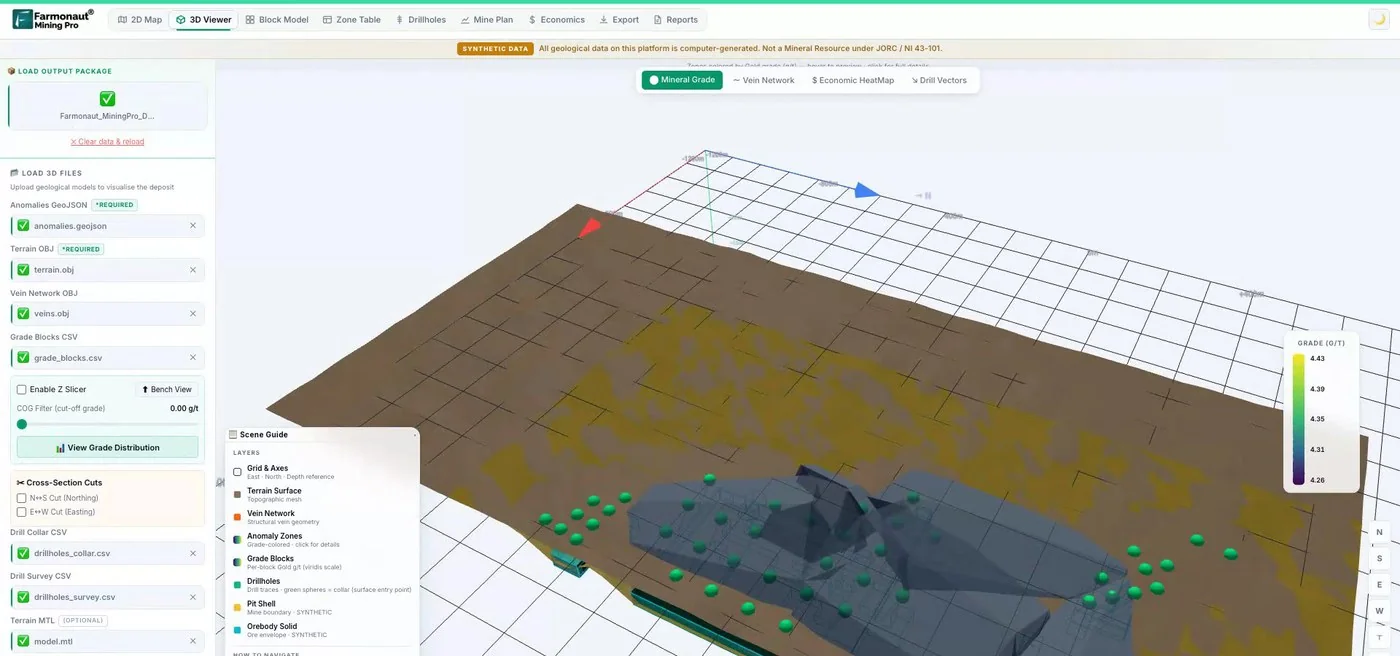
Mining Pro sample view, synthetic data
Keep reading
Sources
- USGS, Alaska Resource Data File (ARDF): mrdata.usgs.gov
- USGS, ARDF web feature service (queried 15 October 2026): mrdata.usgs.gov
- USGS, USMIN mineral deposit database: mrdata.usgs.gov
- USGS, Mineral Resources Data System (MRDS): mrdata.usgs.gov
- USGS, Mineral Commodity Summaries 2026: Gold: pubs.usgs.gov
- USGS Bulletin 1374, Placer Deposits of Alaska (Cobb, 1973): pubs.usgs.gov
- Alaska DGGS, Alaska’s Mineral Industry: dggs.alaska.gov
- Alaska DGGS, 2025 Alaska mining industry overview (Szumigala, January 2026): dggs.alaska.gov
- Alaska DNR, Division of Mining, Land and Water: Mining: dnr.alaska.gov
- Kinross Gold, Q2 2026 results news release: s204.q4cdn.com
- Northern Star Resources, June 2026 quarterly activities report: nsrltd.com
- Northern Star Resources, FY26 financial results (20 August 2026): nsrltd.com
- Northern Star Resources, mineral resources and ore reserves update (3 June 2026): nsrltd.com
- Coeur Mining, Q2 2026 results (5 August 2026): nasdaq.com
- NovaGold, definitive agreements to acquire 100% of Donlin Gold (22 July 2026): nasdaq.com
- Mining.com, Novagold targets new Donlin feasibility study (June 2025): mining.com
- Barrick Mining, 2025 annual report: s25.q4cdn.com
- International Tower Hill Mines, company site (Livengood): ithmines.com
- Northern Alaska Environmental Center, Livengood Gold Project summary: northern.org
- Contango Silver and Gold, Q2 2026 results (13 August 2026): contangoore.com
Discussion
Questions, corrections or field experience? Share them below. First-time comments are reviewed before they appear, and your email is never published.
No comments yet. Be the first to add a question or your experience.

 Mining SARL
 SenGold Invest SAS
 Sania Corporation
 Sean Mining Limited
 NTS Group (Pty) Ltd
 Mine4Africa
 Lithspo Minerals Limited
 Tintina Mining Group
 Dalgety Minerals Pty Ltd
 Vortex Minerals Pty Ltd
 Faith At Work (Pty) Ltd
 Geotech Mining Solutions plc
 Vulcan International Limited
 Kidepo Associates
 GKY Mining
 Alkimy SARL
 Double A Trading
 GemSprout Metals Limited
 Qader Group
 Ileys General Trading
 SG Gold Mining LLC
 VRV Global Pte Ltd
 Omsri International FZE
 G.I.T.T.










