

Arizona copper · Mine fact guide
Pinto Valley Mine: Output, Water Limits, Mine Life
Pinto Valley, Capstone Copper’s Arizona mine, produced 42,382 tonnes of copper in 2025, down 26% on 2024 as drought cut mill water. This guide covers output, costs, water, the permit to 2039 and a mill output calculator.
Key takeaways
- Pinto Valley produced 42,382 tonnes of copper in 2025, against 57,272 tonnes in 2024 (Capstone Copper, March 2026).
- Mill throughput fell from 49,461 to 41,187 tonnes per day, mainly from drought-related water constraints; the mill’s nameplate is 60,000 tonnes per day (Capstone).
- C1 cash cost rose from $2.80 to $3.72 per pound in 2025 and was $4.17 in the second quarter of 2026 (Capstone, July 2026).
- A 2021 Forest Service decision permits the mine and tailings to expand onto 229 more acres of forest, with mine life to 2039 (KJZZ; Capstone).
- The mine won The Copper Mark in August 2025, the third Capstone site to do so (Capstone, 25 August 2025).
In this article
- Pinto Valley mine at a glance
- Location and geology of the Arizona mine
- Pinto Valley mine production and costs compared
- Why output fell: water limits and mill problems
- How much water the mine uses and what happened to Pinto Creek
- Permit, tailings and mine life
- Seven sustainability facts that can be checked
- District growth study and the case for a longer mine life
- Where the mine fits in US copper production
- Estimate copper output from your own mill figures
- How satellite data helps monitor mine sites like this
- Frequently asked questions
Pinto Valley mine at a glance
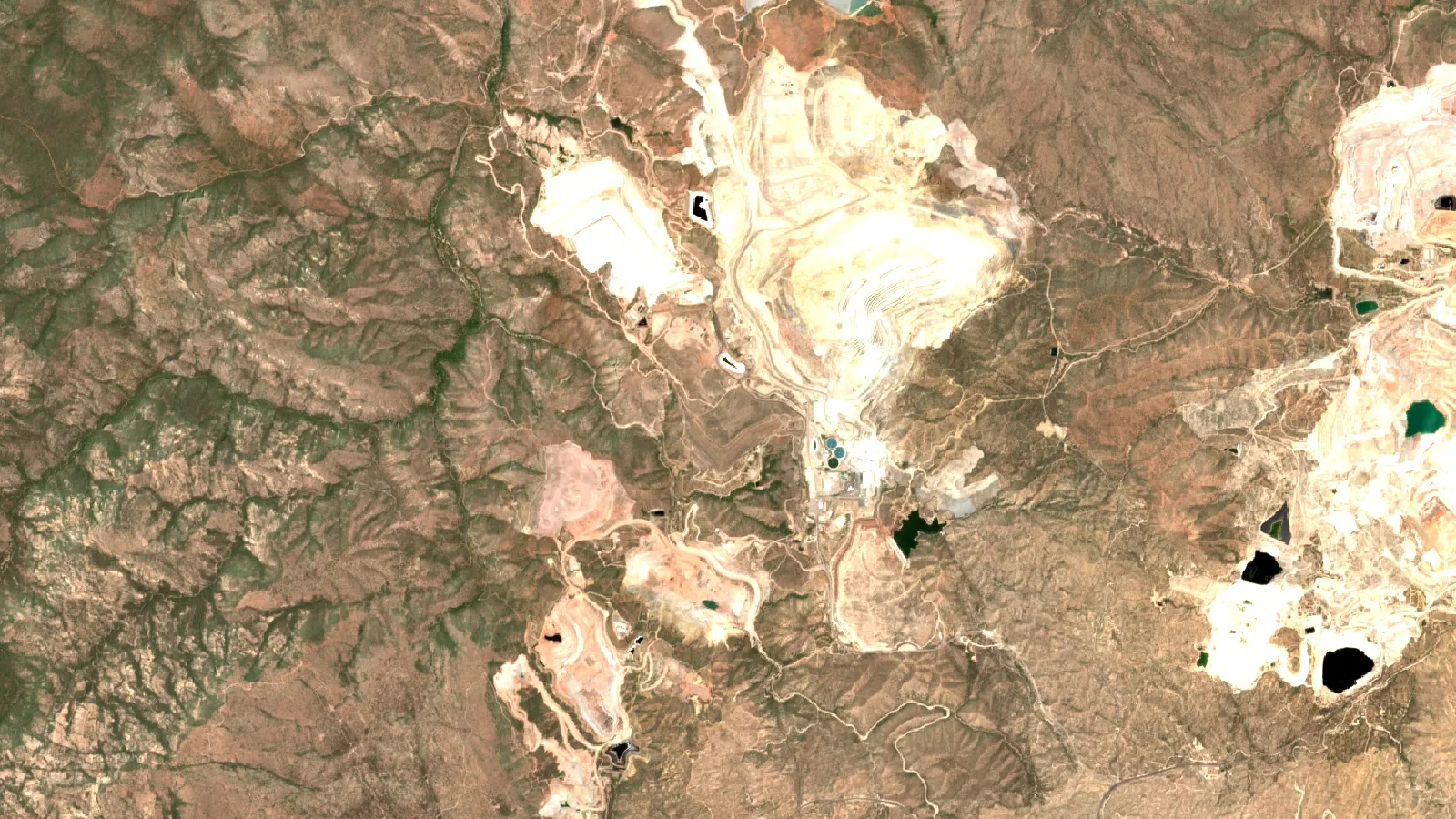
Pinto Valley is an open-pit copper mine in Gila County, Arizona, about 80 miles east of Phoenix. Capstone Copper owns it outright, and in 2025 it produced 42,382 tonnes of copper, down 26% from 57,272 tonnes in 2024, mainly because drought cut the water available to its mill (Capstone Copper fourth-quarter 2025 results, March 2026). The mine is fully permitted to 2039 under a 2021 US Forest Service decision, and the company is studying a larger district plan that could stretch operations further.
Chart
Copper production by Capstone mine, 2025
Thousand tonnes of copper, sulphide business (Mantoverde on a 100% basis; Pinto Valley includes some cathode)
This page gathers what the filings and regulators actually say about the mine: where it is, how much it produces, what it costs to run, how much water it needs, what its permit allows, and which sustainability claims can be checked. Every production and cost figure below is quoted from Capstone’s own results, and each one carries its date.
- Owner: Capstone Copper Corp. (TSX: CS, ASX: CSC), which bought Pinto Valley from BHP in October 2013 (Capstone, Pinto Valley operation page).
- Processing: a 60,000 tonnes per day concentrator that makes copper concentrate with a molybdenum by-product, plus a 25,000 tonnes per day solvent extraction and electrowinning (SX-EW) plant that makes copper cathode.
- Permit: a Forest Service Mine Plan of Operations approved in 2021, covering mine life to 2039.
- Jobs: about 2,250 direct and secondary jobs a year, according to Capstone.
- Latest quarter: 10,047 tonnes of copper in the second quarter of 2026, with cash costs of $4.17 per pound (Capstone, second quarter 2026 results, 30 July 2026).
Location and geology of the Arizona mine
The mine sits at the west end of the Globe-Miami mining district in central Arizona. Capstone describes the district as one of the oldest and most productive in the United States, and says Pinto Valley is now the only operating mill there. The Tonto National Forest says the mine lies west of the town of Globe, with much of it on private land and part on national forest land (KJZZ, 20 August 2021).
The deposit is a porphyry copper deposit. A porphyry deposit is a very large body of rock in which fine copper minerals are spread through the rock and along small veins, usually around an intrusion that cooled underground. Capstone reports that the main sulphide minerals at Pinto Valley are chalcopyrite and pyrite, with a little molybdenite, hosted mainly in an old granitic rock called the Lost Gulch Quartz Monzonite (Capstone).
Porphyry deposits supply most of the world’s copper. The US Geological Survey puts their share of world copper production at about 60 percent and notes that grades are low, averaging 0.44 percent copper in 2008 (USGS Scientific Investigations Report 2010-5070-B). Pinto Valley’s reported feed grade is lower still, at 0.31% in 2025 and 0.34% in 2024. That means roughly 320 tonnes of rock must be crushed and ground for each tonne of copper that ends up in concentrate, before recovery losses.
Grade is the share of metal in the rock, here measured as percent copper. Recovery is the share of that copper the plant actually captures. C1 cash cost is a company measure of the direct cost to produce a pound of payable copper after by-product credits such as molybdenum and silver, and it leaves out items such as depreciation and head-office costs.
Pinto Valley mine production and costs compared
Pinto Valley is the third-largest of Capstone’s four sulphide copper operations by output, and it is the most expensive to run. In 2025 its C1 cash cost was $3.72 per pound, against $1.32 to $1.92 per pound at the other three mines (Capstone, March 2026). In 2024 it cost $2.80 per pound, so the gap widened as Pinto Valley’s costs rose while the Chilean mines’ costs fell.
Chart
C1 cash cost by Capstone mine
US$ per pound of payable copper, net of by-product credits
The table sets out Capstone’s own figures. Mantoverde is shown on a 100% basis, as Capstone reports it; Capstone owns 70%.
| Mine (country) | Copper production 2024 (tonnes) | Copper production 2025 (tonnes) | C1 cash cost 2024 ($/lb) | C1 cash cost 2025 ($/lb) |
|---|---|---|---|---|
| Pinto Valley (US) | 57,272 | 42,382 | 2.80 | 3.72 |
| Mantoverde (Chile) | 21,777 | 62,308 | 1.88 | 1.40 |
| Mantos Blancos (Chile) | 37,744 | 54,793 | 2.85 | 1.92 |
| Cozamin (Mexico) | 24,907 | 25,348 | 1.78 | 1.32 |
Capstone gave two main reasons for the rise: lower production volume (+$0.89 per pound) and higher contractor costs (+$0.30 per pound), partly offset by lower treatment and selling costs and lower spend on mechanical and electrical parts. Its 2025 recovery was 86.2% against 87.4% in 2024, which the company links to a higher share of acid-soluble copper in the ore and to lower-grade ore from the mine sequence.
Why output fell: water limits and mill problems
The main reason for the 2025 drop was water. Capstone reported that mill throughput averaged 41,187 tonnes per day in 2025, against 49,461 in 2024, mostly because of water constraint measures, with unscheduled downtime and lower feed grade adding to the loss (Capstone, March 2026). In October 2025, drought conditions in central Arizona restricted the mill to two-thirds availability, with four of its six mills running. All six were back online in November and December, and the fourth quarter was the mine’s strongest of the year at 11,423 tonnes.
Chart
Pinto Valley mill throughput
Thousand tonnes per day
The mill is still well below its nameplate capacity of 60,000 tonnes per day. The fourth quarter of 2025 averaged 42,029 tonnes per day, with four of six mills online in October and all six in November and December.
The second quarter of 2026 shows that water was not the only constraint. Capstone attributed that quarter’s shortfall to unplanned downtime, continuing problems with the filter plant that dewaters concentrate, and flotation disruptions caused by unplanned maintenance. Recovery was 86.02% against 87.34% a year earlier, and the cash cost was $4.17 per pound against $3.89 (Capstone, 30 July 2026). Capstone’s July report said a major maintenance shutdown was planned for September 2026 to work on the primary crusher mainframe and the filter plant, and that it expects more stable operation afterwards; Capstone reports Q3 2026 results after the shutdown.
How much water the mine uses and what happened to Pinto Creek
Capstone’s 2024 sustainability report shows Pinto Valley withdrew 11.0 million cubic metres of water in 2024, equal to 8,932 acre-feet or about 2.9 billion gallons. About 65% was groundwater and about 30% was third-party water pumped from closed open pits; the rest was surface water and rain. The journalist Jonathan P. Thompson also reported the figure in March 2026 (The Land Desk, republished by Coyote Gulch, 30 March 2026). The same article reports that Capstone pumps about 400 gallons per minute from the pit itself. An acre-foot is the volume of water that covers one acre to a depth of one foot, about 325,851 gallons.
That article also records a local dispute. Flow in Pinto Creek, measured at the Magma Weir gauge, fell from 4,147 acre-feet in 2013 to 482 acre-feet in 2014, and the stream has run only intermittently since. The author notes that 2013 was a dry year and that correlation is not proof of cause, but says the Tonto National Forest saw enough evidence of a link to the mine’s groundwater pumping to ask the Arizona Department of Water Resources to act. The state did not, the Forest Service dropped its complaint, and it approved the mine’s expansion in 2021. Readers who want the full argument should read the original article; it is an investigative opinion piece, not a regulatory finding.
Capstone’s stated water goal is to reduce freshwater consumption intensity by 2030 and to raise the share of lower-quality desalinated or recycled water across its operations (Capstone, Responsibility).
▶ The seven environmental impacts of mining, explained in clay · 2:31
Permit, tailings and mine life
Pinto Valley’s current mine life runs to 2039. That date first appeared in a January 2016 pre-feasibility study, which reported 473.8 million tonnes of proven and probable reserves at 0.31% copper (Capstone press release, 18 January 2016). That reserve figure is a 2016 estimate and is not a current reserve statement; Capstone’s present technical report for the mine is dated 31 March 2021.
The permit came later. In August 2021 the Tonto National Forest issued its final Record of Decision. It renewed expired permits and allowed the mine and its tailings to expand onto another 229 acres of national forest, and it finalised an Environmental Impact Statement that extends mine life by about 19 years (KJZZ). Capstone says the mine is fully permitted for the duration of its current plan, which extends to 2039.
Tailings are the finely ground waste rock left after the copper minerals are removed. They are stored in engineered impoundments, and their safe storage is one of the main long-term risks at any porphyry copper mine. Capstone has committed to apply the Global Industry Standard on Tailings Management at all its tailings facilities by the end of 2028 (Capstone, Responsibility). The same Land Desk article records a 1993 spill, under the mine’s previous owner, in which heavy rain overwhelmed water management and carried tailings and contaminated water into Pinto Creek. That event predates Capstone’s ownership by two decades.
Seven sustainability facts that can be checked
Mining companies make many sustainability claims. The seven below each have a named source, a date and a limit on what they prove.
| Area | What the source says | Source and limit |
|---|---|---|
| Independent assurance | Pinto Valley was awarded The Copper Mark in August 2025, the third Capstone site to get it, after assessment against 33 criteria across environment, social and governance. | Capstone release, 25 August 2025. The Copper Mark has since been renamed Veramark Assurance, and the site appears on its participant list. It shows practices meet the framework, not that impacts are zero. |
| Permit | A Forest Service decision with an Environmental Impact Statement covers operations to 2039. | KJZZ, 2021. The permit sets conditions; it does not measure performance. |
| Water use | 8,932 acre-feet withdrawn in the 2024 reporting year. | Capstone sustainability report as reported by The Land Desk, 2026. Not an official state figure. |
| Water risk | Drought limited the mill to two-thirds availability in October 2025. | Capstone results, March 2026. Shows the operation depends on local water. |
| Local employment | About 2,250 direct and secondary jobs a year; second-largest employer in the Globe-Miami district. | Capstone operation page. A company estimate. |
| Tailings | Commitment to meet the Global Industry Standard on Tailings Management by the end of 2028. | Capstone, Responsibility page. A target, not yet an audit result. |
| Climate | Target to cut greenhouse gas emissions from fuel and power by 30% by 2030, company-wide. | Capstone, Responsibility page. Not a Pinto Valley figure. |
District growth study and the case for a longer mine life
Capstone says Pinto Valley is running a district growth study to test whether part of about one billion tonnes of mineral resources can move into the mine plan, which it says could extend mine life to 2050. Options include a larger mill and more leaching capacity, backed by upgraded water, heap, dump and tailings infrastructure (Capstone). A mineral resource is a body of mineralised rock with reasonable prospects of economic extraction; it becomes a reserve only after a study shows it can be mined at a profit under current conditions. The study results had not been published in the second-quarter 2026 report.
The company is also reviewing consolidation of the wider district. It completed a two-phase drilling programme at BHP’s nearby Copper Cities deposit, about 10 km east of the mine, under an access agreement. This is evaluation work, not an acquisition.
Any expansion will meet the same constraint seen in 2025. More ore means more water, and water is the input Pinto Valley has found hardest to guarantee.
Where the mine fits in US copper production
Arizona produces about 70% of US copper, according to the USGS, and US mine output has slipped from 1.23 million tonnes in 2021 to an estimated 1.0 million tonnes in 2025 (USGS Mineral Commodity Summaries 2026, copper). The USGS counts 26 US mines producing copper, of which 17 account for more than 99% of output. By that count Pinto Valley’s 42,382 tonnes in 2025 was about 4% of US mine output, a rough estimate that combines a company figure with a national USGS total.
Chart
US copper mine production
Thousand tonnes of recoverable copper; 2025 is an estimate
For readers looking at other deposit types and countries, see our guide to copper deposits and where to explore and the explainer on porphyry copper deposits, alteration and grades. Our earlier piece on the mine’s technology projects is at Capstone’s Pinto Valley mine innovations.
▶ Why copper matters: how a copper mine feeds electric vehicles · 6:03
Estimate copper output from your own mill figures
The calculator below turns four inputs into an estimate of copper in concentrate and its gross value. The default numbers are Pinto Valley’s reported 2025 averages, so you can see the formula reproduce roughly the reported output; change them to test a different mill. It is a simple screening tool: it ignores smelter charges, payability and by-product credits, so it will not match a company’s reported margin.
Calculator
How much copper does a mill like this produce?
Enter your own mill figures. Defaults are Pinto Valley’s reported 2025 averages.
- Copper in concentrate (million pounds): 88.6
- Gross value at your price (US$): $442,818,474
- Gross margin over C1 cost (US$): $113,361,529
Defaults: throughput, feed grade and recovery are Capstone’s 2025 averages for Pinto Valley (March 2026); price is an example, use today’s price. The cost default is Capstone’s 2025 C1 cash cost of US$3.72 per pound. Pinto Valley’s reported 2025 total of 42,382 t is higher than the 40,000 t this formula gives because it also includes about 2,000 t of SX-EW cathode. Gross figures ignore smelter charges and by-product credits.
How satellite data helps monitor mine sites like this
Water, tailings and land disturbance are all visible from orbit. Repeat satellite images can show how a pit and tailings footprint grow, how vegetation recovers on reclaimed ground and how a creek corridor changes between wet and dry years. Those are screening tools for consultants and licence owners, not substitutes for monitoring wells, surveys or regulator data. Farmonaut offers satellite-based mineral detection for licence areas, and you can request a quote through the mining query form or by contacting the team.
▶ Remote sensing for mining explained in three minutes · 2:01
Related reading on this site: Boddington Mine WA: Output, Reserves and Mine Life.
Frequently asked questions
Where is the Pinto Valley mine?
It is in Gila County, central Arizona, at the west end of the Globe-Miami mining district, about 80 miles east of Phoenix by Highway 60 (Capstone, operation page).
Who owns the Pinto Valley mine?
Capstone Copper Corp. owns 100% of it. Capstone bought the mine from BHP in October 2013 and is listed on the Toronto Stock Exchange (TSX: CS) and the Australian Securities Exchange (ASX: CSC).
How much copper does Pinto Valley produce?
It produced 42,382 tonnes of copper in 2025, down from 57,272 tonnes in 2024, and 10,047 tonnes in the second quarter of 2026 (Capstone results, March and July 2026).
How long will the Pinto Valley mine operate?
The current permitted mine plan runs to 2039. Capstone’s district growth study could support operations to 2050, but that depends on a study the company had not yet published.
Why did Pinto Valley’s production fall?
Mill throughput fell from 49,461 to 41,187 tonnes per day, mainly because drought-related water constraints, with unscheduled downtime, lower feed grade and lower recovery also contributing (Capstone, March 2026).
What kind of deposit is Pinto Valley?
It is a porphyry copper deposit with molybdenum as a by-product. Capstone reports chalcopyrite and pyrite as the main sulphides.
Is Pinto Valley an open pit or an underground mine?
It is an open-pit mine. Ore is drilled, blasted, loaded and hauled to a primary crusher, then ground and floated in the concentrator.
Does Pinto Valley have an environmental certification?
Capstone says Pinto Valley was awarded The Copper Mark in August 2025. The scheme was renamed Veramark Assurance in 2026.
How much water does Pinto Valley use?
Capstone’s 2024 sustainability report gives 11.0 million cubic metres (8,932 acre-feet) withdrawn in 2024. Capstone had not published 2025 water data when its 2024 report was released.
Is this page investment advice?
No. It reports company and government figures for information. It does not forecast prices or recommend buying or selling any security.
This page is for information only. It is not investment advice.
Farmonaut mining
Map your mining site from space
Send your licence boundary and get a quote for satellite mineral and land-surface mapping.
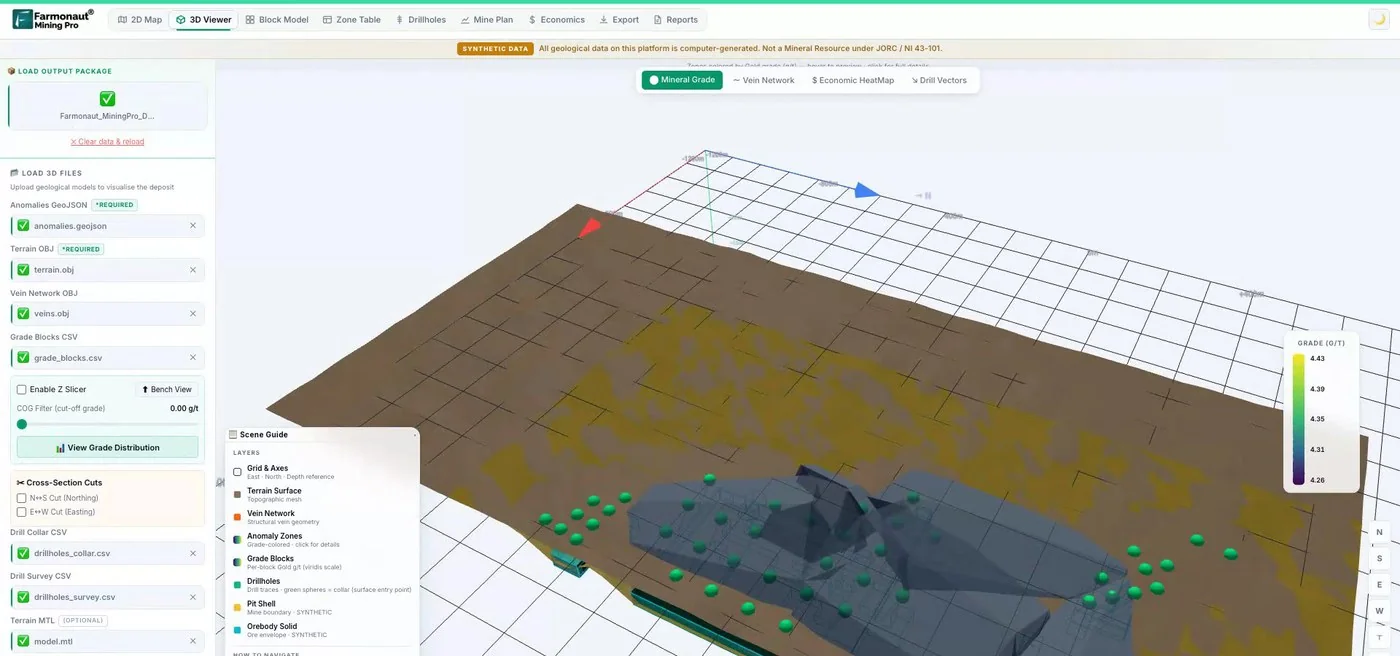
Mining Pro sample view, synthetic data
Keep reading
Sources
- Capstone Copper, Pinto Valley operation page: capstonecopper.com
- Capstone Copper, fourth quarter 2025 results (ASX, 3 March 2026): announcements.asx.com.au
- Capstone Copper, second quarter 2026 results (30 July 2026): capstonecopper.com
- KJZZ, Tonto Forest approves Record of Decision for Pinto Mine (2021): kjzz.org
- Capstone Copper, Pinto Valley awarded The Copper Mark (25 August 2025): capstonecopper.com
- Capstone Copper, Responsibility: capstonecopper.com
- The Land Desk via Coyote Gulch, water footprint of Arizona copper mines (30 March 2026): coyotegulch.blog
- USGS, Mineral Commodity Summaries 2026, copper: pubs.usgs.gov
- USGS, Porphyry Copper Deposit Model, SIR 2010-5070-B: pubs.usgs.gov
- Capstone Mining, PV3 pre-feasibility study (18 January 2016): prnewswire.co.uk
- Veramark Assurance (formerly The Copper Mark), participants: veramark.org
Discussion
Questions, corrections or field experience? Share them below. First-time comments are reviewed before they appear, and your email is never published.
No comments yet. Be the first to add a question or your experience.

 Vortex Minerals Pty Ltd
 Faith At Work (Pty) Ltd
 Geotech Mining Solutions plc
 Vulcan International Limited
 Kidepo Associates
 GKY Mining
 Alkimy SARL
 Double A Trading
 GemSprout Metals Limited
 Qader Group
 Ileys General Trading
 SG Gold Mining LLC
 VRV Global Pte Ltd
 Omsri International FZE
 G.I.T.T.
 Jaunita Erss Ltd
 Almosi SARL
 SRK Consulting
 Berks Gold Limited
 Mwerezi Minerals Company Limited
 Mining SARL
 SenGold Invest SAS
 Exploration consultancy · South Africa · Gold










